
Feeding a raised bed vegetable garden is a different game than feeding plants in the ground. Because the soil lives inside a contained box, nutrients wash out faster with every watering, and the typical “more is better” approach easily burns delicate roots. You need a fertilizer formulated to release steadily without overwhelming young seedlings, yet hit hard enough to support a full season of tomatoes, peppers, and leafy greens. The six options here are proven to handle that exact balance — each picked because it either delivers timed nutrition, builds long-term soil health, or gives a quick fix when your plants look tired.
I’m Rikta — the co-founder and writer behind Lawn Gear Lab. This guide is built by comparing the manufacturers’ published specifications and the patterns across verified customer reviews, so you get each pick’s real strengths and trade-offs instead of marketing spin.
The best place to start is often a slow-release granular feed that matches your soil type, which is exactly what you will find in this list of best fertilizer for raised bed vegetable garden picks.
How To Choose The Best Fertilizer For Raised Bed Vegetable Garden
Raised bed soil is a closed system. Unlike a traditional row garden where roots can stretch deep into mineral-rich earth, a raised bed relies entirely on what you mix in. Pick a fertilizer that releases nutrients too fast, and a heavy rain will flush it out before your plants have a chance to feed. Pick one that skimps on micronutrients, and your tomatoes will yellow by mid-season. The following three factors are the shortcuts experienced gardeners use to avoid both extremes.
NPK Ratio — The Three Numbers That Control Growth
Every fertilizer bag shows three numbers separated by dashes, like 5-1-7 or 14-14-14. The first number is nitrogen (N), which drives leaf and stem growth. The second is phosphorus (P), the key for roots and flowers. The third is potassium (K), which supports overall plant health and disease resistance. For leafy greens like lettuce and spinach, a higher first number (nitrogen) works well. For tomatoes, peppers, and squash, you want more phosphorus (the middle number) during bloom and fruit set. A balanced formula like 14-14-14 feeds everything in the bed equally, which is often the safest bet for mixed plantings.
Release Speed — Instant vs. Slow vs. Controlled
Your watering schedule in a raised bed directly determines how much of the fertilizer actually reaches the roots. Instant-release powders (water-soluble) give a fast green-up but can burn seedlings if overdone. Slow-release pellets (like pelleted manure or coated granules) break down over weeks, releasing nutrients with each watering. Temperature-controlled granules (like Osmocote) use a coating that releases only when the soil warms up, which matches the plant’s natural growth cycle. For most raised bed gardeners, a slow-release or temperature-controlled formula means fewer applications and less risk of accidental overfeeding.
Organic vs. Synthetic — What the Label Actually Means
Organic fertilizers (compost, worm castings, manure-based pellets) feed the soil biology first — the microbes break down the material and make nutrients available slowly over months. Synthetic granular fertilizers feed the plant directly with lab-created compounds that are immediately available. Neither is “wrong” for a raised bed, but organic options build long-term soil structure and moisture retention, while synthetic options give faster correction of deficiencies. If you only grow a single season of annual vegetables, synthetic works fine. If you amend the same bed year after year, organic material pays off by reducing how much you need to add each spring.
Quick Comparison
On smaller screens, swipe sideways to see the full table.
| Model | Category | Best For | Key Spec | Amazon |
|---|---|---|---|---|
| Miracle-Gro Raised Bed Plant Food | Granules | Quick greening in 2 standard 4×4 beds | 5-1-7 + calcium | Amazon |
| Coop Gro Organic Chicken Manure | Pellets | Organic slow-release feeding | 3-3-4 + 27% carbon | Amazon |
| R&M Organics Compost | Compost | Soil amendment & moisture retention | 10 lbs, 0.31 cu. ft. | Amazon |
| BuildASoil Worm Castings | Castings | Premium biological soil enhancer | 2 gal (7.57 L) | Amazon |
| Osmocote Smart-Release | Controlled-Release | Mistake-proof, single-application feeding | 14-14-14, 8 lbs | Amazon |
| Organic Plant Magic | Spreadable Granules | Large-scale organic coverage | Covers 5,000 sq. ft. | Amazon |
In‑Depth Reviews
1. Osmocote Smart-Release Plant Food Flower & Vegetable
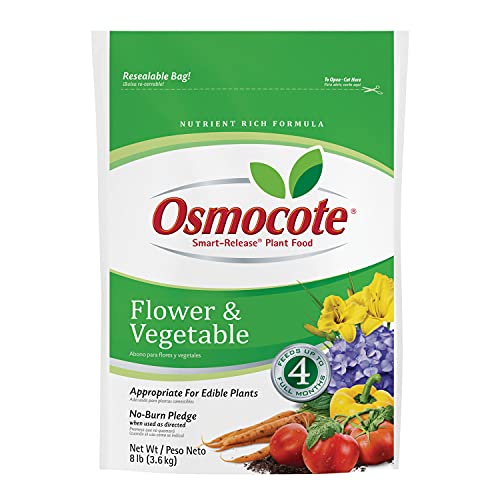
14-14-14 NPK with a soil-temperature-controlled release mechanism makes Osmocote the top pick for any raised bed gardener who wants to skip the guesswork of when to feed. One scoop per 4 square feet delivers a balanced meal for everything from lettuce to bell peppers, and the coating only breaks open when the soil warms up, naturally syncing with active plant growth. An 8-pound container covers 320 square feet, enough for a large multi-bed setup, and lasts a full growing season.
Buyers report that even accidental over-application up to three times the recommended rate produced zero leaf burn, a safety margin rare in granular fertilizers that makes Osmocote nearly foolproof for beginners. Owners mention plants turned noticeably greener and grew faster after a single application, with many calling it “mistake-proof.”
Compared to the Miracle-Gro Raised Bed Plant Food, Osmocote holds a tenfold advantage in coverage — its 8-pound bag covers 320 square feet versus Miracle-Gro’s 2-pound bag covering roughly 32 square feet. The catch is that the granules are not organic, so gardeners committed to 100% organic soil building will prefer a compost-based pick below. For everyone else, Osmocote is the most set-it-and-forget-it performer on this list.
Why it’s great
- Won’t burn plants even at triple the recommended rate.
- One application feeds for an entire growing season.
- Balanced 14-14-14 formula works for all vegetables and flowers.
Good to know
- Not OMRI certified for organic gardening.
- A 2-pound bag covers only 80 sq. ft.
2. Coop Gro Organic Chicken Manure Fertilizer 6 lb. Bag

Where Osmocote relies on a temperature-controlled coating for slow release, Coop Gro uses a fermentation process that breaks chicken litter into pelleted form, delivering a natural 3-3-4 NPK with 27 percent carbon for soil structure. One 6-pound bag feeds up to 200 square feet, covering roughly five times the area of the Miracle-Gro Raised Bed Plant Food per pound. Because the pellets are slow-release, they will not burn roots even when used as a pre-plant amendment or a side-dress (a strip of fertilizer applied alongside growing plants) mid-season.
Customers note that the pellets eliminate the need for precise measurement — they simply scatter them and water in, with several customers noting that plants stayed healthy and productive without any of the leaf scorch common with raw manure. One reviewer specifically said they used it “as pre-plant and side dress” with zero issues. The resealable, water-resistant bag also keeps the pellets dry during storage, which matters if you buy in bulk for a full season.
Choose this over the top pick if you want an OMRI-certified organic source that doubles as a soil builder, especially if you are planning to grow in the same raised bed for multiple years and want to avoid synthetic salt buildup. The downside is that the 3-3-4 NPK is relatively mild, so heavy feeders like tomatoes and corn may still need a supplemental boost during peak fruiting.
Where it shines
- OMRI certified for organic vegetable production.
- Pellets make application simple without precise measuring.
- Adds 27% carbon to improve soil structure and water retention.
Worth noting
- Mild NPK may not be enough for heavy feeders alone.
- Low odor but still noticeable compared to compost.
3. R&M Organics Premium Organic Compost 10 lb Bag
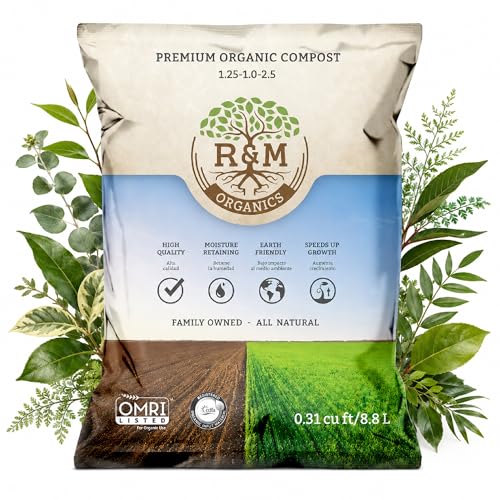
Imagine one of your tomato plants turns yellow at the lower leaves and refuses to set fruit — that is the exact scenario where R&M Organics compost arrives like a rescue crew. At 10 pounds and 160 ounces (67% more volume than the Coop Gro 96-ounce bag), this dairy cow manure-based compost works as a top-dressing or soil mix-in to correct nutrient deficiency fast. One reviewer noted that in mixing it into a 27-gallon planter, ailing tomato leaves turned green within one week, and new growth and flower buds appeared shortly after.
Reviewers point out that the compost has a fine topsoil texture with no clumps and almost no manure smell, so you can use it indoors for container plants without the house smelling like a barn. It holds moisture noticeably better than plain soil — the manufacturer claims it “reduces the frequency of watering,” which is a real advantage in a raised bed that tends to dry out faster than in-ground soil. The low-odor, fully composted material also means you can apply it right before planting without worrying about burning tender roots.
The standout spec here is the fine texture and moisture retention: at 0.31 cubic feet per 10-pound bag, a thin quarter-inch layer around each plant is enough. This makes it the most effective pick for spot-treating a struggling plant without overhauling the entire bed. It is not a balanced fertilizer on its own like Osmocote, so use it as a soil amendment alongside a complete NPK feed.
What stands out
- Revives struggling plants fast — verified one-week recovery for stressed tomatoes.
- Fine, clump-free texture makes it easy to mix or top-dress.
- Adds significant moisture retention to raised bed soil.
The trade-offs
- It is a compost, not a complete fertilizer — pair it with a nutrient source.
- 10-pound bag covers only small to medium beds.
4. BuildASoil Worm Castings for Gardening – Premium Organic Earthworm Castings, 2 Gallons
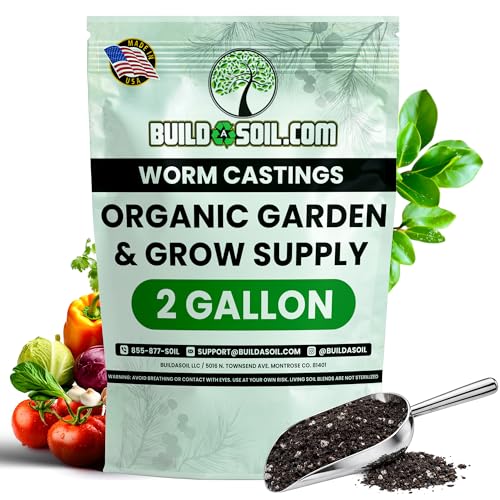
The single number that matters most in this category is the calcium-to-sodium ratio, and BuildASoil’s lab-tested 2-gallon bag delivers exceptionally high calcium with low sodium, meaning it won’t raise soil salinity the way many synthetic fertilizers do. Reviewers report that a single application “significantly improved garden box soil” and helped grow good string beans and herbs — a direct result of the beneficial microbes that worm castings introduce into the root zone. The 2-gallon bag (about 7.57 liters) is the right size for a single standard 4-by-4 foot raised bed as a top-dressing or mixed into the top few inches.
The trade-off is that worm castings are a biological soil amendment, not a complete fertilizer with guaranteed NPK numbers. While they contain small amounts of nitrogen, phosphorus, and potassium, the primary benefit is the living biology that cycles existing nutrients in your soil. If your plants are already showing yellow leaves from nitrogen deficiency, worm castings alone will not correct it as fast as a granular feed would. They work best when used as a regular maintenance layer — think of them as a probiotic for your soil rather than a multivitamin for the plant.
At this price point, you pay a premium for the purity and the low-sodium, high-calcium profile that BuildASoil specifically guarantees. Compared to generic bagged castings from big-box stores, shoppers say BuildASoil’s product is “always fresh, never last season’s leftovers,” and the consistent moisture content means you can brew it into aerated worm tea (steeping castings in water to create a liquid microbe inoculant) without worrying about mold. For serious organic gardeners who want to build soil that regenerates itself year after year, this is the best long-term investment on the list — a price-to-value read that favors upfront cost for sustained soil health.
The upsides
- Lab-tested high calcium, low sodium formula.
- Encourages beneficial soil biology for long-term health.
- Ideal for brewing worm tea for fast liquid feeding.
Keep in mind
- Not a complete fertilizer — needs pairing with other NPK sources.
- Premium price compared to bagged compost.
5. Miracle-Gro Raised Bed Plant Food, 2-Pound

At 2 pounds with a 5-1-7 NPK mix and added calcium, this is the smallest package by weight in the lineup — one bag feeds roughly two standard 4-by-4-foot raised beds for three months. What it lacks in volume it makes up for in speed: buyers report seeing blooms within one week of sprinkling the granules on the soil surface. That rapid response makes it the best pick for reviving a bed that has been neglected for a few weeks, especially for fruiting plants like peppers and eggplants that need extra potassium (the 7 in the 5-1-7 ratio supports fruit development).
You are giving up longevity compared to Osmocote — you will need to reapply after three months rather than once per season. Additionally, at only 2 pounds per bag, covering a large 8-by-4-foot bed with multiple plantings will require two or more bags. Some owners mention that the granules dissolve quickly with watering, so heavy rain can flush them out faster than a slow-release pellet, meaning you pay a bit more attention to your weekly application schedule.
This is the exact budget-friendly pick you want if you are running a single season of vegetables in a standard 4×4 or smaller bed and you value quick visible results over long-term soil building. It includes the added calcium that tomatoes need to prevent blossom end rot (a common disorder where the bottom of the fruit turns black), which is a detail the more general-balanced formulas overlook.
Why we’d pick it
- Blooms visible in one week of sprinkling, per buyer reports.
- Added calcium helps prevent blossom end rot in tomatoes.
- Formulated specifically for raised bed soil conditions.
A few caveats
- Needs reapplication every 3 months.
- Small 2-pound bag covers roughly 32 sq. ft.
6. Organic Plant Magic – Truly Organic Long-Lasting Spreadable Plant Food, 20 lb Bag
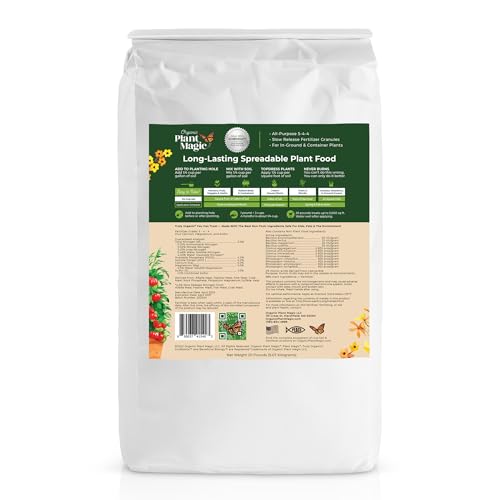
Organic Plant Magic is perfect for the large-scale raised bed gardener who manages multiple big beds or a combination of vegetable patches, flower borders, and shrubs, and wants a single, high-volume fertilizer that covers up to 5,000 square feet or 240 gallons of soil from one 20-pound bag. The spreadable granules require no mixing or dissolving — just scatter and water in. One buyer mentioned that it “revived languishing raised bed vegetables overnight” and that their beefsteak tomatoes have been thriving since.
One limitation is the odor. Multiple reviews mention that the product has a noticeable smell that, while it dissipates outdoors, becomes persistent if used on indoor plants — one user described a “foul smell lasting 4 months with each watering.” Additionally, for indoor use, the mixture must be used within 24 hours of adding water, which limits how you can prepare it for smaller pots. For outdoor raised beds, however, the smell disappears quickly, and the forgiving application amount (the manufacturer says it works even if you overdo it) makes it a solid choice for large-scale organic feeding.
One reason to choose Organic Plant Magic over the smaller bags: the sheer coverage-to-weight ratio. At 20 pounds covering 5,000 square feet, it delivers roughly 250 square feet per pound — more than double the coverage of Osmocote per pound. If you are feeding a community garden, a farm stand operation, or a multi-bed home setup, the convenience of one bag replacing six smaller bags is the deciding factor. Just keep the bag sealed tight in storage to manage the smell.
Strong points
- Massive 5,000 sq. ft. coverage from a single bag.
- Spreadable granules require no mixing or dissolving.
- Customers note rapid revival of struggling raised bed vegetables.
Before you buy
- Noticeable odor, especially in enclosed spaces.
- Not ideal for indoor container plants due to persistent smell.
Understanding the Specs
NPK Ratio — The Core Numbers
NPK stands for nitrogen (N), phosphorus (P), and potassium (K) — the three primary macronutrients every plant needs. The numbers on a bag (like 5-1-7 or 14-14-14) represent the percentage of each nutrient by weight. Higher nitrogen (the first number) pushes leafy growth, which is why lawn fertilizers are often high in N. For raised bed vegetables, you typically want a more balanced ratio or one with a slightly higher middle number (phosphorus) during blooming and fruiting. A 14-14-14 formula gives equal support to all growth stages, while a 5-1-7 mix delivers more potassium for fruit development.
Slow-Release vs. Quick-Release
Slow-release fertilizers (like Osmocote’s temperature-controlled granules or Coop Gro’s pelleted manure) break down gradually over weeks or months, releasing nutrients each time the soil gets moist. Quick-release granules (like Miracle-Gro Raised Bed Plant Food) dissolve almost immediately and must be reapplied every few months. Slow-release is safer for beginners because you cannot accidentally overdose — the nutrients meter out naturally. Quick-release gives a faster visible greening but requires careful reading of the instructions to avoid burning plants.
Organic vs. Synthetic
Organic fertilizers come from living sources: manure, compost, worm castings, bone meal. They feed the soil microbes, which in turn feed the plants. Synthetic fertilizers are manufactured from chemical compounds that plants absorb directly. Organic materials improve soil structure and water retention over years but release nutrients more slowly. Synthetic options are faster and easier to measure precisely but can cause salt buildup in raised bed soil over repeat use. For raised beds that you amend each season before planting, a mix of both often works best — an organic base to build the soil and a synthetic boost when plants need a quick correction.
Soil Temperature & Release Timing
A unique feature in controlled-release fertilizers (like Osmocote) is that the coating around each granule responds to soil temperature. When the soil is cold (early spring), the coating stays tight and releases very little nutrients — which matches the plant’s slow dormant growth. As the soil warms toward 70°F (ideal growing temperature), the coating expands and releases more nutrients, timing perfectly with the plant’s peak feeding demand. This means you apply once at the start of the season and the fertilizer paces itself, which is especially valuable in a raised bed where the smaller soil volume heats up and cools down faster than in-ground soil.
FAQ
How often should I fertilize a raised bed vegetable garden?
Can I use regular garden fertilizer in a raised bed?
What is the difference between compost and fertilizer?
How do I avoid burning my plants with fertilizer?
Final Thoughts: The Verdict
For most people, the fertilizer for raised bed vegetable garden winner is the Osmocote Smart-Release Plant Food because it provides the widest coverage, the safest burn margin, and a single-season application that adapts to the way raised bed soil temperature fluctuates. If you want an organic, OMRI-certified option that builds soil biology at the same time it feeds, grab the Coop Gro Organic Chicken Manure. And for reviving a single struggling plant or amending a specific bed without overhauling your entire system, the standout is the fast-acting texture and moisture retention of the R&M Organics Premium Organic Compost.