
Specs are compiled from manufacturer listings and verified buyer reviews and can change over time — please confirm the key details on the product page before buying.
Hibiscus are hungry, acid-loving plants that stop blooming and start yellowing the moment they run low on the right nutrients. The difference between a few sad blooms and a show-stopping tropical display is picking a fertilizer that delivers the nitrogen, phosphorus, and potassium ratios they actually need — without overdoing it on any one element.
I’m Rikta — the founder and writer behind Lawn Gear Lab. This guide is built by comparing the manufacturers’ published specifications and the patterns across verified customer reviews, so you get each pick’s real strengths and trade-offs instead of marketing spin.
Whether you grow hibiscus in containers or in the ground, the right formula fuels vigorous blooms and healthy leaves. That is exactly what you will find in this review of the best fertilizer for hibiscus.
Quick Picks
- BGI Fertilizers HIBISGAIN, Hibiscus Fertilizer, 10lb Bag — Best Overall
- Fertilome Hibiscus and Tropical Plant Food 17-7-10 (4 lbs.) — Fast-Acting
- Espoma Organic Palm-Tone 4-1-5 Natural & Organic Plant Food; 4 lb. Bag (Pack of 3) — Organic Powerhouse
- TPS Nutrients Hibiscus Fertilizer – Liquid Plant Food, 32 oz — Premium Liquid
- HiThrive 16oz Hibiscus Fertilizer – Makes 16 Gallons — Budget Champ
- Dr. Earth Acid Lovers Azalea, Camellia, Rhododendron & Maple Fertilizer 4 lb — Pet & Family Safe
- ENVY Plant Foods Acid-Loving Special Water Soluble Fertilizer (1.5 lb) — Versatile Concentrate
How To Choose The Best Fertilizer For Hibiscus
Hibiscus plants are heavy feeders, meaning they need a steady supply of nutrients during the growing season to stay vibrant. The right formula hinges on three factors: NPK ratio, liquid vs. granular form, and organic slow-release vs. fast-acting synthetic. Understanding these three factors leads you to a product that keeps your hibiscus blooming all season.
NPK Ratio — Nitrogen, Phosphorus, and Potassium Balance
The three numbers on a fertilizer bag (like 17-7-10 or 4-1-5) stand for the percentage of nitrogen (N) for leafy growth, phosphorus (P) for root and flower development, and potassium (K) for overall plant health. Hibiscus respond best to a formula that is higher in phosphorus and potassium relative to nitrogen, which encourages sturdy stems and abundant blooms rather than just giant leaves. Look for a ratio where the middle number (phosphorus) is similar to the last number (potassium), or a slightly higher last number for strong blooms.
Liquid vs. Granular — Speed vs. Convenience
Liquid fertilizers are absorbed by the roots almost immediately, making them an excellent choice for a quick turnaround when you spot yellow leaves or a lack of blooms. Granular feeds, on the other hand, release nutrients slowly over several weeks, making them more of a low-maintenance option for maintaining healthy plants through the season. Many gardeners keep a liquid formula on hand for a booster and use a granular product as their base feed.
Organic vs. Synthetic — Soil Health and Long-Term Results
Organic fertilizers, like those made from plant or animal byproducts, break down more slowly and feed the soil microbes that help roots absorb nutrients naturally. They are gentler and reduce the risk of burning your plants if you apply a bit too much. Synthetic or chemical-based fertilizers work faster and deliver a precise NPK ratio, but they can build up salts in the soil over time if not flushed out with regular watering. Your choice depends on immediate results versus long-term soil improvement.
Quick Comparison
On smaller screens, swipe sideways to see the full table.
| Model | Best For | NPK Ratio | Form | Unit Count | Amazon |
|---|---|---|---|---|---|
| BGI Fertilizers HIBISGAIN | Serious bloomers | Not listed | Granules | 10 lb bag | Amazon |
| Fertilome Hibiscus & Tropical Plant Food | Fast results | 17:7:10 | Granules | 4 lbs (bag states 3.25) | Amazon |
| Espoma Organic Palm-Tone | Organic care | 4:1:5 | Granules | 192.0 oz | Amazon |
| TPS Nutrients Hibiscus Fertilizer | Quick liquid fix | 1:28 | Liquid | 32.0 fl oz | Amazon |
| HiThrive 16 oz Hibiscus Fertilizer | Budget-friendly | Not listed | Liquid | 16.0 fl oz | Amazon |
| Dr. Earth Acid Lovers | Pet-safe organic | Not listed | Granules | 16 ounces | Amazon |
| ENVY Plant Foods Acid-Loving | Versatile concentrate | 21:7:7 | Liquid | 24.0 oz | Amazon |
In‑Depth Reviews
1. BGI Fertilizers HIBISGAIN, Hibiscus Fertilizer, 10lb Bag

The commercial-grade granular feed that brings faded hibiscus roaring back in a week.
BGI Fertilizers HIBISGAIN is designed and used by commercial hibiscus growers in Homestead, FL, so this is not a general-purpose blend — it is formulated exclusively for the unique growing habits of hibiscus. You apply it directly on top of the soil or mulch with no mixing, and the 10-pound bag comes with a resealable top and a convenient cut-out handle for easy storage and handling.
Buyers report that when their hibiscus stopped blooming and leaves yellowed after a few weeks, HIBISGAIN restored healthy foliage within a week and brought blooms back. The same improvement is echoed by owners whose aging plants exploded with growth and flowers after one application of this granular feed.
Given its professional roots, it is the clearest choice for anyone with multiple hibiscus plants who wants a reliable, low-effort feed. The 10-pound bag is the heaviest option here, significantly heavier than the 4-pound Espoma Palm-Tone, making it a premium long-term value for serious gardeners.
Why it stands out
- Made exclusively for hibiscus by a specialist brand
- No-mixing granular formula you apply straight to soil
- 10-pound resealable bag covers a lot of plants
Things to consider
- Heavier upfront cost than smaller bags
- Product can have a strong smell
Ideal if: You have multiple hibiscus and want a commercial-grade granular feed that works with minimal effort.
Not for: Someone looking for a budget-friendly small pack or a liquid formula for a single potted plant.
2. Fertilome Hibiscus and Tropical Plant Food 17-7-10 (4 lbs.)
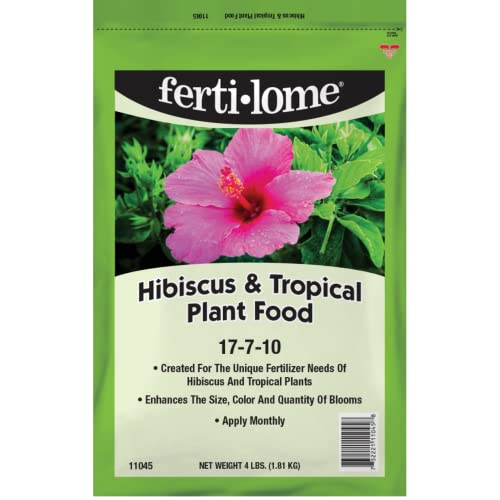
A specialized granular formula that growers say boosts blooms in under a week.
Fertilome (11045) is a targeted 17-7-10 (a ratio of 17% Nitrogen, 7% Phosphate, and 10% Potassium) blend designed to enhance the size, color, and quantity of tropical blooms. You apply it every two weeks until the flowers appear, then switch to monthly feedings during bloom season, which keeps the plant steady without overfeeding.
Buyers confirm the results are immediate — one reported that flowers “boomed within a week,” and the same quick response is echoed by those who said their hibiscus love this product and delivered a bunch of blooms shortly after application. A small number of customers noted the bag weight listed as 4 pounds is not always accurate and may read 3.25 pounds, so it is worth checking your bag upon arrival.
This pick outpaces the liquid TPS Nutrients formula in terms of sheer longevity of supply for the money spent, but it still offers the fast-acting punch of a granular feed. It is a solid mid-range option for anyone who wants a proven, high-bloom formula without stepping into commercial-grade pricing.
Why it works
- High phosphorus (7%) and potassium (10%) for strong flowers
- Granules are simple to apply around the base of the plant
- Owners mention visible results within a week of application
Potential downsides
- Some bags ship with less than the advertised 4 lbs
- Granular form is not as fast to react as liquid
Best suited for: Gardeners who want a specialized granular feed that customers note reviving blooms in under a week.
skip it if: You prefer organic ingredients or need the fastest possible liquid absorption for a plant in distress.
3. Espoma Organic Palm-Tone 4-1-5 Natural & Organic Plant Food; 4 lb. Bag (Pack of 3)
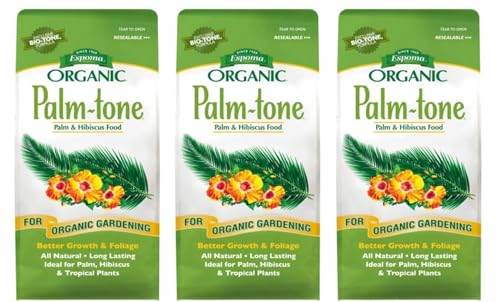
A three-pack of gentle organic granules that nourishes soil while feeding your hibiscus.
Espoma Palm-Tone delivers a 4-1-5 fertilizer analysis (4% Nitrogen, 1% Phosphate, 5% Potassium) with an extra 5% calcium, all from natural and organic ingredients enhanced with the brand’s exclusive Bio-tone formula. Because it is an organic granular, you apply it to the soil around the drip line of the plant and water it in — no mixing required. For tropical plants, Espoma recommends using it monthly throughout the growing season.
Reviewers point out that their hibiscus produced beautiful blooms and deep green leaves after using this product, although they do note a strong barnyard smell that fades quickly after application. At 4 pounds per bag, the pack of three offers a generous supply that lasts for many application rounds across a decent-sized garden.
This is an excellent pick for organic gardeners who want to improve soil health over time while still encouraging strong blooms. It is a much larger total unit count than the single-pack Dr. Earth Acid Lovers, giving it a leg up in long-term value for anyone committed to organic methods.
What makes it special
- Organic formula with Bio-tone for enhanced nutrient release
- Includes 5% calcium for stronger plant cell structure
- Three-pack provides a long-lasting supply
Minor trade-offs
- Strong smell right after application
- Slow-release organic takes longer to show results
Pick this if: You prefer organic, slow-release fertilization and have multiple tropical plants to feed through the season.
Look elsewhere if: You need a fast-acting liquid feed to instantly fix a yellowing hibiscus.
4. TPS Nutrients Hibiscus Fertilizer – Liquid Plant Food, 32 oz
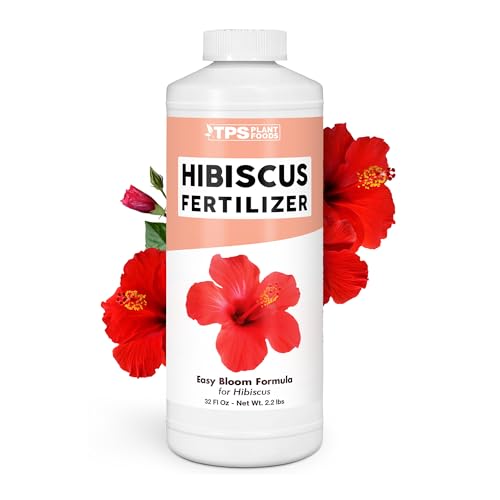
A quick-acting liquid feed that revived a non-blooming hibiscus inside a single week.
TPS Nutrients Hibiscus Fertilizer is a liquid concentrate formulated for outdoor and potted tropical plants, with a mixing ratio of 1:28 (meaning you mix one part fertilizer with 28 parts water). This makes the 32-ounce bottle stretch to a significant number of feedings. The formula is designed to support vibrant blooms and large, colorful flowers from early spring through the growing season.
Shoppers say that one application alone “revived a hibiscus with yellow leaves and no flowers within a week.” Another noticed visible improvement in growth and flowers soon after starting. The main feedback from regular users is that the per-application cost feels higher than granular alternatives, especially if you have many plants that need feeding on the manufacturer’s recommended schedule.
In liquid volume, this 32-ounce bottle offers twice the amount of the HiThrive 16-ounce liquid version, making it a better value for anyone who wants the speed of liquid feeding without needing to reorder as quickly.
Why it stands out
- Liquid formula is absorbed by roots almost instantly
- Large 32 oz bottle diluted at 1:28 stretches far
- Buyers noted a visible revival even on distressed plants
Trade-offs
- Per-application cost is higher than granular options
- Frequent applications add up quickly for multiple plants
Go for it when: You need a quick fix for a struggling hibiscus and want the fastest results from a liquid formula.
Not ideal for: Gardeners on a strict budget who need to feed a large number of plants regularly.
5. HiThrive 16oz Hibiscus Fertilizer – Makes 16 Gallons
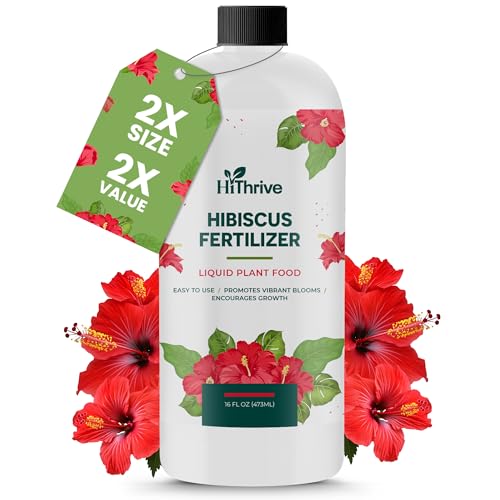
A budget-friendly liquid concentrate that makes 16 gallons for a whole season of feeding.
HiThrive’s 16-ounce liquid fertilizer is formulated for all hibiscus varieties, including Rose of Sharon, Tropical Hibiscus, and Confederate Rose. It is packed with essential macronutrients and micronutrients to strengthen roots, enhance flower size, and correct common nutrient deficiencies like pale leaves and weak stems. The manufacturer recommends feeding every 1-2 weeks during spring and summer, and every 4 weeks in fall and winter.
Buyers report this product delivered dramatic results — one shared that last year they “only got a couple blooms” on their hibiscus tree, but after using this once a week, they saw a striking improvement. The 16-ounce bottle is half the size of the TPS Nutrients 32-ounce option, but it costs significantly less, making it an excellent entry point for someone with one or two hibiscus plants.
This is the easiest way to start a regular feeding routine without measuring large quantities or storing a bulky bag. It fits neatly on a shelf and mixes directly into your watering can.
Highlights
- Simple liquid application you can start immediately
- Works on all hibiscus types, including indoor plants
- Cost-effective for single-plant owners
Limitations
- Smaller bottle runs out faster for large gardens
- Liquid requires more frequent application than granules
Who it is for: Casual gardeners with a few container hibiscus who want an affordable, effective liquid route.
Not the best for: Heavy-feeding schedules or multiple large in-ground plants where granules are more economical.
6. Dr. Earth Acid Lovers Azalea, Camellia, Rhododendron & Maple Fertilizer 4 lb

An organic granular that is safe around kids and pets, revived a sad camellia in days.
Dr. Earth Acid Lovers is the only Non-GMO Project Verified fertilizer in the U.S.A., and it is handcrafted from human and feed grade ingredients. That means no synthetic chemicals, no GMO-infested chicken manure, and no toxic ingredients. It is enriched with multi-minerals, proteins, carbohydrates, humic acids, and trace elements that promote healthy soil biology. Formulated by the brand’s founder Milo Shammas, it is sustainably made in the U.S.A. and carries OMRI, OIM, CCOF, and NOP certifications for organic purity.
Buyers confirm the results firsthand — one shared that Dr. Earth “revived sad camellias” without any digging or making tea; they just tossed it around the plants and watered. The same plant greened up quickly, produced new leaves, and nearby agapanthus flowered a month early. Others noted their gardenias bloomed the best ever, and rhododendrons that had not bloomed for two years were covered with huge pink flowers soon after application.
The 16-ounce item weight is lighter than the Espoma Organic Palm-Tone’s 4-pound weight per bag, so it is ideal for targeted application on a few prized acid-loving shrubs rather than feeding a large tropical bed.
What you get
- Human and feed grade ingredients, safe for pets and people
- Non-GMO Project Verified with multiple organic certifications
- Buyers saw fast results on struggling acid-loving plants
Be aware
- Smaller bag size limits application to a few plants
- Granular organic release is slower than liquid formulas
Best for: Anyone who wants an organic, people-and-pet-safe fertilizer for a few treasured acid-loving shrubs or trees.
Consider another if: You need a large quantity of feed for an entire tropical garden bed or prefer a fast-acting liquid.
7. ENVY Plant Foods Acid-Loving Special Water Soluble Fertilizer (1.5 lb)
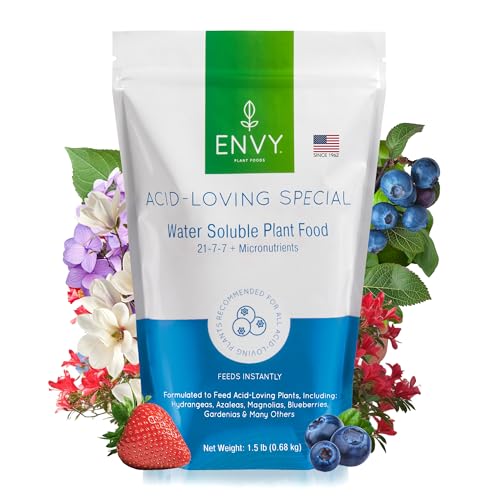
A versatile water-soluble formula that targets hydrangeas, blueberries, azaleas, and hibiscus alike.
ENVY’s Acid-Loving Special is a 100% water-soluble powder that dissolves instantly into water, and it comes in a resealable pouch with a measuring scoop to remove all the guesswork from mixing. It has a 21:7:7 mixing ratio (21% Nitrogen, 7% Phosphate, 7% Potassium), which is higher in nitrogen than many hibiscus-specific blends but still supports strong growth across many acid-loving plants: azaleas, hydrangeas, magnolias, gardenias, camellias, rhododendrons, blueberries, and citrus. The resealable pouch and included scoop make storage and measurement tidy and simple.
Owners mention that the hydrangeas in their garden bloomed more than expected after spring application, with plants appearing healthier and growing strong. Another added that their blueberries were great this year after using this formula. The 24.0-ounce unit count makes this a light, compact option for targeted feeding of a few key plants, though the high-nitrogen formula may not be perfect for hibiscus if you already have very leafy plants that lack blooms.
This is the most versatile pick if you have a mix of acid-loving flowers and berries in your garden. It is not as specialized as the Fertilome Hibiscus formula, but it covers a much wider range of plants with one pouch.
Why it is useful
- Works on a broad range of acid-loving plants, not just hibiscus
- Water-soluble powder with a scoop for precise mixing
- Resealable pouch keeps the formula dry and fresh
Caveats
- 21:7:7 ratio may be too high in nitrogen for some hibiscus
- Lightweight 0.5 lb bag runs out faster than granular bags
Reach for this if: You have a mixed garden of acid-loving plants and want one versatile powder concentrate to feed them all.
Pass on it if: You want a specialized hibiscus formula with a lower nitrogen ratio for maximum bloom output.
Understanding the Specs
NPK Ratio — What Those Three Numbers Mean
The three hyphenated numbers on a fertilizer label (like 17-7-10 or 4-1-5) stand for the percentages of nitrogen (N), phosphorus (P), and potassium (K) in the mix. For hibiscus, you want a formula where the middle and last numbers are relatively close to each other, since phosphorus helps with bloom production and potassium supports overall plant health and flower size. A ratio with too much nitrogen (the first number) will push the plant to grow lots of green leaves at the expense of flowers.
Liquid vs. Granular — When Each Form Shines
Liquid fertilizers, like the TPS Nutrients 32-ounce option, are absorbed by the roots almost immediately, making them ideal for a fast intervention when a plant looks sick or has stopped blooming. Granular fertilizers, like Espoma Palm-Tone, release their nutrients slowly over several weeks as they break down from watering. Granular feeds require less frequent application and are better for the long-term maintenance of established plants, while liquid is the go-to when you need a quick turnaround.
FAQ
What NPK ratio is best for hibiscus blooms?
Can I use a general-purpose fertilizer on my hibiscus?
How often should I fertilize my hibiscus during the growing season?
Will liquid fertilizer work faster than granules for a struggling hibiscus?
What causes yellow leaves on my hibiscus even when I water it?
Is organic fertilizer better than synthetic for hibiscus?
How much fertilizer should I use for potted hibiscus vs in-ground?
Can I use the same fertilizer for my hibiscus and azaleas?
How long does it take to see results from a new fertilizer?
Will fertilizing in summer burn my hibiscus plants?
Final Thoughts: The Verdict
For the majority of shoppers, the fertilizer for hibiscus winner is the BGI Fertilizers HIBISGAIN because it is a commercial-grade granular feed designed exclusively for hibiscus, and its 10-pound resealable bag offers long-term value for serious gardeners. If you want a quick liquid fix that can revive a struggling plant in under a week, grab the TPS Nutrients Hibiscus Fertilizer. And for a pet-safe, organic option that is perfect for a few treasured acid-loving shrubs, the standout is the Dr. Earth Acid Lovers.
How We Picked
We do not accept paid placement, and we did not hands-on test every unit. Instead, we match each pick to a real buyer and use-case by comparing the manufacturers’ published specifications against the patterns in verified customer reviews — so you get each pick’s real strengths and trade-offs instead of marketing copy.
Sources & Methodology
Specifications: manufacturer listings and product documentation. Review insights: verified customer reviews, as of July 2026. Pricing: not shown on this page (it changes often); check the current price via the retailer link.
As an Amazon Associate, Lawn Gear Lab earns from qualifying purchases. This does not affect which products we feature.