
Specs are compiled from manufacturer listings and verified buyer reviews and can change over time — please confirm the key details on the product page before buying.
Picking a fertilizer for your herb garden is not about getting the biggest bag — it is about finding a mix that delivers steady, gentle nutrition without burning the tender roots of basil, parsley, or thyme. Herbs are lighter feeders than tomatoes or squash, so the wrong NPK ratio or a harsh synthetic blast can ruin flavor, cause leggy growth, or even kill the plant. This guide breaks down the best options for every growing style, from soil beds to hydroponic towers, so you can match the feed to your setup and taste the difference in your leaves.
I’m Rikta — the founder and writer behind Lawn Gear Lab. This guide is built by comparing the manufacturers’ published specifications and the patterns across verified customer reviews, so you get each pick’s real strengths and trade-offs instead of marketing spin.
If you want bigger harvests and more fragrant leaves without guesswork or accidental over-feeding, start here with the fertilizer for herbs that matches your exact garden style and experience level.
Quick Picks
- Back to The Roots Organic All-Purpose Plant Food (5 lb. Value Size) — Best Value
- True Organic All Purpose Plant Food (4lb) — Top Performer
- Miracle-Gro Raised Bed Plant Food, 2-Pound — Best for Raised Beds
- Down To Earth All Natural Fertilizers Organic All Purpose Tomato & Vegetable Mix, 5 lb — Rescue Pick
- Espoma Organic Garden-Tone 3-4-4 Organic Fertilizer (4 lb. Bag – Pack of 2) — Best Overall
- Growth Technology GT Herb Focus – Liquid Plant Food (8.5 fl oz) — Hydroponic Specialist
How To Choose The Best Fertilizer For Herbs
Herbs are naturally resilient, but the wrong feed can make them grow too fast, lose essential oils, or become more appealing to pests. Focus on these three factors to get it right the first time.
NPK Ratio and Why It Matters for Leaf Growth
Herbs need a balanced or slightly nitrogen-forward formula — the first number in the NPK ratio (nitrogen) drives leafy green growth, which is what you harvest. A ratio like 3-4-4 or 4-6-2 gives enough nitrogen for lush leaves without sacrificing phosphorus for root health. Avoid high-nitrogen lawn fertilizers (like 30-0-0), which push watery, flavorless growth.
Organic vs Synthetic for Flavor and Soil Life
Organic fertilizers release nutrients slowly as soil microbes break them down, building long-term soil fertility and supporting the microbial life that helps herbs develop their characteristic aromas. Synthetic options give a quick green-up but can leach nutrients past the root zone and, over time, reduce soil organic matter. For culinary herbs you plan to eat, organic sources like fish bone meal, kelp meal, or alfalfa meal are the safer, more flavor-conscious choice.
Liquid vs Granular Application for Your Setup
Liquid concentrates mix with water and deliver nutrients immediately to the roots — ideal for hydroponic systems, containers, and plants that need a quick pick-me-up. Granular fertilizers are sprinkled on the soil surface or mixed into the potting mix before planting; they release over weeks or months and need fewer applications. Choose liquid if you want precise control over each watering, and choose granular if you prefer a “set and forget” approach for a full growing season.
Quick Comparison
On smaller screens, swipe sideways to see the full table.
| Model | Best For | Weight | NPK Ratio | Form | Amazon |
|---|---|---|---|---|---|
| Back to The Roots Organic All-Purpose | Vegan organic feeding | 5 lb | Not stated | Powder | Amazon |
| True Organic All Purpose Plant Food | Balanced NPK with seabird guano | 4 lb | 5% nitrogen, 4% phosphate, 5% potash | Granules | Amazon |
| Miracle-Gro Raised Bed Plant Food | Quick visible results in raised beds | 2 lb | 5-1-7 | Granules | Amazon |
| Down To Earth All Natural Tomato & Veg | Reviving struggling plants fast | 5 lb | 4-6-2 | Granules | Amazon |
| Espoma Organic Garden-Tone | Long-season bulk harvests | 4 lb (pack of 2) | 3-4-4 | Granules | Amazon |
| Growth Technology GT Herb Focus | Hydroponic and container herbs | 8.5 fl oz | 1:200, 1:400 dilution | Liquid | Amazon |
In‑Depth Reviews
1. Back to The Roots Organic All-Purpose Plant Food (5 lb. Value Size)

A 100% plant-based feed that treats herbs like the delicate edibles they are.
You get a vegan fertilizer with no animal waste or synthetic chemicals — this 5-pound powder is made entirely from plant and mineral sources (kelp meal, alfalfa meal, rock phosphate, and mycorrhizae, which are beneficial fungi that help roots absorb nutrients). Mix just 1 tablespoon per gallon of water to create a liquid drench for container herbs. Reviewers report it works well and, as one reviewer noted, “hasn’t burned our crops.” Unlike the Down To Earth bag below, this one matches it in weight (5 pounds) but uses a vegan, non-meal-based ingredient list that some organic purists prefer.
Buyers report the packaging is not recyclable and some wish for a larger size, but the feedback on safety is consistent — no root burn even with regular use. It is a solid pick for anyone who wants a clean, guilt-free feed for their kitchen herb pot.
What works
- Vegan and plant-mineral-based — no animal byproducts.
- Includes mycorrhizae to strengthen root systems.
- At 5 pounds, covers many applications for the price.
What to know
- Some packages direct sprinkling, others suggest mixing — check your bag’s instructions.
- Non-recyclable plastic packaging.
- Not the most concentrated option; you use more per watering.
Reach for this if: you want a 100% vegan, all-natural feed that will not burn your basil or parsley, and you prefer powder you can mix yourself.
Look elsewhere if: you need a granular “sprinkle and forget” formula for a big raised bed.
2. True Organic All Purpose Plant Food (4lb)

An organic granule with 5% nitrogen, 4% phosphate, and 5% potash for steady leaf and root growth.
True Organic delivers 5% nitrogen, 4% phosphate, and 5% potash, with 3.75% slow-release nitrogen, plus 4% calcium and 1% sulfur, so herbs get a steady meal without a salt surge. The 4-pound bag covers 87 square feet, and the brand offers larger sizes up to 25 pounds for serious gardeners. The exclusive organic blend uses seabird guano, shrimp and crab shell meal, soybean meal, and fish bone meal — a diverse nutrient source that feeds both the plant and the soil biology. The granules are easy to apply monthly.
Buyers describe it as “100% organic, mixes easily, no root burn,” and report faster growth and more blooms on herbs and vegetables. The main trade-off is the smell — it comes from the fish and shell meals, and one reviewer joked it is “not tolerable unless you don’t smell it up close.” But the concentrated formula means a little goes a long way, and the performance is consistent enough that many call it the best organic fertilizer they have used. skip it if you are sensitive to strong odors; otherwise, the results speak for themselves.
Why it stands out
- Well-balanced nutrient profile with 5% nitrogen, 4% phosphate, 5% potash, and slow-release nitrogen — no burning.
- Includes calcium and sulfur for soil structure and flavor.
- Available in multiple sizes to match any garden footprint.
Consider this
- Strong, natural smell from the fish and shell meal ingredients.
- Granules require watering in to activate.
Best for: gardeners who want a proven organic granular feed that supports both leaves and roots without guesswork.
pass on it if: you are sensitive to odors or need a liquid concentrate for a hydroponic setup.
3. Miracle-Gro Raised Bed Plant Food, 2-Pound

A quick-release granule that delivers visible growth in as little as one week.
This 2-pound bag from Miracle-Gro is formulated specifically for raised beds, feeding herbs, flowers, fruits, and vegetables for up to 3 months. The 5-1-7 NPK skews toward nitrogen and potash rather than phosphorus, which makes sense for leafy herbs and fruiting vegetables in a soil blend that already has some base fertility. Each bag covers two 4-by-4-foot raised beds, so you can treat a decent-sized garden with a single purchase. The granules are sprinkled dry and watered in — no mixing.
One buyer reports “blooms in one week of sprinkling plant food,” which matches the fast-acting reputation of synthetic-based feeds. The catch is that this is not organic — it contains synthetic nutrients — and the 2-pound weight is lighter than most organic competitors. While it is convenient, the quick-release nature means you must follow the dosage carefully to avoid over-feeding, especially with tender herbs that are sensitive to high nitrogen.
What makes it effective
- Feeds for up to 3 months from a single application.
- Contains calcium and micronutrients for a bountiful harvest.
- Simple sprinkle-and-water process — no measuring or mixing.
The trade-offs
- Synthetic formula — not suitable for organic herb gardens.
- 2-pound bag is relatively small compared to organic 4-5 pound competitors.
- Can burn herbs if over-applied or applied to dry soil.
Go for it if: you want a no-fuss, fast-acting feed for a raised herb bed and you are not concerned about organic certification.
it’s not for you if: you need an organic, slow-release formula or if you are growing in containers with limited soil volume.
4. Down To Earth All Natural Fertilizers Organic All Purpose Tomato & Vegetable Mix, 5 lb

A gentle, non-burning formula known for reviving struggling plants within two weeks.
Down To Earth’s 4-6-2 mix is designed to deliver a steady supply of nutrients while enhancing soil microbial activity naturally. It comes in a 5-pound box, versus the 2-pound Miracle-Gro raised bed feed, and is OMRI-listed for organic production. The ingredients include fish bone meal, blood meal, feather meal, rock phosphate, langbeinite, greensand, humates, and kelp meal. That is a dense, diverse blend that feeds the soil itself, not just the plant. It is labeled for vegetables, herbs, flowers, and container plants.
Owners mention impressive results: one gardener says it “revived pale, flimsy tomato plants within two weeks of application.” The smell is strong for the first few days after application, but dissipates. Unlike the Growth Technology liquid below, this is a granular, slow-release product that you mix into the soil or top-dress. The catch for herb gardeners is that the phosphorus (6) is higher than what most culinary herbs need — great for tomatoes and peppers, but slightly overkill for basil or parsley.
Strengths
- OMRI-listed — fully approved for certified organic gardens.
- Contains 8 diverse organic ingredients including humates and greensand.
- Gentle, non-burning formula that works well for stressed plants.
Weaknesses
- Strong natural smell for a few days after application.
- Higher phosphorus (6) than herbs typically need.
Grab this if: you are rehabbing pale or flimsy herbs and want a proven organic granular feed that works fast without burning.
Pass if: you want a mix specifically matched to herb-level nutrition or prefer a liquid concentrate.
5. Espoma Organic Garden-Tone 3-4-4 Organic Fertilizer (4 lb. Bag – Pack of 2)

A long-season performer that helps herbs survive heat and still deliver heavy harvests.
Espoma Garden-Tone delivers a 3-4-4 NPK with 5% calcium, making it one of the best-matched ratios for culinary herbs that need steady leaf growth without being pushed too hard. The Bio-tone formula includes beneficial microbes that improve nutrient uptake. This pack of two 4-pound bags gives you 8 pounds total — enough to feed a generous garden for a season. It is approved for organic gardening and registered as an Organic Input Material. Apply it monthly to the soil around the drip line of the plant and water it in.
Customers note impressive real-world results: one reviewer in zone 10b (a warm climate region) noted that annuals and vegetables “survived late July heat, yielding 400lbs tomatoes and 100lbs carrots” after using Espoma fertilizers. Another buyer called it a “standout” for garden health and bloom longevity. The granules have a mild organic smell that dissipates quickly, and users say it does not burn plants even with slight over-application. This is the pick for gardeners who want a forgiving, slow-release granular that handles heat stress better than the liquid GT Herb Focus below.
Why it wins
- Tailored 3-4-4 ratio with calcium is ideal for herb leaf and root growth.
- Contains exclusive Bio-tone beneficial microbes for soil health.
- Pack of two 4-lb bags offers excellent value at a premium tier price.
Keep in mind
- Requires monthly reapplication during growing season.
- Granules need watering in; not suitable for hydroponic systems.
Best for: herb gardeners who want a top-tier organic granular feed with beneficial microbes and season-long support, all in a convenient two-pack.
Consider another option if: you prefer a liquid concentrate or are gardening in a hydroponic setup where granules cannot be used.
6. Growth Technology GT Herb Focus – Liquid Plant Food (8.5 fl oz)
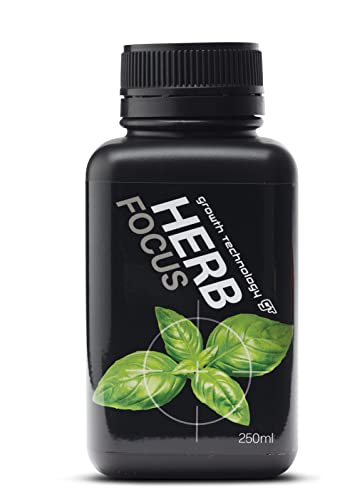
The only liquid formula here built exclusively for herbs, from soil to hydroponics.
You get a complete liquid concentrate that delivers all 12 essential minerals, including calcium, in a balanced formulation specific to culinary herbs like basil, parsley, coriander, dill, mint, thyme, rosemary, and oregano. It uses single-part technology, so you do not mix A and B bottles — just dilute 3-5 ml per liter for soil or 5-7 ml per liter for hydroponics (a method of growing plants in water without soil). It is the only pick on this list that works smoothly across soil, potting mix, hydroponic, and semi-hydroponic systems. The bottle is 8.5 fluid ounces (250 ml), which sounds small but is highly concentrated.
Buyers rave about the results: one says “my hydro plants grow like weeds with it,” and another reports “the new growth and leaf size is significantly larger.” The main complaint is that the original bottle can leak during shipping. Compared to the 4-5 pound granular bags above, this is a completely different format — immediate delivery, no soil life required, and precise control over dosage. It is the right choice for indoor kitchen herb towers or any container grower who wants same-day results, not the slower release of the Espoma granules.
what separates it
- Formulated for herbs specifically — with all 12 essential minerals.
- Works in soil, hydroponic, and semi-hydroponic systems.
- Single-part liquid — simple to mix and apply.
What to watch
- Some bottles leak in transit; check the seal on arrival.
- Higher cost per ounce than granular options — you pay for precision.
Best fit: hydroponic herb growers, indoor kitchen gardeners, and anyone who wants a herb-specific liquid feed with fast, measurable results.
Not for you if: you have a large outdoor raised bed where a 5-pound granular bag will give you better coverage per dollar.
Understanding the Specs
NPK Ratio — The Three Numbers
The NPK ratio (for example, 3-4-4 or 5-1-7) tells you the percentage of nitrogen (N), phosphorus (P), and potassium (K) in the fertilizer. Nitrogen pushes leafy green growth, which is the main goal for herbs you harvest for leaves. Phosphorus supports root and flower development. Potassium helps overall plant health, disease resistance, and water regulation. For culinary herbs, choose a balanced ratio where the first number (nitrogen) is close to the second and third — or slightly higher. A ratio like 3-4-4 or 4-6-2 works well because it gives enough nitrogen for lush leaves without neglecting roots and resilience.
Release Method — Slow vs Fast
Slow-release fertilizers (most organic granules) break down gradually as soil microbes digest them, feeding the plant over weeks or months. Fast-release fertilizers (most synthetic granules and some liquids) make nutrients available immediately, which can produce rapid green-up but also carries a higher risk of burning delicate herb roots. A slow-release feed requires less frequent application but takes longer to show results. A fast-release feed works quickly but demands careful dosing. The right choice depends on how much attention you want to give your herbs and whether you prefer a “low-maintenance” approach or active weekly feeding.
FAQ
Can I use tomato fertilizer on my herbs?
How often should I fertilize herbs in containers?
Does organic fertilizer really make herbs taste better?
Can I use the same fertilizer for herbs and vegetables?
What happens if I over-fertilize my herbs?
Do I need to fertilize herbs in a hydroponic system?
Is it safe to use synthetic fertilizer on culinary herbs?
How long does a 5-pound bag of granular fertilizer last for herbs?
Can I mix liquid and granular fertilizers for my herbs?
What is the best fertilizer for woody herbs like rosemary and thyme?
Final Thoughts: The Verdict
For most buyers, the fertilizer for herbs winner is the Espoma Organic Garden-Tone because its 3-4-4 ratio with calcium is perfectly matched to culinary herb needs, and the Bio-tone microbes build long-term soil health. If you want a liquid concentrate for hydroponic or container herbs, grab the Growth Technology GT Herb Focus for its herb-specific mineral profile. And for a budget-friendly all-purpose organic option that covers everything from basil to bell peppers, the Back to The Roots Organic All-Purpose gives you 5 pounds of vegan, no-burn feed at a great value.
How We Picked
We do not accept paid placement, and we did not hands-on test every unit. Instead, we match each pick to a real buyer and use-case by comparing the manufacturers’ published specifications against the patterns in verified customer reviews — so you get each pick’s real strengths and trade-offs instead of marketing copy.
Sources & Methodology
Specifications: manufacturer listings and product documentation. Review insights: verified customer reviews, as of July 2026. Pricing: not shown on this page (it changes often); check the current price via the retailer link.
As an Amazon Associate, Lawn Gear Lab earns from qualifying purchases. This does not affect which products we feature.