
If your African violets grow plenty of leaves but rarely, if ever, bloom, the issue is almost always the fertilizer — specifically its nutrient balance. These plants are hungry feeders with fragile roots, so a wrong-strength mix or a formula without the right ratio of phosphorus (the nutrient that drives flower growth) can leave you with a lush green bush and zero flower stalks.
I’m Rikta — the co-founder and writer behind Lawn Gear Lab. This guide is built by comparing the manufacturers’ published specifications and the patterns across verified customer reviews, so you get each pick’s real strengths and trade-offs instead of marketing spin.
Below, I break down five of the most popular liquid formulas, from organic concentrates to budget-friendly staples, to help you find the best fertilizer for african violets for your particular plant setup and watering habits.
How To Choose The Best Fertilizer For African Violets
The wrong fertilizer can cause salt buildup in the soil, burning the delicate roots, or it can push leaf growth at the expense of flowers. Here are the key things to look for.
N-P-K Ratio — The Three Numbers That Decide Blooms vs Leaves
Every fertilizer label shows three numbers (like 8-14-9 or 3-3-3). The middle number — phosphorus — drives flower production. African violets typically need a higher middle number than typical all-purpose plant foods. A balanced 3-3-3 formula is gentler for regular feeding, while a bloom booster like 8-14-9 gives a stronger phosphorus push for maximum flowers.
Liquid vs Granular — Convenience Matters
All the picks here are liquid concentrates that you mix with water. Liquids absorb quickly and let you control the dose precisely — you can adjust the strength based on whether your plant is actively blooming or resting. Granular options release nutrients slowly and are harder to manage in small pots.
Organic vs Synthetic — Root Safety and Smell
Organic formulas (like those made from fish or seaweed) are gentler on roots and less likely to cause chemical burn, but they can have a noticeable odor. Synthetic formulas deliver nutrients faster and are usually odorless, but you must follow the dilution instructions exactly to avoid salt damage.
Quick Comparison
On smaller screens, swipe sideways to see the full table.
| Model | Category | Best For | Key Spec | Amazon |
|---|---|---|---|---|
| Espoma Organic Violet! | Organic Pick | Gentle feeding with organic ingredients | 16 fl oz total (2x8oz bottles) | Amazon |
| Houseplant Resource Center 3-3-3 | Balanced Formula | Gentle weekly feeding for large collections | 8 fl oz, 3-3-3 NPK | Amazon |
| HiThrive 32oz | Best Value | Most liquid for the price — 48 gallons of mix | 32 fl oz, makes 48 gallons | Amazon |
| TPS Nutrients 32oz | Premium Pick | Gentle root-safe liquid in a large bottle | 32 fl oz, gentle formula | Amazon |
| Schultz SPF44900 8-14-9 | High-Phosphorus Booster | Maximizing blooms with strong phosphorus | 12 fl oz total (3x4oz bottles), 8-14-9 | Amazon |
In‑Depth Reviews
1. Espoma Organic Violet! (2-Pack)
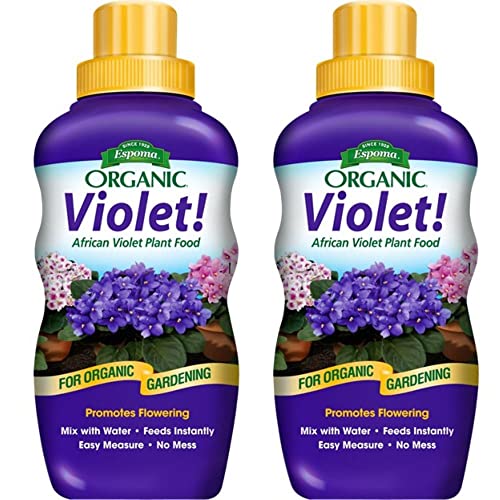
16 fl oz total (two 8-ounce bottles) makes the Espoma Organic Violet! the top pick for most growers who want a gentle organic fish-and-seaweed base that feeds plants without risking root burn — buyers report that a single teaspoon per typical water bottle keeps a consistent feeding routine going.
This liquid food provides organic nutrients that are safe around kids and pets, and according to reviewers, it pushes vigorous growth and consistent blooming. Simply mix half a cap per quart of water and use it every 2–4 weeks — the plants respond by producing more vibrant flowers, even after a long dormant stretch.
The catch is the organic odor — a few reviewers mention a fishy smell when mixing — but the consistent blooming results make that a minor inconvenience. If you want a reliable, all-around organic formula that works year after year, this is the one. skip it if you cannot tolerate any smell during mixing.
Why it’s great
- Organic and safe around children and pets
- Simple to measure, easy to use
- Proven to restore blooms even on long-dormant plants
Good to know
- Has a noticeable fishy smell when mixing
- Liquid can separate in the bottle; shake well before each use
2. Houseplant Resource Center 3-3-3
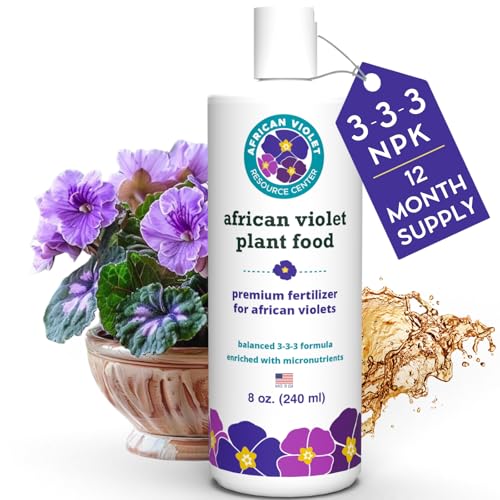
Where the Espoma focuses on organic ingredients, this Houseplant Resource Center formula takes a different approach: a perfectly balanced 3-3-3 NPK ratio (equal parts Nitrogen, Phosphorus, and Potassium) that is safe enough for weekly feeding without any risk of overloading the soil. The balanced middle number (3) is lower than the bloom-boosting Schultz 8-14-9, so it produces healthy steady flowers rather than a sudden burst — ideal for year-round care.
The gentle formula includes sea kelp, humic acid (a natural soil conditioner), and fulvic acid (a nutrient transporter), which support strong roots and lush foliage alongside blooms. One reviewer with a collection of 40 African violets used this fertilizer weekly for two weeks and reported that the plants outgrew their pots and bloomed beautifully, including rare “Flame” varieties — a testament to its reliability for large collections.
It mixes at 1 teaspoon per gallon of water, and the 8-ounce bottle lasts many watering cycles. Choose this over the top pick if you have a serious collection and want a fertilizer you can use every time you water without guessing the dose.
Where it shines
- Balanced 3-3-3 formula safe for weekly feeding
- Contains kelp, humic acid, and fulvic acid for root health
- Works beautifully on large collections
Worth noting
- 8 oz bottle is smaller than some competitors
- Not as strong a bloom booster as a high-phosphorus formula
3. HiThrive 32oz
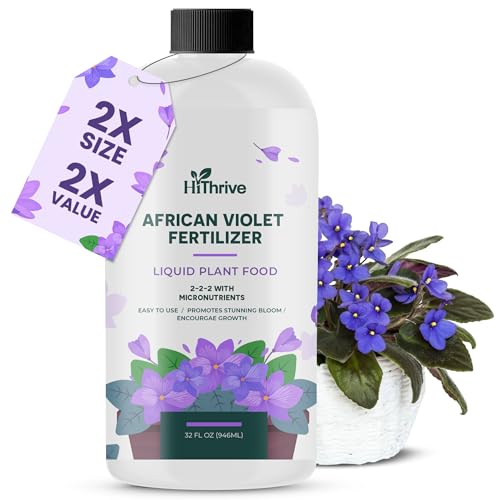
If you have a sprawling collection of African violets that demands gallons of feeding solution every month, the HiThrive 32oz is the volume king — at 32 fluid ounces, it packs 8 times the liquid of the Schultz 12 oz (3x4oz) bottles and 4 times the volume of the Houseplant Resource Center 8-ounce bottle. Each bottle makes 48 gallons of feeding solution, which is enough to water a large collection for months without repurchasing.
Owners mention that it works fast: one reviewer noted it “revived non-blooming African violets with blooms appearing within a week.” The formula includes a full spectrum of micronutrients — calcium, magnesium, iron, copper, manganese, and zinc — which fixes yellowing leaves and slow growth quickly.
The standout spec is the 48-gallon yield, which makes it the most economical choice on this list by a wide margin.
What stands out
- Makes 48 gallons — the highest yield on the list
- Revives non-blooming violets within a week, per reviewers
- Includes full micronutrient spectrum
The trade-offs
- 32 oz bottle is large; takes up space on a shelf
- Not organic if that matters to you
4. TPS Nutrients 32oz
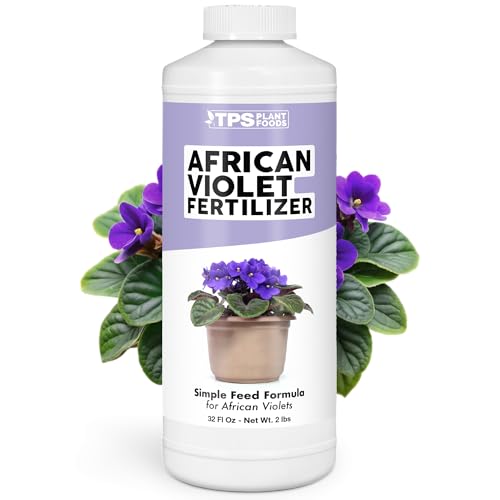
The single number that matters most in this category is the formula’s gentle nutrient profile — it delivers consistent nutrition without the risk of root stress, scoring high on safety for delicate African violet roots. It is specifically designed for delicate African violet roots, so you can use it regularly without worrying about salt buildup or chemical burn — a common issue with stronger synthetic formulas like the Schultz 8-14-9.
One long-time grower described the result simply: “Got some blooms which hasn’t happened in a while.” The formula encourages continuous flowering and richer green leaf color, but it does not have a super-high middle number — the downside is that it is less of a bloom bomb and more of a steady health-and-flower supporter.
At 32 ounces, you get the same large bottle as the HiThrive but with a formula that prioritizes root gentleness. If your violets are sensitive or you have had trouble with other fertilizers causing leaf edge burn, this is the safe upgrade — offering solid price-to-value for growers seeking root-safe nutrition over maximum volume at the lowest cost.
The upsides
- Extremely gentle on sensitive roots
- Large 32 oz bottle for long-term use
- Encourages steady blooms and vibrant leaf color
Keep in mind
- Not a fast-acting bloom booster
- Higher price per ounce than the HiThrive
5. Schultz SPF44900 8-14-9 (Pack of 3)
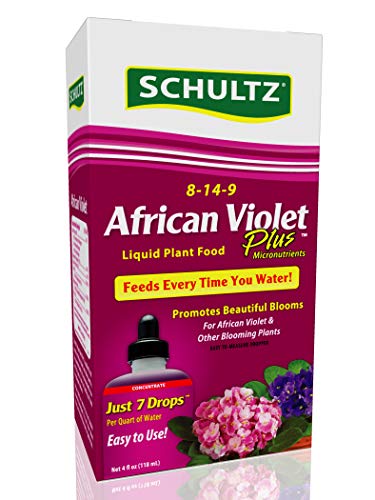
The Schultz SPF44900 delivers the highest phosphorus level of any formula on this list — an 8-14-9 N-P-K ratio (Nitrogen-Phosphorus-Potassium), with the middle number (14) being significantly higher than the 3 in the balanced formulas like the Houseplant Resource Center 3-3-3. This is a bloom-booster designed to maximize flower production when you need it most.
You get three 4-ounce bottles (12 ounces total), which makes it the smallest total volume on this list — and at 4 ounces per bottle, it holds 8 times less liquid than the TPS 32oz bottle. A mixed review noted: “So far I have not seen any major improvement with this violet food” — suggesting results vary depending on your starting plant health.
However, for growers who want to push their violets into a heavy blooming cycle quickly, the high phosphorus is the right tool. It is best used as a periodic treatment rather than a weekly all-purpose feed. If your violets are already healthy but refuse to flower, this is the targeted nudge they need. Go with the Espoma or Houseplant Resource Center for gentler all-around care.
Why we’d pick it
- Strongest phosphorus boost (14) for maximum blooms
- Pack of 3 small bottles is convenient for travel or gifts
A few caveats
- Small 4 oz bottles; high phosphorus can burn if overused
- Some users saw no immediate improvement
Understanding the Specs
N-P-K Ratio
These three numbers stand for Nitrogen (promotes leafy growth), Phosphorus (drives flower and root development), and Potassium (supports overall plant health and disease resistance). For African violets, a middle number that is at least as high as the first number — like 3-3-3 or 8-14-9 — generally gives you the best flower results. A fertilizer with a very high first number (like 20-10-10) will push leaves but starve you of blooms.
Liquid Volume and Yield
Liquid volume (reported in fluid ounces) tells you how much concentrate is in the bottle. Yield tells you how many gallons of feeding solution you can make from that bottle — for example, 32 oz concentrate that makes 48 gallons. A larger bottle is better value only if you actually use it within a reasonable time; concentrates do not expire quickly but can degrade if stored poorly.
FAQ
How often should I fertilize my African violets?
What happens if I use a general all-purpose fertilizer instead of an African violet formula?
Final Thoughts: The Verdict
When it comes down to it, the best fertilizer for african violets winner is the Espoma Organic Violet! because it combines organic safety, simple dosing, and consistent blooming results. If you want a balanced formula you can use weekly on a large collection, grab the Houseplant Resource Center 3-3-3. And for the absolute best value — 48 gallons of mix from one bottle — the standout is the HiThrive 32oz.