
Yellowing leaves, stunted growth, and disappointing blooms on your azaleas, blueberries, or gardenias often point to one problem: alkaline soil blocking nutrient uptake. Acid-loving plants demand a specific pH range to access the iron, manganese, and other micronutrients they need. Using a general-purpose fertilizer only worsens the issue, locking away the very elements your plants require.
I’m Rikta — the co-founder and writer behind Lawn Gear Lab. My approach to this guide involves weeks of cross-referencing NPK ratios, sulfur content, organic certifications, and real-world owner experiences from hundreds of verified purchases to separate effective acid-specific formulas from generic products.
This deep dive into the best options available helps you cut through the marketing and select the right fertilizer for acid-loving plants based on your specific shrubs, soil conditions, and feeding preferences.
How To Choose The Best Fertilizer For Acid-Loving Plants
Selecting the right acid-specific fertilizer requires more than grabbing a bag with an azalea picture. You need to match the formula to your soil’s current pH, your plant’s growth phase, and your tolerance for application frequency.
NPK Ratio & Acidifying Agents
Standard fertilizers with high nitrogen (like a 30-10-10) can push soil pH higher over time. Acid-loving plants need a lower-nutrient profile often paired with elemental sulfur or ammonium-based nitrogen to actively lower pH. Look for ratios around 4-3-4 or 8-4-8 and check the label for sulfur content — 5% or higher is a reliable indicator of acidifying power.
Form: Granular vs. Water-Soluble
Granular slow-release formulas (like Espoma Holly-Tone or True Organic) provide consistent feeding over 2-3 months and are ideal for established shrubs and trees. Water-soluble options (like Miracle-Gro) deliver an immediate nutrient boost, perfect for potted plants or correcting early-season chlorosis. Your choice depends on whether you want set-and-forget convenience or rapid, targeted correction.
Micronutrients & Organic Matter
Iron, manganese, and magnesium are critical for acid feeders because alkaline soil binds these elements, causing yellow foliage (chlorosis). A premium fertilizer includes chelated iron and soil microbes to unlock existing nutrients. Organic-certified formulas like Dr. Earth and FoxFarm Happy Frog also add humic acids and mycorrhizal fungi to build long-term soil structure without synthetic salt buildup.
Quick Comparison
On smaller screens, swipe sideways to see the full table.
| Model | Category | Best For | Key Spec | Amazon |
|---|---|---|---|---|
| Espoma Organic Holly-Tone | Organic Granules | Established acid shrubs & trees | 4-3-4 with 5% sulfur | Amazon |
| True Organic Azalea Food | Organic Granules | Lowering soil pH naturally | 5-4-3 with 5% sulfur | Amazon |
| Fertilome Azalea Food | Synthetic Granules | High-phosphorus bloom boost | 9-15-13 high P-K ratio | Amazon |
| GARDENWISE 8-4-8 | Bio-Solid Granules | Iron-rich feeding for chlorosis | 8-4-8 slow-release w/ microbes | Amazon |
| FoxFarm Happy Frog Maple | Organic Powder | Japanese maples & container plants | 4-3-4 w/ mycorrhizal fungi | Amazon |
| Miracle-Gro Water Soluble | Water-Soluble Powder | Quick green-up & potted plants | Instant feed every 7-14 days | Amazon |
| Dr. Earth Acid Lovers | Organic Granules | Non-GMO & pet-safe gardening | 0.3-0.4-3 w/ humic acids | Amazon |
In‑Depth Reviews
1. Espoma Organic Holly-Tone 4-3-4

Espoma’s Holly-Tone has been the gold standard for acid-loving plant nutrition since 1929, and the current 4-3-4 formulation with 5% elemental sulfur remains the most versatile single bag for homeowners. The Bio-tone-enhanced organic base breaks down slowly, feeding holly, azaleas, rhododendrons, blueberries, and hydrangeas across the entire growing season with just two applications — spring and fall. This 36-pound bag delivers enough coverage for a substantial mixed border or several large shrubs, making it the most cost-efficient premium option per square foot.
Verified owners consistently report that Holly-Tone revived underperforming shrubs within a single season. Multiple long-term users note that magnolia trees in the Bay Area and azaleas in the Northeast produced significantly denser foliage and more abundant blooms after switching from generic 10-10-10 feeds. The organic ingredients, including feather meal and poultry manure, support soil microbial activity without the salt burn risk of synthetic concentrates.
The primary trade-off is the granular format — you need to scratch it into the soil surface and water thoroughly for best results. It also includes no quick-release nitrogen, so plants showing acute chlorosis may need a supplemental liquid iron chelate to bounce back faster. Holly-Tone is OMRI-listed for organic production, satisfying gardeners who prioritize certified inputs.
What works
- Industry-standard reliability with proven owner results across dozens of acid-loving species
- Large bag size provides excellent coverage for extensive gardens
- Contains sulfur to actively acidify soil while feeding
What doesn’t
- Granules require incorporation into soil and watering-in for activation
- Slower to correct acute yellowing compared to water-soluble iron supplements
2. True Organic Azalea, Camellia & Rhododendron Food
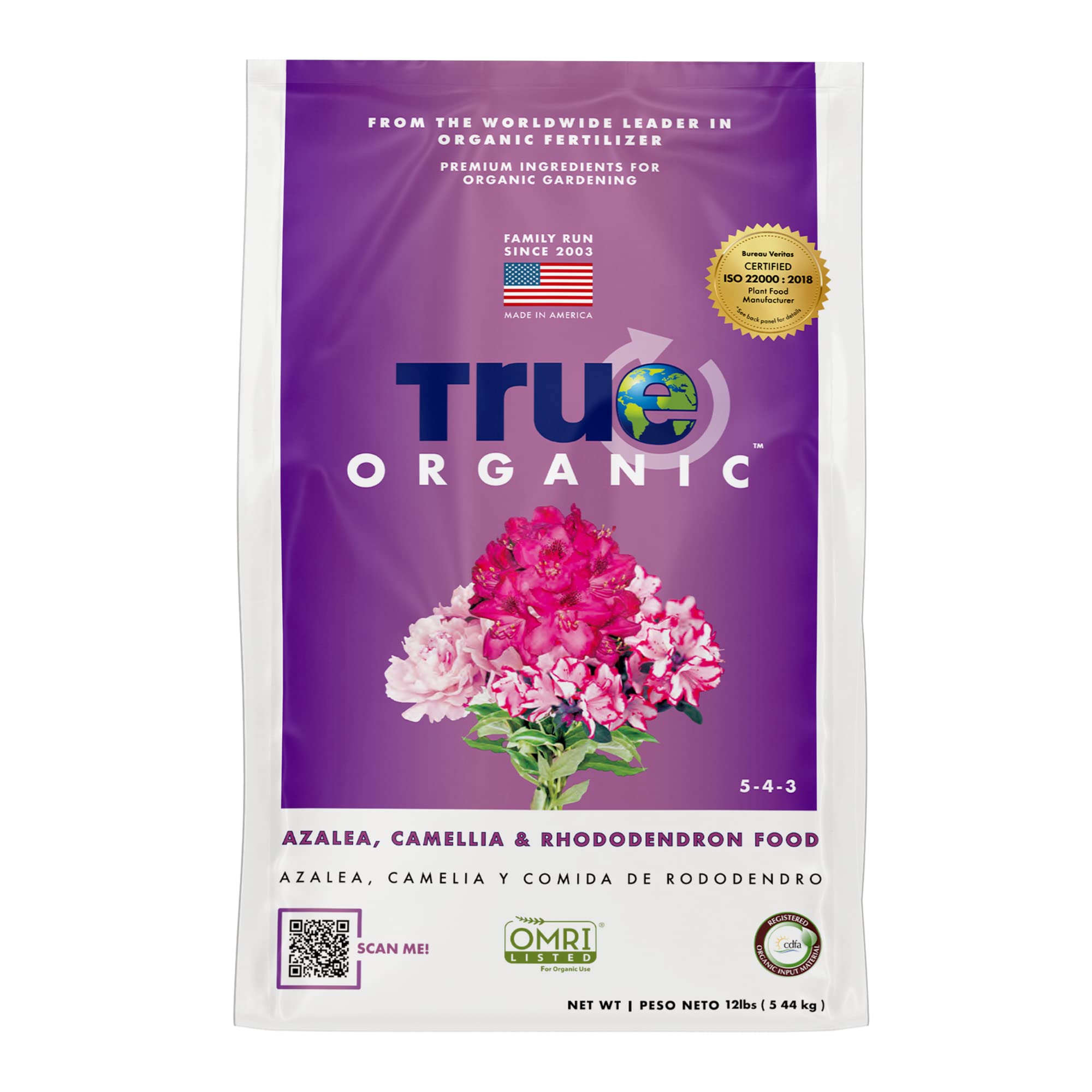
True Organic takes a direct approach to pH correction by packing 5% soil sulfur into a 5-4-3 formula derived from seabird guano and shrimp/crab shell meal. This makes it the best pick for gardeners struggling with high-alkaline tap water or naturally limestone-heavy soil. The 12-pound bag covers up to 261 square feet with just two applications per year — spring and fall — which simplifies feeding schedules for larger landscapes.
Owner feedback highlights dramatic results on roses and raspberries. One verified buyer reported a Playboy rose bush skyrocketing from 3 feet to 7 feet after switching to this granular feed, noting zero fishy odor even after rain. Another user revived a neglected raspberry patch, with older canes suddenly producing healthy berries. The sulfur component is particularly effective for pines and evergreens showing tip dieback from high pH.
The downside is that the seabird guano base has a distinctly earthy smell when first applied, though it fades quickly after watering. The 5-4-3 ratio is slightly nitrogen-heavy, so gardeners with established Japanese maples should apply at half the recommended rate to avoid excessive vegetative growth at the expense of branch hardening.
What works
- 5% sulfur actively reduces soil pH each season
- Made in USA with certified organic inputs
- Large coverage area per bag reduces annual reordering
What doesn’t
- Guano and shell meal create a temporary earthy scent
- Higher nitrogen may require adjusted rates for sensitive maples
3. Fertilome (13695) Azalea, Camellia, Rhododendron Food 9-15-13
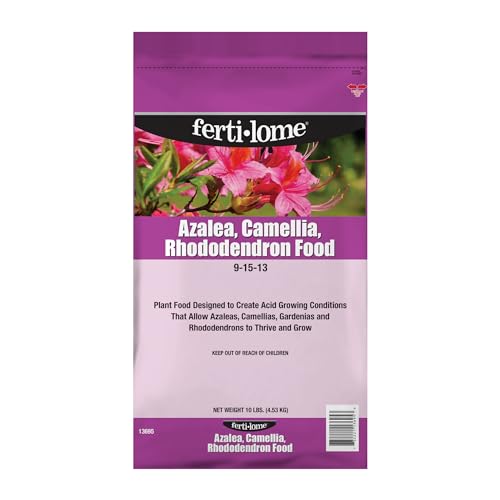
Fertilome’s 9-15-13 formulation is purpose-built for one job: pushing massive, vibrant blooms on established azaleas, camellias, and rhododendrons. The high phosphorus (15%) and potassium (13%) content directly support flower bud formation and root strength, while the moderate nitrogen encourages steady leaf development without the soft, sappy growth that invites pests. This synthetic granule is a top choice for gardeners whose soil pH is already in the 5.0-6.0 range and just needs a bloom-specific boost.
Verified buyers are emphatic about the turnaround they saw on long-dormant shrubs. One owner reported that a rhododendron which had not bloomed for three years exploded with flowers after a single spring application. Another user with bare azaleas saw new leaf growth within a month and then used a reduced rate on hydrangeas, which bloomed for the first time in years. Fertilome covers 1- to 5-foot plants with just 1/4 to 1/2 cup per application.
Because this is a synthetic formulation, it provides no organic matter or soil-microbe benefits — it feeds the plant directly rather than building long-term soil structure. Overapplication risks salt accumulation and root burn, especially in containers. The 10-pound bag is smaller than the premium organics, making it better suited for focused beds rather than whole-property feeding.
What works
- High phosphorus and potassium trigger exceptional flowering
- Provides quick visible greening and bud development within weeks
- Economical for targeted beds with established plants
What doesn’t
- Synthetic salts can burn roots if overapplied or not watered in
- Lacks organic matter or soil microbes for long-term soil health
4. GARDENWISE 8-4-8 Acidic Fertilizer
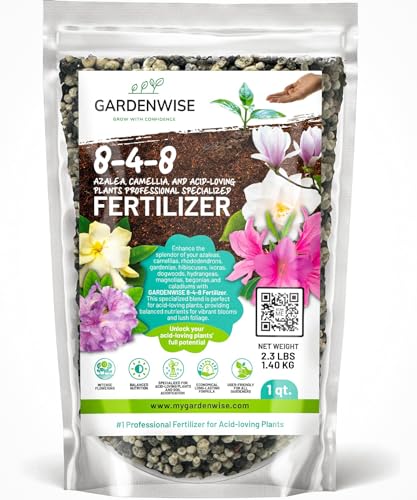
GARDENWISE positions its 8-4-8 formula as an iron-rich, slow-release solution specifically designed to prevent and treat chlorosis in acid feeders. The bio-solid base is processed through heating and prilling to remove toxins and heavy metals, then enriched with live bacterial microbes and chelated iron, magnesium, and manganese. This makes it a strong candidate for magnolia trees, gardenias, and blueberries that regularly show yellow interveinal leaf tissue.
Owner experiences align with the marketing. One buyer with a near-death magnolia reported the tree doubled its leaf count and produced a blossom within one week of application. Another user’s newly planted rhododendron doubled in size after the initial feeding. The slow-release granules require just three feedings per year, making it one of the lowest-maintenance options on this list. The 1-quart bag covers roughly 25 square feet of bed area.
The bio-solid manufacturing process means this product is not OMRI-certified organic, which may rule it out for strict organic gardeners. The 8-4-8 ratio also delivers more nitrogen than typical acid-specific formulas, so gardeners with very young or sensitive plants should start at half the recommended dose. Some owners note that the granules can crust on top of dry soil if not watered in immediately.
What works
- Three annual feedings deliver season-long slow-release nutrition
- Iron, magnesium, and manganese directly address chlorosis symptoms
- Contains live bacterial microbes for soil vitality
What doesn’t
- Not OMRI-certified for organic gardening
- Granules must be watered in promptly to prevent surface crusting
5. FoxFarm Happy Frog Japanese Maple Fertilizer 4-3-4

FoxFarm’s Happy Frog series is beloved by container growers, and this 4-3-4 Japanese Maple formula brings the same low-pH precision to ornamental trees, hydrangeas, dogwoods, and junipers. The dry powder includes beneficial mycorrhizal fungi and soil microbes that colonize root systems, improving water and nutrient absorption over time. The 4-3-4 ratio is deliberately conservative — it supports dense, deep-green foliage without pushing the soft growth that leaves Japanese maples vulnerable to sun scald.
Owners with container-grown Japanese maples in high-desert shade report that this fertilizer brought struggling trees back to full canopy condition. One reviewer noted that after a single season of monthly applications, their maple was “almost unrecognizable” — leaves were darker, branching was tighter, and the tree resisted heat stress better than before. The recommended 2-tablespoons-per-gallon mixing rate makes it easy to customize dose sizes for different pot volumes.
The primary limitation is the small 4-pound bag size, which covers roughly 50 square feet per season at the monthly application rate. For gardeners with large in-ground maple groves, the Espoma or True Organic bags will be more economical. The powder form also cakes up if stored in humid conditions, so keep the bag tightly sealed between uses.
What works
- Mycorrhizal fungi improve nutrient and water uptake efficiency
- Conservative NPK ratio safe for sensitive container trees
- Dry powder mixes easily into potting soil or top-dress
What doesn’t
- 4-pound bag is small for large in-ground plantings
- Powder can clump if exposed to humidity
6. Miracle-Gro Water Soluble Azalea, Camellia, Rhododendron Plant Food

When an acid-loving plant needs an immediate intervention — say, a potted gardenia showing chlorosis or a newly planted azalea struggling to establish — Miracle-Gro’s water-soluble formula delivers a rapid, measurable response. This 5-pound bag mixes at a 1:144 ratio for indoor plants or 1:18 for outdoor feeding, making it highly concentrated. The formula is designed for application every 7-14 days, providing a steady supply of chelated micronutrients directly to the root zone.
Owner feedback confirms that this product greens up rhododendrons and azaleas within a week. One buyer whose rhododendron was severely stressed from weather reported it “recovering and looking stunning” after a single season of biweekly feedings. The powder dissolves almost completely in water, and the flexible ratio allows it to be used safely on orchids, hibiscus, and indoor tropical plants. The resealable bag attempts to address moisture control, though that feature has mixed results.
The main drawback is that water-soluble feeding demands consistency — skipping two weeks can cause a visual decline. The synthetic salts in this formula provide no long-term soil structure improvement, and overuse increases the risk of salt buildup in containers. The resealable Velcro closure on the bag is widely reported as ineffective, requiring a clothespin or separate storage container to prevent the powder from absorbing ambient moisture.
What works
- Shows visible green-up and bloom improvement within 7-10 days
- Dissolves completely with minimal residue in watering cans or hose feeders
- Versatile enough for both indoor and outdoor acid feeders
What doesn’t
- Requires consistent biweekly schedule for best results
- Bag reseal closure fails often; powder clumps if exposed to humidity
7. Dr. Earth Acid Lovers Azalea, Camellia, Rhododendron & Maple Fertilizer

Dr. Earth’s Acid Lovers formula is the only Non-GMO Project Verified fertilizer in the U.S., and it goes a step further with OMRI, OIM, CCOF, and NOP organic certifications. The granular mix is handcrafted from human- and feed-grade ingredients — no synthetics, no GMO-infested chicken manure, and no toxic additives. The NPK of 0.3-0.4-3 is extremely mild, reflecting its design as a soil amender and microbial stimulant rather than a heavy feeder. Multi-minerals, humic acids, and proteins work to rebuild the soil food web that acid-loving shrubs depend on.
Verified owners frequently call this product a “must have” for gardenias. One user said it produced the best blooming their gardenia had ever seen. Another owner saved an azalea bush that was on the verge of dying. The gentle formulation means you can apply it around pets and children without the safety concerns associated with synthetic salt fertilizers. The 4-pound bag is best suited to small beds or container collections.
The low NPK numbers mean this product is not a rescue tool for plants already in severe deficiency — it works best as a regular maintenance feed for healthy but underperforming shrubs. Some buyers expect a higher primary nutrient punch and feel the price per pound is steep given the near-zero nitrogen content. The bag size also goes quickly when used as a monthly top-dress across multiple plantings.
What works
- Multiple organic certifications including Non-GMO Project Verified
- Safe for use around children and pets with zero synthetic chemicals
- Humic acids and minerals build long-term soil structure
What doesn’t
- Very low NPK means it cannot correct acute nutrient deficiencies
- Small bag size and mild formula require frequent reapplication
Hardware & Specs Guide
NPK Ratio & Sulfur Content
The three numbers on a fertilizer bag represent nitrogen, phosphorus, and potassium percentages. For acid-loving plants, the ratio matters less than the presence of 5% or more elemental sulfur, which actively lowers soil pH. A 4-3-4 or 5-4-3 ratio works well for maintenance; high-phosphorus formulas like 9-15-13 are reserved exclusively for bloom-stage feeding.
Granular vs. Water-Soluble Forms
Granular slow-release fertilizers (like Espoma Holly-Tone and True Organic) require 2-3 months to fully break down, providing sustained feeding with minimal effort. Water-soluble formulas (like Miracle-Gro’s) deliver nutrients instantly but require biweekly mixing and application. Your choice should match your schedule: set-and-forget for established shrubs, fast-feed for potted plants or spring correction.
Organic Certification & Micronutrients
OMRI-listed organic fertilizers feed the soil microbiome alongside the plant, building long-term fertility. Key micronutrients for acid feeders include iron (to prevent chlorosis), manganese (for enzyme function), and magnesium (for chlorophyll production). Products like Dr. Earth and FoxFarm Happy Frog add humic acids and mycorrhizal fungi to unlock locked-up soil nutrients.
Application Frequency & Coverage
Most acid-specific granular fertilizers recommend feeding every 2-3 months during the growing season. A 4-pound bag typically covers 80-100 square feet, while a 36-pound bag covers about 700 square feet. Water-soluble products suggest 7-14 day intervals. Overfeeding acid-loving plants can lower pH too quickly, causing leaf tip burn; always follow the label’s rate for your plant’s size.
FAQ
How do I know if my soil is too alkaline for acid-loving plants?
Can I use standard all-purpose fertilizer on acid-loving plants?
What’s the difference between sulfur and iron in acid fertilizers?
Should I fertilize acid-loving plants in fall or only in spring?
Can I use these fertilizers on indoor acid-loving plants?
Final Thoughts: The Verdict
For most gardeners, the fertilizer for acid-loving plants winner is the Espoma Organic Holly-Tone because its proven 4-3-4 formula with 5% sulfur delivers consistent results across azaleas, rhododendrons, blueberries, and hydrangeas with just two annual applications. If you need to actively lower soil pH from high-alkaline levels, grab the True Organic Azalea Food. And for targeted bloom boosting on established shrubs, nothing beats the Fertilome 9-15-13 for explosive flower production.