
Specs are compiled from manufacturer listings and verified buyer reviews and can change over time — please confirm the key details on the product page before buying.
An electric tiller needs to break up hard, compacted soil without costing a fortune or making you fight with a gas engine. The real question isn’t whether electric power can handle your garden—it’s which corded or battery-powered model delivers the torque, tilling width, and depth your specific soil type actually demands. This guide cuts straight to the specs that matter, the trade-offs you’ll live with, and the picks that earn their spot by how they perform, not by their sticker price.
I’m Rikta — the founder and writer behind Lawn Gear Lab. This guide is built by comparing the manufacturers’ published specifications and the patterns across verified customer reviews, so you get each pick’s real strengths and trade-offs instead of marketing spin.
Whether you are prepping a new vegetable patch or maintaining existing flower beds, the right machine depends on amp draw, tine design, and tilling depth. That’s exactly what this comparison of the best electric tiller models is designed to help you figure out.
Our Picks at a Glance

How To Choose The Best Electric Tiller
Choosing an electric tiller depends on matching the machine’s power and dimensions to the size of your garden and the condition of your soil. A few key specs separate a tiller that finishes the job in one pass from one that leaves you wrestling with clods of dirt.
Amp Draw and Motor Power
The amp rating tells you how much electrical current the motor can pull. Higher amp motors—think 12-amp or 15-amp—generate more torque at the tines, which lets them chew through hard clay and buried roots without stalling. An 8-amp or 10-amp motor works fine for previously tilled beds and loose soil, but it will struggle and bounce on rocky ground. If you are breaking new ground, look for 12 amps or higher.
Tilling Width and Depth
Wider tilling width means fewer passes across the same bed. A 14-inch or 18-inch tiller covers ground faster than a 9-inch or 12-inch model, but a narrower tiller fits between rows in an established garden. Depth matters because roots need aerated soil below the surface: look for at least 8 inches of tilling depth for vegetables and flowers. Some models top out at 6 inches, which works for light cultivation but not for heavy soil amendment.
Corded vs. Battery-Powered
Corded tillers deliver unlimited runtime and consistent power—you never stop to recharge, but you drag an extension cord everywhere. Battery-powered tillers let you roam freely without a cord, but runtime is capped by the battery capacity. If your garden is far from an outlet or you dislike managing a cord, battery power is convenient; if you have a large plot or tough soil, corded power is more reliable.
Tine Design and Material
Steel tines are the standard, but the shape and count affect how the tiller bites into the ground. Curved, angled tines lift and turn soil more effectively than straight ones. More tines (like 48 on some battery models) distribute the load and reduce vibration, but fewer, thicker tines (like 4 on most corded tillers) penetrate hard ground more aggressively. Rust-resistant coatings extend the tines’ lifespan, especially in damp soil.
Safety and Overload Protection
An overload protection system automatically stops the motor if the tines hit a rock, root, or buried object. This protects the motor from burnout and gives you a chance to clear the obstruction before continuing. A safety lock that requires pressing two buttons (or a button and a trigger) before the tines spin prevents accidental starts that could injure you or a bystander.
Quick Comparison
| Model | Best For | Amp Draw | Tilling Width | Tilling Depth | Amazon |
|---|---|---|---|---|---|
| IncwBo 10.5-Amp★ Best Overall | Pool/garden prep | 10.5 A | 12 in | 8 in | Amazon |
| Westinghouse W18TCACAlso Great | Large gardens & tough soil | 15 A | 18 in | 9 in | Amazon |
| Sun Joe TJ605ETop Performer | Heavy-duty tilling | 15 A | 15.7 in | 7.7 in | Amazon |
| MAXLANDER 14-Inch | Clay soil & rocks | 12 A | 14 in | 8 in | Amazon |
| WEN TC1014 | Established gardens | 10 A | 14 in | 8.7 in | Amazon |
| Sun Joe TJ602E | Flower beds & small plots | 8 A | 12 in | 8 in | Amazon |
| IncwBo 8.5-Amp | Value & light use | 8.5 A | 12 in | 8 in | Amazon |
| TaskStar TH4000 | No-cord convenience | Battery | 9 in | 7 in | Amazon |
| Earthwise TC70020IT | Small gardens & seniors | Battery | 7.5 in | 6 in | Amazon |
In‑Depth Reviews
1. IncwBo 10.5-Amp 12-Inch Corded Electric Rototiller Garden Tiller
Our pick — over 4.5★ from 800+ verified ratings; the strongest balance of quality and price.
A 10.5-amp tiller with a unique ground spur that reduces forward pull fatigue.
The 10.5-amp motor gives the IncwBo more torque than the 8.5-amp version from the same brand, which makes a real difference in hard-packed soil. The 4 rust-resistant steel blades till a 12-inch path up to 8 inches deep. What sets this model apart is the equipment spur: a small metal prong that inserts into the soil to help you control the forward force, reducing the arm strain that electric tillers often cause when they try to run away from you.
One reviewer used it to prepare a 18 x 12-foot area for a pool and said “this little machine, even though it might be electric did an awesome job.” The mechanical overload protection automatically turns off the motor if the tines jam against a foreign object. The main complaint across reviews is that the left handle hardware can loosen during use—a few owners fixed it with their own hardware.
Unique advantages
- The ground spur gives you more control than a standard tiller, reducing arm fatigue in long sessions.
- 10.5-amp motor handles NC hard clay dirt effectively, per multiple buyer reviews.
- Mechanical overload protection prevents motor burnout from hidden rocks and roots.
Watch for
- Left handle hardware may loosen during repeated use; some buyers needed to replace the bolts.
- Grass and root buildup on tines requires frequent stops to untangle.
- At 10.84 kg (23.9 lbs), it is heavier than some rival tillers with the same cutting width.
Reach for it when: You want extra torque over an 8-amp tiller and the spur feature sounds helpful for reducing fatigue in a large garden or pool-prep project.
skip it if: You prefer a lighter machine or want a tiller with a folding handle for easy storage—this model has a fixed handle.
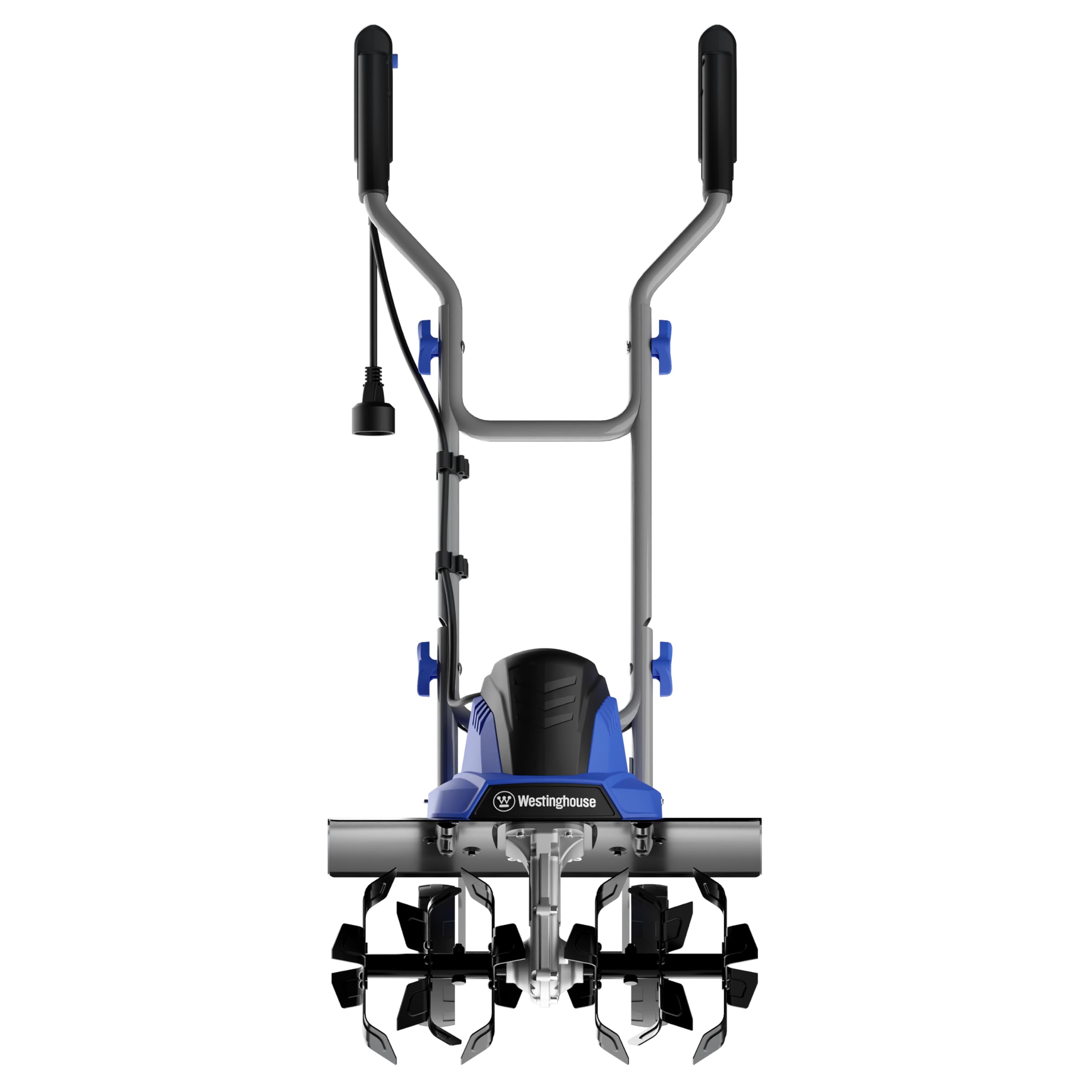
2. Westinghouse 18-Inch, 15 Amp Corded Electric Tiller Cultivator
The widest cutting width with the highest amp draw in this lineup for serious soil prep.
You get a 15A motor that spins up to 400 RPM—more than enough torque to shred grassy areas and dig into compacted clay. The 18-inch working width means you cover more ground per pass than the 14-inch or 12-inch models below it, which is a real time-saver for medium to large gardens. Buyers report it “really digs in deep and shreds grassy areas with ease,” though one owner noted the gap between the blades leaves a strip of untilled soil in the middle on the first pass, so you’ll overlap slightly.
At 23.9 pounds, this tiller is lighter than most gas models, and the foldable handle makes storage simple. The 6 steel blades are integrated directly into the design, and the 9-inch tilling depth gives roots plenty of room. You need a heavy-duty extension cord here, but the performance justifies the extra cable management.
Real power advantage
- 15A motor at 400 RPM handles hard clay and overgrown beds without stalling.
- 18-inch tilling width is the widest in this guide, cutting down total passes.
- Foldable handle and 23.9 lb weight make transport and storage easy.
Trade-offs you need to know
- Blade gap leaves a narrow un-tilled strip; you need to overlap passes.
- Motor gets hot during extended use—don’t touch it immediately after.
- Requires a heavy-duty extension cord; standard cords may overheat.
Reach for this if: You have a large garden or tough clay soil and want a corded machine that finishes faster than narrower models.
Look elsewhere if: Your garden beds are narrow or you need to till between rows of existing plants—the 18-inch width is too wide to fit.
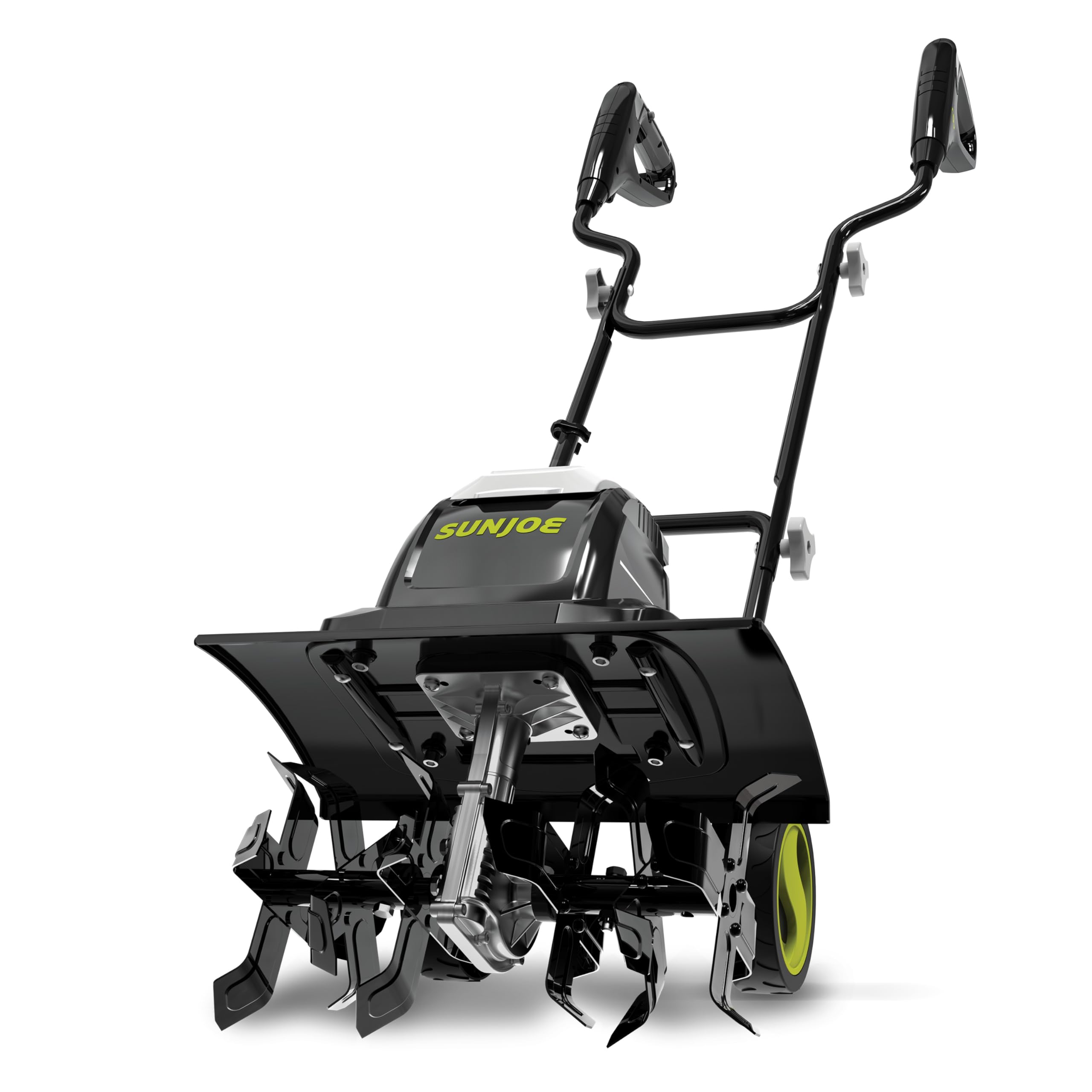
3. Sun Joe TJ605E Corded Electric Garden Tiller & Cultivator
A 15-amp motor with 6 steel tines that delivers 400 RPM for breaking compact soil.
Sun Joe steps up from the 8-amp TJ602E with a 15-amp motor that turns 6 rust-proof, angled steel tines. The result is a tiller that owners mention “easily destroys roots” and handles compacted soil without bogging down. The 15.7-inch cutting width covers a wide path, and the 4-position wheels let you adjust depth control depending on the terrain.
One reviewer noted the tines can clog with weeds in overgrown areas, requiring occasional stops to clear them. But the same owner said it still beats doing the chore with a hoe. The foldable handle saves garage space, and at 7.7 inches of depth, you get enough soil penetration for most garden beds. Unlike the Westinghouse, the Sun Joe lacks variable speed control—so what you see at the trigger is what you get.
Why it stands out
- 15A motor with 400 RPM matches the Westinghouse’s power for similar soil conditions.
- 6 steel tines distribute the cutting load across a wider area than 4-tine models.
- 4-position wheels improve depth control and maneuverability across different yard layouts.
What holds it back
- No variable speed control; you run at a single speed.
- Weedy or very thick growth can clog the tines during operation.
- At 7.7 inches, the depth is slightly shallower than the 9-inch Westinghouse.
Great match for: Gardeners who want big-amp power from a trusted brand and value easy storage over maximum depth.
Try a different model if: You need to till deeper than 8 inches for heavy soil amendment or large root vegetables.
4. MAXLANDER 14-Inch 12-Amp Corded Electric Garden Tiller Cultivator

A 12-amp motor and 4 steel tines that spin at 360 RPM for clay and rocky soil.
Customers note the “12 amp motor handles clay soil with rocks/roots; tines are strong,” which is exactly what you want from a corded tiller in tough ground. The 14-inch width is a useful middle ground: wider than the 12-inch models below but still narrow enough for most garden beds. The folding handle and wheels make moving and storing it far easier than rigid-handle alternatives like the older Sun Joe TJ602E.
The double safety button system requires you to press both buttons before the motor engages—a real safeguard if you store the tiller where kids or pets might wander. The 8-inch depth is on par with the rest of the corded class, and the 360 RPM speed is enough to break up compacted soil. One reviewer warned that the safety shield sends debris airborne, so eye protection is a must.
Built for hard ground
- 12A motor offers 41% more amp draw than the IncwBo 8.5-amp model, meaning more torque.
- 14-inch width is 17% wider than the 12-inch IncwBo tillers, reducing passes by nearly a fifth.
- Foldable handle and wheels make it simple to transport and store compared to fixed-handle tillers.
Watch out for
- The tiller bounces when hitting roots; release the trigger when approaching a hidden obstruction.
- Debris shield does not stop all flying material—eye protection is required.
- Cord management is tricky; use a bright cord and disconnect when clearing tangled roots.
Ideal for: Anyone breaking new garden beds in clay or rocky soil who wants a strong, foldable corded tiller at a mid-range price point.
Not the best fit if: You need a battery-powered option or prefer a lighter machine for small raised beds only.
5. WEN TC1014 10-Amp 14-Inch Corded Electric Tiller and Cultivator

A 10-amp motor that tills 14 inches wide and 8.7 inches deep for established gardens.
The WEN TC1014 is the pick for gardeners who have already broken ground and now need to maintain it. One buyer mentioned they “did my whole garden in a few hours” — proof of the 14-inch width and the 16 blades across 4 reinforced steel tines. The 8.7-inch tilling depth is 9% deeper than the IncwBo 12-inch model, which is noticeable when you are incorporating compost or clearing old root systems.
At 9.41 kilograms, it is 15% lighter than the IncwBo 10.84-kilogram model, making it easier to lift and maneuver for longer sessions. The overload protection stops the motor if you hit rocks or concrete, and the adjustable 5-5/8-inch wheels help with transport. The main drawback is tine wear: one buyer in rocky ground reported bent tines they had to straighten, and another wished replacement tines were available.
Why it wins for maintenance
- 14-inch width and 8.7-inch depth give you the broadest, deepest cut among the 10-amp and 8.5-amp models.
- At 9.41 kg (20.75 lbs), it is lighter than many tillers with smaller cutting widths.
- Overload protection automatically cuts power when you hit a hard obstruction.
Limitations to know
- Tines can bend in very rocky soil; availability of replacement tines is limited.
- The 10-amp motor has less torque than a 12-amp or 15-amp model for breaking new clay ground.
- Not ideal as a primary tiller for first-time garden prep in heavy soil.
Best suited for: Gardeners with established beds who need a light, easy-to-use tiller for seasonal maintenance and weed control between rows.
Consider stepping up if: Your garden has never been tilled before, especially if the soil is heavy clay or full of rocks.
6. Sun Joe TJ602E 8-Amp 12-Inch Corded Electric Garden Tiller and Cultivator
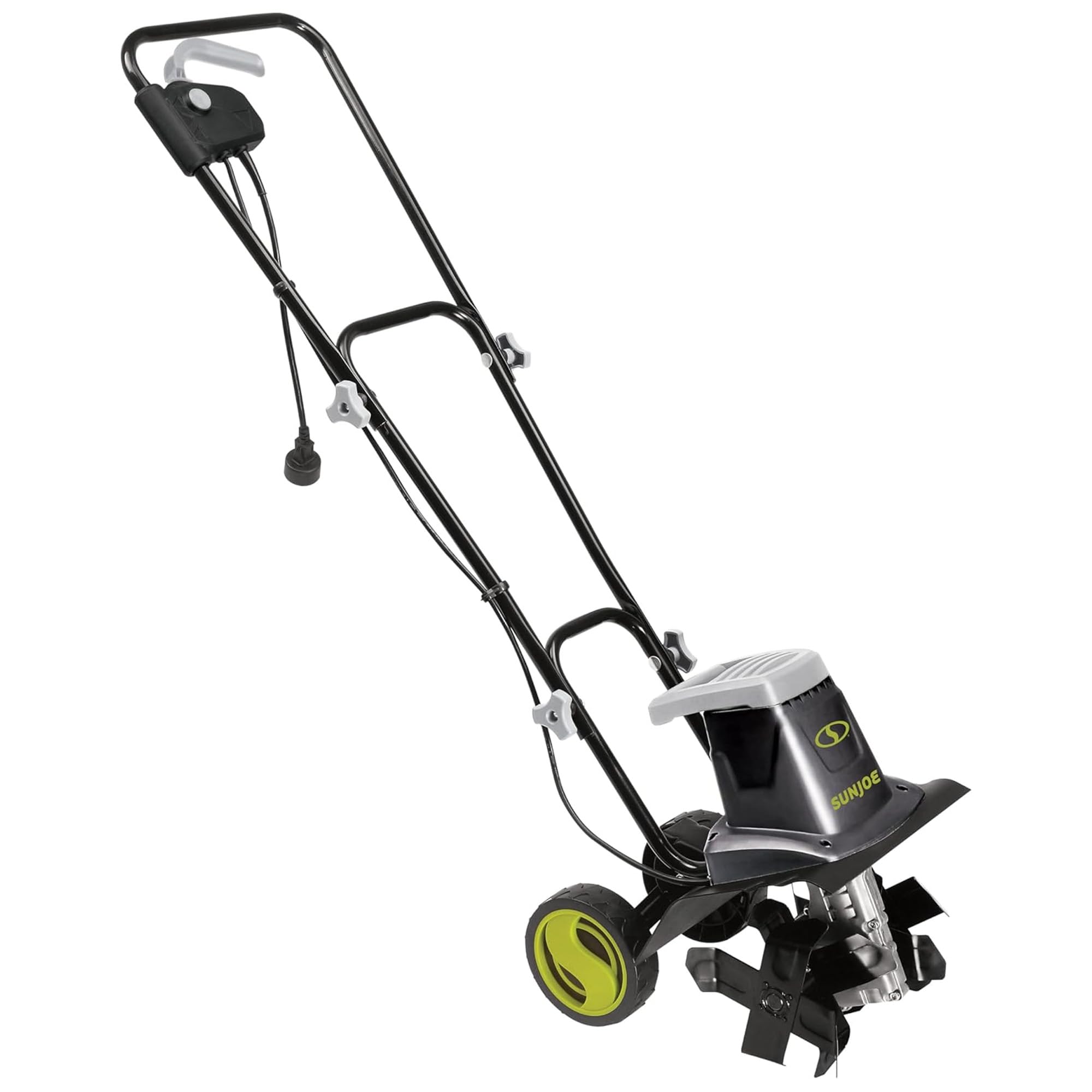
An 8-amp motor with 3-position adjustable wheels for controlling depth across different terrains.
The Sun Joe TJ602E is among the most-reviewed tillers in this guide, with 862 ratings and a 4.5-star average. That high count reflects a proven design: the 8-amp motor runs at 300 RPM and tills 12 inches wide and 8 inches deep. Buyers regularly mention it works great on heavy clay soil, though it does bounce when hitting roots—taking shallow passes and letting the soil dry out helps.
The 3-position height-adjustable rear wheels give you more control than fixed-wheel or no-wheel models. One owner reported the handle is not designed to conveniently fold, so storage requires a bit more space than the MAXLANDER or Westinghouse. The collapsible handle is actually removable, not foldable, which is a distinction that matters if you were expecting a quick-stow system.
Proven design features
- 3-position rear wheels let you adjust the tilling depth and control on uneven ground.
- 4 heavy-duty angled steel tines are durable enough for tough dirt and roots.
- 8-inch tilling depth matches larger-amp corded models for soil penetration.
Real-world downsides
- Handle assembly does not fold—it partially disassembles for storage, which is less convenient.
- 8-amp motor (300 RPM) has less torque than the 10-amp, 12-amp, or 15-amp options for hard clay.
- The extension cord connector cup may not fit all cords; some buyers had to modify their cord.
Perfect for: Flower beds and small vegetable plots where you need adjustable depth control and don’t want to spend on a larger motor.
Choose something else if: You need a foldable handle for compact storage or have large amounts of heavy soil to break up.
7. IncwBo 8.5-Amp 12-Inch Corded Tiller Cultivator 8-inch Depth

An 8.5-amp corded tiller that punches above its draw by cutting through roots and rock.
Reviewers are emphatic: one customer observed it “cut through 1 inch tree roots” and “managed to till an old rock bed with no issues.” That is unexpected from an 8.5-amp motor, but the 360 RPM speed helps compensate for the lower current. The 12-inch cutting width and 8-inch depth are standard for this class, and the built-in safety mechanism stops the motor automatically when it hits large roots or hard objects.
The tiller weighs 16.1 pounds, making it one of the lighter corded options in the lineup. Buyers mention the handles can become unstable and need retightening after a few uses—a common issue across entry-level tillers. The yellow color makes it easy to spot if you set it down in the garden, and the simple plug-and-start operation means no battery charging or gas mixing.
Why it surprises
- At 8.5 amps, it still cuts through inch-thick tree roots and river rock, per multiple reviews.
- 16.1 lbs is very manageable for a corded tiller; easy enough for a petite person to handle.
- Automatic stop mechanism protects the motor when hitting buried obstacles.
Honest trade-offs
- Handles loosen during use; you may need stronger bolts for long-term reliability.
- 8.5 amps is a 41% draw disadvantage vs. the 12-amp MAXLANDER, noticeable in heavy clay.
- No wheels or foldable handle—transport and storage are less convenient.
Go for it if: You want a very affordable corded tiller for small to medium beds and aren’t afraid to retighten the handles occasionally.
Look elsewhere if: You need a more sturdy machine for breaking large areas of virgin clay or require a folding handle for storage.
8. TaskStar TH4000 Cordless Tiller Cultivator (9-Inch Width, 48 Steel Tines)
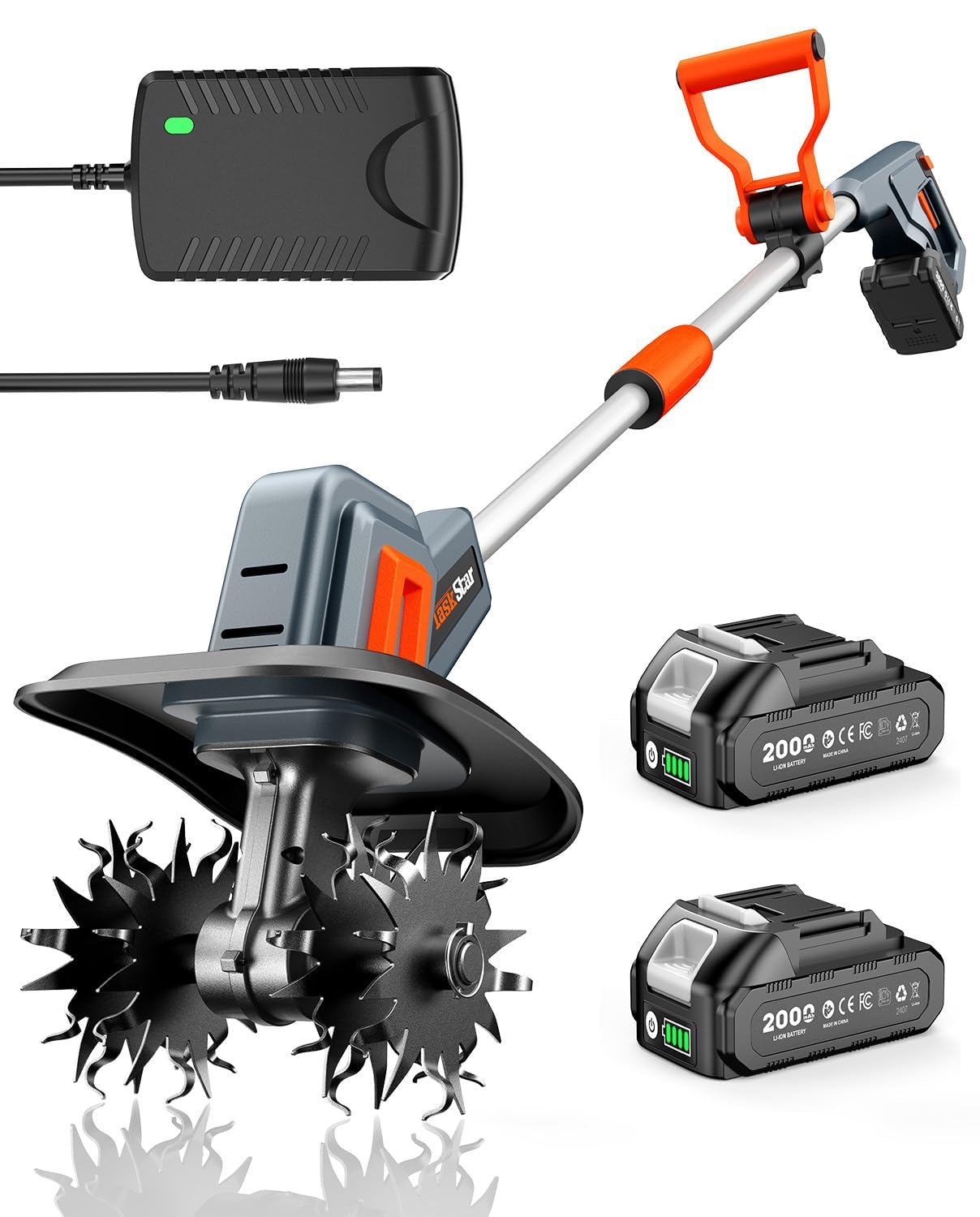
A battery tiller with 48 tines and 360 RPM that turns soil to powder in previously tilled ground.
The TaskStar TH4000 runs on two 2.0Ah lithium-ion batteries totaling 4000mAh, giving you cordless freedom for garden beds far from an outlet. The 48 heavy-duty steel tines are a huge jump from the 4 or 6 tines on corded models, which smooths out the tilling action and reduces vibration. One buyer who disliked battery power initially admitted it “tilled a 30’x40′ garden in an hour” and left the dirt “like powder.”
The 9-inch tilling width and 7-inch depth are smaller than corded alternatives, but this is intentional: the TaskStar is built for raised beds, flower borders, and small vegetable plots where a cord is a nuisance. The 3-year manufacturer warranty is longer than most in this guide, which adds confidence in the build quality. The main limitation is the battery runtime—you get 2 batteries, but for large gardens you may need a third or a quick recharge break.
Cordless freedom features
- 48 steel tines distribute the load for a smoother, more controlled tilling experience.
- Two 2.0Ah batteries (4000mAh total) provide enough runtime for small to medium tasks.
- 3-year manufacturer warranty is the longest coverage in this comparison.
Know the limits
- 9-inch width and 7-inch depth are significantly smaller than the 14-inch/8.7-inch WEN.
- Battery runtime is capped; large gardens may need additional batteries beyond the two included.
- Less effective on very hard, unbroken clay than higher-amp corded models.
Choose this for: The cordless freedom in raised beds, flower gardens, and small plots where you want to avoid extension cords entirely.
Stick with corded if: Your garden is larger than 200 square feet or you are breaking heavy clay for the first time.
9. Earthwise TC70020IT 20-Volt 7.5-Inch Cordless Electric Garden Tiller Cultivator

The lightest and narrowest tiller here, designed for small gardens, seniors, and flower beds.
The Earthwise TC70020IT weighs very little—it’s powered by a 20-volt 2.0Ah battery and tills only 7.5 inches wide and 6 inches deep. That is a fraction of the size of the 18-inch Westinghouse, but that is by design: this tiller is for the gardener who wants to turn over a small flower bed, mix in soil additives, or pull weeds along garden edges without handling a heavy machine. Buyers describe it as “ideal for seniors with limited strength” and “perfect for small areas.”
The 4 durable steel tines handle the job, but the battery life is the main complaint—you get about 20-30 minutes of runtime per charge, which is fine for a small garden but not for larger projects. The 2-year manufacturer warranty is decent for the price point. If your garden is bigger than a couple of raised beds, the TaskStar above gives you more width and depth for a similar budget.
Ultra-compact advantages
- Extremely lightweight and easy to operate, especially for seniors or those with limited strength.
- Cordless design eliminates cord management in small, tight flower beds.
- Quick blade stop safety button adds an extra layer of protection for casual use.
Realistic limitations
- Only 7.5 inches wide and 6 inches deep—far smaller than any corded model in this guide.
- Battery runtime is short; you may not finish a medium garden on a single charge.
- Not suitable for breaking new ground or hard-packed clay soil.
Best for: The smallest gardens, flower beds, and the gardener (especially seniors) who needs a truly light tool they can handle comfortably without help.
Grab a larger model if: You have more than a couple of raised beds, clay soil, or any plan to expand your garden in the future.
Understanding the Specs
Tilling Width and Depth
Tilling width is the area the tines cover in a single pass. A wider width (14 inches or more) means you finish a garden bed in fewer passes, which saves time and energy. Depth matters because plant roots need loosened soil below the surface to grow strong. For most vegetables and flowers, 8 inches of tilling depth is the minimum; 6 inches works for light soil turning but not for incorporating compost deeply.
Amp Draw and RPM
A higher amp draw (like 15 amps) means the motor can pull more current to generate torque, which is the twisting force that powers the tines through hard soil. Higher RPM means the tines spin faster, which helps break up soil but can also cause the tiller to bounce on very hard ground. the balance for most garden work is 10-12 amps with 360 RPM—enough torque and speed combined.
Overload Protection
This is a mechanical or electrical mechanism that stops the motor when the tines hit an immovable object like a rock, root, or concrete. Without it, you risk burning out the motor or damaging the gearbox. If you garden in rocky soil or near buried tree roots, look for this feature—it saves you from expensive repairs and limits frustration when you hit a hidden obstacle.
Battery vs. Corded Power
Corded tillers draw continuous power from your home’s electrical system, which means no runtime limits and consistent torque as long as you have an extension cord. Battery tillers give you freedom of movement but run on a finite charge—typically 20-40 minutes per battery. If your garden is far from an outlet, battery is convenient. If you tilling a large area, corded power is more reliable.
Tine Count and Material
More tines (like 48 on the TaskStar) distribute the cutting load and produce a finer, more aerated soil consistency. Fewer, thicker tines (like 4 on most corded tillers) penetrate harder ground more aggressively. Steel is the standard material, and rust-resistant coatings extend the tines’ lifespan in damp soil. Curved, angled tines lift and turn soil better than straight ones.
Weight and Maneuverability
Heavier tillers (around 24 pounds or more) have more downward force to dig into hard soil, but they are harder to lift, turn, and transport. Lighter tillers (around 12-16 pounds) are easier to maneuver in tight spaces but may bounce on compacted ground, requiring multiple passes. If you have a small garden or limited physical strength, weight matters more than raw power. If you have tough clay, heavier is better.
FAQ
Can an electric tiller handle hard clay soil?
How deep should an electric tiller dig for a vegetable garden?
Is a cordless tiller as powerful as a corded one?
What does overload protection mean on a tiller?
How long should an electric tiller last with normal use?
Can I use a regular extension cord with a corded electric tiller?
Do electric tillers require maintenance like gas tillers?
What is the difference between a tiller and a cultivator?
Will a battery tiller work for a 30×40 foot garden?
How do I keep grass and roots from wrapping around the tines?
Final Thoughts: The Verdict
Across the board, the electric tiller winner is the Westinghouse W18TCAC because its 15-amp motor, 18-inch tilling width, and 9-inch depth give you the fastest, most powerful tilling for large gardens and tough soil. If you want a more compact corded model with foldable storage and strong torque for clay, grab the MAXLANDER 14-Inch 12-Amp. And for cordless freedom in smaller raised beds and flower gardens, the standout is the TaskStar TH4000 with its 48 tines and two included batteries.
How We Picked
We do not accept paid placement. Every pick is matched to a real buyer and a real use-case; we do not hands-on test units.
Sources & Methodology
Specifications: manufacturer listings and product documentation. Review insights: verified customer reviews, as of July 2026. Pricing: not shown on this page (it changes often); check the current price via the retailer link.
As an Amazon Associate, Lawn Gear Lab earns from qualifying purchases. This does not affect which products we feature.