
The single most common failure point in a drip irrigation system is a clogged or inconsistent emitter. When one plant gets drenched and the next one stays bone dry, the entire watering strategy falls apart. For any gardener running a drip setup, the choice between pressure-compensating, adjustable, or fixed-orifice emitters determines whether your beds thrive or just survive.
I’m Rikta — the co-founder and writer behind Lawn Gear Lab. I’ve spent hundreds of hours cross-referencing flow-rate data, pressure ratings, and owner reports to find the drip emitters that actually deliver on their specs without failing mid-season.
Whether you need precise root-zone watering for raised beds or broad coverage for shrubs, this guide narrows down the best drip emitters for every real-world garden layout and budget level.
How To Choose The Best Drip Emitters
Selecting drip emitters is not a one-size-fits-all decision. The correct choice depends on your water pressure, tubing size, terrain, and the specific watering needs of each plant. Ignoring these factors leads to uneven irrigation, wasted water, and stunted growth.
Pressure Compensating vs. Non-Compensating
Pressure-compensating (PC) emitters deliver a consistent flow rate regardless of variations in water pressure or elevation. If your garden has long tubing runs, slopes, or changes in elevation, PC emitters are non-negotiable. Non-compensating emitters work fine on flat, short runs where pressure is uniform, but they will over-water at the start and under-water at the end of any line longer than 50 feet.
Flow Rate (GPH) and Soil Type
Emitter flow rates are typically 0.5, 0.8, 1, or 2 GPH. Sandy soil drains fast and needs higher flow rates (1–2 GPH) to wet the root zone before water runs past. Clay soil absorbs slowly and needs low flow rates (0.5 GPH) to avoid runoff. Loam sits in the middle—0.8 to 1 GPH typically works best. Matching your emitter GPH to your soil type prevents over-saturation and underwatering.
Connection Method: Barbed, Push-to-Connect, or Pre-Installed
Barbed fittings are the traditional standard—reliable but require manual effort and sometimes hot water to soften the tubing. Push-to-connect emitters have become popular because they snap onto 1/4-inch tubing in seconds with no tools, and they are just as leak-free when properly seated. Pre-installed dripline, like Rain Bird’s 6-inch spacing, eliminates the need to punch individual holes—ideal for dense vegetable beds but less flexible for custom layouts.
Quick Comparison
On smaller screens, swipe sideways to see the full table.
| Model | Category | Best For | Key Spec | Amazon |
|---|---|---|---|---|
| Rain Bird ET256-50S | Pre-Installed Dripline | Even watering in raised beds | 0.8 GPH at 6″ spacing | Amazon |
| MIXC 60pc Push-to-Connect | Adjustable Stake | Large gardens needing quick setup | Up to 25 GHP per emitter | Amazon |
| MIXC 20pc Quick Connector | Push-to-Connect | Easy connection without barb struggle | Adjustable 360° spray | Amazon |
| DIG 100′ MICROLINE | Pre-Installed Dripline | Long continuous runs in flower beds | 0.65 GPH at 9″ spacing | Amazon |
| Spalolen 0.5 GPH PC 60-pack | Pressure Compensating | Slopes and uneven terrain | 0.5 GHP constant flow at 10–60 PSI | Amazon |
| HUISUYTON 30-pc Double Lock | Adjustable Stake | Daisy-chaining in raised beds | Up to 18 GPH, 40 PSI max | Amazon |
| Yulaiyoen 50-pack Adjustable | Adjustable Stake | Budget bulk for large flowerbeds | 220 L/H max flow, 5 Bar max | Amazon |
In‑Depth Reviews
1. Rain Bird ET256-50S Drip Irrigation Pressure Compensating 1/4″ Emitter Tubing

The Rain Bird ET256-50S is pre-installed dripline with pressure-compensating emitters built every 6 inches, each flowing 0.8 GPH. This design eliminates the need to punch individual holes and ensures that every emitter along the 50-foot roll delivers the same volume, even at the far end of the run. The brown tubing blends into garden beds and the dual-outlet design reduces clogging risk.
At 8.5 to 60 PSI operating range, this line handles most residential systems without a regulator, though many owners pair it with a filter and pressure reducer for optimal longevity. The 0.25-inch outside diameter fits standard 1/4-inch barb fittings, and the Micro-Porous construction grips the fitting for a leak-free seal. Users report excellent uniformity in square-foot garden grids and raised beds where straight rows are the norm.
The trade-off is flexibility—once installed, the emitter spacing is fixed at 6 inches, so it’s less suited for containers or widely spaced shrubs. The tubing is noticeably stiffer than standard 1/4-inch line, especially in cold weather, but warming it in the sun softens it enough for routing. For dense vegetable beds where consistent root-zone moisture is the goal, this dripline outperforms individual emitters in both convenience and reliability.
What works
- Pressure-compensating design delivers uniform flow across the entire run
- Pre-installed 6-inch spacing saves installation time in dense beds
- Dual-outlet emitters reduce the chance of clogging
What doesn’t
- Fixed 6-inch spacing limits layout flexibility for large plants
- Stiffer tubing requires warmth to handle easily in cold weather
2. MIXC 60pcs Quick-Connect Drip Irrigation Emitters
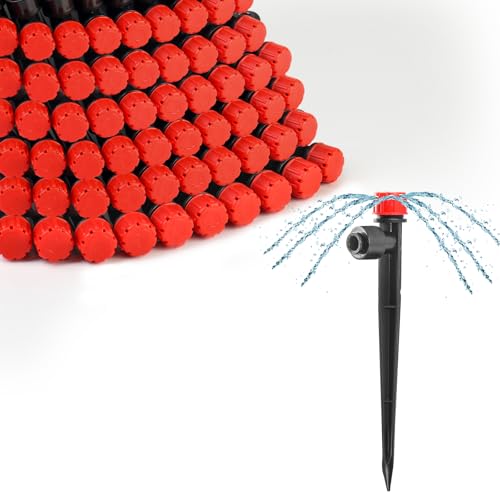
The MIXC 60-pack uses a push-to-connect mechanism that locks onto 1/4-inch tubing without heating, tools, or barbed fittings. Each emitter sits on a 6-inch stake and offers a full 360-degree rotating head that can be adjusted from a gentle trickle up to a 10-foot spray diameter. The max flow rate of 25 GPH makes these overkill for container tomatoes but ideal for covering large ground-cover areas or shrub borders.
Owner feedback highlights the ease of use for gardeners with arthritis or limited hand strength—the push-fit design eliminates the thumb strain of forcing tubing onto barbs. The heads are fully detachable for cleaning, which addresses the most common cause of drip system failures. Compatibility extends to vinyl, PVC, and polyethylene tubing with an OD of 0.27 inches or less.
Some users note that the spray pattern can be inconsistent across units, and the plastic feels less robust than premium brands like DIG or Rain Bird. The adjustable cap can also be sensitive—small twists produce big flow changes, making fine-tuning a bit finicky. Still, for a fast, tool-free installation at scale, this kit saves hours of labor compared to traditional barbed setups.
What works
- Push-to-connect eliminates barb struggle and heating
- 360-degree adjustable head with up to 10-foot coverage
- Detachable design simplifies cleaning and maintenance
What doesn’t
- Spray pattern can vary between individual units
- Flow adjustment is sensitive and not finely tunable
3. MIXC Quick Connector Drip Emitters for 1/4″ Tubing, 20 Packs
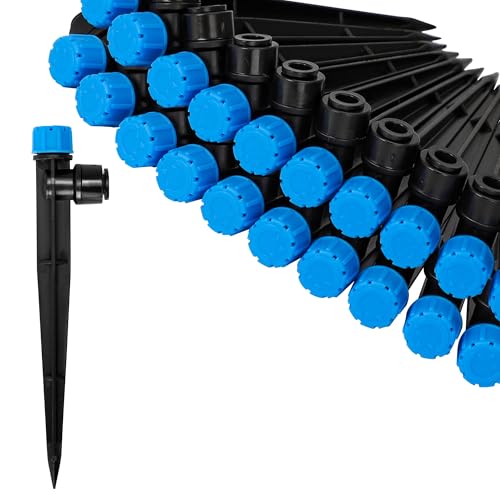
This 20-pack from MIXC shares the same push-to-connect technology as the larger kit but focuses on a single flow pattern called “Drip Emitter Stream.” The design creates a targeted stream rather than a wide fan, making it better suited for deep watering of individual plants without overspray onto foliage. It connects directly to standard 1/4-inch tubing without any additional fittings.
The compression-style connection uses a nut that tightens down over the barb, creating a seal that owners describe as leak-free even at higher line pressures. The adjustable head rotates 360 degrees and allows flow to be dialed down for seedlings or opened up for mature perennials. Reviewers consistently praise the ease of swapping out emitters when rearranging garden layouts—just push to remove and snap in a new unit.
One downside is the sensitivity of the flow adjustment—some users report it’s difficult to set a precise drip rate without overshooting. The 20-pack size is ideal for smaller gardens or targeted expansions but may not be cost-effective for full-bed coverage compared to bulk packs. For gardeners upgrading from barbed systems, the reduced installation time and elimination of leak points make this a worthwhile swap.
What works
- Compression nut creates a leak-free, secure seal
- 360-degree rotation with targeted stream for deep watering
- Tool-free push-to-connect for quick layout changes
What doesn’t
- Flow adjustment is too sensitive for precise drip rates
- 20-pack quantity is small for large-scale installations
4. DIG ¼” 100’ MICROLINE Dripline – Enhanced 6” Emitter Spacing

The DIG MICROLINE dripline comes in a 100-foot roll with pre-installed pressure-compensating emitters spaced 9 inches apart, each delivering 0.65 GPH at 25 PSI. The dual-outlet emitter design reduces clogging potential, and the UV-resistant polyethylene is safe for edible crops. The maximum recommended run length from the supply line is 22 feet for optimal uniformity, which is generous for most residential garden layouts.
Owners report that this line is noticeably more flexible than Rain Bird’s dripline, making it easier to snake around trees and through winding flower beds without kinking. The 0.25-inch outside diameter accepts all standard barb fittings, and the line is compatible with both manual and timer-controlled systems. Users also highlight that the twin-outlet emitters help maintain consistent flow even when sediment is present in the water supply.
The primary limitation is the operating pressure range of 15 to 25 PSI—running this line above 25 PSI risks blowing out emitters unless you install a pressure regulator. Also, the 9-inch spacing (compared to 6-inch on the Rain Bird) means seedlings or densely planted crops may not get uniform coverage without additional line routing. For gardeners with irregular bed shapes who value flexibility over fixed-grid precision, the DIG MICROLINE is the superior choice.
What works
- More flexible tubing handles curves and tight bends without kinking
- Dual-outlet emitters resist clogging in moderate sediment conditions
- 100-foot length provides extensive coverage for large gardens
What doesn’t
- Narrow operating pressure range requires a regulator
- 9-inch emitter spacing may leave gaps in dense seedling plantings
5. Spalolen 60PCS 0.5 GPH Pressure Compensating Drip Emitters
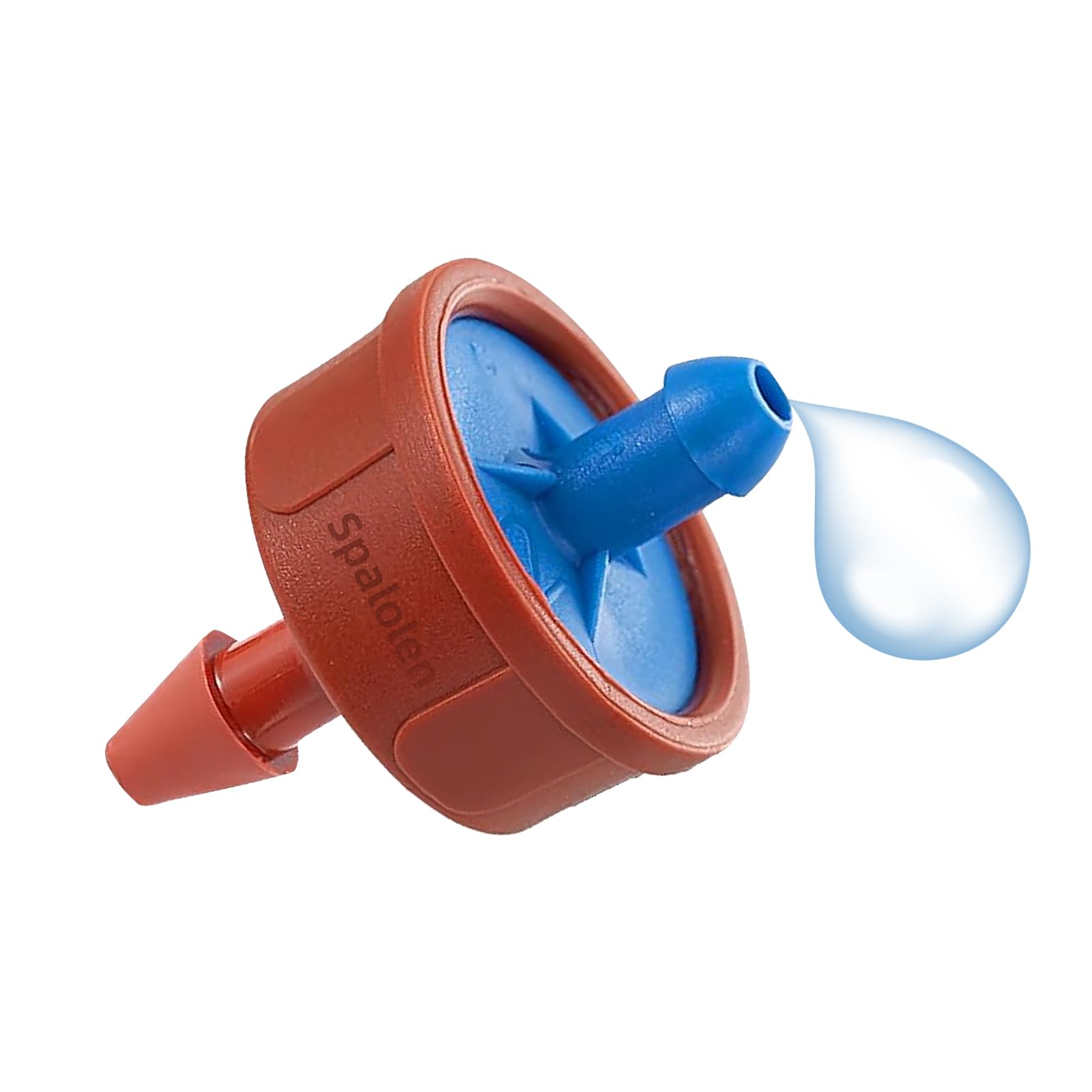
The Spalolen 60-pack of pressure-compensating spot-watering drippers maintains a constant 0.5 GPH flow across a working pressure range of 10 to 60 PSI. This is the narrowest, most precise flow rate in this lineup, making these emitters the best choice for slow-watering applications like clay soil beds, container gardens, and newly transplanted seedlings that need steady moisture without saturation.
The self-cleaning internal diaphragm flushes out small particles each time the system cycles, which significantly reduces clogging compared to non-compensating orifices. Installation is straightforward—the barb end connects directly to 1/4-inch tubing, and the outlet accepts 1/8-inch micro extension tubes for directed watering. Owners using these on sloped properties report that the flow consistency from the first to last emitter is remarkable, with no noticeable pressure drop even on long runs.
The limitation is the lack of adjustability—what you get is 0.5 GPH, period. If you need higher flow for larger plants, you’ll need to buy the 1 GPH or 2 GPH versions separately. Additionally, the barb fittings can be tight; some users recommend soaking the tubing ends in warm water to ease insertion. For precision watering where flow rate consistency matters more than adjustability, these PC emitters are the most reliable option at this price tier.
What works
- Self-cleaning diaphragm maintains consistent flow despite debris
- Uniform 0.5 GPH output across slopes and long runs up to 60 PSI
- Accepts micro extension tubes for directed root-zone delivery
What doesn’t
- Fixed 0.5 GPH rate limits application to low-flow scenarios
- Tight barb fit may require tubing warm-up for installation
6. HUISUYTON 30 Pcs Drip Irrigation Sprayer Emitters on Double Lock Stake

The HUISUYTON 30-pack features a double-lock barbed design that allows daisy-chaining emitters directly in line without separate T-fittings. Each emitter sits on a 6.5-inch stake and has an adjustable top cap that controls flow from zero up to a maximum of 18 GPH. The operating pressure max is 40 PSI, and the manufacturer recommends connecting no more than 10 emitters per line to maintain adequate pressure.
Gardeners using these in raised beds report that the daisy-chain setup simplifies layouts significantly—tubing runs continuously through each emitter, reducing the number of connection points and potential leaks. The double-lock nut adds extra securing force, and owners note that the emitters stay firmly in place even when the tubing gets tugged during bed maintenance. The spray pattern is adjustable from a gentle bubble to a fan, though some users note the maximum spray radius is under 2 inches, making this more of a spot-watering bubbler than a wide-area sprinkler.
The main complaint is that the spray heads underperform compared to the listed specs—many owners find the effective coverage radius is much smaller than expected, especially at lower line pressures. Additionally, the plastic construction feels lighter than premium alternatives, so careful handling during installation is advised. For budget-minded gardeners running small to medium raised beds who want a simple daisy-chain setup, these deliver good value with minimal fuss.
What works
- Double-lock design allows direct daisy-chaining without extra fittings
- Adjustable cap provides good flow control from off to full flow
- 6.5-inch stake holds firmly in raised bed soil
What doesn’t
- Effective spray radius is notably smaller than advertised
- Plastic feels less durable than more premium emitter stakes
7. Yulaiyoen 50 Pack Drip Irrigation Emitters Adjustable with Stake

The Yulaiyoen 50-pack offers adjustable drip emitters on ground stakes for gardeners who need a large quantity at a low entry point. Each emitter connects to standard 1/4-inch tubing (4mm ID, 7mm OD) and features a vortex-style cap that produces a fine, fan-shaped spray rather than a single stream. The flow rate is adjustable up to 220 L/H (approximately 58 GPH) and the spray radius reaches up to 1.5 meters at 5 Bar maximum pressure.
Owner feedback is split between gardeners who find these perfectly adequate for their flowerbeds and ground cover and those who note that the build quality is noticeably lower than Rain Bird or DIG components. Several users report that the barb connections can be loose if the tubing is slightly undersized, leading to drips at the connection point. The included 18cm stake has a sharp tip that penetrates even compacted soil easily, but the overall plastic feels thinner than mid-range competitors.
Despite these compromises, the 50-count pack offers the lowest per-unit cost of any adjustable emitter in this lineup, making it a practical choice for gardeners covering large areas on a tight budget. The adjustable cap allows for full shutoff, which is useful for turning off water to specific plants without leaving the bed. If you need to equip a large greenhouse or extensive flowerborder with basic drip coverage, this pack provides the volume without the premium price tag.
What works
- Low per-unit cost makes it ideal for large-scale installations
- Adjustable cap allows full shutoff for individual plant targeting
- Sharp stake penetrates tough soil without excessive force
What doesn’t
- Barb connections can be loose with undersized tubing
- Plastic construction feels less durable than premium brands
Hardware & Specs Guide
Flow Rate (GPH/L/H)
Flow rate is the volume of water each emitter delivers per hour. In the US, it’s measured in gallons per hour (GPH); in metric systems, liters per hour (L/H). The most common drip rates are 0.5, 0.8, 1, and 2 GPH. Low-flow emitters (0.5 GPH) are ideal for clay soils and small containers, while higher rates (1–2 GPH) suit sandy soils and large shrubs. Always match emitter flow to your soil’s infiltration rate to avoid runoff or parched zones.
Pressure Compensation
Pressure-compensating (PC) emitters use a diaphragm that flexes to maintain a constant flow rate regardless of inlet pressure changes. This is critical on sloped sites, long tubing runs, or systems with elevation changes. Non-PC emitters will output more water at higher pressure and less at lower pressure, leading to uneven irrigation. PC emitters cost more but eliminate the guesswork in system design.
FAQ
What PSI should my drip system run for pressure-compensating emitters?
Can I mix 0.5 GPH and 1 GPH emitters on the same tubing line?
How do I prevent drip emitters from clogging with hard water or sediment?
Final Thoughts: The Verdict
For most gardeners, the best drip emitters winner is the Rain Bird ET256-50S because its pre-installed pressure-compensating dripline delivers uniform 0.8 GPH coverage with zero guesswork in raised beds and vegetable gardens. If you want tool-free installation with adjustable coverage, grab the MIXC 60pc Push-to-Connect. And for precise low-flow watering on slopes or clay soil, nothing beats the Spalolen 0.5 GPH PC Emitters for consistency and clog resistance.