
You can spend years wrestling with heavy, compacted potting mixes that hold too much water or dry to a hard crust. Coir growing medium solves both problems at once — it aerates the root zone while holding moisture like a sponge, but without the sogginess that rots roots. The trick is picking the right brick or bag, because not all coir is washed free of the salts that can stunt your plants.
I’m Rikta — the co-founder and writer behind Lawn Gear Lab. To build this guide, I analyzed dozens of coir products, cross-referenced their expansion ratios, EC levels, and pH claims against hundreds of verified owner reports to separate the truly consistent media from the dusty, salty duds.
The challenge is finding a consistently washed, low-EC coir that expands predictably every time. After comparing dimensions and grower feedback, the complete list of the best coir growing medium candidates is ranked here to save you the guesswork.
How To Choose The Best Coir Growing Medium
Not all compressed coir bricks are created equal. A few key specs separate the premium media that supports explosive root growth from the dusty bricks that leave your plants struggling. Here is what to check before you buy.
Salt Content & EC Ratings
Coir naturally contains sodium and potassium salts from the coconut husk. If the manufacturer does not wash the coir thoroughly, those salts raise the electrical conductivity of the medium, which can burn delicate roots and block nutrient uptake. Look for brands that explicitly state “low EC” (typically below 0.5 mS/cm) and “triple-washed” or “buffered” on the label. Unwashed coir requires you to rinse and buffer it yourself, adding time and extra water to your prep routine.
Expansion Ratio & Dry Volume
A standard 1.5-pound brick should yield about 9 to 10 quarts of hydrated coir, but cheap bricks often claim inflated volumes that never materialize. Check the expanded-quart specification on the package and cross-reference it with user reviews that mention actual yield. Premium bricks use a finer grind that holds more water and expands more consistently, while coarse bricks may leave large air pockets that reduce usable volume.
Pre-Buffered vs. Unbuffered
Buffering is the process of soaking coir in a calcium and magnesium solution to displace sodium ions from the cation exchange sites. Pre-buffered coir is ready to use straight out of the bag — just hydrate and plant. Unbuffered coir requires you to mix a calmag supplement into your feed water from day one, especially for calcium-loving crops like tomatoes, peppers, and cannabis. Serious hydroponic and indoor growers almost always prefer pre-buffered media for consistency.
Quick Comparison
On smaller screens, swipe sideways to see the full table.
| Model | Category | Best For | Key Spec | Amazon |
|---|---|---|---|---|
| Modellor 4 Bricks | Brick | Budget-conscious growers who want clean coir | Expands to 36 quarts total | Amazon |
| GROW!T 3-Pack | Brick | Seed starting and small-batch potting | Expands to approx. 30 quarts total | Amazon |
| Thunder Acres 3-Pack | Brick | Organic certification seekers | OMRI Listed for organic use | Amazon |
| MagJo Naturals 11 lb Block | Block | Large soil amendments and worm bins | Expands to 17 gallons (68 quarts) | Amazon |
| Vivlly 10 lb Brick | Brick | High-volume seed starting and hydroponics | Expands to 75 quarts (2.5 cu ft) | Amazon |
| Canna Coco Brick 40L | Brick | Serious hydroponic and cannabis cultivation | Expands to 40 liters (42+ quarts) | Amazon |
| FoxFarm Cultivation Nation 70:30 | Pre-mix | Ready-to-use container gardens | 2-cu-ft bag, pre-blended with perlite | Amazon |
In‑Depth Reviews
1. Modellor 4 Bricks (5 lb)
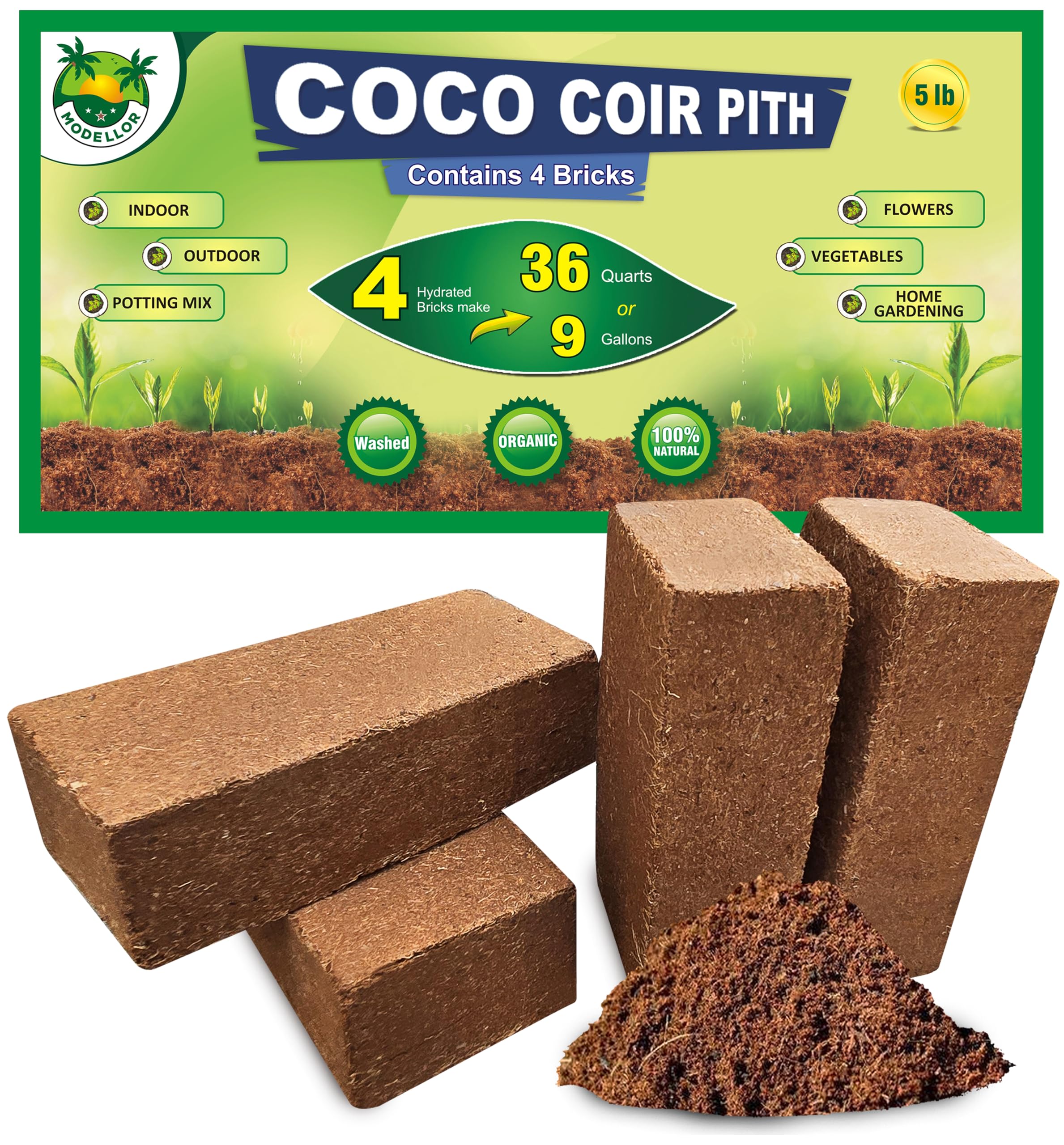
The Modellor 4-pack hits a sweet spot that most coir bricks miss: genuinely low salt content without a premium price tag. Each 1.25-pound brick expands to about 9 gallons of fluffy, consistent medium, and the triple-washing process keeps the EC low enough that seedlings and cuttings root without the leaf-tip burn you sometimes see with cheaper unbuffered bricks. Experienced growers in the reviews confirm the texture holds up brick after brick — no dust, no sticks, no funky smell.
What sets this pack apart is the total usable volume. Four bricks yielding a combined 36 quarts gives you enough medium to fill a dozen standard 3-gallon nursery pots or a full 2×2-foot raised bed. The pH arrives in the 5.5-to-6.5 sweet spot, so you can hydrate and plant immediately without needing to adjust the water chemistry first.
The only catch is that the bricks are quite hard when dry — you will want to soak them in warm water for 20 minutes and let them fully absorb before breaking them apart by hand. Rushing the hydration process leaves dry pockets that waste medium. For the price per quart of clean, usable coir, this four-pack is the most reliable entry point for any gardener moving away from peat.
What works
- Consistent low-EC across all four bricks
- Expands to full 9 gallons per brick as claimed
- No rinsing needed — just hydrate and plant
What doesn’t
- Bricks are very dense when dry and need patient soaking
- Not pre-buffered with calmag for calcium-sensitive crops
2. CANNA Coco Brick 40L

CANNA is the benchmark in the hydroponic world, and this 40-liter expanded brick explains why. The 8-liter dry brick expands into a fluffy, low-dust medium that has been pre-buffered with calcium and magnesium, meaning you can feed a complete nutrient schedule from day one without worrying about calcium lockout or pH swings. The fiber consistency is finer than most generic coir, which gives it a higher water-holding capacity while still draining fast enough for drip-fed systems.
The bag doubles as the hydration vessel — you pour warm water directly into the included bag and let the brick expand inside it. This reduces mess significantly compared to wrestling with a loose block in a bucket. Once expanded, the coir holds its structure through multiple grows if you rinse and re-buffer between cycles, making it one of the few options that genuinely pays for itself over time.
The tradeoff is the upfront price. Per quart of expanded medium, CANNA costs roughly double what a budget brick costs. It is a premium product designed for growers who cannot afford pH instability or salt buildup in a high-value crop. For hobbyists mixing coir into general potting soil, the extra cost rarely translates to better results.
What works
- Pre-buffered with calmag for immediate hydroponic use
- Includes a reusable bag for mess-free hydration
- Can be rinsed and reused for multiple grow cycles
What doesn’t
- Significantly more expensive than comparable brick options
- Not OMRI-listed for organic certification
3. MagJo Naturals 11 lb Block

MagJo Naturals takes a single-block approach with its 11-pound compressed slab. When fully hydrated, this one block expands to roughly 17 gallons (68 quarts) of growing medium — enough to fill a 4×4-foot raised bed to a depth of about 4 inches or amend dozens of container pots. The block is sourced from OMRI-registered manufacturers and includes a thorough washing step that keeps the EC low enough for organic gardeners who avoid synthetic salt flushes.
The texture lands between a medium and fine grind, producing a balanced coir that retains moisture without turning into a mud-like paste. Reviewers using it for reptile enclosures and worm bins praise the clean smell and the absence of the ammonia scent that sometimes accompanies improperly cured coir. The pH sits slightly acidic, around 5.8 to 6.2, which pairs well with most base nutrients and pH-down adjustments.
The main downside is the sheer density of the block. Trying to break it into smaller portions before soaking is nearly impossible — you essentially need to commit to hydrating the entire 11 pounds at once or have a very large container and strong arms. If you only need a few quarts at a time, a brick format with smaller individual units will treat you better.
What works
- Massive yield from a single block — best cost-per-quart ratio
- OMRI-listed and sourced from registered organic facilities
- Low EC and neutral pH require minimal prep
What doesn’t
- Almost impossible to break into smaller dry portions
- Smells like tea tree oil according to some users
4. Thunder Acres 3-Pack OMRI

Thunder Acres focuses on organic integrity first. Each of the three 1.5-pound bricks holds the OMRI certification for use in certified organic production, and the feedback from seed starters is consistently enthusiastic about the fine, fluffy texture that emerges after hydration. The coir breaks apart easily once soaked — no dense clay-like clumps that require aggressive hand-pulling — and the dust content is noticeably lower than many generic bulk bricks.
The growing medium works especially well as a base for custom soil blends. Succulent and cactus growers in the reviews report mixing it 50/50 with pumice or perlite and getting excellent drainage without the medium shrinking away from the pot sides as it dries. For seed starting, the light texture allows delicate radicles to push through without resistance, and the coir stays moist long enough that you are not watering twice a day.
The expansion is decent but not class-leading. Each brick yields roughly 9 quarts, putting the three-pack total around 27 quarts. That volume is good for several batches of seed trays or a few container pots, but the cost per quart is slightly higher than the Modellor or MagJo options. If OMRI certification is a non-negotiable requirement, this pack delivers consistent results without compromising your organic status.
What works
- OMRI-listed for certified organic operations
- Low dust compared to many alternative bricks
- Breaks apart easily when hydrated
What doesn’t
- Yield per brick is average at roughly 9 quarts
- Higher cost per quart than similarly sized packs
5. Vivlly 10 lb Brick

Vivlly claims the boldest expansion ratio in this lineup: a single 10-pound brick that promises 75 quarts (2.5 cubic feet) of hydrated medium. That is enough to fill seven to ten standard 1020 seed trays or a pair of 15-gallon fabric pots. The manufacturer ages the coir for 18 months before compression, which stabilizes the fiber and reduces the lignin content that can tie up nitrogen in fresh coir.
The triple-washing process brings the EC down to under 0.5 mS/cm, and the included buffering step displaces enough sodium that you do not see the leaf-edge scorching sometimes reported with fast-processed bricks. The coir hydrates quickly when you add warm water in stages — do not dump all 4 gallons at once or you will create dry pockets in the center. The final texture holds a 30 percent air porosity rating, which is ideal for hydroponic media beds and passive wicking systems.
Some users note a powdery dust layer on the outside of the brick, likely from the compression process. It does not affect performance, but you may want to hydrate the brick in a well-ventilated area or wear a dust mask if you are sensitive to fine particulates. For large-scale seed starting or a single big grow tent fill, this brick saves you the headache of hydrating multiple smaller units.
What works
- Largest single-brick yield at 75 quarts
- Low EC and 18-month aging for stable pH
- Hydrates fast with staged warm-water addition
What doesn’t
- Outer dust layer requires careful handling during hydration
- Needs precise staged watering to avoid dry pockets
6. GROW!T Coco Coir Mix 3-Pack

GROW!T has been a stable name in horticultural supply for years, and this three-brick pack reflects the reliability that regular seed starters and aroid collectors depend on. Each brick has a very fine grind — almost powdery before hydration — which makes it an excellent aeration component for dense tropical soil mixes. The fine particles hold water more evenly than coarser grinds, reducing the risk of dry channels through the pot.
The pathogen-free claim holds up well in the reviews. Multiple users mention using it as a sterile starting medium for expensive seeds and sensitive cuttings, with no cases of damping-off or fungal outbreaks. The bricks expand to roughly 10 quarts each (the packaging says 2 gallons, which is conservative), giving you about 30 quarts total from the three-pack. That is a manageable volume for a single season of seedling production or mixing into a custom aroid substrate.
The main drawback is the sand-like sediment that settles at the bottom of the hydration bucket. Some coir brands shed a bit of fine coconut dust, but GROW!T seems to leave more residual sediment than the Modellor or CANNA options. Rinsing the expanded coir for about 30 seconds in a colander removes the sediment, but it is an extra step you may not expect from a middle-tier product.
What works
- Fine texture integrates seamlessly into aroid and orchid mixes
- Sterile and pathogen-free for sensitive seed starts
- Compact bricks store easily in small spaces
What doesn’t
- Sediment at the bottom of hydration water requires rinsing
- Packaging volume estimates are notably conservative
7. FoxFarm Cultivation Nation 70:30

FoxFarm skips the brick format entirely and delivers a premixed 70:30 blend of buffered coco coir and perlite in a 2-cubic-foot bag. This is the most convenient option on the list: open the bag, scoop the medium into your pots, and plant. There is no hydration time, no dust, no waiting for a brick to expand. The coir is already buffered with calcium and magnesium, so you can begin a complete nutrient program immediately without balancing a calmag supplement.
The 30 percent perlite content creates a structure that drains aggressively while still holding enough moisture for a full day between waterings in most indoor environments. The FoxFarm Cultivation Nation line is designed for container gardens and soilless cultivation, and the feedback from experienced growers is overwhelmingly positive — multiple side-by-side tests against other coir products show noticeably faster growth and larger root balls in the FoxFarm mix.
The major consideration is weight and logistics. A 2-cubic-foot bag of wet coir-and-perlite is heavy and bulky compared to storing dry bricks. The cost per cubic foot is also higher than hydrating your own bricks.
What works
- Zero prep — open and plant straight from the bag
- Buffered coir with perlite delivers immediate drainage
- Consistent results in controlled grow tests
What doesn’t
- Heavy and bulky compared to dry brick storage
- Higher cost per volume than self-hydrated coir
Hardware & Specs Guide
EC (Electrical Conductivity)
Measured in millisiemens per centimeter (mS/cm), EC tells you how much soluble salt remains in the coir after washing. Low-EC coir (under 0.5 mS/cm) is safe for seedlings and sensitive crops. Coir above 1.0 mS/cm can cause root burn, stunted growth, and nutrient antagonism, especially in hydroponic systems where there is no soil buffer to dilute the salts.
Buffering & CEC
Cation exchange capacity (CEC) measures how well the medium holds onto positively charged nutrients like calcium, magnesium, and potassium. Raw coir has a high CEC but holds mostly sodium and potassium from the husk. Buffering replaces those sodium ions with calcium and magnesium, making the coir immediately plant-friendly. Unbuffered coir requires you to add calmag to every watering to prevent deficiency.
FAQ
What does “low EC” mean for coir bricks?
Can I reuse coir growing medium after one harvest?
Is pre-mixed coir with perlite better than mixing my own?
Final Thoughts: The Verdict
For most gardeners, the best coir growing medium winner is the Modellor 4-brick pack because it delivers triple-washed, consistently low-EC coir at a cost that undercuts most competitors without sacrificing expansion quality. If you want a pre-buffered medium ready for hydroponic feeds, grab the CANNA Coco Brick. And for zero-hassle, open-and-plant convenience at scale, nothing beats the FoxFarm Cultivation Nation 70:30 bag.