
Specs are compiled from manufacturer listings and verified buyer reviews and can change over time — please confirm the key details on the product page before buying.
Your lawn feels spongy underfoot, or brown patches appear no matter how much you water. That is thatch — a dense layer of dead grass blocking water and air from the soil. A dethatcher slices through that layer, pulls it to the surface, and gives your lawn room to breathe, but the wrong machine clogs, bogs down, or leaves half the debris behind. Here is what separates the machines that finish the job from the ones that just cause more raking.
I’m Rikta — the founder and writer behind Lawn Gear Lab. This guide is built by comparing the manufacturers’ published specifications and the patterns across verified customer reviews, so you get each pick’s real strengths and trade-offs instead of marketing spin.
A good dethatcher for lawn should cut through thatch quickly without leaving a mess that takes hours to hand-rake.
Quick Picks
- WEN 15-Inch 13-Amp 2-in-1 Electric Dethatcher and Scarifier with 12-Gallon Collection Bag (DT1315) — Best Overall
- EVEAGE 16 Inch 2-in-1 Electric Dethatcher and Scarifier 5-Position Depth Adjustment, 15 Amp Motor, 14.5-Gal Collection Bag — Best for Large Lawns
- BILT HARD 16 Inch Dethatcher Scarifier Electric Powered, 15 Amp Copper Motor, 5-Position Depth Adjustment, 14.5 gal Thatch Bag — Tough Material Pick
- MZK 15-inch 2-in-1 Electric Dethatcher and Scarifier with 45L Collection Bag, 4-Position Height Adjustment — Best Bag Capacity
- MAXLANDER 13 Inch 12 Amp Electric Dethatcher and Scarifier, 2-in-1 with 30L Collection Bag — Best Value Entry
- SOYUS Electric Dethatcher and Scarifier with 30L Collection Bag, 13-Inch 12 Amp 2-in-1 Corded Lawn Dethatcher — Budget Scarify Champ
- Sun Joe Corded Electric Lawn Dethatcher and Scarifier, 12-Amp, 12.6-Inch Cutting Width, AJ798E — Small Lawn Specialist
How To Choose The Best Dethatcher For Lawn
Dethatchers look similar — a wheeled frame with a spinning roller and a bag — but the specs that matter most are motor strength, cutting width, number of depth positions, and bag capacity. Ignoring those four numbers leads to a machine that bogs down in thick moss or forces you to empty the bag every 30 seconds.
Amp Power and RPM: Why They Set the Ceiling
A higher amp rating means the motor can keep spinning when the tines hit thick thatch. Most dethatchers range from 12 to 15 Amps. At 12 Amps and roughly 3000 RPM, the machine handles light moss and annual dethatching on small lawns. At 15 Amps and around 3300 RPM, you get steady torque through thick thatch and heavy dead grass without the motor slowing down — so it doesn’t stall in the toughest patches. If your lawn has never been dethatched, aim for at least 13 Amps.
Cutting Width: Speed Versus Maneuvering
A wider cutting width means you cover more ground per pass, but the machine is heavier and harder to turn around trees and flower beds. A 12–13-inch cutting width works well for small to mid-sized lawns (under 5,000 square feet) because you can pivot easily. A 15–16-inch width cuts more surface per pass than a 12–13-inch model, making it a better fit for open, larger lawns where time matters more than tight cornering.
Depth Adjustment: Why Multiple Positions Protect Your Grass
Depth adjustment controls how deep the tines dig into the soil. Too deep on a thin lawn, and you rip out healthy roots. Too shallow on thick thatch, and the machine rides over the problem. Look for 4 to 5 positions — that gives you a shallow pass for light maintenance and a deeper setting for the first big clearing of the season. Models with fewer than 4 positions leave less room to fine-tune.
The Collection Bag Reality
Nearly every buyer report mentions the same thing: the collection bag fills fast. An 8-gallon (about 30-liter) bag means stopping every 40–50 feet on a heavy lawn. A 14.5-gallon (about 55-liter) bag buys you more time between empties, but no bag catches everything — you will still want a rake or a mower with a bag attachment for a final clean sweep. The bigger the bag, the fewer trips to the compost pile, but also the heavier the machine gets when full.
Quick Comparison
| Model | Best For | Cutting Width | Motor Power | Bag Capacity | Amazon |
|---|---|---|---|---|---|
| WEN DT1315 | Larger lawns needing speed | 15 Inches | 13 Amp / 3300 RPM | 12 Gallon | Amazon |
| EVEAGE 16 Inch | Big yards, premium motor | 16 Inches | 15 Amp / 3300 RPM | 14.5 Gal | Amazon |
| BILT HARD 16 Inch | Heavy moss & pine needles | 16 Inches | 15 Amp / 3300 RPM | 14.5 Gal | Amazon |
| MZK 15-Inch | Best bag-to-price ratio | 15 Inches | 3700 RPM | 45L (≈11.9 Gal) | Amazon |
| MAXLANDER 13 Inch | Entry-level value | 13 Inches | 12 Amp / 3000 RPM | 30L | Amazon |
| SOYUS 13 Inch | Budget scarifying | 13 Inches | 12 Amp / 3000 RPM | 30L | Amazon |
| Sun Joe AJ798E | Small lawn precision | 12.6 Inches | 12 Amp | 8 Gal | Amazon |
In‑Depth Reviews
1. WEN 15-Inch 13-Amp 2-in-1 Electric Dethatcher and Scarifier with 12-Gallon Collection Bag (DT1315)

The wide, powerful workhorse that finishes lawns fast without breaking your budget.
The WEN DT1315 cuts a 15-inch path versus the 13-inch MAXLANDER, so you cover noticeably more ground on every pass. That speed matters on anything over a quarter acre. The 13-Amp motor spins at 3300 RPM (revolutions per minute, which measures how fast the tines rotate), and this is a solid step above the 12-Amp, 3000 RPM MAXLANDER — enough extra torque to pull through thicker thatch where lesser motors bog down.
Buyers report the machine “dethatched and scarified 2000 sq ft” without overheating. The 12-gallon collection bag is decent, though several owners mention it fills fast and you are better off using a large bucket or a mower bag for the final cleanup. The 5-position height adjustment lets you dial in how deep you dig — from a +1/4-inch gentle skim (just above the soil) to a -1/2-inch deep rake — so you can do a light pass in spring and a heavy clearing before overseeding.
The 16-blade scarifying head (which cuts into the soil to promote growth) and the 24-tine (tooth) dethatching head are both steel, which holds up season after season. Just be ready to empty the bag often, or skip it and rake after — that is the one trade-off every buyer mentions.
Why It Earns the Top Spot
- Widest cutting width in the mid-range tier (15 inches) plus a 13-Amp motor for steady torque
- 5-position depth control lets you fine-tune from +1/4″ to -1/2″
- Customers note assembly is simple and the machine is quiet for a corded tool
One Real Trade-Off
- Collection bag fills quickly; most owners end up raking debris afterward anyway
- Corded design means you manage a 100ft extension cord on larger lawns
Reach for this if: You have a medium to large lawn (5,000–10,000 sq ft) and want the fastest pass time without jumping to a premium price bracket.
Look elsewhere if: You need a machine with a truly usable collection bag or a cordless setup — the bag here is more of a helper than a solution.
2. EVEAGE 16 Inch 2-in-1 Electric Dethatcher and Scarifier 5-Position Depth Adjustment, 15 Amp Motor, 14.5-Gal Collection Bag

The widest rake path in this lineup, paired with the strongest motor for steady power.
At 16 inches of cutting width and 15 Amps of motor power spinning at 3300 RPM, the EVEAGE is the machine you pick when your lawn is measured in acres rather than feet. The extra inch over the WEN’s 15 inches might not sound like much, but across a full-acre property it saves dozens of passes. The 14.5-gallon collection bag is the biggest in the mid-range tier, so you stop less often.
The 5-position depth adjustment operates on two separate ranges depending on which blade you install — the dethatcher blade adjusts from -0.32″ to 0.39″ (that’s below the soil surface to just above it), while the scarifier blade goes from -0.47″ to 0.24″. That split lets you set a very precise aggression level for each job. The handle adjusts to 3 heights (37.4″ to 42.5″), which helps if multiple people in the house will use it. Reviewers point out the machine “dethatched in 2 hours vs. 2 days with a rake” and that it is lightweight enough to push comfortably.
The catch, as with nearly every dethatcher here: the collection bag is small relative to the machine’s output. One reviewer flatly said, “the bagger is VERY small and rendered almost useless,” and recommended just removing it and raking after. You get a powerful, fast machine with the biggest bag in class — just know you will still need a rake for the final pass.
Fastest path for big yards: Nobody covers ground quicker at this price — 16 inches at 15 Amps is the efficiency balance for acre-plus lawns.
The bag reality: Even with the 14.5-gallon bag, you will empty it frequently; plan to rake behind it or use a mower bag for collection.
Grab this one if: You have a large, open lawn and want the fastest possible dethatching time with a motor that won’t bog down in heavy moss.
Think twice if: You are working a small, obstacle-filled yard where the 16-inch width makes turning around trees a hassle.
3. BILT HARD 16 Inch Dethatcher Scarifier Electric Powered, 15 Amp Copper Motor, 5-Position Depth Adjustment, 14.5 gal Thatch Bag

Alloy steel build and a 15-Amp motor that chews through moss and pine needles without complaint.
The BILT HARD uses an Alloy Steel frame — heavier (33.6 pounds) and more rigid than the aluminum or plastic frames on the EVEAGE and WEN. That weight helps it plow through tough debris rather than bouncing over it. The 7-inch front and 6-inch rear flat-free wheels roll smoothly, and the 16-inch cutting width with 20 spring steel tines (flexible but strong steel teeth) pulls up dense thatch and even embedded pine needles. Buyers confirm it is “very effective” for moss and “awesome” for pine needles. One owner said it became their favorite tool after an auger attachment helped level ground post-stump grinding.
You get the same 14.5-gallon bag and 5-position depth adjustment as the EVEAGE, but the dethatching roller here has 20 steel tines versus the EVEAGE’s 16 — a real difference when the thatch layer is thick and matted. The scarifying roller uses 16 blades, and a tool-free quick-lock knob and foldable handle make storage simpler.
The bag fills very fast — one reviewer noted “bag fills quickly but is adequate; frequent emptying needed” — and the cord can be a tripping hazard on larger properties. But if your main enemy is moss or pine needles, the steel construction and aggressive tine count give it an edge over the other 16-inch models.
Where It Excels
- Alloy steel frame and 20 spring steel tines handle the toughest debris without flexing
- 5-position depth plus tool-free blade swap makes switching between dethatching and scarifying fast
Where It Lags
- At 33.6 pounds, it is the heaviest pick here — noticeable on slopes or long sessions
- Buyers recommend removing the bag and using a mower or rake for collection rather than fighting the small bag
Best for: Yards with deep moss, heavy pine needle coverage, or compacted thatch that lighter machines can’t pull through.
skip it if: Your lawn is small or has lots of obstacles — the weight and 16-inch width make tight maneuvering harder than a 13-inch model.
4. MZK 15-inch 2-in-1 Electric Dethatcher and Scarifier with 45L Collection Bag, 4-Position Height Adjustment

The highest spin speed in the group, paired with a 45L bag instead of the 30L bags on the entry-level models.
The MZK spins its tines at 3700 RPM versus the MAXLANDER’s 3000 RPM, which translates to cleaner cuts through tangled debris. At 15 inches wide, it keeps pace with the WEN’s cutting path, but the higher RPM is what buyers notice first.
The 4-position depth adjustment ranges from -0.47″ to 0.24″, covering light maintenance and deep clearing. Shoppers say the machine is “lightweight, easy for women” to handle and that the “large collection bag” (45 liters, about 11.9 gallons) made a real difference on larger jobs. One buyer mentioned their yard had “never been dethatched” and the MZK “pulled 5 lawn bags of debris out of my front yard alone.” The foldable handle and dual safety switches are standard, but the build feels solid for the price despite weighing only 27.5 pounds.
Like the others, the bag has limits. One buyer wrote “the bag is essentially useless on it unless you want to stop every 5 seconds to empty.” The MZK’s advantage is that you stop a little less often than the rest.
Speed plus capacity: 3700 RPM is class-leading here, and the 45L bag means fewer interruptions than any 30L or 8-gallon model.
Still plan to rake: Even with the largest bag in the mid-range, buyers report debris spills out underneath; a final rake or mower pass is still needed.
Choose this if: You want the fastest tine speed and the most bag capacity you can get without stepping up to premium prices.
Look elsewhere if: You need more than 4 depth positions — the WEN and EVEAGE offer 5 for finer control on delicate lawns.
5. MAXLANDER 13 Inch 12 Amp Electric Dethatcher and Scarifier, 2-in-1 with 30L Collection Bag
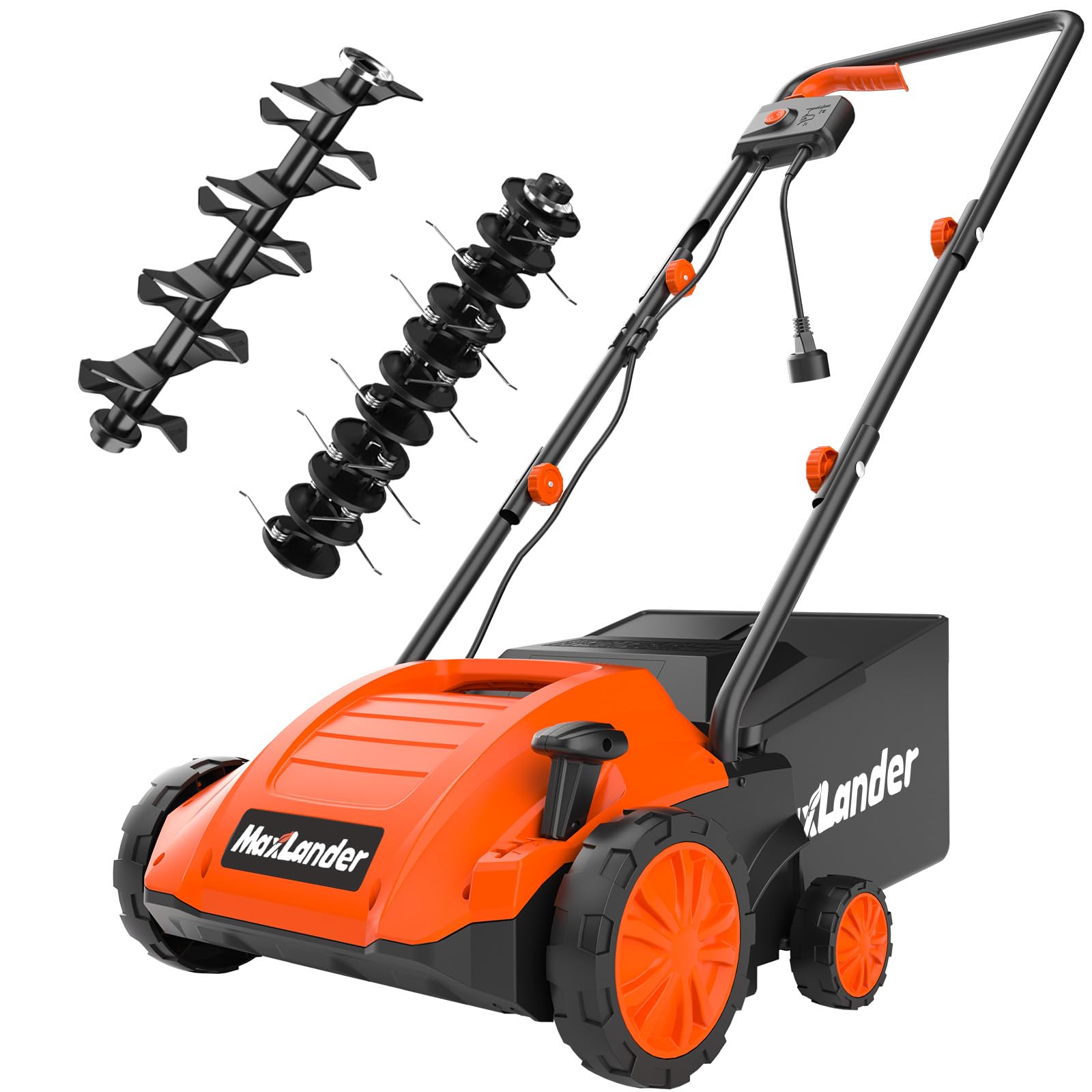
The light, affordable starter that still packs dual blades and real depth control.
For smaller lawns where cost matters more than raw speed, the MAXLANDER delivers the essential features without the premium price. The 12-Amp motor and 3000 RPM are the baseline numbers here — they handle annual dethatching on a 3,000–5,000 sq ft lawn well, but you will feel the difference versus the 13-Amp and 15-Amp models if the thatch is thick. The 13-inch cutting width is narrower than the WEN’s 15 inches, so expect more time walking.
Owners mention it “effectively removed years of thatch, moss, pine needles” and call it a “great value vs manual raking.” The 4-position depth adjustment lets you start shallow on thin grass and go deeper on neglected patches. The foldable handle saves storage space, and the 30L collection bag is standard for the entry tier — but customers note only “about half of the material goes in the bag,” so you will be raking after anyway.
The main durability concern: several reviews mention the plastic handle snapping, though most say it is fixable with a screwdriver. At this price, consider it a capable tool for light-to-medium duty rather than a heavy-use machine for multi-acre properties.
What Makes It a Good Start
- Light at 20.28 pounds and easy to push, even for first-time users
- Dual safety switches and a foldable handle for safe, compact storage
What Holds It Back
- Plastic construction means the handle can snap under stress (fixable, but a hassle mid-job)
- 30L bag catches only about half the debris; plan to rake behind it
Best for: A first-time buyer with a small to medium lawn who wants a functional dethatcher without spending more than the budget tier.
Not ideal if: You have a large lawn or heavy moss — the narrower path and lower RPM will make the job slow and require multiple passes.
6. SOYUS Electric Dethatcher and Scarifier with 30L Collection Bag, 13-Inch 12 Amp 2-in-1 Corded Lawn Dethatcher

The cheapest option that still includes a real scarifier blade and adjustable depth settings.
The SOYUS is a near-identical competitor to the MAXLANDER — same 12-Amp motor, 3000 RPM, 13-inch cutting width, and 30L collection bag — at nearly the same price. The differences are subtle: a plastic frame (like the MAXLANDER) with a different handle design and color scheme. The 4-position depth adjustment works the same range ( -0.47″ to 0.2″ ), so you get the same level of control.
Reviewers point out the machine “works as claimed; great as electric rake at highest setting” and that it “pulled up huge thatch bins” when used for overseeding prep. The scarifier blade held up — one owner ran it over 4,000 sq ft and “no wear” was visible. The bag, though, is widely considered useless. Multiple shoppers say they “didn’t use the bag because you would be emptying it too often” and recommend raking after. The 13-inch path is narrow, making it slow for anything beyond a small lawn.
One reviewer warned that the lever pinches your hand, so wear gloves. Assembly takes 15–20 minutes. If your budget is tight and you need both dethatching and scarifying, this is a functional entry point — just know you will be raking the debris yourself.
Functional entry point: Dual blades, adjustable depth, and a price that beats renting a gas machine for a one-time job.
Expect to rake: The bag is a minor helper at best — every experienced buyer in the data removed it and raked after.
Pick this if: You are on a strict budget and just need a machine that cuts through thatch — you accept the bag won’t do the cleanup for you.
Avoid if: You want a machine with a genuinely usable collection system or you have a medium-to-large lawn where the 13-inch width means too many passes.
7. Sun Joe Corded Electric Lawn Dethatcher and Scarifier, 12-Amp, 12.6-Inch Cutting Width, AJ798E
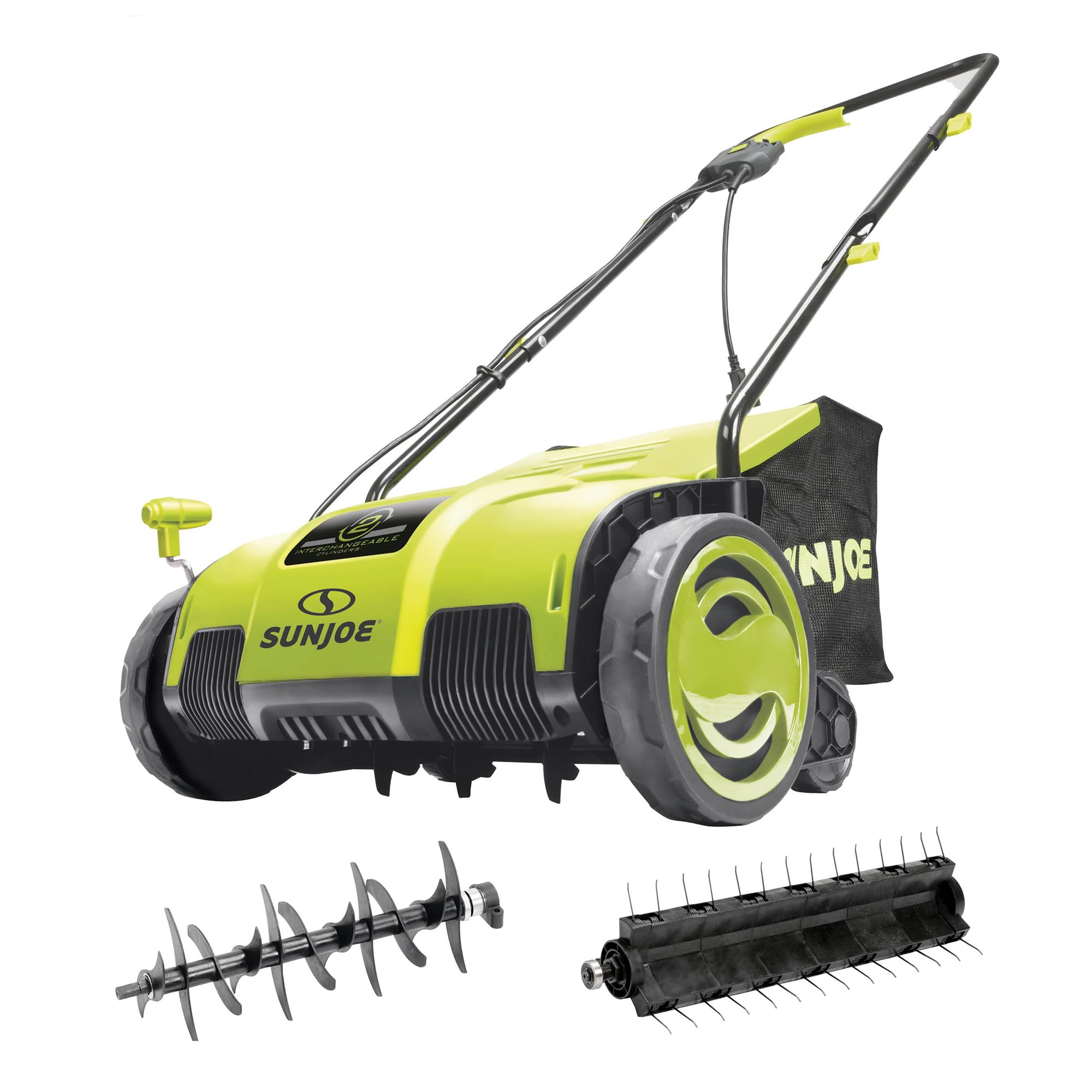
The compact choice for small lawns that prioritizes nimble handling over raw speed.
The Sun Joe AJ798E is the narrowest dethatcher here at 12.6 inches, and that is deliberate — a narrower machine pivots much more easily around flower beds, trees, and tight corners. For lawns under 3,000 square feet, the speed loss from the smaller path is offset by how much less effort it takes to maneuver. The 12-Amp motor is the same baseline as the MAXLANDER and SOYUS — fine for light-to-medium thatch on a small yard.
Buyers report it “effectively removed dead grass and scarified 800 sq ft in 2 hours” and that the scarifier is excellent for overseeding prep. The 4-position depth adjustment lets you dial in from a light skim to a deeper rake, and the AirBoost spring steel tines (flexible steel teeth designed to lift maximum debris) do a thorough job. The 8-gallon collection bag (the smallest in this lineup) fills quickly — one owner reported it needs emptying “every 40 ft pass” — and the safety switch can be finicky. Another buyer had the unit stop powering on after emptying the bag, which is a reliability concern to note.
The 2-year warranty from Snow Joe/Sun Joe is one of the better coverage plans here, and at just 21 pounds, it is the lightest machine in the group. For a small lawn where storage space is tight and maneuverability is king, the Sun Joe fits a specific niche that wider machines miss.
Its Best Qualities
- Lightest at 21 pounds and narrowest at 12.6 inches — ideal for tight spaces and small lawns
- 2-year warranty with no-questions-asked support adds confidence
Real Weaknesses
- 8-gallon bag fills in about 40 feet of heavy thatch; you will empty it constantly
- Some units have failed after a single use — reliability is inconsistent based on buyer reports
Ideal for: Small, obstacle-filled yards under 3,000 sq ft where a wider machine would be cumbersome and you prioritize easy storage.
Not for: Larger lawns or heavy thatch — the narrow path and small bag make it a slow, frustrating tool when conditions get demanding.
Understanding the Specs
Amps and RPM: What They Actually Do
Amps measure how much electrical current the motor can draw — more amps means more force (torque) when the tines hit a thick patch of thatch. RPM is how fast the tines spin, measured in revolutions per minute. A 12-Amp motor at 3000 RPM works fine for annual maintenance on a small lawn. A 15-Amp motor at 3300 RPM keeps the tines slicing through heavy debris without bogging down. You want both numbers higher if your lawn has never been dethatched or is mostly coarse grass and deep moss.
Cutting Width: How Fast You Cover Ground
Measured in inches, this is the width of the path the tines clear in one pass. A 13-inch machine takes more passes than a 16-inch machine to cover the same area. The trade-off: wider machines are heavier and harder to turn in tight spaces. For small lawns under 5,000 sq ft, a 13-inch width balances speed and maneuverability. For larger properties, a 15-inch or 16-inch width saves real time.
Collection Bag Capacity: Why It Rarely Does the Whole Job
Bag sizes range from 8 gallons (Sun Joe) to 14.5 gallons (EVEAGE, BILT HARD) to 45 liters (MZK). In every single buyer review across this category, the same pattern emerges: the bag fills fast, and most debris ends up on the lawn rather than in the bag. A larger bag means fewer stops, but you should still plan to rake after or use a mower with a bagger for the final pass. Treat the bag as a convenience, not a solution.
Depth Adjustment Positions: Fine-Tuning Aggression
Depth adjustment controls how deep the tines dig into the soil. More positions (4 or 5) let you match the intensity to your lawn’s condition. A shallow setting (near 0″) works for light maintenance on thin grass, while a deeper setting (down to -0.6″ or -1/2″) is needed to rip out years of accumulated thatch. Models with only 3 positions leave less room to fine-tune, often forcing a single aggressive setting that can scalp a delicate lawn.
FAQ
How often should I dethatch my lawn?
What is the difference between dethatching and scarifying?
Can I use a dethatcher on wet grass?
Will a dethatcher damage my lawn if I set the depth too deep?
Why does my dethatcher collection bag barely catch anything?
How do I know if I need a dethatcher at all?
Is a corded dethatcher better than a gas one for home use?
Can I use a dethatcher instead of a rake for leaves and pine needles?
What size extension cord do I need for a corded dethatcher?
Should I mow before dethatching?
Final Thoughts: The Verdict
For most people, the best dethatcher for lawn is the WEN DT1315 — its 15-inch cutting width, 13-Amp motor, and 5-position depth control at a mid-range price outpace the entry-tier machines without hitting the cost of the premium 15-Amp models. If you want the widest path and most powerful motor for a large lawn, grab the EVEAGE 16 Inch. And for a small, obstacle-filled yard where nimble handling matters more than raw speed, the Sun Joe AJ798E does the job in a compact, lightweight package.
How We Picked
We do not accept paid placement. Every pick is matched to a real buyer and a real use-case; we do not hands-on test units.
Sources & Methodology
Specifications: manufacturer listings and product documentation. Review insights: verified customer reviews, as of July 2026. Pricing: not shown on this page (it changes often); check the current price via the retailer link.
As an Amazon Associate, Lawn Gear Lab earns from qualifying purchases. This does not affect which products we feature.