
Deer can devastate a carefully planted garden in a single night, turning blossoms and vegetables into a memory. Motion-activated noise repellents offer a chemical-free, humane way to keep them off your property without the constant expense of sprays or the risk of traps. This guide dives into the specific sonic deterrents designed to send deer and other foragers packing.
I’m Rikta — the co-founder and writer behind Lawn Gear Lab. My approach to finding the best deer noise repellent involves dissecting technical specifications, comparing ultrasonic frequency ranges and solar panel efficiency, and analyzing hundreds of owner experiences across verified purchase reviews to separate effective deterrents from gimmicks.
After evaluating each device for its motion sensor range, volume output, power source reliability, and durability against the elements, I have curated a list of the most dependable options so you can identify the best deer noise repellent for your specific yard or farm scenario.
How To Choose The Best Deer Noise Repellent
Selecting the right noise repellent depends on your property layout, the local deer pressure, and how much maintenance you want to handle. Paying close attention to a few key specifications will ensure you invest in a deterrent that animals cannot ignore.
Motion Sensor Coverage and Reliability
The PIR (passive infrared) sensor is the brain of the device. A standard sensor may offer a 110-degree detection angle with an 8-10 meter range, which works well for a focused zone like a single garden bed. For wider areas or properties with multiple entry points, a three-sensor 360-degree design ensures deer cannot approach from an unprotected side. A higher sensitivity sensor is better, but be aware that extremely sensitive units may trigger falsely from swaying tree branches or passing cars, draining battery life.
Sound Output: Volume and Frequency Range
Decibel (dB) ratings directly correlate to how far the noise carries across your yard; a 130 dB maximum provides a strong deterrent for larger spaces. The sonic deterrent itself must offer variety. Devices that only produce a single ultrasonic frequency often fail as animals acclimate. Advanced units cycle through frequencies (13.5kHz to 65.5kHz) or offer alternative sounds like pre-recorded dog barks or gunshots to create a dynamic, unpredictable environment that deer struggle to ignore.
Power Source and Weather Endurance
Solar-powered units eliminate the need for wiring but require direct sunlight for a full daily charge. Check the battery capacity (mAh) if you expect cloudy stretches; a 2200mAh battery can often support up to 30 days of standby on a full charge. The IP rating dictates resilience. An IP65 rating guarantees protection against water jets and dust, which is critical for a device left exposed to rain, snow, and heat cycles year-round. Units with a lower rating may fail prematurely in wet climates.
Quick Comparison
On smaller screens, swipe sideways to see the full table.
| Model | Category | Best For | Key Spec | Amazon |
|---|---|---|---|---|
| TLXLT Ultrasonic Repeller | Premium 360° | Full yard coverage | 3 PIR sensors, 360° | Amazon |
| PEXPEL Repeller | Premium 360° | Low maintenance setups | 3-sided ultrasonic, 360° | Amazon |
| G-Jyuncyou Repeller | Premium 360° | All-angle garden defense | 3 motion sensors, 360° | Amazon |
| Kittmip Solar Lights (12-Pack) | Passive Light | Perimeter predator control | 12 units, red LED eyes | Amazon |
| RQQN Solar Repeller (2-Pack) | Mid-Range Sonic | Cost-effective dual coverage | 2-pack, IP66 rating | Amazon |
| Grrwz Ultrasonic Repeller | Entry-Level Sonic | Budget-friendly sonic zone | 30ft range, 150° zone | Amazon |
| ChunHee Solar Alarm | Entry-Level Audio | Loud audio predator mimicry | 130 dB, recordable sounds | Amazon |
In‑Depth Reviews
1. TLXLT Ultrasonic Animal Repeller Outdoor
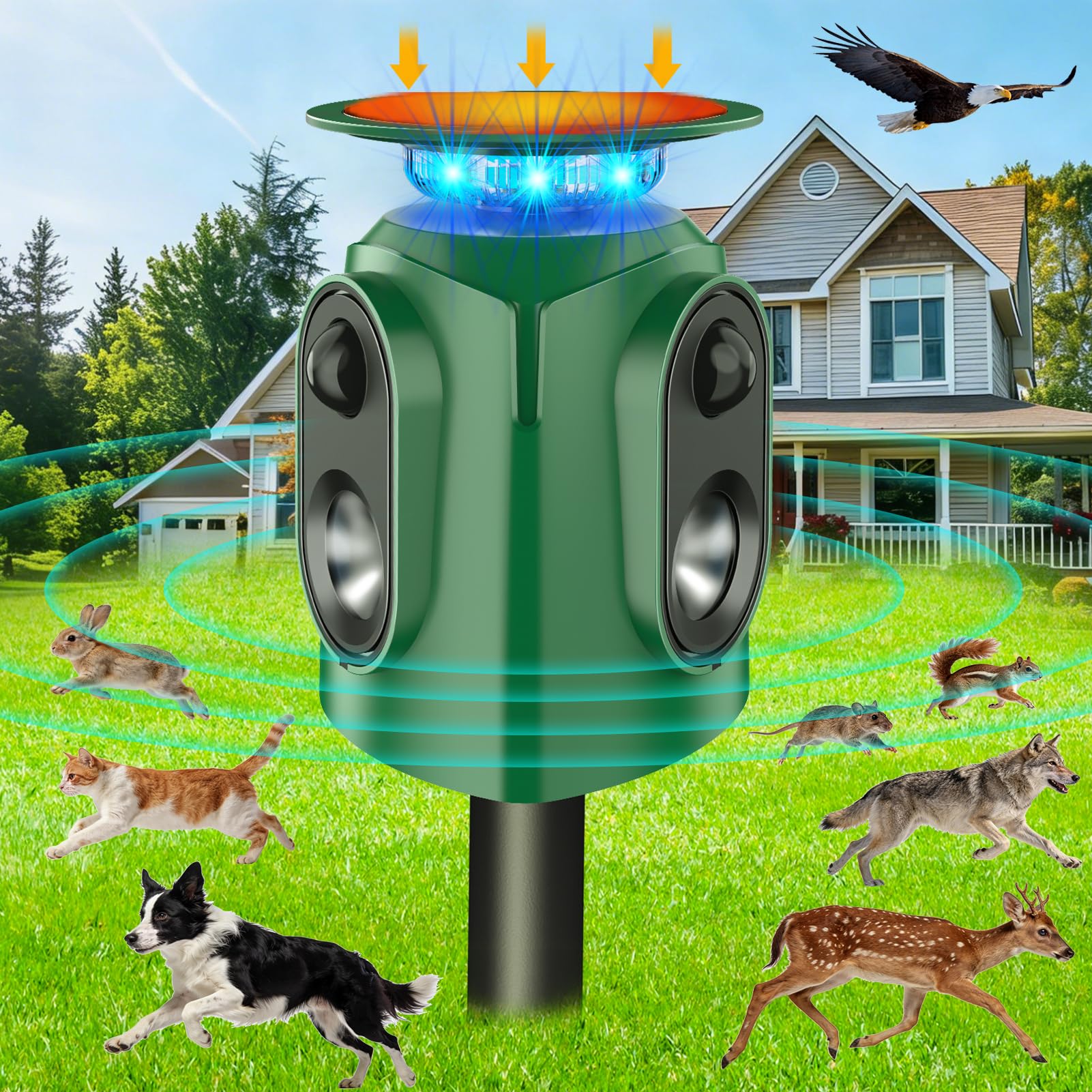
The TLXLT unit stands out because it solves the single most common failure of these devices: blind spots. With three independent PIR motion sensors and speakers arranged for true 360-degree coverage, deer cannot approach your flower beds from an angle the sensor misses. The frequency range spans 13.5KHz to 61KHz, and the five adjustable modes let you toggle ultrasonic with flash, flash only, or night-only operation, preventing animals from habituating to a single trigger pattern.
Power continuity is handled by a 2200mAh rechargeable battery that supports up to 30 days of use. The solar panel provides an efficient top-up during daylight, and the Type-C USB port offers a quick 4-hour charge backup for prolonged cloudy spells. Owners consistently report that the sensitive PIR sensors catch movement instantly, and the 360-degree configuration stops cats, deer, and raccoons from sneaking into previously vulnerable corners of the garden.
The IP65 waterproof rating ensures the unit survives rain, snow, and direct sun exposure without housing degradation. Assembly is tool-free, with simple pole components that press into the ground or sit on a flat surface. For a property owner seeking comprehensive, set-and-forget protection that adapts to different pest types and weather patterns, this premium device represents the finest balance of features and reliability.
What works
- Triple sensors eliminate blind spots for complete coverage.
- Five adjustable modes prevent long-term animal habituation.
- Large 2200mAh battery handles extended cloudy periods.
What doesn’t
- Some squirrels may ignore the ultrasonic frequency.
- USB port cover could be more robust against moisture.
2. PEXPEL 360° Solar Ultrasonic Animal Repeller Outdoor
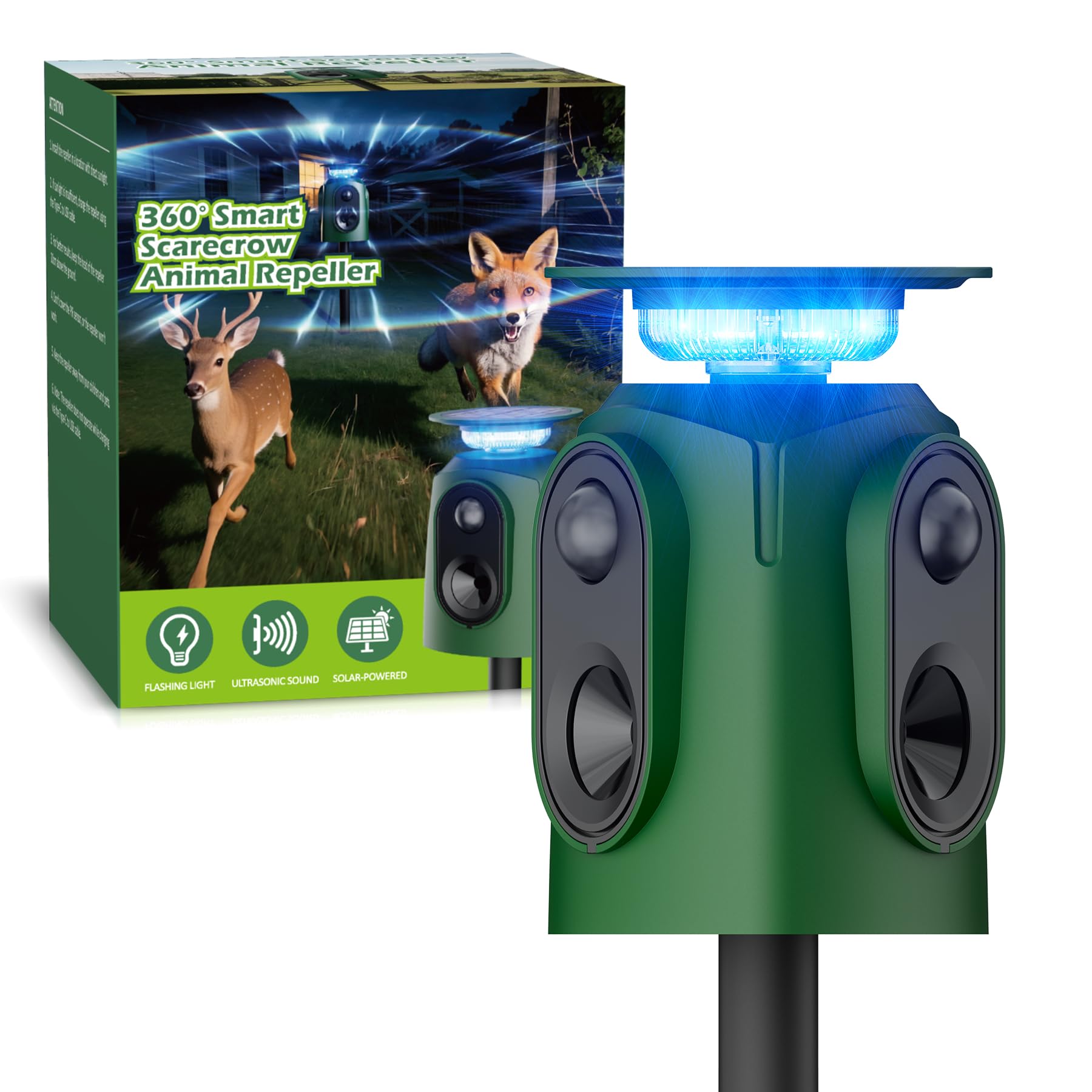
The PEXPEL repeller employs a 3-sided configuration that places PIR sensors, ultrasonic speakers, and dual LED flashing lights on each face, delivering a robust 360-degree deterrent field. The multi-directional approach is specifically designed to prevent deer from slipping in behind the device, a problem common to single-front models. The ultrasonic waves target auditory sensitivity while the strobe lights startle visual senses, creating a layered sensory assault that is difficult for persistent animals to ignore.
Five adjustable modes allow you to fine-tune the frequency and flash patterns to target different species or to change the output if deer begin to adapt. The solar panel charges the internal battery during the day, and the Type-C USB port ensures you can maintain power during long overcast stretches. Owners appreciate the low-maintenance aspect, noting that the unit charges itself and only activates when motion is detected, eliminating the annoyance of constant noise.
The IP65 weatherproof housing protects the electronics from rain, snow, and intense heat, making it suitable for year-round deployment in gardens, lawns, and patios. Setup is straightforward: assemble the stake, push it into the ground, and select your mode. For users who want a hands-off solution that reliably blends ultrasonic and visual deterrents, this unit delivers excellent performance with minimal daily interaction.
What works
- Three-sided sensor panel for true 360-degree detection.
- Self-charging with USB backup for low-sun periods.
- Quiet during the day; activates only on real motion.
What doesn’t
- Heavy deer pressure may require weeks of consistent use.
- Sensors may miss very small critters like chipmunks.
3. G-Jyuncyou Solar Animal Repellent for Yard & Garden
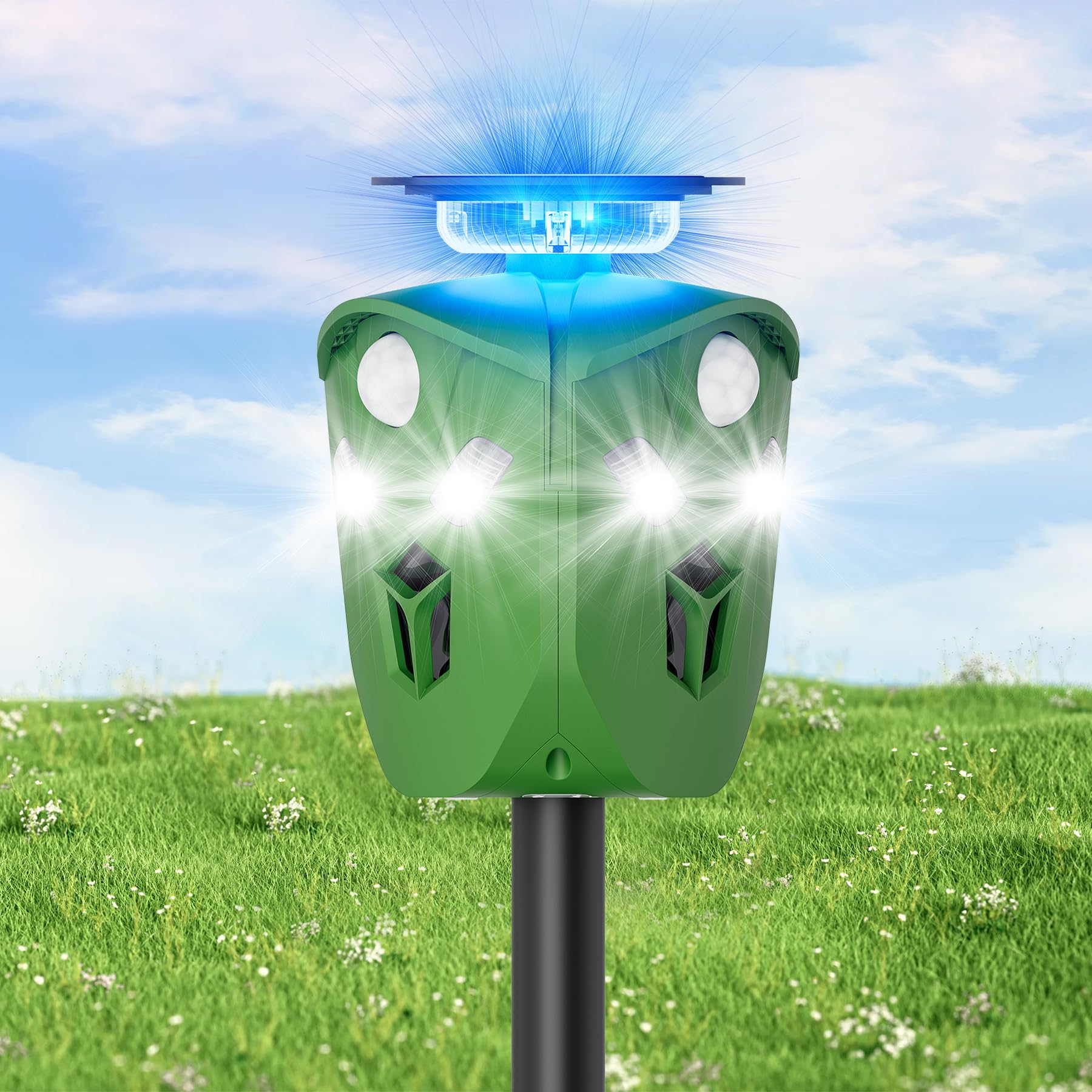
The G-Jyuncyou unit directly addresses the frustration of deer sneaking into unprotected sides of the yard. It features three integrated motion sensors that detect movement from every direction, instantly triggering both ultrasonic sound and a flashing light. This design eliminates the need to angle the device perfectly, as the 360-degree field ensures no approach route goes undetected. The unit builds a protected zone that deer learn to avoid over a period of a few weeks.
Solar power keeps the repeller running continuously without battery replacement, and the durable IP65 waterproof housing stands up to rain, snow, and heat without failure. Setup is simple: stake the unit into the ground in a sunny area with high animal traffic. Owners report a noticeable reduction in cat, squirrel, and deer activity, with one user noting that while animals still visit the edges of the property, the central protected zone remains largely undisturbed.
The rotating head design provides flexibility as you can direct the sensor array toward different areas if animal patterns shift. The “night setting” mode ensures the strobe light is most active when nocturnal deer are foraging. For a user who wants a reliable, eco-friendly guard that covers every angle without complex programming, this model offers a well-rounded solution that grows more effective as animals learn to associate the area with the deterrent.
What works
- Triple sensors provide true all-directional coverage.
- Solar-powered with no wiring or battery swaps needed.
- Durable build stands up to rough weather conditions.
What doesn’t
- Some units may produce no sound on night-only mode.
- Detection range may fall short of the advertised 30 feet.
4. Kittmip Solar Control Light Nocturnal Animal Repeller (12-Pack)

The Kittmip system takes a completely different approach from the sonic devices on this list. It relies on two flashing red LED lights per unit that simulate an animal’s eyes or fire, triggering a fear response in nocturnal predators like coyotes, raccoons, and deer. The 12-pack allows you to establish a perimeter around chicken coops, garbage bins, garden fences, or barn perimeters, creating an optical barrier rather than an acoustic one.
Each unit is solar-powered with a 1000mAh rechargeable battery that lasts 5-7 days on a full charge. The built-in light sensor activates the red LEDs at dusk and shuts them off at dawn, so there is zero daily maintenance. Owners report that the blinking lights effectively stopped heavy predator losses and significantly reduced deer damage to fruit trees, with one reviewer noting deer were pushed roughly an eighth of a mile away from the protected zone at night.
The IP44 waterproof rating is slightly lower than the IP65 of the sonic units, but the lights are designed for simple post or fence mounting with minimal electronics exposure. While some raccoons may habituate to the red glow over time, this pack remains one of the most effective perimeter deterrent tools for large properties or homesteads needing to cover multiple structures. For a user looking for silent, chemical-free predator control with expansive area coverage, this 12-pack offers exceptional value.
What works
- 12 units provide massive perimeter and structure coverage.
- Solar-powered with passive dusk-to-dawn operation.
- Stopped heavy predator losses in chicken coops and barns.
What doesn’t
- Red LEDs may not deter raccoons habituated to lights.
- IP44 rating is less resilient than IP65 in heavy rain.
5. RQQN Solar Animal Repellent (2-Pack)
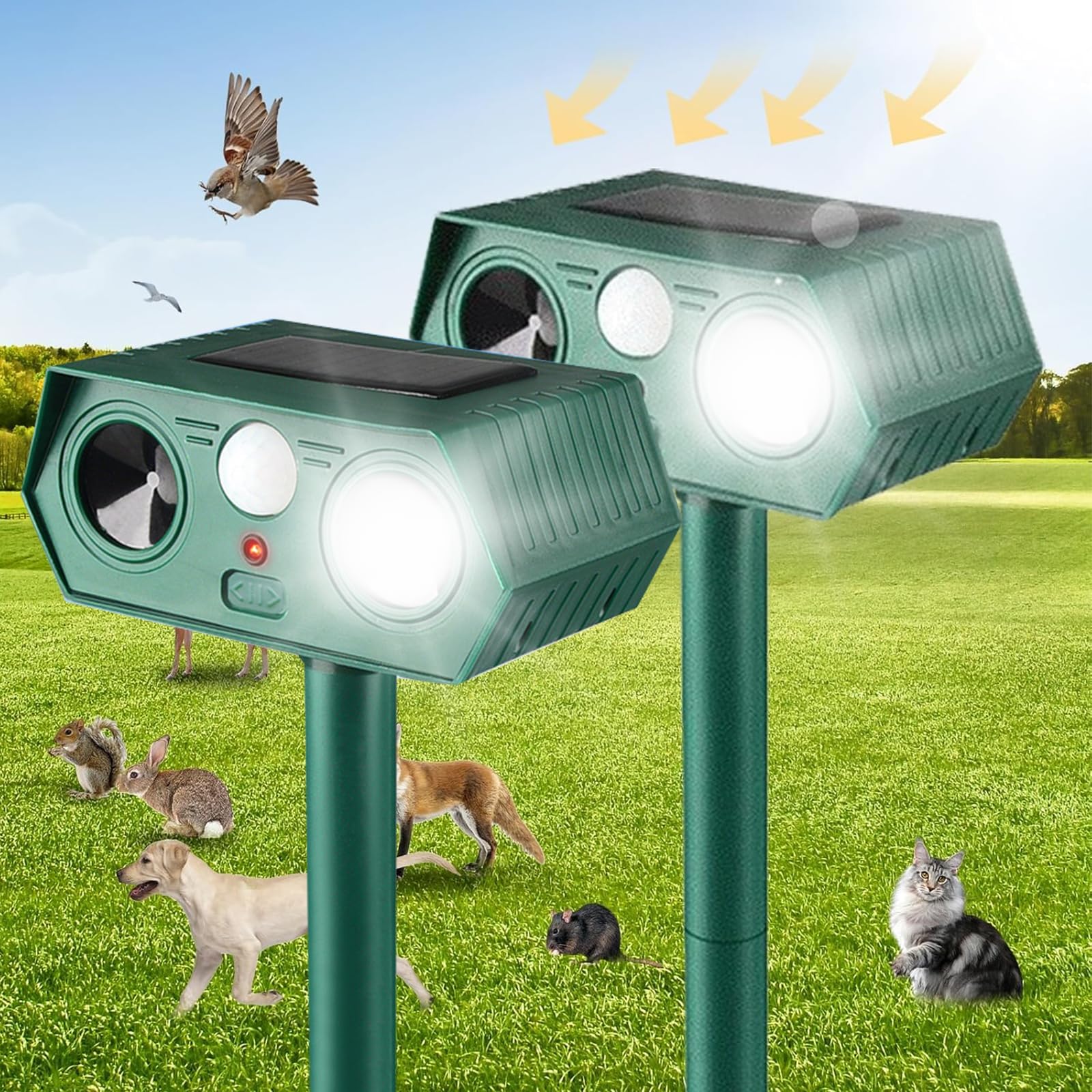
The RQQN two-pack is a strong mid-range option designed to protect two separate zones simultaneously. Each unit emits ultrasonic frequencies ranging from 13.5kHz to 65.5kHz, cycling through the spectrum to prevent habituation. During the day, the ultrasound alone drives away deer and rabbits, and at night, the system pairs the sound with bright LED flash lights to deter more persistent nocturnal visitors like coyotes and raccoons.
Installation is fast, taking roughly a minute per unit. The 110-degree infrared sensor detects movement from 20 to 33 feet depending on the animal’s size. The IP66 waterproof rating exceeds the standard IP65, making it particularly suited for very wet climates or areas prone to monsoons. Owners in rainy regions report the device continues functioning perfectly without degradation, even when left exposed all season.
The two-pack format solves a common pain point: a single device often leaves a large yard partially unprotected. Placing one unit at each garden entrance or at opposite ends of a chicken run creates a contiguous deterrent zone. While some smaller animals like rabbits may occasionally test the perimeter, most users report a significant reduction in deer and ground-squirrel activity within a few weeks. For the price of a single premium unit, this two-pack delivers broader physical coverage.
What works
- Two units cover more area than a single device.
- IP66 rating handles very wet weather conditions.
- Wide ultrasonic frequency range prevents habituation.
What doesn’t
- Some rabbits may ignore the ultrasonic output entirely.
- Solar panel size is small for extended charging capacity.
6. Grrwz Solar Ultrasonic Animal Repellent Outdoor
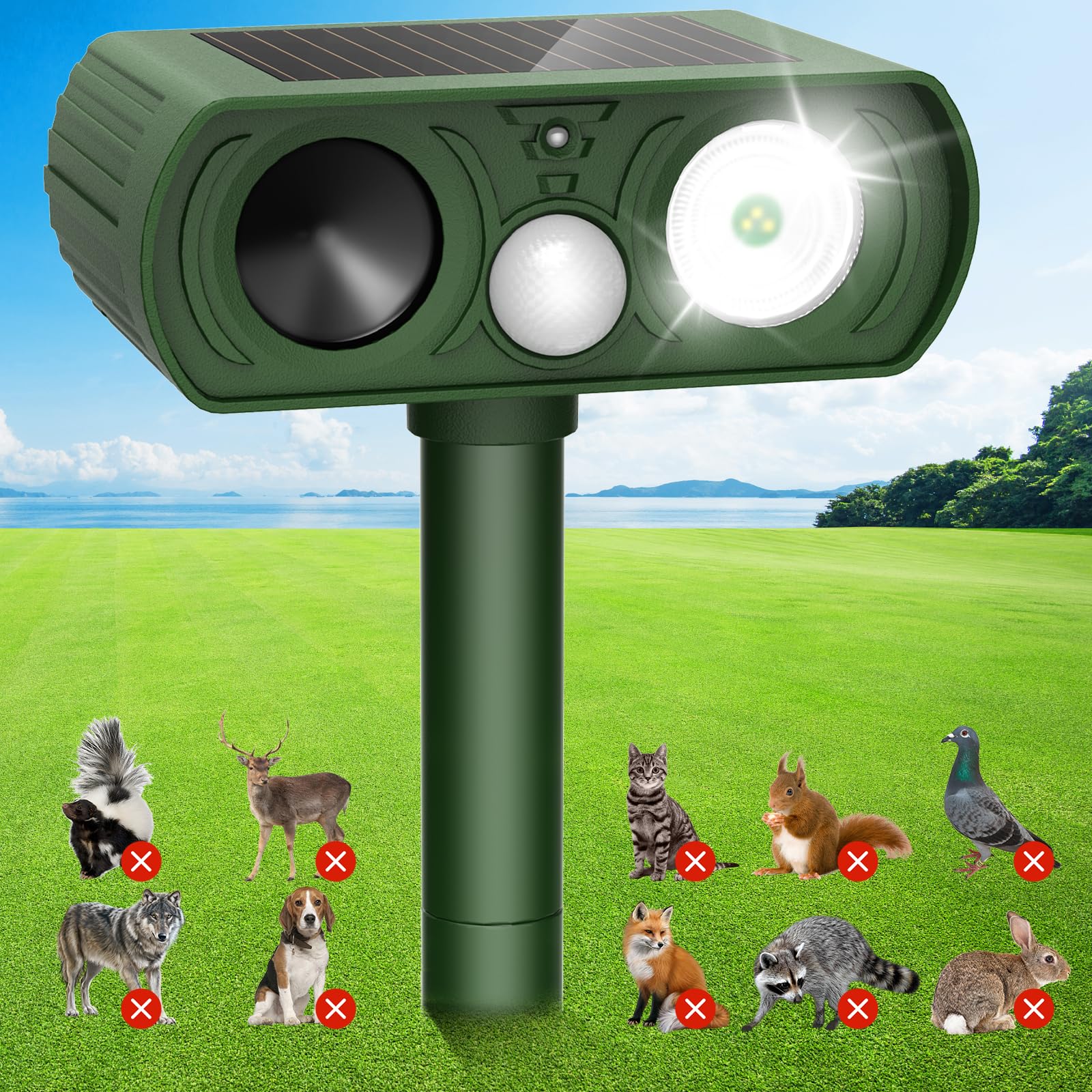
The Grrwz repeller is an entry-level sonic deterrent that covers a 150-degree zone with a detection range of up to 30 feet. It uses an advanced PIR sensor to detect movement and instantly releases high-frequency ultrasonic sound waves paired with flashing LED strobe lights. This dual output is designed to discourage deer, raccoons, squirrels, and cats without using chemicals or traps, making it a straightforward option for smaller gardens or targeted use.
Solar power provides continuous, maintenance-free operation. The rugged ABS construction and IP65 rating ensure it withstands sun, rain, and snow over multiple seasons. Installation is fully wireless: stake the unit into the ground or use the hanging holes to mount it on a fence. Owners report seeing significantly fewer deer and rabbits around their plants within days of setup, and the unit blends naturally into the outdoor environment.
One important caveat is that the 150° sensor angle leaves the rear of the device unprotected. For a single garden bed placed against a wall or fence, this is perfectly fine. However, for an open yard, you may need two units or a model with 360° coverage. As a budget-friendly starter device for a specific zone, the Grrwz delivers reliable performance with minimal investment, especially for users who only need to protect a concentrated area.
What works
- Affordable entry point for solar ultrasonic protection.
- Wireless stake installation takes seconds to set up.
- Effectively reduced deer activity around plants.
What doesn’t
- 150° field leaves a rear blind spot.
- May not deter large or highly motivated deer.
7. ChunHee Solar Outdoor Motion Sensor Alarm
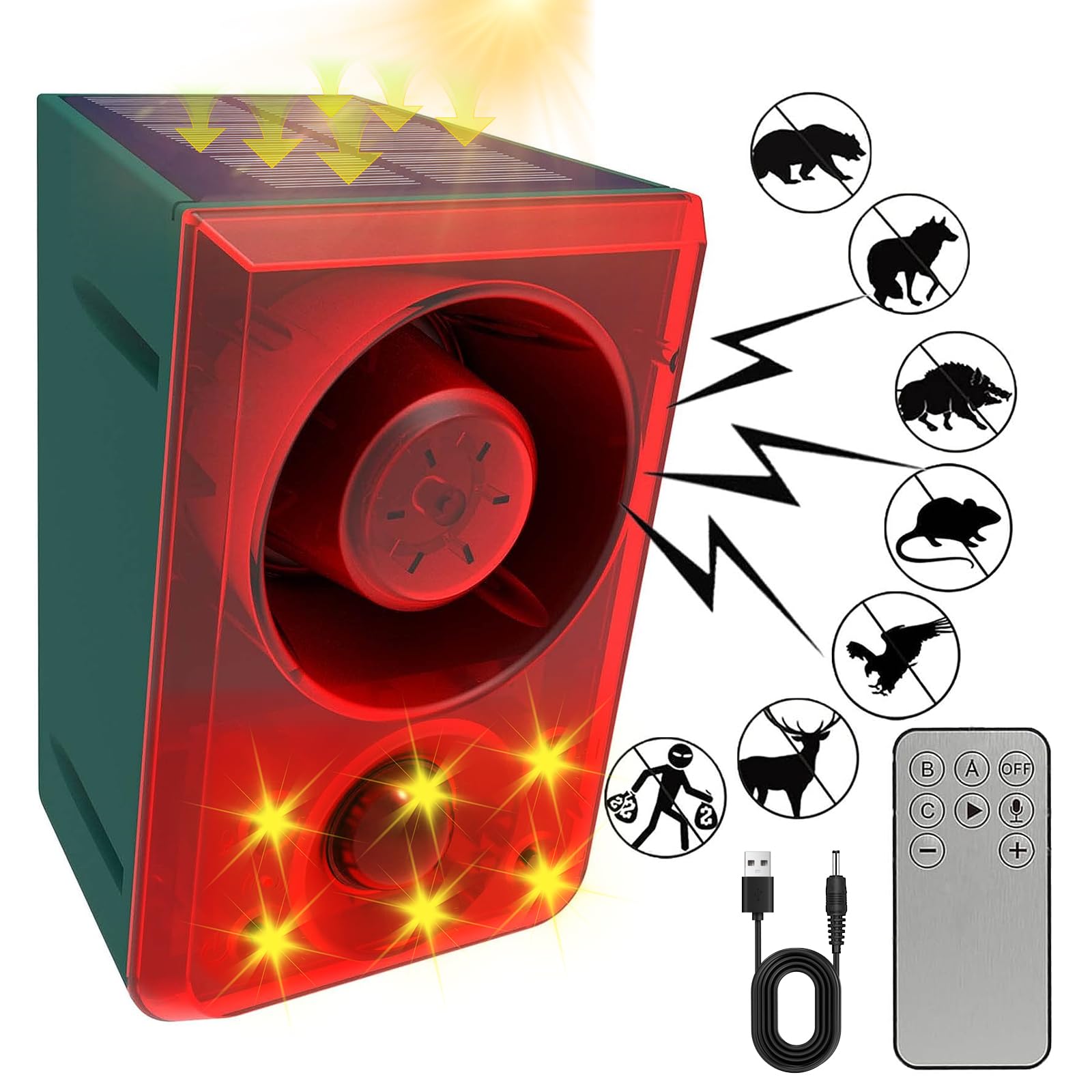
The ChunHee alarm distinguishes itself by offering a sound-based approach that goes beyond standard ultrasonic frequencies. It reaches a maximum of 130 dB and includes pre-loaded sounds like barking dogs and gunshots, plus the ability to record your own custom message up to 20 seconds. This versatility is particularly useful for deer that have become habituated to ultrasonic hums; a sudden, loud dog bark or human voice can trigger a much stronger flight response.
The PIR sensor detects movement within a 110-degree angle at a range of 5-8 meters. Three operating modes let you choose 24-hour activation with flash and alarm, night-only activation with flash and alarm, or a timer mode. Solar power and an IP65 waterproof ABS housing allow for year-round outdoor installation with minimal maintenance. Owners report the device quickly stopped bears, coyotes, and raccoons from raiding garages and chicken coops.
The recording function is a standout feature, allowing you to use commands unique to your property, like a specific voice or whistle that animals will not hear from neighboring properties. The adjustable volume control is a thoughtful addition, letting you dial down the output to avoid disturbing neighbors while still deterring deer. For a user facing persistent deer pressure and wanting a loud, customizable audio deterrent rather than just an ultrasonic hum, this device offers a flexible and powerful alternative.
What works
- Recordable sound allows fully customizable deterrent audio.
- 130 dB maximum volume covers large outdoor areas.
- Adjustable volume prevents neighbor disturbance.
What doesn’t
- 110° sensor angle has a significant rear blind spot.
- Some animals may take weeks to respond to the sound.
Hardware & Specs Guide
PIR Sensor Range
The PIR (passive infrared) sensor measures the distance your device can detect body heat from a trespassing deer. An 8-meter (26 feet) range is the entry-level standard, while premium 360-degree units detect up to 33 feet. A longer range gives you more reaction time, but also increases the chance of false triggers from warm air currents or large pets. Matching the sensor range to your property’s hot spots ensures the device activates only when necessary.
Ultrasonic Frequency Spectrum
Ultrasonic frequencies range from 13.5kHz to 65.5kHz, though humans can only hear about 20kHz and below. Devices that cycle through a wide frequency band prevent deer from acclimating to a single tone. Some models add audible options like dog barks or gunshots (recorded sounds up to 130 dB) for a multi-faceted deterrent. A broader spectrum with periodic changes is significantly more effective for long-term protection.
Solar Panel mAh Battery Capacity
Battery capacity measured in milliampere-hours (mAh) determines how long your device runs without sunlight. A standard 1000mAh battery provides 5-7 nights of operation, while a 2200mAh cell supports up to 30 days of standby. For properties in consistently cloudy regions or under tree cover, opt for a unit with a battery capacity over 2000mAh or select a model with a USB-C charging backup to maintain protection during extended overcast periods.
IP Waterproof Rating
The Ingress Protection rating (IP44 vs IP65 vs IP66) defines how well the housing resists moisture and dust. IP44 protects against splashing water, adequate for mild rain. IP65 seals against low-pressure water jets and total dust ingress, making it suitable for intense storms. IP66 withstands high-pressure jets. For year-round outdoor exposure in snowy or monsoon regions, choose an IP65 or higher rating to prevent moisture from corroding the electronics.
FAQ
Do deer noise repellents work on all deer?
How long should I leave the repeller on to see results?
Can ultrasonic sound harm my pets or children?
What is the best placement for a solar deer repellent?
Final Thoughts: The Verdict
For most gardeners, the best deer noise repellent winner is the TLXLT Ultrasonic Animal Repeller Outdoor because its 360-degree sensor coverage, five adjustable modes, and 2200mAh battery eliminate the blind spots and downtime that cripple lesser units. If you want silent perimeter protection for a large property with structures and livestock, grab the Kittmip Solar Light 12-Pack. And for a customizable, budget-friendly audio deterrent that uses recordable sounds to outsmart habituated deer, nothing beats the ChunHee Solar Motion Sensor Alarm.