
A cutting zero turn mower is the defining upgrade for anyone serious about lawn speed and finish quality. Unlike a standard lawn tractor, the zero-turn-radius steering and a high-output deck allow you to shave minutes off every pass while navigating tight tree rings and fence lines without leaving uncut strips. The category spans from rugged residential units with fabricated decks to pro-grade fleet machines built for daily commercial use, so choosing the wrong one can mean a rough ride, a ragged cut, or a machine that bogs in tall grass.
I’m Rikta — the co-founder and writer behind Lawn Gear Lab. This guide is built on weeks of cross-referencing deck fabrication, engine displacement, transmission type, cutting width vs. lot size, and real owner reports across seven models that span the practical range of what most buyers should consider.
Whether you manage a two-acre homestead or run a part-time mowing crew, finding the best cutting zero turn mower means matching deck strength and engine torque to your specific grass conditions and terrain slope — not just buying the widest deck you can afford.
How To Choose The Best Cutting Zero Turn Mower
Zero turn mowers are more specialized than conventional lawn tractors. Deck construction, engine platform, and transmission type determine whether a machine delivers a manicured finish or leaves you fighting vibration, streaking, and scalping across dips.
Deck Type: Stamped vs. Fabricated Steel
A stamped deck is pressed from a single sheet of steel and is lighter and cheaper, but it tends to flex under heavy loads and can crack over years of rough use. A fabricated deck is welded from multiple pieces of thicker steel — usually 11 to 13 gauge — and holds its shape under the stress of tall, wet grass or debris strikes. If your property contains uneven terrain, hidden rocks, or you mow at higher speeds, a fabricated deck is worth the step up in price.
Engine Power and Platform
Engine choice affects starting reliability and torque under load. Kawasaki and Kohler dominate the premium tier with V-twin designs that offer smooth power delivery. Briggs & Stratton single-cylinder engines reduce cost and complexity but may struggle in heavy or damp grass. Look for at least 20 HP on decks 46 inches and wider, and verify that the engine has a cast-iron cylinder sleeve for longevity.
Transmission: Hydrostatic vs. Manual vs. Belt Drive
True zero-turn mowers use dual hydrostatic transmissions that allow independent wheel control. Entry-level units may use a single hydrostatic pump with a belt-drive system, which reduces maneuverability and can slip under load. Integrated hydrostatic transmissions (the type sealed and maintenance-free) offer the best combination of smooth control and durability for residential use.
Cutting Width and Property Size
A 42-inch deck covers roughly 1.5 to 2 acres per hour at moderate speed. Jumping to a 54- or 61-inch deck can cut that time by nearly half, but the added width reduces maneuverability in fenced yards and around tight landscaping beds. For properties under 2 acres, a 42- to 46-inch deck provides the best balance of agility and speed. For 3 acres and above, a 54-inch or wider deck saves meaningful time per session.
Quick Comparison
On smaller screens, swipe sideways to see the full table.
| Model | Category | Best For | Key Spec | Amazon |
|---|---|---|---|---|
| Husqvarna Z254F | Premium Gas | Estates & Heavy Residential | 54″ ClearCut Fabricated Deck | Amazon |
| Husqvarna MZ61 | Pro Grade | Commercial & Large Acreage | 61″ 11-Gauge Fabricated Deck | Amazon |
| EGO Power+ ZT5207L | Electric Premium | Quiet, Large Residential Cuts | 52″ Deck w/ 6x 56V Batteries | Amazon |
| Craftsman 46″ Zero Turn | Mid-Range Gas | Steady Residential Performance | 46″ Stamped Deck w/ Kohler 22 HP | Amazon |
| DAREDEVIL VYPER 9HP | Specialty Remote | Steep Slopes & Remote Operation | 22″ Deck w/ Rubber Tracks | Amazon |
| CRAFTSMAN 42″ Gas Tractor | Value Gas | Flat Lots Under 2 Acres | 42″ Stamped Deck / 18″ Turn Radius | Amazon |
| Swisher RC14544CPKA | Rough Cut Pull-Behind | Brush Clearing & Trail Mowing | 44″ Deck w/ 14.5 HP Kawasaki | Amazon |
In‑Depth Reviews
1. Husqvarna Z254F

The Husqvarna Z254F sits at the sweet spot of the residential zero turn market. Its 54-inch ClearCut fabricated deck is deep and generates high-velocity airflow that lifts wet grass before the blades hit, reducing clumping and producing a uniform finish even on damp mornings. The Kawasaki FR691V V-twin starts reliably and holds consistent blade speed through 2-inch thick patches, which is exactly where lesser engines bog down.
Dual Hydro-Gear hydrostatic transmissions deliver smooth, intuitive control. The Z254F’s top speed of 6.5 mph is on the faster end for this class, so a 2-acre lot can be finished in under an hour. The high-back seat and ergonomic lap bars are comfortable for longer sessions, and the no-maintenance transmission means one less fluid change to track. Owners consistently report that the machine feels solidly built without the price tag of a commercial unit.
One area to watch is the deck spindle. A few owners have noted that the stamped spindles can loosen over extended use on rocky terrain, and replacement parts are best sourced directly from Husqvarna’s dealer network rather than general retailers. For the residential property owner who wants pro-grade cut quality without stepping into a 800-pound commercial machine, the Z254F delivers the best value per inch of deck width.
What works
- Kawasaki V-twin engine provides excellent torque and reliable cold starts.
- ClearCut deck design keeps clippings suspended for a consistent finish.
- Maintenance-free hydrostatic transmission reduces long-term service costs.
What doesn’t
- Deck spindles may require periodic re-torquing on rough terrain.
- Mulching and bagging kits are sold separately and can be pricey.
- Seat comfort is good but lacks the armrests found on some competitors.
2. Husqvarna MZ61

The MZ61 is Husqvarna’s bridge into commercial-grade territory. The 11-gauge fabricated steel deck is over a millimeter thicker than even the Z254F, and it holds its shape under the punishment of daily operation across uneven fields. The Kawasaki FX751V produces 24 horsepower and drives the deck through a heavy-duty shaft, not a belt, eliminating the most common failure point on high-hour mowers.
The roll-over protection system (ROPS) is factory-installed on this model, and the foot-operated deck lift lets the operator change cutting height without releasing the lap bars. With 11 cutting positions ranging from 1 to 3 inches, you can dial in a precise finish for Bermuda grass or let it sit higher for cool-season blends. Owners report the MZ61 handles steep slopes without the rear sliding common on lighter machines, thanks to its 844-pound curb weight and low center of gravity.
The assembly experience is the main friction point. Several owners describe the crate as poorly designed, and installing the ROPS requires aligning bolts in tight spaces. The transmission reservoir has also been shipped low on a small number of units, requiring an immediate top-off. If you have dealer support nearby, the MZ61 is a fleet-quality mower that will outlast a residential machine by years on large estates or light commercial routes.
What works
- 11-gauge fabricated deck resists warping under heavy commercial use.
- Foot-operated deck lift allows on-the-fly height adjustments.
- Shaft-driven deck eliminates belt slippage at high blade loads.
What doesn’t
- Crate and assembly process is more difficult than most residential models.
- Transmission fluid level should be verified before first start.
- Seat suspension is stiff on bumpy fields; aftermarket upgrades help.
3. EGO Power+ ZT5207L

The EGO ZT5207L represents a genuine shift in what electric riding mowers can achieve. Six 56-volt ARC Lithium batteries provide a 25-horsepower equivalent that matches or exceeds gas engines in this deck width, and the 52-inch fabricated deck delivers a cut quality that rivals the Husqvarna Z254F. The electric drivetrain delivers instant torque — the mower accelerates smoothly without the vibration of an ICE engine, and the noise level sits around 75 dB, which is quiet enough for early-morning mowing in tight neighborhoods.
Battery life on the supplied 12.0 Ah pack covers up to 4 acres per charge in real-world use, which aligns with the official claim for moderate cutting conditions. The EGO app allows speed adjustment from 4 to 8 mph, blade speed control, and serves as a digital key. The integrated hose wash port makes deck cleaning simple after each mow. Owners note that the ride quality is excellent thanks to the mower’s 720-pound weight distribution, and zero-turn responsiveness is immediate without the lurch of a belt-driven hydrostatic pump.
The largest drawback is the charging time. Fully recharging six 12.0 Ah batteries takes roughly 4 hours, so mowing large properties back to back requires planning. Replacement batteries represent a significant investment when they eventually decline. A small number of units have required a logic board reboot caused by the battery management system freezing. For the buyer willing to trade gas infrastructure for quiet operation and minimal daily maintenance, the EGO ZT5207L is a fully competitive alternative.
What works
- Instant torque and silent operation compared to any gas zero turn.
- 52-inch fabricated deck produces a consistent cut across varying grass heights.
- App-based control adds customization without proprietary keys.
What doesn’t
- 4-hour recharge time limits back-to-back acreage sessions.
- Battery pack cost is high when replacement is eventually needed.
- Infrequent logic board freeze requires pressing battery button to reset.
4. Craftsman 46″ Zero Turn (17ARFACT093)

The Craftsman 46-inch zero turn is a capable residential machine that pairs a Kohler 7000 series V-twin with a dual hydrostatic transmission. The 22-horsepower twin-cylinder engine starts reliably across temperature swings, and the stamped steel deck cuts cleanly on level lawns up to 2 acres. The 20×8 Turf Master tires provide good traction on moderate slopes without tearing the turf during sharp turns.
The adjustable lap bars offer three positions, accommodating operators of different heights, and the high-back seat provides better lumbar support than older Craftsman tractor seats. At 500 pounds, the machine feels planted but is still maneuverable in and out of garage storage. Owners report that mowing time drops significantly compared to the typical 42-inch lawn tractor — the zero-turn agility cuts out the back-and-forth passes around trees and garden beds.
A recurring complaint involves a front wheel squeal that appears after a handful of hours. The cause is typically a dry axle bushing rather than a serious structural defect, but it requires disassembly to lubricate. Additionally, the blade bolt pattern on this model is non-standard for some aftermarket blades, so sourcing replacements may require ordering through Craftsman or an authorized dealer. For steady residential use on flat to gently rolling terrain, the Craftsman delivers consistent performance at a mid-range investment.
What works
- Kohler 7000 series engine provides smooth power and reliable starting.
- Dual hydrostatic transmission enables responsive zero-turn control.
- Adjustable lap bar positions improve fit for different operator heights.
What doesn’t
- Front wheel squeal may develop within the first 10 hours of use.
- Blade bolt pattern is non-standard, limiting aftermarket options.
- Stamped deck may flex under heavy or wet cutting conditions over time.
5. DAREDEVIL VYPER 9HP
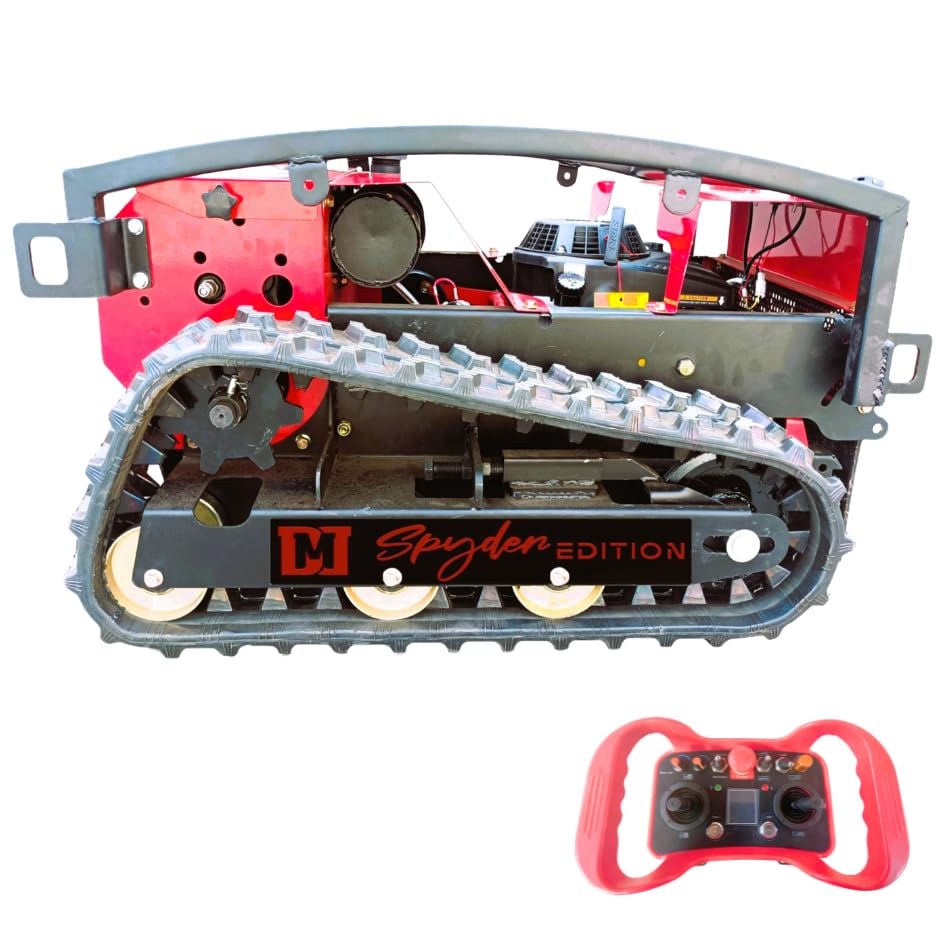
The DAREDEVIL VYPER exists in a category of its own — a remote-controlled zero turn mower designed for slopes up to 55 degrees. Its hybrid drive uses a 224cc gas engine to power an integrated alternator that charges dual batteries, which then feed two 1200-watt brushless drive motors on rubber tracks. This layout eliminates the traditional drive belts and hydrostatic pumps, and the rubber tracks distribute the mower’s 325 pounds over a wide footprint to avoid rutting on soft ground.
The remote operates up to 200 meters away, which removes the operator from the danger zone on steep hillsides. The VYPER cuts from 1.18 to 6 inches in height, and owners report it chews through 0.5-inch thick brush without stalling. The included snowplow attachment turns it into a year-round tool for properties with steep driveways. The learning curve for the remote is real — the controls are sensitive, and several buttons on the remote are non-functional according to the manufacturer.
Support responsiveness is the weak point. Multiple customers describe long email wait times and a small support staff, which is risky for a machine with unique drivetrain components. The 22-inch cutting width is narrow compared to any standard zero turn, so it is slow for flat, open areas. If your property is defined by steep slopes that a conventional mower cannot safely traverse, the VYPER is the only option that directly solves that problem.
What works
- Capable of operating on slopes up to 55 degrees that no standard mower can handle.
- Rubber tracks prevent turf damage and provide excellent grip on loose soil.
- Hybrid alternator system extends run time beyond battery-only operation.
What doesn’t
- 22-inch cutting width makes it slow for large, flat lawns.
- Customer support response is slow and limited during high-demand periods.
- Remote control has multiple unused buttons and a fragile build.
6. CRAFTSMAN 42″ Tractor (13AN77XSA93)
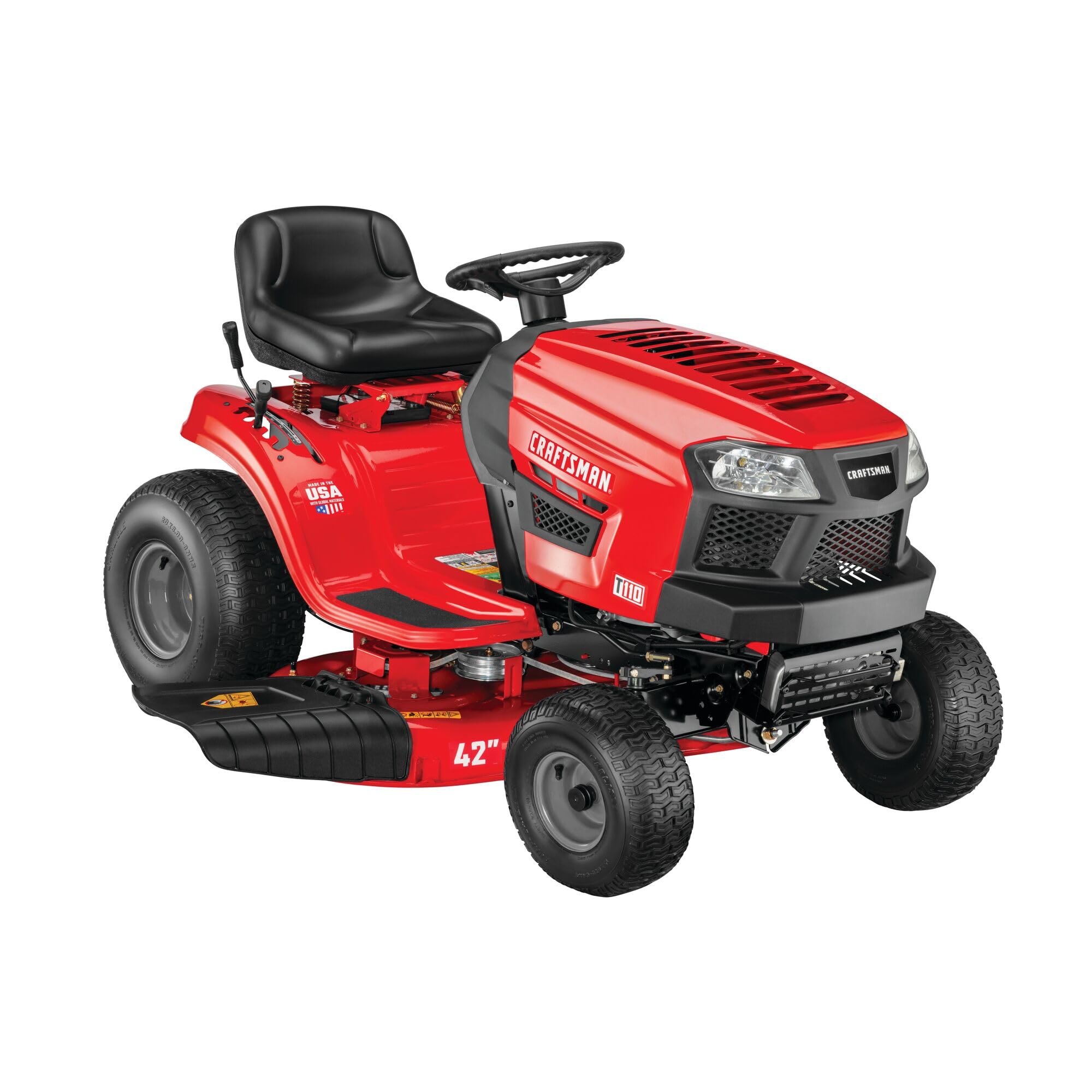
The Craftsman 42-inch gas tractor is not a true zero-turn mower — it uses a 7-speed manual transmission with an 18-inch turning radius — but it deserves mention as the value entry point for buyers who want a sharp cut on a limited budget. The Briggs & Stratton 17.5 HP single-cylinder engine starts easily and provides enough torque for the 42-inch stamped deck to handle 2 acres of typical fescue or Bermuda. The 18-inch turning radius is tighter than most lawn tractors, allowing better access around flower beds than a standard steering-wheel tractor.
Assembly is straightforward: attach the steering wheel, seat, and battery. The mower ships pre-filled with break-in oil, and the manual 7-speed transmission lets the user select the optimal ground speed for the grass condition. For a homeowner with a flat, open 1.5-acre lot who cannot justify the jump to a hydrostatic zero turn, this Craftsman delivers a clean cut in about 1.5 hours per session.
The main drawbacks are related to the transmission. The 7-speed manual requires a clutch and brake to shift, which slows down direction changes compared to a true zero turn. The blades disengage in reverse, a safety feature that can be frustrating when trimming near obstacles. A few owners reported the drive system failing within the first few hours, though this appears to be an outlier rather than a systemic defect. Consider this a capable lawn tractor, not a zero turn, and set expectations accordingly.
What works
- Briggs & Stratton engine provides reliable starting and adequate power for small lots.
- 18-inch turning radius is tighter than typical lawn tractors.
- Easy assembly with pre-filled oil and minimal tool requirements.
What doesn’t
- Manual 7-speed transmission is not a true zero-turn system.
- Blades disengage in reverse, limiting trimming efficiency.
- Seat is too small for operators over 6 feet tall or 210 pounds.
7. Swisher RC14544CPKA

The Swisher RC14544CPKA is a pull-behind rough cut mower designed for clearing brush, not manicured lawns. It attaches to any vehicle with a 2-inch receiver and uses a 14.5 HP Kawasaki V-twin engine to spin heavy-duty 1/4-inch steel blades that can shred saplings up to 2 inches in diameter. The 44-inch cutting width covers wide paths quickly, and the articulated hitch allows infinite offset adjustment so the mower tracks beside the towing vehicle rather than directly behind it.
The deck adjusts from 3 to 7 inches, which is higher than any residential zero turn, allowing the operator to clear uneven ground without scalping. Owners consistently report that the Swisher starts instantly and chews through blackberry thickets, sumac, and small trees without bogging. The remote control console lets the operator engage or disengage the blades from the towing vehicle, a real safety advantage when unexpected obstacles appear.
This mower is not a finish mower. The cut quality is rough — it leaves a shredded appearance that is ideal for trail maintenance, pasture topping, or power line access, not a putting-green lawn. The tires are a weak point: the 420-pound mower can cause sidewall failures on rocky ground. The breakaway blade system can lock up with debris, causing vibration. If your need is clearing overgrown property rather than weekly lawn maintenance, the Swisher is a purpose-built tool that fills a gap no zero turn can cover.
What works
- 14.5 HP Kawasaki V-twin handles 2-inch saplings without stalling.
- Articulated hitch allows offset positioning for clearing along fence lines.
- Remote blade engagement adds safety for the operator.
What doesn’t
- Rough cut deck produces a shredded finish, not suitable for lawns.
- Tires are prone to failure under the mower’s weight on rocky terrain.
- Breakaway blade system can lock up with debris, causing vibration.
Hardware & Specs Guide
Deck Construction
The deck is the structural core of any zero turn. Fabricated decks use multiple steel plates welded into a single rigid unit — typically 11 to 13 gauge — which resists flexing when the mower hits uneven ground or heavy grass. Stamped decks are pressed from a single sheet and are lighter and cheaper, but they can crack at weld points or warp under prolonged stress. Rough cut decks are often fabricated from heavier plate steel with reinforced spindles designed to withstand impacts from woody debris.
Engine Displacement and Cylinder Count
V-twin engines (Kawasaki, Kohler, Briggs Vanguard) produce higher torque at lower RPM and run smoother than single-cylinder units. Displacement, measured in cubic centimeters (cc), generally correlates with power: engines in the 600-725 cc range deliver 20-24 hp, which is the sweet spot for 46- to 54-inch decks. Single-cylinder engines in the 500-550 cc range are adequate for 42-inch decks on flat terrain but will struggle in wet or tall grass.
FAQ
What is the practical minimum horsepower for a 54-inch zero turn deck?
Can a zero turn mower handle slopes over 15 degrees?
How often should the hydrostatic transmission fluid be changed?
Final Thoughts: The Verdict
For most gardeners, the best overall cutting zero turn mower winner is the Husqvarna Z254F because its Kawasaki V-twin, fabricated ClearCut deck, and maintenance-free hydrostatic transmission deliver pro-level cut quality at a mid-range investment. If you want maximum acreage coverage without the vibration and fuel maintenance of gas, grab the EGO Power+ ZT5207L. And for steep-slope properties that no standard zero turn can safely navigate, nothing beats the DAREDEVIL VYPER.