
Buying a greenhouse is different from buying a shed. You are balancing light transmission against heat retention, ventilation against wind resistance, and a frame that will stand for years against one that will twist in the first storm. The wrong choice can cook your seedlings on a sunny afternoon or collapse under a modest snow load. This guide breaks down the real-world specs, frame material tradeoffs, and panel thicknesses that separate a functional growing environment from a frustrating kit.
I’m Rikta — the co-founder and writer behind Lawn Gear Lab. I’ve spent hundreds of hours dissecting polycarbonate panel weights, aluminum extrusion gauges, and read thousands of owner feedback reports to build this guide around real-world installation experiences and long-term durability patterns.
Whether you are starting seedlings, overwintering tender perennials, or aiming for year-round harvests, finding the right custom greenhouse means matching your climate, space, and budget to a structure that will hold up season after season without constant repairs.
How To Choose The Best Custom Greenhouse
The greenhouse market splits on two lines: frame material and panel quality. Aluminum frames resist corrosion and keep weight low, but they transmit cold more readily; wood frames offer natural insulation and a classic look but demand sealing and maintenance every few years. Polycarbonate panels range from 580 g/m² to 720 g/m² in this guide, with heavier panels providing better insulation and impact resistance. Your climate determines which tradeoffs are acceptable.
Panel Density and Heat Retention
Double-wall polycarbonate panels work by trapping air between two layers. Heavier panels — around 720 g/m² or thicker — reduce heat loss and resist hail or falling branches. Lighter panels (580 g/m²) transmit more light but allow greater temperature swings. In colder zones, panel weight is more important than frame material.
Ventilation and Temperature Management
Even in cool weather, an unvented greenhouse can reach 100°F within an hour of sun exposure. Roof vents are non-negotiable; the best designs place them high to draw out hot air via natural convection. Greenhouses with only one vent struggle during spring and fall when daytime sun is strong but nights are cold.
Anchoring and Foundation Requirements
A greenhouse acts like a sail in wind. Ground stakes alone are insufficient in exposed locations. Most kits recommend a treated lumber base or a concrete paver foundation. Some premium models include pre-drilled holes for anchoring and a galvanized steel base. Skipping a proper foundation is the most common cause of frame distortion in high winds.
Quick Comparison
On smaller screens, swipe sideways to see the full table.
| Model | Category | Best For | Key Spec | Amazon |
|---|---|---|---|---|
| Palram Canopia 6×14 | Premium Hybrid | Balanced light/insulation | Hybrid twin-wall roof + clear wall panels | Amazon |
| Backyard Discovery Zalie 11×7 | Premium Cedar | Year-round with power & water | 100% cedar frame, 4-wall PC, exhaust fan | Amazon |
| HOWE 16×12 Pavilion | Premium Large | Extra-large pavilion style | 16×12 FT footprint, 4 vent windows, double doors | Amazon |
| Yardenaler 8×16 Wooden | Premium Wood | Classic wood aesthetic | 6 mm panels, wood frame, 45° adjustable roof | Amazon |
| WUKHG 10×12 | Mid-Range Large | Budget large footprint | 5 mm panels, 35 MPH wind rating, 2 doors | Amazon |
| WUKHG 12×12 | Mid-Range Large | Square footprint for rows | 5 mm panels, 12×12 FT, electronic thermometer | Amazon |
| FLY BY YAN 8×14 | Mid-Range Long | Long narrow footprint | 720 g/m² panels, 3 roof vents, 8×14 FT | Amazon |
| Jiliusure 8×12 | Value Mid-Size | Slide-in assembly system | Reinforced aluminum, integrated rain gutter | Amazon |
| Jiliusure 8×10 | Value Mid-Size | Compact backyard option | Charcoal black finish, lockable sliding door | Amazon |
| Sylviera 8×10 | Value Large | Budget large with hygrometer | 580 g/m² panels, 2 roof vents, aluminum frame | Amazon |
| Jiliusure 8×8 | Entry-Level | Smallest footprint | 0.157 inch wall thickness, 1 roof vent | Amazon |
In-Depth Reviews
1. Palram Canopia 6×14 Greenhouse
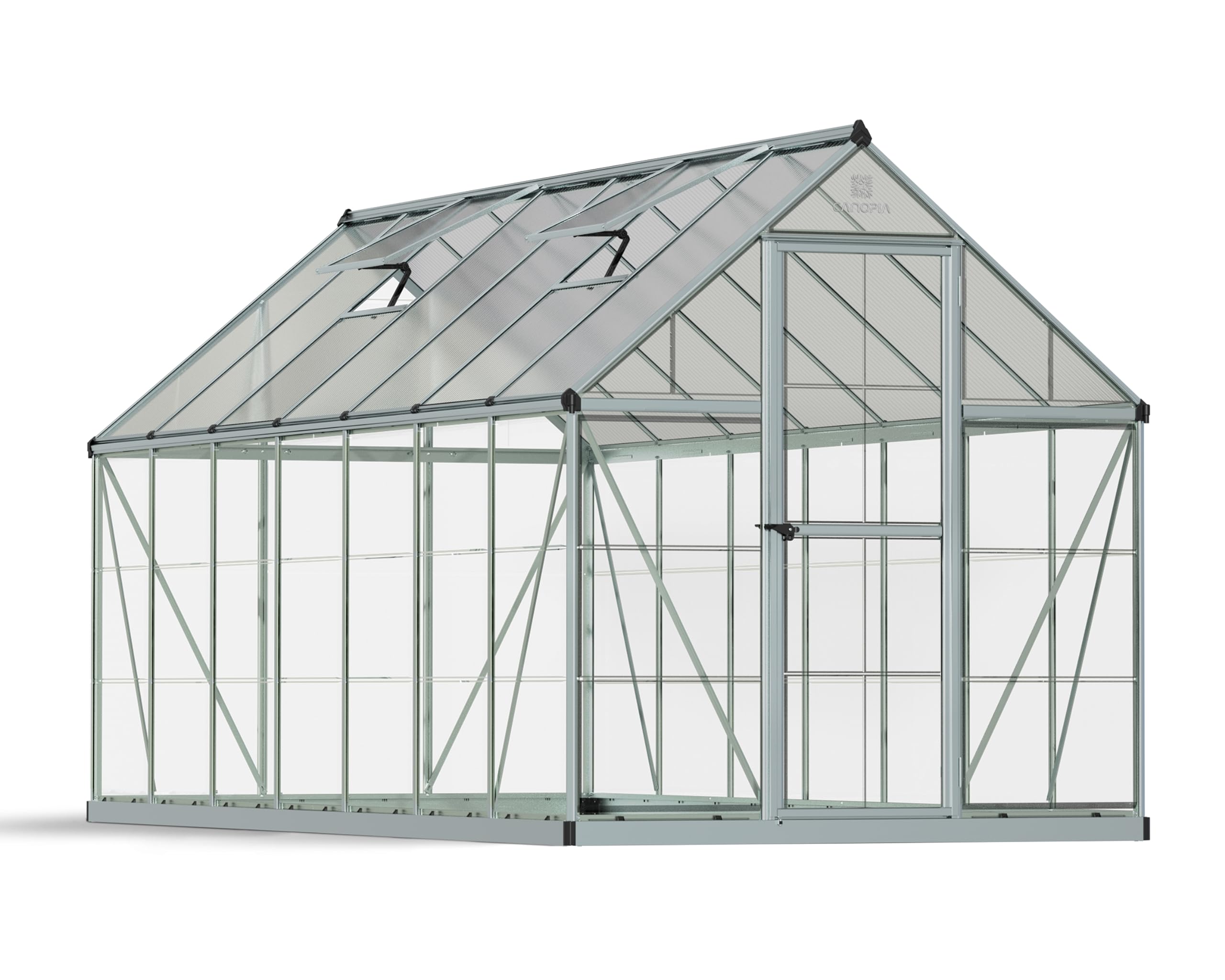
The Palram Canopia 6×14 combines two panel types: twin-wall polycarbonate roof panels for UV protection and heat retention, with clear wall panels providing over 90% light transmission. This hybrid approach lets you control the light intensity hitting your plants while keeping the structure solid. The powder-coated aluminum frame resists oxidation and the galvanized steel base adds genuine structural stability that you won’t find in most kits.
Owner reviews highlight straightforward assembly when you take your time—parts align well and spares are included. The built-in gutter system channels rainwater effectively, and the magnetic door catch is a thoughtful touch for days when you need airflow. Several users report the structure surviving storm seasons without issues, though some note that in sustained 30+ mph winds, additional anchoring or a tie-down kit is wise.
What you get here is a thoughtful, maintenance-free design with a reputation for lasting years. The hybrid panel strategy is unique in this price range and directly addresses the dual challenge of temperature swings and light diffusion that every greenhouse grower faces.
What works
- Roof panels block UV while clear walls maximize light transmission
- Galvanized steel base adds wind resistance missing in all-aluminum frames
- Magnetic door catch and rain gutters are practical daily-use details
What doesn’t
- Roof bracket numbering issue in some units can add 30 minutes to assembly
- Clear wall panels feel thin relative to the twin-wall roof sections
- Some owners add a wind tie-down kit for exposed sites
2. Backyard Discovery Zalie 11×7 Cedar Greenhouse

The Backyard Discovery Zalie moves beyond kit-grade construction with a 100% cedar frame that is naturally resistant to decay and rot. The 4-wall polycarbonate panels improve heat retention by about 30% compared to standard double-wall panels, and the temperature-activated exhaust fan provides forced ventilation that passive roof vents cannot match during still summer days.
This greenhouse is built for serious year-round use. The patented PowerPort includes three electrical outlets and three USB ports, while interior and exterior hose hook-ups make watering convenient. The 23 linear feet of staging shelves and a built-in workstation mean you can start seeds, pot plants, and store tools without bringing everything inside. Owners consistently praise the BILT app for interactive assembly guidance and report that the structure withstands heavy snow loads (up to 4,400 lbs) and high winds when properly anchored.
Assembly is time-consuming — expect several weekends — but pre-cut, pre-drilled, and pre-stained pieces simplify the process. The price point puts it in a different league, but for a gardener who wants electricity, running water, and a structure that will last two decades, the Zalie justifies every dollar.
What works
- 100% cedar frame offers natural rot resistance and better insulation than aluminum
- Temperature-activated exhaust fan prevents heat buildup even on still days
- Integrated electrical outlets and hose hook-ups eliminate extension cord and bucket hassles
What doesn’t
- Assembly requires significant time investment — several weekends for most people
- Blue UV coating on panels can be visually distracting until you get used to it
- Door panels are susceptible to shipping damage; manufacturer support is responsive
3. HOWE 16x12x9.5 FT Pavilion Greenhouse
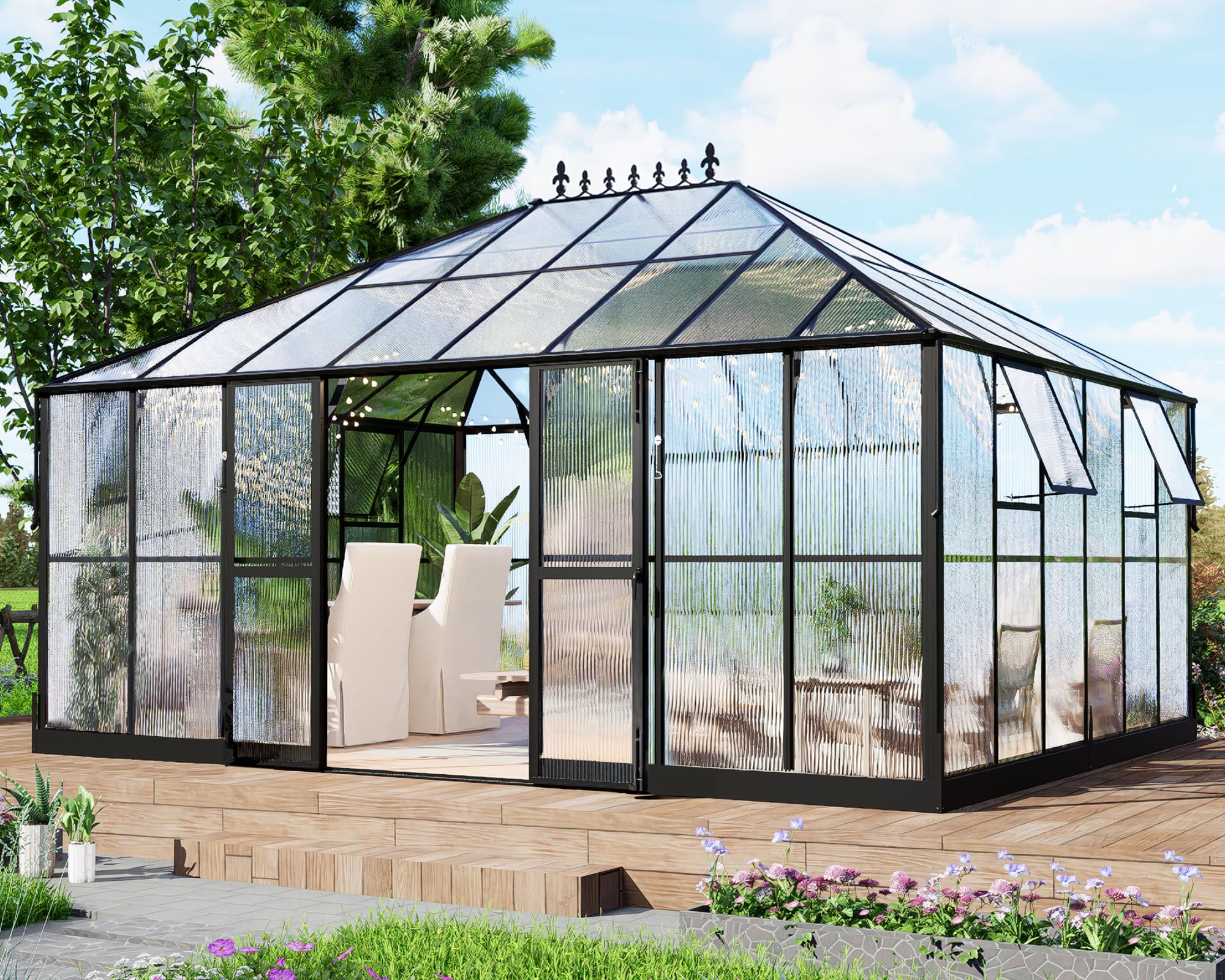
The HOWE 16×12 stands out with its pavilion-style design that adds architectural presence to your garden. The 6 mm polycarbonate panels are the thickest in this guide, providing exceptional insulation and impact resistance. Four vent windows, raised doors with a lower threshold, and double swing doors make access easy for wheelbarrows and larger equipment.
Owner reports are mixed on assembly complexity — careful owners who labeled and organized all parts before building had good experiences, while those who rushed found picture-only instructions frustrating. The aluminum frame feels flimsy during assembly but becomes rigid once fully bolted and anchored. In wind-prone areas, the provided ground stakes should be supplemented with a proper foundation.
Heating performance is impressive: owners reported interior temperatures in the 50s on 30°F days, and the 9.5 ft peak height means you never feel cramped. The gutters have sealable gaps that some owners filled with silicone. If you have the space and want a greenhouse that doubles as a garden room, the HOWE delivers size that few competitors match.
What works
- 6 mm panels provide the best insulation and impact resistance among options reviewed
- Raised threshold and double doors allow wheelbarrow access into the greenhouse
- High 9.5 ft peak creates comfortable standing room and hot air collection space
What doesn’t
- Picture-only instructions require patience and careful inventorying before starting
- Frame feels unstable until fully assembled and anchored; not a solo build
- Gutter design has gaps that require silicone sealing for proper drainage
4. Yardenaler 8×16 FT Wooden Greenhouse
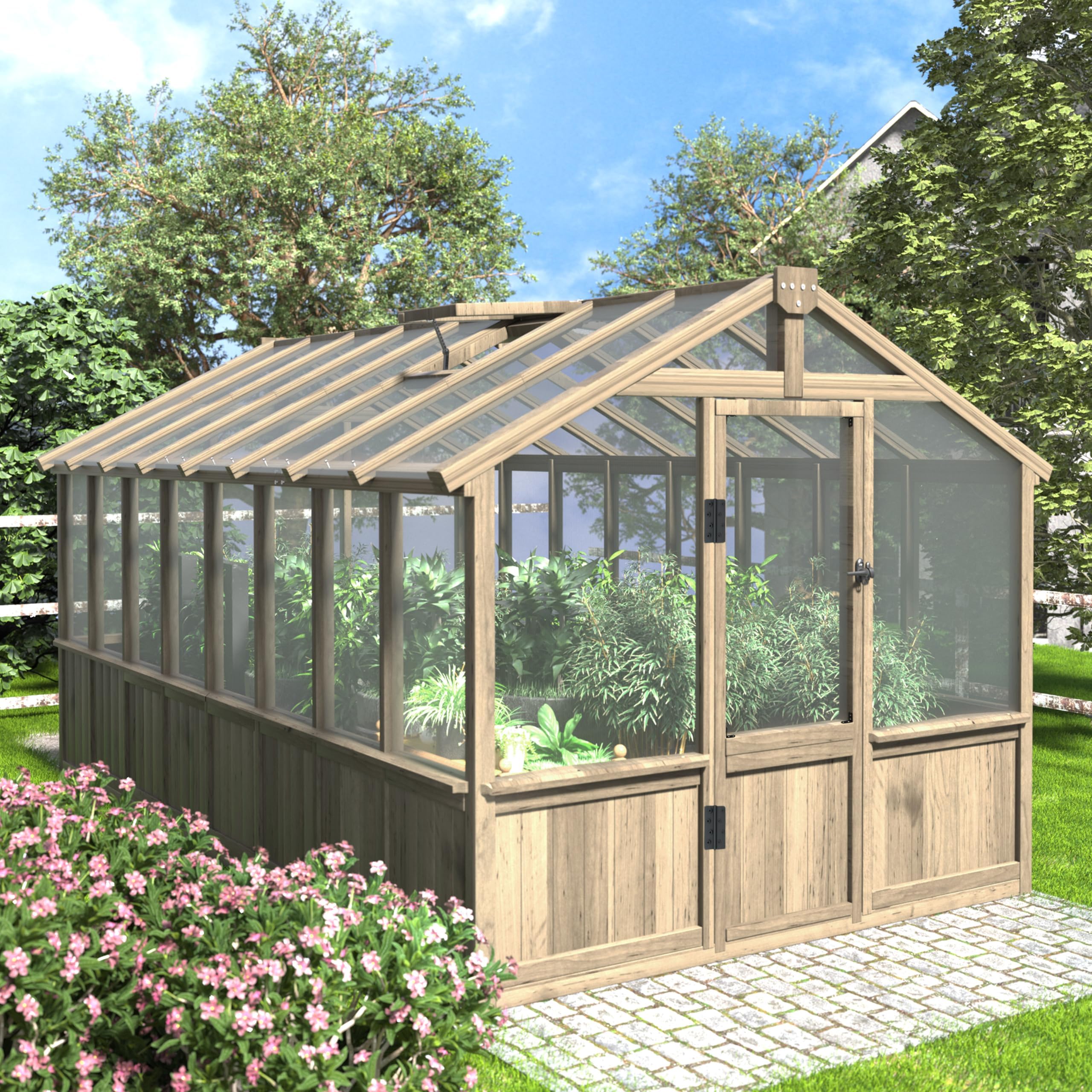
The Yardenaler 8×16 is a true wooden greenhouse — the frame is built from wood, not aluminum. The 6 mm multi-layer polycarbonate panels are an upgrade over the thinner panels found on budget kits, and the adjustable roof vent that opens up to 45 degrees gives you real control over airflow. The light mocha brown finish fits naturally into a garden setting without looking industrial.
Owners consistently report that the cedar frame smells great during assembly and that the structure feels solid once built. Assembly requires a 4×4 foundation — this is not a kit you place directly on grass. The pre-drilled holes in the frame are helpful, though some owners noted that thin wood can split if you over-tighten screws. The adhesive on the frosted film that comes with the panels can peel over time, but this does not affect structural integrity.
This greenhouse has been tested in 50-60 mph winds and blizzards without snow entering the structure. The 8×16 size (about 128 square feet) gives you room for several staging levels plus a seating area. If you prefer the look and insulation properties of wood over aluminum, the Yardenaler is the strongest wood-frame option at this price tier.
What works
- Cedar frame provides natural insulation and a classic aesthetic that aluminum lacks
- 6 mm panels offer genuine insulation for colder growing zones
- 45-degree adjustable roof vent gives superior ventilation control compared to fixed vents
What doesn’t
- Frosted film on panels has adhesion issues that may require replacement
- Thin wood can split at screw holes; pre-drilling with a smaller bit is recommended
- Requires a proper wood or concrete foundation — not a ready-to-go kit
5. WUKHG 10×12 FT Greenhouse
The WUKHG 10×12 delivers a 10×12-foot footprint — one of the largest in the mid-range category — with 5 mm polycarbonate panels and an aluminum frame. The manufacturer rates it for 35 MPH winds and a 20 PSF snow load, numbers that match up well with real owner experiences. Two doors and three vents provide decent cross-ventilation for a structure this size.
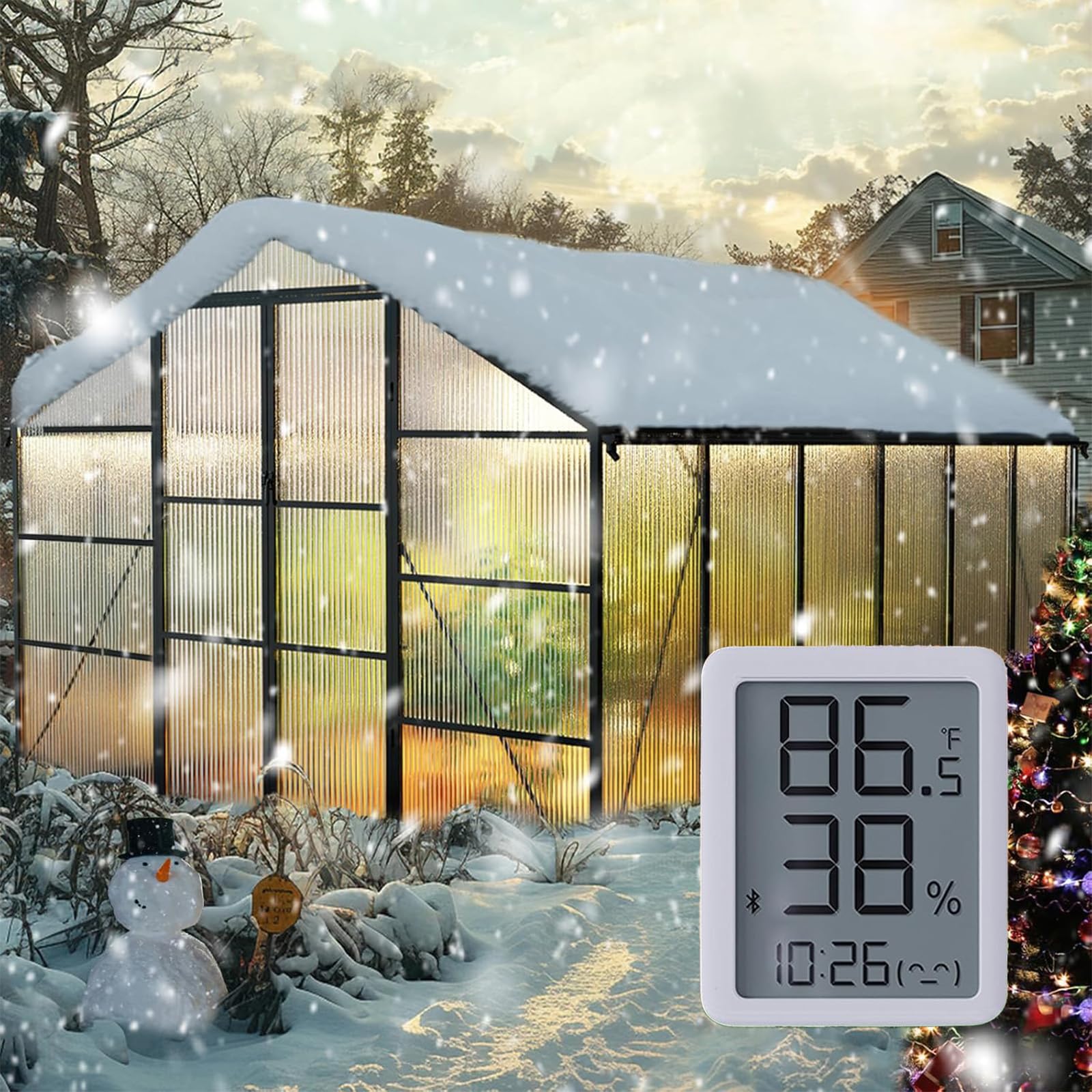
Assembly is best done with three people over a weekend. Some owners report mislabeled parts and a door crosspiece that may need modification to fit properly. The electronic thermometer included is a useful addition, though it is an entry-level unit. The structure tends to heat up quickly — over 100°F on a 40°F day — so automated vent openers are a smart upgrade if you are away during the day.
For the footprint you get, this greenhouse offers strong value. The panel thickness and frame quality sit in the middle of the pack, but the size alone makes it worth considering if you need to grow in volume and are prepared to handle a slightly more involved assembly process.
What works
- 10×12 footprint is genuinely spacious for starting plants in volume
- 5 mm panels provide better insulation than the more common 4 mm panels
- Rated snow load of 20 PSF offers confidence in moderate snow regions
What doesn’t
- Assembly instructions have ambiguous sections and some mislabeled parts
- Roof vent window can blow out if not securely installed on windy nights
- Heats up very quickly; passive vents alone cannot maintain safe daytime temperatures
6. WUKHG 12×12 FT Greenhouse
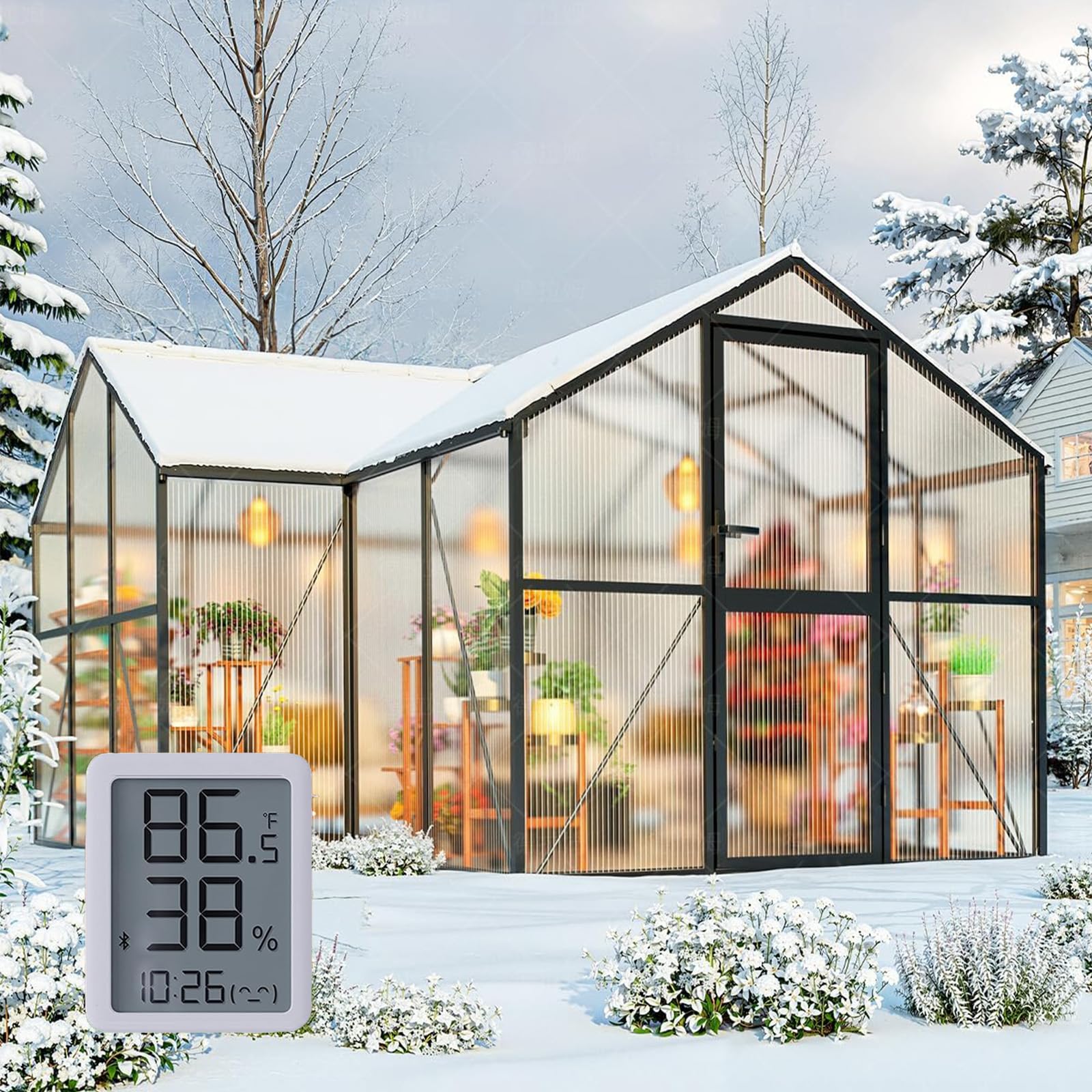
The 12×12 WUKHG follows the same design language as its 10×12 sibling but in a square format that maximizes interior layout flexibility. Square footprints allow more efficient bench and shelf arrangements compared to long narrow designs, and the 12×12 gives you 144 square feet of growing space. The 5 mm polycarbonate panels and aluminum frame are identical in construction to the 10×12 version.
Owner feedback closely mirrors the 10×12 model: the structure is sturdy when assembled, but the process requires patience. Some owners report windows falling out during assembly, which points to the need for extra silicone or sealant during installation. The included thermometer is helpful but does not connect to a phone app — it is a simple digital display.
The primary differentiator here is the square shape and larger total area. If you are planning a greenhouse with central aisles and benches along two walls, a square layout is more efficient than a long rectangle. The WUKHG 12×12 gives you that layout at a price well below premium brands, though you will invest more time in assembly than you would with a Palram.
What works
- Square 12×12 footprint enables efficient bench layout and easy access from any side
- 144 square feet is one of the largest growing areas for this price level
- Aluminum frame holds up well when anchored properly and silicone is used on gaps
What doesn’t
- Windows may fall out of tracks during assembly if panels are not seated firmly
- Some parts are mislabeled, requiring extra time to sort and identify
- Daytime temperatures spike rapidly; automatic vent openers are essential for unattended use
7. FLY BY YAN 8×14 FT Greenhouse
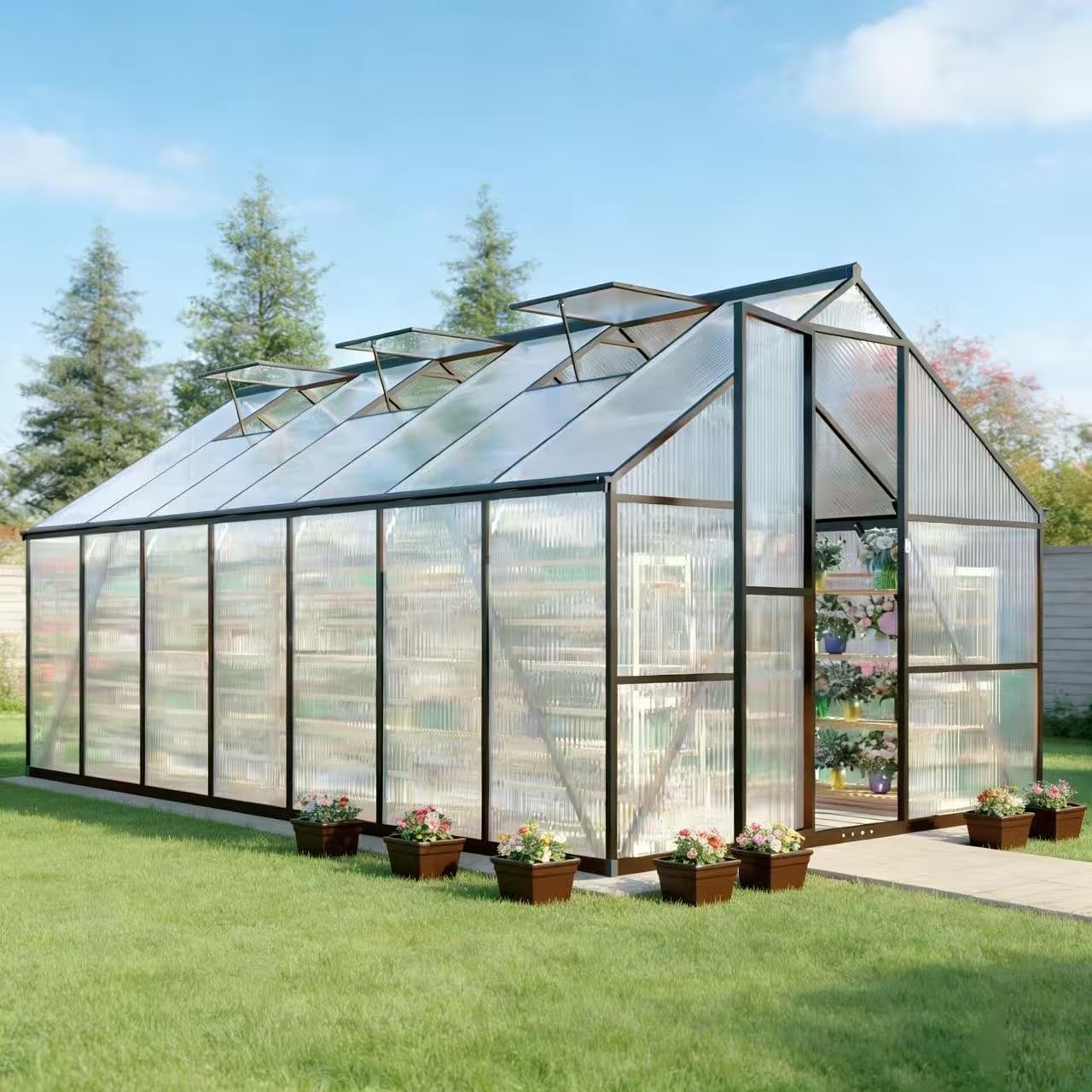
The FLY BY YAN 8×14 uses 720 g/m² polycarbonate panels — the heaviest standard panels in the mid-range category — paired with a reinforced aluminum frame. The three roof vents provide better hot-air extraction than two-vent designs, and the rain gutter system is integrated rather than added as a bolt-on. The charcoal black finish is scratch-resistant and hides dirt better than lighter colors.
Assembly requires 4-5 people and at least 6 hours. Some owners report misaligned bolt holes and poor-fitting window gaps, though others praised the pre-cut, numbered parts. The 8×14 shape works well for long, narrow garden spaces or for creating separate growing zones (cool side near the door, warm side at the far end). One owner documented this greenhouse surviving 60 mph winds with only minor damage, which speaks to the structural integrity when properly anchored.
The main tradeoff is assembly difficulty. If you have a helper crew and patience, this greenhouse delivers heavy-duty panels and good ventilation at a mid-range price. If you want a quick weekend build, look at the Jiliusure slide-in system instead.
What works
- 720 g/m² panels are the heaviest in the mid-range tier, improving insulation and impact resistance
- Three roof vents provide superior hot-air extraction compared to two-vent designs
- Survived 60 mph winds in real-world testing with only minor damage
What doesn’t
- Assembly requires 4-5 people and a full day — not a two-person weekend project
- Some bolt holes misalign and window gaps may not fit perfectly
- Panel material feels thin despite the high g/m² weight; door fit is imperfect
8. Jiliusure 8×12 FT Greenhouse
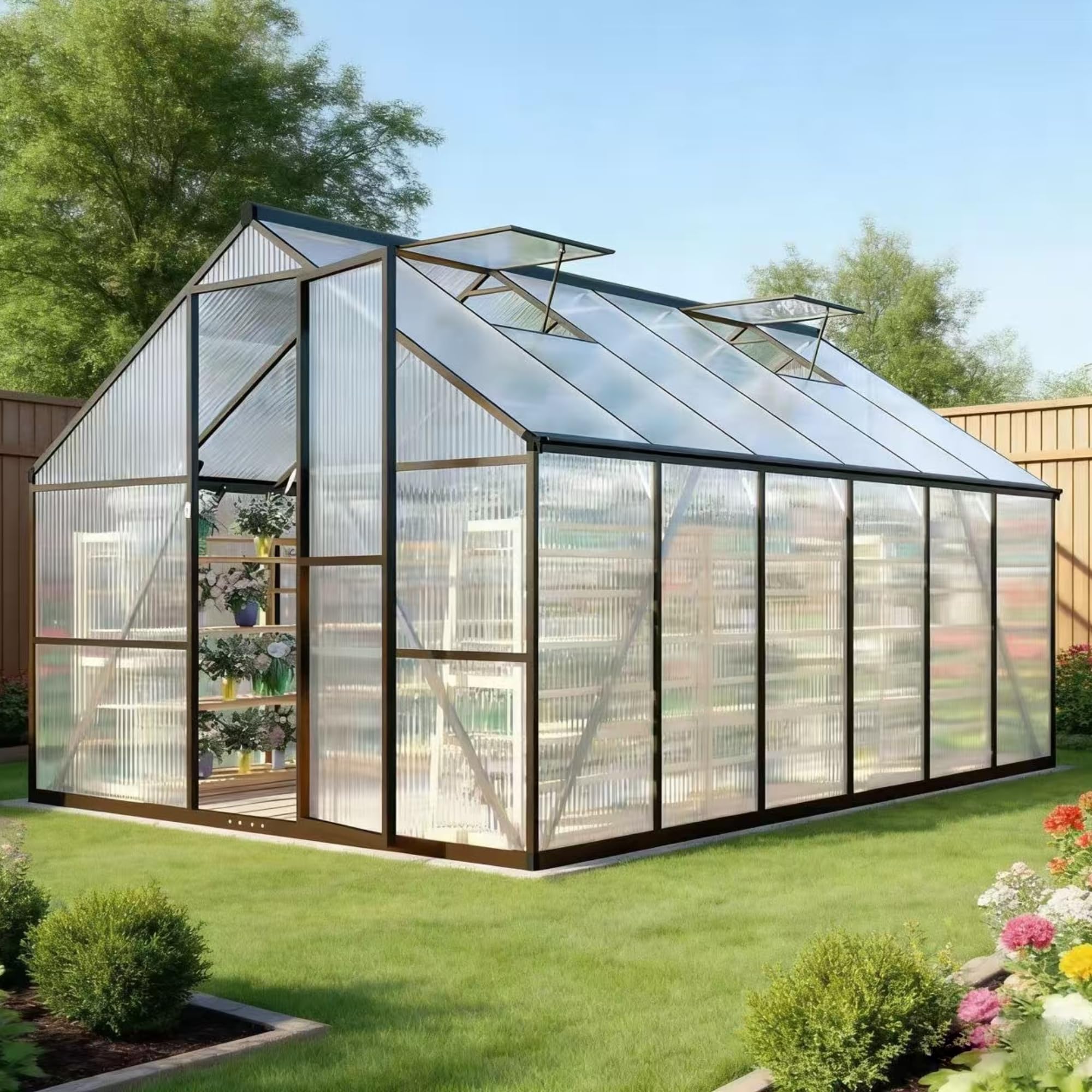
The Jiliusure 8×12 uses a slide-in panel assembly system that eliminates cutting and drilling. The reinforced aluminum frame and upgraded connectors are designed for stability, and the integrated rain gutter directs water away from the foundation. The charcoal black finish is scratch-resistant and blends into most garden environments.
Several owners praised the straightforward build — something worth noting in a category where assembly complaints dominate negative reviews. The frame holds up well in windy conditions and the double-wall panels diffuse light effectively. Some buyers reported that the actual interior dimensions are slightly smaller than advertised (closer to 7.5×11.5 ft), which matters for precise bench planning.
At this size, the Jiliusure hits a sweet spot between footprint and assembly complexity. You get 96 square feet of growing space with a gutter system that prevents water pooling at the base — a detail that many similarly priced greenhouses overlook.
What works
- Slide-in panel assembly is genuinely faster and easier than screw-in alternatives
- Integrated rain gutter protects the foundation from water damage
- Charcoal black finish is scratch-resistant and easy to maintain
What doesn’t
- True interior dimensions are slightly smaller than the 8×12 product title suggests
- Panel thickness (0.157 inch) is adequate but not premium
- Assembly instructions have some contradictory steps that require logical workarounds
9. Jiliusure 8×10 FT Greenhouse
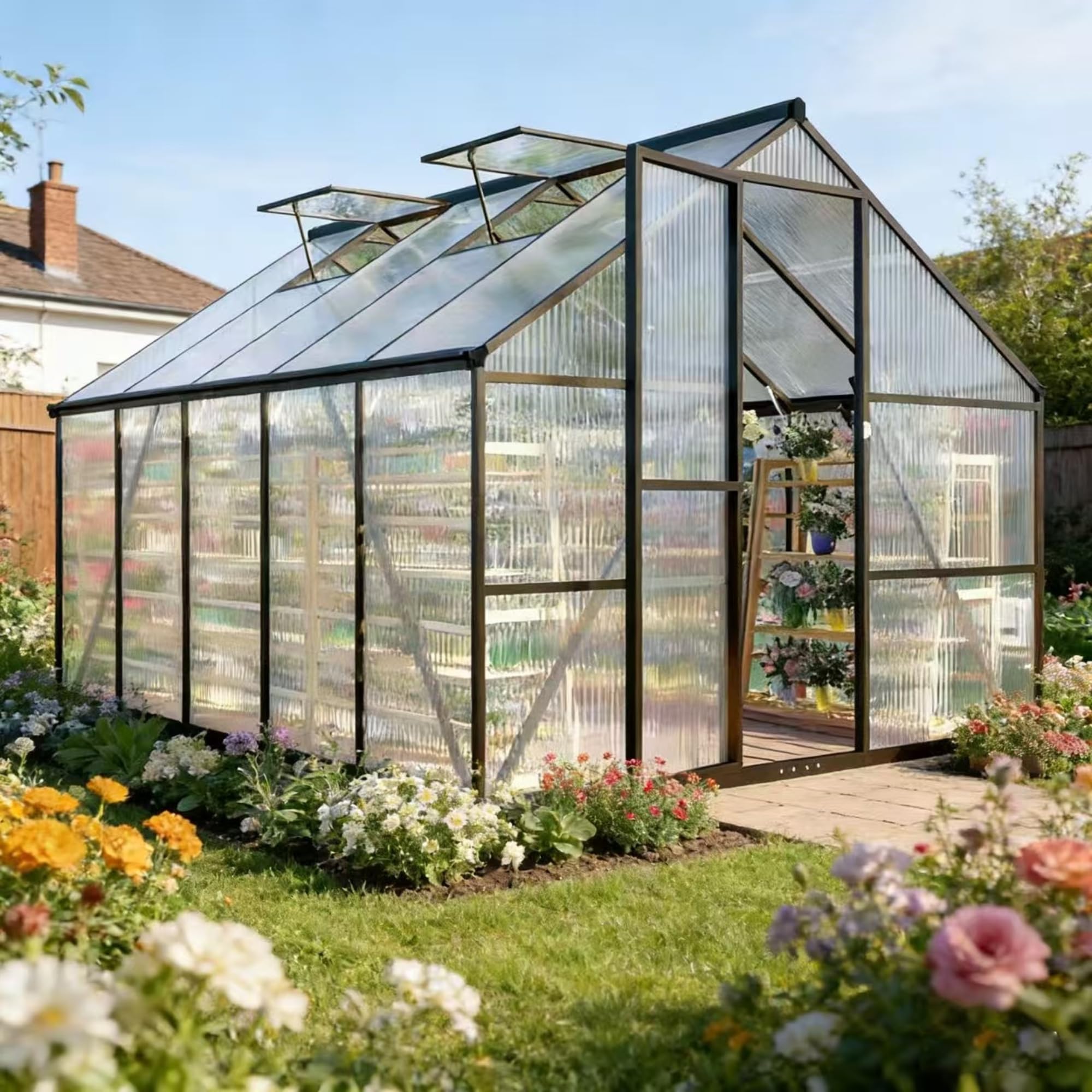
The Jiliusure 8×10 is the same design as the 8×12 but in a smaller footprint. The lockable sliding door saves space compared to a hinged door, and the single roof vent is adequate for a structure of this size. The same reinforced aluminum frame and slide-in panel system make assembly straightforward for two adults.
Owner experiences mirror the 8×12 version — most are satisfied with the build quality and wind resistance. The smaller size means you lose some interior flexibility, but the tradeoff is a lower cost and easier placement in tighter yards. The integrated gutter works well to keep water away from the door area.
This is a solid option if your space is limited and you want a greenhouse that you can assemble in a weekend without calling for extra help. The 8×10 offers 80 square feet — enough for several shelving units and a small work area.
What works
- Slide-in panel assembly is fast enough for a weekend build with two people
- Sliding door saves interior floor space compared to a swing door
- Good wind resistance for the price — holds up in moderate gusts
What doesn’t
- Single roof vent limits airflow; you may need an additional fan in warmer months
- Actual interior dimensions are slightly smaller than 8×10
- Panel thickness is adequate but thin panels reduce insulation in cold climates
10. Sylviera 8×10 FT Greenhouse
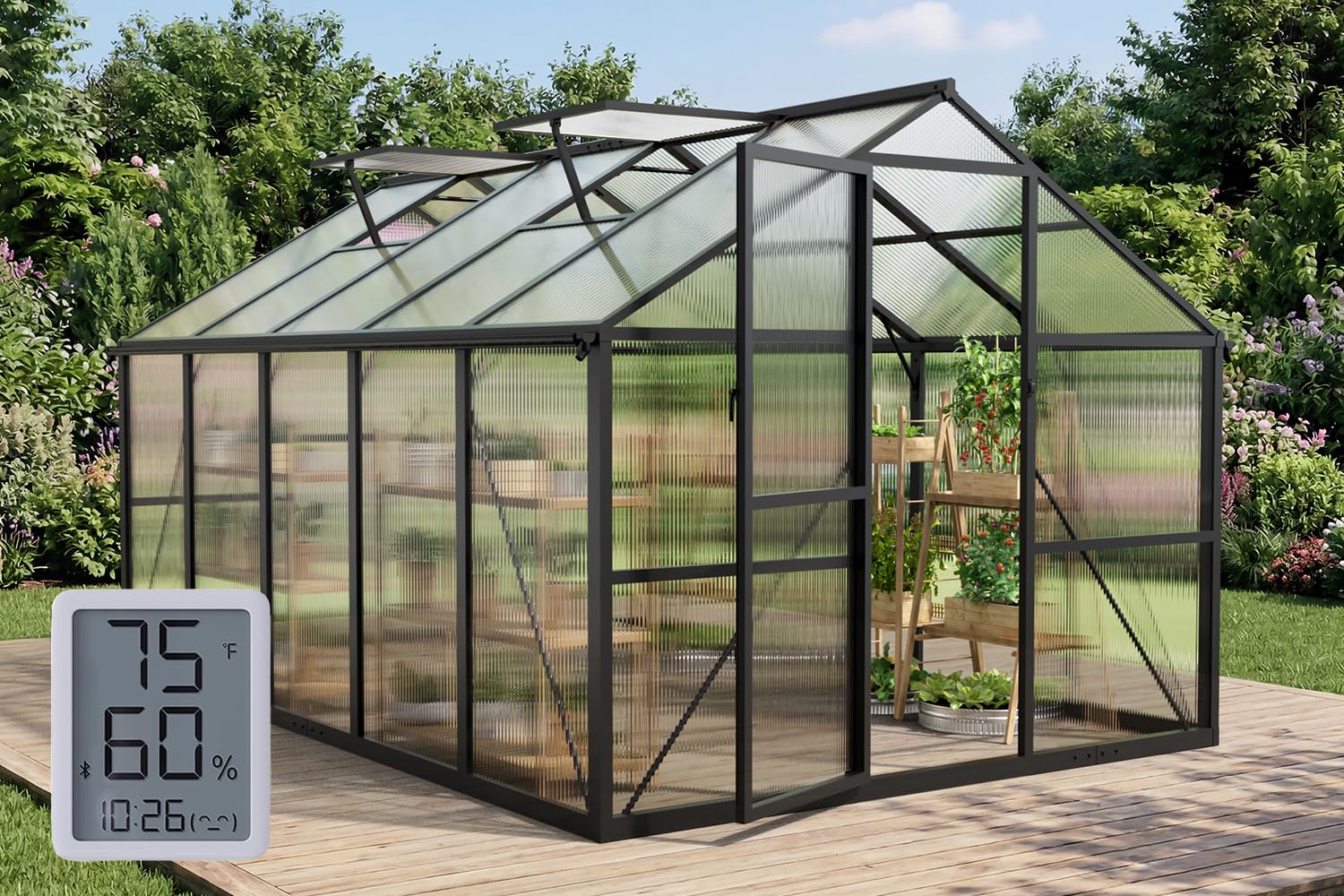
The Sylviera 8×10 includes a built-in hygrometer and uses 4 mm twin-wall polycarbonate panels (580 g/m²). The aluminum frame is reinforced at the corners, and two roof vents provide better airflow than single-vent designs. At this price, it competes directly with the Jiliusure line but adds the vent count advantage.
Owner reviews emphasize that the protective film must be removed from both sides of the panels before assembly — a step that the instructions do not highlight clearly. Some owners noted that the panels feel thinner than expected and recommended sealing panel gaps with silicone. The roof vents need rubber bands or a small prop to stay open, which is a minor annoyance.
For the budget-conscious buyer who wants a larger footprint, the Sylviera delivers. The hygrometer is a nice extra that saves you from buying one separately, and the two vents provide real ventilation improvement over single-vent designs. Assembly takes a weekend with two people, and the structure holds up well in moderate weather.
What works
- Two roof vents improve cross-ventilation compared to budget single-vent alternatives
- Included hygrometer saves a separate purchase and helps monitor humidity
- Aluminum frame feels stable when fully assembled and silicone-sealed
What doesn’t
- Protective film must be removed from both panel sides; assembly instructions skip this step
- Panels feel thin; sealing with silicone is essential for weather resistance
- Door fit has gaps that require weatherstripping in colder climates
11. Jiliusure 8×8 FT Greenhouse
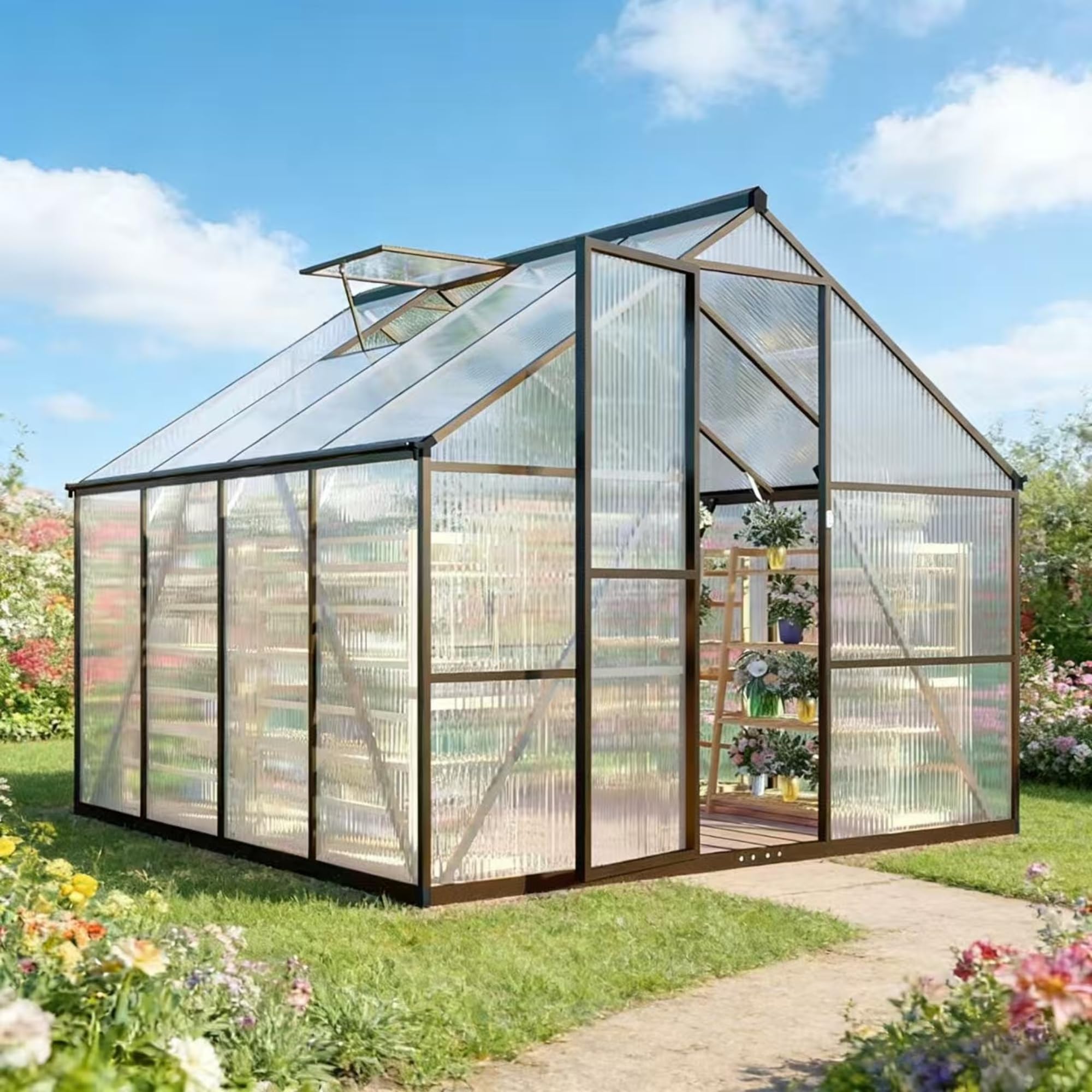
The Jiliusure 8×8 is the entry point into aluminum-framed polycarbonate greenhouses. At 64 square feet, it is compact enough for small backyards while still providing enough space for a shelving unit and a few larger pots. The slide-in panel system and reinforced aluminum frame mirror the larger Jiliusure models, and the integrated rain gutter is present even at this size.
Owners consistently note that the frame is strong for the price and that the lockable sliding door works well. The single roof vent is a limitation — on warm days, the interior heats up quickly and the lone vent cannot keep up. Several buyers recommended using the included ground-anchoring footings immediately, as the lightweight structure can shift in strong winds if not secured.
This is a budget-friendly entry-level option that gives you the basics: a solid aluminum frame, polycarbonate panels, and a reasonably fast assembly process. If you plan to use it seasonally for starting seedlings rather than year-round growing, the single vent limitation is manageable.
What works
- Slide-in panel system makes assembly faster than most entry-level kits
- Aluminum frame with reinforced connectors provides good stability for the price
- Integrated rain gutter is a detail typically missing at this price point
What doesn’t
- Single roof vent is insufficient for warm-day temperature control
- Lightweight frame requires secure anchoring to prevent wind movement
- Actual interior dimensions are smaller than the 8×8 title suggests
Hardware & Specs Guide
Polycarbonate Panel Weight
The most overlooked spec in greenhouse buying. Panel weight is measured in g/m² (grams per square meter). Budget greenhouses typically use 580 g/m² panels, while premium models use 720 g/m² or higher. Heavier panels provide better insulation, higher impact resistance, and longer lifespan. They also transmit slightly less light, which is beneficial in hot climates where light intensity can burn seedlings.
Frame Material and Maintenance
Aluminum frames do not rust, require no painting, and are easy to assemble. They also conduct cold more readily than wood, meaning you may need more heating in winter. Wood frames (cedar is the best choice) provide natural insulation and a classic appearance, but they require periodic sealing and are heavier to assemble. The frame gauge (wall thickness) matters — thicker extrusions resist twisting and last longer.
Ventilation: Roof Vents vs Exhaust Fans
Passive roof vents work by natural convection — hot air rises and escapes through high vents. Two vents provide significantly better airflow than one. Temperature-activated exhaust fans are expensive but prevent heat buildup automatically when you are away from the greenhouse. Greenhouses larger than 8×10 should have at least two vents or a fan to avoid temperature spikes on sunny days.
Foundation Requirements
Every greenhouse needs a level, stable base. The best foundations are a level concrete slab, a treated lumber perimeter frame on gravel, or concrete pavers. Greenhouses with a galvanized steel base (like Palram) are designed to be bolted directly to a foundation. Aluminum-only frames require a separately built base. Ground stakes alone are inadequate in most regions — they work only in completely sheltered, low-wind locations.
FAQ
What size greenhouse do I need for year-round vegetable growing?
Should I choose an aluminum or wood frame greenhouse?
How important is polycarbonate panel thickness for insulation?
Do I really need to anchor a greenhouse to a foundation?
Final Thoughts: The Verdict
For most gardeners, the custom greenhouse winner is the Palram Canopia 6×14 because it balances twin-wall roof insulation with clear wall light transmission, includes a galvanized steel base, and offers the lowest maintenance profile in the mid-premium range. If you want integrated electricity, water, and a cedar frame that will last two decades, grab the Backyard Discovery Zalie 11×7. And for a large footprint with thick 6 mm panels at a price that undercuts dedicated brand names, nothing beats the Yardenaler 8×16 Wooden Greenhouse.