
Bushes and shrubs anchor the landscape, but their deep root systems demand a different feeding strategy than annual flowers or lawn grass. A misapplied fertilizer burns feeder roots or pushes weak, leggy growth that can’t survive winter dormancy. The difference between a thriving hedge and a struggle with yellowing leaves often comes down to matching the nitrogen-phosphorus-potassium balance to the plant’s specific woody perennial biology.
I’m Rikta — the co-founder and writer behind Lawn Gear Lab. I’ve spent hundreds of hours cross-referencing NPK ratios, release mechanisms, and soil pH requirements against verified owner experiences to break down exactly what works for flowering shrubs, evergreens, and fruiting bushes.
Whether you’re tending azaleas, hydrangeas, or a mixed border of ornamentals, this guide cuts through the marketing to deliver the most reliable bush fertilizer options for your specific soil conditions and growth goals.
How To Choose The Best Bush Fertilizer
Selecting a fertilizer for bushes requires you to shift from a general plant-feeding mindset to one that respects the slower metabolism and greater nutrient storage capacity of woody perennials. Three factors dominate the decision.
Match the NPK Ratio to the Growth Stage
Shrubs in their first two years need a balanced formula like 4-4-4 or 16-16-16 to establish a robust root system and branching structure. Once established, flowering shrubs respond best to a phosphorus boost — look for the middle number to be at least as high as the first. For evergreens and foliage-focused bushes, a higher nitrogen ratio supports dense leaf production without sacrificing root health.
Choose Between Granules, Spikes, and Liquid Concentrates
Granular fertilizers spread over the root zone and water in, offering even coverage for large beds. Spikes deliver nutrients directly to the root ball without runoff, making them ideal for individual specimen shrubs and preventing weed feeding. Liquid concentrates provide the fastest green-up but require frequent reapplication, which is less practical for deep-rooted bushes that benefit from a steady supply over weeks or months.
Verify Organic Certification and Soil Compatibility
OMRI-listed organic fertilizers feed the soil microbiome alongside the plant, building long-term tilth and reducing the risk of salt buildup that synthetic formulas can cause. For acid-loving bushes — rhododendrons, azaleas, camellias, blueberries — a specialized low-pH blend with added sulfur or iron prevents chlorosis and unlocks micronutrients otherwise locked in alkaline soil.
Quick Comparison
On smaller screens, swipe sideways to see the full table.
| Model | Category | Best For | Key Spec | Amazon |
|---|---|---|---|---|
| Supply Solutions 16-16-16 | Granular All-Purpose | Balanced feeding for young shrubs | NPK 16-16-16 | Amazon |
| FoxFarm Happy Frog 6-4-5 | Organic Granular | Gentle feeding with soil microbes | NPK 6-4-5 | Amazon |
| Espoma Holly-Tone 4-3-4 | Acid-Loving Formula | Azaleas, rhododendrons, hydrangeas | NPK 4-3-4 with 5% Sulfur | Amazon |
| Espoma Rose-Tone 4-3-2 | Bloom-Boosting Organic | Roses, bougainvillea, clematis | NPK 4-3-2 with 5% Calcium | Amazon |
| Jobe’s Organics 4-4-4 | OMRI Granular All-Purpose | Large beds and heavy feeders | NPK 4-4-4, 16 lbs bag | Amazon |
| Jobe’s Tree Spikes 16-4-4 | Slow-Release Spikes | Individual shrubs and trees | NPK 16-4-4, 30 spikes | Amazon |
| GreenView Fairway 27-0-5 | High-Nitrogen Lawn Feed | Turf around shrubs (not bushes) | NPK 27-0-5, 10k sq ft cover | Amazon |
In‑Depth Reviews
1. Espoma Organic Rose-Tone 4-3-2

The Espoma Rose-Tone delivers a 4-3-2 NPK ratio that prioritizes phosphorus and potassium over nitrogen, which is exactly what repeat-blooming shrubs need to sustain flower production without forcing excessive leaf growth. The inclusion of 5% calcium strengthens cell walls in stems, reducing the risk of black spot and powdery mildew on susceptible varieties like hybrid tea roses and knockout shrubs. Its Bio-tone microbial inoculant accelerates nutrient cycling in the root zone, making nutrients available even in cooler spring soils when biological activity is still low.
<
Owner reports confirm that drift roses and climbing varieties respond within three weeks — one reviewer noted a dramatic transformation from spindly canes to lush, multi-bloom plants after applying one cup per mature shrub monthly through September. The organic formulation breaks down gradually over roughly four weeks, providing steady feeding without the salt buildup that can damage surface feeder roots. The 4-pound bag covers approximately ten established bushes per season when applied at the recommended rate.
Drawbacks center on the strong earthy odor, which arises from the composted poultry manure base. Indoors or confined spaces are not suitable during storage. A few users also mention the granules clump if exposed to humidity before the bag is fully closed — resealing with a clip or storing in a dry shed solves the issue. For any gardener growing flowering bushes, especially in ornamental beds where bloom count determines visual impact, this is the most targeted and effective option.
What works
- Calcium fortification improves stem strength and disease resistance
- Bio-tone microbes boost nutrient uptake in cool soils
- Ideal phosphorus level for continuous blooming on repeat-flowering shrubs
What doesn’t
- Strong poultry-based odor during and after application
- Granules can clump in humid storage conditions
- Bag size is small for very large mixed shrub borders
2. Espoma Organic Holly-Tone 4-3-4
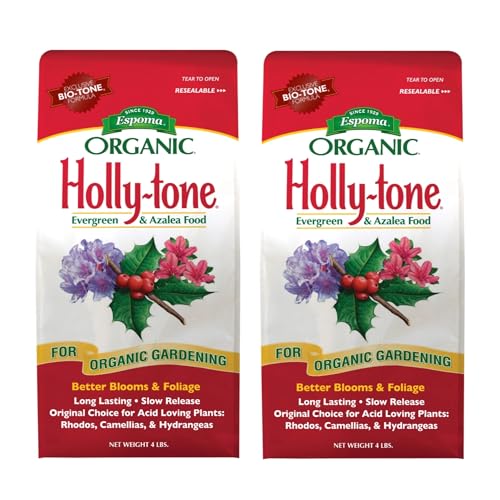
Holly-Tone is the original specialized fertilizer for acid-loving bushes, carrying a 4-3-4 NPK that delivers balanced macro-nutrients while the 5% sulfur content gradually lowers soil pH over several weeks. This makes it indispensable for rhododendrons, azaleas, hydrangeas, blueberries, and camellias — plants that cannot efficiently absorb iron and manganese in neutral or alkaline soils. The sulfur works with existing soil bacteria to acidify the root zone, unlocking micronutrients that prevent the interveinal chlorosis that turns leaves yellow while veins stay green.
User feedback from southern gardens with naturally alkaline clay soils is overwhelmingly positive. One reviewer revived a large, older rhododendron that had been declining for two seasons — after applying Holly-Tone around the drip line and watering in, the shrub bloomed heavily within two months. The formula is OMRI-listed and contains no synthetic chemicals or sludge byproducts. Application windows are spring and fall for flowering shrubs, with a separate early- and late-spring schedule for fruiting bushes like blueberries and strawberries.
The powder-like consistency can create dust during application if the soil is dry; wearing a mask and dampening the soil beforehand minimizes this. The two-bag pack is a strong value for gardeners with multiple acid-loving specimens, and the slow organic breakdown means one spring feeding supports growth through the main season without a second dose unless soil tests indicate deficiency.
What works
- 5% sulfur effectively acidifies soil for iron-sensitive bushes
- OMRI-listed with no synthetic additives or sludge
- Two-bag pack provides excellent coverage for multiple shrubs
What doesn’t
- Powder form creates dust when applied to dry soil
- Strong smell that attracts pets if left on the surface
- Not suitable for alkaline-loving shrubs like lilacs or clematis
3. Supply Solutions 16-16-16 All Purpose
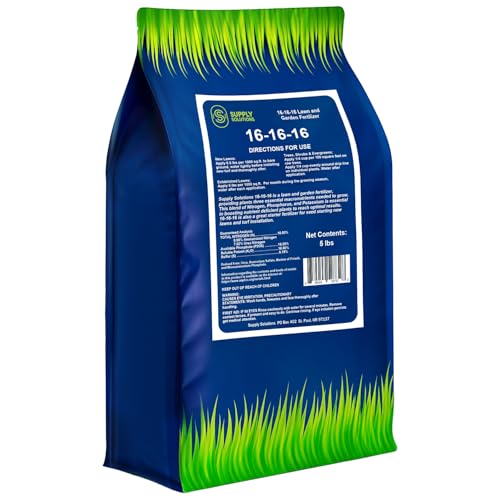
The Supply Solutions 16-16-16 is a synthetic granular fertilizer that provides an equal and highly concentrated dose of nitrogen, phosphorus, and potassium. This 1:1:1 ratio makes it a strong choice for establishing newly planted bushes or for a heavy spring green-up on established hedges where you want rapid, uniform growth across the entire plant. The 5-pound bag covers 2,500 square feet, making it economical for large shrub borders, foundation plantings, or mixed perennial beds containing both bushes and flowers.
Owner reports consistently mention fast results. One reviewer saw tomatoes and peppers visibly improve within five days, while another cited that a 6-foot rose grew 3/8-inch-thick canes in two months after switching from a failed specialized rose food. The granules are fine enough to distribute evenly with a handheld broadcast spreader, and the formulation dissolves steadily with rainfall or irrigation. For gardeners who want a simple, single-product solution for mixed plantings that include bushes, vegetables, and lawn edges, this is the most straightforward option.
The synthetic nature means it can burn tender roots if over-applied, especially on shallow-rooted shrubs like azaleas or camellias. Following the label rate precisely and watering in immediately is critical. Additionally, the balanced high-nitrogen content may cause excessive leafy growth at the expense of blooms on mature flowering shrubs, so it is best reserved for the establishment phase or for evergreen hedges where foliage density is the primary goal.
What works
- Highly concentrated formula requires less product per square foot
- Rapid green-up visible within days on most shrubs
- Fine granules spread easily with a standard broadcast spreader
What doesn’t
- Must be watered in immediately to prevent root burn
- High nitrogen can reduce flowering on mature bloomers
- Synthetic formula does not improve soil microbiology
4. FoxFarm Happy Frog 6-4-5

FoxFarm Happy Frog is built around the principle that healthy soil drives healthy plants, and its 6-4-5 NPK formulation is designed to complement — not overwhelm — existing soil biology. The key differentiator here is the inclusion of active soil microbes and mycorrhizal fungi that colonize root systems and extend the effective root zone, allowing bushes to access water and nutrients beyond the immediate root ball. This makes it especially valuable for transplanting new shrubs or for rehabilitating bushes in compacted or degraded soil where biological activity is low.
Several owners report that yellowing tomato and zucchini plants recovered within a week of application, and the same response is observed on flowering shrubs. The gentle release profile means you can apply it monthly through the growing season without worrying about salt buildup or root burn — a significant advantage over synthetic high-nitrogen products. The 4-pound bag is compact but goes further than expected because the recommended application rate is lower than many competitors. The formula is OMRI-listed, so it is fully compliant with organic growing standards.
The most common complaint is the manure-like smell that lingers for several days after application, which can be off-putting in containers or raised beds near patios. A few users also noted white mold forming on the surface if the granules were layered too thickly without raking in. Despite these cosmetic issues, the soil-building effects and safety profile make Happy Frog one of the best choices for the gardener focused on long-term soil health rather than a quick green fix.
What works
- Beneficial soil microbes and mycorrhizae improve root efficiency
- Gentle, slow release virtually eliminates risk of root burn
- OMRI-listed for certified organic gardening
What doesn’t
- Strong manure odor persists for days after application
- White mold can form if granules are applied too thickly
- Small bag size may require multiple purchases for large borders
5. Jobe’s Organics 4-4-4 All Purpose

The Jobe’s Organics 4-4-4 is the largest organic granular option in this guide at 16 pounds, making it the logical choice for gardeners feeding a substantial mixed border, hedge row, or community plot. The balanced NPK is intentionally low and slow — the 4-4-4 ratio provides steady background nutrition without pushing explosive growth, which reduces the risk of burning shallow feeder roots on established bushes. The bag is resealable, a practical feature for those who do not use the entire supply in one session, and the granules are small enough to flow smoothly through a hand crank or drop spreader.
Owner feedback highlights the product’s versatility: one user mixed it into a liquid tea for weekly drenching on squash and peppers with impressive yield results, while another applied the dry granules directly to a lawn with a hand spreader for even coverage. The OMRI listing confirms no synthetic chemicals, which is important for gardeners who also grow edible berries or herbs near their ornamental shrubs. For large-scale organic feeding where convenience and coverage matter, this is the most economical choice per pound of nitrogen.
The slow-release nature means that results are not as visually dramatic as a synthetic high-nitrogen feed — expect gradual greening over two to three weeks rather than a five-day transformation. The bag’s weight (16 pounds) can be awkward for users with mobility issues, and the resealable closure does not always hold perfectly if the bag is stored in a humid garage. For those who prioritize soil health over instant results and need to feed a large area, the trade-offs are minor.
What works
- 16-pound bag offers the lowest cost per application in this guide
- Resealable packaging protects granules from moisture
- Can be used dry or steeped into a liquid tea for foliar feeding
What doesn’t
- Visual results take two to three weeks to appear
- Heavy bag can be difficult to handle for some gardeners
- Resealable closure may fail in humid storage conditions
6. Jobe’s Tree Spikes 16-4-4

Jobe’s Tree Spikes offer a fundamentally different delivery mechanism: pre-measured 16-4-4 spikes that are hammered into the soil around the drip line of individual bushes and trees. This design eliminates runoff, waste, and the risk of over-application because each spike releases nutrients slowly over an entire growing season. The high first number (16) drives strong leaf and stem development, which is excellent for deciduous shrubs, lilacs, hydrangeas, and roses of Sharon that need to rebuild canopy after pruning or winter dieback.
Users repeatedly cite ease of application as the primary advantage. One reviewer reported using the spikes on hydrangea, lilac, honeyberry, and peonies each spring with consistently vigorous blooming. Another noted that the spikes are particularly effective for drought-stressed trees, helping them recover after a single season. The 30-count package is enough for ten medium-sized shrubs (three spikes per bush depending on diameter), and the slow-release formulation means a single application in early spring feeds through fall without additional labor.
The spikes require pounding into the ground, which can be difficult in rocky or heavily compacted soil — several users recommend pre-drilling holes with a metal rod or rebar to avoid bending the spikes. They are not ideal for shallow-rooted acid-lovers like azaleas, where the concentrated release may be too strong for the fine feeder roots. For the gardener with a mix of established deciduous bushes who wants a set-and-forget solution, the labor savings are substantial.
What works
- No runoff, no measuring, no mess — one application feeds all season
- High nitrogen content drives fast canopy regrowth after pruning
- 30-count package covers multiple shrubs with a single purchase
What doesn’t
- Difficult to install in rocky or compacted soil without pre-drilling
- Concentrated release can damage shallow-rooted acid lovers
- Spikes cannot be split for smaller or container-grown bushes
7. GreenView Fairway Formula 27-0-5

The GreenView Fairway Formula is a high-nitrogen lawn fertilizer with a 27-0-5 NPK that contains zero phosphorus. It is included in this guide because many gardeners use lawn fertilizer around shrub beds, but this product is fundamentally formulated for turf grass, not for woody perennials. The 63% slow-release nitrogen feeds grass for up to twelve weeks, and the 33-pound bag covers 10,000 square feet, making it a practical choice for those who want to feed the entire property with one product and are willing to accept suboptimal results for the bushes.
Owner reviews confirm excellent lawn greening — several users report dark green color within days and sustained growth through the spring. The zero-phosphate formulation is designed to protect waterways, which is a genuine environmental benefit in areas with runoff concerns. For those who maintain a mixed lawn-and-shrub landscape and prioritize the turf over the bushes, this is an efficient single-product solution. The slow-release nitrogen also means fewer applications per season compared to fast-release lawn foods.
Using this product on flowering bushes is counterproductive because the extreme nitrogen-to-phosphorus ratio forces leafy growth at the expense of blooms. Additionally, the lack of phosphorus means that flowering and fruiting shrubs will eventually become deficient if this is the only fertilizer they receive. This product belongs firmly in the lawn fertilizer category and should only be used around bushes if the user is deliberately managing a phosphorus-restricted environment based on a soil test. For best results on bushes, choose a product with a more balanced or phosphorus-forward ratio.
What works
- Excellent slow-release nitrogen greets lawn quickly and lasts 12 weeks
- Zero phosphate protects waterways from nutrient runoff
- 33-pound bag covers large properties economically
What doesn’t
- Zero phosphorus starves flowering and fruiting shrubs over time
- High nitrogen forces foliage growth at the expense of blooms
- Formulated for lawns, not for the specific needs of woody perennials
Hardware & Specs Guide
Understanding NPK Ratios for Bushes
The three numbers on a fertilizer bag stand for nitrogen (N), phosphorus (P), and potassium (K). For bushes, nitrogen drives leaf and stem growth, phosphorus supports root development and flower/fruit production, and potassium strengthens cell walls and disease resistance. A ratio like 4-3-4 is considered balanced for flowering shrubs, while a 1-1-1 or 2-1-1 ratio (such as 16-16-16) is better suited for the rapid establishment phase of new plantings. Avoid ratios with a zero middle number for any bush you expect to bloom.
Slow Release vs. Quick Release
Slow-release fertilizers (coated granules, organic meals, or spikes) meter nutrients out over weeks or months, providing a steady supply that matches the slow growth rate of woody plants. Quick-release synthetic fertilizers deliver an immediate nitrogen spike that can push tender new growth susceptible to late frosts or pest pressure. For established bushes, a slow-release or organic formulation reduces the risk of burning roots and supports consistent health without the boom-and-bust cycle of synthetic fast-release products.
FAQ
What NPK ratio is best for flowering bushes?
Can I use the same fertilizer on acid-loving bushes and neutral-soil shrubs?
Final Thoughts: The Verdict
For most gardeners, the bush fertilizer winner is the Espoma Organic Rose-Tone because its calcium-amended 4-3-2 formula directly supports repeat blooming and stem strength across the widest range of flowering shrubs. If you need an acid-loving formula for azaleas or hydrangeas, grab the Espoma Holly-Tone. And for a no-fuss, season-long feeding of established deciduous bushes, nothing beats the Jobe’s Tree Spikes.