
Reach for a cordless blower and you instantly cut the tether that ties you to an outlet. The trade-off used to be weak air speed or a dead battery halfway through the yard, but the latest brushless motors and high-capacity lithium packs have flipped that equation. Now the question isn’t whether to go cordless — it’s which voltage, CFM, and battery ecosystem gives you the strongest return for your time.
I’m Rikta — the co-founder and writer behind Lawn Gear Lab. I spend hours comparing specification sheets, studying brushless motor efficiency curves, and analyzing thousands of owner feedback threads to separate real-world performance from marketing claims in the power equipment space.
The selection of a strong, reliable unit from the list of the top cordless blowers depends on matching air volume to your property size, battery runtime to your cleanup tolerance, and platform compatibility to your existing tool collection.
How To Choose The Best Cordless Blowers
Selecting the right cordless blower requires understanding three key pillars: air power metrics, battery architecture, and motor technology. Ignore any one and you risk buying a tool that either lacks the muscle to clear wet leaves or dies before you finish the driveway.
CFM vs. MPH — Which Number Matters More?
CFM (cubic feet per minute) measures the volume of air the blower moves. MPH (miles per hour) measures the speed of that air. For moving large piles of dry leaves, a high CFM number (530+) is your priority because it pushes a wider column of air. For dislodging stuck debris from gravel or damp grass, a high MPH (over 120) helps concentrate the stream. Mid-range units often balance both, while premium models offer a turbo mode that spikes MPH for stubborn spots.
Battery Voltage and Amp-Hour Ratings Decoded
A 20V blower is fine for patios, walkways, and light deck sweep-ups but will struggle with a quarter-acre of oak leaves. 40V platforms (from brands like WORX, RYOBI, and SKIL) deliver the sweet spot for most suburban lots, offering enough sustained power for 20–30 minutes of continuous use. 60V systems (Greenworks) approach gas-equivalent performance but come with heavier batteries and higher upfront costs. Pay attention to Ah (amp-hour) as much as voltage — a 4.0Ah battery stores twice the energy of a 2.0Ah, directly translating to longer runtime between charges.
Brushless vs. Brushed Motors
Every cordless blower worth buying today uses a brushless motor. Brushless designs eliminate physical brushes that create friction, heat, and wear, resulting in longer motor life, quieter operation, and up to 50% more runtime per charge compared to brushed equivalents. If you see a blower that doesn’t mention “brushless,” it is a budget-tier product with lower performance and shorter lifespan.
Quick Comparison
On smaller screens, swipe sideways to see the full table.
| Model | Category | Best For | Key Spec | Amazon |
|---|---|---|---|---|
| RYAHT DD8179 | Entry-Level | Patios & light debris | 20V, 2×2.0Ah batteries | Amazon |
| Sihuird SL9501 | Value | Medium yards & night use | 765 CFM, 2×7.8Ah batteries | Amazon |
| WORX WG585 | Mid-Range | Balanced CFM & battery life | 620 CFM, 2×4.0Ah (20V series) | Amazon |
| RYOBI RY40LB01B | Platform | Existing 40V RYOBI owners | 550 CFM, tool only | Amazon |
| CRAFTSMAN CMCBL730P1 | Compact | Small lots & low noise | 410 CFM, 5.0Ah battery | Amazon |
| Greenworks BL60L251 | High-Voltage | Wet leaves & large properties | 610 CFM, 60V 2.5Ah | Amazon |
| SKIL BL4713C-11 | Premium | Ecosystem expansion | 530 CFM, 40V 2.5Ah | Amazon |
In‑Depth Reviews
1. SKIL PWR CORE 40 BL4713C-11

The SKIL PWR CORE 40 delivers a strong 530 CFM of clearing power from a 40V brushless platform that feels noticeably balanced in the hand at 6.4 pounds. Its variable-speed trigger gives you fine control from a gentle sweep on flower beds up to full blast for stubborn leaf mats, and the cruise lever with a Power Boost button lets you lock in speed without holding the trigger down. The turbine fan design maximizes airflow efficiency, making this unit feel stronger than its CFM rating suggests on wet grass clippings and damp oak leaves.
Battery life on the included 2.5Ah pack runs about 10 minutes at full throttle, which is standard for this capacity, but the Auto PWR JUMP charger brings the battery from dead to 30% in roughly 15 minutes — a practical feature when you forget to charge beforehand. The quick-release tube also makes storage convenient, and the IPX4 water resistance rating means light rain during a cleanup won’t damage the tool.
The main trade-off is the short full-blast runtime, which demands either a second battery for larger yards or disciplined speed management. The price point has crept upward recently, but the build quality, 40V ecosystem compatibility with other SKIL tools, and the fast-charging technology still make this the most well-rounded cordless blower for homeowners who want one tool that does everything from patios to heavy leaf piles.
What works
- Excellent balance of CFM and weight for one-handed use
- Variable-speed trigger with cruise control reduces finger fatigue
- Auto PWR JUMP charger is genuinely fast for top-ups
What doesn’t
- Full-blast battery life is limited to about 10 minutes
- Extra battery purchase is needed for properties over a quarter acre
2. Greenworks 60V BL60L251

The Greenworks 60V steps up the voltage game with a 610 CFM axial blower that feels like a gas backpack unit in a handheld form factor. The brushless motor is rated for 130 MPH at the nozzle, and the turbo button unleashes that peak speed for prying wet leaves out of dense shrubbery. The variable-speed trigger combined with a cruise control lock makes long cleanup sessions manageable, and the 2.5Ah battery provides up to 50 minutes of runtime at lower speeds — enough to handle a standard suburban lot on a single charge if you don’t constantly run in turbo.
At 5.3 pounds, this is one of the lighter high-CFM cordless blowers on the market, which reduces fatigue during extended use. The 60V platform shares compatibility with over 75 Greenworks tools, including mowers, trimmers, and chainsaws, making it a smart entry point if you plan to expand your outdoor power equipment lineup.
Turbo mode drains the 2.5Ah battery in about 10 minutes, so heavy-duty users will want a larger 4.0Ah or 5.0Ah pack. Some owners have reported occasional charger defects, though Greenworks customer service has been responsive with replacements. The unit is also noticeably louder than lower-voltage competitors, though still quieter than any gas alternative.
What works
- Gas-equivalent CFM power in a lightweight 5.3-pound package
- Turbo button delivers real 130 MPH for wet, stuck debris
- Shares batteries with 60V mowers, trimmers, and saws
What doesn’t
- Turbo drains the 2.5Ah battery rapidly
- Occasional charger failure reported in early batches
3. RYOBI 40V RY40LB01B
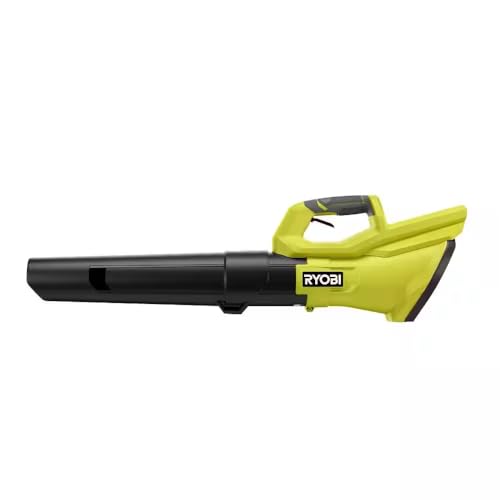
The RYOBI RY40LB01B is a tool-only blower designed for users already invested in the 40V ONE+ ecosystem. At 550 CFM and 120 MPH, it provides enough air volume to clear a typical suburban driveway and lawn of leaves in a single pass. The brushless motor keeps runtime efficient, and owners report excellent compatibility with existing RYOBI 40V batteries from mowers and trimmers.
The unit is lightweight at just over 8 pounds and handles well for a 40V platform tool. It delivers noticeably more power than the older RYOBI Expand-It attachment blower, and the handheld design makes it easier to maneuver around flower beds and under patio furniture. Several owners specifically mention using it to clear up to 5 inches of light snow from sidewalks, which speaks to its real-world force.
The trade-off is that you need to own a RYOBI 40V battery already — buying one separately pushes the total cost into mid-range territory. The blower also chews through batteries faster than some competitors, meaning a 4.0Ah pack will give you about 15 minutes of continuous heavy use. It is an excellent upgrade path for existing RYOBI owners, but not the best starting point for someone building a tool collection from scratch.
What works
- Powerful 550 CFM performance for a 40V handheld
- Light enough for one-handed operation on patios and decks
- Great companion tool for existing RYOBI 40V battery owners
What doesn’t
- Tool-only — requires a separate battery purchase
- Runs through batteries faster than some 40V rivals
4. CRAFTSMAN V20 CMCBL730P1

The CRAFTSMAN V20 brushless blower is engineered for users who prioritize low noise and compact storage without sacrificing everyday cleaning power. At 410 CFM and 110 MPH with the boost button engaged, it won’t move wet leaf piles the way a 600+ CFM unit will, but for patios, garages, and light to medium leaf coverage on a standard lawn, it delivers more than enough force. The boost button triggers a temporary burst of power that is useful for dislodging debris from corners and under cars.
The included 5.0Ah battery is a standout feature at this tier — it provides up to 24 minutes of runtime at full power and over 30 minutes at lower speeds, significantly outpacing the 2.5Ah packs common at this price point. The Weatherguard technology adds dust and moisture protection to the tool, and the integrated hook allows hanging on a VERSATRACK wall system for tidy garage storage. Owners also note the 50% noise reduction compared to gas blowers, making this a neighbor-friendly choice.
The lower CFM ceiling means this blower struggles with deep wet leaves or large debris piles. It is best suited for homeowners with small to medium lots who want a single, quiet, and lightweight tool for routine cleanup rather than heavy-duty seasonal work.
What works
- Large 5.0Ah battery provides excellent runtime for its class
- Boost button delivers a useful power spike for stubborn debris
- Very quiet operation — good for early morning or tight neighborhoods
What doesn’t
- 410 CFM is low for wet leaves or heavy debris
- Not powerful enough for large properties or dense leaf piles
5. Sihuird SL9501
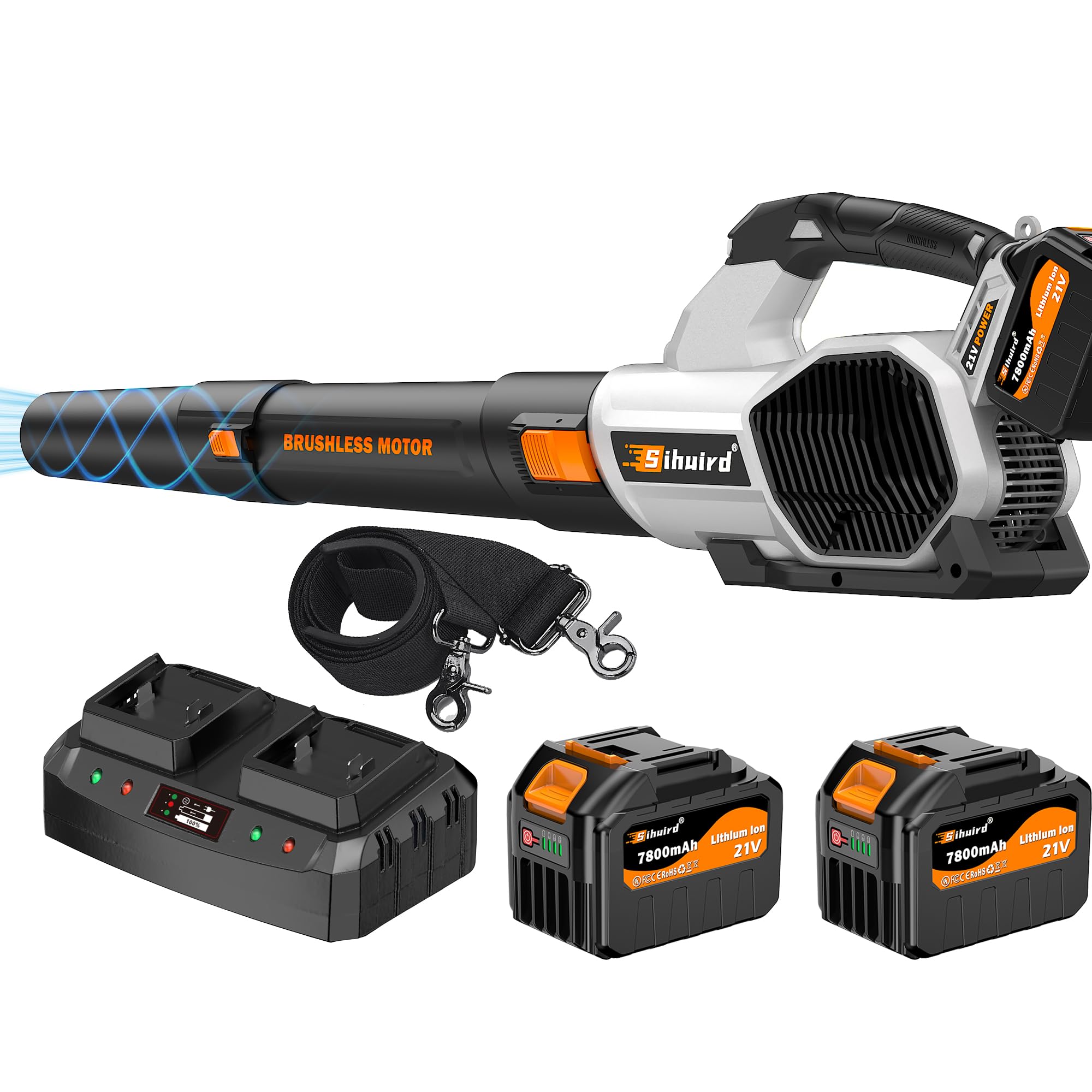
The Sihuird SL9501 is a surprising value proposition that brings 765 CFM of air volume — the highest in this lineup — at a fraction of the cost of premium competitors. The 21V brushless motor spins up to 45,000 RPM, and the axial fan technology delivers a massive column of air that can push wet leaves and small twigs across the yard with ease. The kit includes two massive 7.8Ah batteries that provide up to 180 minutes of total runtime at low speeds and around 60 minutes at maximum output.
The ergonomic design includes a rubber-wrapped handle, a bottom bracket that stabilizes the batteries during use, and a built-in LED light that makes dusk cleanups practical. The three-speed control plus a 15-second Turbo burst gives you flexibility for different tasks, and the fast dual charger fills both batteries from empty in about 2.5 hours. Owners consistently report that the performance rivals blowers costing significantly more, especially for clearing walkways, driveways, and patio dust.
The noise level at full speed is described as high by some users, and the turbo mode drains even these large batteries quickly. The brand is less established than WORX or SKIL, so long-term parts availability and warranty support may be less robust. For the sheer CFM-per-dollar ratio, however, this blower is hard to beat.
What works
- 765 CFM air volume outperforms many premium blowers
- Two 7.8Ah batteries offer exceptional runtimes
- Built-in LED light enables effective evening cleanup
What doesn’t
- Turbine noise is louder than some competitors on high speed
- Brand ecosystem is limited — batteries not shared with major tool lines
6. WORX Nitro WG585
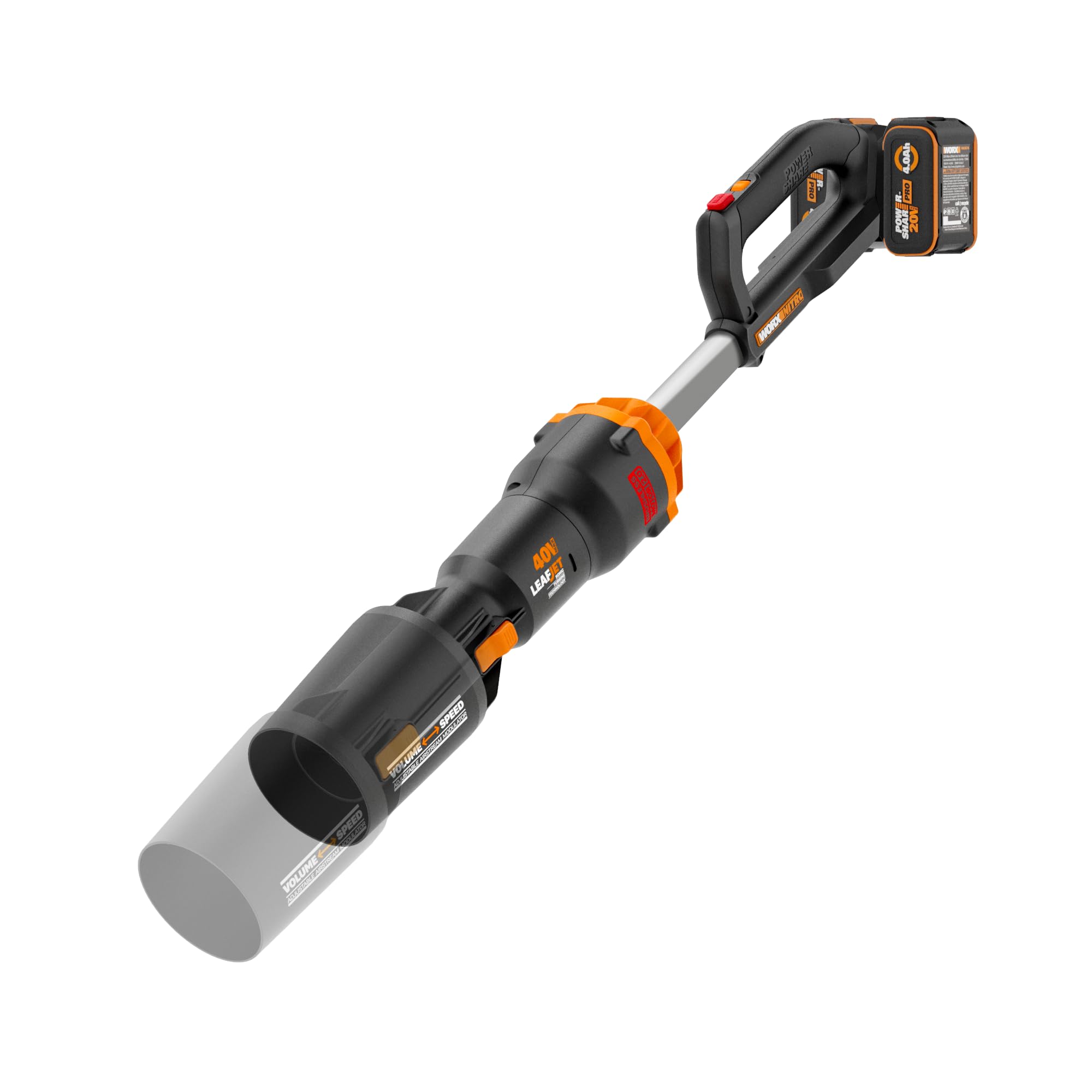
The WORX Nitro WG585 uses a 40V platform that derives its power from two 20V 4.0Ah PowerShare Pro batteries wired in series. This design allows the batteries to be shared with all other WORX 20V tools, giving you access to a 140+ tool ecosystem. The sonic turbine fan pulls in more air than a traditional centrifugal design, producing 620 CFM and a 14N jet stream force — enough to move wet leaves and compacted lawn debris.
The variable air nozzle is a smart addition: rotate it for volume mode (high CFM for wide-area clearing) or speed mode (high MPH for focused blasting). Three speed settings plus a turbo button give you granular control, and the unit weighs 6.8 pounds, making it comfortable for extended sessions. Owners praise the turbo mode for clearing wet, stubborn leaves where other blowers stall.
Battery runtime on the included 4.0Ah packs is solid but not class-leading — expect about 20 minutes of mixed-speed use before swapping. The non-locking turbo button requires continuous thumb pressure, which some users find tiring. The 40V system is heavier than 20V blowers, but the power increase more than justifies the extra weight for medium to large yards.
What works
- Versatile dual-mode nozzle adjusts between volume and speed
- 140+ tool battery ecosystem adds long-term value
- Sonic turbine fan produces strong 14N force for wet debris
What doesn’t
- Turbo button requires continuous thumb pressure to stay active
- Heavier than 20V blowers, can cause fatigue in long sessions
7. RYAHT DD8179
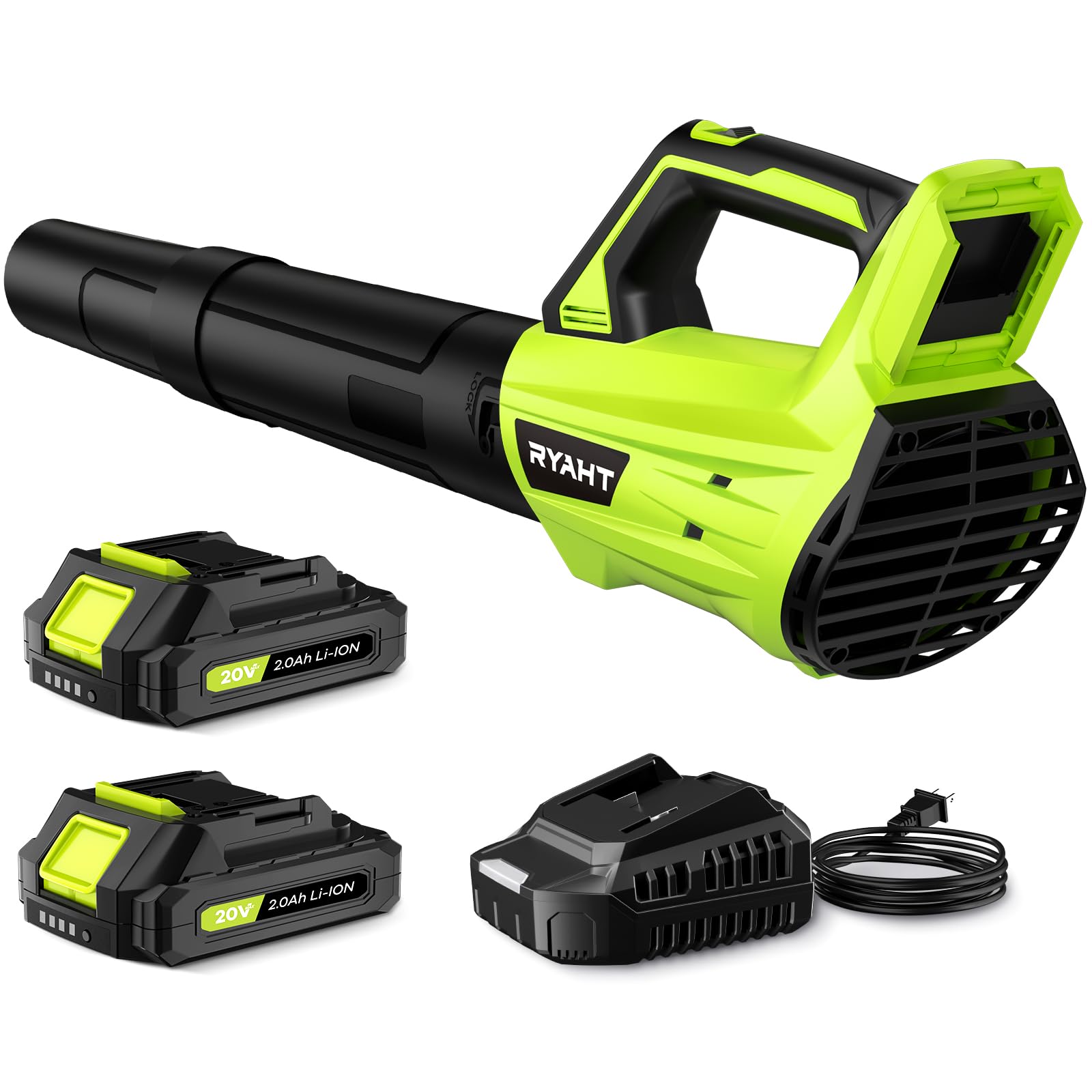
The RYAHT DD8179 is a lightweight 20V cordless blower designed for quick cleanups of patios, decks, and tight spaces. At just 3.4 pounds, it is the lightest unit in this guide and can be operated one-handed with zero strain. The axial flow turbine fan delivers two speed settings — low for dusting off car interiors and window sills, and high for pushing dry leaves off concrete and paving stones.
The kit includes two 20V 2.0Ah batteries and a rapid charger, allowing continuous use by swapping packs. Each battery provides roughly 20–30 minutes of runtime on high speed, which is sufficient for small yards and regular maintenance. The adjustable dual-tube lets you switch between a standard nozzle and an extension for reaching under bushes or between slats, and the ergonomic anti-slip handle provides a secure grip even in damp conditions.
The main limitation is power — the RYAHT cannot match the CFM or MPH of 40V or 60V units. It will struggle with wet leaves, large debris piles, or deep snow. It is a capable tool for its intended niche but should not be considered a primary heavy-duty yard blower for large properties.
What works
- Extremely lightweight design reduces fatigue for overhead or extended use
- Two batteries and a fast charger minimize downtime
- Adjustable tube length improves reach and storage convenience
What doesn’t
- Low CFM output struggles with wet leaves and heavy debris
- Battery life per pack is limited to about 20 minutes on high
Hardware & Specs Guide
CFM vs. MPH Revisited
CFM (cubic feet per minute) measures the total volume of air the blower pushes per minute. A higher CFM number means the blower can cover a wider area faster. MPH (miles per hour) measures the speed of the air stream at the nozzle. High MPH is useful for dislodging debris stuck in gravel or wet grass. For most yard cleanup, a blower with 500+ CFM provides the best balance of coverage and power. Units under 400 CFM are best limited to patios, garages, and light leaf dusting.
Brushless Motor Efficiency
Brushless motors use an electronic controller to manage power delivery instead of physical carbon brushes that create friction and wear. This design results in up to 50% longer runtime per charge, quieter operation, and significantly longer motor lifespan. Every premium and mid-range blower in this guide uses a brushless motor. If a product specification does not explicitly state “brushless,” the motor is brushed and will deliver lower efficiency and a shorter service life.
Battery Voltage and Amp-Hours
Voltage determines the maximum power output of the blower. 20V blowers are entry-level, 40V platforms (SKIL, WORX, RYOBI, CRAFTSMAN) offer the best balance of power and weight, and 60V systems (Greenworks) approach gas-equivalent performance. Amp-hours (Ah) determine runtime — a 4.0Ah battery stores twice the energy of a 2.0Ah battery. For a standard quarter-acre lot, a 40V system with a 4.0Ah or larger battery is recommended.
Turbo and Boost Modes
Turbo or Boost modes temporarily increase motor RPM beyond the maximum continuous speed to deliver a short burst of high airspeed. This is useful for dislodging wet leaves, moving heavy debris piles, or clearing dense gravel. Most units limit turbo to 15–30 seconds per activation to prevent motor overheating. Turbo mode significantly reduces battery runtime — expect a 40–50% drop in duration compared to running at the highest continuous speed setting.
FAQ
What CFM is enough for a typical suburban lawn?
Can I use a 40V battery on a 20V blower?
Does a higher MPH number mean a better blower?
Are brushless motors worth the extra cost?
Why should I consider the battery ecosystem before buying?
Final Thoughts: The Verdict
For most homeowners, the cordless blowers winner is the SKIL PWR CORE 40 BL4713C-11 because its 530 CFM output, variable-speed trigger, cruise control, and fast-charging battery deliver the best balance of power and usability for typical suburban yards. If you want maximum air volume for wet leaves and large properties, grab the Greenworks 60V BL60L251 with its 610 CFM turbo performance. And for a budget-friendly entry point that still offers solid cleanup capability, nothing beats the Sihuird SL9501 for its 765 CFM output and two massive batteries.