
Specs are compiled from manufacturer listings and verified buyer reviews and can change over time — please confirm the key details on the product page before buying.
You plug a corded leaf vacuum into an outlet, so you never stop to recharge batteries or lose suction on wet leaves. But a bad one clogs on the first damp oak leaf and forces you to dig gunk out of the tube. The specs that separate a tool you grab every fall from one you hate are airspeed, air volume, bag capacity, and the impeller material (the blade that shreds leaves).
I’m Rikta — the founder and writer behind Lawn Gear Lab. This guide is built by comparing the manufacturers’ published specifications and the patterns across verified customer reviews, so you get each pick’s real strengths and trade-offs instead of marketing spin.
From a 250-mph corded blower that chews through wet leaves to a 530-cfm shop vac that begs for a longer extension cord, here is the practical breakdown of every corded leaf vacuum worth your time this season.
Quick Picks
- BLACK+DECKER BV6000 — Best Overall
- Shop-Vac 3 in 1 Electric Leaf Blower, Vacuum & Mulcher — Top Performer
- WORX WG505.2 Trivac 3-in-1 — Premium Pick
- SENIX AC-AE 3-in-1 — Best Versatile Pick
- MZK LB67M 3-in-1 — Budget Champion
- DEKOPRO DKPGBLB300C1 3-in-1 — Entry-Level Value
- GreenSweep GS-LB1 3-in-1 — Budget Pick
How To Choose The Best Corded Leaf Vacuum
A corded leaf vacuum is a simple machine on paper, but a few design choices separate the ones that finish the job from the ones that frustrate you. Focus on the specs that matter most for your yard.
Air Speed vs. Air Volume
Air speed (mph) tells you how far the stream will carry—useful for blowing leaves out of flower beds. Air volume (cfm) tells you how much air moves at once—this matters more for vacuuming because a high-cfm machine can suck up thick piles without stalling. For vacuum mode, prioritize cfm over mph.
Bag Capacity and Mulching Ratio
A larger bag means fewer trips to the compost pile, but a full bag is heavy. Look at the mulch ratio (how many bags of leaves get compressed into one). A 16:1 ratio turns a huge pile into a single manageable bag. Also check whether the bag is reusable fabric or disposable—reusable saves money over time but can get dusty, while disposable means you just tie and toss.
Impeller Material
The impeller (the spinning blade that shreds leaves) is the heart of a mulching vacuum. Metal impellers handle twigs, acorns, and wet leaves without breaking. Plastic impellers are lighter and quieter but may crack if you suck up a rock or a heavy branch. If your yard has anything beyond soft dry leaves, look for a metal impeller.
Quick Comparison
| Model | Best For | Air Speed | Air Volume | Bag Capacity | Amazon |
|---|---|---|---|---|---|
| BLACK+DECKER BV6000 | Heavy wet leaves & disposable bags | 250 mph | 400 cfm | Disposable bag system (16:1 mulch) | Amazon |
| Shop-Vac 5430234 | Highest air volume & large yards | 180 mph | 530 cfm | 35L | Amazon |
| WORX WG505.2 Trivac | Metal impeller durability & bagging system | 210 mph | 350 cfm | Reusable bag (16:1 mulch) | Amazon |
| SENIX AC-AE | Variable speed control (6 settings) | 179 mph | 420 cfm | 1.24-bushel reusable bag | Amazon |
| MZK LB67M | Budget-friendly with high cfm | 167 mph | 460 cfm | 40L | Amazon |
| DEKOPRO DKPGBLB300C1 | Entry-level value & lightweight handling | 14,000 RPM | — | 40L | Amazon |
| GreenSweep GS-LB1 | Lightest weight for smaller users | — | — | 10-gallon | Amazon |
In‑Depth Reviews
1. BLACK+DECKER BV6000

A 12-amp workhorse that turns a mountain of leaves into a single disposable bag.
You clear your yard so the leaves disappear, not so you can spend an hour untangling them from a fabric bag. The BV6000’s disposable bag system lets you tie the top and toss the whole thing—no dumping, no dust cloud. The 12-amp motor pushes air at 250 mph, easily enough to move wet matted leaves that stall lesser blowers. In vacuum mode, the metal fan (a high-impact metal fan that resists clogging) mulches 16 bags of leaves down to one, so you are not running back and forth to the compost pile.
Buyers report the suction on high is strong enough to pick up smashed leaves and even small pebbles between flagstones. One reviewer noted the motor has an auto-shutoff if something gets clogged (a rag, for example) and then restarts once cleared—a nice safety net. The trade-off: the bag gets dusty, and one buyer mentioned you will definitely want eye and mask protection when emptying because the fine dust escapes. At 8.1 pounds it is not the lightest, but the included shoulder strap helps distribute the weight during long sessions.
Unlike the Shop-Vac below which peaks at 530 cfm for raw air volume, the BV6000 leads on sheer speed at 250 mph versus the MZK’s 167 mph. That speed matters when you need to blast wet leaves out of a flower bed from a distance. Worth noting: the cord is short, so plan on a heavy-duty extension cord.
Where it shines
- Disposable bag eliminates messy emptying — just tie and toss
- 250 mph air speed handles wet, matted leaves with ease
- Metal fan resists clogging and grinds leaves to fine mulch
- 16:1 mulch ratio means fewer trips to empty
The downsides
- Bag gets very dusty; mask and eye protection are needed
- Short power cord requires a heavy-duty extension
- Not the lightest option at 8.1 pounds
Your best bet if: you have a medium to large yard with wet leaves and want to skip the dump-and-dust routine with disposable bags.
Think twice if: you want a reusable bag to avoid buying consumables—the BV6000’s system is built around disposable bags.
2. Shop-Vac 3 in 1 Electric Leaf Blower, Vacuum & Mulcher
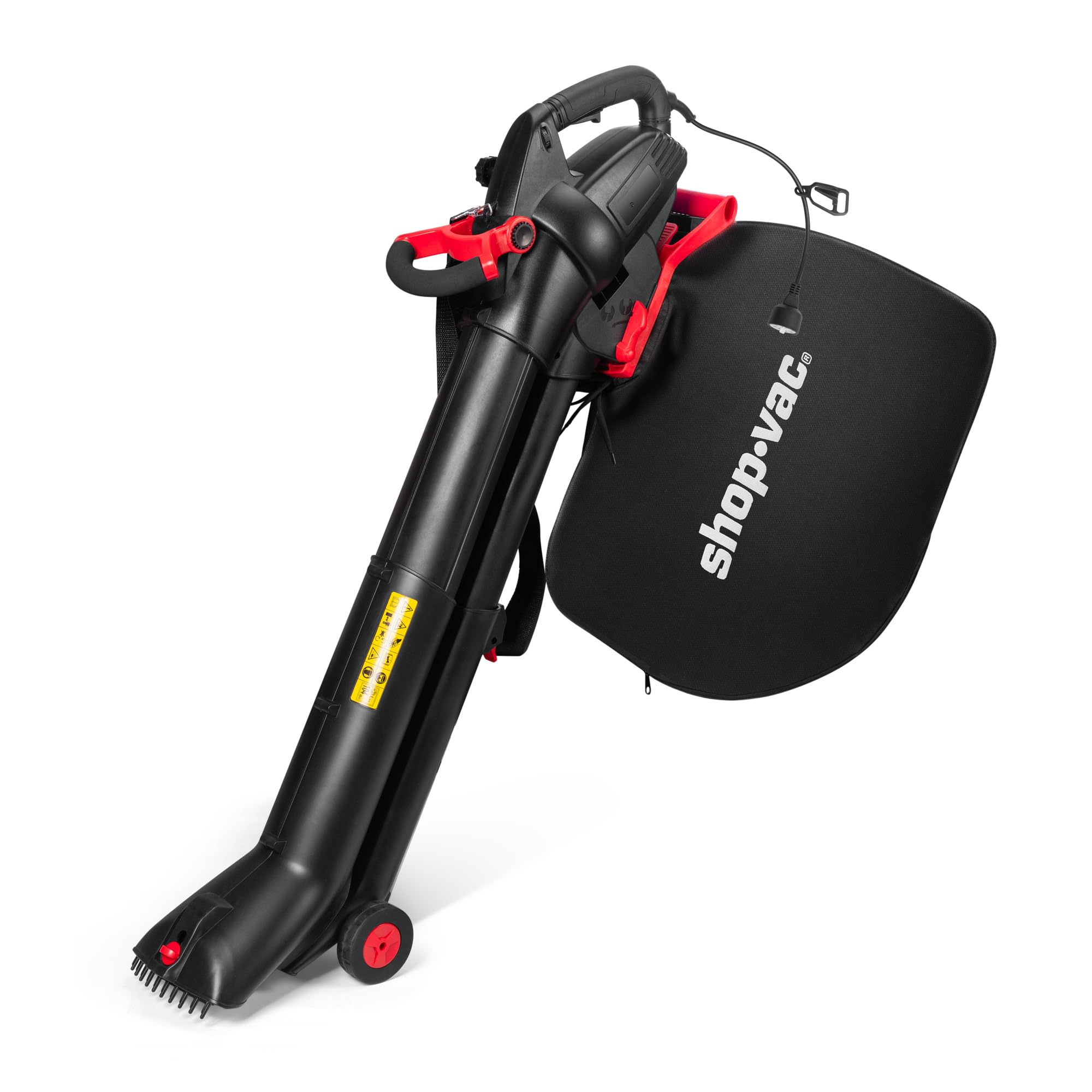
The highest air volume on this list for vacuuming thick piles in one pass.
Shop-Vac brings its shop-vac DNA into the yard: this machine delivers 530 cfm of air volume versus the MZK’s 460 cfm, and a clear lead over every other model here. That volume matters when you are vacuuming—it creates a wide suction path that pulls in leaves before they scatter. The 180 mph air speed is modest compared to the BLACK+DECKER’s 250 mph, but in vacuum mode, cfm is king. The integrated mulcher shreds leaves on contact into the 35L bag, and the stepless speed control lets you dial from 4 amps up to 12 amps so you match the power to the task.
Buyers highlight the strong suction of a corded vacuum over cordless models. One owner reported it handles small, prickly oak and eucalyptus leaves without clogging — a real test. Another owner called it their favorite yard tool, praising the wheels for maneuverability and the balanced feel with the shoulder strap. The honest catch: the collection bag material is porous enough that fine dust escapes, and one buyer returned theirs because the bag blew dust through tiny holes. Also, the power cable is only about 1.15 feet long, so an outdoor-rated extension cord is non-negotiable.
At 4.89 kilograms (about 10.8 pounds), it is on the heavier side, but the strap and wheels make the weight less noticeable. The mulch bag is 35L versus the MZK’s 40L bag, but the higher cfm means you vacuum faster anyway.
Air volume leader: With 530 cfm, this is the best pick for vacuuming thick, wet leaf piles where suction width matters more than blast distance.
Bag dust warning: Fine dust escapes through the fabric; wear a mask if you have allergies.
Pick this for: large yards with heavy leaf coverage where you want to vacuum first and blow second, and you value air volume over air speed.
Avoid if: dusty bag material bothers you or you need a long integrated power cord.
3. WORX WG505.2 Trivac 3-in-1

A metal impeller and LeafPro bagging system that skips the heavy bag altogether.
If you have ever dragged a full collection bag across the yard, you will appreciate the LeafPro system on this WORX: it attaches a trash can directly to the vacuum so leaves go straight into your bin — no bag lifting, no zippers, no dust. The metal impeller (a durable metal blade that shreds leaves instead of a plastic one) delivers a 16:1 mulch ratio, meaning 16 bags of leaves become one. That ratio matches the BLACK+DECKER, but the metal construction is tougher for occasional twigs or acorns.
At 210 mph air speed and 350 cfm, the WORX is a solid mid-range performer in both blowing and vacuuming. It is not the fastest blower (the BLACK+DECKER hits 250 mph) nor the highest cfm (the Shop-Vac does 530 cfm), but the balance is good for small to mid-sized yards. Owners mention it vacuums leaves, grass, twigs, and even acorns effectively, and one owner said it reduced two full 32-gallon cans of leaves to a quarter of a can. Another reviewer noted the machine worked great for three years before failing to turn on, with poor customer support. At 9.7 pounds, it is one of the heavier handheld units — one buyer called it “a bit heavy but works really well.”
One-second conversion from blower to vacuum via a flip switch is genuinely convenient — no tools, no disassembly. The curved vacuum tube helps you reach under decks and patio furniture, which is a thoughtful detail most models ignore.
Strong points
- LeafPro system lets you vacuum directly into a trash can – no bag lifting
- Metal impeller lasts longer and handles tougher debris than plastic
- 16:1 mulch ratio dramatically reduces leaf volume
- One-second switch between blower and vacuum modes
Weak points
- Heavier than other handheld options at 9.7 pounds
- Some buyer reports of unit failing after a few seasons
- Needs a heavy-duty extension cord; cord is short
Reach for this if: you want to skip the collection bag entirely and shoot leaves straight into your curbside bin, especially in a small to mid-sized yard.
Look elsewhere if: you need the lightest possible tool or you want a longer manufacturer warranty than 2 years.
4. SENIX AC-AE 3-in-1
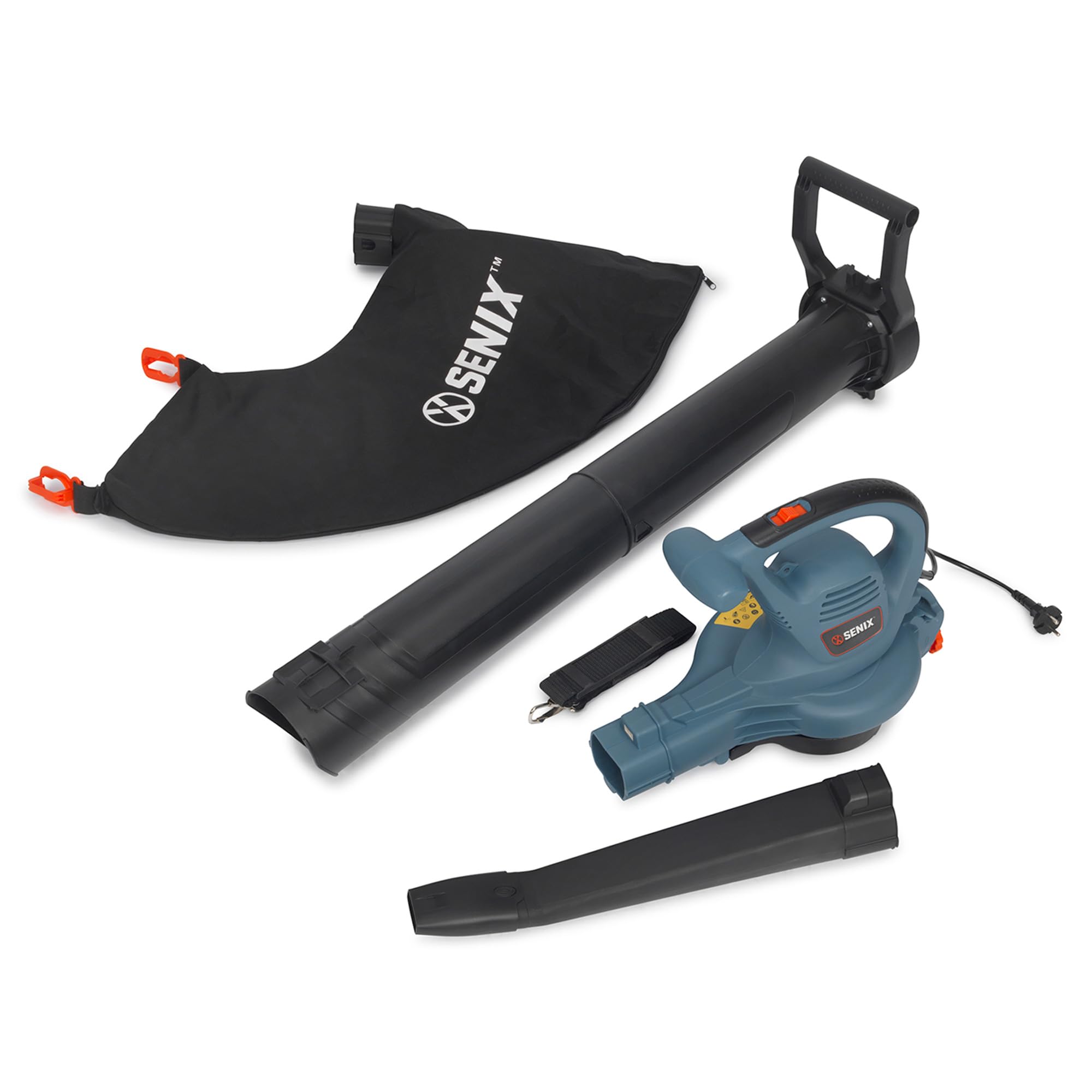
Six speed settings so you dial in the perfect airflow for every surface.
Most corded leaf vacuums give you two speeds: low and high. The SENIX gives you six variable speed settings, so you can go from a gentle breeze on gravel (so you do not spray stones everywhere) up to maximum power at 179 mph and 420 cfm for stubborn wet leaves. That fine control is rare at this price point. It also includes a concentrator nozzle that boosts air speed at the tip for focused blasting on heavy debris.
The 420 cfm air volume is solid middle-of-the-pack — lower than the Shop-Vac’s 530 cfm but higher than the WORX’s 350 cfm. The built-in cord retainer keeps your extension cord locked in during use, a small detail that prevents annoying disconnections mid-vacuum. Customers note the unit works well for drying cars after washing (since it is corded and never runs out of power), and one owner said it sucks up branches and twigs without pulling up gravel. Another reviewer noted the 3-year limited warranty as a confidence boost. The 7-pound weight makes it one of the lighter options on the list — you can work for an hour without your arm fatiguing.
The bag is a 1.24-bushel reusable fabric bag — about the same as a 35L bag on other models. One customer observed assembly involves “too much stuff to hook together” and wished the switch was in a handier place. Still, for a price point with a 3-year warranty and six-speed control, the SENIX is a strong value proposition.
Speed-control champion: Six settings give you precision that no other model here matches — great if your yard mixes gravel paths, decking, and lawn.
Grab this for: yards with varied surfaces where you want to fine-tune airflow rather than blast everything at full power.
skip it if: you want a simpler assembly or one-button conversion — the SENIX has a few more parts to connect.
5. MZK LB67M 3-in-1
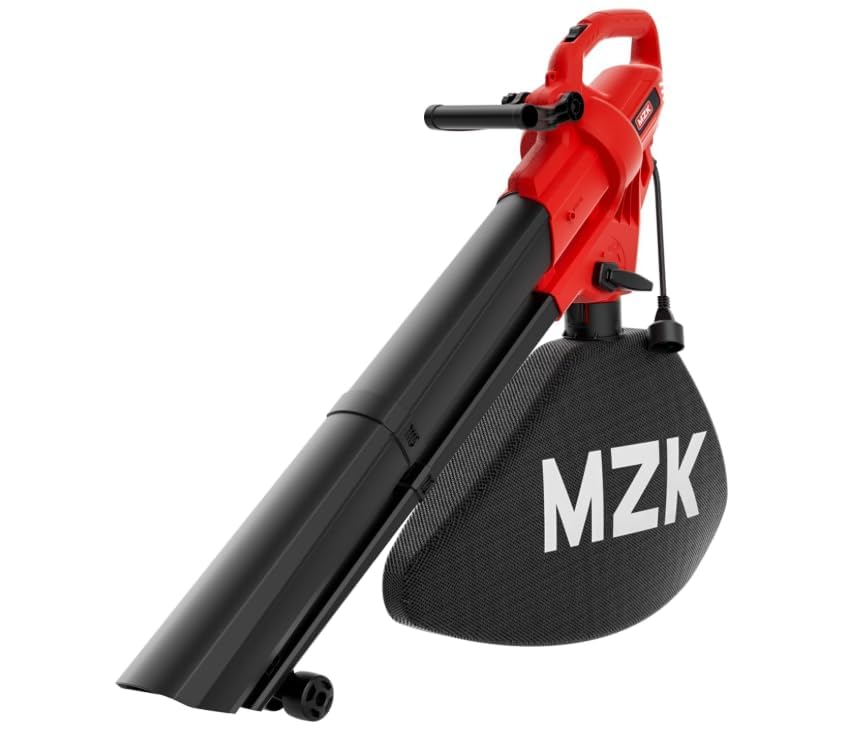
A generous 40L bag and high cfm at a price that undercuts the premium crowd.
Wait, no — the Shop-Vac has 530 cfm, but the MZK’s 460 cfm is ahead of the BLACK+DECKER’s 400 cfm and the WORX’s 350 cfm. At 167 mph, the air speed is the lowest on the list (the BLACK+DECKER is 250 mph), but in practice, that trade-off works for vacuum-focused cleanup. The 40L collection bag is the largest on this list — 40L versus the Shop-Vac’s 35L bag — so you empty less often. The 15:1 mulch ratio means 15 bags of leaves become one.
The MZK is a minimalist design with no extra bells — no variable speed, no cord retainer, just a blower tube, vacuum tube, and collection bag. Buyers have not left reviews yet, so the real-world experience is unproven. The specs look competitive on paper, but without user feedback, the durability and actual performance are unknowns. It is worth considering if you want the largest bag possible and the highest cfm at the lowest cost, but you are taking a risk on a newer model.
The 17 x 8 x 15-inch dimensions are compact, and the handheld form factor should store easily in a garage corner.
The numbers
- 460 cfm — second-highest air volume on this list
- 40L bag — the largest collection bag here
- 15:1 mulch ratio reduces leaf volume significantly
The uncertainty
- No customer reviews yet — real-world performance is unverified
- 167 mph air speed is lowest of the group
- No variable speed control for different surfaces
Consider this if: you need the biggest bag to minimize trips and prioritize cfm over mph in a budget-friendly package.
Proceed with caution if: you want proven reliability — there are no buyer reports to confirm this model’s durability.
6. DEKOPRO DKPGBLB300C1 3-in-1
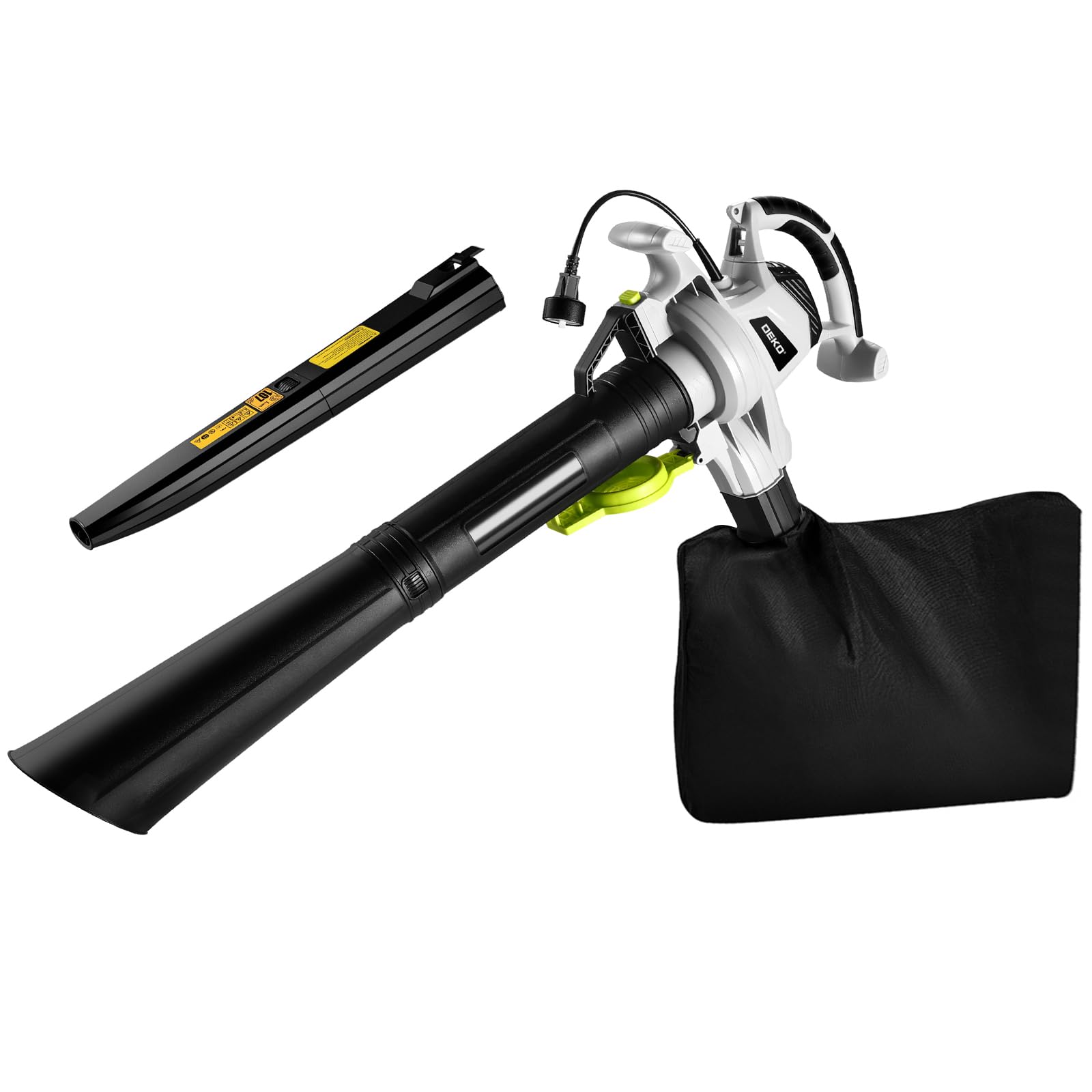
A 12-amp mulcher that reviewers point out clears years of neglect in record time.
The DEKOPRO runs on a 12-amp motor that spins the impeller at up to 14,000 rpm — that is fast enough to shred leaves into fine mulch that packs tight in the 40L collection bag. The 40L bag matches the MZK for capacity, so you get the same emptying frequency at a similar entry-level price point. It features a shoulder strap to help distribute the weight of the machine during long sessions, and the handle is designed for a comfortable grip.
Shoppers say clearing yards that had not been touched in three years — “I was able to clear leaves and debris in record time,” one user highlighted. Another noted it mulches great but the bag gets heavy when full. The honest limit: this machine does not like wood mulch or large particles. One buyer warned the blade is small and easily breaks if you try to mulch anything beyond leaves or very soft debris. Another buyer’s unit started smoking on first use and had to be returned, with a slow refund process. Quality control seems inconsistent, which is the main risk at this price.
The impeller area uses metal construction, but the reviews show a split between delighted users and one-bad-unit experiences. If you get a good one, it is a capable budget mulcher; if you get a lemon, the return process can be slow.
Mixed bag: Buyers either love the speed or get a defective unit. Stick to leaves only — wood mulch will break the blade.
Worth a try for: a low-cost entry point if you have only soft leaves and you are comfortable with a possible return process.
Not for you if: reliability is your top priority — inconsistent quality control makes this a gamble.
7. GreenSweep GS-LB1 3-in-1
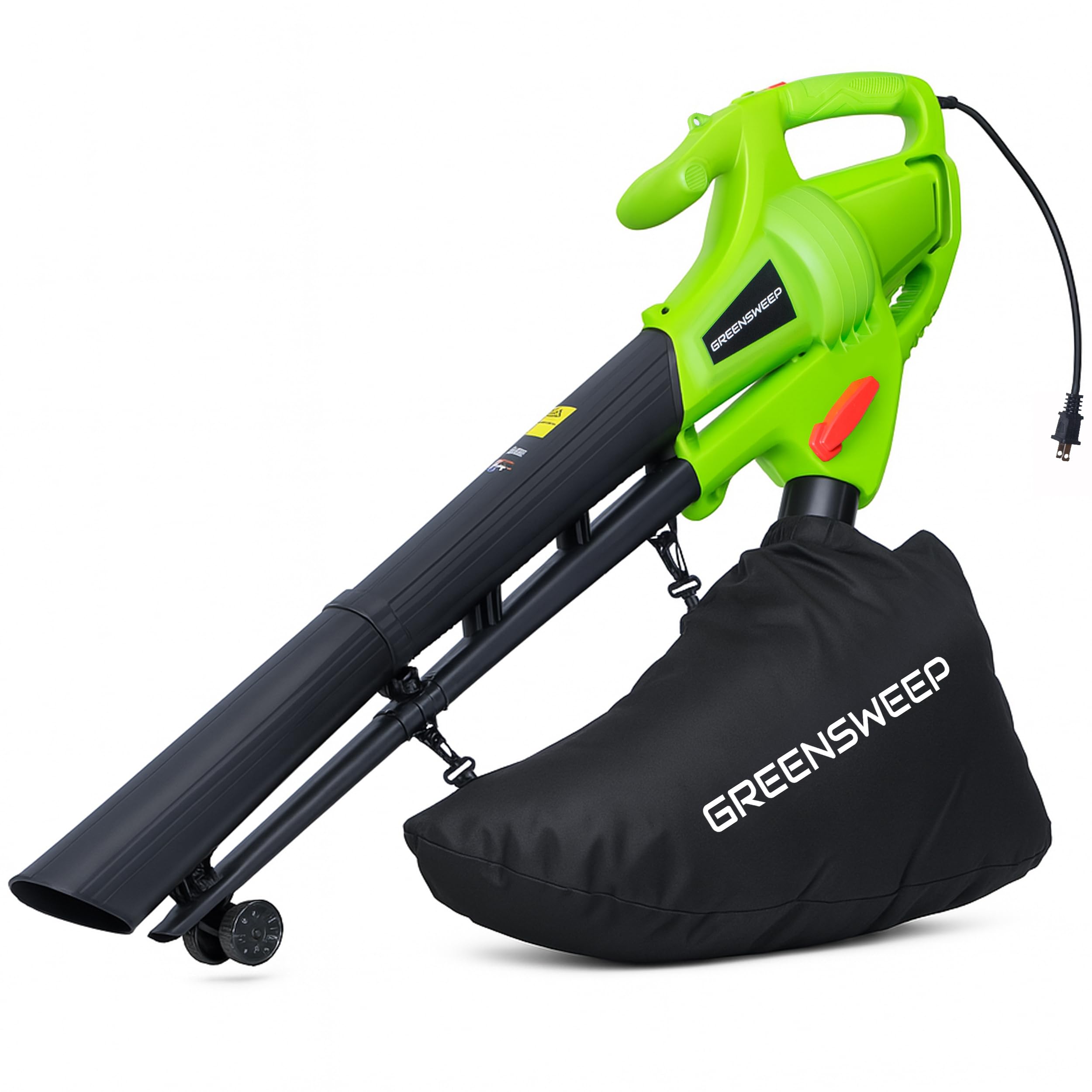
A lightweight 10-amp machine that women especially find easy to handle.
The GreenSweep is for you if power-to-weight ratio matters more than raw numbers. At 10 amps, it is 10 amps versus the 12 amps of the BLACK+DECKER and DEKOPRO, and the 10-gallon bag is the smallest on the list. It features adjustable speed control, so you can dial down for gravel paths and dial up for wet leaves. The 10:1 mulch ratio means 10 bags of leaves become one — that is less aggressive than the 16:1 or 15:1 ratios on the bigger machines, so you will empty the bag more often.
The reviews are polarizing. One shopper added the mulcher is “not powerful enough to work — only small leaves will get sucked up and then spin around the tube for a little while before clogging everything up.” Another reviewer loved it and found it “light weight especially for women” and a best friend for leaf cleanup. The contradiction suggests quality control issues or that the machine only handles small, dry leaves. The bag tore on first use for one buyer, who called it “very poor quality.” Assembly instructions were confusing — one reviewer installed the bag upside down and had to get a neighbor to fix it.
At 8.86 x 12.13 x 16.54 inches, it is compact and stores easily. But the mix of 1-star and 5-star reviews tells you this is a gamble: you might get a unit that works great for small leaves, or one that frustrates you every time you use it.
Potential upsides
- Lightweight design — easy for smaller users to handle
- Adjustable speed control for different surfaces
- Compact dimensions for easy garage storage
Real risks
- Mulcher clogs on anything beyond small dry leaves
- Bag tore on first use for one buyer — low quality
- Inconsistent buyer experiences across reviews
Suits: a small yard with only light dry leaf coverage, or someone who values minimal weight over everything else.
Not for: anyone with wet leaves, oak leaves, or a yard larger than a postage stamp — the power just is not there.
Understanding the Specs
Air Speed (mph) vs. Air Volume (cfm)
Air speed, measured in miles per hour (mph), tells you how fast the air jet moves — useful for blowing leaves across the yard or out of tight corners. Air volume, measured in cubic feet per minute (cfm), tells you how much air moves at once — this matters in vacuum mode because a high-cfm machine creates a strong, wide suction path. For blowing, prioritize mph; for vacuuming, prioritize cfm.
Mulch Ratio
Shown as “16:1” or “10:1,” this means “X bags of leaves get reduced to one bag.” A 16:1 ratio turns a massive pile into a single bag, meaning fewer trips to the compost and less bag handling. A lower ratio like 10:1 means more frequent emptying. The number depends on the impeller design and motor power.
Impeller Material
The impeller is the spinning blade inside the vacuum that shreds leaves. Metal impellers (usually steel) handle wet leaves, small twigs, and acorns without cracking. Plastic impellers are lighter and cheaper but can break if you accidentally suck up a rock or heavy branch. If your yard has anything beyond soft dry leaves, look for a metal impeller.
Amp Rating
The motor’s amp rating (e.g., 10 amps, 12 amps) roughly indicates power. More amps generally mean stronger suction and faster mulching, but also more weight and noise. A 12-amp motor is the standard for most corded leaf vacuums; a 10-amp motor is entry-level and best for very small yards.
FAQ
Can a corded leaf vacuum handle wet leaves?
How long of an extension cord do I need for a corded leaf vacuum?
What is the difference between a reusable bag and a disposable bag system?
Will a corded leaf vacuum pick up acorns or small twigs?
How do I prevent the leaf vacuum from clogging?
Can I use a leaf vacuum to clean my gutters?
What does “mulch ratio” mean in practice?
Is a corded leaf vacuum quieter than a gas leaf blower?
How heavy is a typical corded leaf vacuum?
Can I use a corded leaf vacuum on gravel or dirt?
Final Thoughts: The Verdict
Across the board, the corded leaf vacuum winner is the BLACK+DECKER BV6000 because its 250 mph air speed, metal impeller, and disposable bag system handle wet leaves efficiently and make disposal a tie-and-toss affair. If you want the highest air volume for heavy vacuuming, grab the Shop-Vac 5430234 with its 530 cfm. And for a metal impeller and trash-can direct bagging, the WORX WG505.2 Trivac is a reliable mid-yard companion.
How We Picked
We do not accept paid placement. Every pick is matched to a real buyer and a real use-case; we do not hands-on test units.
Sources & Methodology
Specifications: manufacturer listings and product documentation. Review insights: verified customer reviews, as of July 2026. Pricing: not shown on this page (it changes often); check the current price via the retailer link.
As an Amazon Associate, Lawn Gear Lab earns from qualifying purchases. This does not affect which products we feature.