
Copper fungicide concentrates are your first line of defense against a relentless wave of bacterial and fungal diseases — from peach leaf curl and fire blight to powdery mildew and anthracnose — but choosing the wrong formulation can leave your fruit trees and ornamentals vulnerable and your sprayer clogged with sticky residue. The market is crowded with liquids, powders, and multi-purpose blends, yet the real differentiators lie in rainfastness, copper content, and how easily they mix into a uniform spray.
I’m Rikta — the co-founder and writer behind Lawn Gear Lab. My process for evaluating these concentrates involves cross-referencing active ingredient percentages against OMRI listings, analyzing thousands of owner reports for staining and mixing complaints, and comparing the certified disease claims on each label to find the formulas that actually prevent infection without damaging your foliage.
After hours of spec-sheet analysis and user-experience research, the single most reliable solution for protecting home orchards and vegetable gardens is the best copper fungicide concentrate, which balances a high copper content with an easy-to-mix, rainfast gel formulation that stays put through heavy spring downpours.
How To Choose The Best Copper Fungicide Concentrate
Selecting a copper fungicide concentrate is not about picking a brand name — it is about matching the active ingredient formulation, rainfastness, and application method to your specific crop and regional disease pressure. Below are the critical specs to evaluate before you mix your first tank.
Copper Content and Chemical Form
The label must specify whether the active ingredient is copper octanoate, copper sulfate pentahydrate, or basic copper sulfate. Copper octanoate formulations tend to be gentler on foliage and cause less staining, making them ideal for edible crops like tomatoes and peaches where residue on fruit matters. Higher metallic copper equivalent (MCE) percentages deliver longer residual protection but also increase the risk of phytotoxicity on sensitive plants in hot weather.
Rainfastness and Gel vs. Liquid Base
A fungicide that washes off after the first rain forces you to reapply on a tight schedule, wasting product and time. Gel-based concentrates, once dry, form a flexible film that resists wash-off much better than simple liquid solutions. Check user reports for specific mentions of rainfastness on stone fruits and roses — this spec is often buried in the fine print of the product label.
Staining Potential and Application Equipment
Copper compounds stain concrete, wood, and even the sprayer itself. Copper sulfate liquids are notorious for turning everything blue-black. If you are using a backpack or hose-end sprayer, look for formulations described as “non-staining” or “clear mixing,” and always dedicate a separate sprayer to copper applications to avoid contaminating other pesticides.
Quick Comparison
On smaller screens, swipe sideways to see the full table.
| Model | Category | Best For | Key Spec | Amazon |
|---|---|---|---|---|
| Monterey Liqui-Cop | Copper Concentrate | Rainfast coverage on fruit trees | Gel-based, rainfast after drying | Amazon |
| Southern Ag Liquid Copper | Copper Sulfate | General moss and algae control | 32 oz quart, copper sulfate | Amazon |
| Monterey Complete Disease Control | Biofungicide | Organic root drench application | OMRI listed, colonizes roots | Amazon |
| Bonide Captain Jack’s Orchard Spray | Multi-Purpose | All-in-one insect + disease control | 32 oz, controls insects & fungi | Amazon |
| Bonide Revitalize Biofungicide | Biofungicide | Organic houseplant disease control | 16 oz, triggers immune response | Amazon |
| Bonide Fung-onil | Chlorothalonil | Broad-spectrum synthetic control | 16 oz, chlorothalonil active | Amazon |
| Jonathan Green Lawn Fungus Control | Granular Turf | Large lawn disease prevention | 22.5 lb, 15,000 sq ft cover | Amazon |
In‑Depth Reviews
1. Monterey Liqui-Cop Copper Fungicide Spray

The Monterey Liqui-Cop is the standout performer in this category because its gel formulation delivers exceptional rainfastness — once dry, the film resists wash-off far better than standard liquid copper solutions. Users consistently report that a single dormant application controls peach leaf curl for an entire season, and the quart bottle yields an impressive number of tank mixes, often lasting several years for the home orchardist.
Mixing is straightforward: the concentrate glides into water with minimal agitation and sprays cleanly without leaving the sticky, gummy residue that plagues some other copper brands. It is labeled for a huge range of crops including stone fruits, citrus, nuts, and ornamentals, and the EPA registration covers anthracnose, brown rot, downy mildew, and botrytis blight.
The downside is that copper is strictly preventative — it must be applied before infection takes hold, and thorough coverage of all plant surfaces is non-negotiable. Some users note the faint odor typical of copper products, but the lack of staining compared to copper sulfate liquids is a clear advantage for those using backpack sprayers on patios and driveways.
What works
- Rainfast gel film stays on through heavy spring rain
- Mixes and sprays clean without sticky residue
- Concentrated quart lasts home orchard owners years
What doesn’t
- Preventative only — cannot cure an active infection
- Mild copper odor during application
2. Southern Ag Liquid Copper Fungicide 32oz

Southern Ag’s Liquid Copper Fungicide is a broad-spectrum copper sulfate concentrate that excels at controlling not just fungal diseases but also moss and algae on hardscapes and turf. The 32-ounce quart is a workhorse size for medium-sized gardens, and owners praise its effectiveness on pine needlecast fungus and leaf spot on apple trees after just two applications.
The liquid formulation makes it suitable for hose-end sprayers, which is a major convenience for covering large areas like fencelines or foundation plantings. Users in high-humidity Southern states report it as a staple for preventing mold on St. Augustine grass and ornamentals that would otherwise succumb to persistent damp conditions.
However, the copper sulfate base is notorious for staining concrete and sprayer parts — several owners note the bottle’s dosing design makes it nearly impossible to measure without spilling, and the liquid can leave a blue-black residue on any surface it dries on. Dedicate a separate sprayer and handle the concentrate on soil or grass to avoid permanent discoloration.
What works
- Controls moss, algae, and fungi with one formula
- Large 32 oz quart is cost-effective for coverage
- Works well through hose-end sprayers
What doesn’t
- Significant staining on concrete and equipment
- Bottle design makes dosing messy and prone to spills
3. Monterey Complete Disease Control
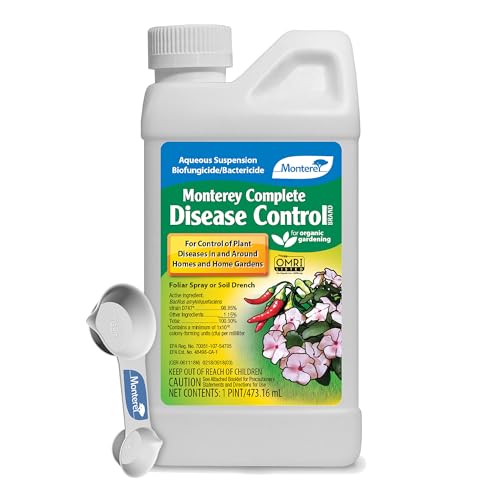
This entry from Monterey is a biofungicide, not a straight copper product — it uses a beneficial bacterium that colonizes root hairs to create a living barrier against pathogens. It is OMRI Listed for organic use and can be applied as both a foliar spray and a soil drench, making it uniquely suited for edible crops where synthetic residues are a concern.
Tomato growers in the rainy South are particularly loyal to this product, reporting that it dramatically slows the progression of early blight and septoria leaf spot during extended wet periods. The ability to apply it as a root drench gives it an edge over pure copper sprays because the internal protection continues even if foliar coverage is washed off.
On the downside, it controls but does not cure — users note that leaves already infected with anthracnose or leaf spot will not recover, and the disease may continue to appear on new growth if conditions are extreme. The mixing rate of one teaspoon per gallon is economical, but the pint bottle is small, so coverage on large gardens will require multiple bottles per season.
What works
- Root drench provides systemic internal protection
- OMRI listed for certified organic gardens
- Exceptionally effective on tomatoes in humid climates
What doesn’t
- Does not cure leaves already showing symptoms
- Small 16 oz bottle covers limited area
4. Bonide Captain Jack’s Orchard Spray

Bonide’s Captain Jack’s Orchard Spray is a triple-action concentrate that kills insects, mites, and fungal diseases in a single application — a massive time-saver for orchard owners who would otherwise need to tank-mix separate products. Users in New Hampshire report it eliminating Japanese beetles within an hour and controlling whiteflies with two applications, while simultaneously treating powdery mildew and rust on apple and cherry trees.
The 32-ounce concentrate makes up to 6.4 gallons of finished spray at the standard mixing rate, and the label covers a huge range of crops: citrus, avocados, stone fruits, berries, and ornamentals. The fact that it can be used up to the day before harvest adds flexibility for food gardeners dealing with late-season outbreaks.
The catch is that this is not a preventative-only product — the insecticidal component means you are deploying multiple active ingredients at once, which may be overkill if your garden only has a fungal issue. Additionally, as a non-persistent formulation, it needs reapplication after heavy rain, and some users find the mixing instructions for different target pests confusing on the label.
What works
- Single concentrate for fungus, insects, and mites
- Labeled for use on edible crops until day of harvest
- Cost-effective for multi-issue orchard management
What doesn’t
- Non-persistent — reapply after rain events
- Mix rates vary by target, label can be confusing
5. Bonide Revitalize Biofungicide

Bonide Revitalize is a biofungicide that works by triggering the plant’s own immune response rather than coating leaves with copper. This makes it uniquely safe for indoor houseplants — no staining, no harsh fumes, and the 16-ounce bottle can be stored in the garden shed without worrying about freezing or crystallization that affects liquid copper products.
Users report success on indoor ornamentals like monstera and pothos where powdery mildew appears during winter months, and the fact that it is approved for organic gardening means you can use it on herbs grown on a kitchen windowsill. The concentrate mixes with water and can be applied as a foliar spray or soil drench depending on the target disease.
The main limitation is potency — several owners note the smell is quite strong despite being a biofungicide, and its effectiveness on aggressive outdoor diseases like late blight on tomatoes is noticeably weaker than copper-based alternatives. It is best positioned as a maintenance product for low-pressure indoor environments rather than a heavy-duty orchard treatment.
What works
- Safe for indoor use with no staining or strong odor indoors
- Triggers plant immune response for prevention
- Approved for organic gardening and edible herbs
What doesn’t
- Less effective on aggressive outdoor infections
- Noticeable odor during mixing and application
6. Bonide Fung-onil Multi-Purpose Fungicide

Bonide Fung-onil is a synthetic chlorothalonil fungicide, not a copper product — it offers a different mode of action that is highly effective on tomato blight, leaf spot, and rust. Users with large vegetable gardens report that two applications spaced ten days apart halted septoria leaf spot on tomatoes and allowed the plants to continue producing fruit.
The milky-white concentrate clings to foliage well and leaves a visible residue that makes coverage easy to monitor. It works on a huge range of plants — beans, vegetables, fruits, ornamentals, shrubs, and trees — and the 16-ounce bottle is budget-friendly for gardeners already familiar with synthetic fungicides who need reliable disease suppression.
The downside is significant: chlorothalonil leaves a white residue on fruits and leaves that requires washing before eating, and it is not OMRI listed for organic production. Some owners find the mixing instructions lacking a simple dilution chart, and the product cannot be used on certain sensitive plants. It is a rotational tool for conventional gardens, not a replacement for copper on organic programs.
What works
- Extremely effective on tomato blight and leaf spot
- Visible white residue shows spray coverage
- Broad label covers vegetables, fruits, and ornamentals
What doesn’t
- White residue on edible fruit requires washing
- Not certified for organic gardening
7. Jonathan Green Lawn Fungus Control
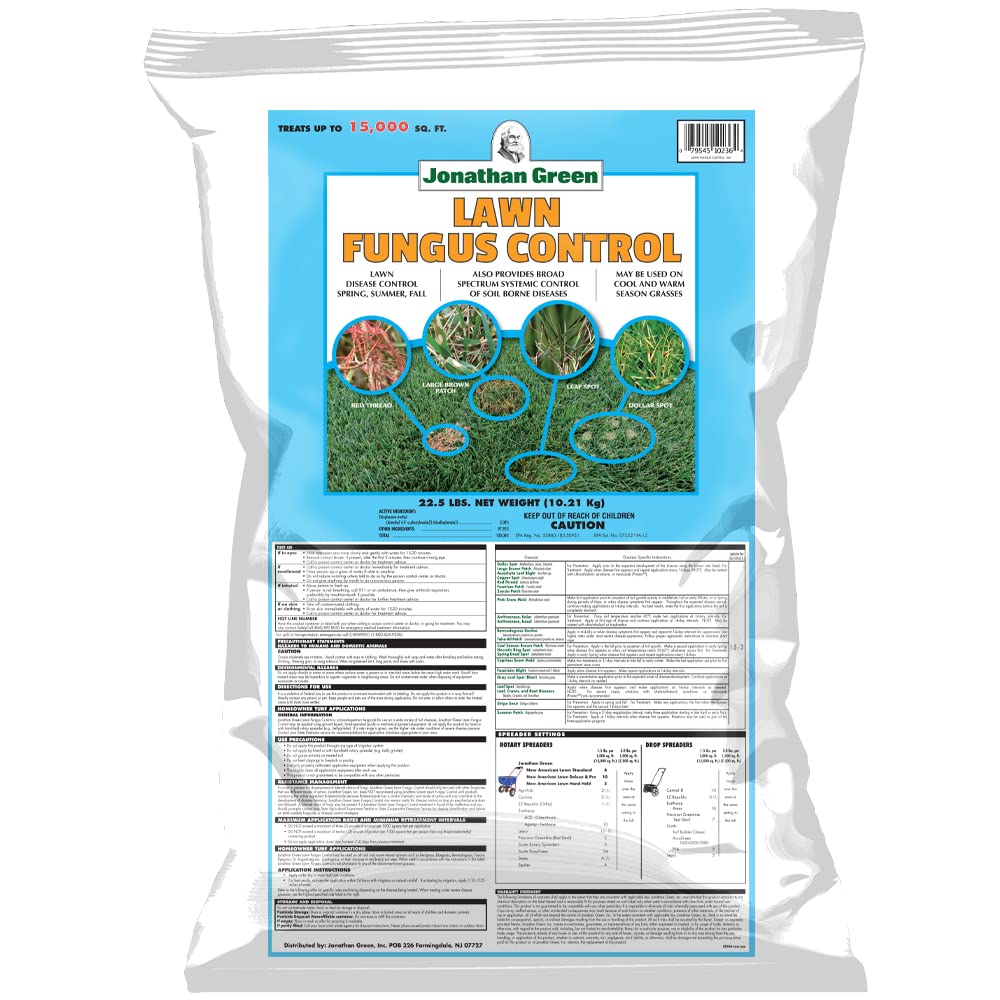
Jonathan Green’s Lawn Fungus Control is a granular fungicide designed exclusively for turf — it is the only product in this guide that is not a liquid concentrate, and it is formulated to prevent and treat soil-borne diseases like brown patch, dollar spot, and red thread on lawns. The 22.5-pound bag covers up to 15,000 square feet, making it the most economical option for large properties dealing with recurring fungus rings.
Users with Zoysia and Kentucky Bluegrass report rapid visible improvement after application, and the granular format is easy to apply with a standard broadcast spreader. The product works on both cool and warm-season grasses and can be used at the same time as seeding, which is a unique advantage for lawn renovation projects where fungus pressure is high.
Quality control is an issue with some batches — multiple customers report bags arriving with large, hard lumps that clog electric spreaders and require manual breaking. It is also important to note that this is a preventative treatment: it stops new fungus from developing but will not repair damage already present. Rotate with a different active ingredient annually to prevent resistance buildup.
What works
- Covers 15,000 sq ft per bag for large lawns
- Controls brown patch, dollar spot, and snow mold
- Safe to use during seeding and overseeding
What doesn’t
- Hard lumps in some bags clog spreaders
- Preventative only — cannot fix existing damage
Hardware & Specs Guide
Copper Content and MCE
The metallic copper equivalent (MCE) is the true measure of a copper fungicide’s potency. Products like Monterey Liqui-Cop and Southern Ag Liquid Copper deliver a high MCE that provides longer residual protection on foliage. Lower MCE formulations, such as copper octanoate biofungicides, are gentler but require more frequent reapplications, especially during wet weather.
Rainfastness and Drying Time
Rainfastness determines how long after application the product can withstand precipitation without losing efficacy. Gel-based copper concentrates like Liqui-Cop are rainfast once fully dry, typically within two to four hours under moderate conditions. Liquid copper sulfate formulations are less rainfast and often require a 24-hour dry period before a storm hits to be effective.
FAQ
Can copper fungicide concentrate be used on edible vegetables and fruits?
How does rainfastness affect reapplication frequency for copper fungicides?
Final Thoughts: The Verdict
For most gardeners, the best copper fungicide concentrate winner is the Monterey Liqui-Cop because its rainfast gel formulation provides long-lasting coverage on fruit trees, ornamentals, and vegetables with minimal staining. If you want a broad-spectrum organic option that offers systemic protection through root colonization, grab the Monterey Complete Disease Control. And for multi-target orchard management that tackles insects and disease in one spray, nothing beats the Bonide Captain Jack’s Orchard Spray.