
Manually turning a compost pile with a pitchfork is hard, slow, and smelly work. A dedicated tumbler replaces that chore with a simple spin, aerating the batch in seconds and cutting decomposition time from months to weeks. The real question isn’t whether to buy one — it’s which capacity, chamber configuration, and build quality actually deliver that promise without leaking, rusting, or collapsing under a full load.
I’m Rikta — the co-founder and writer behind Lawn Gear Lab. I’ve spent hundreds of hours comparing compost tumbler specs, studying aeration geometry, analyzing steel tube gauges, and cross-referencing owner feedback to isolate the designs that genuinely accelerate composting rather than just spinning waste in place.
Whether you’re managing kitchen scraps for a vegetable bed or clearing leaves from a half-acre lot, the right tumbler turns waste into black gold on schedule. This guide breaks down the real differences between budget drums, mid-range dual chambers, and premium cranks to help you pick the best compost barrel tumbler for your garden’s output and your assembly patience.
How To Choose The Best Compost Barrel Tumbler
Compost tumblers seem simple — a barrel on a stand that you spin. But the differences in chamber count, material thickness, aeration design, and bearing quality dictate whether you get rich compost in two weeks or a stinky, sludgy lump after a month. Here are the specs that separate effective tumblers from frustrating ones.
Dual vs. Single Chamber: Batch Continuity
A single-chamber tumbler forces you to empty the whole drum before starting a new batch. Dual-chamber models let you fill one side while the other side finishes decomposing uninterrupted. If you generate kitchen waste daily, dual chambers eliminate the “where do I put today’s scraps?” dilemma and keep your compost pipeline flowing.
Aeration Fin Depth & Hole Pattern
Decomposition is an aerobic process. Shallow fins and sparse holes starve the microbes of oxygen. Look for fins at least 50 mm deep and a dense pattern of aeration holes across the entire barrel surface. Deeper fins also physically break up clumps during rotation, which is critical for materials like grass clippings that mat together.
Frame Material & Rust Resistance
The barrel spins on a metal frame, and that frame sits on the ground in rain, snow, and sun. Galvanized steel with a powder-coated finish resists corrosion far longer than raw steel or painted tubing. Check the gauge of the legs — thinner tubing wobbles once the drum is full of wet scraps, leading to instability during rotation.
Capacity vs. Physical Footprint
Capacity is measured in gallons, but the footprint matters when you’re placing the tumbler near a garden bed or against a shed wall. A 37-gallon drum is manageable for a two-person household. A 65-gallon unit processes yard waste faster but takes up more space and becomes significantly heavier to turn when fully loaded. Match the volume to your weekly waste output, not the maximum number on the box.
Quick Comparison
On smaller screens, swipe sideways to see the full table.
| Model | Category | Best For | Key Spec | Amazon |
|---|---|---|---|---|
| FCMP Outdoor HOTFROG Dual-Chamber 37-Gal | Dual Chamber | Uninterrupted batch composting | 37 Gal / UV-inhibited PE | Amazon |
| RSI Maze Compost Tumbler 65-Gal | Premium Crank | Large volume with easy turning | 65 Gal / Geared crank handle | Amazon |
| FCMP Outdoor HOTFROG Rolling Single 37-Gal | Single Chamber | Zero assembly / beginner use | 37 Gal / Rolling base | Amazon |
| Good Ideas Compost Wizard Jr 7 cu ft | Wheeled Drum | Simple rolling / entry-level | 7 cu ft / Twist-off lid | Amazon |
| Marcytop 45-Gal Dual Chamber | Dual Chamber | High capacity / heavy poly build | 45 Gal / Extra-thick PP | Amazon |
| EJWOX 43-Gal Dual Chamber with Thermometer | Dual Chamber | Temperature monitoring | 43 Gal / Built-in thermometer | Amazon |
| Nova Microdermabrasion 43-Gal Dual Chamber | Dual Chamber | Budget dual chamber / value | 43 Gal / BPA-free PP | Amazon |
In‑Depth Reviews
1. FCMP Outdoor HOTFROG 37-Gallon Dual-Chamber Tumbling Composter
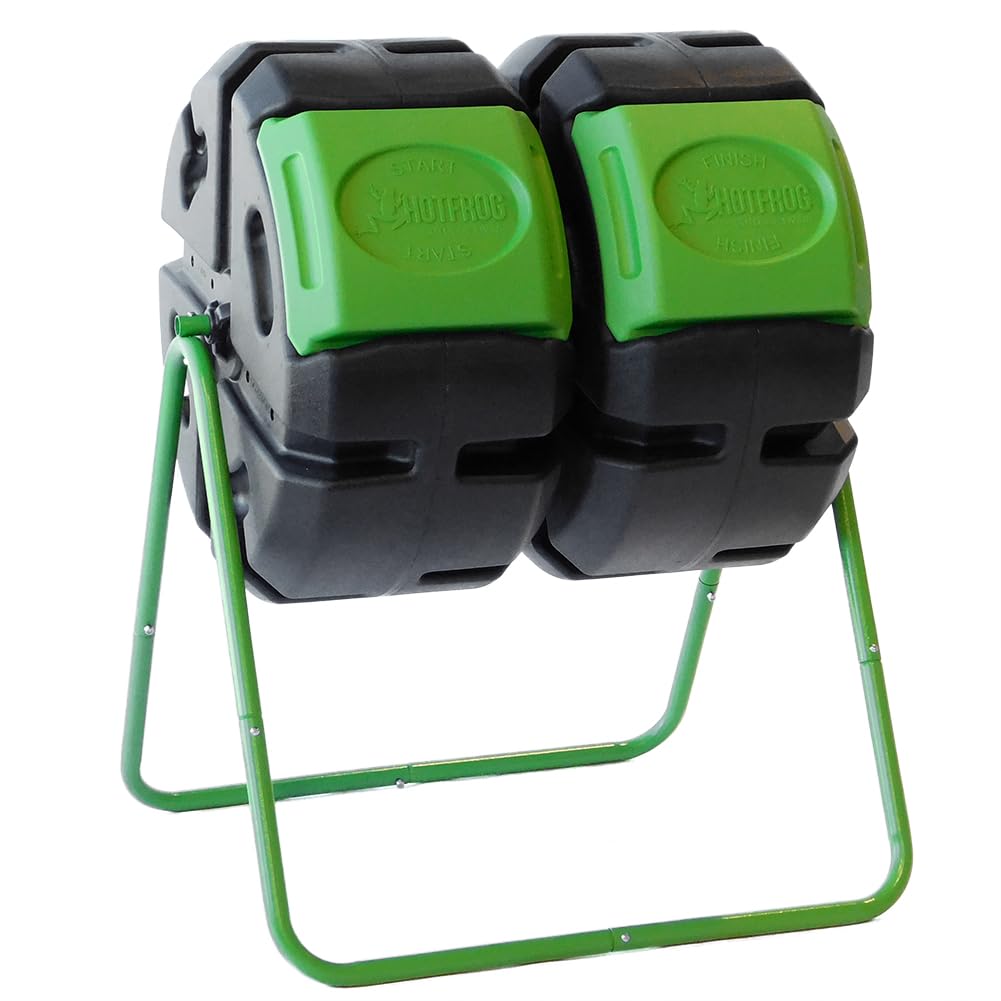
The FCMP Outdoor HOTFROG dual-chamber model hits the sweet spot of capacity, build quality, and price. Its two 18.5-gallon chambers let you load fresh waste on one side while the other side finishes, so you never have to halt your composting cycle. The cylindrical drum is made from UV-inhibited, BPA-free recycled polyethylene — a material that doesn’t become brittle after years of sun exposure, unlike cheaper polypropylene alternatives.
Rotation is smooth thanks to the corrosion-resistant powder-painted galvanized steel frame. Assembly takes about 15 minutes with just eight screws, and the two sliding doors (marked Start and Finish) make loading and extracting compost straightforward. The aeration vents run along the full length of the drum, and the deep fins inside break up clumps during each spin — a critical detail when grass clippings or wet kitchen scraps try to mat together.
In hot, sunny conditions with a balanced brown-to-green ratio, users report finished compost in as little as two weeks. The compact 30-inch width fits well in smaller yards, and the sealed design keeps out rodents and flies. The only minor compromise is that the sliding doors can feel a bit stiff at first, but they loosen with use.
What works
- Fast 15-minute assembly with only 8 screws
- UV-inhibited PE resists cracking and fading
- Dual chambers enable continuous batch composting
- Corrosion-resistant frame holds up in wet climates
What doesn’t
- Sliding doors can be stiff initially
- Plastic drum may flex slightly when fully loaded
2. RSI MCT-MC Maze Compost Tumbler, 65-Gallon

The RSI Maze Compost Tumbler is the heavyweight champion of this list. With a 65-gallon drum capacity, it’s built for households with serious yard waste — think leaves, grass clippings, and garden trimmings by the wheelbarrow load. The drum is made from UV high-impact plastic, and the frame uses heavy-gauge metal that doesn’t wobble when the barrel is packed with wet material.
The standout feature is the geared crank handle. Unlike direct-turn designs that require significant upper-body strength when the drum is full, the geared mechanism multiplies your turning force, making rotation easy even at maximum load. The drum has adjustable built-in air vents, so you can increase airflow during the hot active phase or reduce it during curing. Two sliding doors on the drum make loading and unloading simple, and the large clearance underneath accommodates a wheelbarrow or collection bucket.
Assembly takes roughly two hours — the trade-off for a robust structure with actual-size screw diagrams in the instructions. A few owners report needing to drill misaligned handle holes, but the overall construction quality justifies the effort. After two years of use, the frame shows minimal rust on hardware, and the drum remains structurally sound. The included collection cart is less sturdy than the tumbler itself, but it’s functional for moving finished compost around the garden.
What works
- Geared crank handle makes full-drum turning effortless
- 65-gallon capacity handles high-volume yard waste
- Adjustable air vents let you control oxygen flow
- Heavy-gauge frame remains stable when fully loaded
What doesn’t
- Assembly takes 2+ hours with many screws
- Some handle holes may require drilling to align
- Collection cart feels less durable than the drum
3. FCMP Outdoor HOTFROG Rolling Single Chamber 37-Gallon

The rolling single-chamber HOTFROG is the only tumbler on this list that arrives fully assembled. You pull it out of the box, snap the base onto the drum, and start composting immediately. The 37-gallon cylindrical drum is made from UV-inhibited recycled polyethylene with deep handhold fins molded into the body — no separate handles to break off. The rolling design lets you move the entire unit to wherever you need the compost, eliminating the bucket-and-shovel shuffle.
Rotation works by rolling the drum on its base, which is easier on the back than lifting a pitchfork but does require some force when the drum is full. The deep fins inside the chamber break up clumps and mix oxygen effectively. The large opening and removable sliding door make it easy to add kitchen scraps or extract finished compost. Users report that in hot weather with a proper green-to-brown ratio, the batch can finish in as little as two weeks.
The all-plastic construction means no rust — a real advantage over metal-pivot designs that corrode after a few seasons. Some fine particles (coffee grounds, sawdust) can escape through the aeration holes during rotation, but the loss is minimal. The unit sits on a low-profile base, so it stays stable on level ground. If you want a single-chamber system with zero setup and no metal to rust, this is the pick.
What works
- No assembly required — ready to use out of the box
- All-plastic construction eliminates rust issues
- Rolling design lets you move compost where needed
- Deep fins provide good aeration and clump breaking
What doesn’t
- Requires physical effort to rotate when full
- Fine particles may leak through aeration holes
4. Good Ideas Compost Wizard Jr 7 Cubic Feet
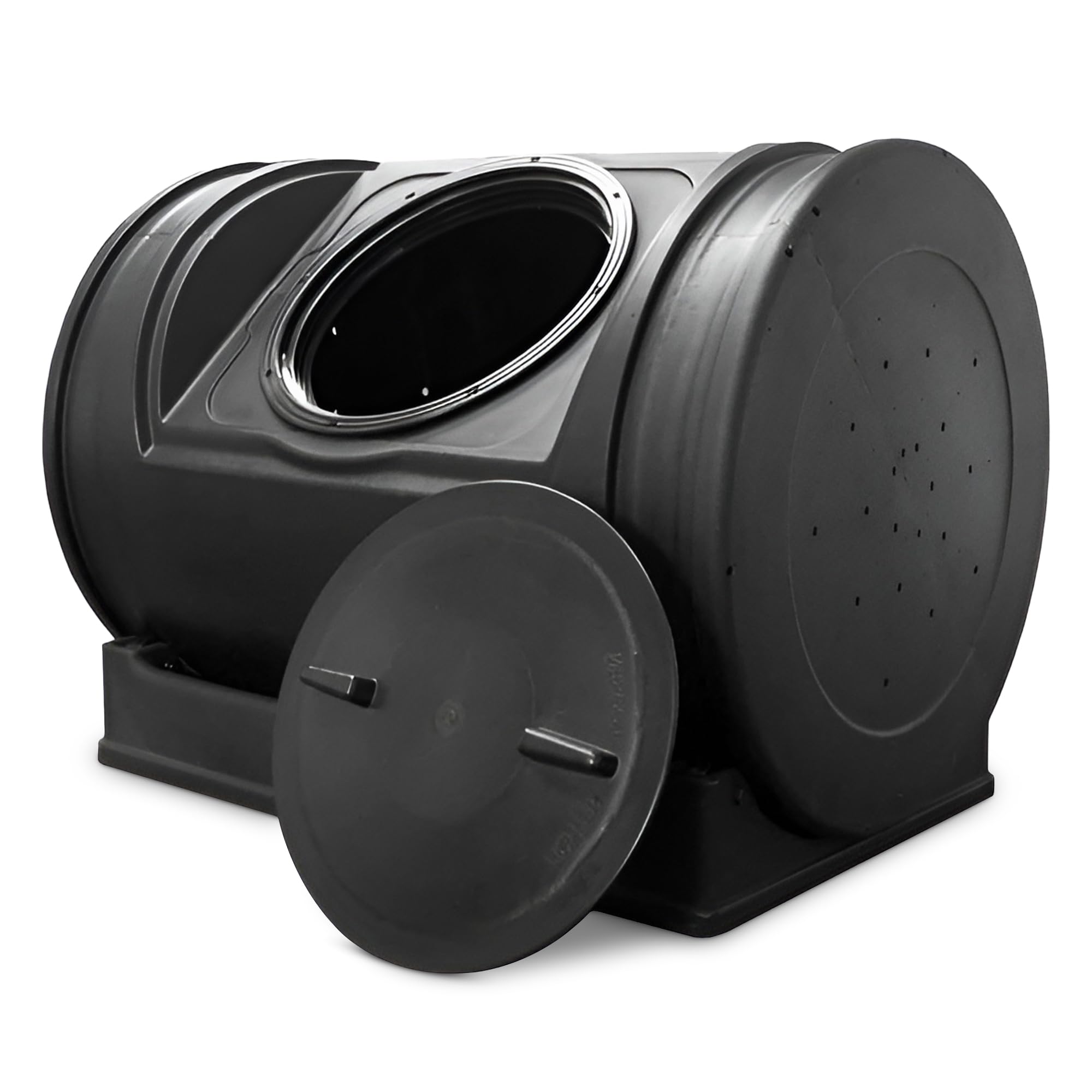
The 7-cubic-foot (roughly 52-gallon) drum is made from BPA-free polyethylene and sits on a wheeled base that lets you roll it around the yard. The twist-off lid seals securely to keep out rodents and flies, and the drum has molded handgrips for turning.
This is a single-chamber system, so you batch-compost: fill it, let it finish, empty it, then start again. The wheeled design makes turning relatively easy compared to stationary tumblers — you just roll the drum a few rotations. The lid is the primary access point, which makes loading simple but can be awkward for removing finished compost from the bottom of the drum. Some users tilt the unit or use a small shovel to extract the mature material.
One issue is that rain can collect inside if the lid isn’t sealed tightly, adding significant weight and making the drum harder to roll. The design also lacks the deep internal fins of newer tumblers, so matting can occur if you don’t turn it frequently enough. For light-duty kitchen scrap composting in a small garden, it’s a reliable workhorse. For heavy yard waste processing, a dual-chamber model with better aeration will outperform it.
What works
- Proven durability — many units last over 10 years
- Wheeled base makes rolling and repositioning easy
- Twist-off lid seals well against pests
- Fully assembled, no setup required
What doesn’t
- Rainwater can collect and make the drum heavy
- Lid-only access makes emptying the bottom difficult
- Shallow internal fins may allow material to mat
5. Marcytop 45-Gallon Dual Chamber Compost Tumbler

The Marcytop 45-gallon dual-chamber tumbler offers the largest combined capacity in the mid-range tier, with two 22.5-gallon compartments. The hexagonal drum is made from extra-thick polypropylene with a reinforced powder-coated steel frame. The plastic panels feel noticeably heavier than budget options, which translates to less flex and better thermal retention — important for maintaining the internal temperature that drives thermophilic decomposition.
Assembly is straightforward with a rubber mallet and screw gun; the interlocking panel system avoids the “10,000 screws” complaint common to many tumblers. The deep fins and multiple aeration holes promote good oxygen circulation, and the large sliding doors make loading and unloading clean. The orange door color is a nice visual cue to differentiate the active chamber from the finishing chamber.
One practical note from long-term users: if you fill both chambers completely, the drum becomes quite heavy and can be difficult to spin. Some owners recommend keeping the two chambers separate so you can spin one at a time. The unit does not include a thermometer, so you’ll need to monitor internal temperature manually if you want to track the hot phase. For households that generate a lot of kitchen and yard waste and want a durable dual-chamber design without paying premium prices, this is a strong contender.
What works
- Extra-thick polypropylene panels resist flexing
- Large 45-gallon total capacity for high waste volume
- Relatively simple assembly with fewer screws
- Deep fins provide good aeration and clump breaking
What doesn’t
- Fully loaded drum is heavy and hard to spin
- No built-in thermometer for temperature monitoring
- Snapping brackets during assembly can be tricky
6. EJWOX 43-Gallon Dual Chamber Compost Tumbler with Thermometer

The EJWOX tumbler differentiates itself with a built-in compost thermometer mounted on the drum. This lets you track the internal temperature at a glance, so you know when the pile has entered the thermophilic range (130-160°F) where pathogens and weed seeds are killed. The thermometer is a genuinely useful tool for beginners who aren’t sure if their pile is heating up properly.
The 43-gallon dual-chamber drum is made from galvanized steel with a green powder-coated finish. The metal construction feels rigid and stable, and the octagonal shape provides flat panel surfaces that are easier to scrape clean than curved drums. The 50 mm deep grooves on the panels provide good ergonomic handholds for rotation. Assembly has been simplified compared to earlier versions — the center divider is a single slip-in piece, and the screw count has been reduced.
Some users note that the thermometer probe could be longer for a more accurate core reading, and that a few screws may have minor threading defects (extras are included). The drum spins smoothly on its metal base, and the doors seal well enough to keep out rodents. If temperature monitoring is a priority for you, this is the only model on the list that includes it out of the box. Just keep in mind that the thermometer is an additional component that could fail over time.
What works
- Built-in thermometer helps monitor composting temperature
- Galvanized steel frame resists rust and corrosion
- Deep 50 mm grooves provide good handholds
- Reduced screw count simplifies assembly
What doesn’t
- Thermometer probe could be longer for core readings
- Some screws may have minor threading defects
- Metal drum can get hot to the touch in direct sun
7. Nova Microdermabrasion 43-Gallon Dual Chamber Compost Tumbler

The Nova Microdermabrasion tumbler is the entry-level dual-chamber option that delivers the core composting functionality without the premium price tag. The 43-gallon hexagonal drum is split into two chambers, each with its own door, so you can start a fresh batch while the other side finishes. The body is made from BPA-free polypropylene with a corrosion-resistant powder-coated steel frame — the same material combination used by more expensive models.
The aeration system includes holes and deep fins molded into the eight panels, which help break up clumps and mix oxygen during rotation. The hexagonal shape provides flat surfaces that make scraping out finished compost easier than with curved drums. Assembly requires about 50 screws and takes roughly an hour with a power screwdriver; the instructions are picture-based and adequate. The drum rotates smoothly when partially filled, though it becomes heavier to spin when both chambers are fully loaded with wet material.
The main compromises are in material thickness and long-term UV resistance. The polypropylene panels are thinner than premium models, so the drum can flex slightly when packed to capacity. The black color absorbs heat well for faster composting, but the plastic may become brittle after several years of intense sun exposure. For budget-conscious gardeners who want dual-chamber capability and are willing to spend a bit more time on assembly, this is a solid starting point that produces compost comparable to tumblers costing significantly more.
What works
- Dual chambers at a budget-friendly price point
- Deep fins and aeration holes promote good airflow
- Hexagonal shape makes emptying easier than round drums
- Sturdy enough for small to medium waste volumes
What doesn’t
- Thinner plastic may become brittle with UV exposure over time
- Drum flexes when fully loaded with wet material
- Assembly requires many screws and about an hour
Hardware & Specs Guide
Chamber Configuration
Dual-chamber tumblers allow continuous composting — fill one side while the other side finishes. Single-chamber models require you to empty the entire drum before starting a new batch. Dual chambers are strongly preferred for households that generate waste daily, while single chambers work fine for occasional gardeners who fill the drum over a week and then let it process.
Aeration Fin Depth
Fins inside the drum serve two purposes: they physically break up clumps during rotation, and they lift material into the airflow. Deeper fins (50 mm or more) are noticeably more effective than shallow ridges. The pattern of aeration holes matters too — look for a dense, evenly distributed pattern rather than a few scattered holes, which create dead zones with limited oxygen.
Frame Material & Gauge
The frame supports the entire weight of the drum plus wet waste. Galvanized steel with a powder-coated finish offers the best rust resistance. Check the leg gauge — thinner tubing (under 1.5 mm wall thickness) can wobble or bend when the drum is full. Premium models use heavier steel that stays rigid during rotation, reducing strain on the axle bearings.
UV Resistance & Plastic Type
Polyethylene (PE) generally holds up better under UV exposure than polypropylene (PP), which can become brittle after a few years in direct sun. Look for “UV-inhibited” or “UV-stabilized” in the material description. Black drums absorb heat faster, helping the compost reach thermophilic temperatures, but they also degrade faster if the plastic isn’t UV-protected.
FAQ
How often should I turn a compost barrel tumbler?
What is the ideal carbon-to-nitrogen ratio for a tumbler?
Can I compost weeds and diseased plants in a tumbler?
Why does my compost tumbler smell bad?
Final Thoughts: The Verdict
For most gardeners, the best compost barrel tumbler winner is the FCMP Outdoor HOTFROG Dual-Chamber 37-Gallon because it combines a fast 15-minute assembly, UV-inhibited polyethylene construction, and a dual-chamber design that keeps your compost pipeline running — all at a reasonable price point. If you want a massive 65-gallon capacity with a geared crank that makes turning effortless, grab the RSI Maze Compost Tumbler. And for a zero-assembly, all-plastic single chamber that’s ready to use the minute it arrives, nothing beats the FCMP Outdoor HOTFROG Rolling Single Chamber 37-Gallon.