
You want your garden soil to feed your plants and hold water, not just sit there like dead dust. The secret is the organic matter (the decomposed plant and animal material) packed into the bag — and the number that tells you how much you can actually spread is the volume, not the weight.
I’m Rikta — the co-founder and writer behind Lawn Gear Lab. This guide is built by comparing the manufacturers’ published specifications and the patterns across verified customer reviews, so you get each pick’s real strengths and trade-offs instead of marketing spin.
Whether you are planting tomatoes in a raised bed, fixing patchy grass, or reviving a potted houseplant, the right compost and manure blend turns struggling plants into thriving ones.
How To Choose The Best Compost And Manure
First-time buyers often grab a bag by its weight. A heavy 40-pound bag might be full of sand and moisture, not the organic matter your plants need. Instead, check the volume — listed in quarts or cubic feet — because that tells you how much soil you can actually amend.
Check for “Fully Composted” on the Label
Raw manure (animal waste right from the barn) can burn your plant roots because it is still releasing ammonia gas. Fully composted manure has been aged and aerated (turned to let in oxygen) until it becomes a stable, dark material that feeds soil bacteria instead of shocking them. Every product here is fully composted.
Match the NPK Ratio to Your Plants
NPK stands for nitrogen (for green leaves), phosphorus (for roots and flowers), and potassium (for overall plant health). The numbers on the bag, like 0.5-0.5-0.5, give the percentage of each nutrient by weight. A low, balanced number like that means it is a gentle slow-release — ideal for tomatoes and flowers because it feeds slowly without burning.
Volume Matters More Than Bag Weight
A 40-quart bag, like the Michigan Peat Wholly Cow, covers about 10 square feet at a 1-inch depth. A smaller 8-quart bag is good for a few potted plants. Always check the quart or cubic-foot rating before buying so you do not run short halfway through your garden.
Quick Comparison
On smaller screens, swipe sideways to see the full table.
| Model | Category | Best For | Key Spec | Amazon |
|---|---|---|---|---|
| Michigan Peat Wholly Cow | Premium | Large beds & mushrooms | 40 Quarts / 34 lbs | Amazon |
| Black Kow (8 qt) | Mid-Range | Veggie gardens & pots | 8 Quarts / 6 lbs | Amazon |
| R&M Organics | Mid-Range | Indoor plants & low odor | 0.31 cu ft / 10 lbs | Amazon |
| Brut Cow Compost | Mid-Range | Seedlings & fast growth | 10 Quarts / 10 lbs | Amazon |
| Black Kow (35 lb) | Budget | Budget-friendly coverage | 35 lbs (approx. 20 lbs) | Amazon |
In‑Depth Reviews
1. Michigan Peat Baccto Wholly Cow Horticultural Compost and Manure for S
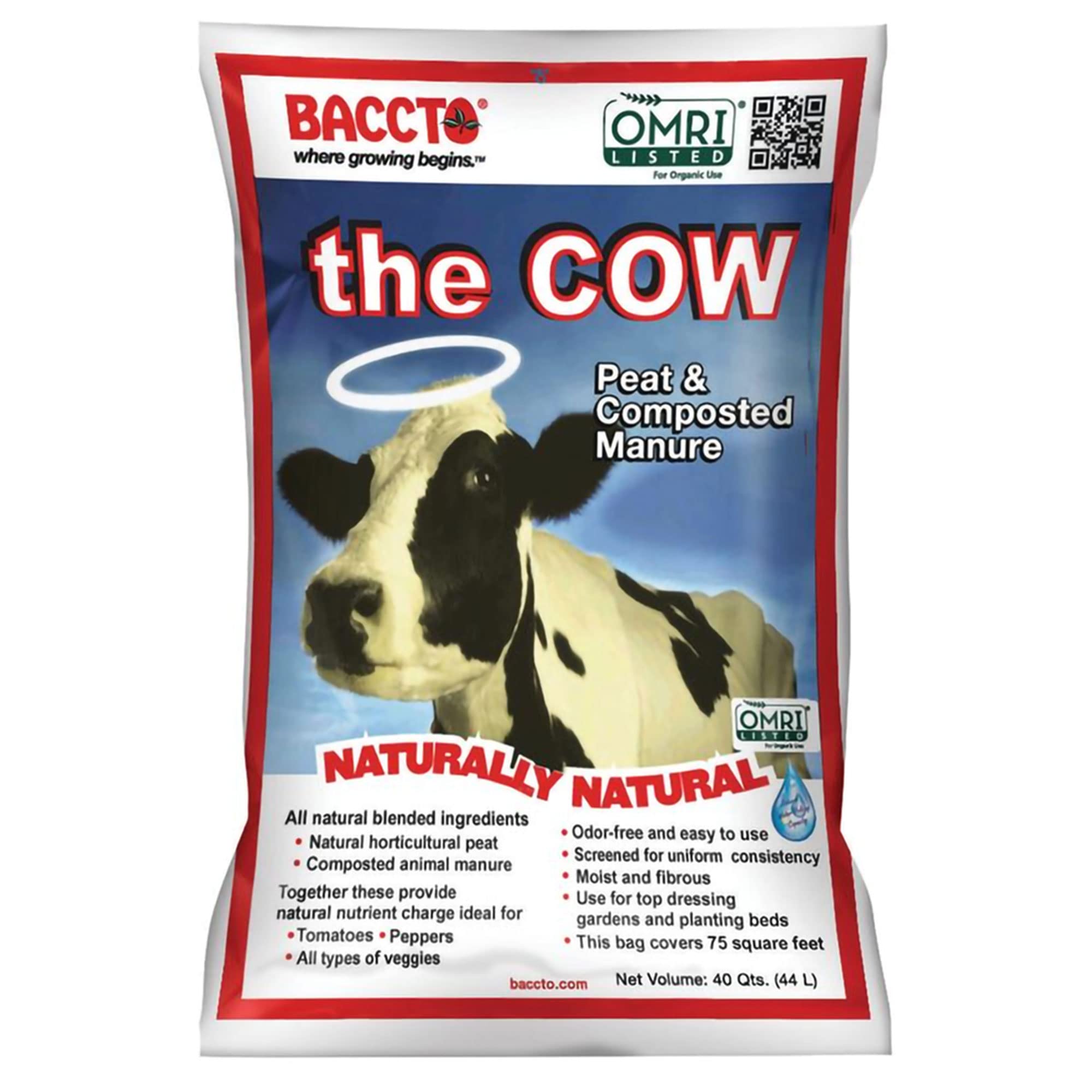
40 quarts (34 pounds) — the largest single-bag volume in this guide — makes the Michigan Peat Baccto Wholly Cow Horticultural Compost and Manure the top pick for serious gardeners who want to cover a full raised bed without buying multiple bags. That single bag covers about 10 square feet at a 1-inch depth. The blend mixes peat (decomposed moss that holds water) with composted animal manure, giving you a dark, fluffy texture that holds moisture naturally, so you water less often during dry weeks.
Buyers report it works especially well as a mushroom-growing substrate because the manure concentration is high. One reviewer describes using a 1:1 ratio with coco coir (coconut husk fiber) and sterilizing at 15 psi (pounds per square inch) for 120 minutes (two hours) to produce bumper crops. The screened texture (passed through a mesh to remove chunks) means you get a uniform consistency with very few sticks or debris — just dark, lightweight material you can handle with your hands.
The biggest limit: the 34-pound bag can be awkward to carry from the car to the garden if you have mobility issues. Reviewers also note the price per quart is slightly higher than budget options. But for volume, even texture, and a no-smell formulation that reviewers consistently describe as “a pleasure to work with,” this is the top pick for serious gardeners who want one bag to do it all.
Why it’s great
- Massive 40-quart size saves multiple trips.
- Odor-free — no manure smell after opening.
- Screened for even texture, no junk.
Good to know
- Heavy bag at 34 pounds.
- Premium price per quart.
2. Black Kow Nitrogen Phosphate Composted Cow Manure Fertilizer for Soil, 8 Quart

You get a lot less volume here — 8 quarts versus the top pick Michigan Peat’s 40 — and a much lighter 6-pound bag. What makes it a great choice for small jobs is the granule form: the particles mix easily into individual planting holes or potted plants without needing to re-fill a wheelbarrow. The 0.5-0.5-0.5 NPK ratio provides gentle, slow-release feeding that will not burn even sensitive roots.
Owners mention it “really helped my garden veggies,” and the bag is small enough to hold in one hand while you sprinkle it into a hole. Black Kow is one of the most recognized names in composted cow manure, and the 1:1 mixing ratio in the specs means you can blend it straight into existing soil without overdoing it.
If you are working with a small raised bed or a handful of pots and do not want to store a huge bag, this is the better choice over the Michigan Peat Wholly Cow. The catch is obvious: at only 8 quarts, you would need 5 of these bags to match the Wholly Cow’s 40-quart volume for a big project. Some reviewers also note a strong smell when first opened, which fades after a few minutes of airing out.
Where it shines
- Small, easy-to-handle bag at 6 lbs.
- Granule form mixes cleanly into planting holes.
- Trusted brand with strong reviews.
Worth noting
- 8-quart volume is too little for large beds.
- Some reviewers mention a strong smell when first opened.
3. R&M Organics Premium Organic Compost 10 lb Bag for Vegetables, Flowers
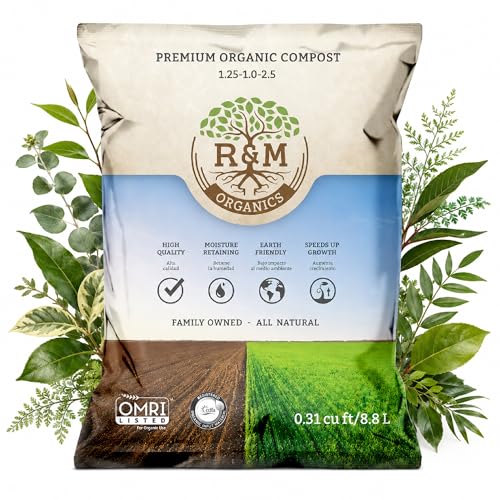
You do not want a barn smell in your living room when you re-pot a houseplant. The R&M Organics bag solves that with fully composted manure that goes through a continuous aeration process (constant air circulation during composting), leaving a clean, earthy scent rather than the sharp ammonia smell of less-processed products. The texture is the standout: customers note it is like fine topsoil with no clumps.
One reviewer describes how it “revived ailing tomato plant: yellow leaves turned green, new growth and flower buds appeared within a week of mixing into 27-gallon planter.” That turnaround happens when the compost is rich in beneficial bacteria and has a fine, soil-like consistency. The 10-pound bag is easy to carry and store without taking over your garage shelf. The 5:1 mixing ratio means you can stretch that 0.31 cubic feet across multiple pots.
For indoor and container use, this bag outperforms the stronger-smelling Black Kow 8-quart because you will not drive anyone out of the room. But the small volume — about one-third of a cubic foot (a cube roughly 7 inches on each side) — means it fits pots and patio planters much better than a 4×8-foot vegetable patch, where you would need a dozen bags.
What stands out
- Low odor — suitable for indoor plants.
- Fine, topsoil-like texture with no clumps.
- Quick visible results on stressed plants.
The trade-offs
- Small volume is best for pots, not big beds.
- Premium price per cubic foot.
4. Brut Cow Compost – Nutrient-Rich Composted Cow Manure Organic Soil Ame

When you start seeds indoors, the one spec that matters most is whether the compost is gentle enough not to burn delicate seedlings. The Brut Cow Compost carries an OMRI-listed organic certification — a seal from the Organic Materials Review Institute that guarantees no synthetic additives, sewage sludge, or genetically modified ingredients. It is packed with nitrogen, calcium, and iron without any filler.
The 10-quart bag hits a sweet spot: it is larger than the 8-quart Black Kow but smaller than the 40-quart Michigan Peat, so you get mid-range volume at a mid-range price. In return, you get a finely sifted, odor-free texture. One first-time grower reports using a 3:2 ratio (compost to soil): “Planted these tomatoes as seeds on March 1st. Today is April 22nd.” That is a 52-day head start toward harvest.
A first-time seed starter gets the most value here because of the certified organic safety and the gentle growth push. The honest trade-off: the price per quart is higher than bulk options like the Michigan Peat, so if you are filling a large bed, you will spend more per bag. Stick with the Brut for a few large pots or a seedling tray and reach for the 40-quart Wholly Cow for garden-scale projects.
The upsides
- OMRI listed — certified organic, no additives.
- Odor-free and safe for seedlings.
- Finely sifted, easy to blend.
Keep in mind
- Mid-range volume — not the biggest or smallest.
- Price per quart is higher than bulk options.
5. Black Kow Composted Cow Manure 35 lb Bag

You get a 35-pound bag of composted cow manure for less cost per pound than premium bags, enough to cover a large vegetable patch or top-dress a full lawn. The manufacturer even suggests planting tomatoes directly in the bag by cutting a slit and punching drain holes — a container hack that saves buying a pot.
But the downside is real: multiple reviews confirm the bag weighs around 19.8 pounds, not the advertised 35 pounds — a 43% shortfall. The compost quality is fine, with the same slow-release 0.5-0.5-0.5 NPK ratio as the smaller Black Kow bag, but the underweight issue frustrates buyers enough that some say it is cheaper to drive to a local hardware store where you can see the bag before buying.
This bag works for bulk coverage if you are comfortable with the weight variance. It is perfect for the budget buyer who wants Black Kow’s reliable compost formula and plans to buy from a retailer where they can inspect the bag weight at the register.
Why we’d pick it
- Bulk size for large gardens at low cost per unit.
- Same trusted Black Kow formulation.
- Can be used as a direct planting container.
A few caveats
- Bag is significantly underweight per reviews.
- Better value at local hardware stores.
Understanding the Specs
NPK Ratio (Nitrogen-Phosphorus-Potassium)
The three numbers on the bag — like the 0.5-0.5-0.5 on the Black Kow bags — give the percentage of each nutrient by weight. A low, balanced number means this is a gentle slow-release fertilizer that feeds plants over weeks instead of hours. High numbers like 10-10-10 are for chemical fertilizers, not compost. For most garden vegetables, a balanced low NPK from compost is exactly what you want.
Volume in Quarts vs Weight in Pounds
A bag labeled “35 pounds” might be mostly moisture and grit. Always check the quart rating instead: 40 quarts of Michigan Peat Wholly Cow covers about 10 square feet at one inch deep. A 10-quart bag like the Brut Cow Compost covers about 2.5 square feet. Volume tells you how much soil you can actually amend; weight only tells you how heavy the bag is to carry.
OMRI Listed (Organic Certification)
OMRI (Organic Materials Review Institute) is a third-party seal that verifies the compost contains no prohibited synthetic chemicals, sewage sludge, or genetically modified ingredients. The Brut Cow Compost is OMRI-listed, which matters if you are growing vegetables and want to maintain organic status in your garden.
Fully Composted vs Raw Manure
Fully composted manure has been aged, aerated, and turned until the heat kills weed seeds and pathogens and the material becomes a dark, crumbly texture. Raw manure is fresh animal waste that can contain E. coli, salmonella, and high ammonia levels that burn roots. Every product in this guide is fully composted — that is why you can mix them directly into soil without waiting or worrying.
FAQ
Can I use this compost and manure straight out of the bag without mixing it with soil?
How much compost and manure do I need for a 4×8 foot raised bed?
Why does my bag of compost and manure smell like ammonia?
What is the difference between composted cow manure and peat-based compost?
Final Thoughts: The Verdict
If you want one dependable pick, the best compost and manure winner is the Michigan Peat Baccto Wholly Cow because its 40-quart volume, screened texture, and no-smell formulation handle everything from a full raised bed to mushroom substrate without needing multiple bags. If you want a small bag for indoor pots with virtually no odor, grab the R&M Organics Premium Compost. And for a trusted name in granule form that mixes easily into planting holes, the standout is the Black Kow 8-Quart.