
Sharpening a dozen heavy-duty mower blades by hand with a file is backbreaking, inconsistent work that steals hours from your day. A commercial-grade dedicated sharpener changes that: it locks in a precise cutting angle, removes material quickly with a powerful motor, and lets you cycle through an entire fleet of blades without fatigue.
I’m Rikta — the co-founder and writer behind Lawn Gear Lab. I’ve spent hundreds of hours dissecting the motor specs, wheel diameters, arbor designs, and owner-reported durability of the machines that keep zero-turn and finish mower blades razor-sharp, analyzing what separates a dependable daily driver from a frustrating clunker.
The skilled searches that land here are hunting for the absolute best commercial lawn mower blade sharpener to keep their cutting gear in peak condition without wasting time or risking blade temper.
How To Choose The Best Commercial Lawn Mower Blade Sharpener
Every commercial mower blade sharpener on this list is a stationary benchtop machine designed for repeated, high-volume use. The wrong choice will overheat your blades, destroy the abrasive wheel in a single session, or vibrate itself loose from the bench. Focus on these four criteria to make the right call.
Motor Power & Torque Delivery
Horsepower ratings alone are misleading — a 1/3 HP motor running at 1750 RPM with high torque gearing can grind steel faster than a 0.66 HP unit with no torque reserve that bogs under contact. Look for continuous-duty rated motors and pay close attention to owner reports of stalling on thick, heat-treated blades.
Abrasive Wheel Diameter & Material
A 7-inch wheel exposes a smaller arc of contact, which helps prevent heat build-up on the blade edge, but it takes more passes per blade. A 9-inch or 10-inch wheel covers more edge per pass, speeding through long commercial blades. Ceramic wheels last much longer than adhesive sanding discs, while bonded stone wheels (like the Oregon uses) stay true without replacement but dress slower.
Angle Control & Blade Guides
Maintaining a consistent 30-45 degree bevel across every blade in your rotation is non-negotiable. Integrated jigs with preset angle stops are faster than freehand grinding, but the hardware must be sturdy — thin sheet-metal guides flex and cause uneven bevels. Look for solid steel or anodized aluminum angle brackets.
Bench Stability & Overall Mass
A sharpener that walks or vibrates during grinding chews up abrasive wheels and delivers inconsistent results. Machines weighing over 35 pounds with cast steel bases damp vibration naturally, while lighter units need bolting to a heavy workbench. Check the base material and the overall package weight before buying.
Quick Comparison
On smaller screens, swipe sideways to see the full table.
| Model | Category | Best For | Key Spec | Amazon |
|---|---|---|---|---|
| SporGain 2/3 HP | Disc Machine | All-day heavy-duty sharpening | 550W / 37.3 lbs | Amazon |
| RBG 712 | Pro Rotary | Professional lawn care fleets | Carborundum wheel / 30° preset | Amazon |
| Oregon 88-025 | Stone Grinder | Precision angle work | 1/3 HP / 46 grit stone | Amazon |
| JLD10-9 | Ceramic Wheel | Large deck blades | 1HP / 9-inch ceramic wheel | Amazon |
| VEVOR 2/3 HP | Disc Machine | Budget commercial sharpening | 500W / 7-inch wheel | Amazon |
| Innisle 1HP | Disc Machine | High-speed volume work | 750W / 9-inch disc | Amazon |
| WEN BG4270T | Water Stone | Multipurpose sharpening | 115 RPM / 220 grit stone | Amazon |
| All American 5005 | Grinder Jig | Portable on-site work | 1 lb / adjustable 15-45° | Amazon |
| SporGain Brushless | Disc Machine | Entry-level stationary grinder | Brushless motor / 3000 RPM | Amazon |
In‑Depth Reviews
1. SporGain Lawn Mower Blade Sharpener 2/3 HP (550W)
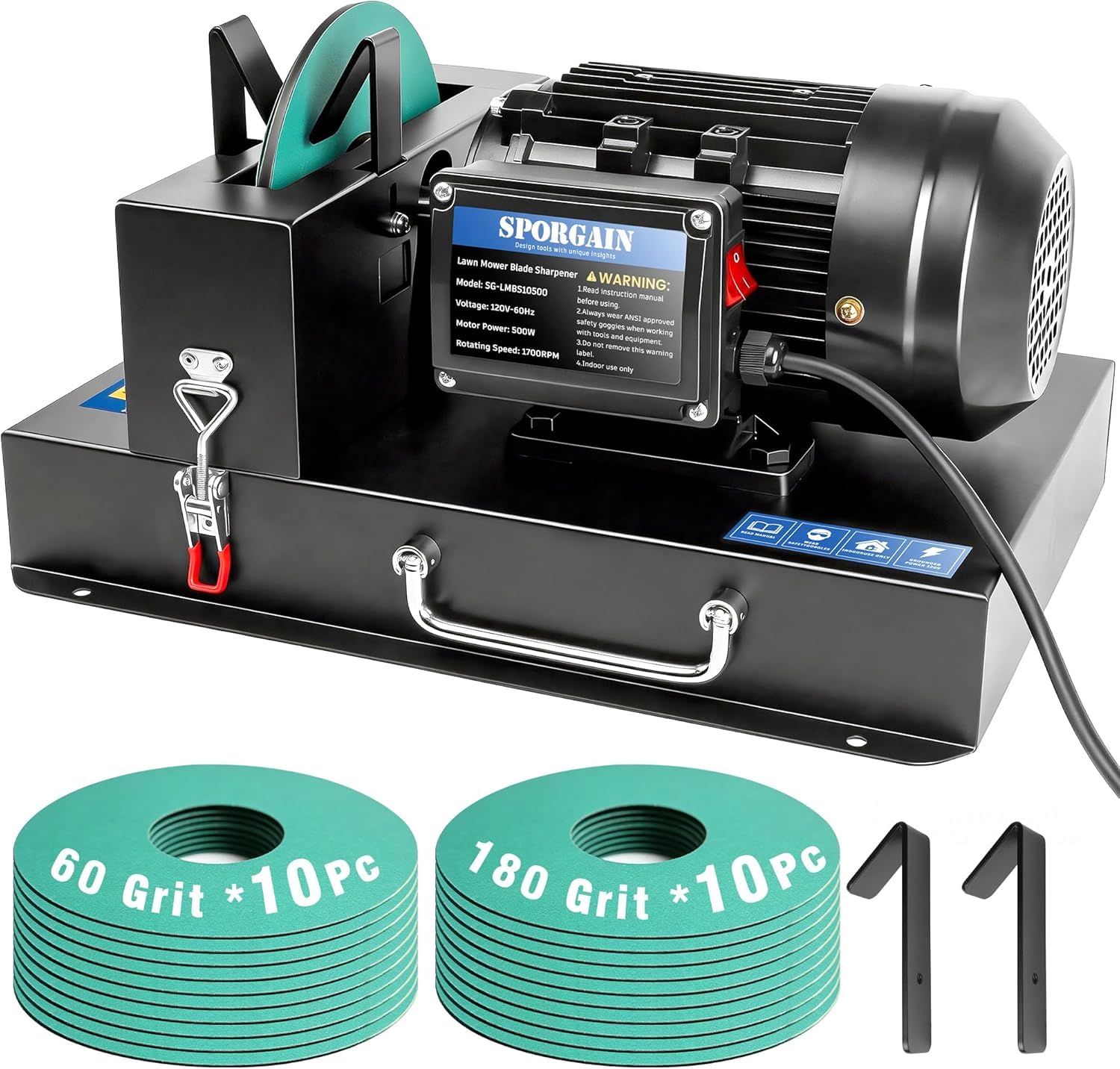
The SporGain 2/3 HP is a 37-pound steel machine designed to survive daily commercial use. Its 550W motor runs a 7-inch sanding disc platform, and the integrated snap-lock disc change system means swapping from 60-grit for rough grinding to 180-grit for finishing takes seconds instead of minutes. The cast steel base and secure blade brackets keep everything planted, even when bearing down on a deeply nicked high-lift blade.
Owner reports consistently praise the raw torque — the motor powers through gator and flat blades without bogging. The included 30° and 45° blade holders lock in the bevel precisely, removing the freehand guesswork that leads to uneven cutting edges. A few users note the machine has a learning curve: if you apply too much pressure on the guide, the blade edge can lift into the disc and scar the sandpaper. Light passes with a controlled feed rate solve the issue entirely.
For a shop sharpening multiple sets of blades per week, the SporGain delivers the durability and speed that justify its position as the top pick. The dual-grit sandpaper pack (ten each of 60 and 180 grit) supplies enough material for dozens of sharpenings out of the box, and the 2/3 HP rating provides the torque margin that lighter 1/3 HP units lack.
What works
- Snap-lock disc change is genuinely fast and tool-free
- Cast steel base provides excellent vibration damping
- Motor torque handles commercial-grade blades without stalling
What doesn’t
- Learning curve for pressure control on the guide
- Can’t use both left and right cutting edges simultaneously without adjusting the jig
2. RBG 7″ Professional Fast Grind Lawn Mower Blade Sharpener 712

The RBG 712 occupies a dedicated niche — it’s a rotary sharpener that uses a bonded carborundum wheel instead of disposable sanding discs. The preset blade guide locks in a 30° bevel for standard and reverse blades without any measuring or angle-setting. This machine was built for production environments where every second counts and consistency across an entire fleet matters.
Commercial landscapers running zero-turn mowers with multiple 60-inch decks report that the RBG 712 restores a factory-quality edge in roughly the same time it takes to drink a coffee. The wheel life is rated at 100-150 sharpenings, dramatically lowering the per-blade cost compared to disc-based systems that require frequent sandpaper replacement. The optional grit collector accessory keeps aluminum oxide dust out of the workshop air, a serious consideration for enclosed spaces.
The main barrier is the upfront premium — this is the most expensive unit in the lineup. However, for professionals who value time over tool cost, the RBG eliminates the hassle of disc changes, guide adjustments, and edge inconsistency. The build quality is universally praised, and the machine’s simple operation means even new employees can produce accurate bevels on the first try.
What works
- Carborundum wheel lasts 100+ sharpenings per disc
- Preset 30° guide removes all guesswork
- Optional grit collector keeps workspace clean
What doesn’t
- Higher upfront investment than disc-based alternatives
- Replacement wheels must be sourced from RBG
3. Oregon Economy Lawn Mower Blade Sharpener 88-025
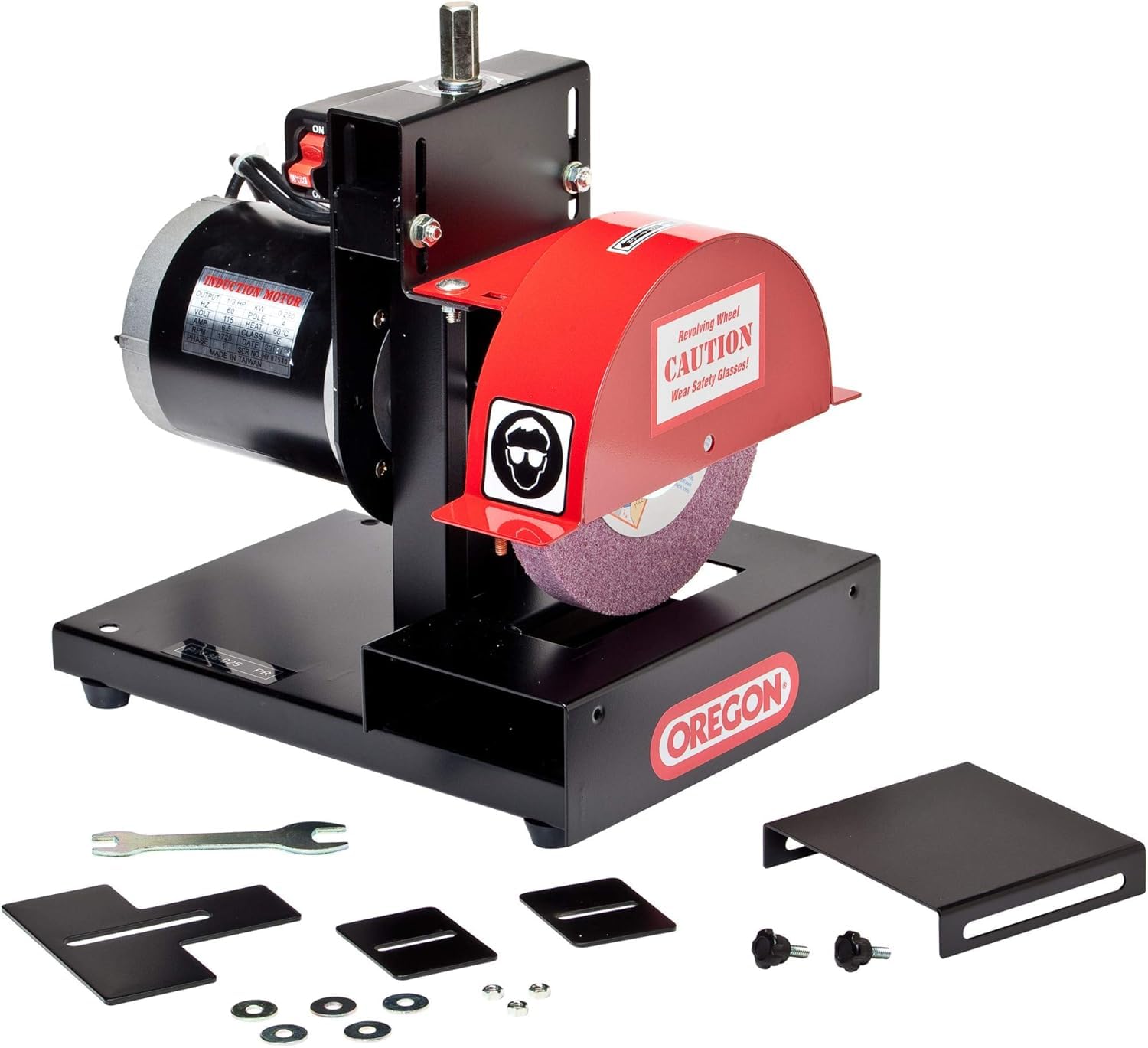
The Oregon 88-025 is a traditional bench grinder purpose-built for mower blades. It uses a 46-grit bonded aluminum oxide stone driven by a 1/3 HP motor at 1750 RPM. Rather than relying on disposable discs, the stone is dressed with the included dressing tool to expose fresh abrasive — this eliminates the ongoing cost of sandpaper replacements that plagues disc-based sharpeners.
The machine delivers highly accurate angle reproduction, which is why multiple owners emphasize buying a blade balancer alongside the grinder. The slow motor speed paired with the stone’s surface area prevents overheating, so blade temper is preserved. Users note that grinding takes slightly longer than with a high-RPM side grinder, but the consistent bevel results in a perfectly balanced blade that cuts cleanly without tearing grass.
The 1/3 HP motor is the limiting factor under continuous heavy use — prolonged grinding sessions can cause the motor casing to become very hot. For a commercial operation sharpening dozens of blades daily, this may shorten motor life compared to a 1 HP unit. Still, for part-time commercial use or as a dedicated sharpening station in a larger shop, the Oregon delivers professional-grade outcomes with minimal consumable cost.
What works
- Bonded stone lasts indefinitely with periodic dressing
- Slow 1750 RPM prevents blade overheating
- Low vibration operation even on lightweight benches
What doesn’t
- Motor runs hot under sustained heavy grinding
- Slower stock removal than comparable HP disc machines
4. JLD10-9 Lawn Mower Blade Sharpener 1HP 750W

The JLD10-9 packs a 750-watt motor that spins a 9-inch ceramic grinding wheel at 1700 RPM. The larger wheel diameter is a tangible advantage for commercial mower blades — the extended arc of contact covers more edge per pass, reducing the number of passes needed to dress a long 60-inch deck blade. The included metal balancer lets you check each blade after sharpening, a critical step for avoiding mower vibration.
The motor has enough torque to maintain speed even when grinding heavily worn blades with deep nicks. The ceramic wheel outlasts standard aluminum oxide discs by a wide margin, and the five included replacement discs provide ample backup stock. The integrated 30° tool holder ensures a consistent bevel, and the cast steel base keeps the machine stable during aggressive grinding.
A few buyers have reported that the claimed blade balancer was missing from the box despite being advertised. Others note that the 9-inch replacement ceramic discs can be difficult to source if the manufacturer discontinues the size. For buyers willing to verify the included accessories upon arrival and stock up on spare discs upfront, the JLD10-9 offers high throughput and a robust build at a competitive price point.
What works
- 9-inch wheel reduces pass count on long blades
- 750W motor maintains speed under load
- Includes a balancer for finishing each blade
What doesn’t
- Some units ship without the advertised balancer
- Replacement 9-inch discs may become scarce
5. VEVOR Lawn Mower Blade Sharpener 2/3HP (500W)

The VEVOR 2/3 HP sharpener offers a 500W motor driving a 7-inch 60-grit ceramic grinding wheel. The integrated steel base and blade brackets provide adequate stability for most grinding tasks.
Owners generally report that the machine performs well out of the box, though several note that the included sanding disc is the weak link — it is an adhesive disc rather than a bonded wheel. Replacing it with a bonded ceramic disc (such as an RPG 712 disc) significantly improves the sharpening experience and disc longevity. The 30° and 40° blade holders are functional but feel less substantial than the solid steel units on the SporGain.
For occasional commercial use or as a backup sharpening station, the VEVOR delivers competent performance. However, the adhesive disc system is a compromise: if you apply too much pressure, the disc can delaminate from the backing plate. Budget-conscious buyers should factor in the cost of an upgraded bonded disc for reliable daily use.
What works
- Affordable entry point for a dedicated bench sharpener
- Ceramic wheel provides decent life for light commercial work
- Easy 3-step assembly gets you grinding quickly
What doesn’t
- Adhesive sanding disc prone to delamination under heavy pressure
- Blade holders feel less robust than premium competitors
6. Innisle 1HP Lawn Mower Blade Sharpener (750W)
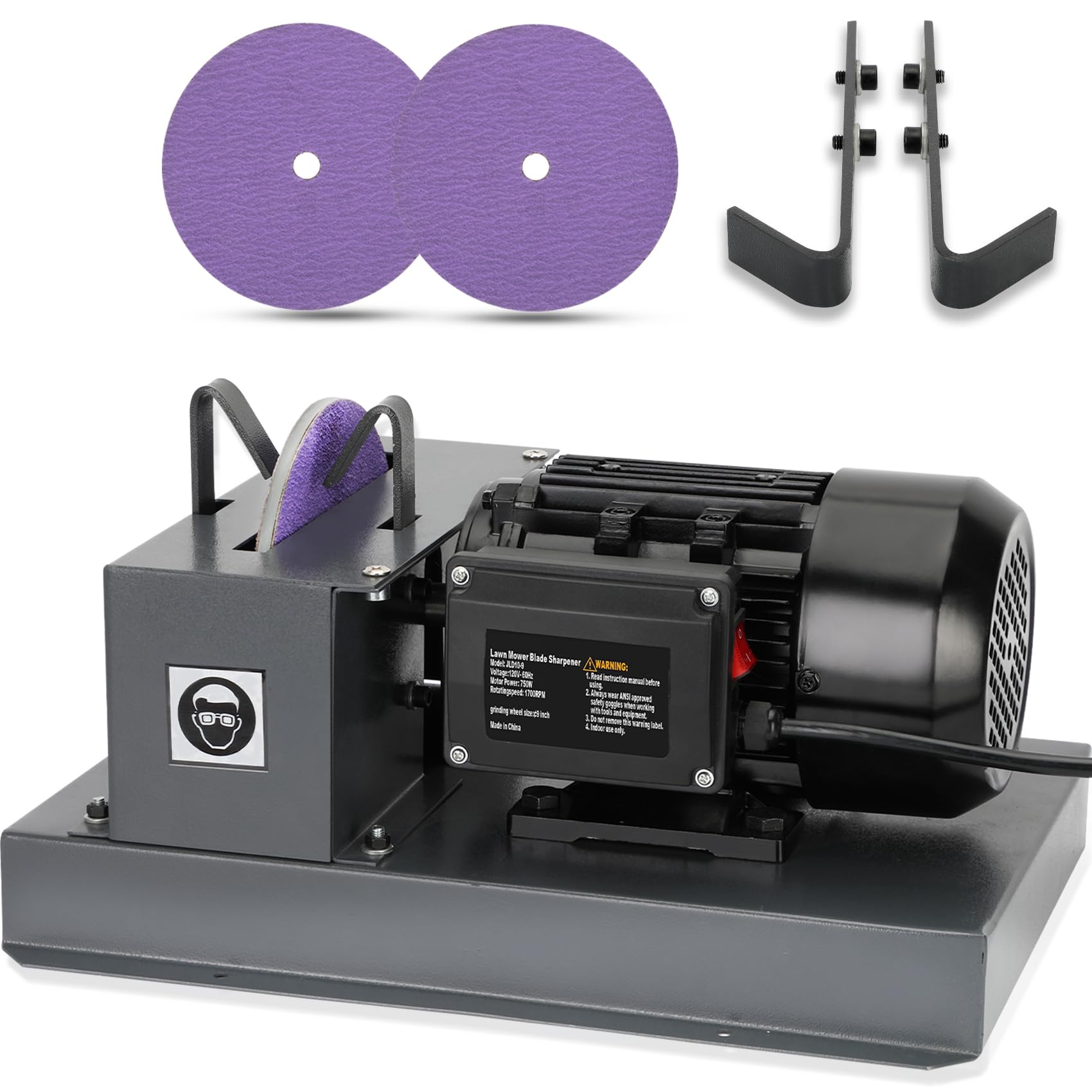
The Innisle 1HP model brings a 750W industrial-grade motor and a 9-inch 60-grit ceramic grinding wheel to the bench. The high torque output is designed to chew through deeply nicked blades quickly, and early users confirm it sharpens nine blades in about 15 minutes with the right technique. The machine runs quietly and shows almost no vibration, even before being bolted to a bench.
Quality control appears inconsistent. Multiple buyers report that the adhesive sanding discs peel off the backing plate during use, tearing up multiple discs per blade. Others note that the included blade guide bars are cut short, making them unusable for accurate angle setting. The solution appears to be using the machine freehand — holding the blade at the correct angle by eye — which defeats the purpose of a jig-based sharpener.
The Innisle has the raw power to be a high-volume commercial machine, but the build quality and consumable issues hold it back. For a buyer willing to replace the disc with a bonded ceramic unit and sharpen freehand, the motor performance is solid. For everyone else, the reliability concerns make the slightly more expensive SporGain or JLD10-9 a safer choice.
What works
- 750W motor provides fast stock removal
- Runs quiet with minimal bench vibration
- 9-inch disc covers large blades quickly
What doesn’t
- Adhesive discs delaminate under moderate pressure
- Guide bars reported as undersized in some units
7. WEN BG4270T 10-Inch Wet/Dry Sharpening System

The WEN BG4270T is a unique entry — a 10-inch water-cooled sharpening stone paired with an 8-inch leather stropping wheel, running at a slow 115 RPM. The water bath completely eliminates blade overheating, preserving the heat treat even on thin-edged blades. The two-direction motor lets you sharpen either side of the blade by flipping a switch rather than flipping the blade.
The system is best suited for shops that also sharpen chisels, plane irons, and knives, as the universal jig support is compatible with Tormek accessories. The included jig for mower blades is functional, but the 220-grit stone removes material slowly compared to a coarse 60-grit ceramic wheel. For heavily nicked commercial blades, you will need to pre-grind the edge with an angle grinder before finishing on the WEN.
The WEN excels at producing a polished, razor-sharp edge that cuts grass cleanly without shredding. However, for a dedicated mower blade operation focused on speed and high stock removal, the slow water stone is not the right primary tool. It works best as a finishing station for the final refinement after rough grinding on a high-RPM machine.
What works
- Water cooling preserves blade temper completely
- Leather strop produces a polished edge
- Reversible direction for both left/right bevels
What doesn’t
- Very slow stock removal for heavy nicks
- Not designed as a stand-alone commercial mower sharpener
8. All American Sharpener Model 5005 Gen 2
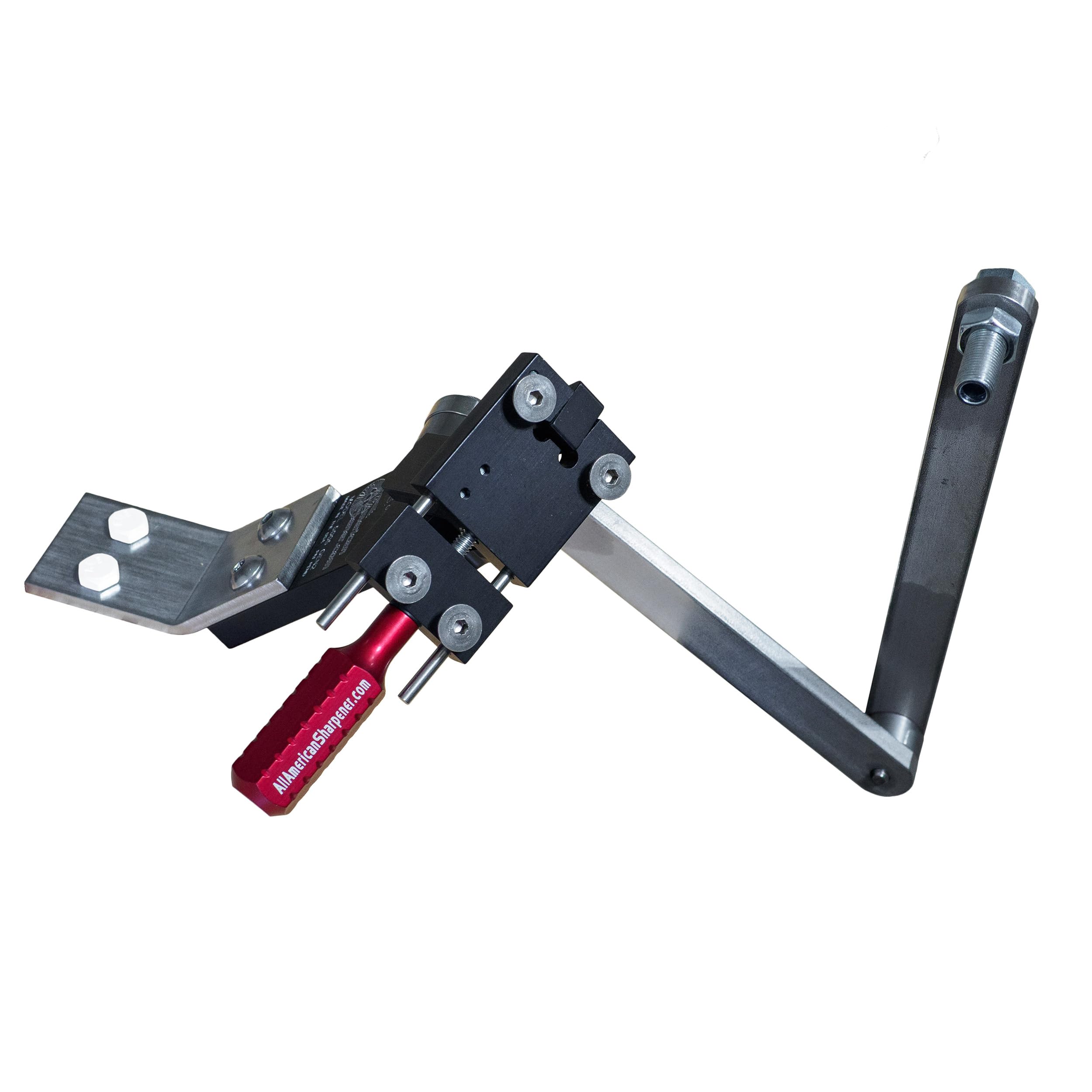
The All American 5005 is not a powered grinder — it is a portable angle jig that accepts a cordless angle grinder. Made from anodized aluminum and stainless steel in the USA, the jig holds a blade at a preset angle (adjustable from 15° to 45°) while you grind the edge with a standard 4.5-inch or 5-inch grinder. It folds down to a compact 14x10x4-inch package that travels easily in a truck.
Commercial landscapers who sharpen blades in the field between jobs report that the All American system restores a dull blade in about one minute. The solid stainless steel arms hold the blade securely without flexing, and operators confirm that the resulting bevel consistently measures to the set angle. The lifetime warranty on the jig adds security for a tool that sees daily abuse.
The main criticism is the high cost for what is essentially a precision metal bracket. The plastic thumb screw for angle adjustment feels mismatched with the otherwise high-end build. Additionally, an angle grinder produces sparks and dust that the jig cannot contain, so personal protective equipment is essential. For mobile operations where a 40-pound bench grinder is impractical, the All American is the only reasonable choice.
What works
- Portable design fits in a toolbox for field use
- Solid stainless steel construction with lifetime warranty
- Consistent bevel reproduction with any angle grinder
What doesn’t
- Plastic thumb screw for angle adjustment feels cheap
- Requires separate angle grinder and PPE kit
9. SporGain Brushless Blade Sharpener (3000 RPM)
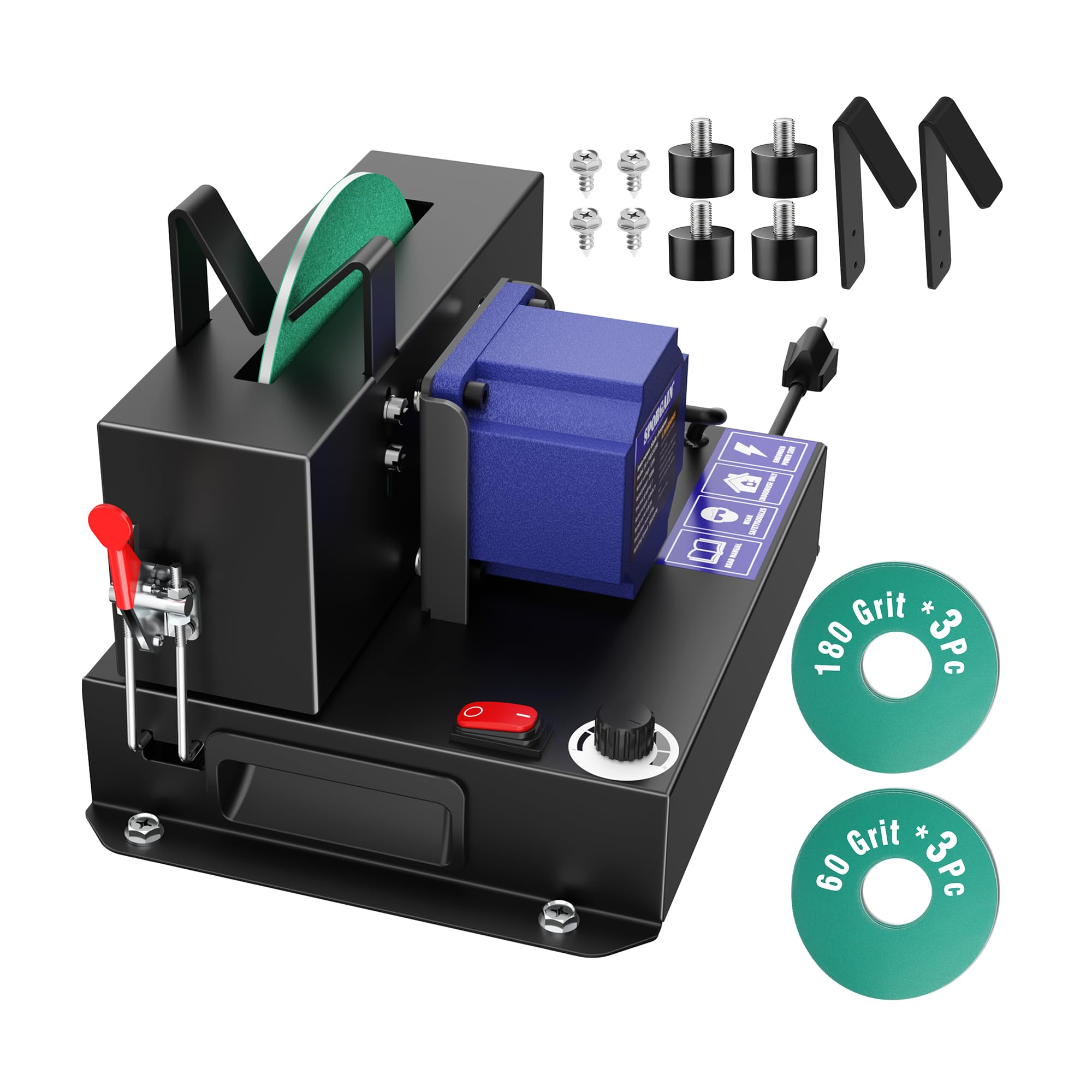
The SporGain brushless model features a high-performance brushless motor with a lifetime warranty, spinning a 7-inch ceramic wheel at adjustable speeds up to 3000 RPM. The brushless design produces less noise and runs cooler than brushed alternatives, and the lifetime motor warranty provides long-term peace of mind. The kit includes 60-grit discs for grinding and 180-grit discs for finishing, plus 30° and 45° blade guides.
Owner feedback is overwhelmingly positive, with multiple users calling the build quality “heavy duty” and the motor “overqualified” for the task. The variable speed control lets you dial down RPM for hardened steel blades that are more prone to overheating. The complete kit includes 63 sanding discs out of the box, significantly lowering the per-sharpening consumable cost in the first year.
The trade-off is that this model uses adhesive sanding discs rather than a bonded wheel or ceramic disc, so heavy pressure can still lift the disc edge. The motor power is also lower than the 2/3 HP SporGain sibling — at 3000 RPM brushless torque, it suits residential and light commercial use better than full-day production sharpening. For a shop that sharpens a few sets of blades per week and wants a quiet, low-maintenance machine, the brushless SporGain is a strong entry-level choice.
What works
- Brushless motor runs cooler and quieter than brushed alternatives
- Lifetime motor warranty protects your investment
- 63 included discs provide exceptional out-of-box value
What doesn’t
- Adhesive discs may lift if too much pressure is applied
- Lower torque than the 2/3 HP brushed SporGain model
Hardware & Specs Guide
Motor Power & Duty Cycle
The motor horsepower and wattage define how quickly you can remove steel, but the thermal design (open frame vs. sealed, aluminum vs. copper windings) determines whether the machine can run for 30 straight minutes without tripping thermal protection. Continuous-duty rated motors with oversized fans are essential for commercial operations sharpening 20+ blades per session.
Abrasive Wheel Material & Grit
Three broad categories exist: bonded ceramic wheels (longest life, expensive upfront), bonded aluminum oxide stones (long life, slower cut), and adhesive sanding discs (cheapest, shortest life, prone to delamination). Coarse 60-grit wheels remove material fastest but leave a rougher edge; 180-grit wheels are for finishing. A two-stage approach — rough with 60, finish with 180 — produces the best combination of speed and smoothness.
Angle Control Systems
Preset jigs that lock the blade at exactly 30° or 45° eliminate variability between sharpenings. The most durable jigs use heavy-gauge steel or anodized aluminum with machined stops. Some sharpeners include both left- and right-hand guides, while others require you to flip the blade and reset the jig for the second edge. Solidly built angle guides with multiple position stops are a significant quality differentiator.
Bench Integration & Footprint
These machines always live bolted to a workbench. Check the base dimensions and whether mounting holes are pre-drilled. A large footprint (over 16 inches wide) provides inherent stability, while narrower units may need a heavy workbench to stay planted. Weight is your friend here — a 40-pound machine will vibrate far less than a 15-pound unit on the same surface.
FAQ
Can I use a standard bench grinder for mower blades?
How often should I replace the abrasive disc on a disc-type sharpener?
Is a blade balancer really necessary for commercial mowing?
What grit should I use for finishing a commercial mower blade?
Final Thoughts: The Verdict
For most commercial operators, the commercial lawn mower blade sharpener winner is the SporGain 2/3 HP because it combines a powerful 550W motor, a heavy cast steel base, and fast snap-lock disc changes into a package that handles daily grinding without hesitation. If you value a bonded wheel that eliminates consumable costs and delivers factory-edge precision, grab the RBG 712. And for mobile sharpening where you cannot drag a 40-pound bench machine to every job, nothing beats the portable angle jig of the All American 5005.