
Heavy clay soil is a gardener’s toughest adversary. It turns into concrete when dry, becomes a sticky mess when wet, and suffocates plant roots by trapping water and blocking airflow. The right clay soil conditioner breaks that cycle by physically restructuring the soil particles, creating pore space for drainage and deep root penetration without altering your soil’s pH balance.
I’m Rikta — the co-founder and writer behind Lawn Gear Lab. I’ve spent countless hours analyzing soil chemistry data, comparing calcium-to-sulfur ratios, evaluating particle solubility rates, and reading through thousands of verified owner reports to understand which conditioners actually deliver measurable structural change in dense clay.
This guide compares seven top-tier formulas to help you select the correct clay soil conditioner for your lawn, vegetable beds, or specialty crops based on real-world performance data and application requirements.
How To Choose The Best Clay Soil Conditioner
Selecting a conditioner depends on your clay’s severity, the crops you grow, and how quickly you need results. The wrong form or particle size can delay improvement for a full growing season.
Particle Size: Powder vs. Pellet
Solution-grade powder dissolves and penetrates the soil profile within weeks of watering in, making it ideal for fast correction of blossom-end rot or salt damage. Pelletized granules release calcium and sulfur more slowly, requiring a full season to show structural change but providing a longer residual effect. For heavy clay lawns, pelletized spreader-friendly products save labor. For vegetable beds with active rot issues, choose powder.
Purity and Calcium Content
Look for 97% calcium sulfate dihydrate or higher. Lower-purity products contain inert fillers that dilute the active amendment and slow down structural change. Products listing calcium content between 22% and 23% with 17% to 18% sulfur deliver the ideal ratio for flocculating clay platelets.
OMRI Listing and Organic Compatibility
If you maintain a certified organic garden, choose a conditioner listed by the Organic Materials Review Institute. OMRI-listed gypsum ensures compliance with USDA National Organic Program standards and guarantees no synthetic additives. Non-certified products may still be natural but lack third-party verification.
Quick Comparison
On smaller screens, swipe sideways to see the full table.
| Model | Category | Best For | Key Spec | Amazon |
|---|---|---|---|---|
| Espoma Organic Garden Gypsum | Pelletized | Large lawns & heavy clay | 36-lb bag, pelletized | Amazon |
| Cz Gypsum Powder 10LB | Powder | Organic gardens & tomatoes | 10 lb, OMRI-listed | Amazon |
| Olympus Myco Gypsum Powder | Powder | Mushroom substrate & planters | 97% pure, 10 lb | Amazon |
| Alpha Chemicals Gypsum | Powder | Feed-grade & pond use | Very fine powder, 10 lb | Amazon |
| Greenway Biotech Gypsum | Powder | Fertigation & fast correction | Solution grade, 2 lb | Amazon |
| Earth Science Fast Acting Gypsum | Granules | Lawn renovation & pet spots | 5-lb, Nutri-Bond tech | Amazon |
| The Andersons Humic DG | Granules | Long-term soil biology | 70% humic, 11 lb | Amazon |
In‑Depth Reviews
1. Espoma Organic Garden Gypsum Soil Conditioner
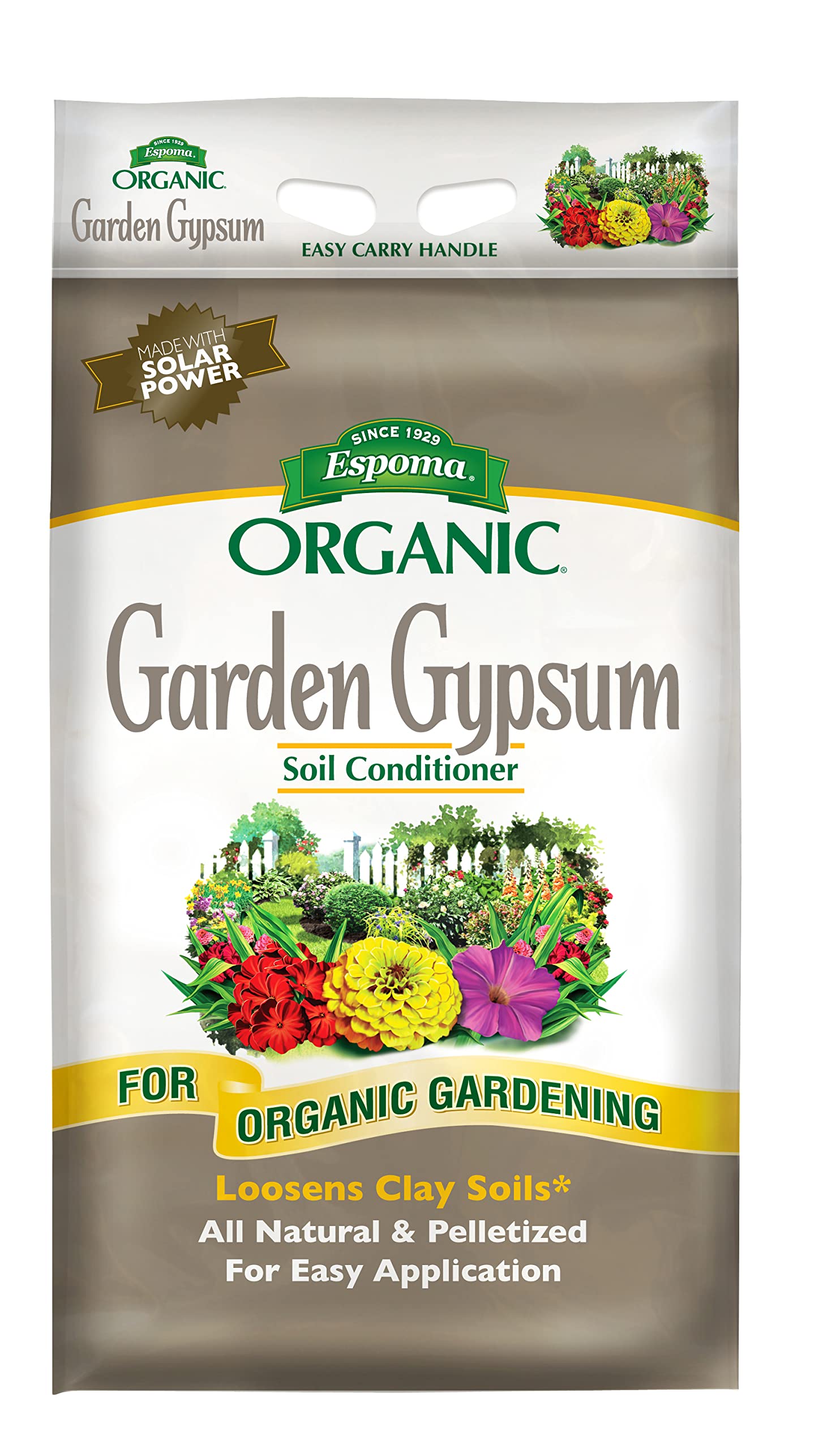
Espoma delivers 36 pounds of all-natural mined gypsum with zero fillers or synthetic additives. The pelletized form spreads effortlessly through a broadcast or drop spreader, making it the most efficient option for covering large lawn areas and sprawling vegetable gardens. Multiple owners report that after one year of application, previously concrete-hard red clay became workable enough to transplant shrubs without a pickaxe.
The 100% natural composition includes no binding agents, so each pellet dissolves at a controlled rate throughout the growing season. This slow release is ideal for annual maintenance programs — apply once in spring, let the calcium and sulfur gradually flocculate clay platelets, and monitor improved drainage over the following months. It is also approved for organic production, meeting all USDA National Organic Program requirements.
Owners consistently highlight its effectiveness against winter ice-melt salt damage and pet urine burns on turf. The 36-pound bag provides substantial coverage at a reasonable per-pound cost, though the upfront investment is higher than smaller packages. For serious clay remediation on a property-wide scale, Espoma’s proven track record since 1929 makes it the reference standard.
What works
- Large 36-lb bag covers substantial area without frequent reordering
- Pelletized form works with any broadcast spreader for fast application
- 100% natural mined gypsum with no fillers and OMRI-compatible
What doesn’t
- Pellet dissolution is slower than powder — full results take one growing season
- Bag weight is heavy for users without a wheeled spreader
2. Cz Garden Supply Organic Gypsum Powder 10LB

Cz Garden Supply packs 10 pounds of calcium sulfate dihydrate in a heavy-duty resealable pouch that makes storage and repeated use practical. The powder form dissolves quickly when watered into the soil, delivering calcium and sulfur to the root zone within days rather than weeks. Multiple owners confirm that correct dosing of one to two ounces per gallon of water stopped blossom-end rot on container Roma tomatoes after just a few applications.
OMRI listing certifies this product for use in certified organic production, so vegetable growers and mushroom cultivators can trust there are no synthetic additives. The fine powder also improves water-holding capacity in mushroom substrate while neutralizing excess acidity. Owner feedback notes that the product improved clay soil structure noticeably, with better drainage and less surface crusting after a single season of use.
The resealable pouch design is a practical improvement over loose bags, keeping moisture out between applications. One minor delivery issue reported was a small hole in the packaging, but the product itself consistently receives high marks for effectiveness. For gardeners who need a balance of fast action, organic certification, and a generous 10-pound quantity, Cz Garden delivers reliable performance.
What works
- OMRI-listed for certified organic gardening and mushroom cultivation
- Fine powder dissolves quickly for fast calcium delivery to roots
- Resealable heavy-duty pouch keeps product dry for long-term storage
What doesn’t
- Powder form is messier to apply than pellets in windy conditions
- Some packages arrived with small holes in the outer bag
3. Olympus Myco Gypsum Powder

Olympus Myco specializes in mushroom cultivation supplies, and this 97% pure gypsum powder reflects that focus with its exceptionally fine particle consistency. The high-purity calcium sulfate dihydrate improves substrate structure by regulating moisture retention, adjusting pH, and reducing clumping for better oxygen circulation through the growing medium. Mushroom growers note that adding this powder to their substrate formula noticeably increased yield and firmness of oyster and shiitake harvests.
Beyond mushroom beds, this product serves as an effective clay soil conditioner. The solution-grade fineness allows it to penetrate compacted topsoil faster than pelletized alternatives. One owner reported that working it into the topsoil of avocado trees in planters corrected severe salt buildup — brown leaves dropped away and new green growth emerged within weeks. The packaging is sealed in a HEPA enclosure, guaranteeing low dust contamination and consistent particle size.
At 10 pounds, the bag suits multiple home grow cycles or medium-sized garden projects. While the product is not specifically marketed for lawn-scale broadcast application, its high solubility makes it excellent for targeted bed treatment and fertigation systems. The purity level and careful processing justify its position for users who demand professional-grade inputs.
What works
- 97% pure calcium sulfate with very fine, consistent particle size
- HEPA-enclosure packaging minimizes dust and contamination
- Fast dissolution corrects salt damage and blossom-end rot quickly
What doesn’t
- Not pelletized — requires watering in or tilling for best results
- Smaller bag size may require multiple purchases for large lawns
4. The Andersons Humic DG Organic Soil Amendment
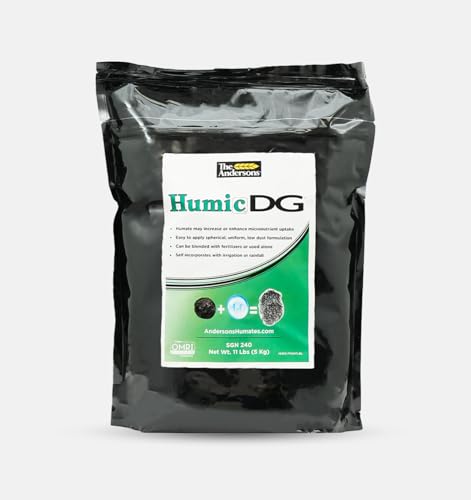
The Andersons takes a different approach to clay soil improvement by feeding the soil biology rather than supplying calcium alone. This 11-pound bag of 70% humic acid granules increases soil organic matter and provides a carbon food source for beneficial microbes. Over time, microbial activity naturally creates the aggregated soil structure that allows clay to drain. Owners of lawns with medium to high clay content report visible improvement in grass health after two seasons of biannual applications.
The patented Dispersible Granule technology allows the humic acids to dissolve and move into the soil profile quickly, chelating nutrients so plants absorb them more efficiently. Root mass and root vigor improve as the humic carbon stimulates deeper root penetration through compacted layers. The product is OMRI listed and safe for all turf and soil types, making it a versatile choice for environmentally conscious gardeners.
This is not a fast fix for blossom-end rot or salt damage — it works on a longer timeframe by rebuilding the soil’s biological engine. Owners recommend using it spring and fall for the first two to three years, then annually for maintenance. The higher price point reflects the concentrated humic content, but the long-term residual effect reduces the need for frequent reapplication.
What works
- 70% humic content feeds beneficial soil microbes for natural structure
- DG technology disperses quickly into soil profile
- OMRI listed and safe for all turf and soil types
What doesn’t
- Results are gradual — takes multiple seasons to fully amend clay
- Higher cost per pound compared to mineral gypsum products
5. Earth Science Fast Acting Gypsum Granules
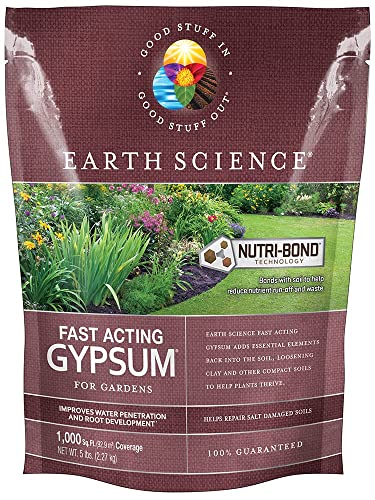
Earth Science uses a finely ground and pelletized gypsum formulation with its proprietary Nutri-Bond Technology, which naturally bonds with soil particles to reduce nutrient runoff by up to 50%. The 5-pound bag is a convenient size for targeted applications around flower beds, vegetable patches, and lawn spots affected by pet urine or winter salt. Owners report that the small pellets dissolve noticeably faster than large-box-store gypsum, with one user noting it softened rock-hard clay from a sewer line trench enough for grass to establish.
The product starts working immediately upon application to loosen compacted clay, improving water penetration and root development. The added calcium helps correct blossom-end rot in tomatoes and other fruiting vegetables, while the sulfur aids in salt damage repair. The granular form is compatible with any broadcast spreader for even coverage, and the manufacturer states it is safe for people and pets to use the lawn immediately after application.
Multiple five-star reviews confirm its effectiveness for breaking up clay annually and helping grass achieve deeper root systems. The Nutri-Bond feature provides added value by keeping more of the amendment in the root zone rather than washing away. For gardeners looking for a fast-acting, spreader-friendly product with anti-runoff technology, Earth Science offers a well-engineered solution.
What works
- Nutri-Bond technology reduces nutrient runoff by up to 50%
- Small pellets dissolve faster than standard large gypsum granules
- Safe for immediate lawn use around kids and pets
What doesn’t
- 5-pound bag is small for large-scale lawn renovation
- Pellets still work slower than solution-grade powder for quick soil correction
6. Greenway Biotech Organic Gypsum Powder

Greenway Biotech offers a solution-grade gypsum powder that goes beyond standard soil amendment. At 97% calcium sulfate dihydrate with 22.5% calcium and 18% sulfur, this professional-grade powder is designed to dissolve completely in water, making it compatible with fertigation systems and hose-end sprayers. The fine particle size absorbs faster than any pelletized product — owners mixing it with water and drenching tomatoes, squash, peppers, and okra reported visible arrest of blossom-end rot within days of application.
Because this gypsum is pH neutral, it adds calcium without raising soil pH, making it safe for acid-loving plants like blueberries and for alkaline soils where lime would cause problems. The formula also flushes excess sodium caused by de-icing salts and heavy fertilizer use, reducing aluminum toxicity and encouraging earthworm activity. The powder works for mushroom cultivation too, improving substrate structure and water-holding capacity for oyster, shiitake, and specialty mushrooms.
The 2-pound package is the smallest in this lineup, suited for precision bed treatment and container gardening rather than whole-lawn coverage. CDFA-registered and manufactured in California since 1989, Greenway Biotech has a long commercial track record. One owner noted that the bag heading describing solubility was technically inaccurate (calcium sulfate has limited water solubility), but the product itself performed as expected for soil drench applications.
What works
- Solution-grade powder mixes with water for fertigation and soil drenches
- 97% purity with 22.5% calcium for fast blossom-end rot correction
- pH neutral — safe for acid-loving plants and alkaline soils
What doesn’t
- 2-pound package is small — multiple bags needed for large gardens
- Powder form is dusty and messy to handle in windy conditions
7. Alpha Chemicals Calcium Sulfate Dihydrate Gypsum

Alpha Chemicals offers a no-frills feed-grade calcium sulfate dihydrate in a 10-pound bag at a straightforward price point. The very fine powder is the same chemical compound as premium gypsum products — 100% calcium sulfate without any additives, coatings, or branded technologies. Mushroom growers praise it for providing calcium and sulfur that improve yield, texture, and substrate pH balance while the natural antifungal properties reduce contamination risk during spawn runs.
For clay soil remediation, the fine powder penetrates quickly when tilled or watered in. One owner reported using it for peanuts, tomatoes, and peppers over a full year and seeing a clear difference in plant vigor and fruit quality. Another applied it to clear up a pond, demonstrating its versatility beyond conventional gardening. The 10-pound quantity provides enough material for several bed applications or multiple mushroom cultivation cycles.
The packaging is basic — a simple plastic bag with a zipper seal that some owners found unreliable, recommending transferring the powder to a rigid container for storage. The product arrived on time and in good condition according to the majority of reviews. For budget-conscious gardeners who want pure gypsum without paying for marketing or specialized formulation, Alpha Chemicals delivers the raw chemistry at a competitive per-pound cost.
What works
- Pure calcium sulfate dihydrate with no fillers or additives
- Very fine powder dissolves quickly for fast soil penetration
- 10-pound bag provides good quantity for the price point
What doesn’t
- Zipper seal is unreliable — needs transfer to airtight container
- No OMRI listing or organic certification
Hardware & Specs Guide
Calcium to Sulfur Ratio
The ideal clay conditioner delivers calcium in the 22-23% range and sulfur around 17-18%. This ratio maximizes the flocculation process, where calcium ions displace sodium and magnesium ions on clay platelets, causing the particles to clump together into larger aggregates. The result is improved pore space for water infiltration and root penetration. Products below 20% calcium require higher application rates to achieve the same structural change.
Particle Size and Dissolution Rate
Solution-grade powder (under 100 mesh) dissolves within days of watering in, making it suitable for fertigation and fast correction of nutrient deficiencies. Pelletized gypsum (typically 2-4 mm) dissolves over weeks to months, providing sustained release throughout the growing season. For lawns, pellets are easier to apply with a spreader. For vegetable beds with active blossom-end rot, powder delivers calcium to the root zone when it is needed most.
Application Rate by Soil Type
Heavy clay soils typically require 40 to 50 pounds of gypsum per 1,000 square feet for initial remediation. Lighter clay loams need 25 to 30 pounds. Annual maintenance applications run 10 to 15 pounds per 1,000 square feet. Always conduct a soil test before applying — if your calcium level is already adequate, adding more gypsum will not improve structure and may imbalance other nutrients.
OMRI Listing and Organic Standards
The Organic Materials Review Institute evaluates soil amendments for compliance with USDA National Organic Program rules. OMRI-listed gypsum guarantees no synthetic binders, fillers, or chemical additives. For home vegetable gardens, this certification matters mostly for personal peace of mind. For commercial organic operations, it is mandatory. Non-listed products may still be 100% natural but lack third-party verification.
FAQ
Will gypsum conditioners raise the pH of my clay soil?
How long does it take for a clay soil conditioner to show visible results?
Can I use clay soil conditioner to fix blossom-end rot on tomatoes?
Should I apply clay conditioner before or after aerating my lawn?
Is there a risk of over-applying gypsum to clay soil?
Final Thoughts: The Verdict
For most gardeners, the clay soil conditioner winner is the Espoma Organic Garden Gypsum because its 36-pound pelletized bag covers large areas efficiently with 100% natural mined gypsum and OMRI-compatible credentials. If you need fast calcium delivery for blossom-end rot, grab the Greenway Biotech Organic Gypsum Powder. And for rebuilding clay soil biology over the long term, nothing beats the The Andersons Humic DG for feeding the microbial community that naturally creates lasting soil structure.