
Yellowing leaves, stunted growth, and disappointing fruit set are the most visible signs that your citrus tree is starving for micronutrients—a problem standard fertilizers often fail to solve. The right foliar spray delivers zinc, iron, and manganese directly to the leaves, bypassing soil pH issues and getting fast, targeted results where it counts.
I’m Rikta — the co-founder and writer behind Lawn Gear Lab. I’ve spent years analyzing the nutrient profiles of foliar feeds, cross-referencing label claims against proven horticultural data, and combing through thousands of verified owner reports to separate formulas that just look good on the bottle from those that actually green up leaves and boost fruit quality.
This guide breaks down the top citrus nutritional sprays by their specific micronutrient content, application rates, and cost-per-gallon value so you can match the right formula to your tree’s exact deficiency. Our goal is to help you find the best citrus nutritional spray for restoring healthy, vigorous growth and a heavier harvest.
How To Choose The Best Citrus Nutritional Spray
Not all sprays are created equal. The right choice depends on your tree’s specific symptoms, your budget, and whether you’re treating a single container tree or a whole grove. Here are the key factors to consider.
Micronutrient Profile Is Everything
Look for sprays that contain the “big three” micronutrients: zinc, iron, and manganese. Zinc regulates growth hormones and prevents rosetting, iron is essential for chlorophyll production (green leaves), and manganese aids photosynthesis. A chelated formula ensures these minerals stay available for leaf absorption even in alkaline water or high-pH soil.
Dilution Ratio and Cost Per Gallon
A concentrated spray that makes 32 gallons from a 16-ounce bottle offers far better value than a small 8-ounce bottle that only makes 16 gallons at a higher per-dose cost. Compare the mixing instructions carefully—some brands require 2 tablespoons per gallon, while others need only 1. The lower the concentration needed, the more applications you get from one purchase.
Organic vs. Synthetic
Organic formulas, often derived from kelp, worm castings, or bat guano, provide a broader spectrum of trace minerals and beneficial microbes, but they can be slower to correct acute deficiencies. Synthetic chelated sprays act faster on severe yellowing because the minerals are already in a form the leaf can immediately absorb. Choose organic for long-term maintenance and synthetic for urgent rescue.
Quick Comparison
On smaller screens, swipe sideways to see the full table.
| Model | Category | Best For | Key Spec | Amazon |
|---|---|---|---|---|
| Southern Ag Chelated Citrus Nutritional Spray | Premium | Large groves & heavy deficiencies | 1 Gallon – 5 Chelated Micronutrients | Amazon |
| Gardenera Plant Superfood for Citrus | Premium | Multi-nutrient rescue | 18 Vitamins & Minerals + Glucose | Amazon |
| Gardenera 32oz Superfood Concentrate | Premium | Organic bio-stimulant | Organic 18-Nutrient Blend – 32oz | Amazon |
| HiThrive 32oz Citrus Fertilizer | Mid-Range | Bigger value, small trees | 4-3-6 NPK + Micronutrients – 32oz | Amazon |
| HiThrive 16oz Citrus Fertilizer | Mid-Range | Budget-friendly bottle | Makes 32 Gallons – 16oz | Amazon |
| TPS Nutrients Citrus Fertilizer | Mid-Range | Simple foliar feed | 8oz – 2 tbsp/gal mix | Amazon |
| Viva Naturals Vitamin C (Disqualified) | – | N/A | Human Supplement | Amazon |
In‑Depth Reviews
1. Southern Ag Chelated Citrus Nutritional Spray

The Southern Ag Chelated Citrus Nutritional Spray comes in a full 1-gallon container, making it the obvious choice for anyone managing multiple trees or a serious deficiency across a larger planting area. Each gallon contains a complete chelated blend of zinc, iron, manganese, and other essential micronutrients that are immediately available to the leaf surface, bypassing problematic soil pH that can lock up these same minerals when applied to the ground.
Experienced container growers rely on this product precisely because potted citrus is notoriously prone to micronutrient shortages—the confined root zone quickly exhausts available minerals. Multiple verified reports confirm that weekly foliar applications reversed severe yellowing and leaf drop on lemon and orange trees within a month, with new green growth and blossoms appearing shortly after. The clear mixing instructions recommend 2 teaspoons per gallon of warm water for best adhesion and absorption.
It’s worth noting that a handful of buyers initially misapplied the product to treat carpenter bee problems rather than citrus deficiencies, but the overwhelming majority of tree-focused feedback praises its rapid corrective action. For a large-volume, pro-grade solution that tackles persistent yellowing at its root cause, this spray sets the benchmark.
What works
- Massive 1-gallon size offers best cost-per-gallon for multiple trees.
- Chelated formula ensures quick leaf absorption even in high-pH water.
- Proven to reverse yellowing and leaf drop within a month.
What doesn’t
- On the pricier side for single-tree households.
- Label could be more specific about application frequency for different deficiency severities.
2. Gardenera Plant Superfood for Citrus Trees
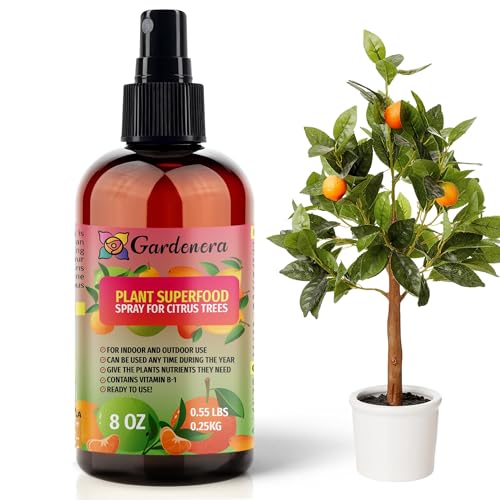
The Gardenera Plant Superfood stands apart from standard micronutrient sprays by including Vitamin B-1 and glucose alongside the typical iron, manganese, and zinc. Vitamin B-1 stimulates root development and reduces transplant shock, while glucose provides an immediate energy boost that supports metabolic processes—making this spray as much a recovery tonic as a straight nutritional supplement. The 8-ounce bottle uses a dilution of 1 tablespoon per gallon, so you get a decent number of applications per bottle.
Owner reviews describe dramatic revivals of dying avocado trees and indoor Meyer lemon trees that had shown no improvement with traditional fertilizers. Several users noted that spraying the trunk, leaves, and branches directly produced faster results than soil drenching alone. The formula is also advertised as safe for year-round use on both indoor and outdoor plants, including decorative houseplants and vegetable gardens, giving it unusual versatility for a citrus-focused product.
One detail that emerges from feedback is that the spray nozzle on the bottle can be finicky—some buyers preferred transferring the liquid to a separate handle-grip sprayer for better control and even coverage. If you’re nursing a tree back from severe stress or transplant shock, the extra bio-stimulants in this formula justify the step up in price.
What works
- Vitamin B-1 and glucose accelerate recovery from transplant shock and stress.
- Works on a wide range of plants beyond citrus.
- Quick visible results—users report improvement within a week.
What doesn’t
- Small 8-oz bottle may not last long for heavy users.
- Stock spray nozzle design could be more ergonomic.
3. Gardenera Organic Superfood Concentrate (32oz)
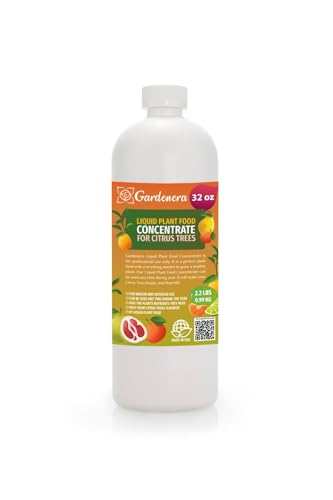
This 32-ounce concentrate from Gardenera represents the deep-end of organic bio-stimulant feeding. Its formula contains 18 different nutrient sources, including poultry litter, bat guano, worm castings, kelp meal, mycorrhizae, and a proprietary mineral blend. The claim is that a unique Zymology Process breaks down these ingredients over five years into thousands of readily absorbable elements, so the final liquid is more like a fermented superfood than a simple salt-based fertilizer.
Users report seeing a new leaf every week on banana plants and significant size increases in begonias after starting this regimen. The concentrate is also advertised as pet-safe, fish-safe, and reptile-safe, which makes it a solid choice for gardeners who keep koi ponds or vivariums near their citrus trees. The dilution rate is 1:128 (roughly 1 tablespoon per gallon), so the 32-ounce bottle makes a substantial 32 gallons of finished spray.
On the downside, heavy users with large collections note that the bottle doesn’t last long if you’re applying 2 tablespoons per gallon for severe deficiencies. The natural ingredients also mean it may work more slowly than a synthetic chelated spray when a tree is in acute distress. Still, for organic-focused growers who want a broad-spectrum, long-term maintenance feed that supports soil biology, this concentrate delivers exceptional value.
What works
- Rich organic profile with 18 nutrient sources improves overall soil and plant health.
- Pet- and fish-safe formulation suits sensitive environments.
- Large 32-oz bottle provides many applications at a good per-use cost.
What doesn’t
- Slower to correct acute deficiencies than synthetic chelated sprays.
- High consumption rate if following aggressive deficiency dosing.
4. HiThrive 32oz Citrus Fertilizer (4-3-6 NPK)
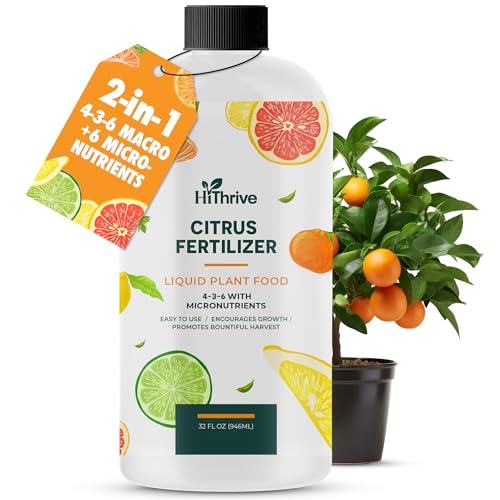
The HiThrive 32-ounce option delivers a solid 4-3-6 NPK ratio alongside the micronutrient suite of calcium, magnesium, and zinc. This is a 2-in-1 formula—it provides both the macronutrients for overall growth and the targeted micronutrients for correcting foliar deficiencies—so you can feed your tree comprehensively from a single bottle. The 32-ounce size makes 32 gallons of spray, which is twice the volume of the brand’s own 16-ounce offering at only a modest step up in price.
Verified buyers using this on container citrus moved indoors during cold weather report that it effectively boosted flower and fruit set, as well as new stem and leaf production. The liquid mixes easily with water and doesn’t leave heavy residue on leaves. The recommended schedule of every 1-2 weeks during the growing season and monthly in fall/winter gives clear guidance even for beginners.
The main limitation is that the NPK ratio is fixed at 4-3-6—fine for maintenance, but not adjustable if your tree needs a higher nitrogen kick during early spring growth. Also, some users noted it took a full growing season before they saw visible blossom development. For a well-rounded, easy-to-use product that balances cost against capacity, this is a strong mid-range contender.
What works
- Excellent value—32 oz makes 32 gallons of ready-to-use spray.
- Combines NPK macronutrients with essential micronutrients in one bottle.
- Clear dosing schedule suitable for beginners.
What doesn’t
- Fixed NPK ratio may not suit trees needing higher nitrogen.
- Results on blossoms may take a full growing season.
5. HiThrive 16oz Citrus Fertilizer
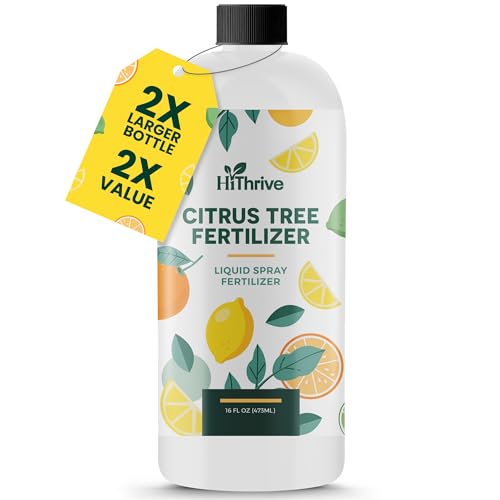
The 16-ounce HiThrive Citrus Fertilizer is the entry-level version of the same brand’s larger bottle, offering the identical micronutrient formulation in a smaller package. At a mixing ratio of 1 tablespoon per gallon, this container still makes an impressive 32 gallons of finished spray, making it one of the most economical options on the list if you only have a couple of trees to treat. The formula is built around magnesium, sulfur, iron, manganese, and zinc—a straightforward deficiency corrector without extra bio-stimulants.
Two years of repeat purchases from several owners speak to the consistency of results, particularly for reviving miniature orange trees whose leaves had turned yellow after standard fertilizer failed. The instruction to double the dose (2 tablespoons per gallon) twice monthly for visible deficiencies is a practical feature that gives the user control over intensity. Many buyers also note using it as an all-purpose spray on non-citrus ornamentals with satisfactory results.
The trade-off is that this is a lean formula—no NPK numbers are prominently listed, and some users reported not noticing dramatic changes in overall growth rate, just a correction of deficiency symptoms. For a purely foliar rescue product at the lowest entry cost, this HiThrive bottle delivers reliable value.
What works
- Very low cost per gallon—great for small budgets or single-tree households.
- Simple mixing instructions with clear deficiency dosing options.
- Proven track record for reversing yellowing on container citrus.
What doesn’t
- No NPK macronutrients included; purely foliar micronutrient corrector.
- Some users expected more visible growth acceleration beyond greening leaves.
6. TPS Nutrients Citrus Fertilizer (8oz)
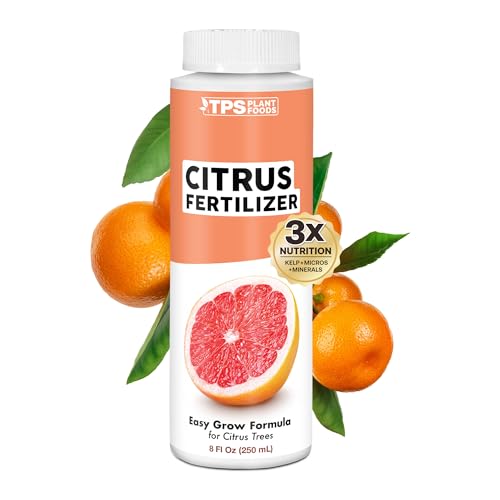
TPS Nutrients offers a small 8-ounce bottle with a straightforward liquid formula that includes magnesium, calcium, and iron—but notably lacks added nitrogen. This makes it a complementary product for growers who already use a high-nitrogen base fertilizer and only need the micronutrient top-up. The mixing ratio of 2 tablespoons per gallon means the small bottle produces about 16 gallons of spray, which is less economical per gallon than the HiThrive alternatives but still workable for a hobbyist with 2–3 trees.
Owner feedback specifically highlights its effectiveness on potted lime trees: leaves turned from yellow back to dark green within two weeks, and existing limes grew noticeably larger during the same period. The liquid absorbs quickly and doesn’t scorch leaves even when applied in warmer weather. Several long-term users mentioned using it as a weekly spray throughout the growing season to keep container trees in peak condition.
The missing nitrogen is the biggest limitation—if your tree is pale all over rather than showing interveinal chlorosis, you’ll need to supplement with a separate nitrogen source. The bottle also has a smaller volume than most competitors, so heavy users will need to reorder frequently. For targeted micronutrient correction in a simple, effective formula, it earns its spot here.
What works
- Fast visible correction of yellowing and improved fruit size.
- Clean, easy-to-mix formula doesn’t clog sprayers or burn leaves.
- Works well as a supplement alongside a high-nitrogen base fertilizer.
What doesn’t
- No nitrogen content—requires a secondary product for complete feeding.
- Small bottle volume means more frequent repurchasing for multiple trees.
7. Viva Naturals Vitamin C Supplement (Not a Citrus Nutritional Spray)

The Viva Naturals product is a human dietary supplement—vegetarian capsules containing 1000 mg of vitamin C with citrus bioflavonoids and rose hips. It is included here only to clarify that it is not a citrus nutritional spray for trees. Some search queries may surface this item because of the keyword overlap, but it has no application as a foliar feed for citrus plants.
The supplement is well-rated for human immune support, with users reporting successful use at high doses for preventing colds and managing age-related bruising. However, its form factor (capsules) and intended use (oral ingestion) make it completely irrelevant to anyone searching for a tree spray. There is no mixing ratio, no NPK value, and no micronutrient profile suited for foliar absorption by citrus foliage.
If you arrived at this product expecting a plant spray, do not purchase it—it will not correct yellowing leaves or boost fruit production. Stick to the liquid concentrates reviewed above for genuine citrus nutritional needs.
What works
- Excellent human vitamin C supplement for immune support.
- Non-GMO and vegetarian-friendly formulation.
What doesn’t
- Not a citrus nutritional spray—cannot be used on trees.
- No micronutrient content useful for foliar feeding.
Hardware & Specs Guide
NPK Ratio
The NPK value (Nitrogen-Phosphorus-Potassium) indicates the percentage by weight of each macronutrient in the formula. For citrus, a ratio like 4-3-6 provides moderate nitrogen for leaf growth, lower phosphorus for root development, and higher potassium for fruit quality and flavor. Many foliar sprays skip NPK entirely and focus solely on micronutrients—this is fine for correcting deficiency but won’t support overall growth. Choose an NPK formula for general feeding and a micronutrient-only spray for targeted yellowing correction.
Chelation vs. Non-Chelated
Chelated micronutrients are chemically bonded to organic molecules (like EDTA or amino acids) that protect them from reacting with other elements in the water or on the leaf surface. This means the zinc, iron, and manganese remain available for absorption even if your tap water is alkaline or your soil pH is above 7.0. Non-chelated sprays work fine in neutral conditions but can precipitate out and become useless in hard water. If you’re unsure about your water quality, always choose a chelated formula for reliability.
FAQ
How often should I apply citrus nutritional spray to my trees?
Can citrus nutritional spray be used on other fruit trees besides citrus?
Final Thoughts: The Verdict
For most gardeners, the best citrus nutritional spray winner is the Southern Ag Chelated Citrus Nutritional Spray because its full gallon size, chelated micronutrient lineup, and proven track record for reversing severe yellowing make it the most versatile and reliable choice for both hobbyists and serious growers. If you prefer a bio-stimulant approach with vitamins and glucose for transplant recovery, grab the Gardenera Plant Superfood for Citrus Trees. And for the best value on a balanced NPK-plus-micronutrient combo for small groves, nothing beats the HiThrive 32oz Citrus Fertilizer.