
Crawling, flying, and nesting insects exploit the smallest gaps in your home’s defenses, and aerosol sprays often fail to reach deep into wall voids, cracks, and crevices where they breed. A finely milled dust insecticide works differently — it coats the target surface and remains active until the pest walks through it, delivering a lethal dose through ingestion or desiccation that sprays simply cannot match in tight spaces.
I’m Rikta — the co-founder and writer behind Lawn Gear Lab. I spent dozens of hours cross-referencing active ingredient concentrations, particle sizes, residual durations, and real-world owner feedback to separate the products that truly work from those that simply look good on a shelf.
Whether you’re battling bed bugs in a mattress seam, yellow jackets in a siding gap, or roaches in a baseboard crack, choosing the right bug powder killer determines whether you solve the problem in days or waste weeks on ineffective treatments.
How To Choose The Best Bug Powder Killer
Not all dust insecticides are interchangeable. The active ingredient, particle size, moisture resistance, and application method determine whether you get a quick knockdown or a lingering deterrent. Understand these four factors before you buy.
Active Ingredient: Boric Acid vs. Silica vs. Diatomaceous Earth vs. Pyrethroids
Boric acid (99% in Rockwell Labs BorActin) works as a stomach poison that sterilizes and starves insects over days. Silica gel (100% in Cimexa) absorbs the waxy cuticle layer and desiccates insects within hours. Diatomaceous earth (77–100% in Safer) abrades the exoskeleton and causes dehydration, but works more slowly than silica. Pyrethroid dusts like lambda-cyhalothrin (BASF Tri-Die) and cyfluthrin (Atticus Tirade) attack the nervous system immediately and maintain residual kill for months. For fast results in high-traffic zones, pyrethroids win. For long-term bait station maintenance, boric acid or silica gel are safer around people and pets.
Moisture Resistance and Residual Duration
A powder that clumps after a single rain is useless outdoors. Boric acid dust, as seen in BorActin, resists moisture and won’t break down under UV or heat, making it ideal for crawlspaces, attics, and new construction pre-treatments. D-Fense Dust claims 8 months of control and stays on brick walls after rain. Silica-based dusts like Cimexa last up to 10 years in undisturbed wall voids. Pyrethroid dusts like Tri-Die lose potency in direct sunlight but remain lethal in enclosed spaces for months. Check whether the label specifies moisture resistance if your target area is exposed to humidity or weather.
Particle Size and Application Control
Ultra-fine powders (Cimexa, Tri-Die) penetrate deep into cracks but drift easily and require respiratory protection. Coarser powders (Safer DE, RobiGuard DE) are less hazardous to inhale but may not reach deep nest sites. Pressurized dust cans (BASF Tri-Die) shoot powder into void spaces without clumping, while bellows-style dusters or puffer bottles (recommended for Atticus Tirade) give you precise control over thin, even layers. If you’re treating wall voids or deep cracks, a pressurized or bellows delivery system is non-negotiable.
Safety Certification and Target Pest Range
Food-grade diatomaceous earth (RobiGuard, Safer) is OMRI-listed and safe for organic gardening, making it suitable for kitchens, pet areas, and vegetable beds. However, food-grade DE kills fewer species than synthetic dusts. Professional-grade pyrethroid dusts like D-Fense and Atticus Tirade kill 50+ species but are toxic to cats, fish, and beneficial insects. Always read the label’s approved species list — a broad-spectrum label doesn’t guarantee effectiveness against your specific pest. Boric acid kills cockroaches, silverfish, and darkling beetles but is less effective on bed bugs and fleas than silica gel.
Quick Comparison
On smaller screens, swipe sideways to see the full table.
| Model | Category | Best For | Key Spec | Amazon |
|---|---|---|---|---|
| Rockwell Labs BorActin | Boric Acid Dust | Roach pre-treatment & long-term void filling | 99% boric acid active | Amazon |
| Safer Brand Diatomaceous Earth | Food-Grade DE | Organic garden & pet-safe indoor use | 77.69% DE, OMRI-listed | Amazon |
| Rockwell Labs Cimexa | Silica Gel Dust | Bed bug & pyrethroid-resistant roach elimination | 100% amorphous silica gel | Amazon |
| RobiGuard DE Peppermint | Enhanced DE | Squirrel & crawling pest repellent in gardens | Food-grade DE + peppermint oil | Amazon |
| D-Fense Dust with Gloves | Synthetic Dust | 8-month outdoor & structural barrier | Water-resistant, 8-mo residual claim | Amazon |
| BASF PT Tri-Die | Pressurized Dust | Deep wall void & yellow jacket nest treatment | Lambda-cyhalothrin + silica gel | Amazon |
| Atticus Tirade 1% Dust | Professional Pyrethroid | Multi-species indoor/outdoor full-coverage | 1% cyfluthrin, kills 50+ pests | Amazon |
In‑Depth Reviews
1. Atticus Tirade 1% Cyfluthrin Dust Insecticide
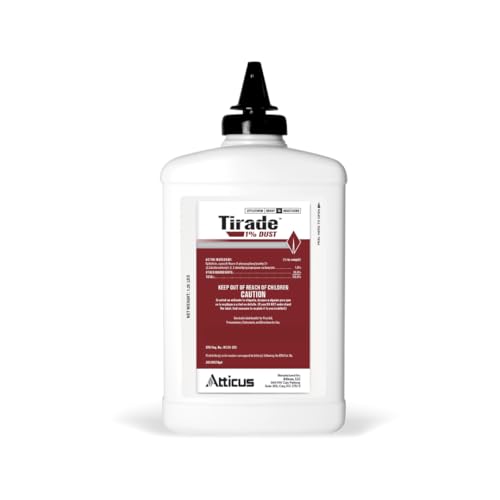
Atticus Tirade delivers professional-grade 1% cyfluthrin in a ready-to-use dust format that controls flying, crawling, and wood-infesting insects without requiring mixing or measuring. The 1.25-pound bottle provides generous coverage for interior crack-and-crevice treatments and exterior barrier applications, and the non-staining, low-odor formulation means you can apply it in kitchens, living areas, and pet kennels without leaving visible residue or chemical smells.
Real-world users report dramatic results against yellow jacket nests in dead trees, carpenter bee infestations, and heavy roach populations that resisted sprays and traps. The dust stays active for weeks in dry environments, and the fine particles penetrate deep into siding gaps, wall voids, and ant mounds. Multiple owners note that a single application eliminated wasp nests within 72 hours with no return activity. The powder requires a puffer-style duster for best results — the bellows method lays down the thin, even coating that maximizes contact.
While the dust is low-odor and non-staining, it is a synthetic pyrethroid and should not be applied directly around fish tanks, open pet food, or in areas accessible to small children during application. A dust mask and gloves are advisable during use. The product is not available for sale in Alaska, California, Hawaii, Puerto Rico, or Vermont due to registration restrictions, so verify your state before ordering.
What works
- Broad-spectrum label covers over 50 pest species from ants to yellow jackets.
- Low-odor and non-staining formulation suitable for kitchen and living area use.
- Ready-to-use dust eliminates measuring and mixing steps entirely.
What doesn’t
- Not registered for sale in five states — check local availability before purchasing.
- Requires a separate puffer duster for precise indoor crack-and-crevice application.
- Synthetic pyrethroid toxicity requires caution around cats and aquatic environments.
2. BASF PT Tri-Die Pressurized Dust Insecticide

BASF PT Tri-Die combines a pyrethroid (lambda-cyhalothrin) with silica gel desiccant in a pressurized aerosol dust canister that shoots powder deep into wall voids, cracks, and nesting cavities without clumping. The dual-action formula delivers immediate knockdown from the neurotoxin while the silica gel physically desiccates insects that survive the initial contact, providing residual control that lasts for months in dry environments.
Homeowners consistently praise this product for eliminating yellow jacket nests that foam sprays and traps failed to touch. The thin straw attachment allows upward spraying into soffits and siding gaps, and users report that a single one-second burst into a nest entrance stops all activity within 48 hours. The pressurized delivery also works well for bed bug treatments in furniture seams, electrical outlets, and baseboard crevices, though the fine dust creates a noticeable cloud that requires ventilation and respiratory protection.
The 8-ounce can is relatively small, and heavy users note that treating multiple large nests can consume half the can in one session. The pressurized propellant also means you cannot store partially-used cans in extreme temperatures. A dust mask, long sleeves, and gloves are mandatory during application because the ultra-fine silica particles are easily inhaled and cause significant respiratory irritation.
What works
- Pressurized delivery reaches deep void spaces that bellows dusters cannot access.
- Dual-action formula provides immediate knockdown plus long-lasting desiccant kill.
- Highly effective against yellow jacket nests and pyrethroid-resistant bed bug populations.
What doesn’t
- Small 8-ounce can size limits coverage for large or multiple infestations.
- Fine silica dust creates heavy airborne cloud requiring full PPE during use.
- Pressurized canister cannot be stored in hot vehicles or near ignition sources.
3. Rockwell Labs Cimexa Insecticide Dust

Cimexa is 100% amorphous silica gel dust that kills insects by absorbing the protective waxy cuticle layer from their exoskeleton, causing fatal dehydration within hours. Unlike diatomaceous earth, which relies on mechanical abrasion, the silica gel particles are microscopic enough to adhere to insect legs and bodies as they walk through treated areas, and the dust remains active for up to 10 years in undisturbed wall voids — a residual duration that no other powder in this category matches.
Bed bug homeowners frequently call Cimexa a “lifesaver,” reporting 100% mortality rates when dusted inside mattress encasements, along baseboards, and behind furniture. Users with severe roach infestations that resisted bait gels, spray foams, and even Gentrol growth regulators saw results within three days for adults and one week for nymphs. The dust also works on fleas, ticks, silverfish, and drywood termites. Application requires a puffer tool or paintbrush because the powder is extremely fine and drifts easily in air currents.
The extreme fineness of the powder is also its biggest drawback. Multiple reviewers report respiratory burns and throat irritation if applied without a full-face respirator, long gloves, and long sleeves. The 4-ounce bottle is also small — several users note that for the price, you get less than one-third of a full bottle by volume, making it one of the more expensive options per ounce in this category. If you have a large infestation, consider supplementing with a bulk silica dust from a commercial supplier.
What works
- 100% silica gel desiccates bed bugs and roaches within hours, not days.
- Residual activity lasts up to 10 years in undisturbed wall voids.
- Effective against pyrethroid-resistant bed bug populations.
What doesn’t
- Extremely fine particles require a full-face respirator and protective clothing.
- Small 4-ounce bottle is expensive per ounce compared to bulk alternatives.
- Powder drifts easily in air currents, making precise application difficult without a puffer.
4. Rockwell Labs BAIP001 BorActin Insect Dust

BorActin contains 99% boric acid as its sole active ingredient, making it one of the most concentrated and stable dust insecticides on the market. Boric acid works as a stomach poison that sterilizes and starves insects over several days, and the powder remains active until physically removed — it will not break down under UV light, heat, or moisture. This makes BorActin exceptionally suited for pre-treatment applications in new construction, crawlspaces, attics, and other areas where you want a permanent layer of protection.
Homeowners praise its performance against cockroaches, Palmetto bugs, waterbugs, silverfish, and darkling beetles. One user dealing with a hornet nest inside a wall reported that dust applied to the outer entrance hole was carried into the nest, killing the queen and larvae without requiring removal of siding. The powder is odorless, moisture-resistant, and safe for use in food and non-food areas, including commercial kitchens, agricultural settings, and poultry houses. The label also allows mixing it as a liquid spray, foam, mop solution, or drain treatment for drain flies.
The primary limitation is speed. Boric acid is a slow-acting poison compared to pyrethroids or silica gel — users note it takes multiple treatments over a week to see significant roach reduction, and effectiveness can wane after about six months in heavy infestations where other products last over a year. It is also less effective against bed bugs, fleas, and ticks than Cimexa or Tri-Die, and the label specifically excludes carpenter ants.
What works
- 99% boric acid concentration provides maximal active ingredient per gram.
- Will not degrade under UV, heat, or moisture — permanent until physically removed.
- Versatile application: dust, spray, foam, mop solution, or drain treatment.
What doesn’t
- Slow-acting — may take a week or more to achieve noticeable population reduction.
- Not effective against bed bugs, fleas, ticks, or carpenter ants.
- Can lose effectiveness after 6 months in heavy infestations compared to silica alternatives.
5. D-Fense Dust with USA Supply Gloves
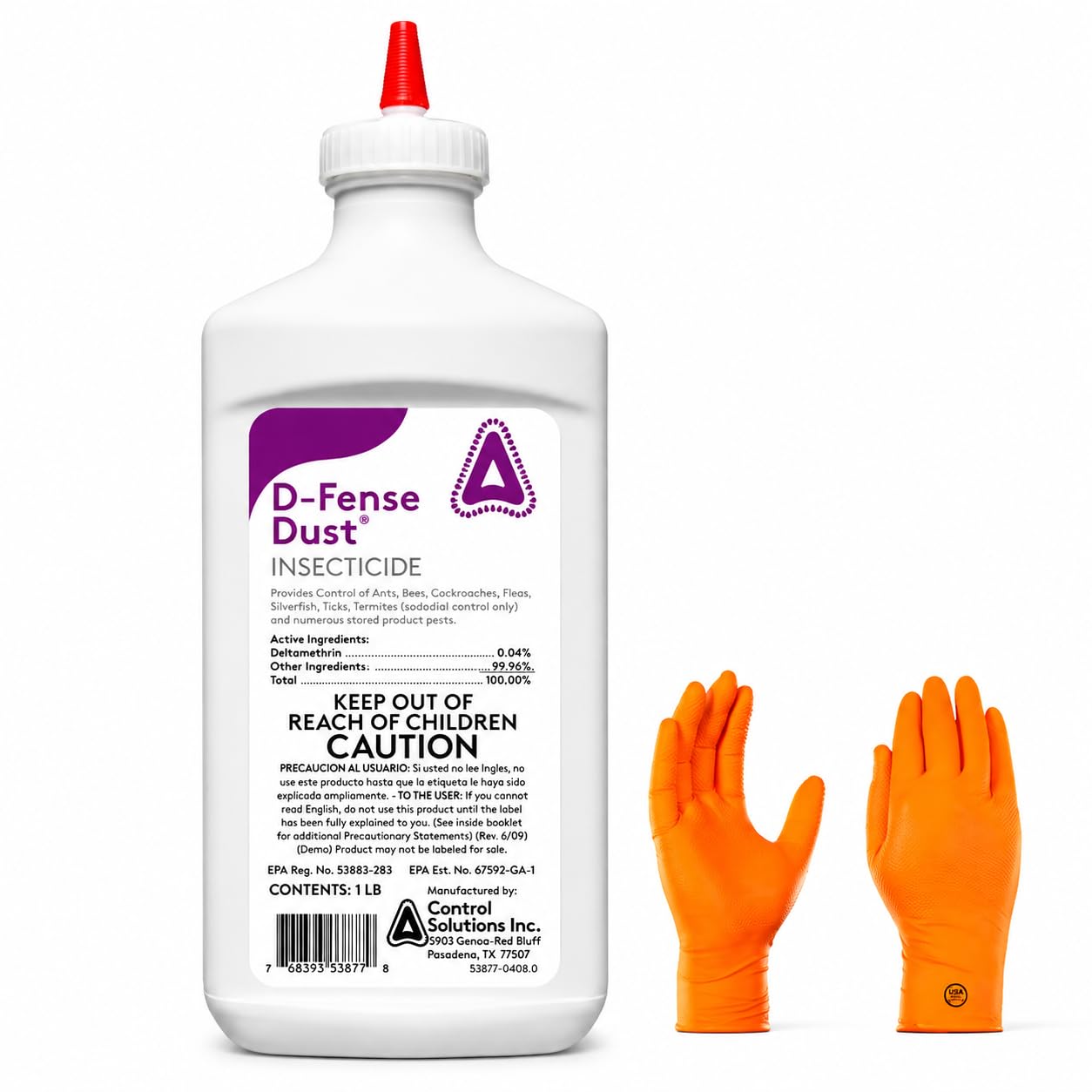
D-Fense Dust is a water-resistant insecticide powder that claims 8 months of residual control on treated surfaces, making it one of the longest-lasting synthetic dust options for outdoor and structural applications. The included USA Supply gloves with ReSist Technology provide basic hand protection during application, and the bundle also includes a pest identification card for reference. The dust stays adhered to brick, wood, and concrete even after rain exposure, which is a significant advantage over non-water-resistant powders that wash away.
Users report strong results against ants, spiders, yellow jackets in wall voids, and carpenter bees. The dust penetrates existing nest holes and kills returning insects that contact the treated surface. One homeowner eliminated an entire ant colony within days, while another successfully sealed yellow jacket nests inside walls with no return activity for months. The water resistance means you can apply it to window frames, door thresholds, and foundation cracks without worrying about the next rain shower washing it away.
The powder is a synthetic insecticide and carries the same toxicity concerns as other pyrethroid dusts — it is not safe for pets, children, or humans to inhale, and multiple reviewers emphasize that it must be kept away from fish tanks and cat litter areas. The included gloves are thin and more suitable for light protection during brief application than for heavy or prolonged handling. Some users also note that the dust requires a few days to kill spiders, so it works best as a long-term barrier rather than a quick-fix knockdown solution.
What works
- Water-resistant formula stays active after rain and outdoor exposure.
- Claims 8 months of residual control on treated surfaces.
- Bundle includes protective gloves and pest identification card for convenience.
What doesn’t
- Synthetic pyrethroid requires strict safety precautions around pets and children.
- Included gloves are thin and offer only basic protection, not heavy-duty safety.
- Slow knockdown time for spiders — takes several days to achieve full kill.
6. RobiGuard Diatomaceous Earth & Peppermint Powder

RobiGuard combines 100% food-grade diatomaceous earth with natural peppermint oil to create a dual-action dust that both kills crawling insects through exoskeleton abrasion and repels pests through strong olfactory deterrent. The food-grade certification means the powder meets FDA standards for incidental food contact, and the peppermint additive provides an extra layer of protection against squirrels, rodents, and larger garden pests that DE alone cannot stop. The resealable pouch makes storage and repeated application straightforward.
Gardeners specifically praise this product for humanely keeping squirrels out of rose beds and raised vegetable gardens — the strong peppermint scent deters mammals for at least three days after application. Indoors, users report quick elimination of ants, fleas, gnats, and earwigs with no chemical smell beyond the peppermint. The food-grade status makes it safe to use around children and pets as long as it is applied dry and not breathed in. Several owners note that it worked faster than their previous brand of DE and cost less per ounce.
The diatomaceous earth remains effective only as long as it stays dry — rain or heavy humidity causes it to clump and lose abrasive action. The peppermint scent, while pleasant to humans, fades over time and requires reapplication every few days for continuous rodent repellency. The powder is also coarser than silica gel dusts, so it does not penetrate deep into wall voids or furniture crevices as effectively as Cimexa or Tri-Die. A dust mask is still recommended during application because any DE powder can irritate lungs.
What works
- Food-grade DE plus peppermint oil provides both kill and repellent action.
- Safe for organic gardening and use around children and pets when applied dry.
- Effective against squirrels, rodents, ants, fleas, gnats, and earwigs.
What doesn’t
- DE loses effectiveness when wet — rain ruins outdoor applications.
- Peppermint scent fades within days, requiring frequent reapplication for rodent deterrence.
- Coarser particle size limits penetration into wall voids and deep crevices.
7. Safer Brand Diatomaceous Earth Powder

Safer Brand’s 5168 Diatomaceous Earth is an OMRI-listed powder containing 77.69% diatomaceous earth, certified for use in organic gardening and compliant with organic farming standards. It kills crawling insects by abrasion and dehydration within 48 hours of ingestion or contact, making it effective against ants, bed bugs, cockroaches, fleas, silverfish, and pantry pests. The 7-ounce canister features a squeezable top for targeted application into cracks, crevices, baseboards, and electrical outlets.
Homeowners dealing with bed bugs report that a light dusting on bed frames, box springs, and furniture encasements stops bites within 24 hours and prevents re-infestation between dwellings when combined with steam treatment and mattress encasements. Ant control users find it effective when sprinkled along walls and behind appliances, though some note that ants simply establish alternate routes around the treated area. The powder is safe for asthma sufferers and pets when applied according to directions, which is a major advantage over synthetic dusts for households with respiratory sensitivities.
The squeeze-top canister delivers a less precise stream than a bellows duster, and multiple users recommend adding a duster tool for better control. DE kills slowly compared to silica or pyrethroid dusts — you will find dead bugs later rather than see them drop immediately. The 7-ounce container is also smaller than it appears, and serious infestations may require multiple canisters for full coverage. The powder must stay dry to remain effective, so outdoor use is limited to protected areas underneath porches and eaves.
What works
- OMRI-listed organic certification makes it suitable for organic vegetable gardens.
- Safe for asthma sufferers and pets when applied according to label instructions.
- Kills bed bugs, ants, cockroaches, fleas, and silverfish within 48 hours.
What doesn’t
- Squeeze-top canister provides less precise stream than a dedicated bellows duster.
- Slow-acting mechanism means results are gradual rather than immediate.
- 7-ounce canister is small — multiple containers needed for large or heavy infestations.
Hardware & Specs Guide
Active Ingredient Chemistry
Boric acid (99% in BorActin) poisons insects through their digestive system and reproductive cycle, making it ideal for long-term population suppression in roach and silverfish colonies. Silica gel (100% in Cimexa) kills by desiccation within hours by stripping the waxy cuticle layer — this mechanism is independent of neural resistance pathways, making it effective against pyrethroid-resistant bed bugs. Diatomaceous earth (77–100% in Safer and RobiGuard) abrades the exoskeleton mechanically and absorbs oils, but requires dry conditions and works more slowly than silica. Pyrethroid dusts (lambda-cyhalothrin in Tri-Die, cyfluthrin in Tirade) attack sodium channels in insect nerves for rapid knockdown and maintain residual activity for weeks to months, but face increasing resistance in cockroach and bed bug populations.
Particle Size and Delivery Method
Ultra-fine silica gel particles (Cimexa, Tri-Die) measure 1–5 microns and can drift into wall voids and electrical boxes, but require respiratory protection because they remain airborne for minutes after application. Coarser DE particles (50–200 microns) settle faster and are less hazardous to inhale but cannot penetrate deep nest sites. Pressurized dust cans (Tri-Die) use propellant to blast powder into voids without clumping, while bellows dusters (recommended for Atticus Tirade and BorActin) give you thin-layer precision for crack-and-crevice treatments. Squeeze-top canisters (Safer DE) offer convenience for quick perimeter dusting but lack the control needed for void penetration.
Moisture Resistance and Residual Duration
Boric acid dust (BorActin) is inherently moisture-resistant and will not break down under UV or heat, making it suitable for pre-treatment in new construction and year-round crawlspace use. Cimexa silica gel remains effective for up to 10 years in undisturbed wall voids because it does not degrade chemically. Pyrethroid dusts (D-Fense, Tri-Die, Tirade) lose potency under direct sunlight but maintain residual kill for 1–8 months in enclosed spaces. DE powders (Safer, RobiGuard) become ineffective when wet and must be reapplied after rain or humidity exposure. For outdoor barrier treatments, choose a water-resistant label like D-Fense Dust that explicitly states it stays on brick and concrete after rain.
Safety Profile and Certification
Food-grade DE products (Safer, RobiGuard) carry OMRI organic certification and are generally recognized as safe for incidental food contact, making them the top choice for kitchens, pet areas, and vegetable gardens. Boric acid (BorActin) has low mammalian toxicity but should not be applied directly to food surfaces. Silica gel (Cimexa) is non-toxic in solid form but highly hazardous when airborne — it must be applied with a full-face respirator, not just a dust mask. Pyrethroid dusts (D-Fense, Tri-Die, Atticus Tirade) are neurotoxic to cats, fish, and beneficial insects and require strict isolation of treated areas during application. Always verify that the product is EPA-registered for your target pest and that your state allows the specific active ingredient — some pyrethroid formulations are restricted in certain states.
FAQ
Can I mix bug powder killer with water and spray it instead of dusting?
How long should I wait after applying bug powder before letting pets back into treated areas?
Why do some bug powders last 10 years while others only last 8 months?
Final Thoughts: The Verdict
For most gardeners, the bug powder killer winner is the Atticus Tirade 1% Cyfluthrin Dust because its broad 50+ pest label, low-odor formula, and generous 1.25-pound bottle provide the best coverage-per-dollar for both indoor and outdoor use. If you need a fast-acting solution for deep void spaces and yellow jacket nests, grab the BASF PT Tri-Die. And for organic gardeners who want food-grade safety in vegetable beds and around pets, nothing beats the Safer Brand Diatomaceous Earth.