
Aloe vera is a succulent that craves bright, indirect sunlight—but most homes offer nothing close to the intense south-facing window it needs. When your aloe starts stretching toward a weak window, that pale, skinny, and limp growth is a direct signal that your current light setup is failing the plant’s photosynthetic demands.
I’m Rikta — the co-founder and writer behind Lawn Gear Lab. I’ve spent hundreds of hours studying the photobiology of succulents, analyzing LED spectral output data, and cross-referencing real owner feedback, so you don’t have to guess which light will actually keep your aloe compact and healthy.
Whether your aloe sits on a dim desk or in a shadowy corner, the right fixture stops leaf stretching and delivers the intense, full-spectrum light that mimics its natural habitat. This guide ranks the seven most effective fixtures on the market to help you find the best aloe grow light for your specific setup and budget.
How To Choose The Best Aloe Grow Light
Aloe vera is a high-light succulent that requires 6–12 hours of bright, indirect illumination daily. Before buying, focus on three critical factors: light intensity (PPFD), spectral composition, and timing control. Ignore marketing wattage numbers—actual usable light to the plant matters most.
Light Intensity: Look for PPFD, Not Wattage
A fixture’s PPFD, measured in μmol/s/m², tells you how many usable photons reach your aloe’s leaves. Aim for a PPFD of at least 150–200 μmol/s/m² at the canopy level. This prevents the etiolation (stretching) that occurs when the plant reaches for weak light. Low-wattage bulbs often fail this test, so check independent PAR maps or owner measurements.
Spectral Quality: Full Spectrum With Red Emphasis
Aloe vera responds strongly to red wavelengths (around 660 nm) for photosynthesis and blue wavelengths (around 450 nm) for compact, thick leaf growth. Full-spectrum lights that include these specific peaks produce better results than generic white-only lamps. Look for fixtures that specify “380nm–800nm” coverage in their specs.
Timer and Dimming Flexibility
Aloe needs a consistent photoperiod to thrive. A built-in auto timer (6, 12, or 18-hour cycles) prevents human forgetfulness and stabilizes the plant’s internal clock. Dimming options let you acclimatize new plants or adjust intensity during heat waves. Without these, your aloe can suffer from light shock or irregular growth patterns.
Quick Comparison
On smaller screens, swipe sideways to see the full table.
| Model | Category | Best For | Key Spec | Amazon |
|---|---|---|---|---|
| LBW Adjustable Halo (3-Pack) | Mid-Range | Compact multiple-pots | 380–800nm, 5 dim levels, ¾”–26″ height | Amazon |
| SANSI 10W Clip-On | Mid-Range | Single pot precision | 169.7 μmol/s/㎡ @ 6″, ceramic tech | Amazon |
| LBW 8″ Halo Stand | Mid-Range | Tall or multiple large plants | 68″ max height, 108 LEDs, 1710 lumens | Amazon |
| SDOVUERC 6-Bar Strip | Mid-Range | Shelves and propagation | 360 pcs LEDs, 3600 lumens, 95″ cord | Amazon |
| SANSI 20W Dual-Head Clip | Premium | High-intensity dual coverage | 2000 lumens, 380–800nm, lifetime bulb | Amazon |
| FECiDA Desktop 25W | Premium | Seed starting and desktop growth | UV-IR+660nm, 2000 lumens, daisy chain | Amazon |
| Mefflypee Tripod 6-Head | Budget | Floor coverage on a budget | 26″–58.66″ tripod, 3 spectra, 10 levels | Amazon |
In‑Depth Reviews
1. LBW Grow Light for Indoor Plants (3-Pack)
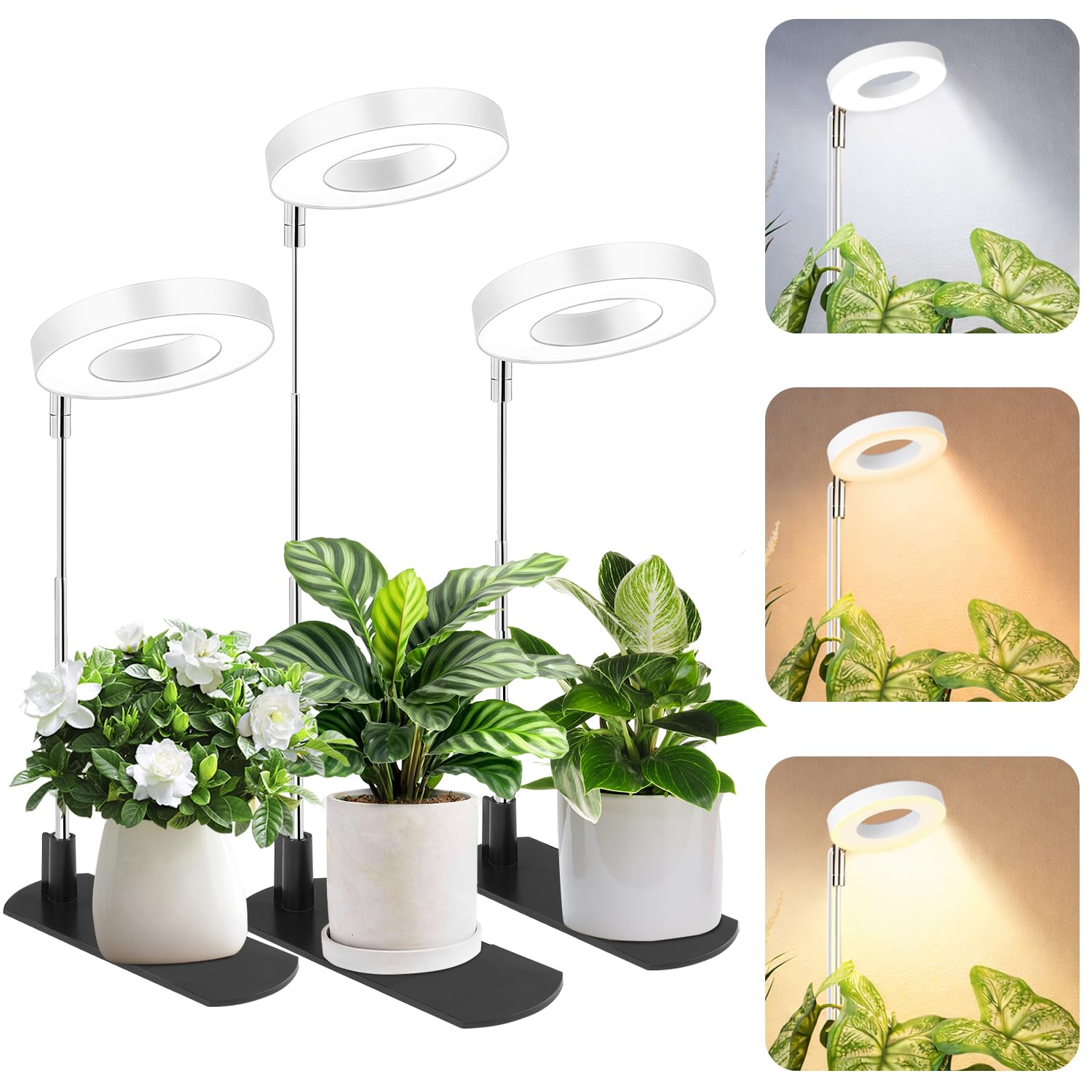
This LBW three-pack delivers a flexible halo design that extends from 7.8 to 26 inches, covering a wide range of pot sizes. The 380–800nm full spectrum covers vegetative and flowering stages, and five brightness levels let you dial in the 80–100% intensity that aloe needs to stay compact. Auto timers for 6/8/12/16 hours maintain consistent photoperiods without daily intervention.
Aluminum construction and a 78-inch cord give placement freedom. The standout feature is the three-color mode (white, warm, full spectrum), allowing you to pick the hue that best mimics natural sunlight without harsh purple cast. Reviewers note that within two months, aloe leaves regained firmness and lost the pale, stretched appearance common in low-light setups.
The trade-off is the base design: the pot must weigh enough to keep the stand from tipping, which means these work best with larger ceramic or terracotta aloe pots. Some users reported a unit stopping after seven weeks, but the 12-month warranty and 30-day return policy cover replacements smoothly.
What works
- Tri-color full spectrum matches aloe’s exact photosynthetic needs
- 5-level dimming allows precise intensity control
- Multiple timer modes ensure consistent daily photoperiods
What doesn’t
- Base is unstable unless the flower pot provides sufficient weight
- One reviewer experienced a stop after several weeks, fixed by swapping the plug
2. SANSI 10W Clip-On LED Grow Light

SANSI’s ceramic thermal management allows this 10W lamp to push 169.7 μmol/s/m² at 6 inches—about 4.7 times higher PPFD than most 10W competitors. That high photon flux is exactly what stops aloe from stretching. The 360° gooseneck and sturdy clamp mount directly to the pot edge or shelf, making it a zero-footprint solution for a single aloe plant.
Four dimming levels (25–100%) let you start seedlings at lower intensity and gradually ramp up to full power as the aloe acclimatizes. The 3/6/12-hour timer cycled on a 24-hour basis, and reviewers saw new leaf growth on monsteras within one month—aloe responds even faster under similar conditions. The 2-year protection plan is a strong safety net for long-term use.
The main limitation is the gooseneck length: at 15.4 inches total, it cannot reach tall pots from a floor mount. For aloe in low-profile containers (8–12 inch diameter), this is perfect. One note: the clamp may feel light for the arm length, but careful positioning prevents sagging.
What works
- Extremely high PPFD per watt prevents etiolation effectively
- Flexible gooseneck and clamp mount install in seconds
- 2-year warranty and reliable timer programming
What doesn’t
- Gooseneck may be too short for tall pots
- Clamp strength is adequate but not heavy-duty
3. LBW 8″ Halo Stand Grow Light
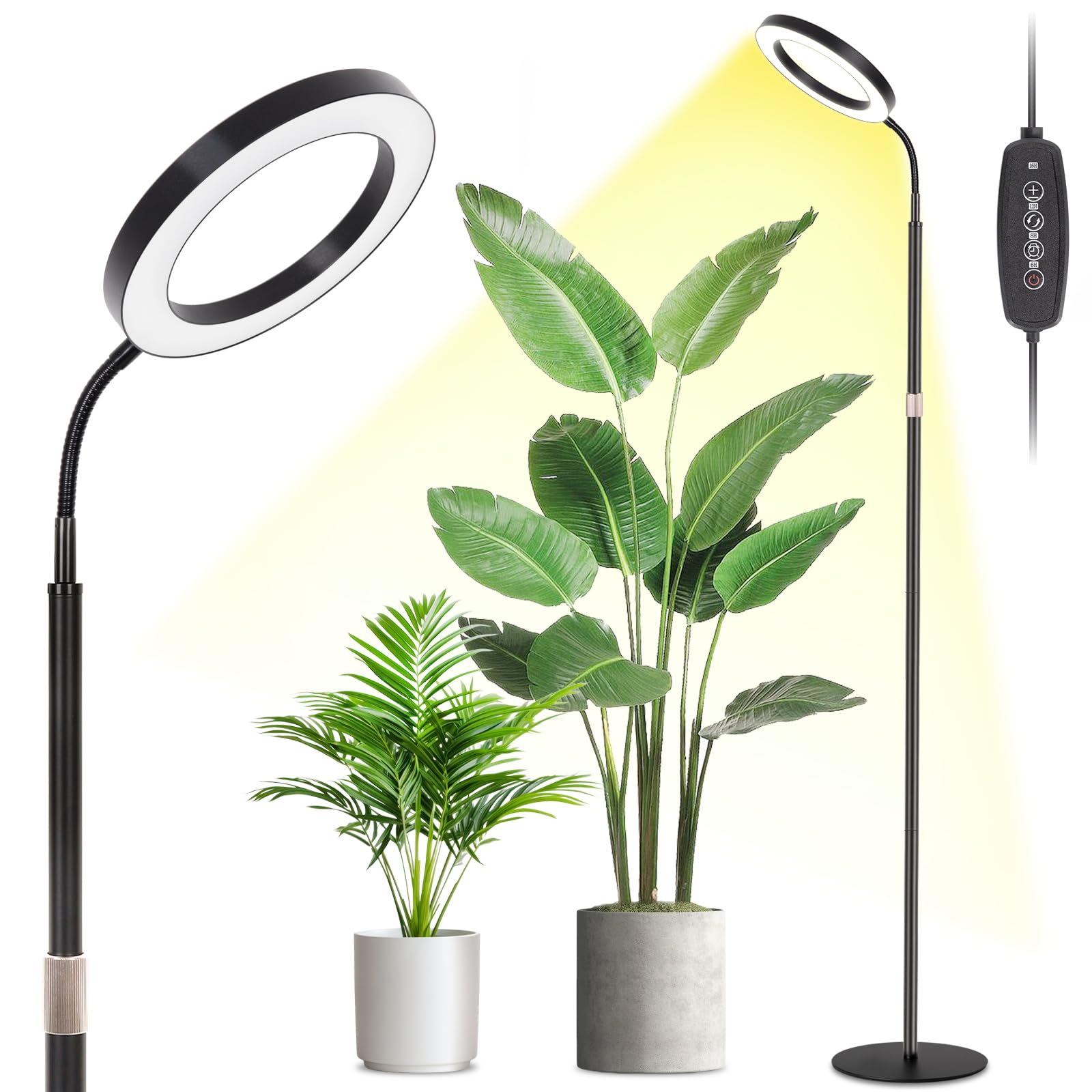
LBW’s 8-inch halo panel packs 108 LEDs (cold white, warm white, red, and blue) delivering 1710 lumens across the full 380–800nm range. The telescoping rod extends from 15.8 to 63 inches, and the entire fixture reaches 68 inches—ideal for tall aloe specimens or for lighting multiple pots on a desk. The 6-level stepless dimming (10–100%) gives fine-grained control.
The memory timer offers 4/8/12-hour cycles, and the circular storage function remembers your setting even after a power disruption. Non-slip pads on the robust metal base keep the fixture stable. Reviewers reported 2 feet of new growth on monsteras over 5 months, with aloe staying thick and upright. The matte black finish looks modern in any room.
One drawback: the light panel is fixed at an 8-inch diameter, which cannot be adjusted to a smaller footprint. If you have a very small aloe pot, some light spill around the edges is wasted. The stand also occupies a 7.9-inch diameter base, so it needs modest desk space. No heat output noted, even after hours of operation.
What works
- Excellent height range (up to 68 inches) for tall aloe or multiple pots
- 108 full-spectrum LEDs with 6-level stepless dimming
- Memory timer with 3 cycle options for consistent care
What doesn’t
- Fixed 8-inch halo may spill light on small single pots
- Base footprint requires 8 inches of clear desk space
4. SDOVUERC 16″ 6-Bar Grow Light Strip
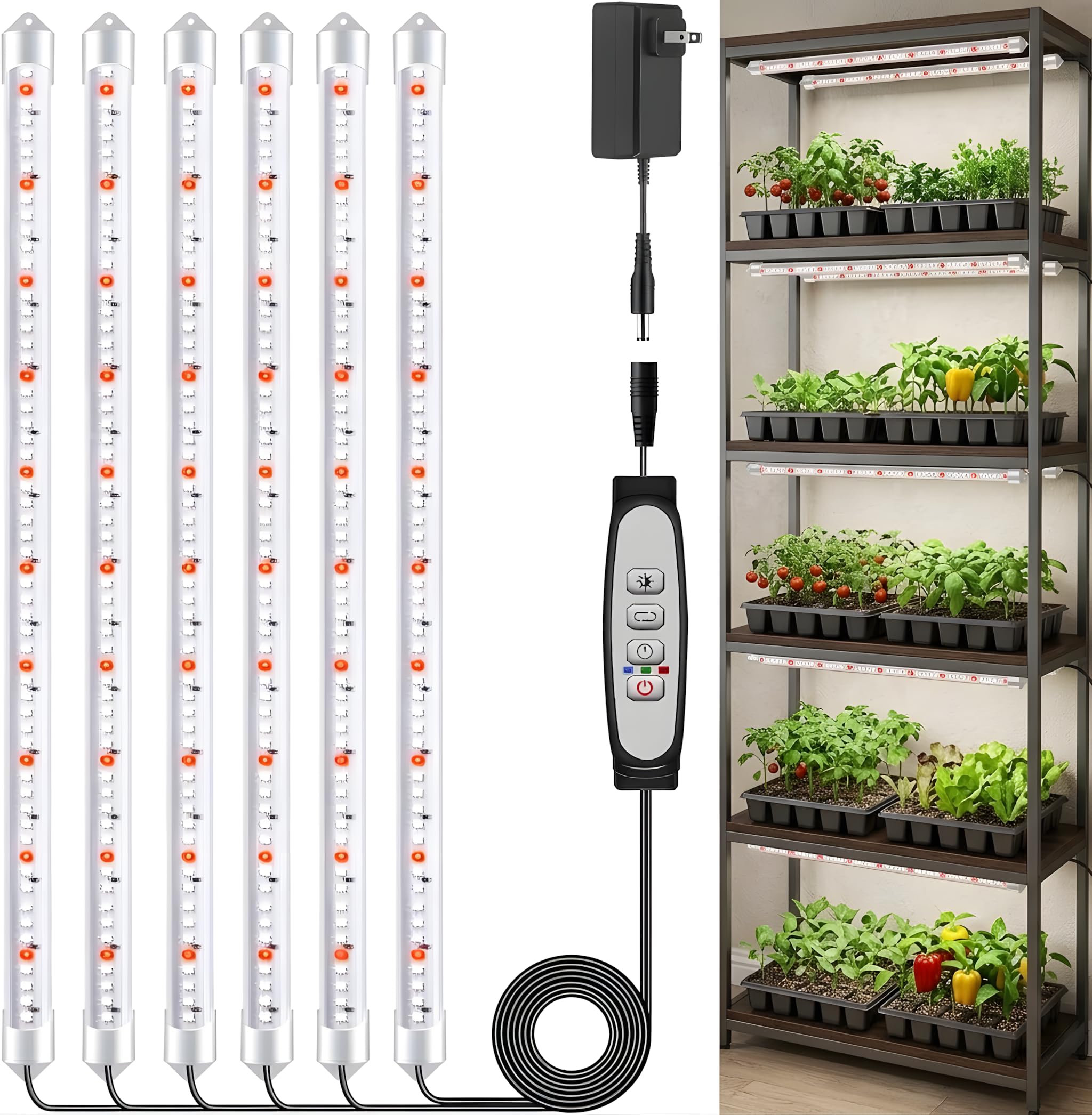
This 6-bar strip array puts out 3600 lumens from 360 LED diodes (including 660nm red), making it a powerhouse for shelf-based aloe propagations or multi-tier setups. The bars measure 16.5 x 3.23 inches each and can be mounted with zip ties, screws, or double-sided tape, adapting to wire shelves, walls, or plant stands in minutes. The 95-inch cord reaches distant outlets easily.
The memory timer runs 6/12/18-hour cycles, and 5 dimmable levels let you adjust intensity without changing the bar height. The 660nm red channel specifically boosts photosynthesis in the deep-red absorption peak of chlorophyll, which aloe uses strongly. Owners report lush, dark green leaves within weeks when this strip is placed 6–10 inches above the canopy.
Installation requires removing the bar from its mounting plate to access the screws, and the included double-sided tape may lose adhesion in humid environments. For permanent shelf setups, using the supplied screws is recommended. One bar per shelf provides sufficient coverage for a row of 4–6 small aloe pots.
What works
- High lumen output (3600) with dedicated 660nm red for photosynthesis
- Three mounting methods allow versatile shelf, wall, or stand installation
- Memory timer with 6/12/18-hour cycles for hands-off operation
What doesn’t
- Double-sided tape may not hold long-term in damp environments
- Mounting requires removing bar from plate for screw installation
5. SANSI 20W Dual-Head Clip Grow Light

The SANSI dual-head fixture uses two replaceable 10W PAR20 bulbs that together output 2000 lumens and cover the 380–800nm full spectrum. Each head can be positioned independently via dual goosenecks, giving you two distinct light angles over a large aloe or two separate pots. The 4/8/12-hour auto timer is based on a 24-hour cycle, so once set, it repeats daily.
The clip-on base is substantial and secures to shelves or table edges up to 2 inches thick. The lifetime free bulb replacement (only for the bulbs, not the fixture) is a standout value proposition—SANSI will replace a burned-out bulb at no cost. Reviewers note that this light kept expensive outdoor succulents alive through a dark garage winter. The 20W total draw saves 90% vs. a 300W incandescent equivalent.
Potential downsides: the bulbs can get hot to the touch—keep at least 3 inches above foliage to avoid leaf burn. The goosenecks, while flexible, have been noted to struggle supporting the weight of the bulbs over time, requiring occasional readjustment. If the power is cut, the timer resets, which can be inconvenient for those with frequent blackouts.
What works
- Two independent heads provide double coverage for large or multiple aloe pots
- Lifetime free bulb replacement adds long-term value
- High PPFD (2000 lumens) and true full spectrum (380–800nm)
What doesn’t
- Bulbs get hot—must maintain safe distance above foliage
- Timer resets after power outage, requiring manual reprogramming
6. FECiDA 25W Desktop LED Grow Light
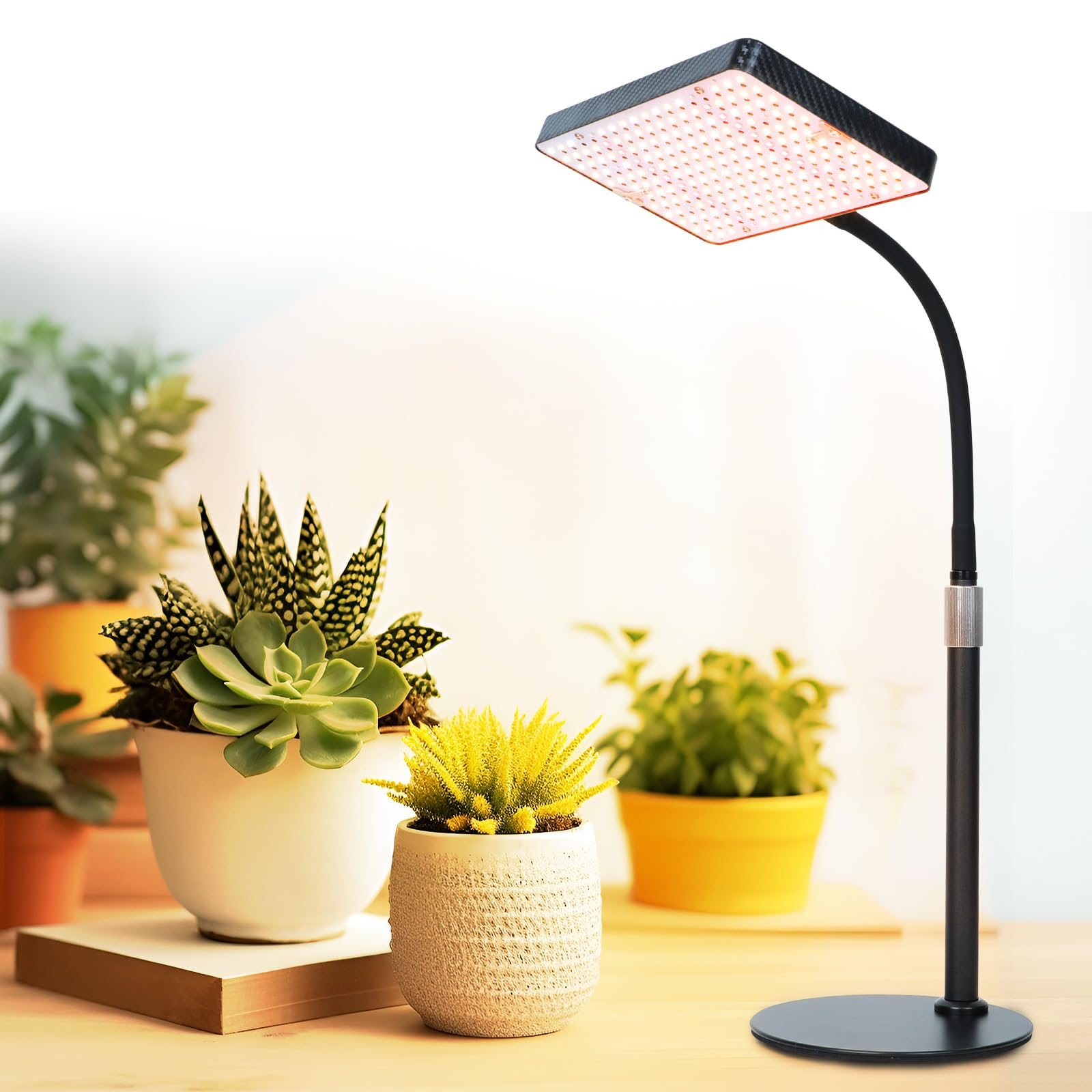
FECiDA’s desktop lamp combines 3000K, 5000K, 660nm red, UV, and IR diodes to create an ideal spectrum for both vegetative growth and flowering. The daisy chain port allows linking up to 4 units on a single outlet, making this scalable for a whole shelf of aloe. At 2000 lumens and 25W actual draw, it is bright enough for seed starting and mature succulents alike.
The adjustable stand ranges from 16 to 24 inches, and the lamp head tilts to direct light precisely. The simple physical on/off switch eliminates the complexity of touch panels, and reviewers praised the easy 3-minute assembly. A 12-month warranty and responsive customer service back the purchase. The UV channel (395nm) is known to boost resin production in some plants and may help aloe maintain thick leaf walls.
The lamp head is wide and produces a broad beam, which may be too bright for very small desktop setups—it can wash out a 6-inch pot with excessive light. Also, there are no built-in timer or dimming functions, so you will need a smart plug for automated cycles. The lack of these integrated features reduces convenience compared to rivals at similar pricing.
What works
- UV-IR plus 660nm red provides a scientifically complete growth spectrum
- Daisy chain capability (up to 4 units) for multi-plant setups
- Stable base and robust aluminum build with a 12-month warranty
What doesn’t
- No built-in timer or dimmer—requires external smart plug
- Broad beam may over-illuminate very small single pots
7. Mefflypee Tripod 6-Head Grow Light
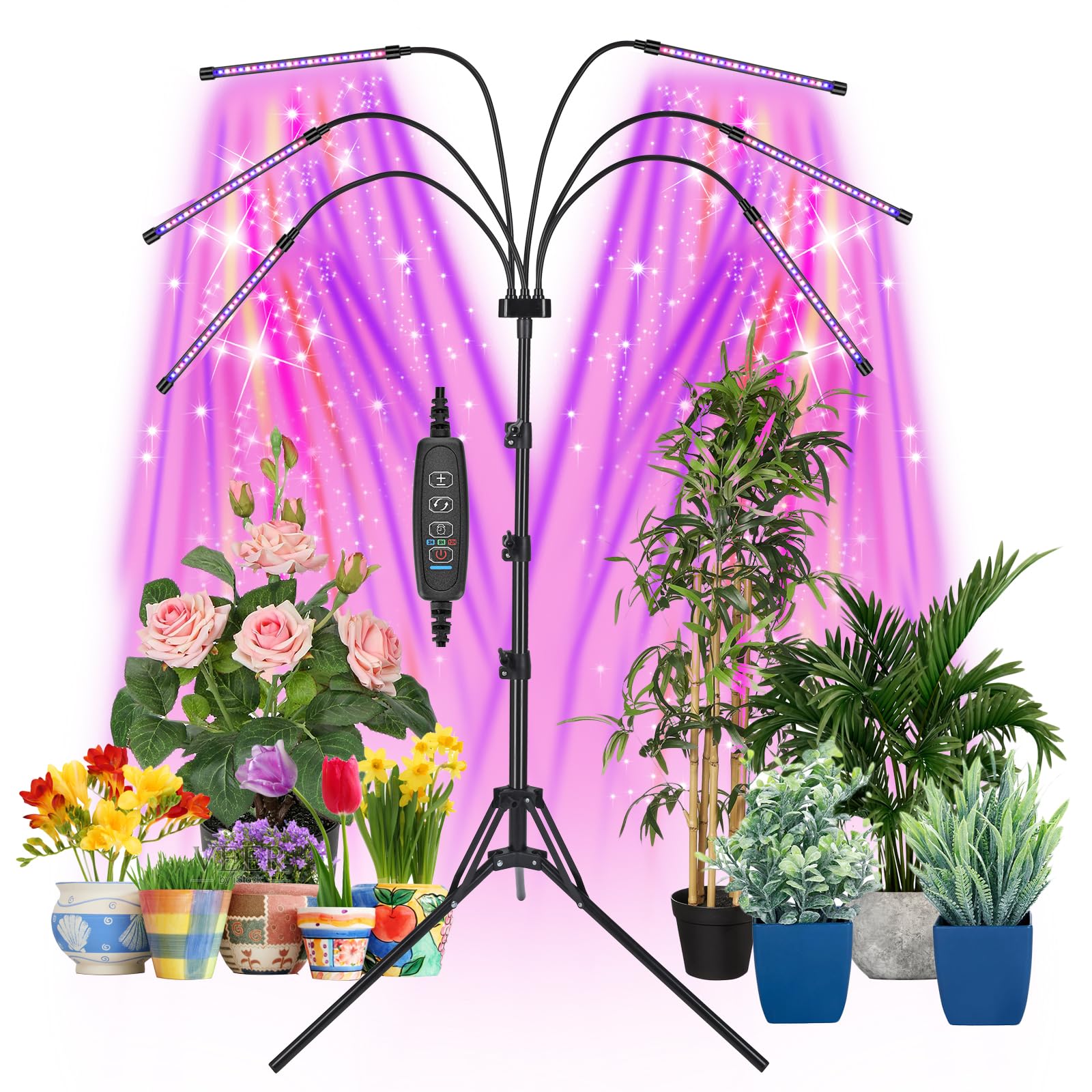
The Mefflypee unit uses six individual LED heads mounted on flexible goosenecks above a tripod stand that extends from 26 to 58.66 inches. It offers three spectral modes (yellow, red, blue, or a mix) and 10 dimming levels (10–100%). This flexibility lets you position heads at different angles to cover an aloe from multiple sides, mimicking the sun’s natural movements throughout the day.
The 3/9/12-hour auto timer (circular memory) ensures daily repeat cycles. Reviewers saw faster growth, greener leaves, and stronger stems on succulents within weeks. The energy-efficient LEDs (rated for 50,000 hours) keep the electricity cost minimal. The tripod base takes up a small footprint, fitting into corners or beside desks.
The trade-off is stability: the tripod legs can slide on smooth floors or tip if one leg is bumped. Several reviewers noted the base feels light and requires careful positioning to stay upright. The plastic and metal construction feels less durable than aluminum-bodied competitors. For a stationary spot where the tripod won’t be moved daily, this offers excellent coverage on a budget.
What works
- Six adjustable heads with 360° goosenecks cover multiple angles
- 3 spectral modes (red/blue/yellow) plus 10 dimming levels
- Timer (3/9/12H) with circular memory for automated daily cycles
What doesn’t
- Tripod base can slide or tip easily on smooth floors
- Materials feel less robust than mid-range aluminum fixtures
Hardware & Specs Guide
PPFD (Photon Flux Density)
PPFD, measured in μmol/s/m², is the most important spec for aloe. Aim for 150–200 μmol/s/m² at the leaf surface. The SANSI 10W delivers 169.7 μmol/s/m² at 6″, hitting the target perfectly. Most inexpensive lights only achieve 30–50 μmol/s/m², which leads to etiolation. The LBW 3-pack adjusts height to dial in distance—closer means higher PPFD.
Full Spectrum vs. Blurple
Full-spectrum LEDs (380–800nm) provide a white light that looks natural and supports all growth stages. Aloe specifically benefits from red (660nm) for photosynthesis and blue (450nm) for compactness. Only fixtures that explicitly list both red and blue peaks—like the SDOVUERC and FECiDA—offer the targeted wavelengths. Avoid single-color purple-only lamps for succulents.
Timer and Dimming Reliability
Circular memory timers automatically repeat your chosen photoperiod (6, 8, 12, or 18 hours) daily without reprogramming. This stabilizes the aloe’s circadian cycle. The LBW and SANSI models have reliable memory that survives brief power interruptions. Models without a timer (like the FECiDA) require an external smart plug for automation.
Mounting and Placement
Aloe grows best with light 6–12 inches above the leaf tips. Clip-on lights (SANSI 10W) save desk space but need a sturdy edge. Halo stands (LBW 8″) are freestanding but require base stability. Strip lights (SDOVUERC) are ideal for shelves. Tripod models (Mefflypee) cover larger areas but need a stable floor position. Always check the adjustable height range before purchase.
FAQ
How many hours per day should I run an aloe grow light?
Can I use a regular LED bulb instead of a dedicated grow light for my aloe?
How close should the grow light be to the aloe leaves?
What does “etiolation” mean and how does a grow light fix it?
Final Thoughts: The Verdict
For most gardeners, the best aloe grow light winner is the LBW 3-Pack Adjustable Halo because it combines tri-color full-spectrum output, fine-grained brightness control, and multiple timer modes at a mid-range price. If you need a precise single-pot solution, grab the SANSI 10W Clip-On for its high PPFD and ceramic durability. And for a tall or multi-plant setup, the LBW 8-inch Halo Stand provides unmatched height and coverage without breaking the bank.