
A lawn crawling with chinch bugs, armyworms, or sod webworms isn’t just an eyesore—it’s a financial loss. Every dollar of seed, fertilizer, and water you pour into your yard is at risk until you break the cycle of soil-dwelling and surface-feeding pests. An effective granular insecticide is the only way to reclaim your ground.
I’m Rikta — the co-founder and writer behind Lawn Gear Lab. I spend my days cross-referencing active ingredient concentrations, bag coverage claims, and residual control windows against real owner feedback to separate products that deliver from those that just settle into the thatch.
To help you decide fast, I’ve ranked the top seven granular insecticides side by side in this complete best bug killer for lawn guide, covering everything from fast-contact knockdown to season-long grub suppression.
How To Choose The Best Bug Killer For Lawn
Choosing a granular lawn insecticide means looking past the brand label and understanding three core factors: the active ingredient chemistry, the coverage-to-price ratio, and the residual protection window. Each of these determines whether you control the problem or watch it return in three weeks.
Active Ingredient Matters More Than Brand
Bifenthrin-based granules like Talstar deliver fast contact kill and a long residual window (2-4 months) against ants, fleas, and surface feeders. Imidacloprid (found in Bayer Merit) is a systemic that works slowly on root-feeding grubs and tree borers but won’t stop surface pests instantly. Deltamethrin products like DeltaGard balance both contact and residual action for general perimeter defense. Match the ingredient to your specific pest—don’t just grab the first bag.
Coverage Per Bag
A 20-pound bag can cover anywhere from 10,000 to 25,000 square feet depending on the product’s active concentration and recommended application rate. A low-coverage bag (10,000 sq ft every 20 lb) means you’re paying more per square foot but getting a higher concentration of active ingredient per granule. High-coverage bags (20 lb covering 20,000+ sq ft) spread thinner—better for maintenance, worse for heavy infestations.
Quick Comparison
On smaller screens, swipe sideways to see the full table.
| Model | Category | Best For | Key Spec | Amazon |
|---|---|---|---|---|
| BioAdvanced Complete | Premium | Wide-area control | Treats up to 25,000 sq ft | Amazon |
| Talstar PL Granules | Premium | Long residual protection | 2 to 4 month residual | Amazon |
| DeltaGard G Granules | Mid-Range | Perimeter & fire ant mounts | Covers 10,000 sq ft | Amazon |
| Bayer Merit 0.5 G | Mid-Range | Grub & tree borer control | Imidacloprid 0.5% systemic | Amazon |
| Ortho BugClear | Mid-Range | Fast knockdown of surface pests | Covers up to 20,000 sq ft | Amazon |
| Ortho Bug B Gon Max | Mid-Range | Versatile garden & lawn use | Kills 100+ insects for 3 months | Amazon |
| Sevin Lawn Insect Granules | Budget | Budget-friendly multi-pest treat | 20 lb, kills 30+ pests | Amazon |
In‑Depth Reviews
1. BioAdvanced Complete Brand Insect Killer Granules
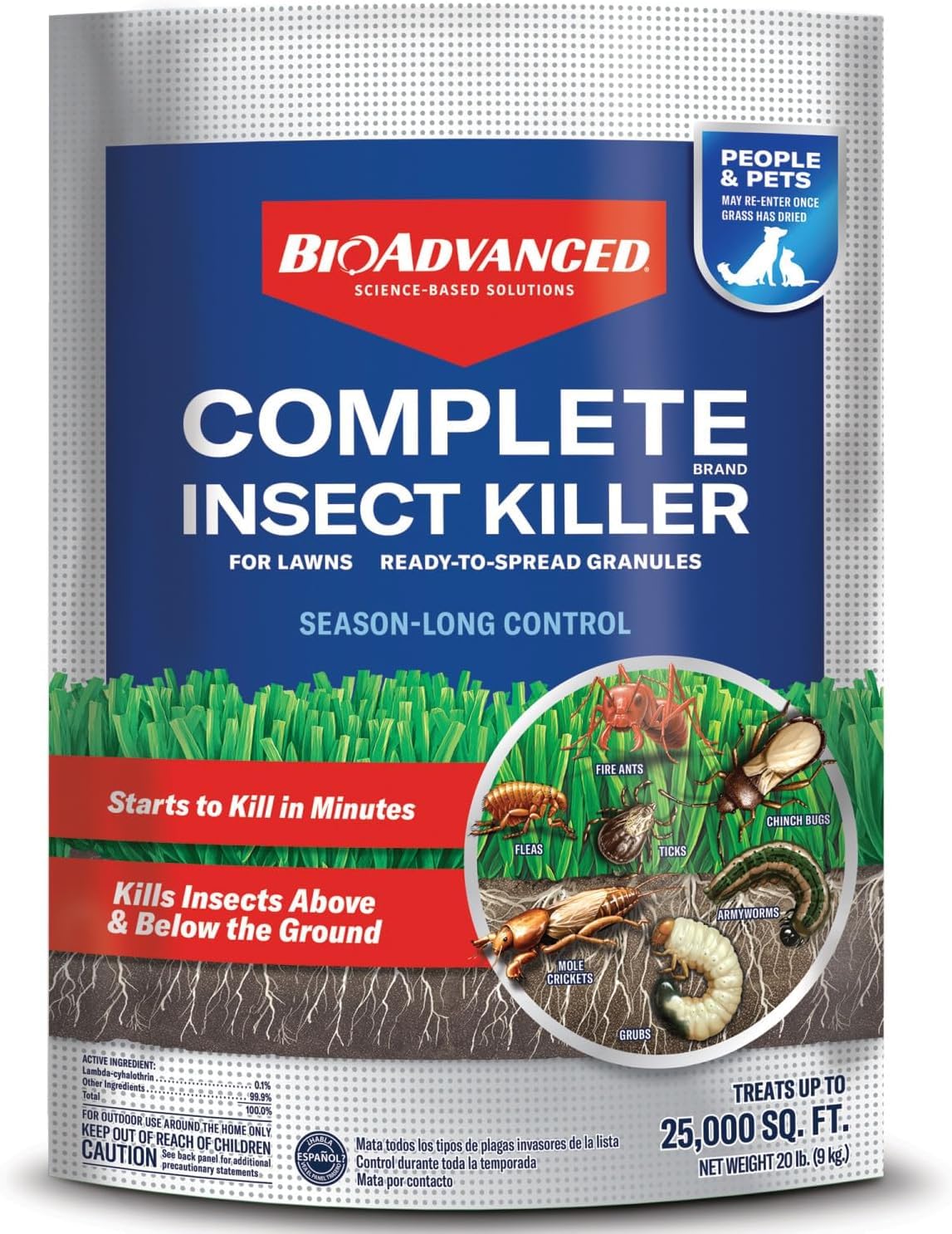
The BioAdvanced Complete Granules deliver the highest coverage per bag in this lineup—20 pounds treats up to 25,000 square feet. That makes it the most efficient choice for larger lots where you want one application to cover the entire lawn without mixing two bags. The bifenthrin-based formula kills both above-ground surface feeders and below-ground grubs on contact, which is critical for lawns with mixed infestations.
Owner feedback confirms that it knocks down heavy tick pressure in wooded campsites and stays effective in humid South Florida climates for roughly three months. However, some users note that stink bugs appear unaffected, and if your primary pest is fleas, you may need a follow-up product. The granules spread easily with a broadcast spreader and are safe for St. Augustine grass when applied per the label.
For season-long control of the widest pest spectrum in a single 20-pound bag, this is the most efficient granular option. The only catch is that you need to water it in immediately to activate the barrier.
What works
- Largest coverage per bag (25,000 sq ft)
- Kills above and below ground on contact
- Safe for St. Augustine and other common turf
What doesn’t
- Does not affect stink bugs
- Requires watering in for activation
2. Talstar PL Granules Insecticide
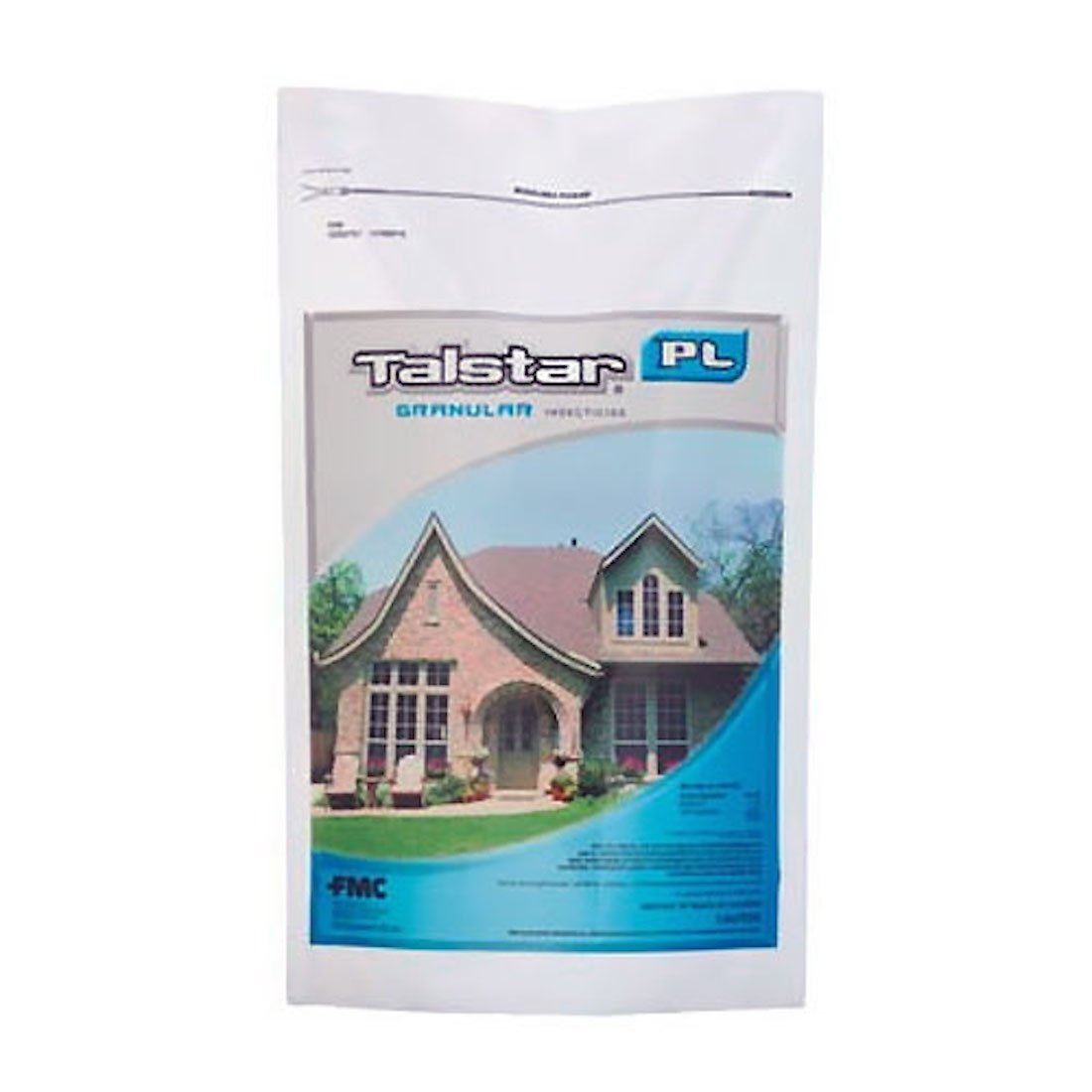
Talstar PL uses bifenthrin in a sand-core granule that penetrates mulch and grass without requiring immediate watering. The manufacturer claims the longest residual of any granule on the market—2 to 4 months—which aligns with user reports of all-season ant suppression including cutter ants. It’s a professional-grade product that delivers where heavy perimeter defense is needed.
Homeowners dealing with ant invasions both inside and out report that it takes about two weeks to fully establish, but once active, the results are dramatic. The dry formulation means you can broadcast it during dry weather without worrying about wash-off. For edging, borders, and cracks, pairing it with the liquid Talstar concentrate gives the best perimeter seal.
If your primary concern is persistent ant, flea, or tick pressure and you want the longest time between applications, Talstar PL is the benchmark. The downsides are that it’s less effective on millipedes and doesn’t kill grubs as well as an imidacloprid systemic.
What works
- Longest residual window (2–4 months)
- No watering required for activation
- Penetrates mulch and dense thatch
What doesn’t
- Not effective against millipedes
- Weak on grubs compared to systemic options
3. DeltaGard Granules 20 lb Bag

DeltaGard uses deltamethrin, a non-repellent pyrethroid that provides excellent control over surface-feeding pests including chinch bugs, ants, spiders, and cockroaches. The application rate is 2 to 3 pounds per 1,000 square feet, making a 20-pound bag cover roughly 10,000 square feet—lower coverage than the BioAdvanced but with a higher concentration of active ingredient per granule for tougher infestations.
User feedback from desert climates like Arizona confirms it eliminates scorpions within days, with owners reporting 9 dead scorpions the first night and gradual reduction over a month. It’s also effective on ant hills when spot-treated with 1 teaspoon per mound. The granular formulation dissolves quickly when watered in, which speeds up the kill.
If you’re battling heavy perimeter invaders like scorpions, large spiders, or chinch bugs in a concentrated area, DeltaGard’s higher granule density per square foot pays off. The trade-off is that the total coverage area is smaller, so you may need two bags for a full acre lot.
What works
- Highly effective scorpions and large spiders
- Fast kill when watered in
- Good ant mound spot treatment
What doesn’t
- Modest coverage (10,000 sq ft per bag)
- Requires water for full activation
4. Bayer Merit 0.5 Granular Systemic Insect Control

Bayer Merit 0.5 G is a systemic insecticide built around imidacloprid, which targets root-feeding pests like white grubs, mole cricket nymphs, and tree borers including emerald ash borer and pine borer. It’s not a contact killer—it works slowly as the plant absorbs the chemical—so you won’t see immediate dead ants on the surface, but the grub population collapses over several weeks.
Users report that it eliminated the soft, spongy spots in their lawn caused by grubs, which in turn discouraged moles from digging. The 30-pound bag is the heaviest in this lineup, providing enough product for multiple applications or large properties. Timing is critical with this product—apply it in late spring or early summer when grub eggs are hatching for maximum efficacy.
If your lawn’s primary problem is grubs, white grubs, or tree borers, Merit is the most targeted systemic you can buy. It’s ineffective against surface feeders like chinch bugs or ants, so pair it with a bifenthrin product if you have mixed pest pressure.
What works
- Targets grubs and tree borers systemically
- Large bag (30 lb) for extended coverage
- Reduces mole activity by removing food source
What doesn’t
- Slow acting—not a contact killer
- Does not control surface-feeding insects
5. Ortho BugClear Lawn Insect Killer 20 lb
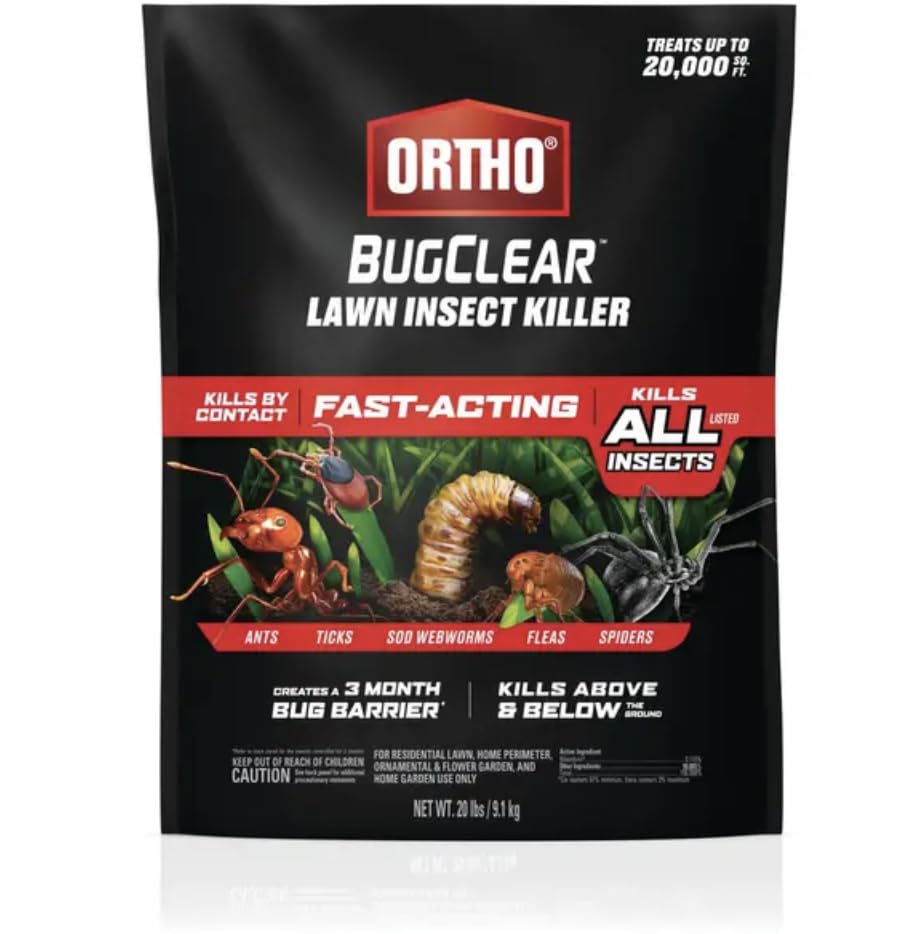
Ortho BugClear covers 20,000 square feet per 20-pound bag and kills a broad list of pests including ants, ticks, armyworms, sod webworms, fleas, and spiders both above and below ground. It’s designed to be fast-acting, with users reporting that swarms of gnats and mosquitos disappeared the day after application. The barrier it creates also keeps bugs from migrating inside the home.
Owners with crane fly infestations saw significant reduction after a single treatment, and those dealing with mole damage found it effective at removing the insect food source, causing moles to leave. In Florida test gardens, it held up against persistent humidity without degrading too quickly. The formula is safe for use on ornamentals, flower beds, and vegetable gardens (on listed vegetables).
If you need a fast-acting granular that covers a mid-sized lot and targets both lawn and perimeter pests, BugClear is a strong mid-range option. Some users report that fleas may develop resistance after repeated use, so rotating with a bifenthrin product is wise if fleas are your primary target.
What works
- Fast contact kill—results visible by next day
- Safe for ornamentals and vegetable gardens
- Effective on crane flies and armyworms
What doesn’t
- Fleas may show reduced efficacy over time
- Requires regular re-application every 2 months
6. Ortho Bug B Gon Max Insect Killer for Lawns

Ortho Bug B Gon Max is a 10-pound bag that treats up to 10,000 square feet and claims to kill over 100 listed insects for up to three months. The label covers lawn, ornamentals, vegetable gardens, flower beds, and home perimeter—making it the most versatile application profile in this group. The active ingredient lambda-cyhalothrin provides strong contact and residual action against ants, chinch bugs, fleas, and ticks.
Long-time users report that it suppresses ant colonies effectively and anecdotally reduces tick pressure on pets over years of use. When applied before heavy rain, the three-month residual may shorten, but in normal conditions it holds up well. The 10-pound bag is smaller than the others, so homeowners with quarter-acre lots typically buy two bags to cover the area fully.
For gardeners who want a single product that handles the lawn, the vegetable rows, and the house perimeter, Bug B Gon Max is the most versatile mid-range pick. The main drawback is that some users report seeing live ants and other insects two weeks after application, suggesting that coverage may need to be heavier in severe infestations.
What works
- Kills over 100 insect species
- Safe for vegetable gardens and flower beds
- Long-term ant colony suppression
What doesn’t
- 10 lb bag covers only 10,000 sq ft
- Some insects may survive if infestation is heavy
7. Sevin Lawn Insect Granules, 20 Pounds

Sevin Lawn Insect Granules (20 pounds) is one of the most recognizable names in home pest control, targeting over 30 listed pests including ticks, fleas, ants, and worms. The label allows use on lawns, ornamentals, and even vegetables (noted on the package), making it a passable entry-level option for light infestations on properties under 5,000 square feet.
Owner feedback is mixed—users report that it worked well when spread thickly around tree bases to stop ants from killing trees, but others say it simply did not work for their specific pest pressure. The carbaryl-based formula is a broad-spectrum insecticide but lacks the residual persistence of bifenthrin or deltamethrin. It’s best for spot treatments or as a first-time prevention rather than a heavy-infestation knockdown.
If you’re on a tight budget and just need a quick hit against visible ants, fleas, or worms in a small area, Sevin gets the job done. For season-long protection of a full lawn, the other options on this list deliver more reliable control with fewer applications.
What works
- Lowest entry cost for a 20 lb bag
- Good for spot treatment around trees
- Familiar brand with easy application
What doesn’t
- Mixed efficacy—some users report no results
- Shorter residual than bifenthrin options
Hardware & Specs Guide
Residual Window
Residual control is the number value you should look at first. Bifenthrin-based products like Talstar PL offer a 2-to-4-month barrier, while imidacloprid systemics like Bayer Merit need to be absorbed by plants and have a slower but longer-lasting soil presence. Products with shorter residuals (like Sevin) require more frequent reapplication and are less effective for season-long prevention.
Application Rate & Coverage
Application rate (pounds per square foot) determines how many bags you need. A product like BioAdvanced Complete covers 25,000 sq ft per 20 lbs—great for large lots. DeltaGard uses a heavier rate (2-3 lbs per 1,000 sq ft), giving higher active density per square foot but lower total coverage. Always compare the per-sq-ft cost, not the bag weight.
Watering-In Requirement
Most granular insecticides need water to break down the granule and release the active ingredient into the soil thatch. Talstar PL is a rare exception—its sand-core structure allows dry activation. Watering-in is not difficult, but if you apply during a drought or forget, a product that requires water may not activate until the next rain.
Target Pest Spectrum
Not all granules kill the same pests. Imidacloprid is specific to grubs, tree borers, and soil-dwelling larvae. Bifenthrin and lambda-cyhalothrin kill surface feeders including chinch bugs, fleas, ticks, ants, and spiders. Deltamethrin covers both but is best for perimeter defense. Match the ingredient to the pest you’ve identified, not the brand name.
FAQ
How do I know if my lawn needs a granular insecticide or a liquid spray?
Can I apply granular bug killer before mowing?
Why does my lawn still have bugs after treatment when my neighbor’s lawn is clean?
Final Thoughts: The Verdict
For most gardeners, the best bug killer for lawn winner is the BioAdvanced Complete Granules because it balances the highest coverage per bag (25,000 sq ft) with season-long control of both above-ground and below-ground pests. If you need the longest possible residual and don’t want to water in the treatment, the Talstar PL Granules is your pick. And for targeted grub and tree borer control, nothing beats the Bayer Merit 0.5 G for systemic protection that stops the damage at the root level.