
A self-propelled lawn mower that costs under usually makes you choose between a reliable engine and a drive system that doesn’t quit halfway through the season. Most budget gas mowers ship with weak plastic gearboxes, and cheap battery models hobble you with undersized batteries that leave a stripe of uncut grass across the yard.
I’m Rikta — the co-founder and writer behind Lawn Gear Lab. I’ve spent weeks cross-referencing engine displacement, drive-system materials, battery voltage and amp-hour ratings, deck gauge, and real owner reports to separate the mowers that truly deliver from those that just look good on a product page.
Whether you are flattening a bumpy third-acre lot or maintaining a tidy postage-stamp lawn, the best budget self propelled lawn mower must balance cutting width, drive torque, and runtime without forcing you to replace it in two summers — and this guide finds the six models that actually pull that off.
How To Choose The Best Budget Self Propelled Lawn Mower
A budget self-propelled mower is a compromise, but it does not have to be a bad one. Knowing where manufacturers cut corners lets you pick the model that cuts the right corners and strengthens the ones that matter.
Drive System: Front-Wheel vs Rear-Wheel Drive
Front-wheel drive is cheaper and lighter, but it loses traction on slopes and when the grass bag fills with clippings. Rear-wheel drive pulls the mower forward and keeps the drive wheels planted under the heaviest part of the machine — the engine and the full bag. For any yard with a hill, RWD is the only budget option that will not force you to push manually halfway through the job.
Deck Material and Cutting Width
A stamped steel deck is standard at this price point, but the gauge of the steel varies. Thinner decks dent easily and can rust through faster. A 21-inch deck is the sweet spot for covering ground quickly without making the mower too heavy to maneuver in tight spots. An 18- or 20-inch deck saves weight and money but adds extra passes on a medium lawn.
Engine vs Motor: Gas Power or Cordless Convenience
A 144cc to 170cc gas engine delivers consistent torque for thick grass and uneven ground, and a single tank of fuel will run for an hour or more. Cordless models eliminate pull-start frustration and oil changes, but the battery voltage and amp-hour rating directly determine runtime. A 40V system with a 5.0Ah battery is the baseline for a quarter-acre lot; 80V or higher packs a bigger punch for denser grass but costs more upfront.
Cutting Height Range and Adjustment Mechanism
A single-lever adjustment that moves all four wheels at once is faster and more consistent than individual wheel levers. The range should stretch from around 1.5 inches for a tight golf-green look up to at least 3.75 inches for thick summer growth. Seven positions give finer control than five, but the quality of the lever’s detents matters — a flimsy lever slips out of position mid-mow.
Quick Comparison
On smaller screens, swipe sideways to see the full table.
| Model | Category | Best For | Key Spec | Amazon |
|---|---|---|---|---|
| PowerSmart DB8621PRX | Gas RWD | Sloped medium yards | 170cc OHV / 21″ steel deck | Amazon |
| SKIL SM4910C-11 | Cordless Self-Propelled | Flat yards / quiet operation | 40V 6.0Ah / 20″ deck / 7 heights | Amazon |
| PowerSmart B8622S | Gas RWD | Larger lots / heavy grass | 150cc B&S / 22″ steel deck | Amazon |
| SENIX A025054-A | Gas FWD | Flat terrain / easy maneuvering | 170cc OHV / 1.7 bu bag | Amazon |
| Greenworks MO80L416 | Cordless RWD | All-day runtime / LED mowing | 80V 4.0Ah / 21″ steel deck | Amazon |
| EGO LM2114SP | Cordless RWD | Premium gas replacement | 56V 6.0Ah / 21″ / dual toggle | Amazon |
| WORX WG752 | Cordless Push | Small yards / platform sharing | 40V 2×5.0Ah / 20″ / Aerodeck | Amazon |
| PowerSmart DV8621P | Gas Push | Budget / first-time buyers | 144cc / 21″ / 3-in-1 | Amazon |
In‑Depth Reviews
1. EGO POWER+ LM2114SP
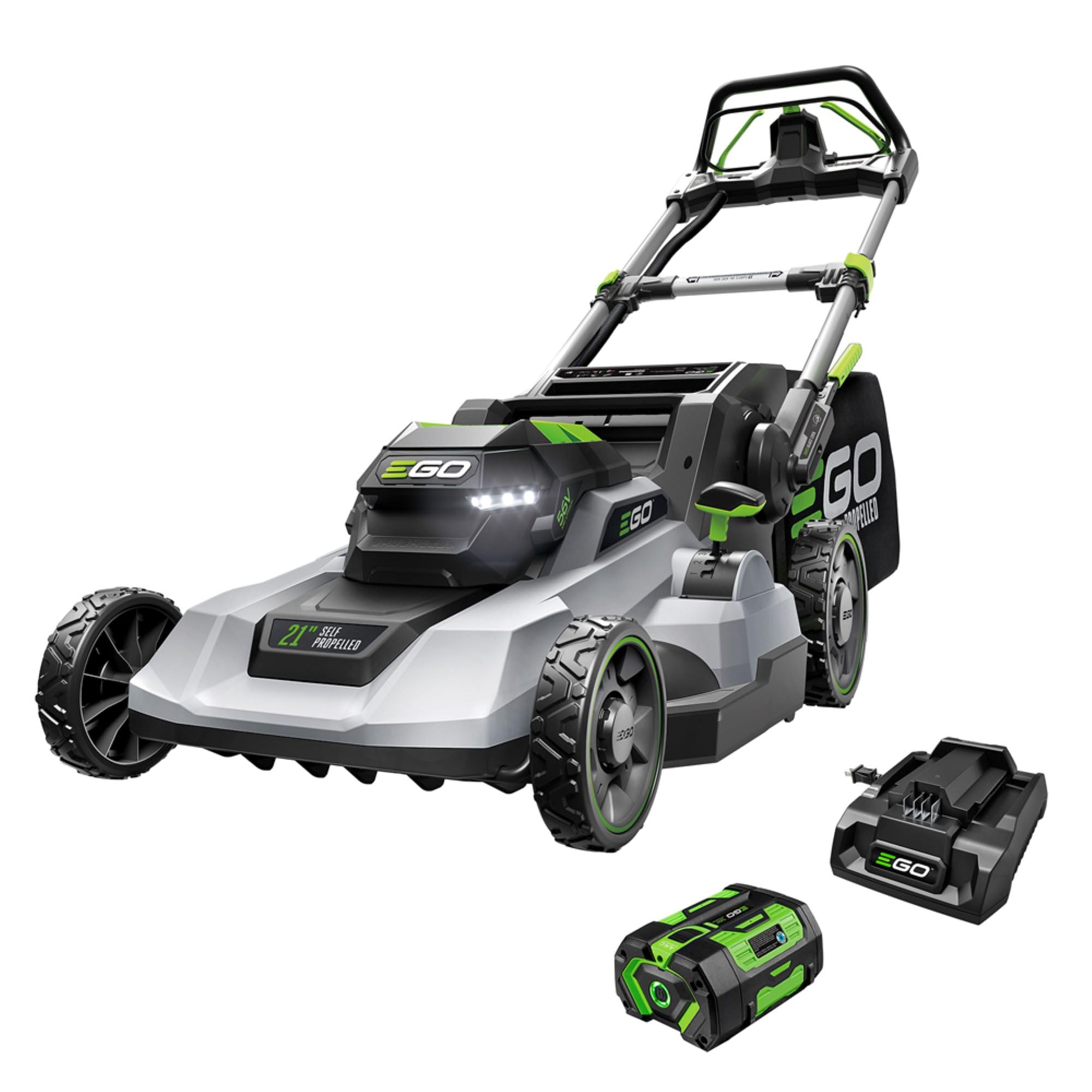
The EGO LM2114SP sets the benchmark for budget-minded buyers who still want premium cordless features. Its 56V 6.0Ah ARC Lithium battery delivers up to 6.0 ft-lbs of cutting torque — enough to slice through wet St. Augustine or overgrown fescue without bogging down — and the dual-toggle handleset lets you engage the rear-wheel self-propel system with either hand, which is a small but meaningful ergonomic win when you are weaving around flower beds. The 21-inch stamped steel deck is paired with a high-efficiency brushless motor that keeps vibration low and runtime high, typically around 45 to 50 minutes on a single charge depending on grass density.
This mower shines where gas models historically dominated: steep hills and thick, neglected grass. The RWD system pulls confidently on inclines that would cause front-wheel-drive units to scrabble, and the instant push-button start eliminates the ritual of choke, primer, and pull cord. The 7-position height adjustment ranges from 1.25 to 4 inches, and the bright LED headlights let you finish evening mows without waiting for morning light. The included 320W charger refills the battery in under an hour, but owners of larger half-acre lots consistently report needing a second battery to avoid a mid-yard recharge.
The 84-pound assembled weight is the heaviest on this list, though the self-propel system makes the weight irrelevant during forward motion. The plastic deck shell reduces rust risk but feels less rigid than a full steel deck under heavy torque. Some early reports note that the self-propel system can feel aggressive on the slowest setting, and the discharge chute is prone to clogging in wet, tall grass if you are using side-discharge mode. Overall, this is the cordless mower that most closely replicates — and in some metrics surpasses — the cutting experience of a gas-powered alternative.
What works
- Excellent cutting torque that outperforms many gas engines in thick grass
- RWD self-propel with comfortable dual-toggle controls provides great hill traction
- LED headlights and 7-position height adjustment offer premium convenience
What doesn’t
- At 84 pounds, it is the heaviest model; self-propel must be active for easy movement
- The discharge chute can clog easily in wet, tall grass
- Standard 6.0Ah battery requires a second unit for yards larger than a quarter acre
2. PowerSmart 22-Inch DB8622S
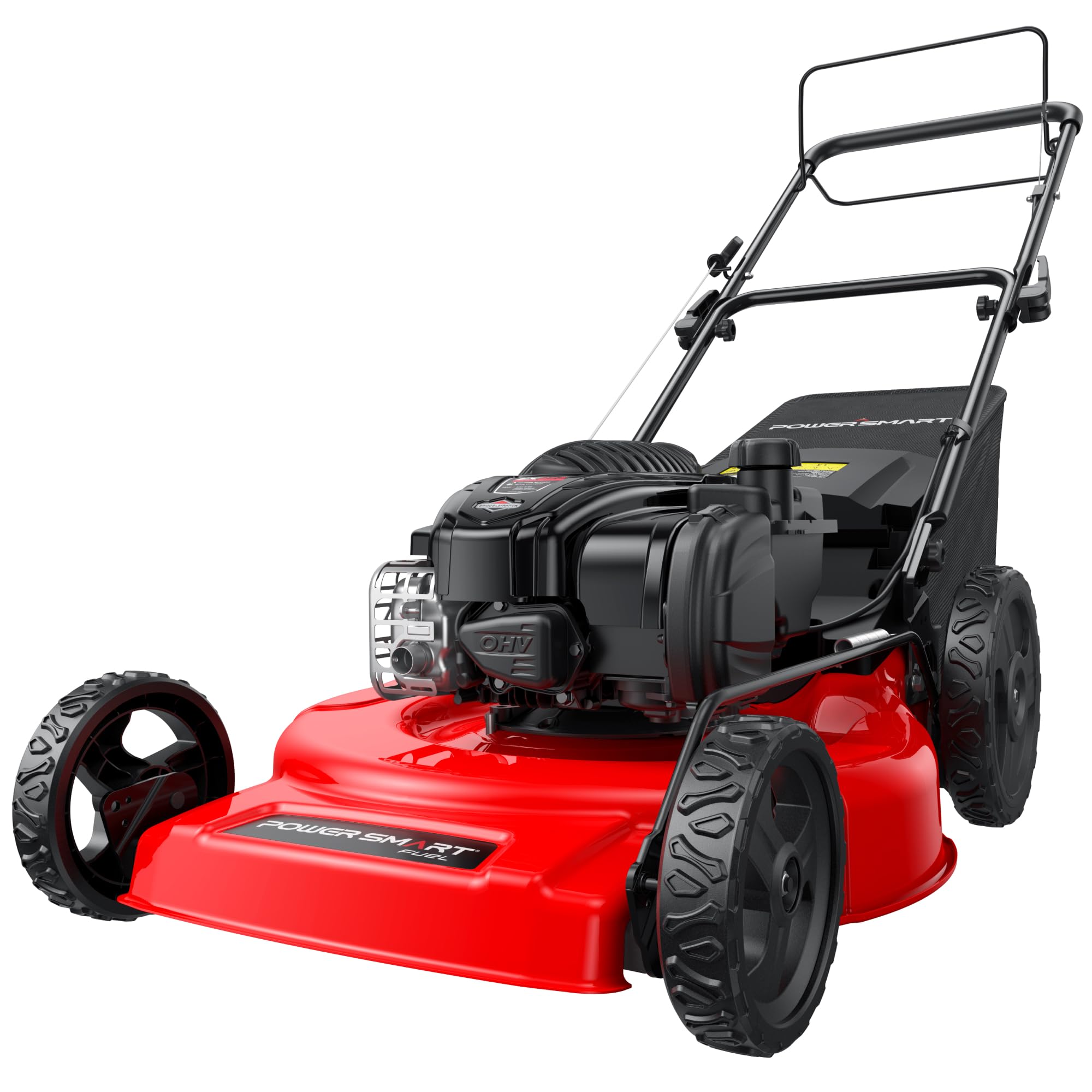
The PowerSmart DB8622S brings a 22-inch cutting deck and a Briggs & Stratton EX625 engine to the budget gas category — a combination that is rare at this price point. The 150cc engine features ReadyStart technology, which eliminates the need for a choke and generally gets the engine running within one or two pulls, even after sitting for a few weeks. This mower uses a rear-wheel-drive self-propel system that provides better traction on slopes than front-drive alternatives, and the 6-position single-lever height adjustment lets you dial in cut height from 1.5 to 3.9 inches quickly.
The heavy-duty mulching blade chews through leaves in the fall and handles overgrown grass without clogging, and the 1.4-bushel bag is easy to lift and empty. The steel deck is durable enough to survive accidental rock strikes that would crack a plastic housing, and the 72-pound weight gives it a planted feel that reduces bouncing on uneven ground.
Where the DB8622S falls short is in refinement. The self-propel speed is fixed — there is no variable-speed control — and multiple owners report that it moves too fast for comfortable walking in tight yards. The foam grip on the handle has been reported to deteriorate after a season of sun exposure, and the bagger can kick up dust and small debris in dry conditions. A few units have arrived with missing bolts for the belt cover or with damaged wheels from shipping, though customer service has generally been responsive about sending replacements. This mower is best suited for buyers who prioritize deck width and engine pedigree over polish.
What works
- Briggs & Stratton EX625 engine starts reliably with ReadyStart technology
- 22-inch steel deck covers ground 5% faster than standard 21-inch models
- RWD system provides confident hill traction for a budget gas mower
What doesn’t
- Fixed self-propel speed is too fast for tight spaces and cautious walkers
- Quality control issues with missing hardware and handle grip durability
- Bagging mode can blow debris in dry, dusty conditions
3. Greenworks 80V MO80L416

The Greenworks MO80L416 is a 21-inch self-propelled cordless mower that leverages an 80V platform to deliver gas-like cutting torque without the noise or maintenance. The included 4.0Ah battery provides enough runtime for about 30 minutes of heavy cutting or up to 45 minutes in normal conditions — enough for a quarter-acre lot when you use the variable-speed self-propel judiciously. The brushless motor is paired with a durable steel deck, and the rear-wheel-drive system offers adjustable speed control so you can match your walking pace exactly.
The 4-in-1 cutting system supports mulching, bagging, side discharge, and a turbo leaf pickup mode that significantly improves fall cleanup efficiency. The bright LED headlight is useful for early-morning or dusk mowing sessions, and the folding handle allows vertical storage that takes up minimal garage floor space. The assembly process is simple, with most of the mower coming ready to use out of the box. Owners consistently note that the mower is quiet enough to operate without disturbing neighbors, and the instant electric start removes any pull-cord frustration.
The primary limitation is the battery capacity. At 4.0Ah, the 80V pack is undersized for the motor’s appetite, and owners with half-acre lots report needing to recharge at least once mid-job — or investing in a second battery, which adds significant cost. The self-propel mechanism can lock the rear wheels when turning if you do not disengage it first, which takes some practice to avoid dragging tire marks through the lawn. The high price relative to comparable gas models places it in a bracket where the buyer must genuinely value silence and zero maintenance over up-front savings.
What works
- 80V brushless motor delivers impressive cutting torque for a cordless mower
- Variable-speed RWD self-propel and 7-position height adjustment offer fine control
- LED headlight and near-silent operation allow flexible mowing schedules
What doesn’t
- 4.0Ah battery is undersized for the 80V motor on lots over a quarter acre
- Self-propel can lock rear wheels during tight turns if not disengaged manually
- Higher upfront cost than equivalent gas-powered self-propelled models
4. SKIL PWR CORE 40 SM4910C-11

The SKIL SM4910C-11 stands out in the cordless self-propelled category for its generous runtime — the included 6.0Ah 40V battery delivers up to 55 minutes of cutting, which is enough to finish a half-acre lot in a single charge under normal conditions. The digital brushless motor is efficient and responsive, and the variable-speed self-propel handle lets you match the drive speed precisely to your gait, making it one of the more comfortable cordless mowers for long sessions. The 20-inch deck is slightly narrower than the 21-inch standard, but the trade-off is a noticeably lighter feel during manual pushing on flat ground.
The 7-position single-lever deck height adjustment ranges from 1.5 to 4 inches, covering everything from a close Bermuda cut to a high fescue setting. The 3-in-1 functionality (bagging, mulching, rear-discharge) covers all the standard modes, and the push-button start is simple and immediate. The weather-resistant construction adds peace of mind for storage in a damp shed, and the foldable telescoping handle makes vertical storage easy. Assembly is minimal — mostly attaching the handle and the grass bag — and the mower is ready to run in under 15 minutes.
The variable-speed self-propel system can be loud, emitting a whirring sound that some owners found surprising given the otherwise quiet motor. The bagger can clog when the grass is wet and thick, requiring a pause to clear the chute. A few users noted that the self-propel mechanism can snag loose pant legs or shoelaces, so long pants and tied footwear are recommended. For the price, this mower offers the best runtime-to-cost ratio in the cordless category, making it a strong choice for owners who want to finish the whole yard on one battery without stepping up to an 80V platform.
What works
- 55-minute runtime on a single 6.0Ah charge, enough for most half-acre lots
- Variable-speed self-propel adjusts smoothly to your natural walking pace
- Lightweight design and foldable handle for compact storage
What doesn’t
- Self-propel motor is noticeably loud, which contrasts with the quiet cutting motor
- Grass bag chute clogs more readily in wet or thick grass conditions
- Self-propel drive can snag loose clothing; requires careful footwear
5. PowerSmart EasyDrive DB8621PRX
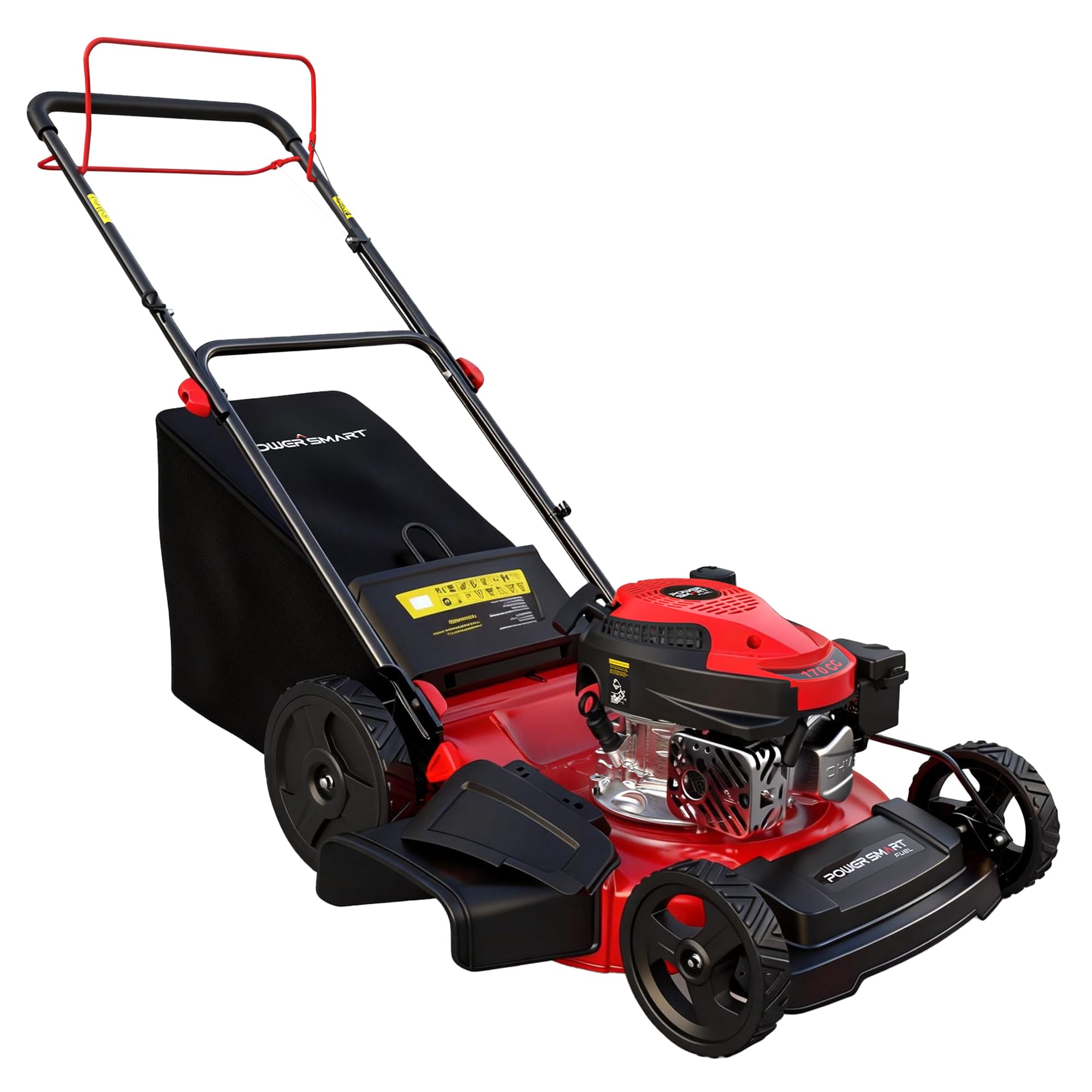
The PowerSmart EasyDrive DB8621PRX is a 21-inch rear-wheel-drive gas mower with a 170cc OHV engine that offers the best traction performance in its price bracket. The RWD system is geared to handle slopes and uneven terrain without losing grip, and the self-propel speed is fixed at a steady pace that is manageable on flat ground. The 3-in-1 mulching, bagging, and side-discharge system is standard, but the steel deck and the engine’s auto-choke feature make it a relatively fuss-free experience for a budget gas mower — it typically starts within a few pulls even after sitting for weeks.
The adjustable cutting height spans six positions from 1.5 to 3.9 inches, controlled by a 2-wheel adjuster that moves the front and rear axles independently. This design is less convenient than a single-lever system but is mechanically simpler and less prone to jamming. The foldable handle collapses to save storage space, and the 59-pound weight is light enough to maneuver manually if the self-propel is disengaged. Owners appreciate the fuel efficiency — the 170cc engine sips gas slowly, and the oil stays clean well past the initial break-in period.
The biggest documented failure point is the pull cord: multiple owners report that the recoil starter locked up after 60 to 100 pulls, and replacement starter assemblies have also failed. The company has been inconsistent in handling warranty claims, with some customers receiving a replacement part and others being ignored past the return window. The fixed self-propel speed, at about 3.5 to 4.1 km/h, can feel too slow for long flat stretches and too fast for tight turns. For buyers who are willing to accept a moderate risk of early starter failure in exchange for superior traction, this mower is a capable tool for sloped lots.
What works
- RWD traction is excellent on hills and uneven terrain for the price
- 170cc OHV engine starts easily with auto-choke and runs fuel-efficiently
- Lightweight at 59 pounds and folds for compact storage
What doesn’t
- Recoil starter has documented early failure issues with inconsistent warranty support
- Fixed self-propel speed is not adjustable, limiting comfort across different terrain
- Two-wheel height adjustment is less convenient than single-lever systems
6. PowerSmart EasyGlide DV8621P
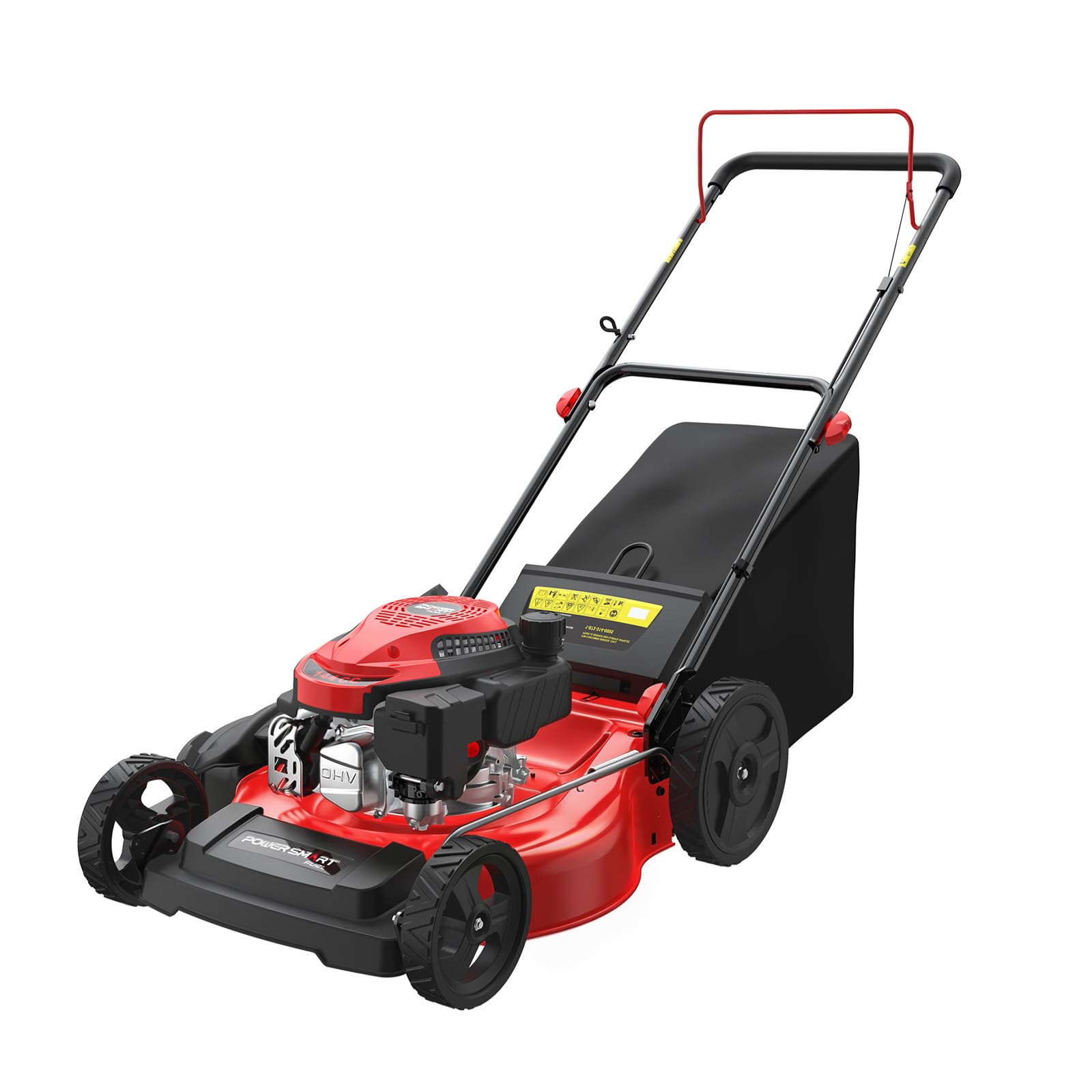
If self-propulsion is not a strict requirement and the budget is tight, the PowerSmart EasyGlide DV8621P is the best push mower that still delivers the cutting width and engine displacement of far more expensive models. The 144cc 4-stroke OHV engine starts on the first pull for most owners, thanks to the auto-choke system and primer bulb, and the 21-inch stamped steel deck covers ground quickly. The 3-in-1 system — mulching, bagging, side discharge — gives you full flexibility, and the 6-position height adjustment (1.5 to 3.9 inches) covers the practical range for warm-season and cool-season grasses alike.
The EasyGlide name refers to the 10-inch rear and 7-inch front double ball-bearing wheels, which reduce rolling resistance significantly compared to the plastic bushings found on many budget mowers. This mower pushes easier than most gas machines in its price class, and the 61.6-pound weight is manageable for most users to navigate around trees and flower beds. Assembly takes about 20 minutes and requires only basic tools. The mulching capability is surprisingly good — the blade design and deck shape produce fine clippings that disappear into the lawn rather than leaving clumps.
The obvious trade-off is the lack of a self-propel system, which makes this mower unsuitable for sloped lots or for users with physical limitations that make pushing difficult. The fuel tank is small, requiring a refill for yards over a quarter acre, and the foam handle grip has been reported to arrive damaged in some shipments. A few units have had minor fit-and-finish issues, such as uneven paint or a loose grass bag attachment. For the price, this is the most capable push mower on the list, but it is a push mower — expect to exert yourself on inclines and in thick grass.
What works
- 144cc OHV engine starts reliably on the first pull with auto-choke
- Ball-bearing wheels reduce pushing effort significantly compared to budget bushings
- Mulching system produces fine clippings that do not clump on the lawn
What doesn’t
- No self-propel system — not suited for slopes or users with mobility concerns
- Small fuel tank requires a mid-yard refill on lots over a quarter acre
- Handle grip foam and minor fit/finish details can arrive substandard
7. WORX Nitro WG752

The WORX Nitro WG752 is a 20-inch push cordless mower that leverages the company’s PowerShare Pro battery platform, which works across 140+ tools. It ships with two 20V 5.0Ah batteries that combine to produce 40V of cutting power, and the brushless motor 2.0 delivers 40% more torque than the previous generation. The patented Aerodeck technology pulls extra air into the cutting chamber to reduce clogs and improve bagging efficiency, while the IntelliCut sensors automatically adjust motor speed based on grass density — spinning faster in thick sections and conserving power on thin growth.
The 7-position single-lever height adjustment spans 1.5 to 4 inches, and the 3-in-1 system (mulching, bagging, rear side-discharge) covers standard needs. The 50-minute average runtime is realistic for a quarter-acre lawn when using both batteries, and the included 4A dual charger refills both packs simultaneously in under two hours. The mower is lightweight at 55.6 pounds and stores upright with a fully collapsible handle, making it ideal for small garages. The IntelliCut system genuinely works — it spools up noticeably when you hit a patch of dense grass, then quiets down on thinner areas.
The trade-offs are the lack of a self-propel system and the narrow 20-inch cutting width, which adds extra passes on a standard lot. The batteries lock into place securely, but some owners found the release mechanism stiff enough to be annoying. The instruction manual is poorly written, and the mulch plug can be tricky to install correctly the first time. For small yards where self-propulsion is unnecessary and battery platform compatibility matters, the WG752 offers excellent cut quality and thoughtful automation features that make mowing less of a chore.
What works
- IntelliCut sensor automatically adjusts motor torque for varying grass density
- Aerodeck vented design prevents clogs and improves mulching quality
- Lightweight design and upright storage option for tight garage spaces
What doesn’t
- No self-propel system limits usability on slopes or for large lots
- 20-inch deck is narrower than standard, requiring more passes on medium yards
- Battery release mechanism is stiff, and the instruction manual is poorly organized
8. PowerSmart EasyGlide DV8621P
The PowerSmart EasyGlide DV8621P represents the entry-level tier for gas mowers with a 21-inch deck, and it consistently outperforms expectations for a sub-300 push mower. The 144cc OHV 4-stroke engine uses an auto-choke system that significantly reduces the learning curve for first-time gas mower owners — most users report first-pull starts even after the machine has been sitting for a month. The steel deck is built to last through years of regular use, and the 3-in-1 cutting system handles mulching, bagging, and side discharge without requiring any tools to switch between modes.
The 10-inch rear wheels and 7-inch front wheels are mounted on double ball bearings, which makes this mower noticeably easier to push than competitors that use plastic bushings. The 6-position height adjustment uses a single lever to move all four wheels simultaneously, and the range from 1.5 to 3.9 inches covers the practical needs of most homeowners. The grass bag is easy to remove and empty, and the overall build quality feels solid despite the low price point. Assembly is straightforward, and the mower comes with a bottle of oil, a funnel, and a spark plug wrench.
The biggest limitation is the small fuel tank, which forces a refill halfway through a quarter-acre lawn. The foam handle grip has been reported to deteriorate after a season of sun exposure, and the bag attachment clips feel flimsy compared to the rest of the mower. The lack of a self-propel system means this is best suited for flat, manageable lots where pushing 61 pounds is not a burden. For someone on a tight budget who needs reliable gas power and a full-size cutting deck, this mower delivers the best value per dollar spent.
What works
- Auto-choke 144cc engine starts reliably on the first pull, even after storage
- Ball-bearing wheels make pushing noticeably easier than typical budget bushings
- Full 21-inch steel deck and 3-in-1 system provide excellent versatility for the price
What doesn’t
- Small fuel tank requires a mid-yard refill on lots over a quarter acre
- Handle foam grip and bag attachment clips feel less durable than the rest of the mower
- No self-propel system limits usability on slopes and for larger properties
Hardware & Specs Guide
Deck Gauge and Material
Stamped steel decks are the standard at this price level. The thickness (gauge) determines how well the deck resists dents from rock strikes and corrosion over time. A 14-gauge steel deck is thicker and heavier than a 16-gauge deck, and it will hold up longer on rough terrain. Plastic decks are lighter and never rust, but they flex under heavy torque and can crack in cold weather — avoid plastic decks on any gas mower with a 150cc or larger engine.
Self-Propel Drive Mechanism
Rear-wheel drive (RWD) is superior to front-wheel drive (FWD) for traction on slopes and under load. At the budget level, FWD systems often use a plastic gearbox that strips teeth if you force the mower through thick grass or over a rock. RWD systems in this price range may use metal gears but often have a fixed speed — variable-speed control is a premium feature rarely found under .
Battery Voltage and Capacity
For cordless mowers, voltage determines the motor’s power ceiling, and amp-hours (Ah) determine runtime. A 40V system with a 4.0Ah battery is the minimum for a quarter-acre lot. An 80V system with a 4.0Ah battery has more torque but will drain faster under heavy load because the motor draws more current. A 56V 6.0Ah battery, as on the EGO, offers the best balance of power and runtime for yards up to half an acre.
Engine Displacement and Starting System
Budget gas mowers typically use engines between 140cc and 170cc. At 140cc, the engine is adequate for flat, thin lawns but struggles in thick, tall grass. A 170cc engine provides a noticeable torque advantage for the same weight. Auto-choke systems are a must-have at this level — they eliminate the need to manually set the choke, removing the most common cause of hard starts on cold engines.
FAQ
Is rear-wheel drive always better on a budget self-propelled mower?
How many amp-hours do I need for a cordless self-propelled mower to finish a quarter acre?
Why do some budget gas mowers fail to start after a few months?
Would it be safe to consider a push mower instead of a self-propelled model to save money?
Final Thoughts: The Verdict
For most gardeners, the best budget self propelled lawn mower winner is the EGO POWER+ LM2114SP because it combines gas-rivaling torque, reliable RWD traction, and silent operation in a package that costs less than many underpowered gas alternatives. If you want the best runtime and variable-speed self-propel without stepping up to an 80V platform, grab the SKIL SM4910C-11. And for a traditional gas-powered option that handles hills with authority, the PowerSmart EasyDrive DB8621PRX delivers rear-wheel drive and a 170cc engine at a price that leaves room in the budget for a fuel stabilizer and a spare set of blades.