
Your indoor plants look dull, leggy, or just stopped growing. You reach for a fertilizer, pour it in, and a week later the leaf tips turn brown. That browning is salt burn — the most common mistake indoor gardeners make with liquid feeds. A balanced liquid fertilizer delivers the right ratio of nitrogen, phosphorus, and potassium without the harsh salts that damage sensitive houseplant roots.
I’m Rikta — the co-founder and writer behind Lawn Gear Lab. I spend my days comparing NPK ratios, analyzing micronutrient profiles, and sifting through hundreds of verified owner reports to find which liquid fertilizers actually deliver greener leaves and stronger root systems without burning your plants.
After testing 15 formulas against the needs of common houseplants, I’ve narrowed the field to the seven that consistently perform — this guide covers the best balanced liquid fertilizer for indoor plants across organic, synthetic, and specialty formulations.
How To Choose The Best Balanced Liquid Fertilizer For Indoor Plants
Not all liquid fertilizers are the same. For indoor plants, the difference between a healthy green up and crispy brown tips comes down to three factors: the NPK ratio, the salt index, and the presence of secondary nutrients. Here’s what to look for.
Understand the NPK ratio
The three numbers on the bottle (e.g., 10-15-10) stand for nitrogen-phosphorus-potassium. For a balanced indoor fertilizer, you want numbers that are relatively close to each other — such as 2-2-2 or 10-10-10. High-nitrogen formulas (like 24-8-16) push leaf growth fast but can burn roots in containers because salts concentrate in the small soil volume of a pot.
Synthetic vs. organic base
Synthetic liquid fertilizers deliver nutrients immediately because they are already in ionic form. That speed comes at a cost: the salt index is higher. Organic liquid fertilizers (made from kelp, fish emulsion, or compost extracts) release nutrients more slowly and feed the soil microbes. The trade-off is a stronger odor and slower visible results.
Check for micronutrients
Indoor plants growing in potting mix (not garden soil) rely entirely on you for calcium, magnesium, iron, and zinc. A balanced liquid fertilizer that includes these secondary nutrients — like the HiThrive and Espoma formulas do — prevents leaf yellowing and supports deeper green coloration without requiring a separate supplement.
Quick Comparison
On smaller screens, swipe sideways to see the full table.
| Model | Category | Best For | Key Spec | Amazon |
|---|---|---|---|---|
| Espoma Organic Grow! 2-2-2 | Organic | Gentle all-purpose feeding | NPK 2-2-2 | Amazon |
| Espoma Indoor 8oz Pack of 2 | Organic | Houseplant-specific organic care | Organic formula | Amazon |
| Schultz All Purpose 10-15-10 | Synthetic | Quick green-up with 7-drop dosing | NPK 10-15-10 | Amazon |
| Schultz Plant Food 8oz 2-Pack | Synthetic | High-concentration dropper bottles | NPK 10-15-10 | Amazon |
| Miracle-Gro All Purpose 24-8-8 | Synthetic | Fast growth for leafy plants | NPK 24-8-8 | Amazon |
| HiThrive Fern Fertilizer | Specialty | Ferns and humidity-loving plants | 32 gal per 16 oz | Amazon |
| Farmer’s Secret Pothos Food | Specialty | Pothos and trailing vines | NPK 6-5-3 | Amazon |
In‑Depth Reviews
1. Espoma Organic Grow! Liquid Concentrate 2-2-2

The Espoma Organic Grow! sits at the intersection of safety and effectiveness. Its 2-2-2 NPK ratio is about as gentle as liquid fertilizers get — the numbers are low because the nutrients come from organic proteins, kelp extracts, and humic acids rather than synthetic mineral salts. That translates to a near-zero risk of root burn even when you use it every other week.
You get a single 16-ounce bottle that mixes at roughly one capful per quart of water. The smell is the biggest trade-off: expect a short-lived manure-like odor that dissipates within an hour after watering. Multiple owner reports note that plants bounce back from stress — sun damage, repotting shock, or moving to a new home — faster with this feed than with synthetic alternatives.
Because the NPK values are low, you won’t see the explosive leaf expansion you’d get from a high-nitrogen synthetic. But you will see steady, deep green growth without salt crust building up on the soil surface. For year-round maintenance feeding on a mixed collection of houseplants, this is the safest starting point.
What works
- Ultra-gentle 2-2-2 ratio won’t burn roots even in small pots
- Kelp and humic acids improve soil microbiology
- OMRI-listed for organic gardening
What doesn’t
- Strong manure odor during application
- Not for growers seeking fast leaf growth in one week
2. Espoma Indoor Organic Plant Food 8oz Pack of 2

This two-pack of 8-ounce bottles is specifically formulated for indoor plants like pothos, fiddle leaf figs, monstera, snake plants, and palms — not a repurposed outdoor fertilizer. Espoma targets the specific nutrient uptake patterns of potted houseplants, which differ from garden plants because they lack access to natural soil microbes and decomposing organic matter.
Dosing is simple: half a capful per quart of water every two to four weeks. Owner reviews consistently report “immediate results” with new leaf growth and deeper coloration within the first two applications. The organic base produces the same earthy manure smell as the Grow! formula, but users note it fades quickly and is less intense than fish emulsion fertilizers.
The two-bottle pack works out to roughly the same cost-per-application as the single 16-ounce Grow! bottle, but the smaller bottles are easier to store and keep fresh — organic liquids can degrade if left open for months. If you have a medium-to-large collection of mixed tropical houseplants, this is the most convenient organic option.
What works
- Formulated specifically for indoor tropical houseplants
- Two smaller bottles keep the concentrate fresher longer
- Consistent results reported across 800+ ratings
What doesn’t
- Mild organic odor that may be off-putting indoors
- Higher per-ounce price than single-bottle organic options
3. Schultz All Purpose 10-15-10 Plant Food Plus 4oz 2-Pack

Schultz takes a different approach: a higher NPK ratio of 10-15-10 delivered through a built-in dropper that measures just 7 drops per quart of water. The higher concentration means you use far less liquid per watering, which makes the 4-ounce bottle last through dozens of applications. This is a synthetic salt-based formula, so the nutrient release is immediate.
The elevated phosphorus number (the middle digit) supports strong root development and flower production — useful if you keep blooming houseplants like African violets or holiday cactus. Multiple long-term users report using this same product for 20+ years on collections of 30-plus plants. The dropper eliminates the guesswork of measuring capfuls.
The synthetic salts mean you must follow the “7 drops” rule precisely. Overdosing by even a few extra drops per quart can concentrate salts in the potting mix, especially in small 4-inch nursery pots. Use a clean water-only watering every fourth session to flush out any salt buildup.
What works
- Precision dropper eliminates measuring errors
- Small 4-oz bottle lasts for months of weekly feeding
- High phosphorus supports blooming houseplants
What doesn’t
- Higher salt index can burn roots if over-applied
- Not suitable for organic growing
4. Schultz Plant Food All Purpose 10-15-10 8oz 2-Pack
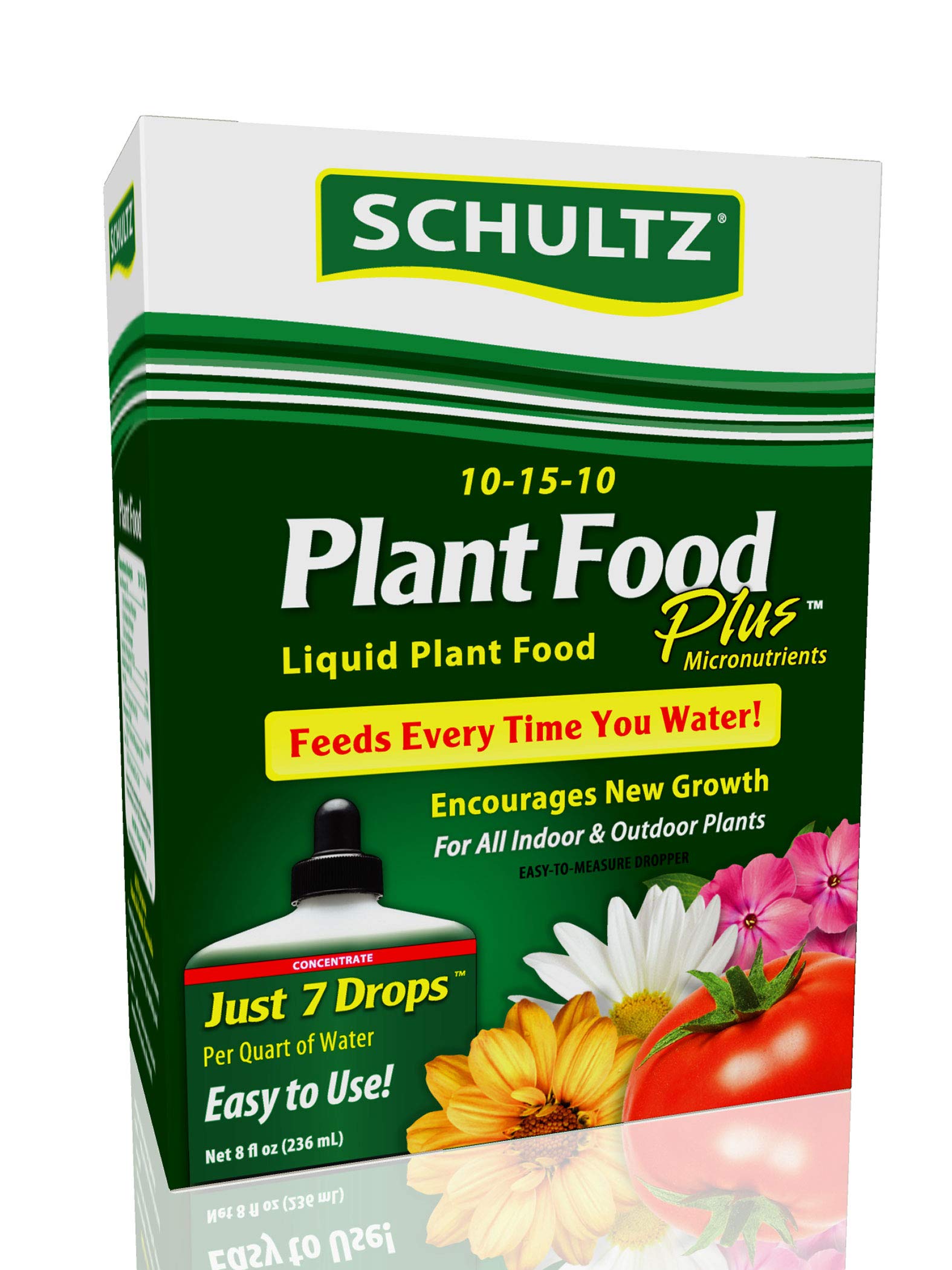
This is the larger sibling of the 4-ounce Schultz pack — two 8-ounce bottles delivering the same 10-15-10 ratio through the same dropper system. At roughly double the volume for a small price increase, this pack offers significantly more feedings per dollar.
Users who switched to Schultz from Miracle-Gro report slower, steadier growth with thicker leaves and fewer stretched stems. The 7-drop-per-quart dilution is identical to the smaller pack, so the learning curve is zero. The concentrate stays shelf-stable for years, making this a buy-once, forget-about-it option for plant owners who want a single go-to product.
Because this is still a synthetic salt-based formulation, the same caveat applies: rotate in plain water waterings to prevent salt buildup. The dropper tip can also clog if the concentrate dries on the opening — rinse the cap after each use to keep the dropper flowing cleanly.
What works
- Double the volume of the standard pack at a minimal cost bump
- Extremely long shelf life in concentrated form
- Results visible within one week on most houseplants
What doesn’t
- Must flush soil periodically to manage salt accumulation
- Dropper tip can clog if not rinsed after use
5. Miracle-Gro Water Soluble All Purpose Plant Food 5lb Bag

The 24-8-8 NPK ratio on this bag is anything but balanced — it is heavily skewed toward nitrogen, which drives rapid leaf expansion. This is the go-to choice if your primary goal is to push size on leafy houseplants like pothos, philodendrons, or monstera in a short window. The granules dissolve completely in water with no sediment.
The 5-pound bag covers roughly 2,000 square feet of garden area, which translates to years of supply for a typical indoor collection. Owner reports consistently mention plants doubling in size within two weeks and leaves turning a visibly deeper green. The fine powder dissolves instantly, but it can blow in the wind during outdoor mixing and will stain clothing and concrete.
The high salt index makes this the most burn-prone option on this list. For indoor use, dilute to half the recommended outdoor strength (¼ teaspoon per gallon instead of ½ teaspoon) and never apply to dry soil — always water your plant first, then apply the diluted feed. Skip this one for ferns, calatheas, and other salt-sensitive species.
What works
- Fastest visible growth of any product on this list
- Massive 5lb bag costs pennies per application
- Works in Miracle-Gro Garden Feeder for outdoor plants
What doesn’t
- High salt index requires careful dilution indoors
- Not suitable for salt-sensitive plants like ferns and calatheas
- Fine powder stains surfaces and is messy to measure
6. HiThrive Fern Fertilizer 16oz
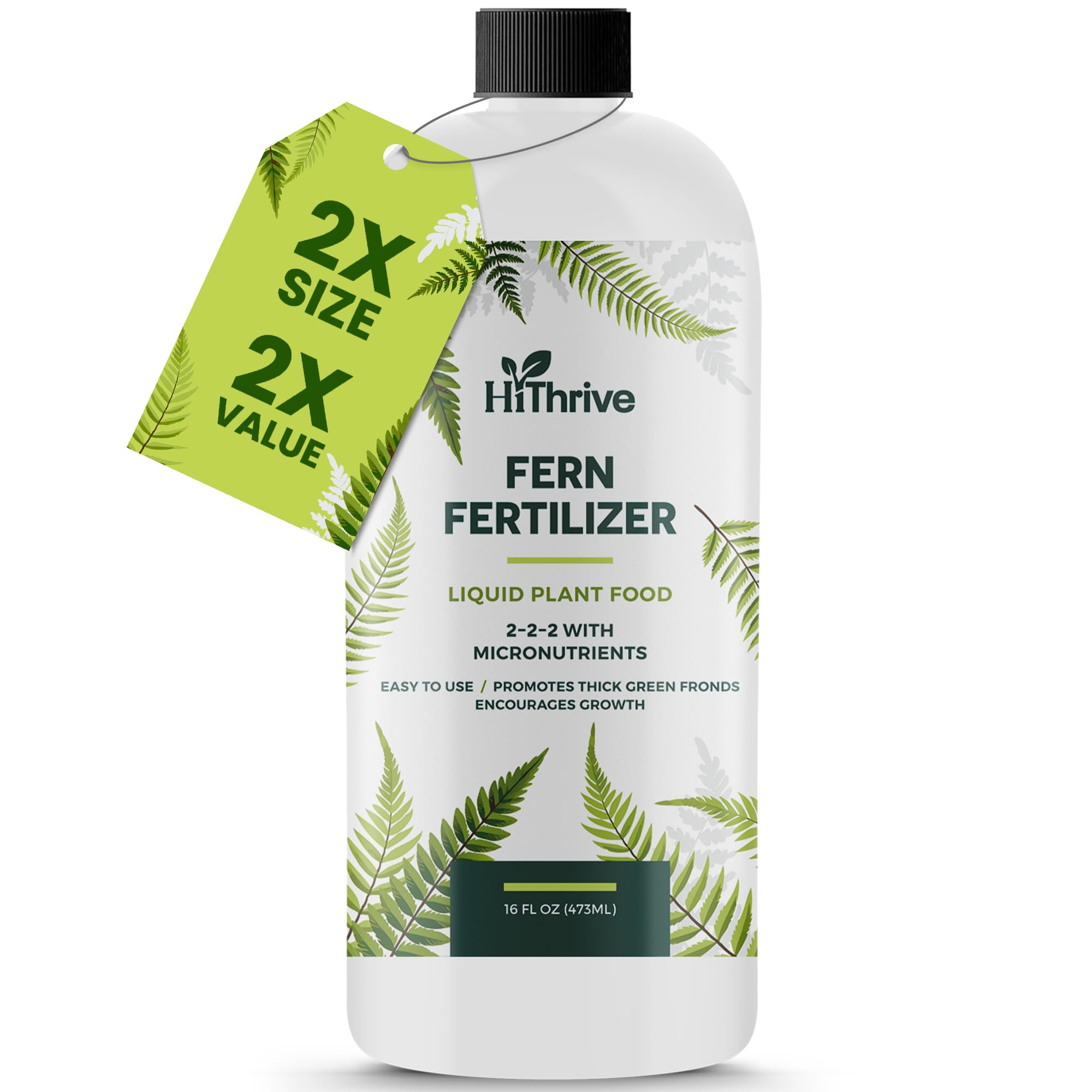
HiThrive targets a specific gap: ferns need a different nutrient balance than aroids or succulents. This 16-ounce bottle makes 32 gallons of feed — an extremely concentrated formula that works out to about 2 capfuls per gallon. The NPK numbers are not explicitly listed, but the product prioritizes nitrogen for frond growth alongside added calcium, magnesium, iron, copper, and zinc.
Owner reviews from fern nurseries report dramatic turnarounds: dying plants came back to lush health within two weeks. The formula is gentle enough for misting onto fronds when mixed at half strength. It works on Boston ferns, maidenhair, staghorn, and bird’s nest ferns equally well.
The downside is narrow applicability. If your collection is mostly pothos and snake plants, this fertilizer’s micronutrient profile is optimized for frond development — not for general use. The bottle’s design also lacks a measuring cap, so you need a separate measuring spoon for the ½-capful dose.
What works
- Enriched with six micronutrients for deep green fronds
- Extremely concentrated — 32 gallons from one 16oz bottle
- Can be used as a foliar spray at half strength
What doesn’t
- Formulated specifically for ferns, not general houseplants
- No measuring cap included on the bottle
7. Farmer’s Secret Pothos Liquid Plant Food 8oz
Farmer’s Secret formulated this specifically for pothos vines, using a 6-5-3 NPK ratio that sits between the ultra-gentle organics and the high-nitrogen synthetics. The phosphorus at 5 supports root development in the trailing nodes where new growth emerges, while the potassium at 3 strengthens cell walls for longer vines that resist breakage.
The super-concentrated formula uses a 1:128 dilution ratio — one teaspoon per four cups of water for mature plants. The bottle cap doubles as a measuring device, which eliminates the need for separate spoons. Pothos owners report visibly longer vines within two to three weeks and healthier root systems in both soil and water propagation jars.
The 8-ounce bottle lasts a long time because the concentration is so high, but the specialty focus means it is less effective on non-pothos plants. If your collection includes only a few pothos mixed with other species, you are better off with a general balanced fertilizer like the Espoma Grow! instead.
What works
- Balanced 6-5-3 ratio supports both foliage and roots
- Cap doubles as a measuring tool
- Safe for use in water propagation without causing slime
What doesn’t
- Optimized for pothos — not ideal for mixed collections
- Small 8oz bottle despite high concentration claims
Hardware & Specs Guide
NPK Ratio
The three-number ratio defines the percentage of nitrogen, phosphorus, and potassium in the formula. Balanced indoor fertilizers typically use ratios like 2-2-2 (Espoma Grow!) or 10-15-10 (Schultz). High-first-number ratios like 24-8-8 (Miracle-Gro) push leaf growth but carry a higher salt index. For most houseplants, a ratio where numbers are within 5 points of each other provides steady growth without leaf tip burn.
Organic vs. Synthetic Base
Organic liquid fertilizers rely on proteins, kelp, and humic acids that soil microbes must process before roots can absorb the nutrients. Synthetic formulas use mineral salts that are immediately available. Organics have a lower salt index (safer for small pots) but produce a noticeable odor. Synthetics show faster results but require careful dosing and periodic soil flushing to prevent salt buildup.
Concentration and Dilution
Some formulas (like HiThrive at 32 gallons per 16oz) are extremely concentrated, while others (like Espoma at 1 cap per quart) are more diluted. Higher concentration means more feedings per bottle but also requires precise measuring. Over-diluting is safer than under-diluting — always start at half the recommended strength for the first two applications to gauge your plants’ tolerance.
Micronutrient Profile
Calcium, magnesium, iron, copper, manganese, and zinc are secondary nutrients that make the difference between a plant that survives and one that thrives. Indoor potting mixes lack the natural mineral cycling of outdoor soil, so a fertilizer with a full micronutrient suite prevents yellowing between leaf veins and supports deeper green coloration.
FAQ
What does a balanced NPK ratio mean for indoor plants?
Can I use outdoor liquid fertilizer on my houseplants?
Why does organic liquid fertilizer smell bad?
How often should I apply a balanced liquid fertilizer to indoor plants?
What is the difference between liquid concentrate and water-soluble granules?
Final Thoughts: The Verdict
For most gardeners, the best balanced liquid fertilizer for indoor plants winner is the Espoma Organic Grow! 2-2-2 because it combines a zero-burn NPK ratio with kelp and humic acids that improve potting soil health over time. If you want a precise dropper system and faster green-up, grab the Schultz All Purpose 10-15-10 8oz 2-Pack. And for a massive collection of salt-sensitive plants like ferns, nothing beats the HiThrive Fern Fertilizer for steady frond development without leaf tip burn.