
A backpack sprayer transforms how you treat a large lawn, but the difference between a productive session and a frustrating afternoon often comes down to a single lever action: the pump. A poorly designed manual pump forces constant stops to repressurize, while an underpowered battery unit can leave you stranded halfway across the property. The real question isn’t just capacity or price—it’s whether the sprayer keeps up with the sustained effort a full acre demands.
I’m Rikta — the founder and writer behind Lawn Gear Lab. My perspective comes from analyzing pump mechanisms, battery runtime data, and nozzle performance across dozens of sprayer models to isolate the specs that actually determine long-term usability for homeowners and light commercial users alike.
After cross-referencing pump types, flow rates, and owner-reported durability, I’ve settled on a clear set of recommendations that cover different budgets and use cases for the best backpack sprayer for lawn and garden.
How To Choose The Best Backpack Sprayer for Lawn and Garden
Selecting a backpack sprayer isn’t just about the size of the tank. The pump mechanism, the hose material, and the wand configuration directly affect how quickly you can cover an area and how often you’ll stop to recharge or repressurize. Understanding these components will help you avoid buying a sprayer that feels more like a burden than a tool.
Pump Type: Manual vs. Battery Powered
The pump is the heart of the sprayer. Manual piston pumps are simple, inexpensive, and reliable, but they require you to stop and pump every few minutes to maintain pressure, especially at higher flow rates. Diaphragm pumps handle abrasive particles and bleach solutions better than piston pumps, making them the right choice for aggressive chemicals. Battery powered pumps eliminate the pumping entirely, letting you walk continuously with a trigger lock engaged, but they add weight and introduce a component that can fail over time. If you are covering more than half an acre in a single session, the time savings of a battery model justifies the higher investment.
Tank Capacity and Effective Load
A 4-gallon tank is the standard for good reason: it holds enough liquid to treat roughly 1,000 to 2,000 square feet of turf depending on the application rate, without exceeding a comfortable weight on your back. A full 4 gallons of water weighs roughly 33 pounds, plus the sprayer itself. If you have back concerns, consider filling only to 2 or 3 gallons, or choose a model with well-padded shoulder straps and a waist belt to distribute the load. Translucent tanks let you see the liquid level at a glance, which prevents accidental dry runs.
Pressure Output and Wand Configuration
Higher pressure (measured in PSI) allows you to reach further and penetrate dense foliage, but excessive pressure on a delicate ornamental plant can cause damage. Models with adjustable pressure regulators let you dial in the right force—low for watering or seedlings, high for tall weeds or tree canopies. A wand length of 30 to 48 inches gives you enough reach to spray under shrubs without bending over. Multiple nozzle tips, including fan, cone, and jet patterns, let you switch between broadcast coverage and targeted spot spraying without changing tools.
Quick Comparison
On smaller screens, swipe sideways to see the full table.
| Model | Category | Best For | Key Spec | Amazon |
|---|---|---|---|---|
| FlowZone Cyclone 3 | Electric | All-day continuous spraying | 60 PSI max, 5-pos. pressure | Amazon |
| DEWALT 20V Backpack | Electric | DeWalt battery ecosystem users | 3000 PSI max, Variflo tech | Amazon |
| MY4SONS M4 | Electric | Heavy-duty residential use | 80 PSI, 35 ft. reach | Amazon |
| Solo 475-B | Manual Diaphragm | Bleach and abrasive chemicals | 60 PSI, 4-pos. regulator | Amazon |
| Roundup Pro 190327 | Manual Piston | Durability and leak-proof design | 150 PSI, internal pump | Amazon |
| NPGLOBAL NPG-120 | Electric | Budget battery entry point | 100 PSI, 8 nozzles | Amazon |
| Rainmaker 708902 | Manual Piston | Lightweight budget manual | 4 gal., 4 ft. hose | Amazon |
In‑Depth Reviews
1. FlowZone Cyclone 3

The FlowZone Cyclone 3 eliminates the manual pump entirely with an 18V lithium-ion battery that delivers up to two hours of continuous runtime, spraying over 60 gallons per full charge. The five-position pressure dial ranges from a gentle 8 PSI for seedlings up to 60 PSI for reaching over 25 feet into tree canopies, giving you exceptional control for different tasks without carrying a separate tool. The inner electronics are sealed against chemical ingress, a critical durability feature that battery sprayers at lower price points often overlook.
The ComfortStraps harness system and the four-gallon translucent tank with quarter-gallon markings make it practical for long sessions, and the UV-resistant hose resists degradation from constant sun exposure. Owners report that a wand holster and three quick-connect nozzles (45-degree fan, 0-degree jet, adjustable cone) come included, covering the most common spray patterns. The threaded brass connector lets you detach the hose without removing the front cover, which simplifies cleaning and storage significantly.
A few users noted that the unit is heavy when filled to capacity, which is inherent to any 4-gallon electric model, and the initial package can occasionally arrive missing a wand component—though customer support resolves this quickly. For anyone covering a full acre or more in a single session, the reduction in spraying time from four or five hours with a manual pump down to under two hours makes this the most efficient option available without moving to a commercial-grade cart system.
What works
- Sealed electronics resist chemical damage
- Five pressure settings cover delicate to deep-reach tasks
- Battery rated for 1,000 charge cycles
What doesn’t
- Heavy when carrying 4 gallons of liquid
- Stainless steel wand missing from some initial shipments
2. DEWALT 20V Backpack Sprayer

For users already invested in the DEWALT 20V battery platform, this sprayer integrates seamlessly without introducing another charging system. The Variflo technology allows you to adjust the flow rate on the fly, and the heavy-duty nylon-reinforced hose resists kinking even when bent around corners. The maximum pressure rating of 3000 PSI is listed at the pump head—the actual spraying pressure is regulated down to practical levels—but the high-pressure capability means the pump has significant overhead and will maintain consistent output even as the battery drains.
The triple-filtration system (a tank strainer, inline filter, and nozzle filter) minimizes clogging from unmixed concentrate, which is a common frustration with cheaper sprayers. Owners report that a 1.5 Ah battery lasts through a full 4-gallon tank with some charge remaining, and a 5 Ah battery can handle multiple refills without a recharge. The harness is well-padded and the pump operates quietly enough that you can hold a conversation while spraying.
The sprayer is sold as tool only, meaning you must supply your own DEWALT battery and charger, which raises the effective entry cost if you don’t already own them. The wand has 10 spray settings, which is more than enough for most homeowners. For anyone who already stocks DEWALT 20V batteries for drills, saws, or blowers, this sprayer removes the biggest annoyance of manual spraying and keeps your tool ecosystem unified.
What works
- Compatible with existing DEWALT 20V batteries
- Triple-filtration system prevents nozzle clogs
- Quiet electric pump operation
What doesn’t
- No battery or charger included
- Higher entry price for non-DEWALT users
3. MY4SONS M4
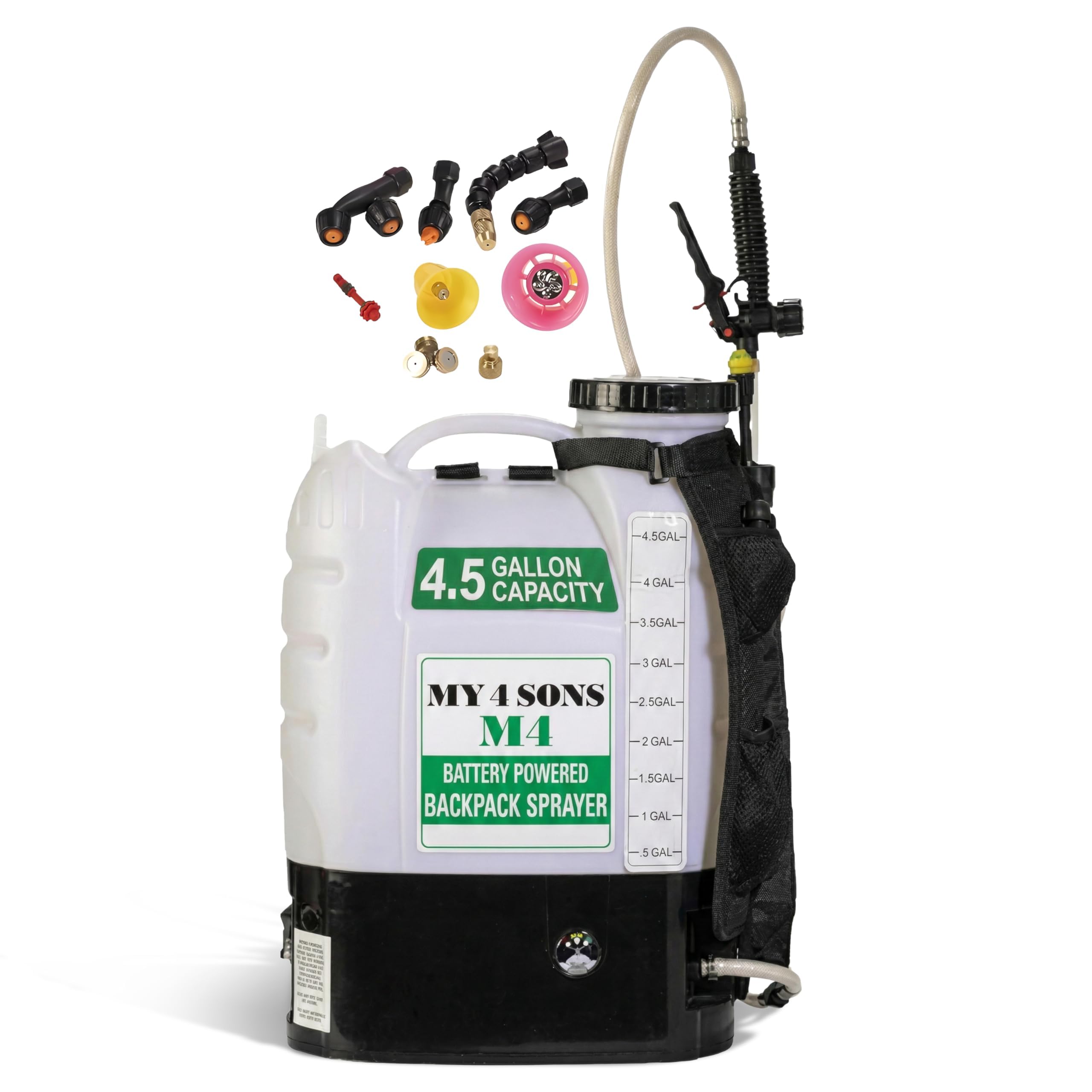
The MY4SONS M4 uses a rechargeable lead-acid battery that delivers an impressive 150 to 200 gallons of spraying per full charge, which translates to roughly five to eight full 4-gallon tanks before needing to recharge. The 80 PSI automatic pump provides up to 35 feet of reach, making it effective for tall shrubs and fence lines. The translucent tank with a wide-mouth opening and screen filter makes filling straightforward, and the neoprene lid seal is watertight when properly seated.
This model comes with both a stainless steel wand for everyday use and a heavy-duty plastic wand for acid or bleach-based products, which is a rare inclusion that extends the sprayer’s versatility. The padded XXL shoulder straps and a wand pocket are thoughtful additions for long sessions. Owners who sprayed over 300 gallons across several charges reported excellent battery longevity and found the variable pressure control useful for switching between fogging and targeted spraying.
Quality control has been inconsistent—some units arrive with a ripped battery strap, missing washers, or lid gaskets that fail to seal properly, leading to chemical leaks on the user’s back. Customer support is responsive and typically sends replacement parts, but this adds friction to an otherwise capable machine. The lead-acid battery, while long-lasting per charge, is heavier and slower to recharge than a lithium-ion pack, so planning ahead for recharging is necessary.
What works
- 150-200 gallons per charge is class-leading
- Dual wand kit (steel + plastic) for chemical flexibility
- Variable pressure control useful for different tasks
What doesn’t
- Lid gasket seal is prone to failure
- Lead-acid battery is heavy and slow to charge
4. Solo 475-B

The Solo 475-B stands apart from nearly every other manual backpack sprayer because it uses a diaphragm pump rather than a piston pump. Diaphragm pumps tolerate abrasive particles, wettable powders, and bleach solutions without internal damage, making this the correct choice for anyone applying harsh chemicals that would quickly degrade a standard piston seal. The four-position pressure regulator (15, 30, 45, and 60 PSI) gives you precise control over droplet size and reach, which is rare in a manual unit.
The 48-inch nylon-reinforced hose is longer than the average 4-foot hose, reducing the need to hunch over when treating low-growing plants. The Tivilon material used in the tank provides outstanding resistance to a wide range of chemicals, and the filter basket combined with a nozzle filter ensures clean delivery. The harness includes a waist belt, which helps distribute the weight better than shoulder-strap-only designs. The pump handle can be swapped for left or right-hand operation, a small but appreciated detail.
The tank is opaque, making it difficult to see the remaining liquid level at a glance—owners have solved this by marking the outside with a permanent marker. The instructions are minimal, and assembly is largely intuitive. At roughly 10 pounds empty, it’s lighter than the battery-powered competition, so even with a full 4 gallons it remains manageable. For users who prioritize chemical compatibility and don’t mind occasional pumping, this is the most durable manual option on the market.
What works
- Diaphragm pump handles bleach and wettable powders
- Four-position pressure regulator gives spray control
- Made in the USA with chemical-resistant materials
What doesn’t
- Opaque tank makes liquid level hard to see
- No printed instructions included
5. Roundup Pro 190327

The Roundup Pro 190327 solves a specific and common complaint with manual sprayers: chemical leaking onto the user. The internal pump design means the pump mechanism sits inside the tank rather than protruding outward, which eliminates the external seals that typically fail and drip down your back. The Viton seals and gaskets provide increased durability against harsh herbicides, and the pump itself can generate up to 150 PSI, though the built-in low-pressure regulator throttles the output to a steady 25 PSI for consistent coverage without overspray.
The 45-foot hose length is unusually long for a backpack sprayer, giving you the flexibility to set the tank down and walk a significant distance while spraying—useful for treating long fence lines or driveways without carrying the weight the entire time. The handle accepts left or right-hand pump operation, and the carry handle makes it easier to lift the filled tank. Owners report that after 40 gallons of use, no clogging or chemical reaction issues appeared, and the spray head remains adjustable for different patterns.
The trade-off for the leak-proof design and long hose is weight: at 12.8 pounds empty, it’s heavier than most manual competitors, and a full 4 gallons brings the total weight to nearly 46 pounds. The pump requires many short strokes rather than fewer long strokes, which some users find more tiring than other manual models. For someone who prioritizes not being soaked in herbicide over absolute pumping efficiency, this design is a clear winner.
What works
- Internal pump eliminates chemical leaks on user
- 45-foot hose allows spray walking without backpack
- Viton seals resist chemical degradation
What doesn’t
- Heavier than other manual sprayers
- Requires many short pump strokes
6. NPGLOBAL NPG-120
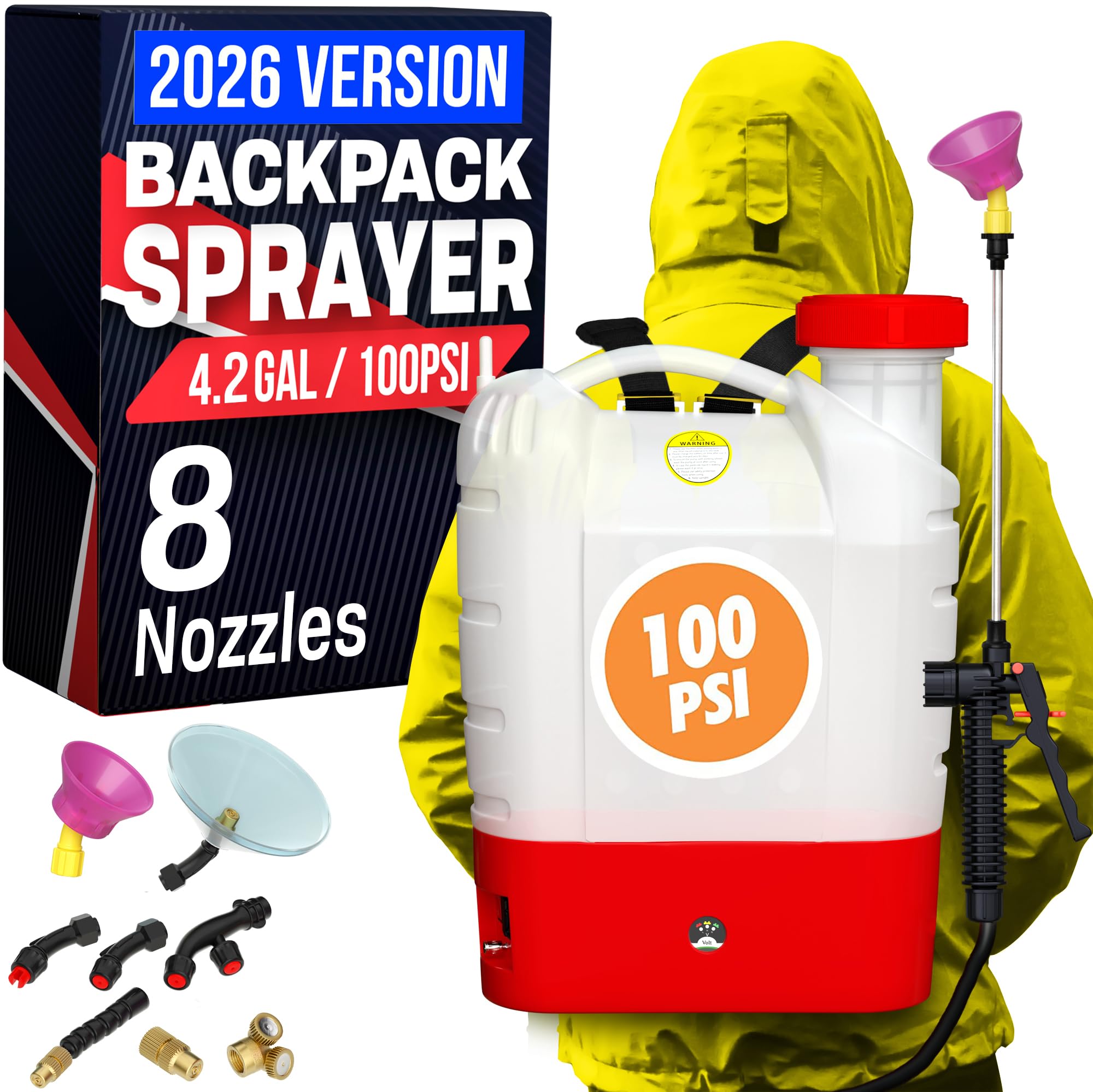
The NPGLOBAL NPG-120 is the most affordable battery-powered backpack sprayer in this lineup, and it delivers the core benefit of electric spraying—no manual pumping—at a significantly lower entry point than the premium competitors. The 100 PSI maximum pressure gives you plenty of overhead for reaching into dense vegetation, and the flow rate of 4.0 liters per minute means you can cover ground quickly. The translucent tank lets you monitor liquid level, and the wide-mouth lid with a built-in strainer makes filling and mixing straightforward.
This model includes eight different nozzles, which is the largest assortment in this review, covering everything from fan patterns for broadcast spraying to jet streams for spot treatment. The stainless steel telescopic lance extends your reach without adding much weight. Owners report excellent battery life, with some spraying 25 gallons of weed killer, 10 gallons of insecticide, and 15 gallons of wood stain on a single charge. Customer service is notably responsive, sending replacement chargers or even complete replacement units without hassle.
The shoulder straps are padded but not as robust as the premium models, and the hose length of 4.26 feet is average. A few owners noted that the pressure knob lacks labeled PSI markers, making it hard to dial in a specific pressure. The lifetime warranty is a strong vote of confidence, though it’s backed by a smaller company. For a homeowner transitioning from a hand-pump sprayer who wants electric convenience without the premium price tag, this is the logical starting point.
What works
- No pumping required at a budget-friendly price
- 8 nozzles provide broad pattern versatility
- Lifetime warranty with responsive customer service
What doesn’t
- Pressure knob lacks PSI markings
- Shoulder straps less padded than premium models
7. Rainmaker 708902

The Rainmaker 708902 is a straightforward manual pump backpack sprayer that keeps costs low while delivering the essential function: delivering liquid to your lawn and garden. The HDPE tank holds 4 gallons, and the manual pump builds pressure effectively—owners report the pump mechanism works better than some cheaper models that require standing on furniture to reach pressure. The padded shoulder straps add comfort for extended wear, and the included four interchangeable nozzles cover basic spray patterns from fan to jet stream.
At just over a pound heavier than the Solo when empty, it’s still one of the lighter options, which is a genuine advantage for older users or anyone with back concerns. Many owners fill it to only 2 gallons to keep the weight manageable. The integrated filter in the tank helps keep debris from clogging the nozzle, and the trigger lock feature allows continuous spraying without holding the trigger down. For a 1/2 acre lot, this sprayer performs adequately without any of the complexity of battery systems.
The straps have a history of breaking on the first use, requiring users to reinforce or replace them. The fill spout seal tends to leak regardless of how tightly it’s closed, and all hose connections should be tightened before first use—a common theme in owner reviews. For someone on a tight budget who needs a working sprayer for a small property and is willing to address a few loose fittings and strap weaknesses, this gets the job done without breaking the bank.
What works
- Lightweight design reduces fatigue
- Better pump mechanism than ultra-budget alternatives
- Four nozzles cover basic spray needs
What doesn’t
- Shoulder straps prone to breaking
- Fill spout seal leaks easily
Hardware & Specs Guide
Pump Types: Piston vs. Diaphragm
Piston pumps are the most common in budget and mid-range manual sprayers. They create pressure by moving a piston through a cylinder, which works well for clean liquids but wears quickly when exposed to abrasive particles or bleach. Diaphragm pumps use a flexible membrane that seals better against harsh chemicals and can pass small particulates without damage, making them the right choice for anyone spraying wettable powders, bleach solutions, or fertilizers with sediment. Battery-powered sprayers use an electric motor to drive either a piston or diaphragm pump, removing the physical pumping effort entirely.
PSI Ratings and Spray Distance
PSI (pounds per square inch) determines how far the spray reaches and how forcefully it penetrates foliage. A sprayer rated at 60 PSI typically reaches 15 to 20 feet with a fan nozzle, while 100 PSI extends that to 25 feet or more. However, the nozzle tip also matters—a 0-degree jet nozzle concentrates the pressure into a thin stream that can reach significantly further than a 45-degree fan nozzle at the same PSI. For most lawn and garden applications, a steady output of 25 to 45 PSI provides sufficient coverage without excessive drift, which is why many sprayers are regulated down from their maximum pump pressure.
Hose Material and Length
The hose connects the tank to the wand and must resist kinking, chemical degradation, and UV damage. Nylon-reinforced PVC hoses are the industry standard, offering a good balance of flexibility and durability. Standard hose length ranges from 4 to 6 feet on backpack sprayers, which allows the wand to reach the ground without bending over. The Roundup Pro 190327 breaks this convention with a 45-foot hose, enabling spray walking without wearing the backpack. UV resistance matters if the sprayer is stored in direct sunlight, as unprotected hoses can become brittle and crack after a single season.
Nozzle Patterns and Their Uses
Fan nozzles produce a wide, flat spray pattern ideal for broadcast coverage over lawns and garden beds. Cone nozzles create a hollow or full cone pattern that works well for targeting individual plants or reaching into shrub interiors. Jet or stream nozzles concentrate the liquid into a single powerful stream for spot-treating weeds or reaching tall branches. Adjustable nozzles let you rotate through multiple patterns, but they tend to produce less consistent droplet size than dedicated nozzles. Most quality sprayers include three to four nozzle tips, while electric models like the NPGLOBAL NPG-120 include eight for maximum versatility.
FAQ
How much can a backpack sprayer hold and is 4 gallons enough?
Can I spray bleach or acid through a backpack sprayer?
How long does a battery backpack sprayer last on one charge?
Final Thoughts: The Verdict
For most gardeners, the best backpack sprayer for lawn and garden winner is the FlowZone Cyclone 3 because it combines sealed electronics, five adjustable pressure settings, and a lithium battery that sustains all-day spraying without manual pumping. If you need chemical resistance for bleach or abrasive powders, grab the Solo 475-B. And for a budget-friendly battery entry point, nothing beats the NPGLOBAL NPG-120.