
I’m Rikta — the co-founder and writer behind Lawn Gear Lab. This guide is built by comparing the manufacturers’ published specifications and the patterns across verified customer reviews, so you get each pick’s real strengths and trade-offs instead of marketing spin.
The Moistenland WPS015 is the one most people should buy. It kept 7 plants healthy through a 3-week vacation according to buyers, and it runs on USB-C or AA batteries — so you get dependable scheduling without a constant power outlet. Here is how it stacks up against 6 other systems, from smart app-controlled kits to passive self-watering bases, to help you pick the right fit for your space and schedule.
How To Choose The Best Automatic Watering System For Potted Plants
Before you buy, it helps to know what separates a system that works from one that leaves you with dry soil or a flooded floor. The right choice depends on how many plants you have, how far apart they are, and how long you need to be away.
Timer vs. Gravity vs. Self-Watering — Which Type Fits Your Routine?
A programmable timer hooked to a faucet drips water on a schedule and works best if your pots are near an outdoor spigot or an indoor water source. A gravity-fed system uses a raised reservoir and wick lines to deliver water without pumps or electricity — it is silent and uses no power, but the water pressure is lower. Self-watering bases are passive: you fill their reservoir and the plant pulls water up through wicks or fabric pots as needed. For indoor pots in a sitting room, a self-watering base is dead simple. For a balcony with 15 separate pots, a timer-based drip kit gives you more control.
Water Pressure and the Anti-Siphon Valve
If your system relies on a water pump or household water pressure, ask about the anti-siphon valve (a small part that stops water from siphoning backward out of the tube when the pump is off). Without it, water can keep leaking from the dripper, puddling your floor or overwatering the first plant in line. The problem is common with cheaper kits, and several negative reviews point to it. Always check that the design prevents siphon effect so the flow stops when the timer stops.
Hose Length and How Many Plants You Can Reach
A 33-foot hose is enough for a row of 7-10 patio pots, while a 50-foot hose lets you route tubing around corners or across a longer balcony. The number of emitters or drippers in the box tells you the maximum plants the kit can handle — 12 to 16 is typical. If you have 6 jade plants scattered around a balcony, a 33-foot hose with 15 drippers gives you plenty of slack. If you are watering 15 pots on a long railing, go for the 50-foot hose to avoid running out of tubing mid-route.
Quick Comparison
On smaller screens, swipe sideways to see the full table.
| Model | Category | Best For | Key Spec | Amazon |
|---|---|---|---|---|
| Moistenland WPS015 | Mid-Range | Vacation peace of mind | 33 ft hose / 15-piece kit | Amazon |
| VIVOSUN A10 Smart | Mid-Range | Grow tent or greenhouse | 16 emitters / App control | Amazon |
| Beday Solar & USB | Mid-Range | Solar-powered outdoor use | 50 ft hose / Solar + USB | Amazon |
| HIRALIY 50FT | Value | Budget balcony watering | 50 ft hose / Adjustable drippers | Amazon |
| VIVOSUN FlexFeed (4-Pack) | Premium | Big fabric pots / Grow tents | 1.3 gal reservoir / 130 lb capacity | Amazon |
| LetPot LP-D3-GY | Premium | WiFi control / indoor precision | 10m hose / IP66 waterproof | Amazon |
| Spider Farmer 4-Pack | Premium | Longest autonomy / Greenhouses | 13 gal reservoir / 4-week supply | Amazon |
In‑Depth Reviews
1. Moistenland WPS015 Automatic Watering System
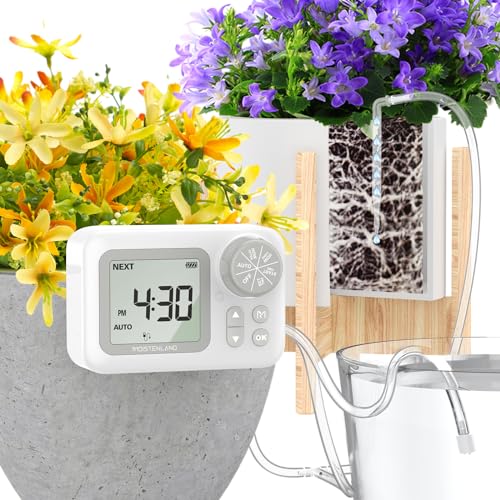
15 pieces — including a digital programmable timer, drippers, and a 33-foot hose — make the Moistenland WPS015 the top pick for potted plant owners who need a system that actually works during a 3-week vacation. Buyers confirm it “passed 3-week vacation test: watered 7 plants efficiently, no dry soil or overwatering,” and the kit waters a row of 10 standard balcony pots without needing an extension.
The timer lets you set specific watering start times and durations, running on either USB-C power or 4 AA batteries so the schedule keeps running even if the power goes out. It delivers water directly to the root zone, which the maker claims saves up to 70% compared to overhead watering — handy for your water bill and for preventing fungus on leaves.
The honest catch: the pump does not have a built-in anti-siphon valve, so you must keep the water source lower than all your pots (or raise the first dripper above the water level) to prevent leaking when the timer is off; for most indoor or balcony setups where the bucket sits on the ground below the plants, this is easy to manage. Buyers seeking a plug-and-play drip kit for 7-15 pots who do not mind one positioning requirement will be happy here. If you want zero siphon worry, the VIVOSUN A10 is a smarter fit with its included anti-siphon connector. This is the reliable vacation-proof pick for most potted plant owners.
Why it’s great
- Proven vacation reliability — buyers confirm it works for weeks straight
- Flexible power: USB-C or 4 AA batteries
- 15-piece kit covers a full balcony or windowsill
Good to know
- No anti-siphon valve means you need to position the water source below the plants
- One reviewer noted LCD segments failing after 2 weeks
2. VIVOSUN A10 Smart Drip Irrigation Kit

The VIVOSUN A10 beats the Moistenland on two fronts: it includes an anti-siphon connector (so you never worry about the siphon effect leaking water everywhere) and you control it from your phone via the Vivosun A10 GrowHub app. It also has 16 emitters versus the Moistenland’s 15, and its upgraded 4mm drippers boost water flow by 30% — powered by a 15W pump that delivers up to 1000 L/H while running at a whisper-quiet 30–40 dB (about as loud as a library). For a grow tent or serious greenhouse setup, that app control and extra flow are major wins.
The system runs on electricity and uses a cotton filter to block dirt — buyers report the built-in pump is reliable on a 2-minutes-per-hour cycle, and one reviewer who runs the pump at 50% speed says it takes roughly 12 minutes to get good runoff in 5-gallon pots. The 16 emitters mean you can water 16 separate plants at once, and the flexible tubing lets you route them around a grow tent or a balcony railing. The quiet pump is a real plus for indoor use where you do not want a hum disturbing the room.
This is the system to pick if you own a grow tent or greenhouse with fabric pots and need to set precise schedules from your phone while away. Just be aware that a few owners mention injection-molded splitters that fail after a month or deliver uneven flow — after a month, one customer found only 2 nozzles dispensing water and nearly lost 3 plants. Stick with it if you value smart control and the anti-siphon protection. If you just need reliable vacation watering for a few pots and do not need the app, the simpler Moistenland costs less and has a longer proven track record.
Where it shines
- App-controlled scheduling from anywhere via GrowHub
- Anti-siphon connector prevents backflow and flooding
- Whisper-quiet 15W pump at 30–40 dB
Worth noting
- Some customers note uneven flow from injection-molded splitters after a month
- Requires a nearby power outlet for the pump
3. Beday Solar Drip Irrigation System

Got a sunny balcony with no outdoor power outlet nearby? The Beday runs on a solar panel during the day and falls back to USB charging when sunlight is weak — its IP67 waterproof rating (meaning it is fully dust-tight and can handle being hosed off or left in rain) means you can mount it right on the railing without worry. The 50-foot hose is 52% longer than the Moistenland’s 33-foot hose, giving you more room to snake tubing around corners or across a wider balcony.
It includes a soil moisture sensor plus three watering modes: Timer (set a schedule), Humidity (triggered by dry soil), and Manual (instant watering). The smart LED display shows watering frequency, duration, and battery level at a glance. Reviewers point out it “functions well to water up to 15 plants” and that its weather-resistant build is holding up after a full year of use — one customer even had a broken part replaced by the company after nearly a year. With 15 T-joints and 15 watering spikes in the box, you can customize the layout exactly to your pot arrangement.
One spec worth noting: the maximum watering interval is 7 days. If you have succulents or winter-dormant plants that need water only every two weeks, that is a real limitation — you will either overwater them or have to supplement manually. For tropical plants and summer annuals that need more frequent drinks, it is a great solar-powered option. The solar panel plus USB dual-charge system means the Beday works year-round in all seasons, not just summer. Budget-conscious buyers who do not need solar or a soil sensor are better off with the HIRALIY 50FT kit for similar hose reach at a lower price. The solar panel plus USB dual-charge system means the Beday works year-round in all seasons, not just summer.
What stands out
- Dual-charging (solar + USB) works in low sun or winter
- 50-foot hose reaches further than most compact kits
- Soil moisture sensor enables humidity-triggered watering
The trade-offs
- Maximum watering interval is only 7 days — too short for some dormant plants
- Tubing is non-standard; finding replacement parts or extensions is difficult
4. HIRALIY 50FT Drip Irrigation Kit
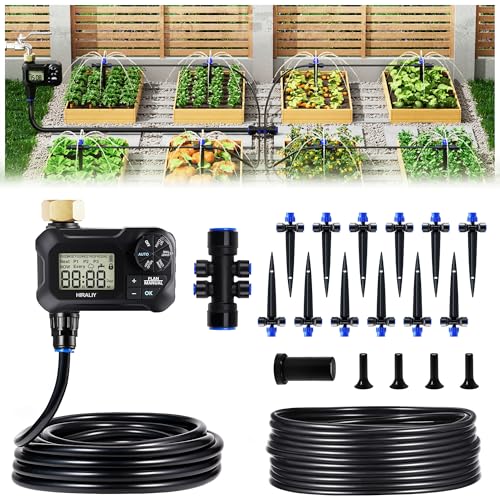
The single number that matters most in this category is hose length, and the HIRALIY gives you a full 50 feet — enough to reach across a sprawling balcony or a dozen raised beds — at a lower price than any other 50-foot kit on this list. It includes 12 adjustable drippers that can switch between shut-off, micro drip, or spray mode, so you can give herbs a fine mist and tomatoes a steady drip from the same system.
The catch you accept for the lower price is that the timer and controller are simpler than the smart options. You can set watering from 1 minute up to 23 hours 59 minutes, with intervals from every 2 to 6 days or specific days of the week, but there is no app, no WiFi, and no humidity sensor — it is a pure manual-program timer. Some reviewers experienced failures: one said the display clouded with water droplets after 4 weeks of rain exposure (though the seller shipped a free replacement), and another said some spray nozzles did not work while others did. Customer service was hit-or-miss in those reviews.
At this price-to-performance point, the HIRALIY is a solid entry-level pick for a first-time buyer who wants to automate watering on a small patio or balcony without investing in a premium smart system. If you are comfortable with a basic timer and can keep the display dry, the 50-foot reach and adjustable drippers give you real flexibility for the money. If rain exposure is a concern, the Beday’s IP67 rating makes it a smarter outdoors choice despite the higher cost.
The upsides
- Generous 50-foot hose and 12 adjustable drippers at a budget-friendly price
- Quick-connect push-fit connectors reduce leaks during setup
- Three spray modes per dripper (shut-off, drip, spray)
Keep in mind
- Timer display is not waterproof and may cloud up in rain
- Some nozzles may not work out of the box; customer service response is inconsistent
5. VIVOSUN FlexFeed Self-Watering Pots (4-Pack)

What you actually get at this lower price is a completely different approach — no tubes, no timers, and no pump. Instead, you set each 1.3-gallon (6L) reservoir under a fabric pot, and wicks pull water up as the plant needs it. The maker says it supports up to 130 lb (60 kg) per tray, so even a heavy, waterlogged pot is safe. Shoppers say that plants in 3-gallon fabric pots on these bases “doubled in size vs. ground” because the roots stretch down into the reservoir to drink.
The 4-pack gives you a week of autonomy per fill. You check the water level through a transparent window and refill through a top slot. The elevated drain plate and multiple drainage holes prevent water buildup and root rot — a common problem with deep saucers. One buyer mentioned that after 3 months, plants were drinking 0.5 gallons per day and roots had grown straight onto the wick lines. The design also keeps the top of the soil dry, which deters fungus gnats and other insects that love moist soil.
For someone with a collection of fabric pots indoors or in a grow tent, the FlexFeed’s no-electricity, no-schedule approach is a time-saver. The honest limit: it only works with fabric pots (or pots that fit the 14.7 x 14.7-inch tray footprint), and the passive wicking may not be fast enough for heavy-drinking plants in hot weather. If you want the simplest setup possible — just fill the tray and let the plant do the rest — this is the perfect system for the budget buyer who wants a low-cost, no-electricity solution for fabric pots and doesn’t need to water heavy drinkers in hot weather.
Why we’d pick it
- Passive wicking — no power, no pump, no timer needed
- 1.3 gal reservoir keeps plants hydrated for a full week
- Keeps soil surface dry, reducing pests like fungus gnats
A few caveats
- Only works with fabric pots or pots that fit the 14.7-inch tray
- Wicking may not keep up with very thirsty plants in hot weather
6. LetPot LP-D3-GY Automatic Watering System

If you live in a small apartment with a city balcony and want to control watering from bed or the office, the LetPot is built for exactly that scenario. It connects to your home WiFi and the LetPot app supports up to 5 simultaneous watering tasks with different schedules for different pots. The app also sends a low-water alert so you know when to refill. Its IP66 rating (protected against high-pressure water jets and heavy rain) means you can leave it outside on a covered balcony without worrying about weather damage.
The kit includes a 10-meter (33-foot) water pipe, 10 adjustable drippers, 10 connectors, and a German-imported silent water pump — buyers confirm it is “quiet but powerful” and works well on a 24-hour continuous drip for running nutrients. The upgraded 2.0 chip and anti-backflow valve (the anti-siphon fix that cheaper kits lack) prevent leaks when the pump is off.
The honest limit: the PE (polyethylene) hose is stiff and tends to stay coiled from the packaging, which makes positioning drippers a minor wrestling match — one owner reported having to soak the tube ends in warm water to attach fittings. The LetPot is also pricier than simpler kits, but you pay for that WiFi convenience and anti-siphon reliability. If you hate wrestling with coiled tubing at setup, this may frustrate you for the first 10 minutes.
Strong points
- Full WiFi + app control with 5 custom schedules
- Anti-backflow valve prevents siphon leaks
- IP66 waterproof — safe for outdoor covered use
Before you buy
- Tubing is stiff and stays coiled — can be tough to position drippers
- Higher cost than simpler non-WiFi drip kits
7. Spider Farmer Gravity-Fed Self-Watering System (4-Pack)
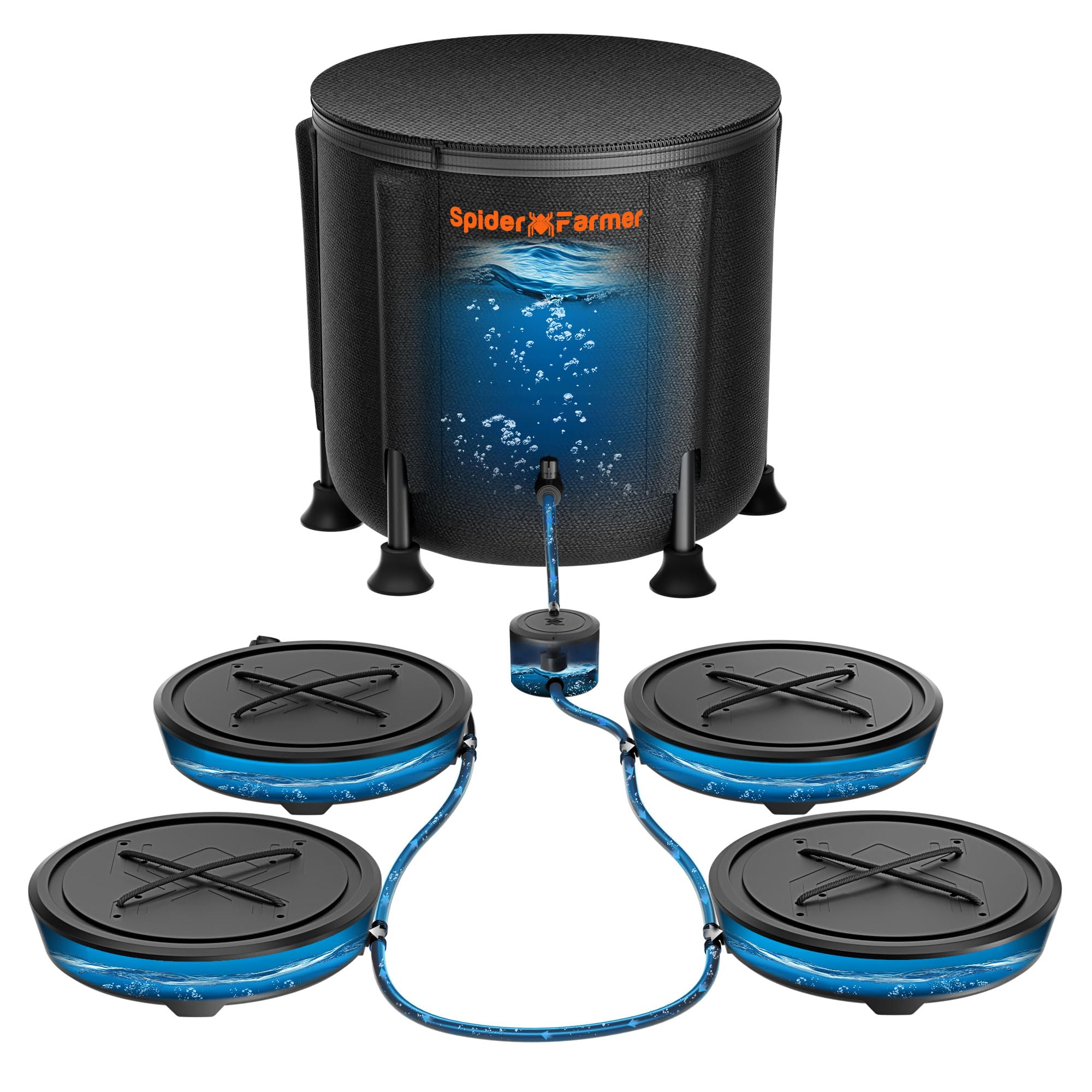
At a lower price than most competitors, the Spider Farmer delivers unmatched value for growers who prioritize autonomy over compactness. Its 13-gallon reservoir feeds 4 wick bases that can keep plants hydrated for up to 4 weeks — no pump, no timer, no electricity needed. That is a huge advantage over the other kits here: compared to the VIVOSUN FlexFeed’s 1-week autonomy, the Spider Farmer goes 4 times longer per fill.
The gravity-fed design uses wick lines that deliver water steadily as the plant drinks, eliminating both overwatering and underwatering. The upgraded outlet position is lowered by 4cm to reduce residual water in the tank to only 5L, meaning you waste almost nothing. The bases are built from high-strength materials and support up to 100 lbs each. Everything comes in the box: 4 self-watering bases, the 13-gallon reservoir, 5-gallon fabric grow bags, wick lines, shut-off valve, and water tubes. The system is completely silent because it has no moving parts — perfect for a bedroom grow tent or a quiet living room.
The downside for that long autonomy is bulk. The 13-gallon reservoir takes up serious floor space, and the system is designed for larger fabric pots (5-gal and up). If you are watering 6 small succulents on a bookshelf, this is overkill — you are better off with a self-watering pot or a small drip kit. The one clear reason to choose it: if you run a 4-pot grow tent and want to be able to leave for a month without worrying about water, the Spider Farmer is the only system here that delivers that kind of hands-off peace.
What we like
- 13-gallon reservoir provides up to 4 weeks of autonomy
- Completely silent — no pump, timer, or electricity needed
- Sturdy construction supports 100 lbs per base
The downsides
- Large footprint — not suitable for small spaces or tiny pots
- Wick lines require regular cleaning to prevent algae growth in the reservoir
Understanding the Specs
Hose Length and Number of Emitters
This is the first number to check: how far can you reach, and how many plants can you connect? Hose length is measured in feet (e.g., 33 ft, 50 ft) and tells you the maximum distance from the water source to the farthest pot. The number of emitters or drippers (e.g., 12, 15, 16) tells you the maximum plants one unit can serve. If your pots are spaced far apart along a long balcony, prioritize a 50-foot hose. If they are clustered near a window, a 33-foot hose is usually enough.
Anti-Siphon Valve
A small but crucial feature that prevents water from siphoning backward out of the tube when the pump or timer shuts off. Without it, water keeps dripping from the lowest dripper — potentially flooding one plant or leaving a puddle on your floor. The problem is commonly called the “siphon effect.” Kits that lack this valve (like the Moistenland WPS015) require you to position the water source lower than all the plants. Kits that include it (like the VIVOSUN A10 and LetPot) give you more freedom to place the water bucket anywhere.
Power Source: Battery, USB, Solar, or None
Timer-based drip kits need power to run the pump and controller. Some run on AA batteries (portable, but need swapping every few weeks), some on USB-C (convenient if near an outlet), and one (the Beday) offers solar charging as the primary source with a USB fallback for cloudy days. Gravity-fed and self-wicking systems (like the Spider Farmer and VIVOSUN FlexFeed) need no power at all — they rely on gravity and capillary action, making them silent and energy-free.
IP Waterproof Rating
If you are using the system outdoors, look for an IP (Ingress Protection) rating. The number after “IP” tells you how well the electronics resist dust and water. For example, IP67 means it is fully dust-tight (6) and can survive being submerged in 1 meter of water (7) — fine for rain and hose spray. IP66 means it is dust-tight and protected against high-pressure water jets. An unrated timer should be kept in a dry location or inside a waterproof enclosure if used outdoors.
FAQ
Can I use a drip irrigation kit indoors without making a mess?
How long can I leave my plants unattended with an automatic watering system?
What is the difference between a drip irrigation kit and a self-watering pot base?
Why do some drippers drip faster than others in the same kit?
Final Thoughts: The Verdict
For most buyers, the automatic watering system for potted plants winner is the Moistenland WPS015 because it combines reliable timer-based watering, a 33-foot reach, and proven real-world performance at a price that leaves room for upgrades. If you want smartphone control from anywhere, grab the VIVOSUN A10 Smart Drip Irrigation Kit with its app and anti-siphon protection. And for the grower who never wants to refill for an entire month, the standout is the Spider Farmer Gravity-Fed System and its massive 13-gallon reservoir.