
Watching a line of ants march across your kitchen counter or through the garden bed is frustrating enough — but the real battle starts when bait traps and granule scatterings only make the problem worse. Ant killer concentrates deliver a different strategy: a liquid chemical payload that you dilute yourself, then apply as a perimeter spray, mound drench, or targeted barrier to hit the colony hard at its source rather than just killing a few wandering scouts.
I’m Rikta — the co-founder and writer behind Lawn Gear Lab. This guide comes from comparing label rates, analyzing active ingredient concentrations like bifenthrin and permethrin, and cross-referencing hundreds of owner reports to find which concentrates truly collapse a colony and which ones just waste your weekend.
If you are shopping for the best ant killer concentrate, you need a formula that balances immediate knockdown power with residual staying power across weather cycles.
How To Choose The Best Ant Killer Concentrate
Not all ant killer concentrates are built the same. The right choice depends on your target ant species, the size of the infested area, and how long you need the treatment to hold up against rain and sunlight. Here are the three specs that separate effective products from diluted disappointments.
Active Ingredient and Concentration
The active ingredient — bifenthrin, permethrin, acephate, or cypermethrin — determines how the chemical disrupts the insect’s nervous system. Higher percentage concentrates (7.9% bifenthrin versus 0.05% ready-to-use sprays) allow you to mix a more potent solution per gallon and cover more square footage per bottle. For tough native fire ants or leaf-cutter ants, a 7.9% bifenthrin or 13.3% permethrin concentrate gives you the knockdown edge that low-concentration homeowner sprays lack.
Residual Longevity and Water Resistance
A good concentrate bonds to soil, wood, and masonry, creating a chemical barrier that kills ants for weeks or months after the spray dries. Premium pyrethroid formulations resist UV breakdown and light rain once dried, with residual protection ranging from four weeks up to three months. Check the label for “residual activity” language — products that promise quarter-long control typically contain bifenthrin, while permethrin options tend to reapply every three to four weeks.
Application Versatility: Barrier Spray vs. Mound Drench vs. Interior Crack
Single-use baits fail when ants ignore the attractant. A versatile concentrate works as a perimeter barrier spray around foundations, a direct mound drench for fire ant colonies, and an interior crack-and-crevice treatment for wall voids. Products labeled for both indoor and outdoor use save you from buying separate formulations, but always verify the label allows interior application before spraying baseboards or under cabinets.
Quick Comparison
On smaller screens, swipe sideways to see the full table.
| Model | Category | Best For | Key Spec | Amazon |
|---|---|---|---|---|
| Liquid Harvest 7.9% Bifenthrin | Premium | All-around colony elimination | 7.9% Bifenthrin | Amazon |
| Paragon Conquer | Premium | Leaf-cutter ants | Generic concentrate | Amazon |
| Martin’s Permethrin 13.3% | Mid-Range | Tick and perimeter mosquito control | 13.3% Permethrin | Amazon |
| Bonide Termite & Carpenter Ant Killer | Mid-Range | Carpenter ant and termite barrier | 32 oz concentrate | Amazon |
| Revenge Termite & Carpenter Ant Killer | Mid-Range | Five-year termite barrier | 32 oz concentrate | Amazon |
| Hi-Yield Fire Ant Control | Budget | Fire ant mound application | Acephate granule | Amazon |
| Wisdom Pro L&H 7.9% Bifenthrin | Premium | Broad-spectrum outdoor perimeter | 7.9% Bifenthrin quart | Amazon |
In‑Depth Reviews
1. Liquid Harvest 7.9% Bifenthrin Insecticide (32 oz)

At 7.9% bifenthrin, this concentrate packs professional-grade active ingredient into a water-based emulsion that dries clear and leaves no visible residue on siding, baseboards, or concrete. The label covers over 75 pests including fire ants, carpenter ants, ticks, and spiders, which means one bottle replaces an entire shelf of single-use products. Owner reports consistently describe three-month residual control from a single perimeter spray — a cycle that matches quarterly preventative treatment schedules used by exterminators.
The mixing ratio is efficient: a 32-ounce bottle makes up to 64 gallons of finished spray at the standard outdoor rate, so even large properties with extensive foundation perimeters get multiple seasons of coverage from one purchase. Multiple five-star reviews note that switching from a pest control service to this concentrate saved them hundreds of dollars annually while delivering equal or better ant suppression. A few owners mentioned that the bifenthrin odor is mild and fades quickly after drying, making it tolerable for indoor crack-and-crevice use.
For anyone looking for a single concentrate that handles fire ant mounds, perimeter barriers, and interior ant trails without needing a separate product, this is the closest thing to a one-bottle arsenal. It also rotates well with other modes of action to prevent resistance buildup in persistent colonies.
What works
- 3-month residual control from one application
- Water-based formula dries clear with no sticky residue
- Excellent value — 32 oz makes up to 64 gallons of spray
What doesn’t
- Not labeled for use in all states — verify local registration
- Stronger odor during mixing compared to 0.05% ready-to-use sprays
2. Paragon Conquer Residual Insecticide (16 oz)
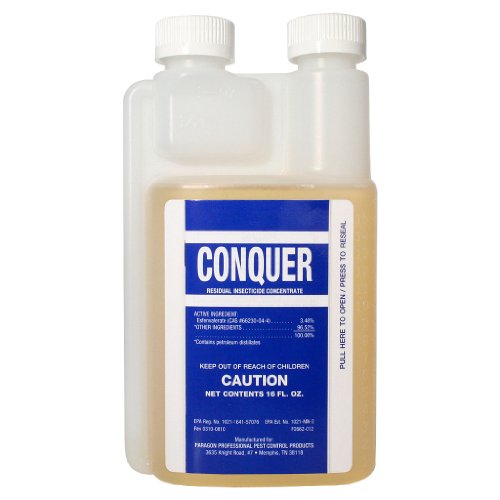
Conquer has earned a near-cult following among property owners battling leaf-cutter ants — a notoriously difficult species that ignores most baits and granular treatments. The concentrate works best when poured directly into colony openings using a funnel; owners report that ants stop foraging within two hours of application, and holes that were actively stripping plants sit abandoned the next morning. The chemistry is effective on carpenter ants, termites, and cockroaches too, making it a versatile second-line product for tough infestations.
Considering the small 16-ounce bottle size, the price per ounce is higher than the bifenthrin-based competitors. But for leaf-cutter ant hotspots in Texas, the Southeast, or Central America, many reviewers say Conquer is the only thing that worked after they exhausted box-store baits, diatomaceous earth, neem oil, and vinegar drenches. The liquid mixes easily in a pump sprayer or can be applied concentrate-strength into deep tunnels, and it leaves very little odor compared to permethrin-based alternatives.
The main limitation is the smaller volume — you will go through the bottle quickly if you are treating multiple large mounds or an extensive perimeter. It is best kept as a specialty tool for targeted colony injection rather than general broadcast spraying.
What works
- Kills leaf-cutter ants within two hours of direct application
- Effective where baits and natural remedies have failed
- Low odor relative to other concentrates
What doesn’t
- Small 16 oz bottle — expensive for large-area perimeter spraying
- Requires direct colony injection for best results
3. Martin’s Permethrin 13.3% Concentrate (32 oz)
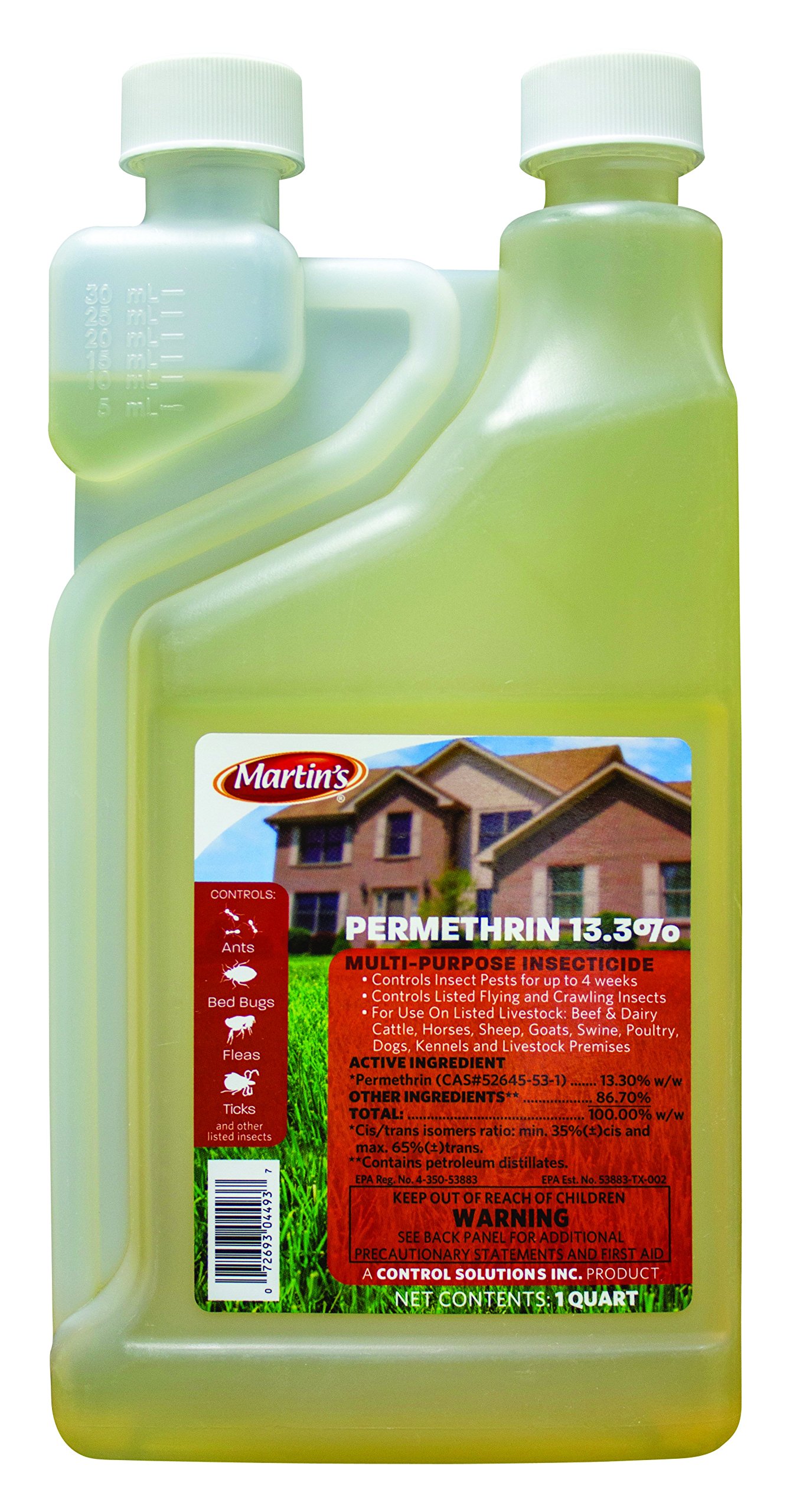
With a 13.3% active ingredient concentration, Martin’s delivers the highest permethrin percentage in this roundup, translating to serious knockdown power for ticks, mosquitoes, ants, and a wide range of flying and crawling pests. Owners frequently mix it at 4 ounces per gallon for perimeter spraying and 3 ounces per gallon for clothing treatment, creating an invisible tick shield that lasts through several weeks of yard work and brush contact. The product is also farm-friendly: several reviewers use it in chicken coops and around livestock runs for fly and mite control.
The biggest trade-off is the strong chemical odor during mixing and application. Multiple long-term users noted that recent batches smell significantly stronger — more like paint thinner — compared to bottles purchased several years ago, and they recommend staying outdoors during and immediately after spraying. Residual control for ants and general insects is solid at about 4 weeks, though tick protection often extends to 6 weeks under dry conditions.
It is not the best choice for ant-only problems because the permethrin breaks down faster in direct sunlight than bifenthrin, requiring more frequent reapplication. However, for properties dealing with dual tick and ant pressure, this concentrate pulls double duty efficiently.
What works
- Highest permethrin concentration at 13.3%
- Excellent tick and mosquito control for 4-6 weeks
- Safe for use around chickens and livestock when dry
What doesn’t
- Strong chemical odor — not ideal for indoor use
- Needs more frequent reapplication than bifenthrin concentrates
4. Bonide Termite & Carpenter Ant Killer (32 oz)

Bonide’s formula is built specifically for wood-destroying pests — carpenter ants, subterranean termites, and wood-infesting beetles — making it the right tool if your infestation is damaging structural timber rather than just trailing across the patio. The concentrate uses a dual-action mechanism: immediate contact kill on spray contact plus residual activity that poisons ants and termites as they pass through treated soil or walk across treated wood surfaces. One owner at a wooded cabin reported 15 consecutive years of black ant and termite suppression with a single annual spring application.
The 32-ounce bottle mixes with water for use in a sprinkler can, hand sprayer, or low-pressure sprayer, and the label claims a 5-year barrier for subterranean termites when properly trenched around the foundation. Real-world feedback is slightly more modest — owners spraying around post-and-beam foundations saw all ant activity stop after one treatment, but a few needed a second or third application for heavy carpenter ant populations in spring. The product also handles fire ants, fleas, mosquitoes, ticks, and wasps, broadening its utility beyond just wood-boring insects.
It is worth noting that this concentrate is not labeled for interior crack-and-crevice use like the bifenthrin options are. It works best as an outdoor perimeter and foundation treatment for homes with known wood-destroying insect pressure.
What works
- Specialized for carpenter ants and termites
- Dual contact-kill and residual action
- Effective with annual application in many situations
What doesn’t
- Not labeled for interior use
- May require multiple spring sprays for heavy infestations
5. Revenge Termite & Carpenter Ant Killer (32 oz)

Revenge is essentially Bonide’s identical twin under a different product name — same 32-ounce concentrate, same dual-action contact and residual claim, same 5-year termite barrier promise on the label. It targets the same broad insect list including carpenter ants, termites, fire ants, fleas, mosquitoes, and ticks. Owners report that it eliminated carpenter ants from a home that had been infested for a full year and cleared up ant-infested landscape rocks overnight after a single spray.
Pound for pound, this is one of the most affordable options in the mid-range tier, making it a strong entry point for homeowners who want professional-grade perimeter protection without paying premium prices. The chemical emulsion is designed to disperse in soil to create a continuous barrier between the structure’s wood and termite colonies underground, and the residual activity continues killing insects that return to treated areas for weeks after drying. The only real complaint across reviews is the modest 32-ounce size — large properties may need two bottles for thorough foundation coverage.
For anyone whose primary concern is carpenter ants or subterranean termites rather than general ant species, this concentrate offers the same active chemistry as Bonide at a lower per-bottle cost.
What works
- Proven carpenter ant and termite elimination
- Residual barrier lasts through weather cycles
- Budget-friendly price for the concentration volume
What doesn’t
- Not labeled for indoor interior use
- 32 oz may not be enough for large perimeter jobs
6. Wisdom Pro L&H 7.9% Bifenthrin (Quart)

Wisdom Pro brings the same 7.9% bifenthrin concentration as the Liquid Harvest product but in a slightly smaller quart-sized bottle, making it a strong competitor for homeowners who want pro-grade chemistry without committing to a full 32-ounce container. The mode of action targets the sodium channels in insect nerve axons, causing rapid paralysis and death, and the residual protection holds up for several weeks on outdoor surfaces. Reviewers consistently note that one quart mixed at 1 to 2 ounces per gallon lasts a very long time, easily covering an entire suburban property for several months of perimeter spraying.
Owners specifically praised its effectiveness on fire ants, noting that mound drenches eliminated colonies within days and that the spray kept the backyard ant-free for over six months in some cases. The label also permits indoor use on baseboards, cabinets, and interior plantscapes, making it one of the few bifenthrin concentrates in this list that can pull double duty inside and out. The one drawback is the smaller bottle size — if you are treating a multi-acre property or need to cover a very large foundation, the 32-ounce Liquid Harvest bottle gives you more concentrate per dollar.
For smaller properties or homeowners who want to test bifenthrin before buying a larger volume, the quart format is a smart entry point with the same active ingredient power.
What works
- Same 7.9% bifenthrin as premium brands at a lower entry volume
- Approved for both indoor and outdoor use
- One quart covers a typical suburban property for months
What doesn’t
- Smaller 32 oz bottles from competitors offer better per-ounce value
- A few users noted inconsistent results on spider control
7. Hi-Yield Fire Ant Control with Acephate (8 oz)
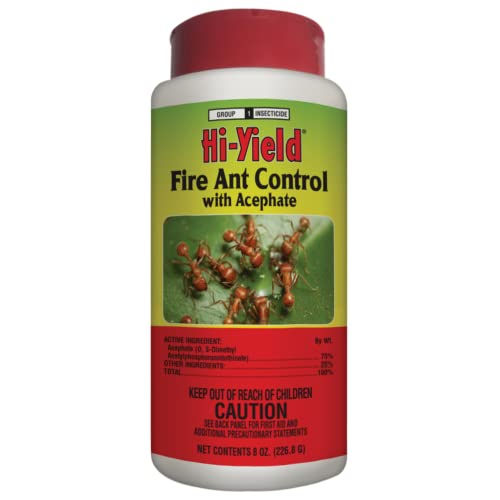
Hi-Yield takes a different approach from the liquid concentrates above: it is a granule formulation containing acephate, an organophosphate active ingredient that works through ingestion rather than contact. You sprinkle 1 to 2 teaspoons directly onto fire ant mounds, and the worker ants carry the poison into the colony where it kills the queen and the brood over the following days. Owners report that the granular bait format is particularly effective for fire ants that are resistant to pyrethroid sprays, and they note seeing complete mound elimination within a week of application.
The 8-ounce container is small, but a little goes a long way — each teaspoon treats one mound, so the bottle covers roughly 24 to 48 mounds depending on how generously you apply. The main trade-off is the smell. Multiple reviews describe the odor as very strong and unpleasant, reminiscent of cheese or broccoli, and one long-term user noted that recent batches smell different enough that they switched to another product. The acephate also has a shorter residual than bifenthrin, and you may need to reapply after heavy rain or irrigation.
This product is best reserved as a targeted mound treatment for fire ants rather than a general perimeter barrier. If your primary problem is native fire ants and you are looking for a bait-style killer rather than a spray, this is a proven acephate option.
What works
- Effective queen-killing action through worker ant ingestion
- Small dose per mound — bottle goes a long way
- Works on fire ants resistant to pyrethroid sprays
What doesn’t
- Strong chemical odor that some users find off-putting
- Granule format not useful for perimeter barrier spraying
Hardware & Specs Guide
Bifenthrin vs. Permethrin vs. Acephate
Bifenthrin (7.9% concentrates) provides the longest residual control — up to 3 months outdoors — and resists UV degradation better than permethrin. Permethrin (13.3%) knocks down ticks and mosquitoes faster but breaks down in sunlight after 3 to 4 weeks, demanding more frequent reapplication. Acephate (granular form) works through ingestion by foraging ants, making it effective against pyrethroid-resistant fire ant colonies, but it degrades in moisture and has no long-term residual barrier.
Concentrate Dilution Ratios
Most bifenthrin and permethrin concentrates instruct you to mix 1 to 4 ounces of product per gallon of water depending on the target pest. A 32-ounce bottle at the standard 1 oz/gallon rate yields 32 gallons of finished spray — enough to cover a 2,000-square-foot foundation perimeter 2 to 3 times. Always follow the label’s specific dilution table: under-mixing reduces efficacy, while over-mixing wastes chemical and may void the warranty.
Residual Protection Duration
Residual activity is the window during which the dried chemical film remains lethal to ants. Bifenthrin-based concentrates consistently deliver 60 to 90 days of outdoor residual control on non-porous surfaces and in soil. Permethrin drops to 21 to 28 days outdoors, though it can last longer in shaded areas. Acephate granules offer no meaningful residual — they rely entirely on ants consuming the bait and carrying it back to the colony.
Indoor vs. Outdoor Labeling
Not all ant killer concentrates are approved for indoor use. Products labeled for both indoor and outdoor application (like the 7.9% bifenthrin concentrates) can be sprayed along baseboards, under appliances, and in wall voids. Concentrates restricted to outdoor use only — such as the Bonide and Revenge carpenter ant killers — should never be applied inside because the chemical emulsion and carrier solvents are not tested for indoor air quality or surface safety.
FAQ
How do I apply an ant killer concentrate to fire ant mounds?
Can I use bifenthrin concentrate indoors safely?
What is the difference between a concentrate and a ready-to-use ant spray?
How long does ant killer concentrate stay effective after mixing?
Final Thoughts: The Verdict
For most gardeners, the ant killer concentrate winner is the Liquid Harvest 7.9% Bifenthrin because it combines the highest concentration of the most reliable pyrethroid active ingredient with a water-based formula that works indoors and out, delivering three months of residual control from a single bottle. If you are battling leaf-cutter ants that laugh at everything else, grab the Paragon Conquer for targeted colony injection. And for tick-heavy properties where dual ant and tick pressure demands a powerful knockdown, nothing beats the Martin’s Permethrin 13.3%.