
African violets have a reputation for being fussy about feeding, but the real issue is almost always the NPK ratio and the delivery method—not the plant itself. The wrong fertilizer can scorch sensitive roots or push all foliage with zero flowers, leaving growers frustrated with a bushy, bloomless plant. Finding a formula that matches the violet’s unique metabolic rhythm is the single highest-impact decision you will make for these Gesneriads.
I’m Rikta — the co-founder and writer behind Lawn Gear Lab. I have spent hundreds of hours cross-referencing NPK ratios, reading through thousands of verified owner feedback on specific violet cultivars, and studying how different nutrient profiles (urea-based versus nitrate-based, high-phosphorus bloom boosters versus balanced maintenance blends) actually perform in real potting mixes and wicking systems.
This guide breaks down seven of the most reliable formulations on the market, from gentle organic concentrates to precision water-soluble powders, so you can match the exact chemistry to your growing style and your plant’s current life stage. Whether you propagate from leaf cuttings or maintain a mature collection, these picks represent the most thoroughly vetted options for the best african violet plant food available today.
How To Choose The Best African Violet Plant Food
African violet fertilizers are not one-size-fits-all. The ideal formula depends on whether you want more leaves, more flowers, or balanced maintenance, and whether you use top-watering, bottom-watering, or wick systems. The three factors below separate effective feeding from root damage.
NPK Ratio — What Each Number Means for Violets
Nitrogen drives leaf and stem growth; phosphorus supports root development and flower bud formation; potassium strengthens overall plant health and disease resistance. For African violets, a higher middle number (phosphorus) is typically preferred during bloom cycles, while a balanced ratio like 3-3-3 works for ongoing maintenance. Ratios such as 12-36-14 are considered bloom boosters and should be used on a rotation rather than at every watering to avoid phosphorus lockout.
Form — Liquid, Powder, or Organic Concentrate
Liquid concentrates offer the most even dispersion in bottom-watering trays and wick systems, but they can separate if not shaken thoroughly before each use. Water-soluble powders like Jack’s Classic provide superior shelf stability and often include chelated micronutrients that stay available across a wider pH range. Organic options rely on natural nutrient sources like sea kelp and fish emulsion, which feed soil microbes but may have a noticeable odor and can degrade if stored improperly.
Feeding Frequency and Dilution Precision
Over-fertilization is the leading cause of crown rot and leaf edge burn in African violets. A formula that requires less than ¼ teaspoon per gallon reduces margin for error for beginners. Look for products with clear, non-ambiguous mixing instructions. For wick-watering setups, using a liquid concentrate diluted to half the recommended strength every time you refill the reservoir is safer than full-strength applications that can concentrate salts at the root zone over weeks.
Quick Comparison
On smaller screens, swipe sideways to see the full table.
| Model | Category | Best For | Key Spec | Amazon |
|---|---|---|---|---|
| Jack’s Classic 12-36-14 | Powder | Bloom Boosting | NPK 12-36-14 | Amazon |
| Houseplant Resource Center 3-3-3 | Liquid | Balanced Maintenance | NPK 3-3-3 | Amazon |
| TPS Nutrients AV Fertilizer | Liquid | Large Collection Owners | 32 oz Bottle | Amazon |
| Schultz African Violet Plus 8-14-9 | Liquid | Gesneriad Family Feeding | NPK 8-14-9 | Amazon |
| Espoma Organic Violet! (Pack of 2) | Organic Liquid | Pet & Kid Safety | Organic, 2×8 oz | Amazon |
| Perfect Plants Liquid Drops 2-2-2 | Dropper Liquid | Beginner Precision | NPK 2-2-2, 4 oz | Amazon |
| Bonide 106 Liquid AV Food | Liquid | Every-Watering Feeding | NPK ratio not listed | Amazon |
In‑Depth Reviews
1. Jack’s Classic 12-36-14 African Violet Water-Soluble Fertilizer

Jack’s Classic is the benchmark formula that serious violet collectors have trusted since 1955, and for good reason. The 12-36-14 analysis delivers a heavy phosphorus punch (36) that specifically targets flower bud development, while the absence of urea eliminates the risk of leaf tip burn that plagues urea-based fertilizers on sensitive Gesneriads. The powder format means you get roughly 8 gallons of finished feed from a single 8-ounce container, making it dramatically more economical than any liquid concentrate over the long term.
Users consistently report blooms within three to four weeks on plants that had previously stalled for months, even under suboptimal lighting. The included measuring spoon removes guesswork: one scoop per gallon yields the standard dilution. Because it is water-soluble, it works equally well for foliar feeding, root drenching, and continuous-feed wick systems. The powder also stores indefinitely without separating, unlike liquid organic bottles that can develop sediment or foul odors after opening.
One trade-off: the water turns a vivid blue after mixing, which can stain light-colored pots or saucers if spilled. Also, the high phosphorus ratio means you should not use this at every watering indefinitely—rotate it with a balanced maintenance feed every four to six weeks to prevent phosphorus buildup in the potting mix.
What works
- Extremely high phosphorus drives fast, reliable blooming
- Urea-free chemistry prevents leaf burn
- Incredible value—one container makes gallons of feed
What doesn’t
- Blue dye can stain porous pots and surfaces
- High-phosphorus formula requires rotation with balanced feed
- Powder must be fully dissolved to avoid undiluted hot spots
2. Houseplant Resource Center African Violet Fertilizer 3-3-3
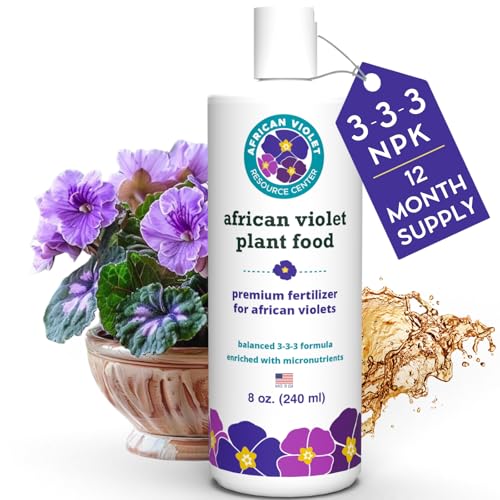
This liquid formula from Houseplant Resource Center takes a fundamentally different approach from the bloom-booster philosophy. The evenly balanced 3-3-3, fortified with sea kelp, humic acid, and fulvic acid, prioritizes long-term root health and steady foliage growth rather than forcing flowers. The humic and fulvic acids act as chelating agents, improving nutrient uptake in potting mixes that have become slightly alkaline or compacted—a common issue in older violet collections.
Owners of large collections (30+ plants) report that this formula allows them to feed weekly without fear of salt buildup or root burn, which is critical when wick-watering dozens of plants from a single reservoir. One verified owner with 40 violets—including rare Flame varieties—noted measurable growth and new blooms within two weeks of switching to this concentrate. The dilution is simple: one teaspoon per gallon of water.
The 8-ounce bottle is smaller than some competitors, and while the balanced ratio is ideal for maintenance, growers seeking maximum bloom output may need to supplement with a phosphorus boost during the flowering cycle. The absence of a strong odor is a welcome surprise for an additive that includes seaweed-based ingredients.
What works
- Humic and fulvic acids improve nutrient absorption
- Gentle enough for weekly use without root damage
- No strong smell despite seaweed content
What doesn’t
- Smaller bottle size relative to price
- Balanced ratio may not trigger blooms in stubborn plants
- Requires shaking well before each use as it can separate
3. TPS Nutrients African Violet Fertilizer, 32 oz
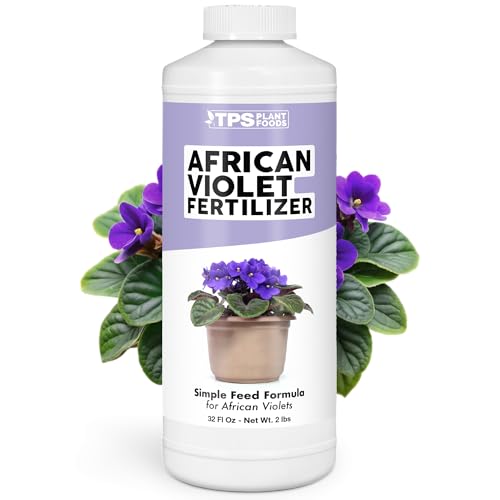
TPS Nutrients delivers the largest liquid volume in this roundup at 32 ounces, making it the obvious choice for growers maintaining double-digit collections or for those who prefer not to reorder frequently. The formula is designed to support continuous blooms and rich leaf coloration without the root stress that aggressive synthetic boosters can cause. The NPK breakdown is not explicitly stated on the packaging in the same way as Jack’s Classic, but user reports indicate it strikes a moderate middle ground suited for both growth and flowering.
Verified buyers highlight that violets that had not bloomed in months put out new flower stalks within two to three weeks of switching to this feed. The liquid format integrates seamlessly into bottom-watering trays and wick systems, and the larger opening of the 32-ounce bottle makes measuring and pouring significantly less messy than smaller concentrate bottles. Multiple reviewers also noted they used it successfully on other Gesneriads (Streptocarpus, Episcia) with no ill effects.
Because the exact NPK figures are not front-and-center on the listing, more analytical growers who want to track precise nutrient loads may find it less transparent. The bottle also lacks a graduated measuring feature, so you will need an external measuring spoon or syringe for consistent dosing.
What works
- Massive 32-ounce bottle offers the best volume per dollar
- Gentle enough for sensitive root systems
- Works across multiple Gesneriad species
What doesn’t
- Exact NPK ratio is not clearly listed
- No measuring features built into the bottle
- Large bottle can be inconvenient for small spaces
4. Schultz African Violet Plus Plant Food 8-14-9
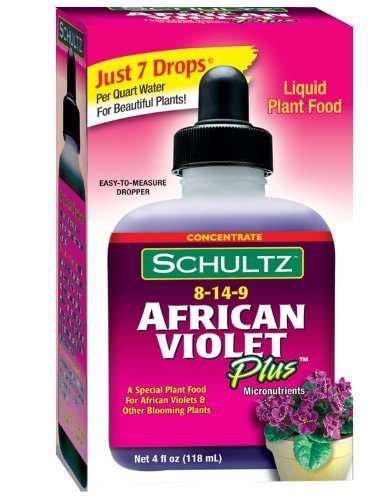
Schultz positions this formula as a dedicated African Violet Plus blend with an 8-14-9 NPK profile that leans moderately toward phosphorus without going to the extreme of a 12-36-14 ratio. This makes it a practical middle ground for growers who want more flowers than a balanced feed provides but do not want to commit to the high-phosphorus rotation schedule required by specialized bloom boosters. The 4-ounce bottle is compact but highly concentrated, delivering a 1:400 dilution ratio.
Long-term users (some reporting six months of consistent use) describe vibrant, non-stop blooming cycles even in homes with dry air, where African violets typically struggle to hold buds. The liquid mixes clear and leaves no detectable odor or residue on leaves, even when used in a foliar spray. It is explicitly formulated for the entire Gesneriad family, so it is safe for Streptocarpus, Episcia, and other relatives if you grow mixed collections.
The 4-ounce bottle is small, and the high dilution can catch beginners off guard—using too much concentrate can quickly cause salt damage. The manufacturer recommends one drop per quart rather than a teaspoon-based measurement, which some users find fiddly compared to scoop-based powders.
What works
- Moderate phosphorus boost without extreme ratios
- No odor or residue on leaves
- Suitable for all Gesneriads, not just violets
What doesn’t
- Small 4-ounce bottle concentrates are easy to over-dose
- Drop-based measurement is less convenient than scoops
- Not ideal for large collections needing frequent refills
5. Espoma Organic Violet! Concentrated Plant Food, Pack of 2
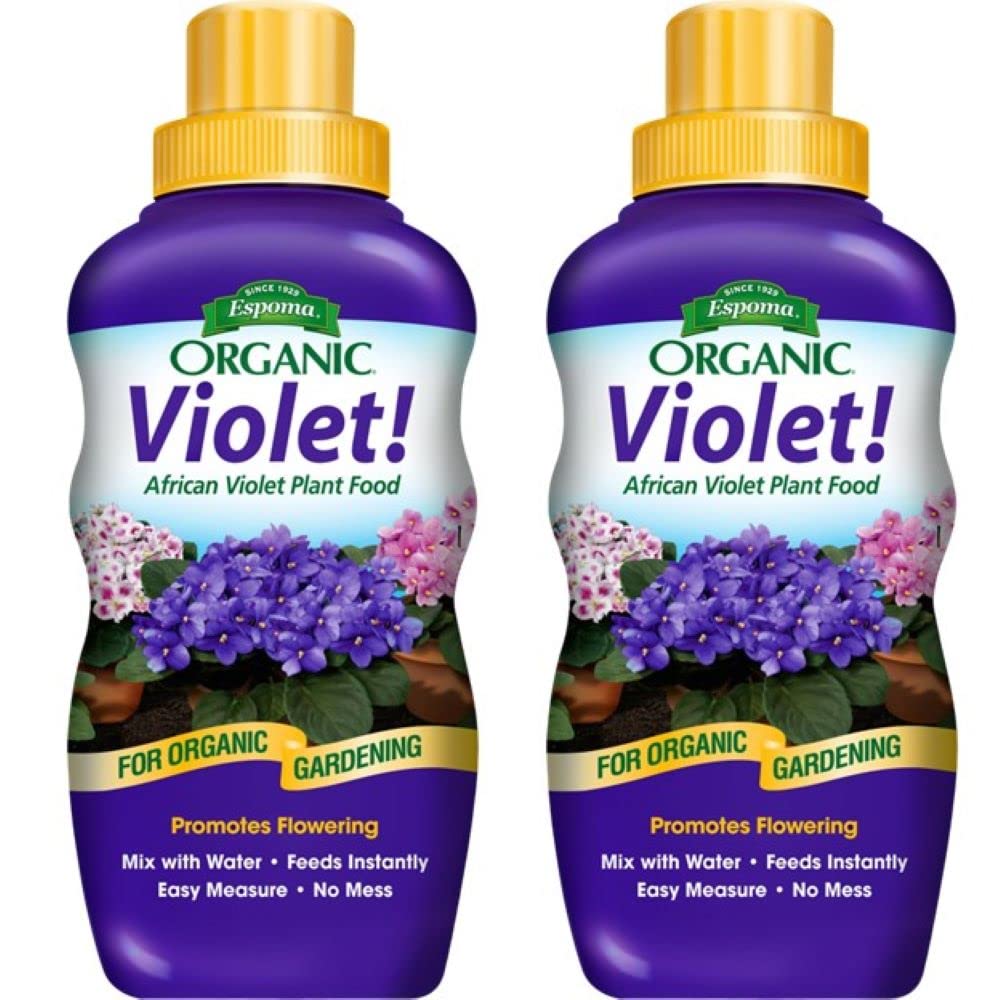
Espoma’s Violet! is the only organic entry in this lineup, and it comes as a two-pack of 8-ounce bottles for a total of 16 fluid ounces of concentrate. The organic certification means it relies on natural nutrient sources rather than synthetic salts, which makes it a strong candidate for households with children or pets who might come into contact with spilled fertilizer water. Users report consistent blooming cycles when used on a two- to four-week schedule during the growing season.
The formula contains essential nutrients derived from natural organic matter, and while Espoma does not publish a standard NPK ratio on the bottle, it performs similarly to a mild balanced feed when diluted at half a cap per quart of water.
The organic ingredients produce a noticeable earthy or fish-based smell during mixing, which some indoor growers find unpleasant. Also, because organic nutrients depend on microbial activity in the soil to break them down, results may be slower in sterile potting mixes that lack active soil biology.
What works
- Organic formula safe around pets and children
- Two-bottle pack provides excellent total volume
- Produces reliable blooms with consistent use
What doesn’t
- Organic sediment separates aggressively—must shake well
- Noticeable earthy/fish smell during mixing
- Slower results in sterile or soilless potting mixes
6. Perfect Plants Liquid African Violet Food Drops 2-2-2
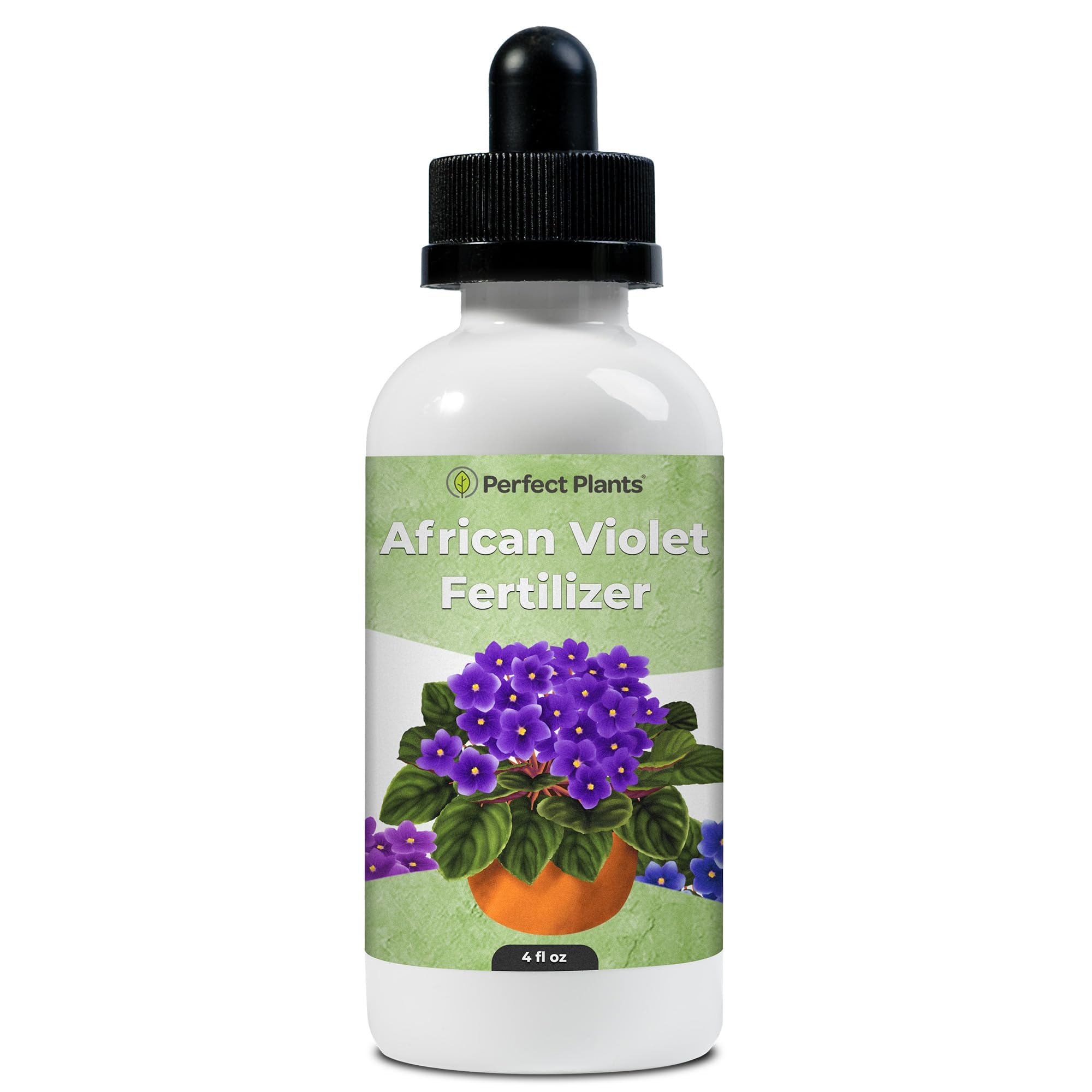
Perfect Plants takes an entry-level-friendly approach with a pipette dropper that dispenses 5 to 8 drops per 32 ounces of water, eliminating the need for measuring spoons or syringes. The NPK ratio is a gentle 2-2-2, which is even milder than the balanced 3-3-3 from Houseplant Resource Center, making this about as close to a “foolproof” African violet feed as exists. New growers who are nervous about burning their plants will appreciate the built-in margin for error.
The 4-ounce bottle is compact, but the low concentration means a single bottle will last a long time for someone with one or two plants. Verified reviewers report that stressed plants perked up noticeably after the first feeding, and the drop-based system makes it easy to incorporate into every-watering routines. The formula is also free from the strong odors associated with organic fish-based feeds.
For experienced growers with large collections or demanding hybrid varieties, the 2-2-2 ratio may be too weak to drive significant blooming. It is best viewed as a maintenance formula for plants already in decent health, not a rescue feed for nutrient-deficient or struggling violets.
What works
- Pipette dropper allows precise, beginner-friendly dosing
- Ultra-gentle 2-2-2 formula virtually eliminates burn risk
- No unpleasant odor
What doesn’t
- 2-2-2 ratio is too weak for aggressive bloom pushing
- Small 4-ounce bottle, not economical for large collections
- Low concentration requires frequent reordering
7. Bonide 106 Liquid African Violet Plant Food, 8 oz

Bonide 106 is a straightforward liquid concentrate specifically formulated for African violets, with a recommended mixing ratio of just 1/8 teaspoon per quart of water. The 8-ounce bottle is larger than the Schultz or Perfect Plants bottles, making it a budget-friendly entry point for one or two plants. Users who feed with every watering report continually blooming violets, which speaks to the formula’s compatibility with frequent low-dose feeding schedules.
That said, the product has a notable quality-control issue: multiple verified reviews describe the bottle arriving partially empty due to leaks during shipping, and the lid is reported to clog after several uses, forcing users to remove the cap and pour rather than use the built-in dispenser. These packing and packaging problems do not affect the formula’s performance, but they add friction to an otherwise simple product.
The NPK ratio is not clearly advertised on the listing, which makes it difficult to compare directly with other formulations. For growers who prioritize transparency and precise ratio tracking, this lack of data may be a dealbreaker. It works well as a low-cost standby, but the packaging reliability concerns push it behind the more consistent alternatives.
What works
- Very low per-dose cost for single-plant households
- Works well with every-watering feeding schedules
- 8-ounce bottle lasts a long time at 1/8 tsp per quart
What doesn’t
- Frequent reports of leaking bottles during delivery
- Lid clogs after a few uses
- NPK ratio is not clearly disclosed
Hardware & Specs Guide
Water-Soluble Powder vs. Liquid Concentrate
Water-soluble powders like Jack’s Classic require dissolving in water before each use but offer superior shelf stability and typically include chelated micronutrients that stay bioavailable across a pH range of 5.5 to 7.0. Liquid concentrates are ready to dilute and disperse more evenly in bottom-watering trays, but they can separate or degrade if exposed to temperature swings or stored for more than one growing season. For wick systems, liquids are generally preferred because they do not leave undissolved solids that could clog the wick fibers.
NPK Ratio and Its Effect on Violet Life Cycles
African violets respond differently to each macro-nutrient depending on their growth stage. A high-nitrogen ratio (first number above 10) encourages leaf production and can suppress flowering if used exclusively. A high-phosphorus ratio (second number above 20) triggers bud formation and is best deployed when the plant has a mature crown with at least three rows of leaves. The potassium number (third number) supports general vigor and disease resistance. Rotating between a balanced feed (3-3-3 or 2-2-2) and a bloom booster (12-36-14) every other month provides the most consistent results across the entire growing season.
FAQ
How often should I feed my African violet with liquid fertilizer?
Can I use regular houseplant fertilizer on African violets?
What does it mean if my violet’s leaves are curling downward after feeding?
Should I use fertilizer in a wick-watering system?
How do I know if my African violet needs more phosphorus?
Final Thoughts: The Verdict
For most gardeners, the best african violet plant food winner is the Jack’s Classic 12-36-14 because it delivers unmatched bloom performance for the lowest cost per gallon, and its urea-free chemistry is safe for even the most sensitive Gesneriads. If you want a gentle, balanced formula that you can use every week without thinking about rotation, grab the Houseplant Resource Center 3-3-3. And for organic households or growers with children and pets, the Espoma Organic Violet! two-pack provides reliable results with natural inputs.