
Specs are compiled from manufacturer listings and verified buyer reviews and can change over time — please confirm the key details on the product page before buying.
Clay soil is the toughest test for any lawn tool. It turns brick-hard when dry, clogs hollow tines within minutes, and laughs at flimsy spike aerators that just poke holes. The fix is a core aerator with hollow tines that extracts soil plugs, giving roots room to breathe. This guide sorts through manual and tow-behind options that genuinely handle clay, not just photo-ready models.
I’m Rikta — the founder and writer behind Lawn Gear Lab. This guide is built by comparing the manufacturers’ published specifications and the patterns across verified customer reviews, so you get each pick’s real strengths and trade-offs instead of marketing spin.
Clay soil demands a tool that pulls plugs, not just pokes holes. The best aerator for clay soil combines sharp hollow tines, a smart ejection system, and enough weight to bite into hard ground.
Our Picks at a Glance
How To Choose The Best Aerator For Clay Soil
Clay soil is dense, sticky, and compacts easily, which blocks water and air from reaching your grass roots. A core aerator with hollow tines pulls out soil plugs, relieving compaction instead of worsening it. Your choice hinges on yard size and your tolerance for manual labor.
Manual vs. Tow-Behind — the real fork in the road
Manual aerators — step-and-pull tools with 3 or 4 tines — are precise and affordable. They shine on small to medium lawns, but they are genuine physical labor. Tow-behind aerators attach to a riding mower or ATV and turn a two-hour workout into a 20-minute drive. For a large yard on heavy clay, the tow-behind is the only sane option, despite the higher cost.
Why hollow tines matter more than anything
Spike aerators press solid rods into the soil, which only compacts the clay further around the hole. Hollow tines — metal tubes with open ends — lift a plug of soil out entirely. Each extracted plug leaves a channel for air, water, and fertilizer to reach roots directly. On clay, this is the difference between real relief and a wasted afternoon.
The moisture rule that can’t be skipped
Every serious owner report repeats the same lesson: aerate when the soil is moist. Dry clay fights the tines and clogs them almost instantly. A good soak the day before (many manuals suggest 24 hours) softens the ground so the tines slide in and eject plugs cleanly. Work the tool vertically — push and pull straight down — and skip sideways twisting to avoid bending the tines.
What to check before you buy
Look for replaceable tines — they wear out on rocky clay and being able to swap them extends the tool’s life. Consider tine depth; 3 to 4 inches is typical for manual units. Check the ejection mechanism; a design that pushes plugs out the side or top beats one that clogs. And weigh the tool itself — heavier steel penetrates better but tires you out faster.
Quick Comparison
| Model | Best For | Tines | Depth | Weight | Amazon |
|---|---|---|---|---|---|
| Lawn Aerator Tool (Alloy Steel)★ Best Overall | Small-to-medium yards, side-ejection design | 3 hollow tines | — | 5.69 lbs | Amazon |
| Manual Core Aerator (Zalawn)Best Value | 4-inch deep plugs, compacted soil | 3 hollow tines | 4 inches | — | Amazon |
| Heavy Duty Steel Hollow Tine (hugeneroy)Clay Specialist | Clay-specific, anti-clog beveled tines | 3 hollow tines | — | — | Amazon |
| Dolibest Lawn Coring Aerator | Small areas, stainless steel 4-tine | 4 coring plugs | 3.5 inches | 5.46 lbs | Amazon |
| Lifeswell Coring Aerator | Small-to-medium yards, storage tray | 4 coring plugs | 3.5 inches | — | Amazon |
| Landzie Original Hollow Tine | 42-inch reach, clog-free beveled tines | 3 stainless steel tines | — | 5.6 lbs | Amazon |
| Suchtale 40-Inch Tow Behind | Large lawns, universal hitch | 24 coring plugs | 2 inches | 55 lbs | Amazon |
| AeroCore Rolling Aerator | Large yards, rolling push design | 7 hollow tines | — | 50.8 lbs | Amazon |
| Brinly Tow Behind Plug Aerator | Large lawns, 150-lb weight tray | 24 plugging spoons | 3 inches | 63.9 lbs | Amazon |
In-Depth Reviews
1. Lawn Aerator Tool, Core Aerator Lawn Tool with Alloy Steel Material
Our pick — over 4.5★ from 100+ verified ratings; the strongest balance of quality and price.
The side-ejecting champion that skips the clogging fight entirely.
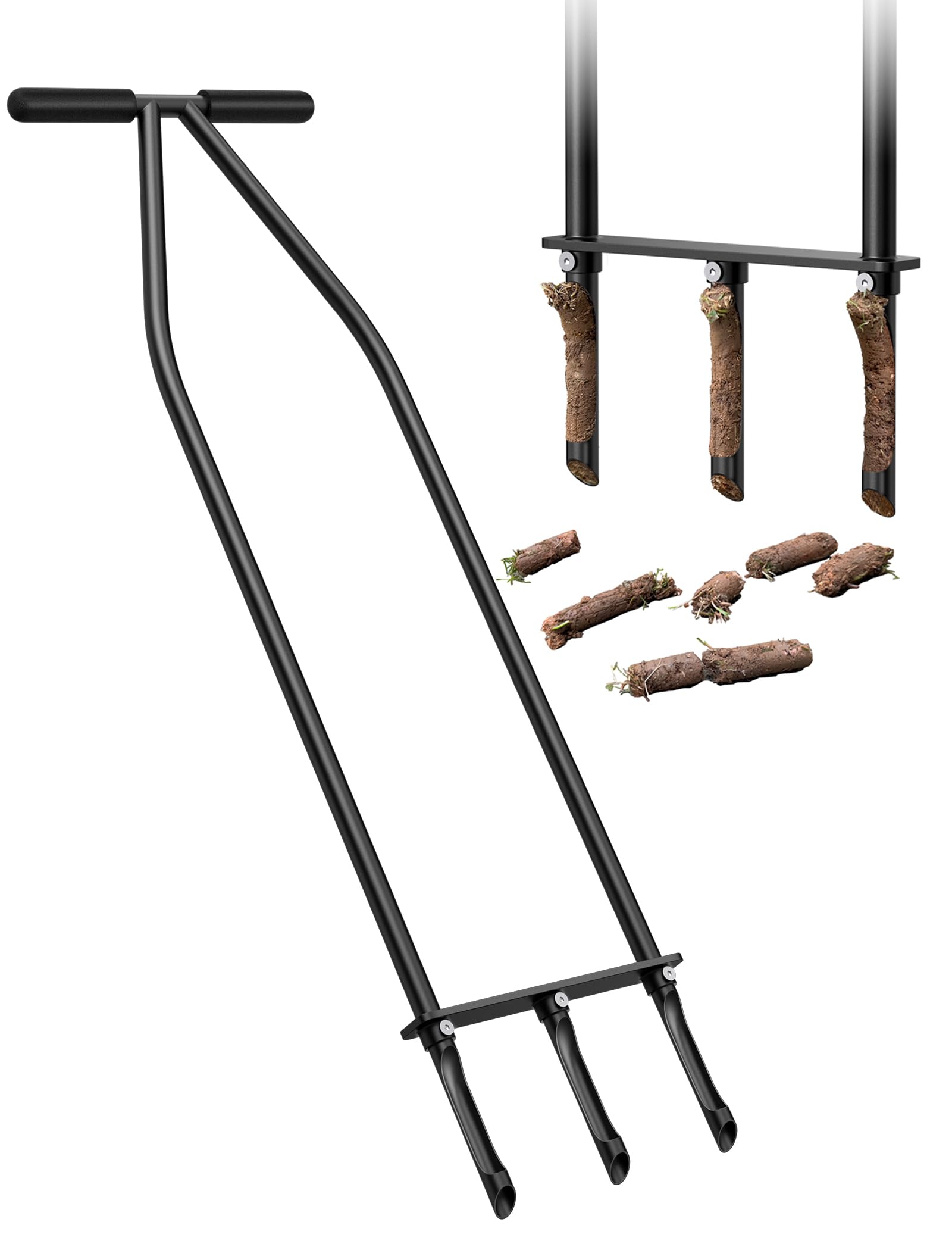
Instead of fighting jammed tines every few steps, this tool pushes soil plugs out the side through a ramp designed after extensive testing. That patented side-ejection geometry is the single biggest reason clay owners stop hating aeration — the plugs slide out easily, so you keep moving instead of stopping to poke them free. At 5.69 pounds, it is light enough to drag around a yard, and the 42 x 11 x 1.9-inch frame gives you reach without turning the work into a heavy-lifting session.
The 3 hollow tines pull real soil cores to loosen compaction, letting air and water reach the roots. The alloy steel frame is integrally formed, which buyers report feels sturdy and well-built right from the start. Assembly is quick, and one owner noted the included tool for tightening loose tines — a small touch that keeps the tool working season after season.
Owners mention real-world proof: one owner aeration about 1000 square feet of St. Augustine grass in central Florida, noting it works far better than the Corona aerator sold at home improvement stores. The recurring advice is in the manual: moist soil makes the job dramatically easier. If pressing down feels too hard with all 3 tines in hard ground, you can remove the middle tine — they connect with screws and are replaceable.
Why owners stick with it
- Side-ejection ramp keeps plugs from clogging the tines
- Replaceable hollow tines extend the tool’s lifespan
- Removing the middle tine eases work on very hard ground
Who should think twice
- One owner developed hip bursitis from pushing too long — take breaks
- Works best on moist grass, so you must plan around rain or watering
Reach for this if: you want a sturdy, light manual aerator whose side-ejection design saves you from the clogging frustration that kills most clay-soil projects.
Look elsewhere if: you have a very large yard or a physical condition that makes repeated stepping painful — this is a workout, not a machine.
2. Manual Core Aerator Lawn Tool with 3 Non-Clogging Hollow Tines
Four-inch core depth that punches through hard-packed soil with body weight.
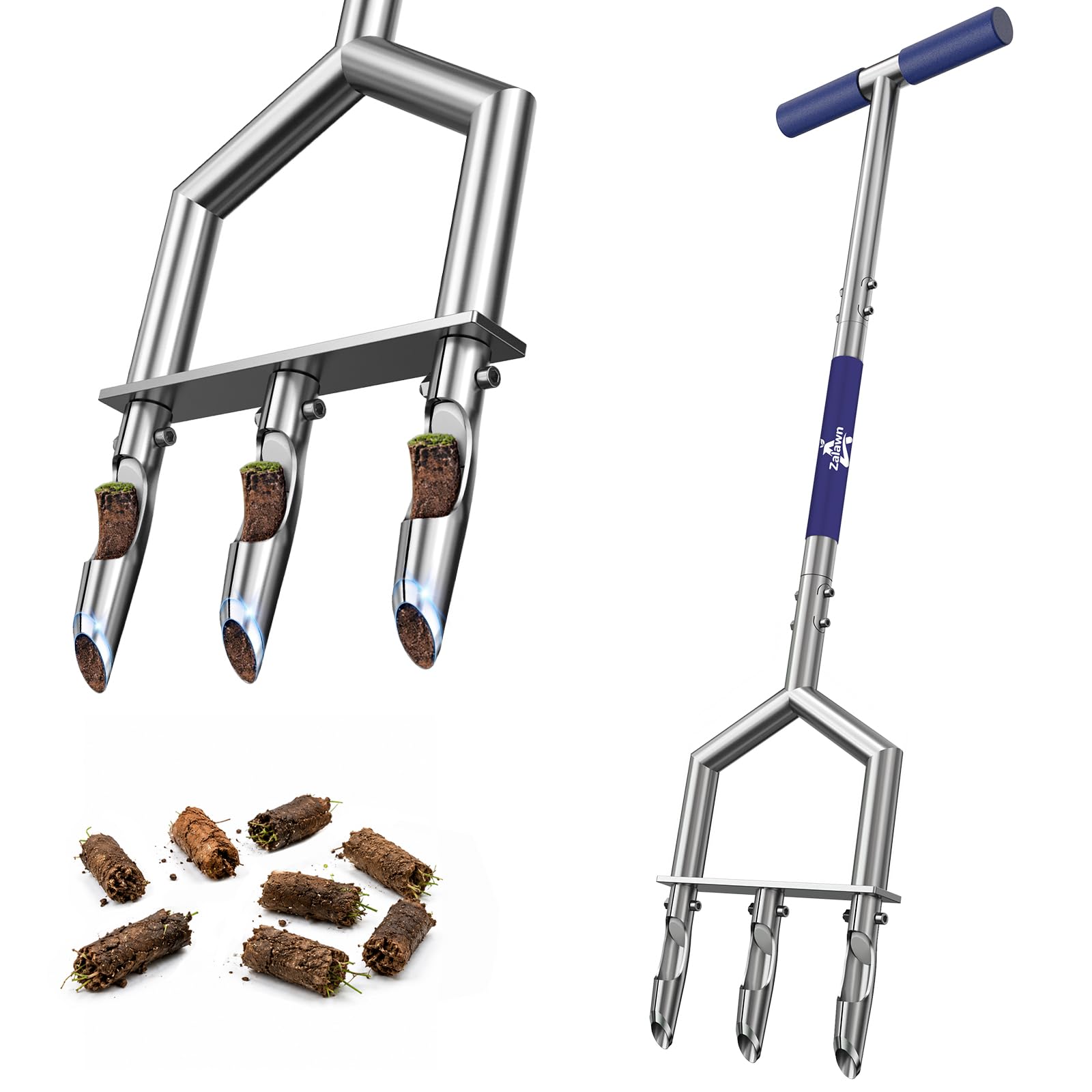
Stepping down on the wide foot bar, your body weight does the work — customers note this tool is easy on hard-packed soil, covering a 10×10 ft section in under 10 minutes. The 3 sharp hollow tines reach up to 4 inches deep, extracting real soil plugs so water, oxygen, and fertilizer bypass the thatch layer and hit the root zone. Unlike spike aerators that just poke holes, this one relieves compaction where it counts.
Heat-treated steel tines resist the bending and snapping common in cheaper iron models, and reinforced connection joints add stability when you hit tough, compacted earth. The ergonomic rubber grip reduces hand fatigue and prevents blisters during longer sessions. The tool arrives semi-assembled, so you skip the headache of complex instructions and get straight to work in minutes.
The non-clogging design ejects dirt plugs smoothly with every step, letting you work continuously without stopping to clear the tines. Reviewers point out that the dirt-redirect insert does its job, though it can clog in dry or hard soil — a reminder that watering first is non-negotiable on clay. The replaceable tines are designed for years of reliable use, and one owner’s unit survived 7 weeks outdoors with only 2-3 tiny rust spots.
Small footprint, big bite: the 15.5 x 10.5 x 3-inch dimensions make it far more compact than the 42-inch alloy model above — easier to store in a shed corner, yet it still pulls full 4-inch cores.
Best for: the budget-conscious homeowner with a small-to-medium lawn who wants real core depth without a large, heavy frame.
One caveat: dry, hard clay will test the anti-clog insert — soak the lawn first and this tool performs like one costing far more.
3. Heavy Duty Steel Hollow Tine Core Aerator for Clay Soil, Non-Clog
The anti-clog beveled tines that slice through compacted clay instead of smashing into it.
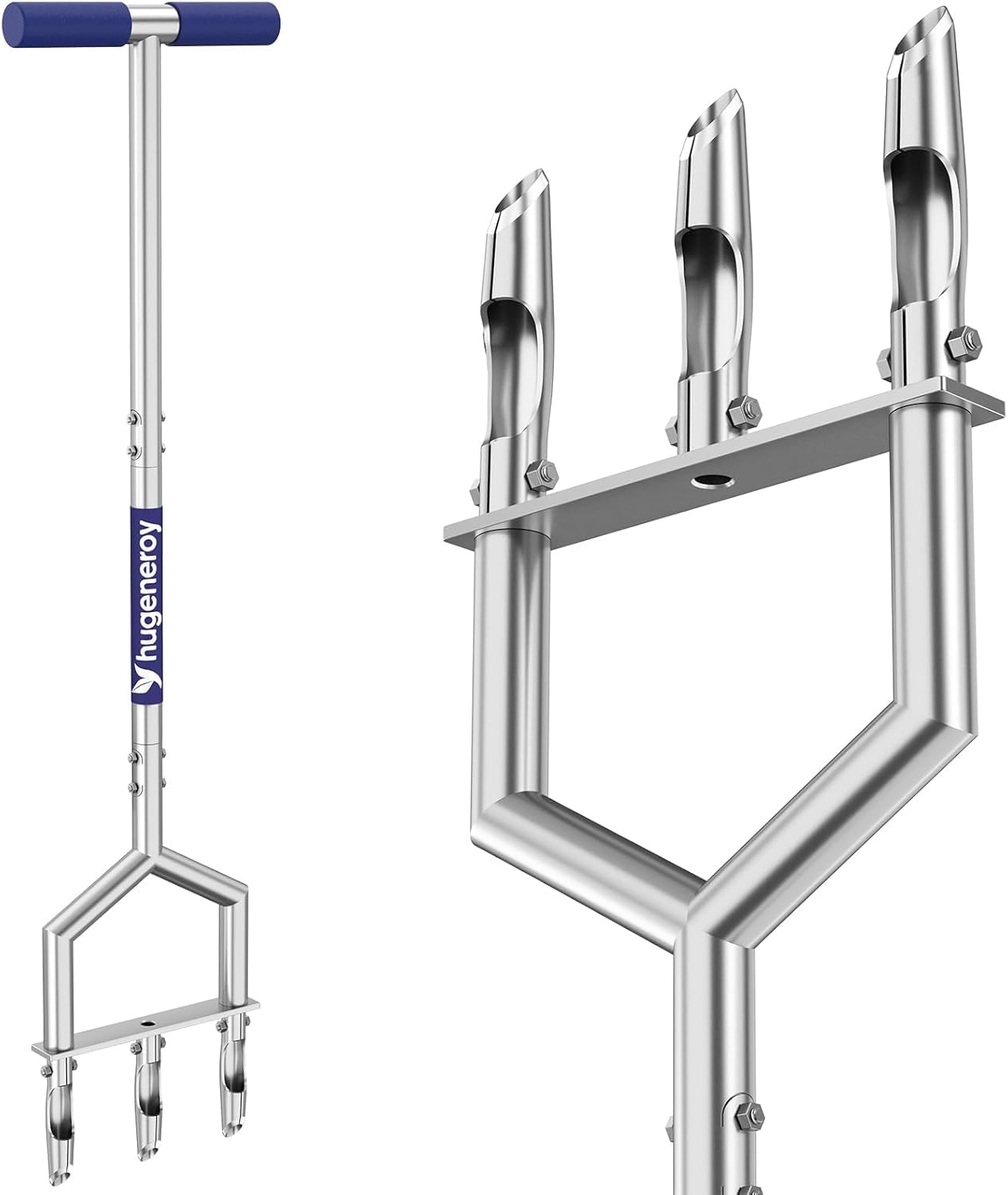
Effectiveness is what wins people over here — it is the single most-mentioned aspect, with owners reporting the tool works well on clay soil and that the steel tines penetrate compacted ground effectively. The precision-engineered beveled spikes slice through compacted earth with minimal effort, maintaining structural integrity through repeated soil extraction. This is a tool built for serious gardeners who see aeration as a routine job, not a one-time chore.
Quality and durability follow close behind in owner feedback — an early report notes the stable, no-flexing feel during use and clean channels left for water, air, and nutrients. The heavy-duty steel construction is designed to endure decades of rigorous use, and the 3 deep-drilling tines reduce compaction while improving drainage. Shoppers say it is superior to the Nowcamp 4-plug model, covering large areas fast with easy plug ejection.
The straightforward honesty of the guidance stands out: water dry areas 24 hours before use, push and pull the tool vertically without sideways twisting, and avoid prying motions when tines are underground. Follow that and the tines slide in cleanly, eject plugs reliably, and never bend or warp. Assembly takes just minutes with the included tools, and it arrives ready to work right from the start.
Real talk on durability: one owner reports pushing through 90% of a yard on clay, rock, and compacted soil before the tool broke. That shows even sturdy steel has limits, and wetting the soil first genuinely reduces wear.
Choose this when: clay is your dominant soil type and you want a tool explicitly designed to handle it, with effectiveness and durability as the top owner-reported strengths.
Think twice if: you are tall — a couple of owners noted the connection bolt can hit your inner knee on some leg lengths; a recessed cover would be a welcome improvement.
4. Dolibest Lawn Coring Aerator, Stainless Steel 4 Corer Plug Aerator
Four stainless corers that keep working even when owners mention heavy clay.
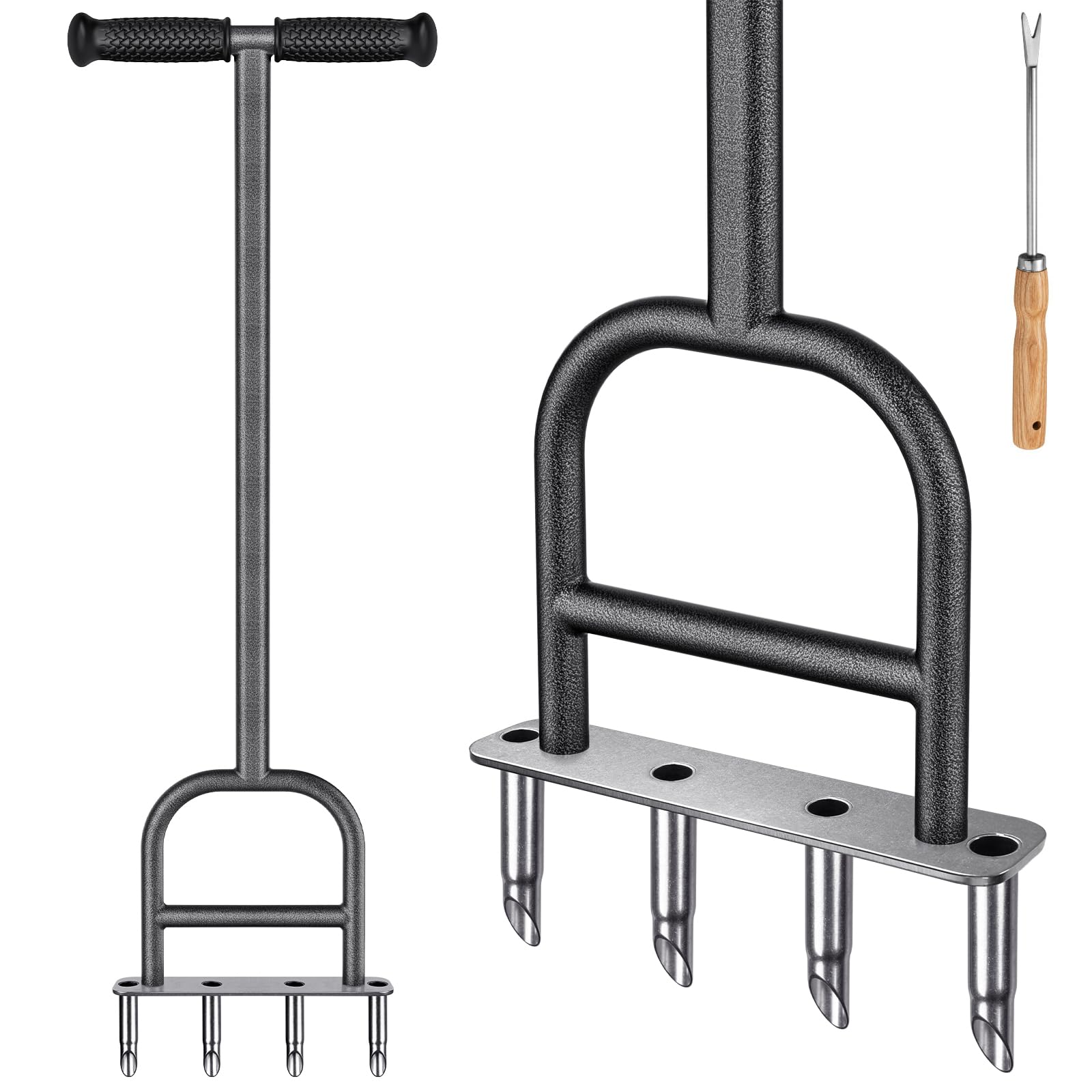
Functionality leads the praise here — it is the biggest owner-reported strength by a wide margin, with over 40 owners singling it out. The 4 corer plugs each measure 3.5 inches long and 0.5 inches in diameter, creating soil plugs that are deep and narrow. Buyers report it works even in heavy clay and is particularly well-suited for small areas, making it a smart choice for patching dead spots or keeping a modest lawn healthy.
Construction ranks second, with owners praising the single welded construction and all-steel build with a black powder-coated finish. The stainless steel bottom and corer plug resist rust and bending, and the soft rubber grip prevents your hands from getting tired or blistered. A thoughtful foot bar keeps your shoes from interfering with the ejection of the core, so plugs come out cleanly on each step.
The honest trade-off is clogging — 17 owners flagged it as an issue, especially with dry clay soil. The experience splits sharply: one owner found it works best on sufficiently dry soil, while another reported it clogs on dry clay. The manual’s advice is to work on moist grass, and one owner found a rolling foot motion easier than pushing all tines straight down. A 12-inch weeder hand tool rides along for cleaning the aerator, transplanting seedlings, or weeding between rows.
Light and sturdy: at 5.46 pounds, it feels light in your hand, yet owners describe it as sturdy with sharp spikes that penetrate easily. It is ideal for smaller jobs where a heavy 3-tine tool feels like overkill.
Grab it for: small-to-medium lawns and spot-treatment where the 4-plug design covers more ground per step than a 3-tine tool.
skip it if: your clay is frequently bone-dry — you will be cleaning out the corers often unless you water the lawn first.
5. Lawn Coring Aerator Tool, 4 Core Stainless Steel Manual Aerator
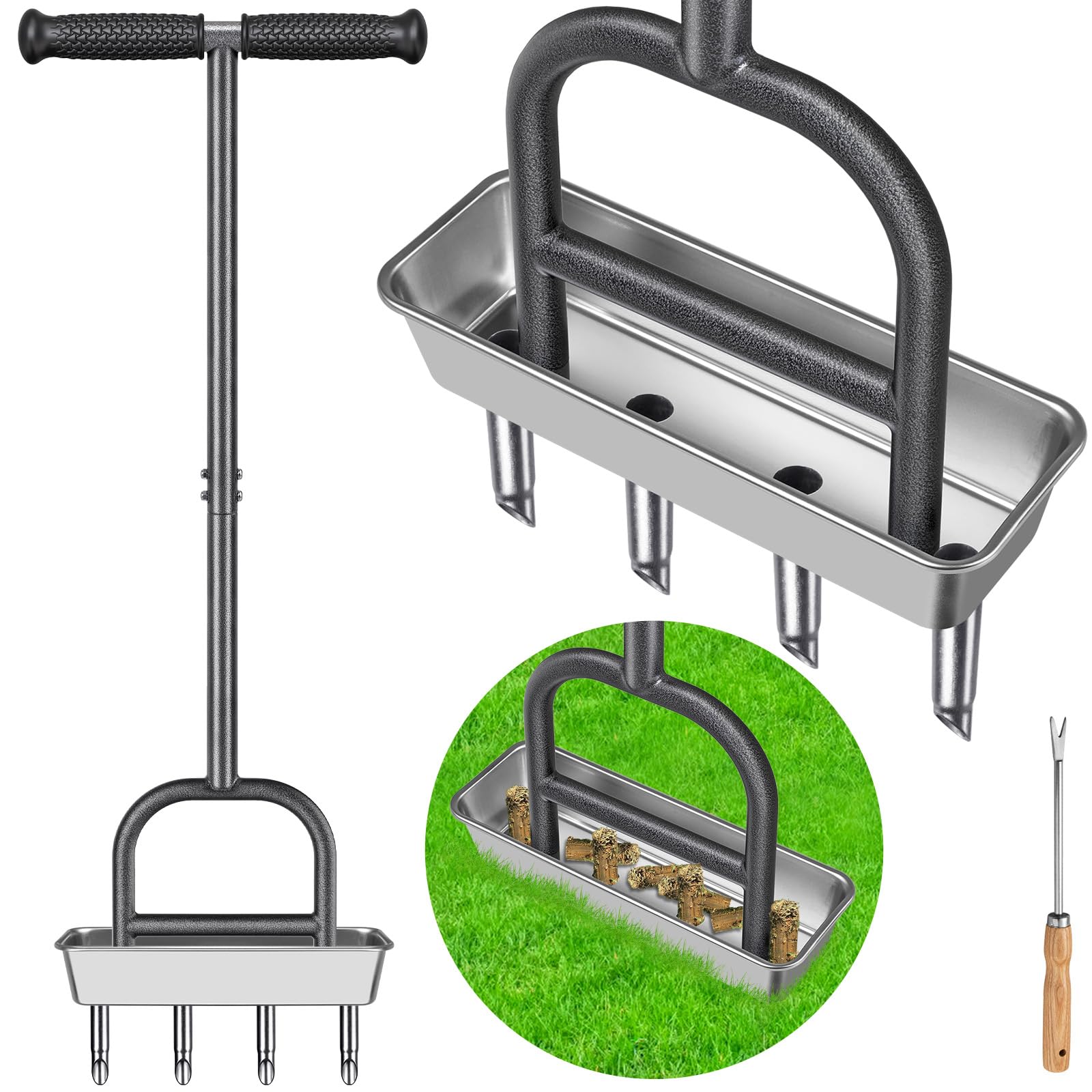
The coring aerator that catches its own mess with a built-in storage tray.
Where most aerators scatter soil plugs across your lawn, this one collects them in a dedicated storage tray — a small feature that owners genuinely appreciate for keeping patios and walkways tidy. The 4 stainless steel coring plugs, each 3.5 inches long and 0.5 inches in diameter, penetrate compacted soil deeply to improve root access to air, water, and nutrients. The tapered spike design minimizes clogging and keeps aeration smooth.
Owners describe the tool as strong, sturdy, and easy to assemble, with the stainless construction earning particular praise. The ergonomic rubber handle reduces hand fatigue for prolonged use, and the bend-proof stainless steel core with reinforced joints is built for heavy-duty work. A hand tool is included to make soil removal from the core easy during the final insertion.
The honest friction comes in the details. Several owners mention the hex nuts are hard to get on during assembly and tend to loosen during use — you will likely be stopping to retighten them. The storage tray does contain the plugs, but it fills up until the corers clog, and wet soil is required for best performance. Customers note plugs stick inside the channel unless the ground is sufficiently wet, so the pre-watering step is essential here.
A cleaner workflow: the storage tray sets this apart from every other manual aerator here — no raking plugs off the driveway afterward, just tip the tray and go.
Best suited for: tidy homeowners who want the convenience of collected soil plugs and a sturdy stainless build for small-to-medium lawns.
Keep in mind: the loosening screws are a recurring gripe — carry a wrench or apply thread-locker on assembly day.
6. The Original Hollow Tine Lawn Aerator Tool — 42 Inch Core Aerator
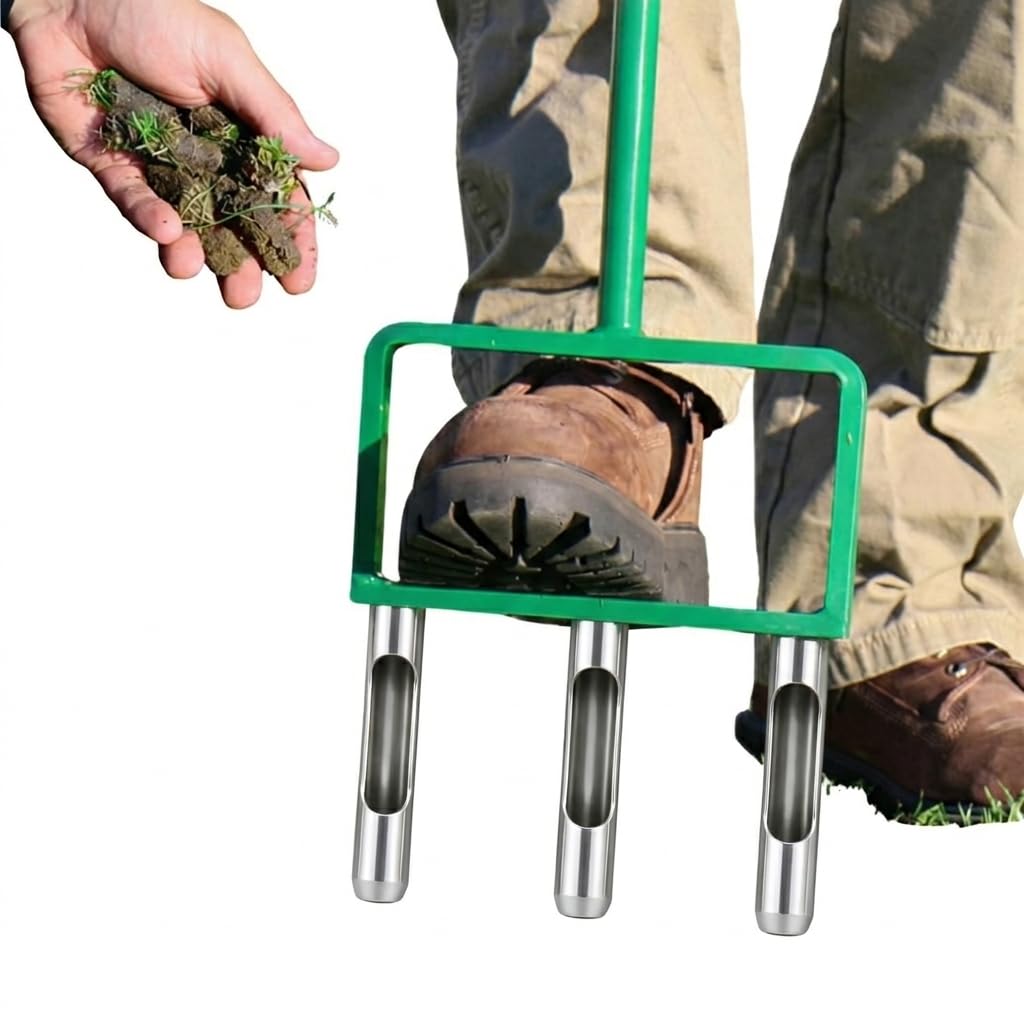
The 42-inch no-assembly tool professionals trust because it simply works.
Effectiveness is the top owner-reported strength by far, and the reason is the revolutionary clog-free beveled tine design. Three solid, stainless steel tines break up soil and push old material up and out each time you press the tool into the ground — no manual unclogging required. Reviewers point out the open tine design ejects plugs with no issue, a genuine relief on dense clay where most aerators jam within minutes. Build quality and construction trail close behind in the praise, with owners noting it will last many years.
The tool arrives completely assembled — no instructions, no wrenches, no frustrating first-hour assembly session. Workers report the tines can be removed easily for cleaning and replacing, and the powder-coated, durable steel is built to withstand demanding jobs from landscapers and professionals. At 5.6 pounds, the 42-inch reach covers a generous arc without adding unnecessary heft to your arms.
The unmistakable trade-off is effort — owners describe aeration as physically demanding, with one athletic 6-foot, 225-pound owner managing about 1000 square feet but calling it a real workout. The technique that emerges from owner experience: moisture is everything. Work 1-2 days after rain for best results, and on a 2,200 square foot lawn, expect a 4-hour session that one owner joked was like cross-fit. The plus side — replaceable solid tines and a durable handle suggest a lifetime tool, and owners say they would choose Landzie over budget brands.
A workout, not a chore: owners consistently praise the self-cleaning, clog-free design but warn about physical strain. This tool suits someone who wants the job done right and does not mind the effort.
Reach for this if: you want a ready-out-of-the-box professional-grade tool with proven clog-free performance on clay, and you have the stamina for a manual session.
Think twice if: you have a large lawn — one owner on 1200 square feet of compacted soil recommended a machine rental instead, and the effort only scales up from there.
7. Suchtale 40-Inch Tow Behind Plug Aerator with Universal Hitch

Twenty-four heat-treated plugs that turn a dreading chore into a relaxing tractor ride.
Forget the stoop-and-step rhythm of a manual aerator. This 40-inch tow-behind unit attaches to your riding mower or ATV with a universal hitch, and you do the whole yard from the comfort of your seat. The 24 heat-treated plugs each penetrate compacted soil up to 2 inches deep, letting water, seed, and nutrients reach the roots. Shoppers say it did several acres with ease, with functionality and durability leading the owner praise.
The all-steel design includes a weight tray that holds up to 125 pounds of added weight — cement blocks or bricks — for increased soil penetration on stubborn ground. The 2-piece steel draw bar with universal hitch pin connects quickly, and the transport handle makes raising and lowering the plugs simple when crossing driveways and walkways. Buyers report it handles clayish soil well after a quarter-inch of rain and supports up to 5 cinder blocks for extra bite.
Assembly is the main friction point, landing as the most-mixed owner aspect. Some find it easy in 1-2 hours solo, while others say the instructions are not always clear. One owner reported missing bolts that Amazon resolved, and another felt the tool was built weak after it fell apart. The consensus: this is a solid value for large yards, but be prepared for a variable assembly experience and consider adding washers on the axle brackets to reduce lever play.
Effort goes to zero: the whole point of tow-behind is saving your back — owners confirm it is fast and sturdy on big properties, though it is less maneuverable on hills than smaller models.
Choose this when: you have a riding mower or ATV, a large flat yard, and you want to aerate without breaking a sweat.
pass on it if: your yard is small or hilly — the wide, heavy frame needs room to turn and a tractor to pull it.
8. AeroCore Rolling Lawn Aerator — Manual Core Plug Aerator
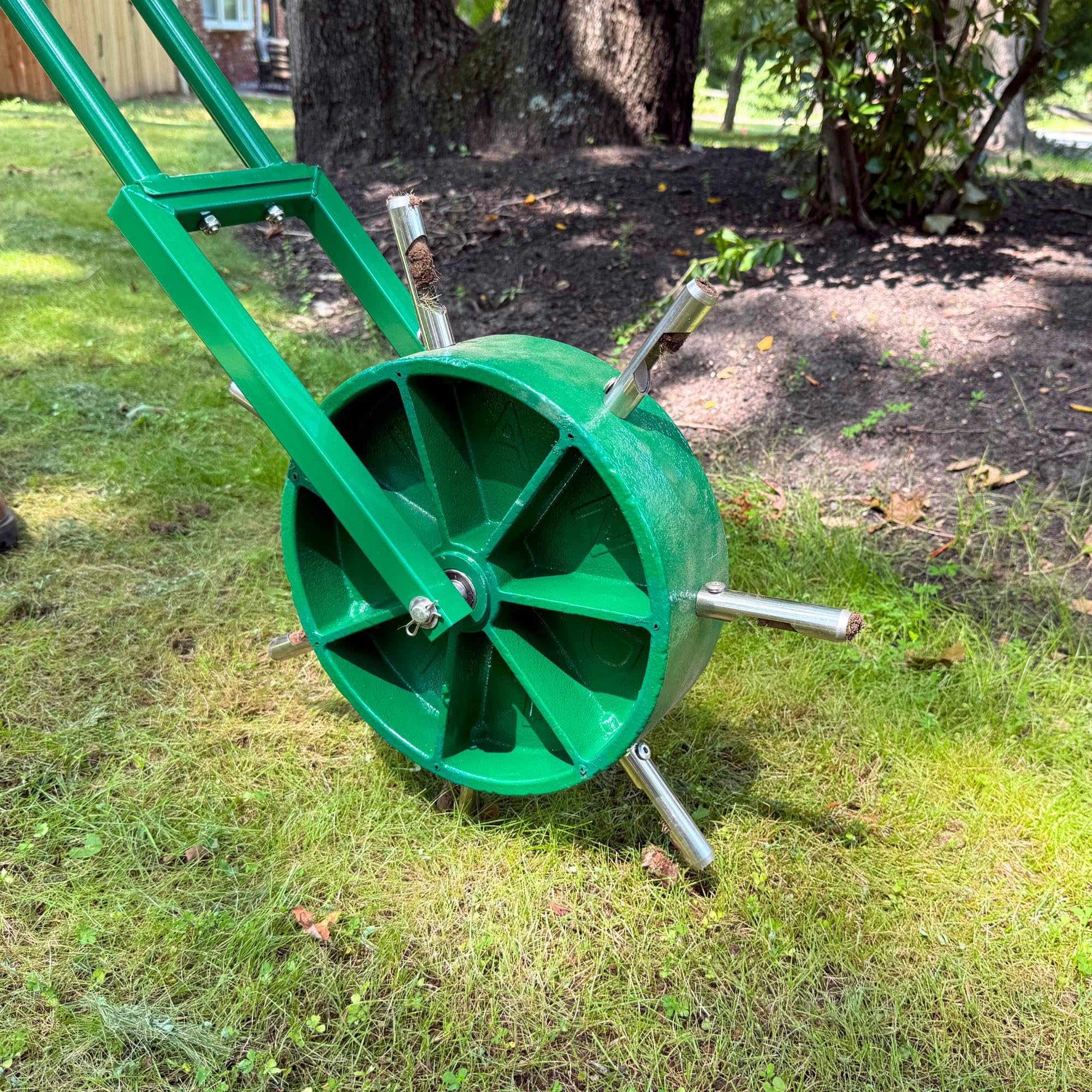
The rolling 50.8-pound drum that does the stepping for you.
This is the bridge between manual and tow-behind — a push roller with 7 stainless steel hollow tines that roll forward and backward, ejecting soil cores as they go. The rolling design removes the constant stepping motion of a manual aerator, so you walk the yard pushing instead of stomping. Owners mention impressive performance, covering 4500 square feet in about 2 hours at 6-inch spacing — a pace no step-aerator can match.
The weight does the work. At 50.8 pounds, this powder-coated heavy-duty steel drum is heavy enough to penetrate tough soil without needing extra ballast, yet light enough to maneuver around obstacles. The wide-diameter chamfered tines remove and eject soil cores as they roll, preventing clogging for continuous aeration. Owners describe the self-ejecting design — an angled stud pushes dirt out — as effective, with no clogging and sharp cores.
The honest reality is that this is still manual labor, just a different kind. Owners call it a heavy workout and note that smaller users may struggle with the weight, especially when transporting it. The tines can be hard to screw in due to alignment, and one owner suggests using thread locker on assembly. But the verdict is consistent: it is a quality product that pays for itself in about 3 seasons compared to renting a machine, and it disassembles easily for storage.
Farm-to-table efficiency: the rolling drum with 7 tines covers ground roughly twice as fast as any 3-tine step tool here, while still giving you the manual control a tow-behind cannot offer.
Best for: medium-to-large lawns where you want machine-like coverage without buying or maintaining a tow-behind unit.
Consider the cost: this is the most expensive manual option on this list — buy it only if you will actually use it every season.
9. Brinly Tow Behind Plug Aerator with Universal Hitch, 40″

The heavyweight tow-behind with 150 pounds of optional ballast for deep clay penetration.
When clay laughs at lighter tools, this 63.9-pound Brinly answers with raw mass. The 24 heat-treated, 16-gauge steel plugging spoons penetrate compacted soil and remove up to 3-inch plugs, and the fully-enclosed weight tray holds up to 150 pounds of added weight for maximum penetration. Customers note producing 2.5 to 3-inch plugs and that the tool pulls easily behind even a 20 HP tractor — one owner towed it with a 9hp John Deere without issues.
The design shows real engineering. The Brinly plug is narrower with sharpened ends, allowing easier penetration that requires less weight than bulkier competitors. Three independently rotating, welded tine sections minimize turf damage during turns and provide consistent penetration on uneven ground — a genuine advantage over rigid frames on lumpy clay. The single transport lever engages 10-inch semi-pneumatic rubber tread tires for easy crossing of drives, walks, and rooted areas.
The universal hitch fits every lawn tractor and most ZTRs and ATVs with a single pin. Owners praise the value, noting it is cost-effective compared to professional services, and appreciate the clear directions and US-made steel. The main friction is assembly — plan for an hour or more, and one owner found the multi-model instructions confusing enough to require a support call. Owners advise wetting the lawn first and using 2-3 concrete blocks in the tray for best plugs.
Heavy is the point: at 63.9 pounds with a 150-pound weight capacity, this is the most substantial aerator here — built for the owner who treats aeration as a serious annual habit on a large property.
Reach for this if: you pull a mower or ATV and want professional-grade plug depth with the flexibility to add serious weight for stubborn clay.
Look elsewhere if: you lack a tow vehicle or your lawn is small enough that a manual tool finishes the job in under an hour.
Understanding the Specs
Hollow Tines vs. Spikes
The most important distinction in this category. Hollow tines are open metal tubes that lift a plug of soil out of the ground, leaving a channel for air and water. Spikes simply press a hole, which compacts clay further around the edges. Every product on this list uses hollow tines or plugging spoons — that is the non-negotiable starting point for clay soil.
Plug Depth and Diameter
Deeper plugs mean more relief for compacted roots. Manual tools typically reach 3.5 to 4 inches deep, while tow-behind units often stop at 2 to 3 inches. Narrower plugs — around 0.5 inches in diameter — penetrate easier and require less force. Match depth to your soil: heavily compacted clay benefits from the deepest plugs you can get.
Ejection Mechanism
Clay is sticky, and sticky soil clogs tines fast. The best designs eject plugs automatically — some push soil out the side through a ramp, others use an angled stud or open-tine geometry. A tool that clogs every three steps turns a 30-minute job into a 3-hour punishment. Look for explicit anti-clog or self-cleaning claims in the design.
Tine Count and Weight
More tines mean more coverage per step but require more force to push in. Threen-tine tools are easier to drive into hard ground, while 4-tine tools cover more area. Weight works the same way — heavier tools penetrate better but tire you faster. Tow-behind units solve this with a vehicle and a weight tray, letting you add ballast for penetration without personal effort.
FAQ
What is the best time to aerate clay soil?
How often should I aerate a clay lawn?
Why does my aerator keep clogging on clay?
Is a spike aerator good enough for clay soil?
How long does it take to aerate a lawn manually?
Can I use a tow-behind aerator on a small lawn?
Are the tines replaceable when they wear out?
How much weight should I add to a tow-behind aerator?
Final Thoughts: The Verdict
For most clay-soil yards, the aerator for clay soil winner is the Lawn Aerator Tool with Alloy Steel because its side-ejection design stops the clogging that makes clay aeration miserable, all in a sturdy 5.69-pound frame. If your ground is hard-packed and you want maximum 4-inch core depth, the Manual Core Aerator delivers at a budget-friendly value. For large lawns where manual work is not realistic, the Brinly Tow Behind — with the highest review count in this lineup and strong owner approval — turns a chore into a tractor ride you will actually look forward to.
How We Picked
We do not accept paid placement. Every pick is matched to a real buyer and a real use-case; we do not hands-on test units.
Sources & Methodology
Specifications: manufacturer listings and product documentation. Review insights: verified customer reviews, as of August 2026. Pricing: not shown on this page (it changes often); check the current price via the retailer link.
As an Amazon Associate, Lawn Gear Lab earns from qualifying purchases. This does not affect which products we feature.