
That lackluster azalea that refuses to bloom, the blueberry bushes that stay puny, or the gardenia leaves turning yellow—odds are your soil pH (a measure of acidity or alkalinity, from 0 to 14 with 7 being neutral) is off and your plant is starving for nutrients it can’t reach. The fix isn’t a random bag of plant food; it’s a fertilizer specifically formulated to feed acid-loving plants and lower the soil’s pH so those nutrients unlock. This guide cuts through the marketing to find the fertilizer that actually delivers deep green leaves and heavy blooms.
I’m Rikta — the co-founder and writer behind Lawn Gear Lab. This guide is built by comparing the manufacturers’ published specifications and the patterns across verified customer reviews, so you get each pick’s real strengths and trade-offs instead of marketing spin.
If you are nursing a single potted gardenia or managing a berry patch, the right best acid loving fertilizer is the one that matches your plant’s need, your schedule, and your soil type—without wasting money on synthetic stuff you do not want.
How To Choose The Best Acid Loving Fertilizer
Picking the wrong bag can either burn your plants or do nothing at all. Focus on these three factors to get it right the first time.
Check the Nutrient Ratio (NPK) and Sulfur
Look at the three numbers on the bag—they stand for nitrogen (N), phosphorus (P), and potassium (K), called NPK. Acid-loving plants need a higher middle number (phosphorus) for blooms and fruit, and a dose of sulfur to keep the soil acidic. A ratio like 5-4-4 or 17-6-6 signals the fertilizer is designed for azaleas, blueberries, and rhododendrons, not lawn grass.
Choose Between Quick-Release and Slow-Release
Water-soluble powders (like Jack’s Classic or Miracle-Gro) enter the soil within hours, giving you fast greening and bloom response—perfect for container plants or a mid-season boost. Granular organics (like Dr. Earth or Espoma) break down slowly over weeks or months, feeding the soil biology and reducing how often you need to apply.
Decide on Organic vs Synthetic
Organic fertilizers use ingredients like seabird guano, crab meal, and composted poultry manure. They feed the soil microbiome (the community of tiny organisms that live in soil) and are safer around pets and children, but release nutrients slower. Synthetic formulas deliver precise NPK ratios immediately, but can burn roots if over-applied and do little to improve long-term soil structure.
Quick Comparison
On smaller screens, swipe sideways to see the full table.
| Model | Category | Best For | Key Spec | Amazon |
|---|---|---|---|---|
| Dr. Earth Acid Lovers | Organic Granules | Pet-safe quick-green | NPK 0.3-0.4-3 | Amazon |
| True Organic Berry Food | Organic Granules | Berry & rose vigor | NPK 5-4-4 | Amazon |
| Miracle-Gro Water Soluble | Powder | Rapid recovery | Mix 1:18 outdoor | Amazon |
| Jack’s Classic Acid Special | Powder | Blueberry & potted plants | NPK 17-6-6 | Amazon |
| True Organic Azalea Food | Organic Granules | Large shrub & tree feeding | 12 lb bag / 261 sq ft | Amazon |
| Espoma Organic Holly-Tone | Organic Granules | Mass planting & evergreens | NPK 4-3-4 / 36 lb | Amazon |
In‑Depth Reviews
1. Dr. Earth Acid Lovers Azalea, Camellia, Rhododendron & Maple Fertilizer 4 lb

The only fertilizer in the U.S. with Non-GMO Project Verified status, Dr. Earth Acid Lovers is for gardeners who want a pet-safe, kid-safe granular feed for azaleas, camellias, rhododendrons, and maples. It is handcrafted from human and feed-grade ingredients with no synthetic chemicals or GMO-infested chicken manure—so you can sprinkle it around the root zone without worrying about your dog nosing through the mulch.
Buyers report that this granular formula “revived sad camellias” fast. One reviewer described how they used Dr. Earth without digging or making tea—just tossed it on top and watered—and the plants greened up quickly with new leaves. Nearby agapanthus (a flowering perennial) even pushed flower buds a month early. Its NPK ratio of 0.3-0.4-3 is very low in nitrogen (N, a nutrient that drives leaf growth), which means it is gentle on established shrubs and will not burn roots even if you over-apply.
The item weight is 16 ounces (1 pound), which covers a modest shrub border but runs out fast if you have a large berry patch. That small bag is the one honest limit here. Still, for a pet-safe, eco-conscious boost that gets gardenias blooming better than ever, this is the top pick.
Why it’s great
- Non-GMO Project Verified and OMRI-listed for organic gardening
- Proven to revive struggling azaleas and camellias within weeks
- Safe around pets and children with no synthetic chemicals
Good to know
- 4-pound bag is small for multiple large shrubs or a berry patch
- Low NPK ratio requires more frequent reapplication for heavy feeders
2. True Organic Berry Food – Organic Fertilizer for Acid-Loving Plants – 4lb Bag

The True Organic Berry Food beats the Dr. Earth on nutrient density for active growth—its NPK 5-4-4 delivers five times the nitrogen and ten times the phosphorus compared to Dr. Earth’s 0.3-0.4-3 formula, making it a stronger choice for berry bushes and roses that are actively fruiting or blooming. It also contains sulfur to naturally lower soil pH (soil acidity, with 7 being neutral), which is essential for plants like blueberries that need acidic conditions to absorb iron (a micronutrient needed for green leaves).
One reviewer noted that a single rose bush in their yard grew from 2-3 feet to 7 feet tall after using this fertilizer. The same reviewer appreciated that there was no fishy smell lingering on the blossoms after rain or heat, unlike with liquid fish fertilizers. With a coverage of 58 square feet per 4-pound bag, it handles a small berry patch or a row of roses without needing to reorder mid-season.
Who should pick this over the top pick? If you grow berries, blueberries, or roses and want a noticeable growth spurt plus a soil pH adjustment in one bag, grab the True Organic Berry Food. The Dr. Earth is gentler for shrubs that just need a maintenance dose, but this one pushes actual growth.
Where it shines
- Significant growth results reported—roses going from 2-3ft to 7ft tall
- Sulfur content helps lower soil pH naturally for blueberries and azaleas
- No fishy odor after application, even in heat and rain
Worth noting
- Requires monthly application during growing season
- Not the most cost-effective for very large gardens at this bag size
3. Miracle-Gro Water Soluble Azalea, Camellia, Rhododendron Plant Food – 5 lb

Imagine you have a rhododendron that looks half-dead and you want to see results within a week—that is the exact scenario where Miracle-Gro’s water-soluble powder shines. This product dissolves instantly in water and feeds through both roots and foliage, which means the nutrients reach stressed plants within hours rather than weeks. The mixing ratio for outdoor plants is 1:18 (one scoop to a gallon and a half of water), and you apply it every 7 to 14 days during the growing season.
Owners mention that “this truly helped our rhododendron to recover and look stunning this summer.” Another reviewer noted that it greened up azaleas and holly bushes after just one application. The 5-pound bag contains enough powder to make multiple gallons of liquid feed, and the resealable Velcro closure keeps the powder dry—though one reviewer pointed out that the Velcro struggles to seal if any powder residue collects on the strip.
It will not harm other plants or burn foliage when used as directed, according to the manufacturer, and is labeled for azaleas, camellias, rhododendrons, gardenias, hibiscus, hollies, hydrangeas, and orchids. That is the widest compatibility in this roundup.
What stands out
- Visible greening and recovery within one week of application
- Versatile for 8+ acid-loving plant types including orchids
- Water-soluble format allows both root feeding and foliar spray (spraying leaves directly)
The trade-offs
- Requires mixing every 1-2 weeks—more hands-on than granular once-a-season products
- Not organic; synthetic formula does not improve long-term soil biology
4. Jack’s Classic 17-6-6 Acid Special Water-Soluble Fertilizer – 1.5lbs

The single number that matters most in this category is nitrogen content, and Jack’s Classic scores a 17—the highest in this lineup—with an NPK of 17-6-6, delivering a concentrated dose of vegetative growth fuel. For acid-loving plants like blueberries, this nitrogen-heavy formula promotes lush green leaves and vigorous shoot development, which directly supports a heavier berry set later. Customers note that Jack’s fertilizer “boosted blueberry bush growth after 3 biweekly applications,” and many gardeners prefer it over Miracle-Gro’s Acid Mix because the lower NPK (17-6-6 vs 30-10-10) reduces the risk of over-fertilization while still delivering strong results.
The catch you accept with this 1.5-pound bag is smaller physical volume compared to the granular bags in this list. However, because it is a water-soluble powder, a single pound makes many gallons of liquid feed—you just mix 1 teaspoon per gallon of water. The included measuring spoon ensures you do not guess the dose. It also contains elevated levels of iron (a micronutrient that prevents leaf yellowing) and sulfur (helps lower soil pH) specifically to keep your plants from turning chlorotic (yellowing from iron deficiency, which is common in alkaline soil with pH above 7).
For the price-to-performance ratio, this is an excellent value if you have a small number of container-grown blueberries, gardenias, or citrus trees and want precise control over feeding without waste.
The upsides
- Highest NPK in the roundup for aggressive growth response
- Contains iron and sulfur to prevent yellow leaves in high-pH soil
- Comes with a measuring spoon for mistake-proof mixing
Keep in mind
- Not organic; synthetic formulation
- Small 1.5-pound bag runs out fast if you have many large in-ground shrubs
5. True Organic Azalea, Camellia & Rhododendron Food – 12lb Bag
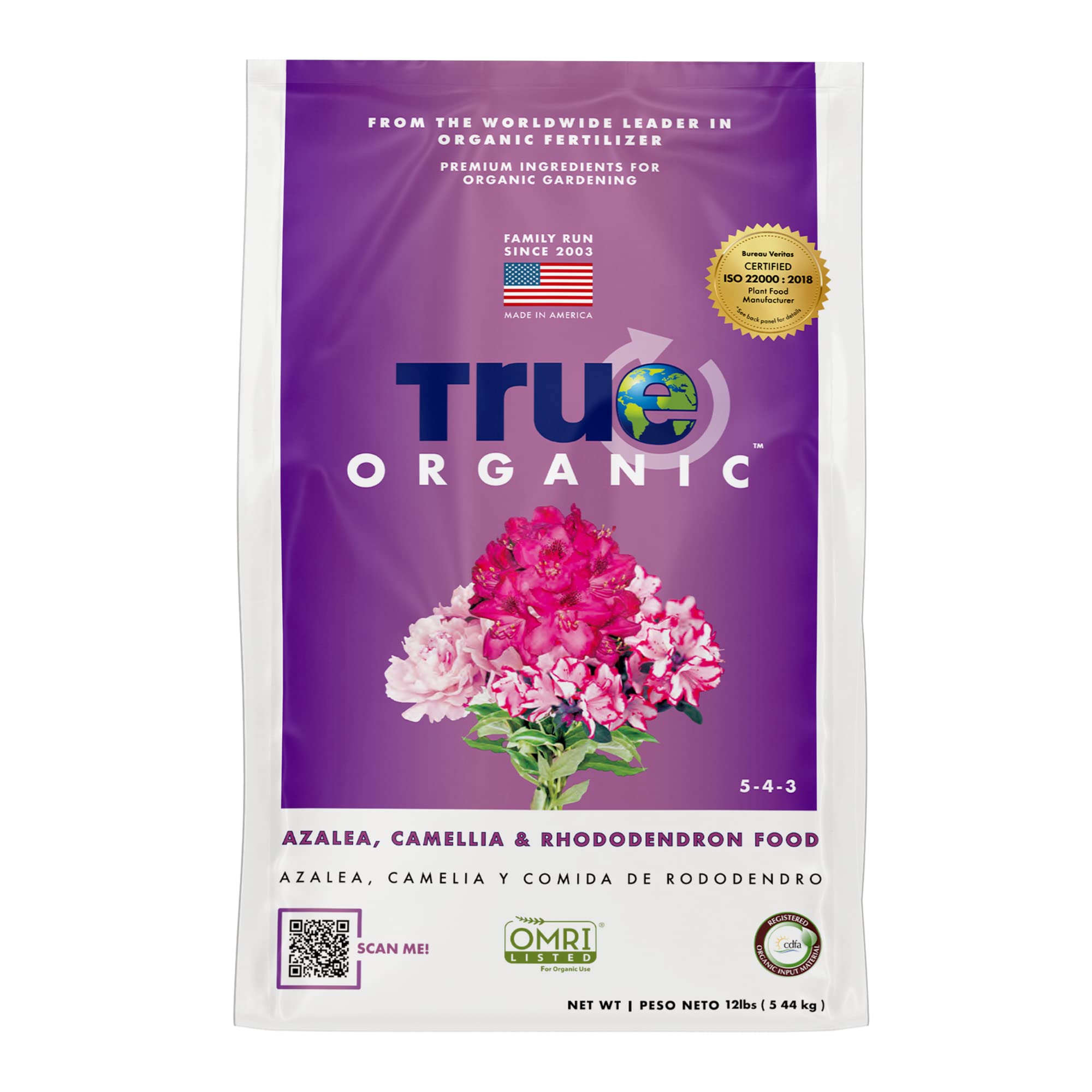
What you actually get at this lower price is a 12-pound bag of True Organic Azalea Food that delivers three times the volume of the 4-pound Berry Food variant at a much better cost per square foot. This is the bag you reach for when you have multiple large azalea bushes, a row of rhododendrons, or an entire acidic border that needs a twice-yearly feeding. With NPK 5-4-3 and 5% sulfur (added to gradually lower soil pH), it is designed to both feed and lower soil pH in one application.
What you give up for that large volume is fine-tuned formulation for specific fruiting plants—the Berry Food is better for blueberries and raspberries, but this Azalea blend is perfect for ornamental shrubs and evergreens. Reviewers point out the same impressive growth seen in the Berry Food variant; one buyer mentioned a rose bush grew from 2-3 feet to 7 feet tall using the same formula. The granules are easy to apply and have no noticeable fishy smell.
This is the exact product for the budget buyer who has a substantial acid-loving shrub border or tree line and wants the most feeding coverage per bag without switching to a synthetic product.
Why we’d pick it
- 12-pound bag covers up to 261 square feet—best coverage for large gardens
- Contains 5% sulfur for natural pH lowering over time
- Rich organic ingredients with no fishy odor
A few caveats
- Twice-yearly application yields slower results than monthly feeding
- Not ideal for young potted plants that need quick-release nutrients
6. Espoma Organic Holly-Tone 4-3-4 Natural & Organic Evergreen & Azalea Plant Food – 36 lb

This 36‑lb bag of Espoma Organic Holly‑Tone is perfect for the gardener with a large property full of acid‑loving plants who wants the lowest per‑pound cost in this roundup—enough to feed hollies, azaleas, camellias, evergreens, dogwoods, rhododendrons, blueberries, and hydrangeas twice a year for several seasons. Espoma, the original brand for acid‑loving plant food since 1929, delivers a proven slow‑release organic with NPK 4‑3‑4, 5% sulfur, and its exclusive Bio‑tone formula of beneficial microbes that feed soil life while building long‑term soil health.
Buyers are emphatic about results: one reviewer called it “miracle level,” reporting more blooms on azaleas and hydrangeas than ever before, while a long‑time Bay Area user trusts it annually for their magnolias. It is OMRI‑listed for organic gardening, contains no sludges or toxic ingredients, and is safe around children and pets once watered in.
Its one weakness is that the massive 36‑lb bag can be cumbersome to handle and store, especially if you have limited space or only a few plants to feed.
Strong points
- Massive 36-pound bag is the best cost-per-application value here
- Trusted brand since 1929 with proven bloom-boosting results
- Slow-release organic formula with Bio-tone microbes for soil health
Before you buy
- Heavy bag (36 lbs) is cumbersome to carry and store
- Slow organic release will not give a quick green-up for severely stressed plants
Understanding the Specs
NPK Ratio (Nitrogen-Phosphorus-Potassium)
These three numbers tell you the percentage by weight of each major nutrient. Higher first numbers (like 17 in Jack’s Classic) drive leaf and stem growth. Higher middle numbers (like 6 in True Organic Berry Food) push flowers and fruit. Lower numbers (like 4 in Espoma) mean slower, steadier feeding. For acid-loving plants, look for a moderate nitrogen number and always check that sulfur is listed in the ingredients.
Water-Soluble vs Granular
Water-soluble powders dissolve instantly and give plants a hit of nutrients within days—great for a rescue or potted plants. Granular formulas (like Dr. Earth, True Organic, Espoma) need soil moisture and time to break down, but feed for weeks or months with one application. Choose granular for garden beds and in-ground shrubs; choose powder for containers and quick corrections.
Sulfur Content for pH
Acid-loving plants need a soil pH (acidity level, measured 0 to 14) between 4.5 and 6.0. If your soil is naturally alkaline (pH above 7, common in areas with limestone bedrock or hard water), the sulfur in fertilizers like True Organic (5%) or Espoma (5%) helps slowly lower pH over time, unlocking iron, manganese, and other micronutrients the plant needs to stay green and bloom.
Organic Certification (OMRI, Non-GMO)
OMRI (Organic Materials Review Institute) listing means the product is approved for use in certified organic food production. Non-GMO Project Verified means no genetically modified organisms are used as ingredients. Both matter if you grow edible berries or vegetables and want to avoid synthetic chemicals or bioengineered inputs.
FAQ
How often should I apply acid-loving fertilizer?
Can I use this fertilizer on plants that are not acid-loving?
Will these fertilizers fix yellow leaves on my gardenia?
Are these products safe for edible berries?
Final Thoughts: The Verdict
For most gardeners, the best acid loving fertilizer winner is the Dr. Earth Acid Lovers because it offers pet-safe, Non-GMO organic granules that revive struggling shrubs without burning roots. If you want fast visible results for a rhododendron or azalea in distress, grab the Miracle-Gro Water Soluble and watch it green up in a week. And for large-scale feeding of many acid-loving plants, the sheer value and proven results of the Espoma Holly-Tone 36-pound bag make it a top call for mass plantings.