
Specs are compiled from manufacturer listings and verified buyer reviews and can change over time — please confirm the key details on the product page before buying.
If your yard has a serious slope, you already know the struggle: a standard mower either loses traction, tears up the grass, or leaves you on a dangerous incline. The fix is a 4WD system that powers all four wheels to climb and mow without slipping. That’s what separates a true terrain-beating machine from a flat-yard specialist.
I’m Rikta — the founder and writer behind Lawn Gear Lab. This guide is built by comparing the manufacturers’ published specifications and the patterns across verified customer reviews, so you get each pick’s real strengths and trade-offs instead of marketing spin.
Here are the best robot-style 4WD lawn tractors for steep, uneven property, ranked by what owners actually experience. Get the breakdown of the 4wd lawn tractors that genuinely handle the tough ground.
Our Picks at a Glance
How To Choose The Best 4WD Lawn Tractor
Picking a 4WD mower is about matching its engineering to your specific land. The three numbers that matter most are the slope rating, the cutting width, and the navigation system, because they decide whether the machine finishes the job or leaves you fixing its mistakes.
Slope rating: know your percentage
The slope rating, shown as a percentage or degrees, is the maximum incline the mower can handle. The higher the number, the steeper the pitch it will climb. A yard that feels “hilly” to you might only be a 20% grade, while a serious bank could be 50% or more, so match the rating to your worst spot, not your average.
Cutting width: set your mowing time
Cutting width is the swath of grass the blades reach in one pass. A wider deck means fewer passes to finish, so it directly shortens your weekly chore. A 20-inch width covers more ground per trip than a 8.7-inch model, but the wider robot is usually bigger and heavier in return.
Navigation: how it finds its way
Modern wire-free mowers use either LiDAR or RTK to map your property. LiDAR reads its surroundings with lasers for precise obstacle dodging, while RTK uses satellite corrections for centimeter-level positioning. The best systems blend those signals with cameras to keep cutting even in shade or under trees.
Quick Comparison
| Model | Best For | Slope Rating | Cutting Width | Battery Runtime | Amazon |
|---|---|---|---|---|---|
| DREAME A3 AWD Pro★ Best Overall | Steep banks, wire-free setup | 38.7° (80%) | 15.75 inches | Up to 1 day | Amazon |
| WORX Landroid Vision Cloud | Extreme slopes, app control | 84% (~40°) | 8.7 inches | — | Amazon |
| YARBO M1 | Very large yards, modular work | 70% | 20 inches | 120 minutes | Amazon |
In‑Depth Reviews
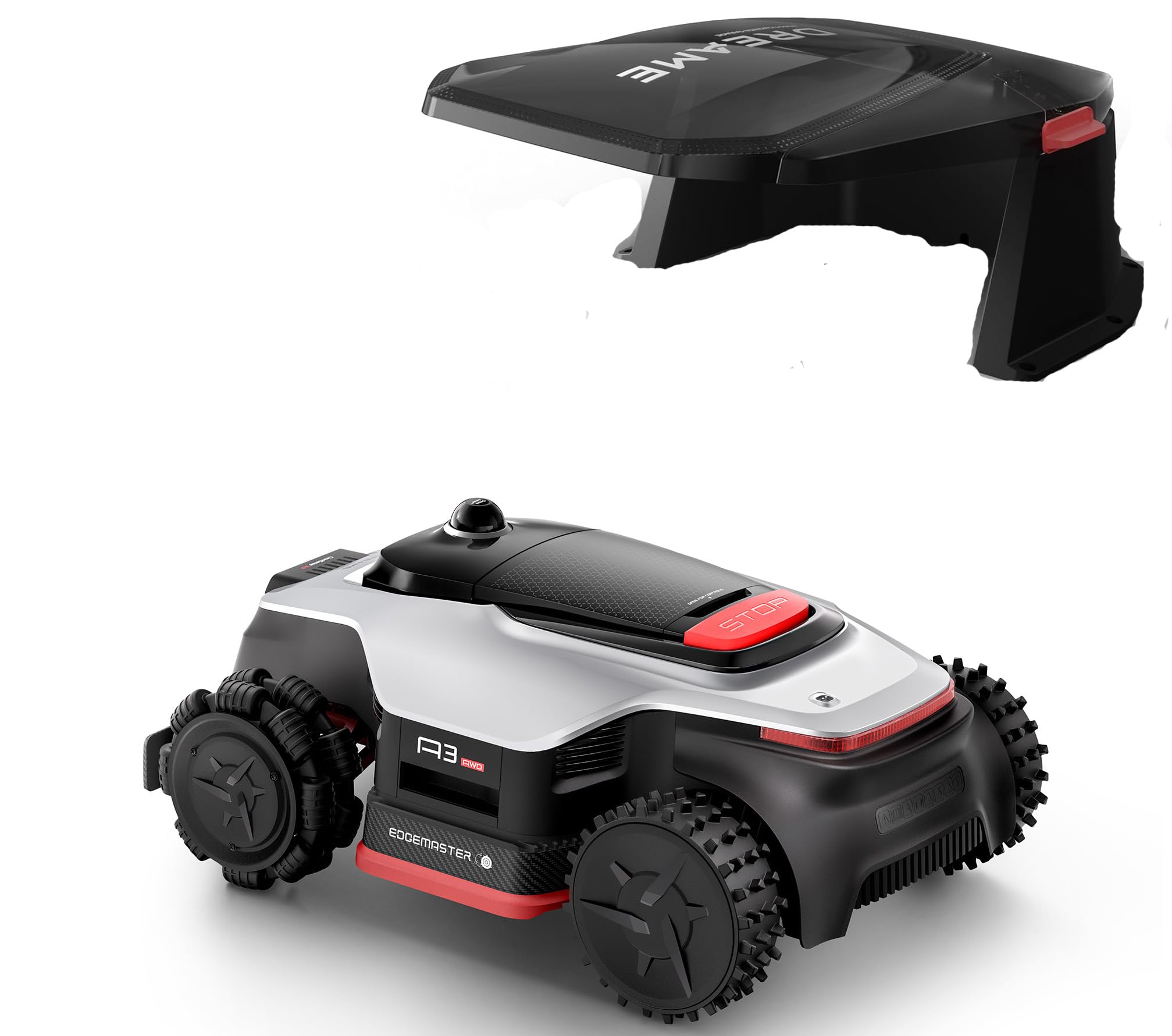
1. DREAME Robot Lawn Mower A3 AWD Pro 2500
Our pick — over 4★ from 20+ verified ratings; the strongest balance of quality and price.
The wire-free climber that takes a 38.7-degree bank in stride.
This mower leads the list because it tackles the two hardest jobs at once: navigating steep ground and doing it without a perimeter wire. Independent hub motors on all four wheels drive it up slopes to 38.7° (80%), and the traction holds on uneven terrain and complex layouts. Owners confirm the hill-climbing is the headline act, and it rarely gets stuck.
Cutting performance comes from dual floating discs that span 15.75 inches of width — that is 81% more swath than the WORX model’s 8.7-inch blade, so it covers a big yard in fewer passes. The OmniSense 3.0 system pairs 3D LiDAR with dual AI vision to recognize and avoid over 300 common backyard obstacles at centimeter-level precision. As buyers report: “Even when the grass is taller than 4 inches, it doesn’t struggle” — it trims overgrown turf gradually instead of stalling.
The catch is a mixed owner record. The battery keeps working for up to a day, and the hard-anodized aluminum and stainless build feels premium, but a few owners hit setup friction and one reported the LiDAR overheating on a hot day and the unit getting lost. DREAME answers with a 3-year warranty and free 4G service bundled in, which softens that risk considerably.
What wins owners over
- Climbs hills up to 38.7° (80%) with real grip from four-wheel drive
- 15.75-inch dual-disc cut finishes lawns faster than narrow decks
- No boundary wire needed thanks to LiDAR and AI vision
- Includes a 3-year warranty plus free 4G anti-theft tracking
Where to be careful
- Setup takes time even though it is straightforward
- A few owners needed a replacement unit after delivery damage
- You will still need to weed-whack edges it cannot reach
Reach for this if: your yard is steep, uneven, and you want to ditch the boundary wire entirely.
Look elsewhere if: you want a wider 20-inch deck or need to cover several acres in one battery cycle.
2. WORX Landroid Vision Cloud WR344
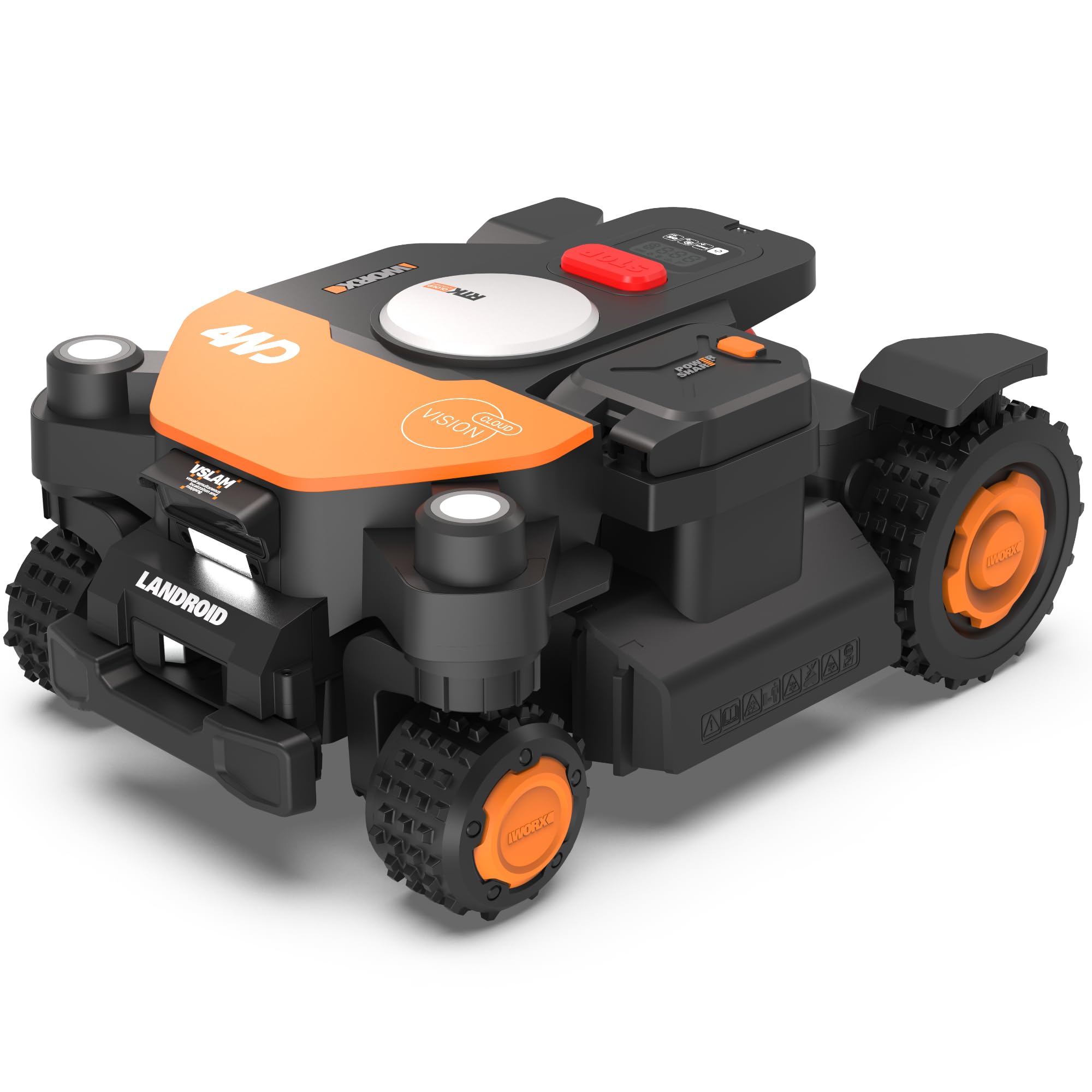
The tracton king built for the steepest, most extreme banks.
If your property has a brutal pitch, this WORX is the one the spec sheet was built for. It climbs slopes up to 84% (~40°), which beats the DREAME’s 38.7-degree ceiling, thanks to a terrain-adaptive chassis that keeps all four wheels planted over raised borders and uneven ground. The true front-wheel steering turns sharply without carving up your turf.
What stands out most to owners is the setup and the mapping. They call the setup simple and genuinely like how it maps the mowing areas from day one. That positive impression comes from real experience — the mapping capability (6 mentions) and simple setup (11 mentions) are the two most-discussed points in the reviews, both earning positive reads. The Cut-to-Zero offset blade trims right along fixed borders to cut down on manual string trimming.
The trade-off is an honest one: reliability gets mixed feedback, with connectivity flagged as a recurring sore spot. One owner on a 2-acre fenced area reported the base-to-unit signal was weak and needed a Wi-Fi extender, then mapping failed repeatedly. The fix that worked for others was moving the base so it had a clear view of the sky. It uses cloud-delivered RTK with no antenna installation or extra cloud fees, and shifts to V-SLAM vision in shaded spots.
Its real strengths
- Solves the hardest terrain with an 84% slope rating
- Simple setup and smart day-one mapping praised by owners
- Cut-to-Zero blade trims closer to edges, less hand finishing
- Night mowing with an automatic FiatLux light system
Its honest limits
- Narrow 8.7-inch deck means slower coverage on big acreage
- Connection issues show up for some, needing a Wi-Fi extender
- Edge coverage is good but not perfect, about 90-95%
Choose it for: the most extreme slopes where other 4WD robots run out of traction.
Think twice if: you want the widest cut or a totally friction-free first setup — both require some patience here.
3. YARBO Robot Lawn Mower M1
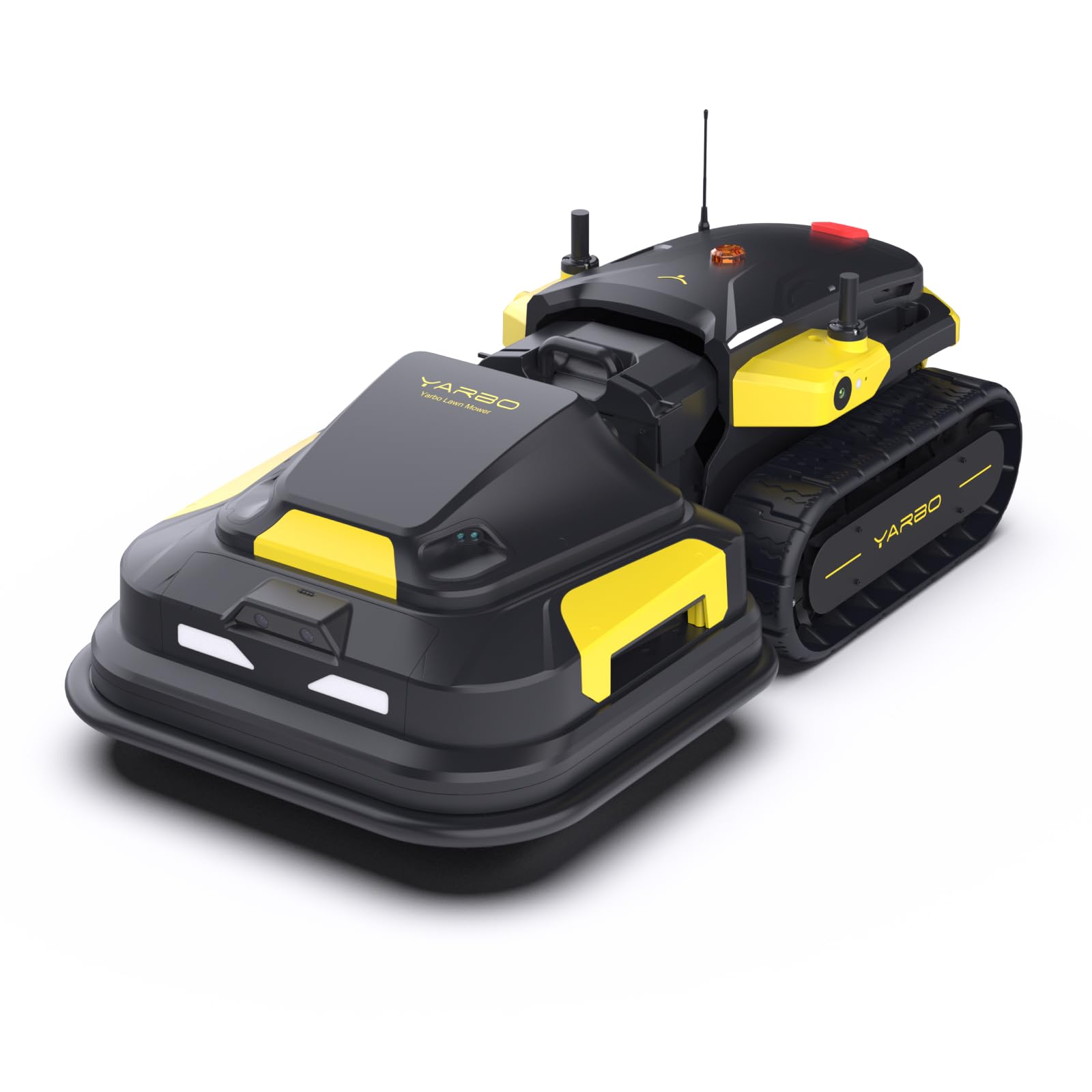
The modular heavy lifter that covers up to six acres per charge.
This is the one for genuinely large properties, and its defining spec is the 20-inch cutting width — the widest of the three, beating the DREAME’s 15.75-inch deck by a clear margin. It handles up to 6.2 acres and delivers 120 minutes of runtime per charge, so it is built for scale, not just slope. Owners with a 4-acre yard confirm it handles the space comfortably.
The all-terrain patented tracks give it a 70% slope capability and let it cross ditches and uneven ground that stop other units. It uses AI vision plus RTK navigation for wire-free boundary setup through a controller, and the dual 150W motors drive the cutting. The adjustable height spans 1.2 inches to 4.0 inches across 64 positions, so you can fine-tune the exact grass length you want.
What surprised owners most is the mowing quality — they describe precise, attractive stripes and excellent cut results. The modular design is the bigger story: you can swap modules later for leaf blowing and snow blowing, though those are sold separately. The honest downsides are the 237-pound weight (plan for two adults and four shipping boxes at delivery) and mixed reviews on customer support, with some owners finding the app unintuitive and support slow to respond.
Why it earns its place
- 20-inch deck and 120-minute runtime cover big acreage fast
- Modular tracks let it blow leaves and snow later
- 64 cutting-height positions for precise grass length control
- All-terrain tracks master 70% slopes and ditches
The fine print
- 237 pounds needs two adults and careful delivery planning
- Support quality gets mixed marks from some owners
- GPS can drop near tall 100-foot trees until setup settles
Best suited to: owners of several acres who want a 20-inch swath and a machine that grows into a snow blower.
Not ideal if: you want a lightweight, single-box robot you can set up solo in an afternoon.
Understanding the Specs
Slope Rating (Degrees vs Percentage)
This is the maximum incline the mower can climb, shown either as an angle in degrees or a percentage grade. A 45-degree angle equals a 100% grade, so a 38.7° rating translates to an 80% slope. The higher the number, the steeper the bank the robot can handle, so check your yard’s steepest spot against this before buying.
Cutting Height Range
This range shows how low or high you can set the blades, from a close 1.2 inches up to a longer 4.0 inches. A wider range with more adjustment positions means you can match the cut to the season and your grass type. A machine with 64 positions gives you much finer control than one with just a few fixed settings.
FAQ
Will a 4WD robot lawn mower work on my yard’s slope?
What is the difference between LiDAR and RTK navigation?
Does a wire-free mower really need no boundary wire at all?
How long does a robot mower battery last per charge?
Can a robot mower handle overgrown grass that I missed for a week?
Do I still need to trim edges by hand with a 4WD mower?
Which mower is best for a very large yard of several acres?
What happens if my robot mower loses its GPS signal?
Final Thoughts: The Verdict
Across the board, the 4wd lawn tractors winner is the DREAME A3 AWD Pro because it pairs a 38.7° slope climb with a 15.75-inch cut and wire-free LiDAR for the best all-round balance. If you want an extreme 84% slope rating, grab the WORX Landroid Vision Cloud. And for several acres with room to grow, the YARBO M1 is the one to reach for with its modular design and 20-inch deck.
How We Picked
We do not accept paid placement. Every pick is matched to a real buyer and a real use-case; we do not hands-on test units.
Sources & Methodology
Specifications: manufacturer listings and product documentation. Review insights: verified customer reviews, as of August 2026. Pricing: not shown on this page (it changes often); check the current price via the retailer link.
As an Amazon Associate, Lawn Gear Lab earns from qualifying purchases. This does not affect which products we feature.