
Specs are compiled from manufacturer listings and verified buyer reviews and can change over time — please confirm the key details on the product page before buying.
A 10×10 greenhouse gives you 100 square feet of controlled growing space — enough to start seedlings, overwinter tender perennials, or keep fresh vegetables going well past the first frost. The hard part is figuring out which frame, cover, and ventilation combo will actually hold up in your backyard through wind, snow, and summer sun without costing a fortune or needing a contractor to assemble.
I’m Rikta — the founder and writer behind Lawn Gear Lab. This guide is built by comparing the manufacturers’ published specifications and the patterns across verified customer reviews, so you get each pick’s real strengths and trade-offs instead of marketing spin.
You have five very different approaches to a 10 x 10 greenhouse here, from heavy-duty pop-ups to permanent wooden structures, so you can match the right build to your garden goals and your comfort level with assembly.
Our Picks at a Glance

How To Choose The Best 10 X 10 Greenhouse
Every 10×10 greenhouse gives you the same floor footprint, but the way it is built completely changes how long it lasts, how easy it is to set up, and what you can grow inside. Here are the key decisions you’ll need to make before buying.
Frame Material: Steel, Pop-Up, or Cedar
The frame is the backbone of the greenhouse. A heavy-duty steel frame, like the 1-3/8 inch powder-coated alloy steel on the ShelterLogic, gives you a rigid, permanent-style structure you can anchor down. Pop-up models with reinforced steel frames (like the INTER HUT) are lighter and set up in minutes without tools, but they are not as sturdy in heavy snow. At the top end, a cedar frame (like the Jocisland) naturally resists rot and looks handsome, but it comes with a much higher price tag and significant weight.
Cover Material: Polyethylene (PE) vs. Polycarbonate (PC)
This choice will likely decide how many seasons your greenhouse survives. Polyethylene (PE) covers, like the 5.5 oz thick ClearView triple-layer ripstop on the ShelterLogic, are waterproof and UV-treated but will degrade after a few years in direct sun and are easier to tear. Polycarbonate (PC) panels, found on the Benass and Jocisland models, are rigid, offer much better insulation with twin-wall construction, block UV rays without yellowing, and last significantly longer. The trade-off is that PC greenhouses are heavier, more expensive, and take longer to assemble.
Ventilation and Airflow
Trapped heat and humidity will kill your plants and promote mold. Look for adjustable roof vents, which let hot air escape naturally from the top. The Jocisland model comes with 2 adjustable roof vents, while the Benass has 1. Pop-up models like the EAGLE PEAK rely on roll-up doors and mesh windows for airflow instead of dedicated roof vents. The number of vents is a straight spec comparison: the Jocisland has 2 vents vs the Benass which has 1.
Quick Comparison
| Model | Best For | Cover Material | Frame Type | Weight | Amazon |
|---|---|---|---|---|---|
| ShelterLogic 10×10 GrowIT★ Best Overall | Permanent-style value | Polyethylene | Alloy Steel | 87 Pounds | Amazon |
| INTER HUT Pop Up 10×10Instant Setup | Instant setup | Polyethylene | Reinforced Steel | — | Amazon |
| EAGLE PEAK 10×10 | Quick pop-up with reinforcement | Polyethylene | Steel | 48.5 Pounds | Amazon |
| Benass Heavy Duty 8×10 | Insulated polycarbonate | Polycarbonate | Reinforced Frame | — | Amazon |
| Jocisland Wood 10×10 | Permanent wood structure | Polycarbonate | Cedar Wood | — | Amazon |
In‑Depth Reviews
1. ShelterLogic 10′ x 10′ GrowIT Greenhouse-in-a-Box
Our pick — over 4★ from 850+ verified ratings; the strongest balance of quality and price.
This is the permanent-style greenhouse that gives you a proper steel frame without the permanent price.
The defining feature here is the structural engineering — the ShelterLogic uses a 1-3/8 inch heavy-duty steel frame with patented metal ShelterLock stabilizers that lock the joints together for rock-solid stability.
The cover is a ClearView triple-layer, heat-bonded ripstop translucent polyethylene that is 5.5 oz thick — waterproof and UV-treated inside and out for plant growth. For ventilation, you get Easy Flow roll-up side panels and half-moon screen vents at each end. Buyers report that the zippered door is sturdy and the frame handles moderate snow loads well, though a few mentioned that the cover can sag if not tensioned properly on a hot day.
Unlike the pop-up models below, this greenhouse requires assembly with tools, but the result is a structure that feels like a real building in your backyard rather than a temporary tent. The peak roof design (96 inches tall) gives you headroom to stand and work comfortably.
Built to Last
- 1-3/8 inch heavy-duty steel frame with patented metal ShelterLock stabilizers
- 5.5 oz thick triple-layer ripstop polyethylene cover with UV treatment inside and out
- Easy Flow roll-up side panels and half-moon screen vents for airflow control
- Peak roof design provides 96 inches of interior height for standing room
Assembly Required
- Heavier build at 87 Pounds makes it harder to move or relocate once assembled
- Cover material is durable polyethylene, not rigid polycarbonate like the premium options
The Steel Standard: This is the pick for anyone who wants a real greenhouse structure with a proper steel frame and doesn’t mind spending an afternoon on assembly. The heavy-duty build beats the EAGLE PEAK on stability and snow-load capacity.
One Thing to Know: The polyethylene cover will eventually degrade in intense sun, unlike the polycarbonate panels on the higher-end picks — expect a few years of service before replacement is needed.
2. INTER HUT 10×10 Pop Up Greenhouse
This pop-up goes from box to growing in minutes, making it the weekend gardener’s best friend.
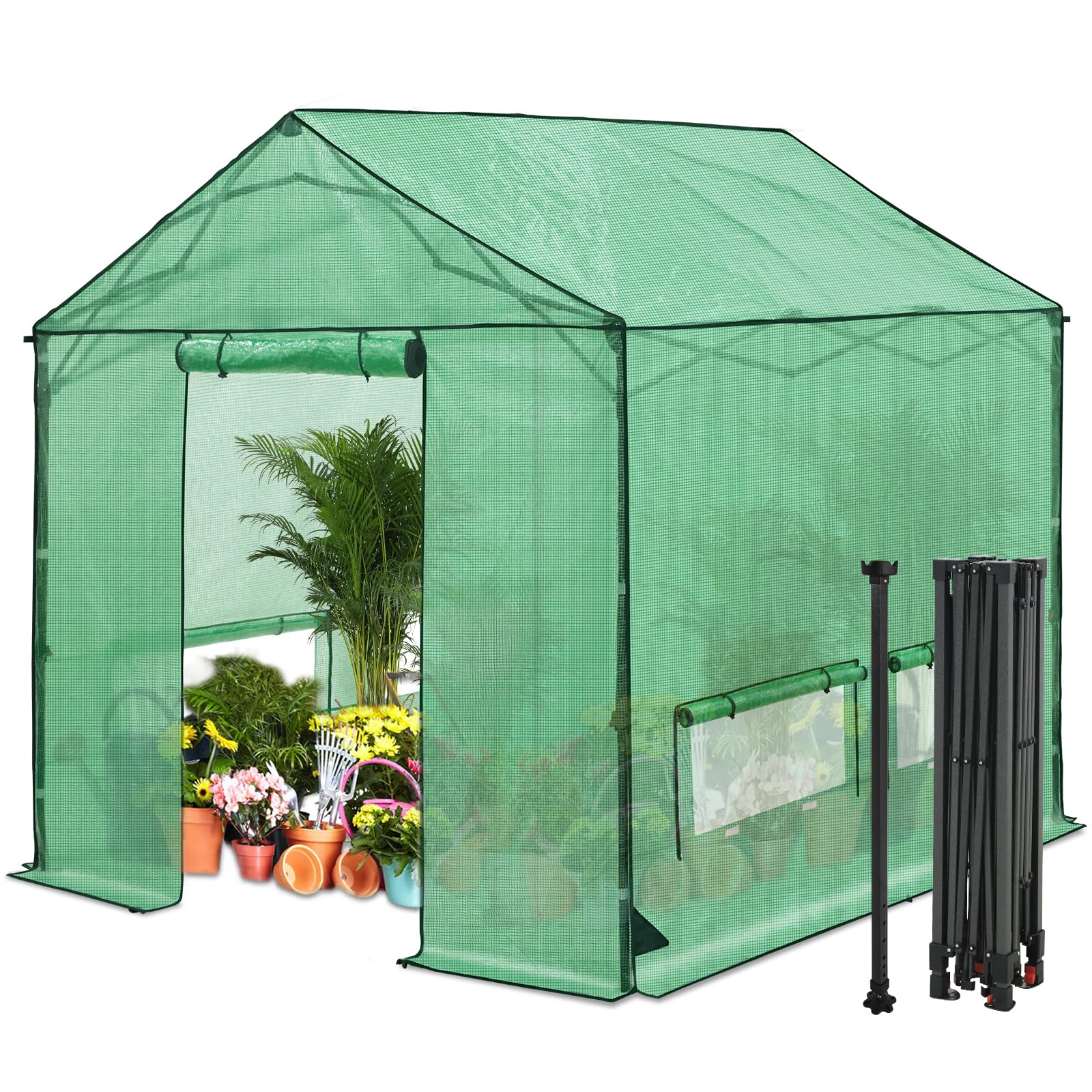
The standout feature is the pop-up design with a center lock system that allows one person to assemble the entire greenhouse without any tools. This is a fundamentally different proposition from the ShelterLogic — you can have this 10×10 structure standing and ready for plants in the time it takes to build a piece of furniture. The reinforced steel frame uses a classic gable roof design that sheds rain and snow efficiently while improving airflow and interior height.
The cover is a premium polyethylene (PE) material offering UV protection and water resistance. You get dual roll-up zippered doors for cross-ventilation and 2 power access ports so you can run a heater or grow lights inside without pinching cables through the door. Owners mention that the green PE cover looks good in a backyard setting and that the pop-up mechanism works reliably after multiple setup and takedown cycles.
INTER HUT backs this with a 1-year limited after-sale protection. Unlike the EAGLE PEAK below, this model does not feature the polyester-reinforced corners, but the center lock system makes single-person setup genuinely achievable.
Minutes, Not Hours
- Pop up design with center lock system for tool-free one-person assembly in minutes
- Classic gable roof sheds rain and snow while improving airflow and headroom
- 2 power access ports for running heaters, grow lights, or fans inside
- Dual roll-up zippered doors for cross-ventilation on warm days
Seasonal Strength
- PE cover is less insulating and less durable than polycarbonate panels on premium models
- Pop-up frame does not match the permanent stability of the ShelterLogic’s 1-3/8 inch steel frame
Grab-and-Go Growing: If you want a greenhouse that sets up in minutes without tools and packs away easily, this is your pick. The gable roof design gives it better snow shedding than typical dome pop-ups.
The Trade-Off: This is a portable shelter, not a permanent structure — the frame and cover will not take the same abuse as the heavy-duty ShelterLogic or the polycarbonate Benass models.
3. EAGLE PEAK 10×10 Portable Walk in Greenhouse
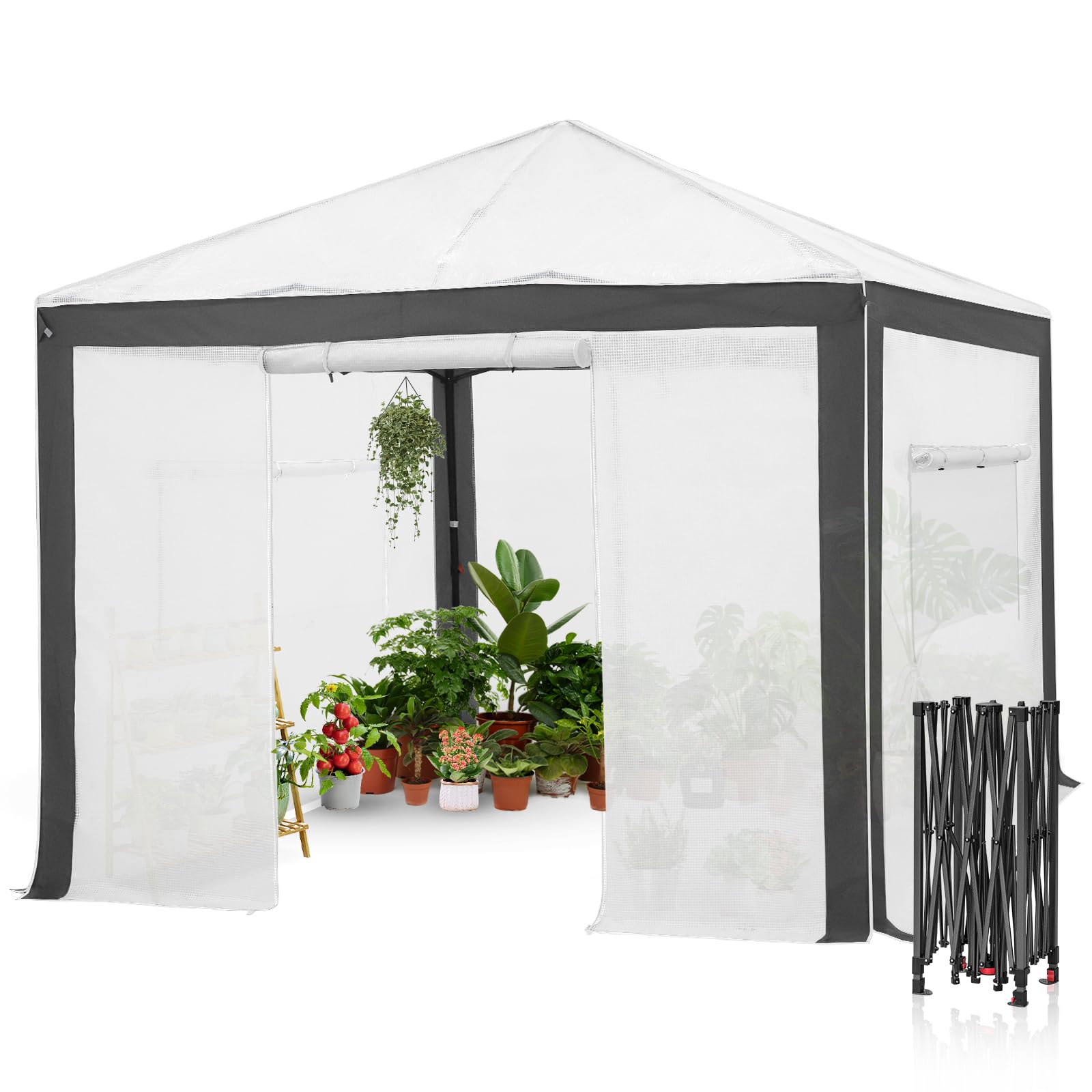
A lightweight pop-up that uses polyester-reinforced corners and a patented center lock for a more durable cover.
The EAGLE PEAK differentiates itself from the INTER HUT with a key material upgrade: the PE cover is scrim-reinforced and features polyester panels sewn into the corners for extra seam strength. The manufacturer specifically notes this avoids the cheaper PVC covers found on many other greenhouses. At just 48.5 Pounds, it is dramatically lighter than the ShelterLogic’s 87 Pounds, making it easy to move around the yard if needed.
The patented Peak Push center lock system allows one-person setup in seconds without tools. You get 100 square feet of floor space with 6-foot-tall walls and wide roll-up doors. The 2 vents (matching the Jocisland count) are mesh windows that roll up for ventilation. Buyers consistently highlight the ease of setup and the quality of the cover material, with many noting it survived a full season of sun without becoming brittle or tearing.
EAGLE PEAK offers a 1-year limited after-sale protection covering the frame and the cover — the same coverage the pricier ShelterLogic and Jocisland models also offer, but at a lower entry price.
Smartly Built
- Scrim-reinforced PE cover with polyester panels at corners for extra seam strength — avoids cheap PVC materials
- Patent-pending Peak Push center lock for truly seconds-quick one-person setup
- Lightweight at 48.5 Pounds, so it is portable and easy to reposition
- 2 mesh window vents and roll-up doors provide good cross-ventilation
Light Duty
- PE cover, while reinforced, does not offer the insulation of polycarbonate panels
- Lightweight frame is less suited for heavy snow loads compared to the 87-pound ShelterLogic
Smart Pop-Up Pick: If you want the convenience of a pop-up but want better cover durability than the basic PE shelters, this EAGLE PEAK with its polyester-reinforced corners is the smart middle-ground choice.
Who Should Pass: If you need a greenhouse that will stand through heavy snow or last for a decade, look at the polycarbonate models instead — the PE cover on this will eventually need replacing.
4. Benass Heavy Duty Polycarbonate Greenhouse (8×10 FT)
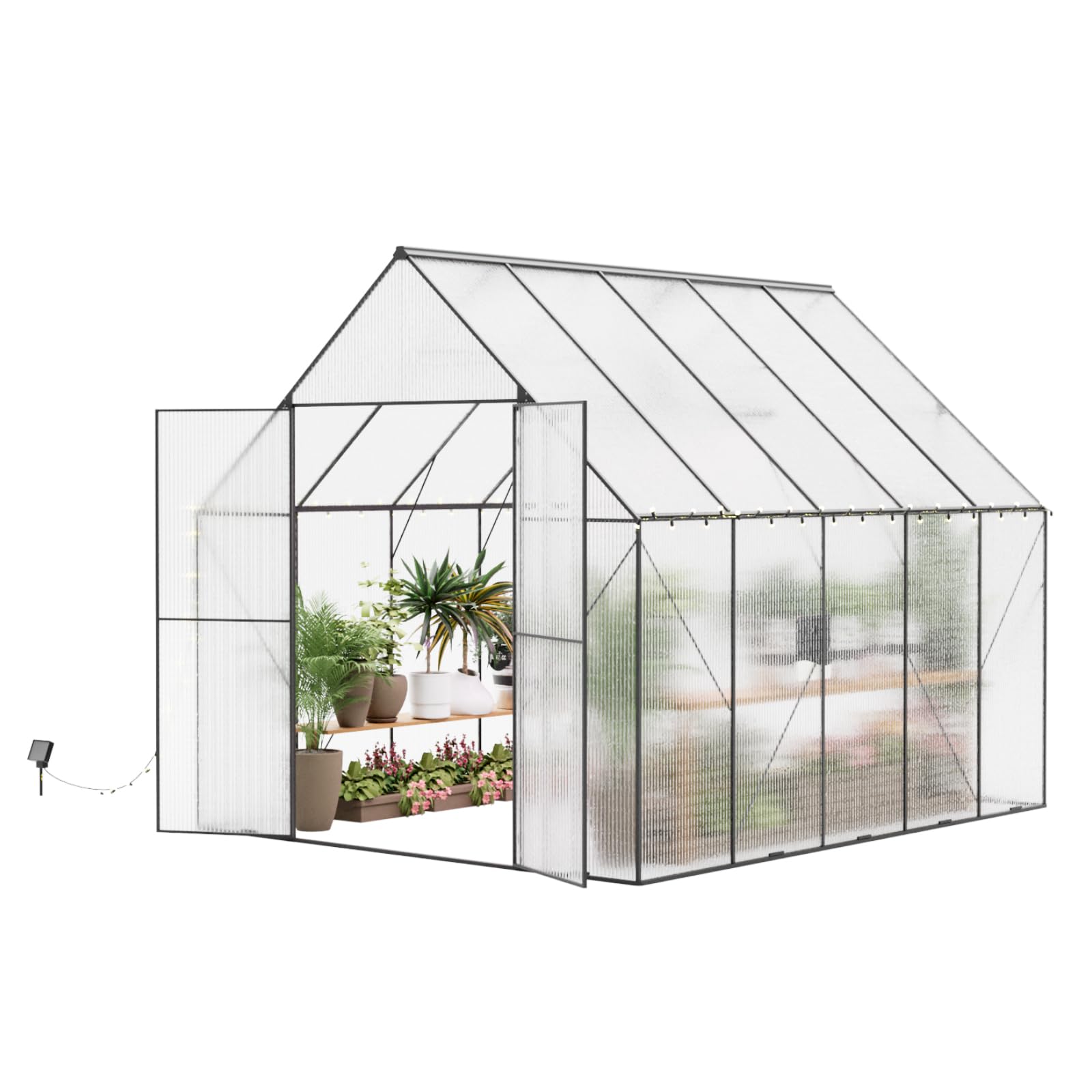
This polycarbonate greenhouse trades instant setup for real insulation and the ability to grow year-round.
The big difference between this Benass and the pop-up models is the cover material — twin-wall polycarbonate panels instead of plastic sheeting. These panels provide excellent light transmission while offering real UV protection and reliable insulation. Unlike a PE cover that lets heat escape quickly, polycarbonate traps warmth, making this a practical greenhouse for winter growing. Note that the listed size is 8×10 FT, which is slightly smaller than the 10×10 footprint of the other picks, but it serves the same purpose for anyone with slightly less yard space.
This model comes as a bonus value bundle that includes a free indoor thermometer, grow lights, and LED solar lights — useful extras for monitoring conditions and extending daylight hours without buying accessories separately. The walk-in greenhouse features an adjustable roof vent to help balance heat and humidity, plus a smooth sliding door with lockable handles for easy access and security.
Assembly is more involved than the pop-ups — the design uses slide-in panels and labeled hardware — but you get a structure that will outlast any PE-covered greenhouse by years. The Benass has 1 roof vent compared to the Jocisland’s 2, which is a trade-off in passive airflow capacity.
Real Insulation
- Twin-wall polycarbonate panels provide excellent light transmission, UV protection, and insulation for year-round growing
- Bonus bundle includes indoor thermometer, grow lights, and LED solar lights
- Sliding door with lockable handles offers easy access and security
- Adjustable roof vent improves airflow and temperature control
Smaller Footprint
- Size is 8×10 FT, not a true 10×10 — about 20 fewer square feet of growing space
- Only 1 roof vent vs the Jocisland’s 2 vents, limiting passive airflow capacity
- Assembly is significantly more involved than the pop-up models
For the Year-Round Grower: If you plan to garden through winter and want real insulation without paying for a wood frame, this polycarbonate greenhouse is the practical choice. The twin-wall panels will keep your plants warmer on cold nights than any PE cover.
The Catch: At 8×10, it is smaller than the other 10×10 options — measure your available space carefully and decide if the insulation trade-off is worth the lost 20 square feet.
5. Jocisland 10×10 Ft Wood Greenhouse
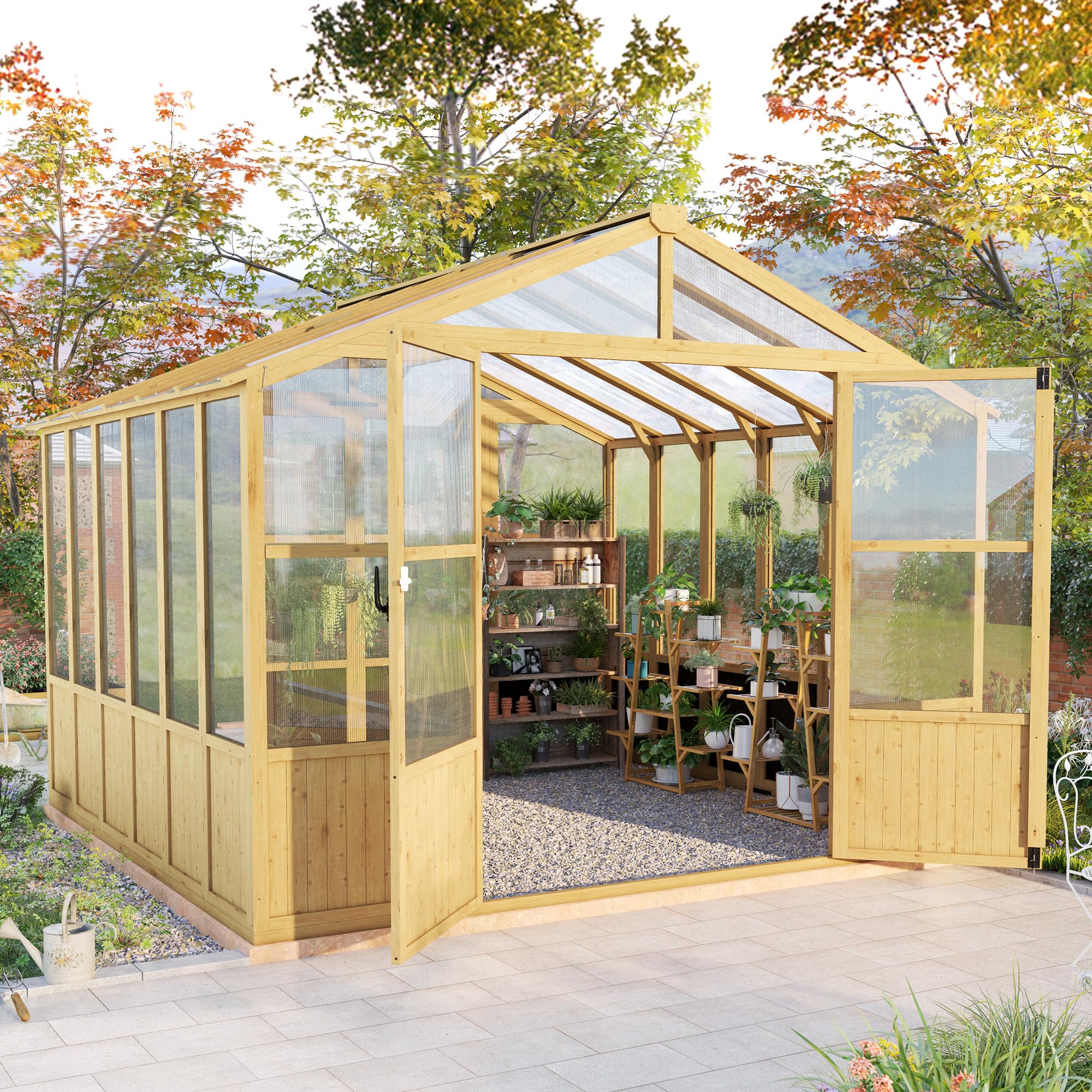
A beautiful cedar greenhouse with real wood walls, dual vents, and the kind of durability that becomes a permanent backyard fixture.
The Jocisland is in a different class from everything else here because of the frame material — it is built with premium cedar wood and metal hardware. Cedar naturally resists rot and insect damage without chemical treatments, so this structure will look good and stay solid for years. The actual dimensions are 9.98 × 9.94 × 7.94 ft, giving you a near-perfect 10×10 footprint with nearly 8 feet of headroom at the peak.
Ventilation is a standout feature: this model has 2 adjustable roof vents, compared to the Benass model which has only 1 vent. Combined with the 2 doors (one on each side), you can create excellent cross-ventilation to manage heat and humidity. The high-quality sunboard panels (polycarbonate) offer heat insulation and UV protection, maintaining a comfortable temperature while protecting plants from harmful rays.
Buyers praise the pre-assembled walls, doors, and windows that connect with hardware for a faster kit assembly than you might expect from a wood greenhouse. The lockable door adds security. Reviewers also note that the cedar finish weathers beautifully and that the structure feels incredibly solid once assembled, easily handling wind that would worry the pop-up models.
Built to Last
- Premium cedar wood frame naturally resists rot and insects — a permanent backyard structure
- 2 adjustable roof vents provide excellent passive airflow, while the Benass model has only 1
- Pre-assembled walls, doors, and windows for faster assembly than typical wood kits
- High-quality sunboard (polycarbonate) panels offer heat insulation and UV protection
Premium Investment
- Significant price investment compared to steel-frame or pop-up alternatives
- Heavy and permanent — not a structure you can relocate easily once assembled
The Heirloom Pick: Buy this if you want a greenhouse that becomes a permanent, beautiful part of your yard and will last for years without the frame rusting or the cover degrading. The 2 roof vents give it a real edge over the Benass for temperature control.
Only If You Are Committed: Skip this if you want a temporary shelter or plan to move — it is a substantial structure that requires a solid foundation and a real investment of both money and assembly time.
Understanding the Specs
Cover Material: The Great Divide
This is the single most important decision for longevity. Polyethylene (PE) is a heavy-duty plastic sheeting — it is waterproof, UV-treated, and affordable, but it will eventually become brittle and tear after a few seasons in direct sunlight. The ShelterLogic uses a 5.5 oz thick triple-layer ripstop PE that is about as good as PE gets. Polycarbonate (PC) is rigid, twin-wall plastic that looks like clear corrugated roofing. It transmits light well, provides real insulation (trapping a layer of air between the walls), blocks UV without yellowing, and lasts many years. The downside is weight and cost — greenhouses with PC panels like the Benass and Jocisland are heavier and more expensive to manufacture.
Frame Material: Weight, Stability, and Assembly
The frame determines how well your greenhouse handles wind and snow and how much work you will do setting it up. Alloy steel frames (like the ShelterLogic’s 1-3/8 inch heavy-duty frame with powder coating) give you excellent strength and rust resistance, but the greenhouse weighs 87 Pounds and requires tools and time to build. Pop-up models use lighter reinforced steel frames that set up in minutes but cannot match that stability in extreme weather. Cedar wood is the premium option — naturally rot-resistant, attractive, and rock-solid, but it comes with a price to match and requires the most permanent foundation and assembly effort.
FAQ
How many vents does a 10×10 greenhouse need?
Will a pop-up greenhouse survive winter snow?
What is the difference between PE and polycarbonate covers?
Can I heat a 10×10 greenhouse in winter?
Which greenhouse is easiest to assemble?
How much weight can a greenhouse frame hold?
Should I get a sliding door or a roll-up zippered door?
How long does a PE greenhouse cover last?
Can I move a 10×10 greenhouse once it is set up?
What is the best 10×10 greenhouse for a beginner?
Final Thoughts: The Verdict
Across the board, the 10 x 10 greenhouse winner is the ShelterLogic 10×10 GrowIT because it gives you a proper 1-3/8 inch heavy-duty steel frame and a 5.5 oz thick triple-layer cover at a reasonable investment — real durability without the polycarbonate price jump. If you want instant setup and portability, grab the EAGLE PEAK with its polyester-reinforced corners and clever center lock. And for year-round, heavy-duty growing with real insulation, the Jocisland Cedar Greenhouse stands out with its 2 roof vents and naturally rot-resistant wood frame.
How We Picked
We do not accept paid placement. Every pick is matched to a real buyer and a real use-case; we do not hands-on test units.
Sources & Methodology
Specifications: manufacturer listings and product documentation. Review insights: verified customer reviews, as of July 2026. Pricing: not shown on this page (it changes often); check the current price via the retailer link.
As an Amazon Associate, Lawn Gear Lab earns from qualifying purchases. This does not affect which products we feature.