
Forgetting to mix oil and gas is the fastest way to smoke a 2-stroke engine, which is why a growing number of homeowners and pros are switching to a dedicated 4-stroke leaf blower that runs on straight pump gas. These engines deliver consistent torque, lower vibration, and emissions that won’t choke the neighborhood—all without the mess of pre-mixing fuel for every job.
I’m Rikta — the co-founder and writer behind Lawn Gear Lab. I’ve spent hundreds of hours cross-referencing CFM ratings, engine displacements, carburetor designs, and owner-reported reliability data to build a guide that cuts through the marketing noise around these oil-free gas blowers.
The market is flooded with options that vary wildly in build quality and real-world performance, making it tough to pinpoint the right 4-stroke leaf blower for your property size and budget without wading through conflicting reviews.
How To Choose The Best 4-Stroke Leaf Blower
Selecting a 4-stroke gas blower comes down to understanding how engine displacement, air throughput, and form factor align with your property’s debris load. Skip the hype and focus on these three pillars.
Engine Displacement and Fuel System
The cubic centimeter (cc) rating of a 4-stroke engine directly correlates to torque and sustained blowing force. Handheld models typically range from 25cc to 30cc and are adequate for drives and small patios, while backpack units start around 49cc and climb past 70cc for heavy wet leaf removal. Look for engines with automatic compression release to reduce pull-start resistance, and note that 4-stroke carburetors are more sensitive to ethanol-laden fuel—using non-ethanol gas or a fuel stabilizer is the single most effective way to avoid clogged jets and hard-start complaints.
Airflow Metrics: CFM vs. MPH
CFM (cubic feet per minute) measures the volume of air moved, while MPH measures the speed of that air. For blowing loose dry leaves across asphalt, a high MPH (150+) with moderate CFM works fine. For wet leaves embedded in turf or gravel, you need a 4-stroke blower delivering at least 500 CFM to lift and shift the mass. Backpack models routinely hit 600 CFM or more, while handheld 4-strokes hover around 400 CFM due to the heavier engine design limiting impeller size.
Form Factor and Weight Distribution
Handheld 4-stroke blowers weigh about 9-10 pounds due to the cast-iron cylinder and oil reservoir, which is heavier than a comparable 2-stroke. This makes a comfortable dual-grip handle critical for reducing wrist fatigue. Backpack models shift the 12-20 pound engine weight to your hips via padded straps, allowing longer sessions without arm burn. Consider the cruising speed (throttle lock) feature essential on backpack units—holding a trigger for 45 minutes straight is a recipe for hand cramping regardless of engine type.
Quick Comparison
On smaller screens, swipe sideways to see the full table.
| Model | Category | Best For | Key Spec | Amazon |
|---|---|---|---|---|
| SENIX 49cc Backpack | Backpack | Large yards needing high CFM without mixing fuel | 600 CFM / 200 MPH | Amazon |
| SENIX 26.5cc Handheld | Handheld | Small properties and budget-focused buyers | 410 CFM / 125 MPH | Amazon |
| SuperHandy Walk Behind | Wheeled | Heavy debris and large commercial lots | 1270 CFM / 150 MPH | Amazon |
| Landworks Walk Behind | Wheeled | Maximum air volume for farm and estate use | 1270-2000 CFM | Amazon |
| Thalorus 52cc Backpack | Backpack | Budget-conscious buyers wanting backpack power | 550 CFM / 230 MPH | Amazon |
| PROYAMA 72cc Backpack | Backpack | Pros needing brute force for wet leaves and snow | 880 CFM / 275 MPH | Amazon |
| Getell 63cc Backpack | Backpack | High-volume 2-stroke alternative for pro use | 665 CFM / 205 MPH | Amazon |
| Husqvarna 350iB | Battery | Zero-emission users wanting gas-like power | 800 CFM / 200 MPH | Amazon |
| EGO Power+ LB8803 | Battery | Premium electric performance with dual batteries | 880 CFM / 200 MPH | Amazon |
In‑Depth Reviews
1. SENIX 49cc 4-Cycle Backpack Leaf Blower (BLB4QL-M)
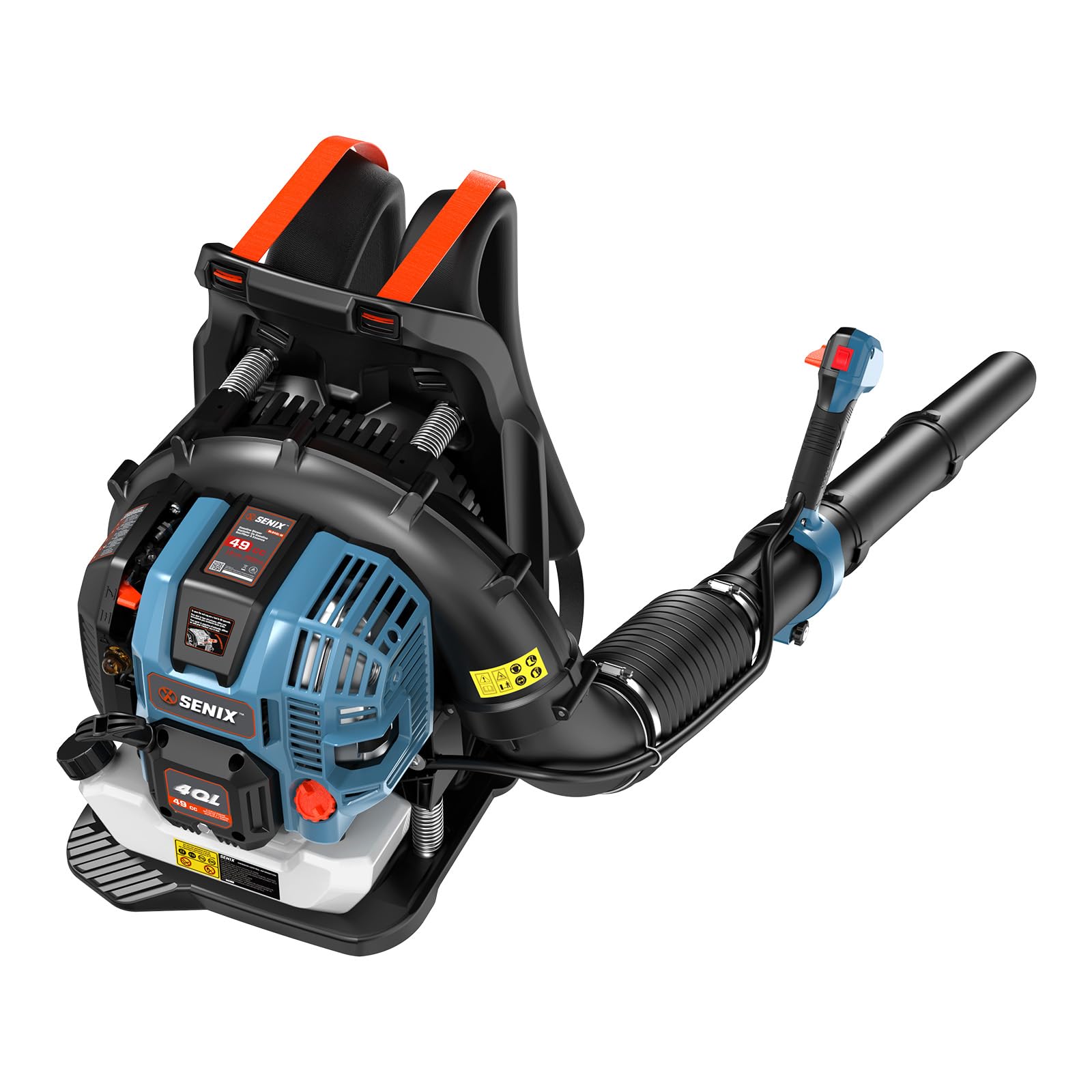
The SENIX 49cc backpack delivers the sweet spot of 4-stroke convenience—no oil mixing, 600 CFM airflow, and a 200 MPH velocity that handles wet October leaves without bogging. The full-crank 4QL engine produces 18N of blowing force, which translates to real lifting power on grass and gravel. Owners consistently report it starts within five pulls and sips fuel compared to 2-stroke alternatives, making it a strong daily driver for half-acre to multi-acre properties.
Ergonomics are well-considered: the padded shoulder straps distribute the weight acceptably, and the variable-speed throttle with cruise control lets you lock in a consistent RPM during long straightaways. The four-stroke architecture means exhaust smells cleaner and the engine runs cooler during extended use. A few users noted a gas leakage issue from the fuel return line slipping out of the tank, which is a simple hose-clamp fix but worth checking before the first fill.
The 3-year limited warranty backs the build, and the 49cc displacement gives enough overhead to clear light snow on driveways. For users who want backpack-level power without the 2-stroke ritual of mixing gas and dealing with smoky exhaust, this SENIX is the most balanced 4-stroke option on the market right now.
What works
- True 4-stroke operation with no oil mixing required
- 600 CFM provides strong wet-leaf clearing capability
- Cruise control reduces hand fatigue during long jobs
- Low vibration and minimal 4-stroke exhaust odor
What doesn’t
- Fuel return line can detach from tank in some units
- Build quality feels less robust than premium brands
- Engine may flood and require cooldown restart when hot
2. SENIX 26.5cc 4QL Handheld Leaf Blower (BL4QL-L)
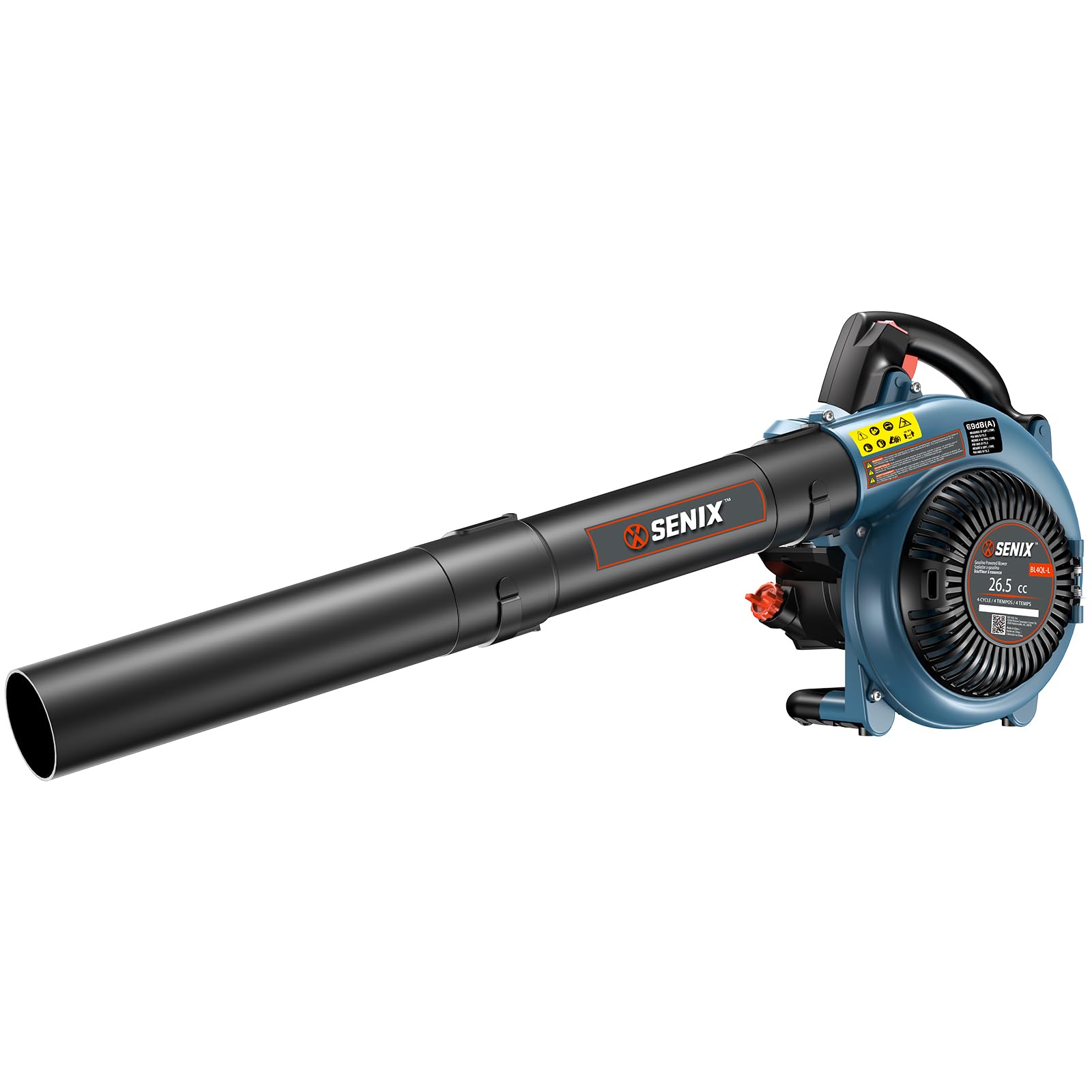
This handheld SENIX is the lightest entry point into 4-stroke leaf blowing, weighing just under 9.5 pounds while delivering 410 CFM and 125 MPH. The 26.5cc 4QL engine uses automatic compression release, and most owners report the blower starts on the first or second pull even after winter storage. The no-mix fuel system is the headline—pour straight gas from the pump and go, with the 4-stroke oil staying separate in the crankcase.
The dual-grip handle improves control during extended use, and the metal washable air filter is a step up from the foam filters found on cost-cut competitors. Vibration levels are noticeably lower than a 2-stroke handheld, and the engine runs quieter overall. However, the 410 CFM output is modest—it handles dry leaves on pavement well but struggles to lift wet leaves from turf or move dense piles across grass. Some users reported the blower pipe loosening over time, resolved with a hose clamp.
Durability is mixed: several owners report years of reliable starting, while others experienced stalling at full throttle or overheating after ten minutes of continuous use. The 3-year warranty provides some peace of mind, and the entry-level price makes it a low-risk trial for anyone wanting to test 4-stroke technology before investing in a backpack model. For small driveways and patios, this is a capable tool; for full-yard cleanup, it needs help from a rake.
What works
- Extremely easy start with automatic compression release
- Runs on straight pump gas with no oil mixing
- Lightweight and maneuverable for detailed blowing
- Lower noise and vibration than comparable 2-strokes
What doesn’t
- Only 410 CFM limits wet-leaf performance
- Left-side air intake can be blocked by operator’s leg
- Small gas tank requires frequent refills
3. SuperHandy Walk Behind Leaf Blower (209cc)

When handheld and backpack blowers are too slow for multi-acre properties, the SuperHandy walk-behind steps in with a 209cc 4-stroke engine producing 7 HP and 1270 CFM of airflow at 150 MPH. This is a manual-propelled unit, meaning you push it like a lawn mower, and the 14.2-inch plastic impeller moves enough air to clear a football field of leaves in a fraction of the time a backpack unit would take. The 12-inch rear wheels and 8-inch swivel front wheel roll smoothly over turf and pavement.
Build quality is solid for the price: a rust-resistant powder-coated steel frame supports the engine, and the adjustable discharge chute lets you direct airflow up to 20 feet. Owners with large wooded lots report cutting cleanup time from over an hour to under 15 minutes. The 4-stroke engine eliminates the smoky smell of 2-stroke mix and runs on regular pump gas with a separate oil fill. A small fuel shutoff valve prevents carburetor flooding during transport, and the engine includes an accessible RPM adjustment screw on the carburetor.
Assembly issues are the main pain point. The handlebar design can conflict with the air filter housing, requiring tube flattening for a proper fit. Overtightening the handlebar bolts risks cracking the paint on the frame tubes due to a shallow bend. Some units arrived with missing hardware, and the fuel switch alignment may need adjustment. Despite these setup frustrations, owners who get past assembly report excellent reliability and power that justifies the investment for large-scale property maintenance.
What works
- 1270 CFM moves massive debris volumes quickly
- 7 HP 209cc 4-stroke runs on straight gas
- Adjustable discharge chute for directional control
- Rugged wheel design handles uneven terrain
What doesn’t
- Handlebar fit and assembly are frustrating
- Oil leaks when tipped upright for filling
- Manual propulsion on slopes is physically demanding
4. Landworks Walk Behind Jet Sweep (212cc)

Landworks pushes the walk-behind concept further with a 212cc 4-stroke OHV engine that generates a claimed 1270 to 2000 CFM of airflow—enough to shift sand, gravel dust, and heavy wet leaves across large lots. The 13.5-inch metal impeller is a notable upgrade over the plastic impellers found on budget wheeled blowers, and the cast-iron cylinder sleeve adds durability for commercial use. The engine produces 4.1 kW of power at 3600 RPM and runs on standard 87-octane gasoline with less than 10% ethanol recommended.
The three-wheel chassis uses two rugged 10-inch rear tires and a single 8-inch swivel front wheel for maneuverability. Owners report the blower moves dry and semi-wet debris with surprising speed, making quick work of farm driveways, parking lots, and large lawns. The 90-degree adjustable flow angle lets you direct the blast precisely, and the manual-propulsion design keeps weight and cost down compared to self-propelled alternatives. Customer service from the manufacturer has been responsive, replacing units with impeller or frame defects.
The reliability record is inconsistent. Several units experienced impeller self-destruction within the first ten uses, and initial customer support was unhelpful before a redesign of the front wheel bracket and fan assembly. Replacement units sent later performed well, indicating early production flaws have been addressed. The assembly process is straightforward, but some hardware quality issues persist—thumb screws and wheel welds may fail. For buyers willing to handle potential early defects under warranty, the raw airflow potential is unmatched at this tier.
What works
- Enormous CFM range handles heavy debris and sand
- Metal impeller and cast-iron cylinder add durability
- Adjustable 90-degree discharge chute for precision
- Responsive manufacturer support for defect replacements
What doesn’t
- Early impeller failures in initial production runs
- Front wheel welds can fail under heavy use
- Hardware quality issues on thumb screws and brackets
5. Thalorus 52cc Backpack Leaf Blower
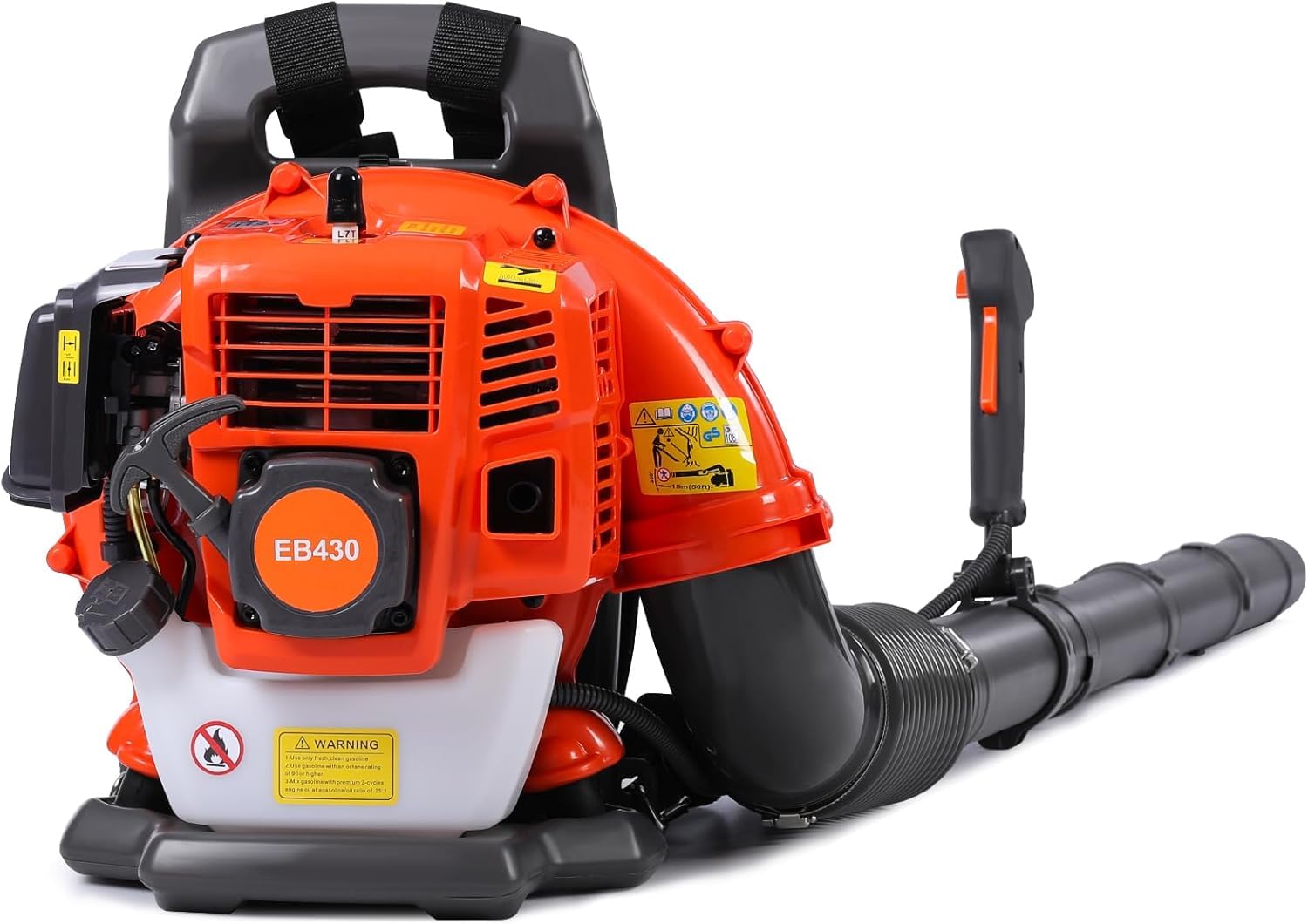
The Thalorus 52cc backpack delivers a strong 550 CFM and 230 MPH at a price point typically occupied by handheld 4-stroke models. This is a 2-stroke engine, not a 4-stroke, so buyers should note it requires a 40:1 gas-oil mix. The design emphasizes comfort with a padded harness and low-vibration construction, and the 1-liter tank provides up to 45 minutes of runtime. The thumb throttle and cruise control let you sustain speed without grip fatigue—a feature usually reserved for more expensive units.
Assembly is straightforward, with the blower starting reliably within two to three pulls for most users. The 13.6-pound weight is light for a backpack blower, and the harness straps are comfortable for extended wear on smaller properties. Airflow is sufficient for dry leaves, grass clippings, and light snow on driveways. Owners with larger lots note the 550 CFM handles routine maintenance but struggles with thick wet leaf mats that require higher volume and airspeed for effective clearing.
The primary reliability complaints center on the throttle trigger mechanism—the screw that holds the trigger to its attachment point has fallen out on multiple units, making the blower inoperable until replaced. The shoulder straps are also too short for wearing over a heavy winter coat, and the noise level, while not extreme, requires hearing protection. Overall, the Thalorus offers strong initial value for buyers wanting backpack ergonomics on a handheld budget, with the caveat that long-term durability may require minor hardware fixes.
What works
- Excellent CFM-to-price ratio for backpack form
- Comfortable low-vibration harness design
- Cruise control and thumb throttle reduce fatigue
- Easy assembly and quick starting
What doesn’t
- Throttle trigger screw can loosen and fall out
- Shoulder straps too short for bulky outerwear
- Requires 2-stroke oil mixing, not pure 4-stroke
6. PROYAMA 72cc Backpack Leaf Blower (PR-BPLB-72)
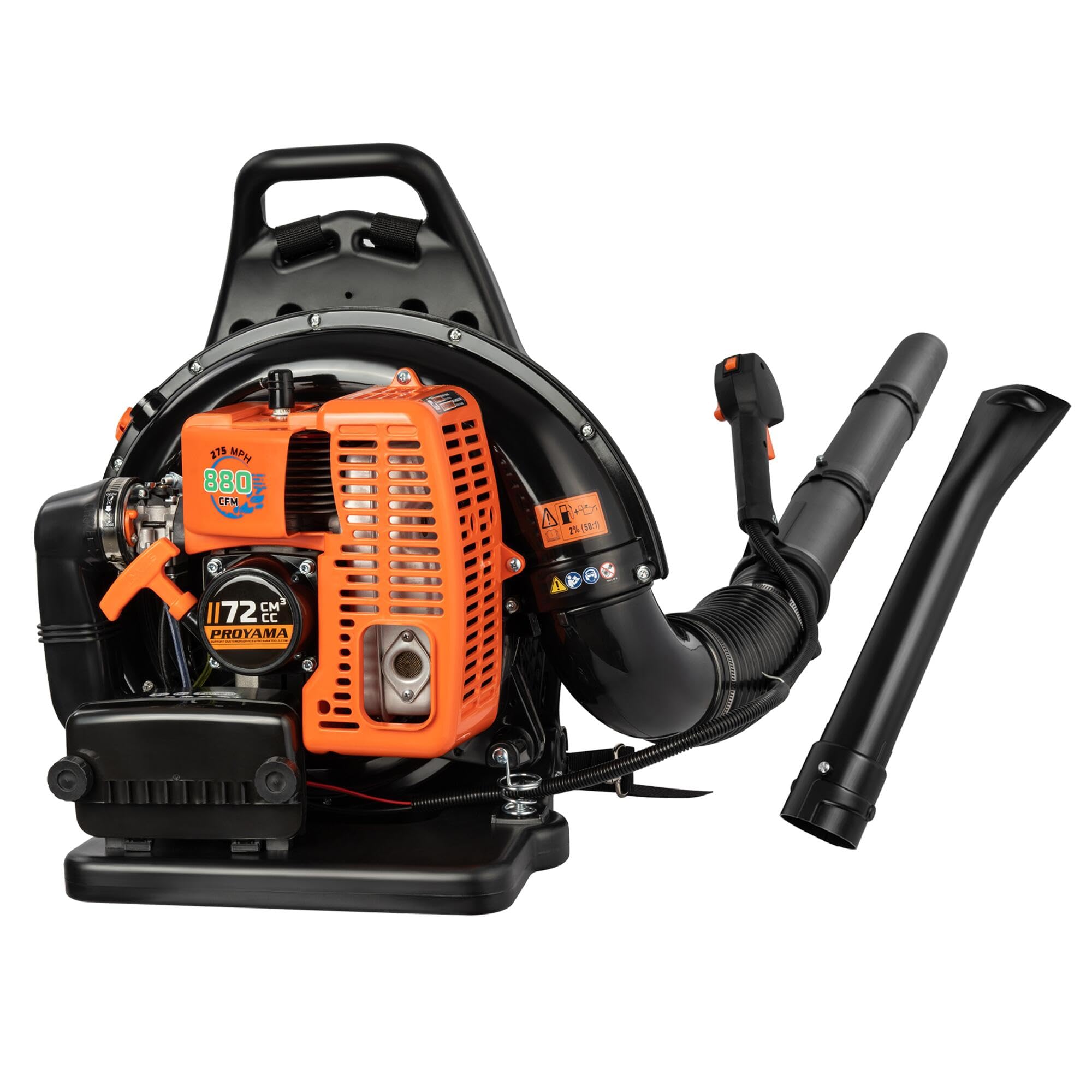
The PROYAMA 72cc backpack blower produces serious numbers—880 CFM and 275 MPH from a 3.7 HP 2-stroke engine—making it a natural competitor to commercial brands like Stihl and Husqvarna at a significantly lower investment. This is a 2-cycle engine requiring a 40:1 fuel mix, but the raw power output allows it to move wet leaves, small branches, and even gravel without hesitation. The dual-tube nozzle design includes flat and round tips for adapting to tight spaces or open areas.
The ergonomic design features shock-absorbing shoulder straps and a balanced frame that distributes the 21-pound weight reasonably well. A self-throttle lock maintains consistent RPM, and the variable-speed trigger with cruise control minimizes hand fatigue during long sessions. Certified mechanic reviewers have praised the build quality of the heavy-duty plastic housing and the easy-start mechanism, noting it matches or exceeds units costing two to three times more. Owners report using it for snow removal on light accumulation days with good results.
The downsides include a learning curve with the long tube design—it takes practice to aim effectively—and the weight is noticeable on the upper back during extended use. Some owners found it heavier than expected despite the harness. The 40:1 mix ratio requires careful measurement to avoid engine damage, and the blower should be drained of fuel during off-season storage to avoid carburetor varnishing. PROYAMA’s customer service has been responsive, with one owner receiving a 20-minute email reply, which is rare in this price segment.
What works
- 880 CFM and 275 MPH match commercial-grade output
- Starts in 1-2 pulls with proper priming
- Comfortable padded harness for extended wear
- Excellent value compared to premium-brand alternatives
What doesn’t
- Heavier 21-pound weight strains shoulders over time
- Long tube design requires practice to control
- 2-cycle engine needs precise 40:1 oil mixing
7. Getell 63cc Backpack Leaf Blower (GB657 PRO)

The Getell GB657 PRO targets professional landscapers who need consistent high airflow without a premium-brand price tag. The 63cc 2-stroke engine pushes 665 CFM at 205 MPH, and the 1.7-liter fuel tank allows extended operation between refills. The smart flow technology adjusts speed from precise garden care up to full-throttle debris removal, with an advanced cruise control that locks in the chosen RPM to eliminate trigger holding fatigue during long commercial jobs.
The backpack chassis features cooling ventilation channels, vibration reduction technology, and padded ergonomic straps that suit all-day use. Build quality is solid with an aluminum tube assembly and reinforced frame, and the tool-free maintenance access makes air filter changes simple. Owners report the blower starts first-pull reliably after the initial break-in and handles wet grass, oak leaves, and pine needles without surging or bogging down. The comprehensive maintenance kit included in the box adds value for professionals who plan to keep the machine running season after season.
The biggest drawbacks are noise and the supplied strap hardware. The blower runs at 78 decibels and requires hearing protection, which is standard for its power class but worth noting for residential neighborhoods. The included backpack straps have a reputation for popping off during use—several owners recommend replacing them with aftermarket clips immediately. A small number of units arrived with carburetion issues that prevented them from staying lit, and the manufacturer’s return policy on these defective units has drawn sharp criticism from affected buyers.
What works
- 665 CFM handles heavy wet debris effectively
- Comfortable anti-vibration backpack design
- Large 1.7L fuel tank for extended runtime
- Tool-free maintenance for air filter changes
What doesn’t
- Backpack straps tend to detach during operation
- Very loud—mandatory hearing protection required
- Some units have carburetion and return policy issues
8. Husqvarna 350iB Battery Powered Leaf Blower

The Husqvarna 350iB is a brushless cordless blower that delivers 800 CFM and 200 MPH, matching or exceeding many gas-powered handheld units in air volume. This is a battery-powered alternative to 4-stroke blowers, ideal for users who want zero emissions and lower noise without sacrificing power. The included 40V 7.5Ah battery provides enough energy for typical residential cleanup, and the Power Boost mode adds 20 percent more output for short bursts when tackling stubborn debris.
Weight is a standout advantage: the blower is 15 percent lighter than comparable battery models when using the 7.5Ah battery, coming in around 10 pounds total. The intuitive keypad offers instant start—no pull cord, no choke—and the cruise control lets you maintain constant speed without pressing the trigger. Owners report it replaces gas blowers effectively for all routine yard work, with the caveat that turbo mode drains the battery in 15-20 minutes. The built-in debris scraper on the nozzle helps loosen caked-on leaves and mud from pavement.
Reliability complaints center on battery and support issues. Several units arrived with dead battery packs that failed to charge, and Husqvarna’s customer service response after 30 days has been described as unhelpful and scripted. The 7.5Ah battery is expensive to replace, and Amazon’s price fluctuation means late buyers may feel they overpaid. The blower itself performs excellently when the battery works, but the inconsistent quality control on the power pack makes this a gamble. For buyers within the return window, initial impressions are overwhelmingly positive.
What works
- 800 CFM airflow rivals gas handheld blowers
- Instant-start keypad with no fuel mixing needed
- Power Boost mode delivers burst of extra output
- Quieter operation with zero exhaust emissions
What doesn’t
- Battery DOA rate is noticeable across buyer reports
- Turbo mode drains battery in under 20 minutes
- Expensive replacement batteries
9. EGO Power+ LB8803 Cordless Leaf Blower (2 Batteries)

The EGO LB8803 is the most powerful handheld cordless leaf blower in the residential market, delivering up to 880 CFM and 200 MPH from a high-efficiency brushless motor. The carbon fiber body keeps weight manageable at roughly 10 pounds with the included 4.0Ah battery, and the dual-battery kit provides up to 90 minutes of runtime on a single charge when running at moderate speeds. The variable-speed trigger ranges from 270 CFM for detail work up to full turbo mode for maximum clearing power.
An onboard digital display shows real-time blower performance, battery charge level, and cruise lock status, giving the operator precise feedback without guessing remaining runtime. The secondary grip zones allow two-handed operation for better control at high power, and the included shoulder strap takes the load off during longer sessions. Turbo mode is genuinely impressive—owners report it moves wet maple seeds, small rocks, and even gravel with ease. The two 4.0Ah batteries charge quickly, though the charger itself is noisy during operation.
The main downsides are battery management and weight. Turbo mode drains a 4.0Ah battery in roughly 15 minutes, meaning users with large properties should budget for additional 5.0Ah or 7.5Ah batteries for uninterrupted work. Some owners felt the kit should have included 5.0Ah batteries given the price point. The blower is slightly heavy for smaller or elderly users, though the strap mitigates this. The 5-year tool warranty and 3-year battery warranty provide solid backing, and the EGO 56V platform compatibility means the batteries work across the entire EGO tool ecosystem.
What works
- 880 CFM turbo mode rivals gas backpack blowers
- Carbon fiber body is lightweight and durable
- Digital display shows battery and power status
- Two included batteries provide extended runtime
What doesn’t
- Turbo drains battery too fast for large properties
- Should include 5.0Ah batteries at this price tier
- Weight may be fatiguing for extended one-handed use
Hardware & Specs Guide
Engine Displacement and Fuel Type
4-stroke leaf blower engines range from 26.5cc in handheld units up to 212cc in walk-behind models. The 4-stroke architecture uses a separate oil reservoir in the crankcase, meaning you pour straight gasoline into the fuel tank. This eliminates the need for pre-mixing gas and oil, reduces exhaust smoke, and significantly lowers hydrocarbon emissions. Walk-behind 4-stroke engines (209cc-212cc) produce 7 HP and deliver 1270-2000 CFM, making them the most powerful gas blowers available for residential use without stepping into commercial-grade tricycle blowers.
Airflow Metrics: CFM and MPH
CFM (cubic feet per minute) is the more important metric for 4-stroke blowers because it determines how much debris you can move per pass. Handheld 4-strokes typically output 400-410 CFM, which is adequate for dry leaves on hard surfaces but struggles with wet leaves on grass. Backpack 4-strokes from SENIX reach 600 CFM, which starts to handle turf effectively. Walk-behind units at 1270 CFM and above shift debris like a commercial sweeper. MPH measures the air velocity for dislodging stuck material—200+ MPH is preferred for wet leaves embedded in gravel or lawn edges.
Starting System and Ease of Use
Many 4-stroke leaf blowers include automatic compression release (ACR), which vents cylinder pressure during the pull stroke to reduce the effort required to start the engine. This is critical on larger engines because the higher compression of a 4-stroke design makes pulling harder than a 2-stroke without ACR. Electric start options exist on premium walk-behind units, but most handheld and backpack 4-strokes use a manual recoil. Priming the carburetor with the purge bulb before starting reduces wear on both the starter cord and the user’s shoulder.
Vibration Control and Ergonomics
4-stroke engines produce a different vibration pattern than 2-strokes—lower frequency but potentially higher amplitude if the crank is not balanced. Quality 4-stroke blowers use full-crank designs and rubber vibration isolators at the handle mounts. Backpack models benefit from padded hip belts and shoulder straps that transfer the engine weight to the skeleton rather than the arms. Cruise control or throttle lock is essential on any 4-stroke blower used for more than 15 minutes continuously, as holding a trigger against spring tension causes hand fatigue that limits productivity.
FAQ
Why choose a 4-stroke leaf blower over a 2-stroke model?
What CFM rating do I need for wet leaves on grass?
Can I use ethanol gasoline in a 4-stroke leaf blower?
How often should I change the oil in a 4-stroke leaf blower?
Final Thoughts: The Verdict
For most gardeners, the 4-stroke leaf blower winner is the SENIX 49cc Backpack because it combines the no-mix convenience of 4-stroke technology with real 600 CFM backpack power for under mid-range pricing. If you want the ultimate portable power without refueling hassles, grab the EGO Power+ LB8803 for its 880 CFM turbo mode and dual-battery runtime. And for clearing acres of heavy wet leaves without breaking your back, nothing beats the SuperHandy Walk Behind and its 1270 CFM jet sweep.