
A lawn that surges green after a chemical drench only to yellow out and require constant re-application isn’t healthy — it’s addicted. The secret to deep, consistent color and dense turf lies in how you deliver nitrogen, not just how much. Slow release lawn fertilizers meter out nutrients gradually, feeding the soil biology and the grass at a pace that builds root mass instead of forcing weak, leafy top growth.
I’m Rikta — the co-founder and writer behind Lawn Gear Lab. I’ve spent hundreds of hours comparing NPK ratios, studying nitrogen delivery mechanisms (polymer-coated, sulfur-coated, and naturally organic), and sifting through field reports from thousands of homeowners to determine which formulas actually deliver steady color without the surge-and-crash cycle.
Whether you’re managing a St. Augustine lawn in humid heat or a fescue blend through a northern winter, the right slow release lawn fertilizer keeps grass fed for weeks between applications with minimal risk of burn or runoff. best slow release lawn fertilizer choices must balance nitrogen longevity, coverage area, and safety for pets and the surrounding ecosystem.
How To Choose The Best Slow Release Lawn Fertilizer
Not every bag labeled “slow release” works the same way. The difference between a steady four-month feed and a short two-week burst comes down to three things: the nitrogen source, the particle coating technology, and the soil biology it supports.
Water-Insoluble Nitrogen (WIN)
This is the single most important spec on the label. WIN measures the percentage of nitrogen that will not dissolve immediately in water. A high WIN percentage (above 50%) means the nitrogen must be broken down by soil microbes, which happens slowly and naturally over weeks. Low WIN formulas are mostly quick-release, prone to surge growth and potential burn if over-applied. Always check the guaranteed analysis for the WIN line.
Coating Technology and Release Duration
Polymer-coated (prilled) granules like those used by Osmocote release nitrogen through osmosis as soil temperature rises. Sulfur-coated granules are cheaper but can release unevenly if the coating cracks. Natural organics like the Bio-tone blend from Espoma rely entirely on microbial activity, which makes them temperature-sensitive but soil-building. Look for a stated feeding duration — 6 to 12 weeks is the sweet spot for most warm and cool season lawns.
Phosphorus Content and Local Regulations
Many municipalities now restrict phosphorus in lawn fertilizers because it runs off into waterways and feeds algae blooms. If your soil test shows adequate phosphorus or your town has a ban, a 0 in the middle NPK slot (e.g., 16-0-8 or 9-0-0) is the right choice. Phosphate-free formulas also prevent weed seed germination in some cases, which is a bonus for pre-emergent strategies.
Quick Comparison
On smaller screens, swipe sideways to see the full table.
| Model | Category | Best For | Key Spec | Amazon |
|---|---|---|---|---|
| GreenView Fairway Formula | High Nitrogen | Large lawns needing 12-week feed | 63% WIN, 27-0-5, covers 10,000 sq ft | Amazon |
| The Andersons PGF 16-0-8 | Pro Grade | High-phosphorus soil correction | Humic DG, 16-0-8, covers 10,000 sq ft | Amazon |
| Espoma Organic Lawn Food | Organic | Organic turf with Bio-tone microbes | 9-0-0, Bio-tone, 28 lb covers annual feed | Amazon |
| Purely Organic Lawn Food | Plant-Based | Pet-safe, no re-entry delay | 10-0-2, covers 3,000 sq ft | Amazon |
| Osmocote Smart-Release | All-Purpose | Containers, raised beds, and garden beds | 11 nutrients, resin-coated, 6-month feed | Amazon |
| Safer Brand Lawn Restore | Natural | Reviving stressed or burned lawns | 9-0-2, greens in 3-5 days, covers 5,000 sq ft | Amazon |
| Fertilome Centipede 15-0-15 | Grass-Specific | Centipede lawns needing iron correction | 15-0-15, covers 5,000 sq ft, 16 lb bag | Amazon |
In‑Depth Reviews
1. GreenView Fairway Formula 27-0-5

The GreenView Fairway Formula delivers a potent 27-0-5 NPK with 63% of its nitrogen in water-insoluble form — the highest WIN percentage in this lineup. That means a steady, non-surge feed that powers deep green color for up to 12 weeks from a single application. The 33-pound bag covers a full 10,000 square feet, making it exceptionally cost-efficient for owners of quarter-acre lots or larger lawns.
Field reports from users in hot southern climates and transitional zones confirm that this formula thickens Bermuda and centipede lawns noticeably within a week of a good rain, and the zero-phosphate composition is compliant with municipal restrictions. The fine granule texture spreads evenly through rotary spreaders without clumping, even in humid conditions.
Where this fertilizer separates from the field is its dual-release design — a small fraction of quick-release nitrogen provides an initial visible greening while the bulk feeds the turf over the entire spring-to-summer window. This avoids the boom-bust cycle of cheaper fertilizers and reduces the total number of applications needed per season.
What works
- 63% slow release nitrogen keeps lawn fed for 12 weeks
- Massive 10,000 sq ft coverage per bag
- Phosphate-free formula meets local regulations
What doesn’t
- Very high nitrogen content can burn if applied on dormant turf
- Not suitable for lawns already high in nitrogen from soil tests
2. The Andersons PGF 16-0-8 with Humic DG
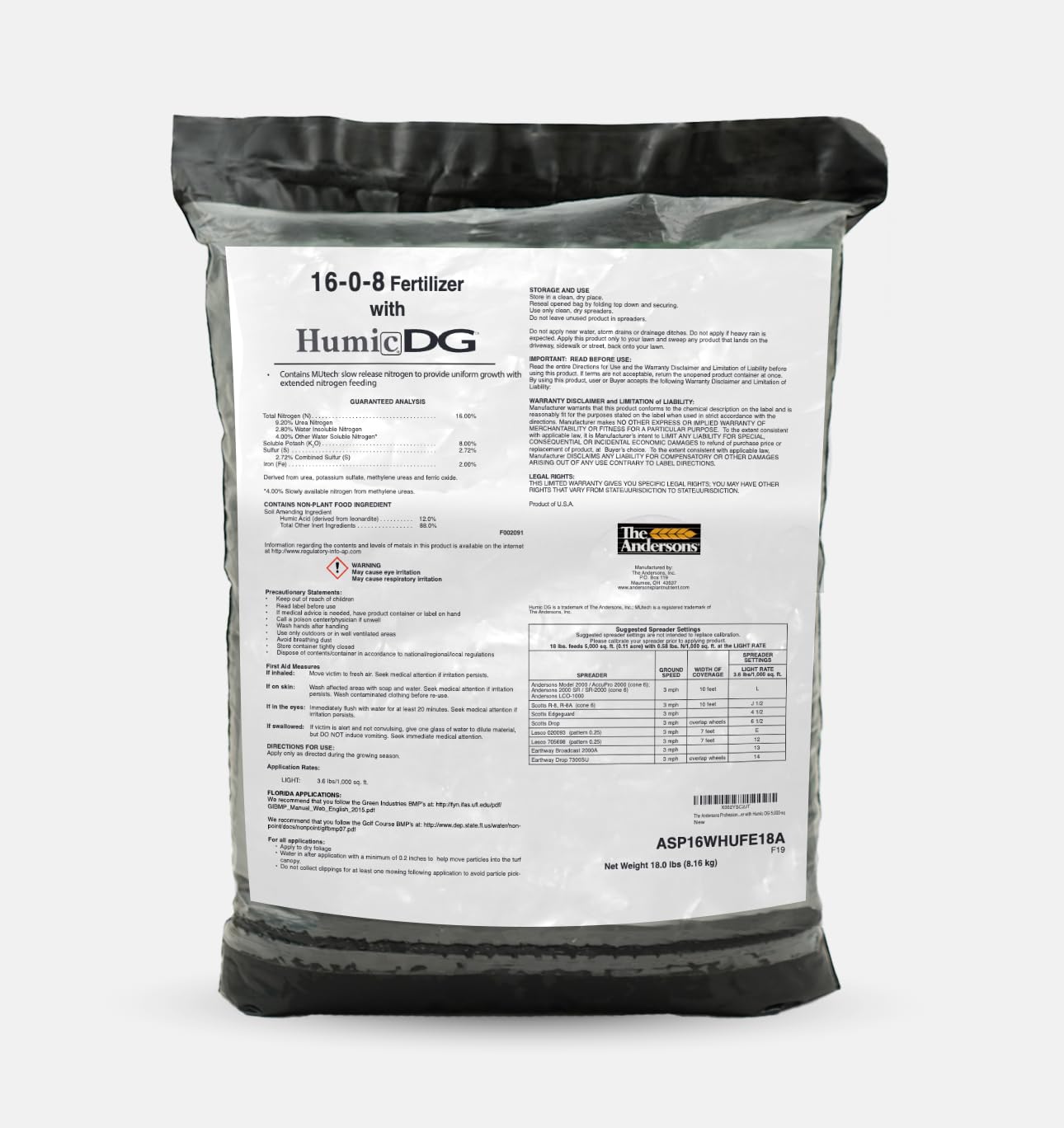
The Andersons Professional PGF is built for turf managers who want precise, layered nutrition. Its 16-0-8 ratio is ideal for soil that already has adequate phosphorus — which is common in lawns that have been fertilized for years. The super-fine particle size delivers double the number of granules per square foot compared to standard fertilizers, eliminating the striped pattern that cheap spreaders produce.
Humic DG is the standout additive here — humic acids chelate nutrients in the soil, making them more available to grass roots while improving cation exchange capacity. This translates to greener color with less total nitrogen applied. The dual quick-and slow-release nitrogen sources provide an immediate color bump followed by sustained feeding for up to 8 weeks.
Users consistently report that this is the best-performing fertilizer for turf that looks “professional” without needing a license to purchase. The only caveat is that it cannot be shipped to California or Oregon due to state regulations, so buyers in those states need an alternative.
What works
- Ultra-fine particles eliminate spreader striping
- Humic DG boosts nutrient uptake for deeper greening
- Phosphorus-free blend corrects high-P soil
What doesn’t
- Restricted for sale in California and Oregon
- Premium pricing per pound compared to commodity fertilizers
3. Espoma Organic All Season Lawn Food 9-0-0

Espoma has been formulating natural organics since 1929, and the EOLF28 is a refined execution of that philosophy. Its 9-0-0 ratio skips phosphorus and potassium entirely, concentrating on nitrogen delivery through feather meal and other natural protein sources. The proprietary Bio-tone blend introduces beneficial microbes that colonize the root zone and accelerate the breakdown of organic matter into plant-available nutrients.
The release rate here is temperature- and moisture-dependent, which means it aligns naturally with grass growth cycles. In cool spring weather the microbial activity slows, so nitrogen hangs back until the soil warms. This prevents the wasteful leaching that occurs when synthetic prills dissolve before roots are active. Longtime users report sustained dark color across the full growing season with just three applications per year.
Because it is OMRI-listed and contains no sewage sludge or chemical salts, this product is a top choice for organic-lawn purists and homeowners who want zero risk of chemical runoff into nearby gardens or water features.
What works
- Bio-tone microbes improve soil biology long-term
- OMRI-listed organic, safe for edible landscaping
- No risk of salt burn even if accidentally double-applied
What doesn’t
- Greening is slower — takes 1-2 weeks longer than synthetic blends
- Not suitable for lawns needing a phosphorus or potassium boost
4. Purely Organic Lawn Food 10-0-2

Purely Organic Lawn Food earns its place for households with children and pets that need zero re-entry delay after application. The formula is built from distillers grains and soy — plant-based inputs that break down slowly without releasing ammonia gas or synthetic salts. The 10-0-2 ratio supplies a moderate nitrogen dose while adding a small potassium kick for root vigor.
Reviews from Florida and Gulf Coast users highlight that this product turned yellow, stressed lawns green within four days, even during peak summer heat. The lack of phosphorus (0) makes it compliant with strict municipal bans, and the absence of manure or biosolids means it has virtually no smell compared to traditional organic fertilizers.
The coverage area of 3,000 square feet per 15-pound bag is smaller than the competition, so owners of large properties will need multiple bags. But for a suburban front-and-back lawn setup, this is a convenient, no-worry option that keeps greenery safe for immediate foot traffic.
What works
- 100% plant-based, no manure or biosolids smell
- No re-entry waiting period for kids or pets
- Fast visible greening within 4-5 days
What doesn’t
- Small coverage area requires multiple bags for large lawns
- Higher per-square-foot cost than synthetic blends
5. Osmocote Smart-Release Plant Food Plus 8 Lb

Osmocote is the most recognized name in resin-coated slow release technology, and this “Plus Outdoor & Indoor” formulation extends that to 11 essential nutrients. Each granule is encased in a semi-permeable resin membrane that allows water to enter and dissolve nutrients at a rate controlled by soil temperature — ensuring plants are fed proportionally to their metabolic activity.
This product is not designed as a dedicated lawn fertilizer — it targets container plants, flower beds, raised vegetable gardens, and shrubs. For gardeners who simultaneously manage turf and ornamental beds, purchasing one bag to handle both tasks simplifies inventory. The 8-pound container covers approximately 300 square feet of garden area at the recommended rate.
Users frequently praise how this product eliminates the need to remember monthly feedings. A single application in early spring delivers a consistent nutrient stream through fall. The primary limitation for turf use is that the NPK ratio is not disclosed as a single number (the bag relies on a proprietary mix of 11 nutrients), so precise nitrogen-to-lawn matching is less transparent than with dedicated grass fertilizers.
What works
- Resin coating provides the most consistent temperature-dependent release on the market
- Feeds up to 6 months with a single application
- Suitable for indoor and outdoor container plants
What doesn’t
- Coverage is too small for open lawn feeding
- NPK ratio is not explicitly stated for precise lawn dosing
6. Safer Brand Lawn Restore 9-0-2
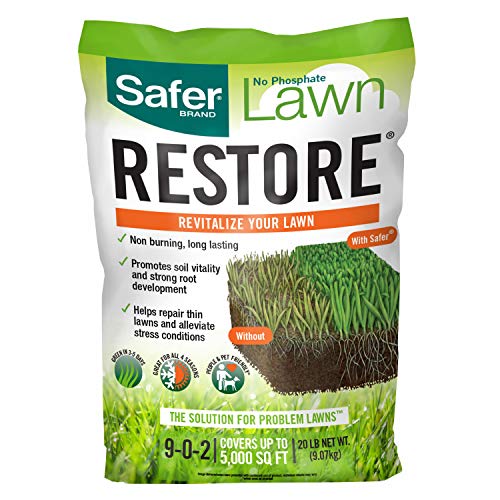
The Safer Brand Lawn Restore is unique in this test because it delivers its nitrogen partly through corn gluten meal, which doubles as a pre-emergent weed suppressant. The 9-0-2 ratio is lightweight, but the formulation is designed to stimulate soil microbes that break down thatch and improve water infiltration — making it a restoration tool, not just a feeder.
Users regularly report that lawns browned out by synthetic fertilizer burn recover within days of applying this product. The 20-pound bag covers 5,000 square feet, and the non-burning composition means you can apply it even during heat stress without worrying about scorching the turf. The main caution is that corn gluten also inhibits grass seed germination, so this should not be applied within 4-6 weeks of overseeding.
For homeowners transitioning from chemical fertilizers to a more natural program, this serves as an excellent bridge product. It provides the quick greening that synthetic users expect while building the microbial foundation that organic programs require.
What works
- Corn gluten provides pre-emergent weed control alongside feeding
- Safe for pets and birds immediately after application
- Revives lawns damaged by synthetic fertilizer burn
What doesn’t
- Cannot be used when overseeding — corn gluten blocks germination
- Slower greening than high-WIN synthetic fertilizers
7. Ferti-lome Centipede Lawn Fertilizer 15-0-15
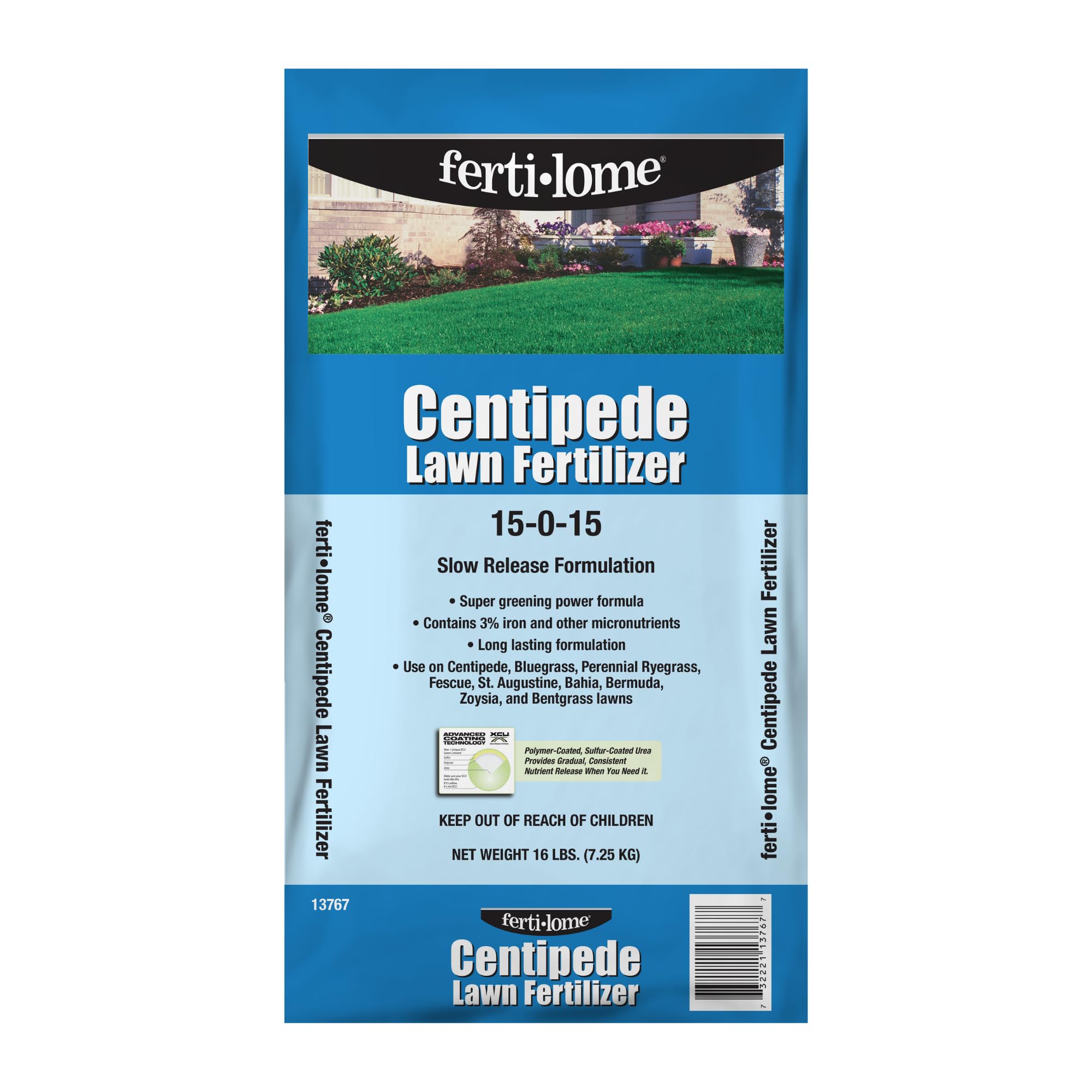
The Ferti-lome Centipede formula is laser-focused on one specific grass type, which makes it a precision tool rather than a generalist. Centipede grass is notorious for yellowing due to iron chlorosis in alkaline soils, and this 15-0-15 ratio targets that condition by providing nitrogen and potash without the phosphorus that centipedes do not need. The zero phosphate slot also protects centipede’s natural low-maintenance growth habit.
Users in the Carolinas and Georgia report that this fertilizer turns patchy, pale centipede lawns into thick, deep-green turf within 10-14 days, even during the extreme heat of July. The 16-pound bag covers 5,000 square feet, and the manufacturer’s recommended schedule is early spring and early fall applications — two feeds per year is often enough for centipede lawns due to their low nitrogen appetite.
The downside is that this fertilizer is not well-suited for fescue, Kentucky bluegrass, or Bermuda lawns that have higher nitrogen and iron demands. For those grass types, the low phosphate and specific potassium balance may produce suboptimal color and density. This is a specialist product for centipede owners who want a tailored, no-guesswork feeding regimen.
What works
- Perfectly matched to centipede grass nutritional needs
- Corrects yellow chlorosis with high potash content
- Two applications per year is sufficient for most centipede lawns
What doesn’t
- Not recommended for fescue, Bermuda, or bluegrass lawns
- Lower coverage area necessitates multiple bags for larger properties
Hardware & Specs Guide
Water-Insoluble Nitrogen (WIN)
The percentage of nitrogen that is not immediately water-soluble. A WIN of 50% or higher indicates a true slow release product that depends on microbial or temperature-driven breakdown. Products like GreenView Fairway Formula (63% WIN) provide sustained color without the dangerous surge of quick-release urea. Lower WIN numbers mean more of the nitrogen is fast-acting, increasing the risk of foliar burn and requiring more frequent application.
NPK and Micronutrients
The three-number ratio represents nitrogen-phosphorus-potassium by weight. For slow release lawn fertilizers, a high first number (20-30) is common when rapid greening is desired, while a lower first number (9-10) combined with organic matter is typical for soil-building formulas. Iron and magnesium are often listed separately in the guaranteed analysis — these influence the deep green “chlorophyll” response that homeowners visually judge.
Coating Mechanisms
Sulfur-coated urea (SCU) is the most common budget slow release method — it is reliable but can release unevenly if the coating cracks during handling. Polymer-coated prills (like Osmocote’s resin shells) offer the most predictable release because water entry is controlled by temperature-driven osmosis. Natural organics rely entirely on soil biology — they build long-term soil structure but release unpredictably in cold or dry conditions.
Coverage and Bag Size
Bag weights in the 15-35 pound range typically cover 3,000 to 10,000 square feet. High-nitrogen synthetic blends can cover more area per pound because the application rate is lower (often 3-4 lbs per 1,000 sq ft). Natural organics usually require a heavier application rate (5-8 lbs per 1,000 sq ft) because the nitrogen content is lower by weight. Always measure your lawn in square feet before buying — a 10,000 sq ft bag is overkill for a 3,000 sq ft property.
FAQ
How do I know if my lawn needs a slow release fertilizer instead of a quick-release?
Can I use a slow release lawn fertilizer on dormant warm-season grass?
What does “water-insoluble nitrogen” mean on the fertilizer bag?
Will slow release fertilizer still burn my lawn if I over-apply?
Final Thoughts: The Verdict
For most gardeners, the best slow release lawn fertilizer winner is the GreenView Fairway Formula because its 63% WIN and 10,000 sq ft coverage deliver the longest feeding window at the lowest per-application cost. If you want organic certification and soil microbial improvement, grab the Espoma Organic Lawn Food. And for correcting high-phosphorus soil with professional-grade results, nothing beats the Andersons PGF 16-0-8 with Humic DG.