
A ceiling-mounted grow light isn’t just a lamp you screw into the sheetrock. It’s a fixed-point light source that defines your entire canopy—dictating how much photosynthetic energy hits your plants’ leaves, how deep the light penetrates, and whether you get tight internodal spacing or leggy, stretched-out foliage. Choosing the wrong one means either scorching your top colas or starving your understory growth.
I’m Rikta — the co-founder and writer behind Lawn Gear Lab. I spend my time analyzing spectral output charts, comparing PPFD maps across brands, and cross-referencing real-world owner reports to find the ceiling grow light that actually delivers on its advertised footprint.
Every fixture here was evaluated for its ability to produce high-yield results across seed-starting, vegetative, and flowering stages, with a specific focus on linkage capability and dimming control.
How To Choose The Best Ceiling Grow Light
Mounting a fixture to the ceiling changes the game compared to a standard stand or clamp. The distance becomes fixed, the spread becomes uniform, and you need to get the specs exactly right before you drill any holes. Here are the three most important criteria to lock in.
1. Coverage Footprint & PPFD Uniformity
A ceiling fixture’s most critical spec is its PPFD map at a given hanging height. A unit that claims 4×4 coverage may only deliver high PAR values in a 2×2 center while the edges fall below the DLI threshold for flowering. Look for manufacturers that publish a 36-point PPFD map. If they only advertise a single center reading, the edges are almost certainly weak. For a 4×4 tent, you need a fixture that maintains at least 600 μmol/m²/s across the entire floor—not just the middle square foot.
2. Dimmability and Control (Manual vs. Digital)
Seedlings demand low photon flux (around 200-300 μmol/m²/s), while flowering plants want 800-1000+. A ceiling light without dimming forces you to raise or lower the fixture, which changes your footprint. A knob dimmer or a dedicated controller with sunrise/sunset simulation gives you granular control. Daisy-chain capability is a bonus: it lets you gang multiple fixtures together and dim them from a single point, which is essential if you expand from a 2×4 to a 4×8 tent later.
3. Thermal Management & Noise Profile
Ceiling-mounted lights trap heat near the top of your tent or room. If the fixture uses a fan, that fan noise can become an annoyance, especially in a bedroom or living-room setup. Fanless designs with thick extruded-aluminum heat sinks are silent but often heavier—make sure your ceiling hooks can support the weight. Active cooling is more efficient at dissipating heat, but check owner reports for fan bearing quality and noise levels above 50% power.
Quick Comparison
On smaller screens, swipe sideways to see the full table.
| Model | Category | Best For | Key Spec | Amazon |
|---|---|---|---|---|
| Mars Hydro SP3000 | Premium Panel | High-yield 4×2 coverage | 727.2 μmol/s PPF | Amazon |
| FARMLITE 360W | Pro Bar | Large 4×4 flowering | 360W / 36000 Lumens | Amazon |
| SAYHON SH2000 | UV-IR Bar | Supplemental UV/IR boosting | 2.7 μmol/J efficiency | Amazon |
| Barrina BU2000 | Adjustable Panel | 60° beam angle focus | 1600 μmol/m²/s center PPFD | Amazon |
| AC Infinity IONBEAM S16 | Supplement Bar | Inter-canopy side lighting | Samsung LM301H EVO diodes | Amazon |
| GroCruiser 2000W | Entry Fan Unit | Budget 3×3 tent setup | 260W draw / 1176 LEDs | Amazon |
| Sunco 4FT 40W | Linear Strip | Seedling shelves & benches | 40W / 2000 Lumens | Amazon |
In‑Depth Reviews
1. Mars Hydro SP3000 2×4 Grow Light
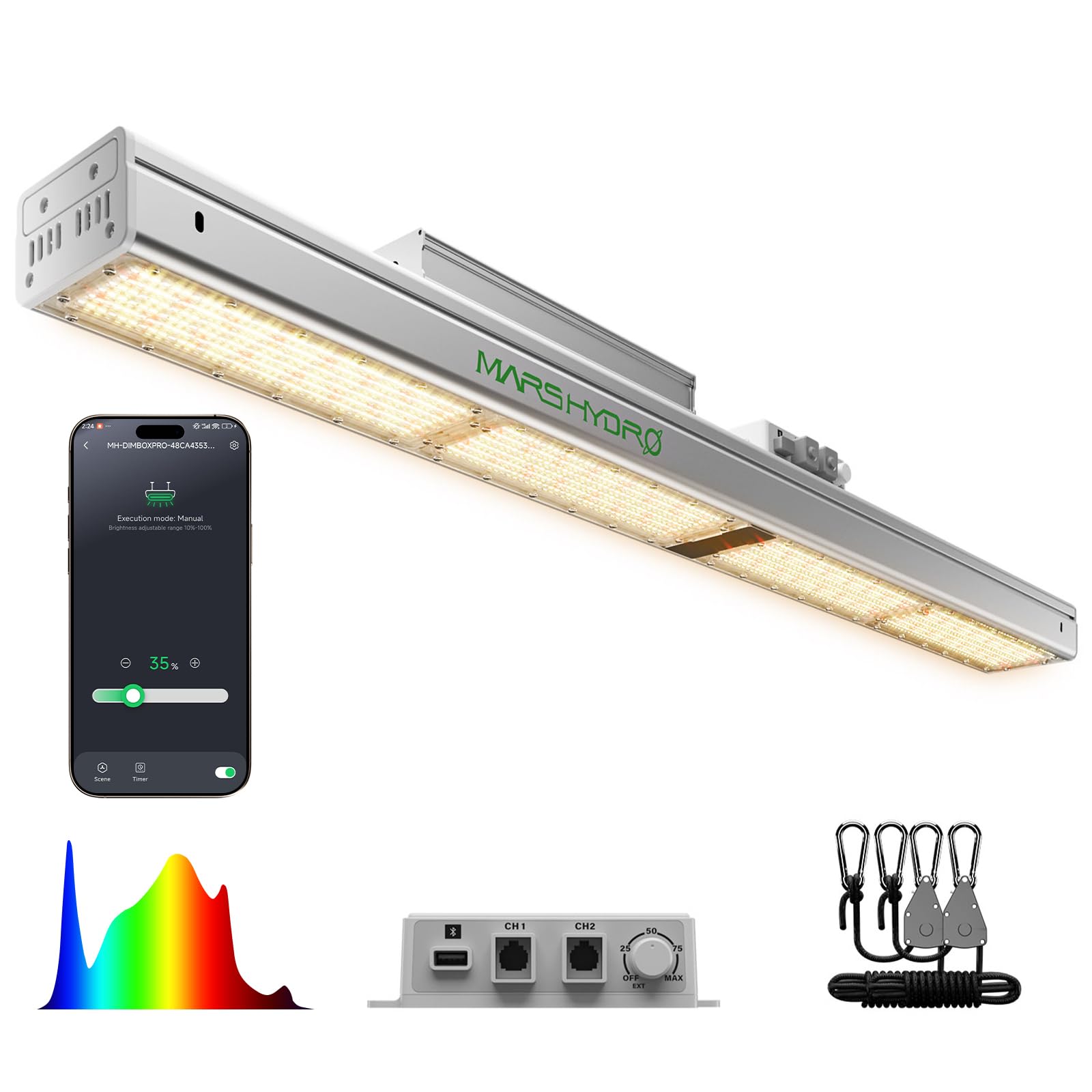
The SP3000 is the most even-coverage fixture in this roundup for a 2×4 grow tent. At 727.2 μmol/s PPF and 2.8 μmol/J efficiency, it beats many bar-style lights that cost twice as much. The 660nm deep-red spectrum combined with 3000K and 5000K white diodes produces tight internodes and dense flowers. The heat sink is thick enough to run fanless in most environments, keeping noise at zero. The dimming box works manually, and if you buy the Iconconnect USB accessory, the Mars Hydro app opens up sunrise/sunset ramping and schedule automation.
Owners consistently report that it fills a 4×2 footprint with a PAR variance under 15% edge-to-edge, which is rare for a single-panel design at this price. The unit is heavy—nearly 10 lbs—so you need sturdy ceiling hooks, but the build quality feels solid. The power cord is long enough for a typical tent ceiling, and the daisy-chain port allows linking up to 50 units for commercial setups. Some users noted the hanging openings are only 3 cm wide, so thick carabiners may not fit.
The five-year warranty is the longest in this comparison, and Mars Hydro’s customer-service response is proven: when one owner’s driver failed after a year, a replacement arrived in three days. For anyone building a dedicated flowering tent in the 2×4 format, this is the ceiling light to beat.
What works
- Outstanding PPF uniformity across a 2×4 canopy
- Fanless, silent operation with heavy aluminum heat sink
- WiFi app control available with optional USB dongle
- Five-year manufacturer warranty
What doesn’t
- No physical on/off switch or dimmer knob included in base package
- Narrow 3cm hanging slots limit hardware options
2. FARMLITE FM-4 360W LED Grow Light

The FARMLITE FM-4 is a serious bar-style panel that pulls a true 360 watts from the wall, delivering 36,000 lumens to a 4×4 footprint. It uses Samsung-class diodes and a reliable driver—owners compare it favorably to the Gavita 1700E at half the price. The bars run fanless, so noise is nonexistent, and the aluminum construction dissipates heat effectively enough that you won’t need supplemental cooling fans in most tents. A 0-10V dimming system gives you external controller compatibility, plus Master/Slave mode to sync dozens of units.
The IP65 rating makes it splash-safe, which is rare for a ceiling-aimed fixture. One owner grew three cherry tomato plants over nine feet tall under this light, and a separate review noted they achieved four successful harvests over a year with zero degradation. The daisy-chain function uses an RJ11 signal cable, and you can connect over 100 units theoretically. However, some users reported that the daisy chain didn’t work out of the box and had to contact support for troubleshooting tips.
Coverage is generous enough for a 4×4 tent during veg, though for heavy flowering you might want a second unit for the edges. The included hanging kits are adjustable, and the light sits at a manageable 10.4 lb total weight. This is a strong pick for the grower who wants commercial-grade PAR without paying commercial-grade prices.
What works
- True 360W draw with high-efficiency diodes
- Silent, fanless operation with excellent heat sinking
- IP65 waterproof rating for humid environments
- 0-10V dimming and Master/Slave control
What doesn’t
- Daisy-chain setup can be finicky out of the box
- Power cord could be longer for tall tents
3. SAYHON SH2000 LED Grow Light

The SH2000’s standout feature is its dedicated UV (390nm) and IR (730nm) supplement bar with a separate switch. This lets you toggle far-red on during the final two weeks of bloom to trigger the Emerson effect, while the UV-A can stay off during veg to avoid stressing young leaves. The main board uses 660nm deep-red, 2700K, and 5000K LEDs for a full-spectrum profile that covers 400-760nm. Efficiency is rated at 2.7 μmol/J, competitive with fixtures costing 50% more.
The fanless design is completely silent, and the 3A+ aluminum heat sink keeps temperatures under control—owners running it at 50% in a 4×4 tent report no heat issues. PAR readings hit the high 900s μmol/m²/s at 18 inches in the center, which is plenty for flowering when paired with a second unit. The dimmer knob lets you adjust from 0-100%, but note it doesn’t function as a power switch—you’ll need to unplug to turn it off completely.
Customer support is responsive; one owner had a blue strip fail after a year, and SAYHON sent a replacement after following up. The 36-month warranty backs the light well beyond the typical two-year period. For growers who want to experiment with UV-B and far-red timing without buying a separate controller, this is the most versatile single-fixture option.
What works
- Independent UV/IR bar with separate on/off switch
- Excellent center PAR values for a 3×3 flowering footprint
- Silent fanless operation with thick aluminum heat sink
- Three-year manufacturer warranty
What doesn’t
- Dimming knob can’t turn the light completely off
- Slightly heavy at 8.8 lbs for ceiling hooks
4. Barrina BU2000 4×4 Dimmable Panel

The BU2000 is unique in this lineup because its two light panels hinge independently. At a 60-degree angle, the center PPFD jumps by over 25%, making it a floodlight focused on a dense 2×2 hotspot. Straighten the panels to 180 degrees, and you get even flood coverage over a 3×3 area. The 816-LED array includes 5000K blue, 3000K warm white, 660nm red, and 730nm IR, giving you a broad spectrum that supports both stretch and flower.
Dimmers are controlled via a manual knob, and the lights can be daisy-chained with a network cable for unified control across multiple fixtures. The unit is fanless, so noise is zero. Owners report that it’s powerful enough to burn plants if cranked to 100% at 12 inches—a testament to its real PPFD. In a 4x2x5 tent, the driver adds about 3-4°F to ambient temps on the lowest setting, which is manageable.
The light weighs only 2.02 lbs, making it one of the easiest fixtures to ceiling-mount without heavy-duty hooks. However, some owners wished for a 24-hour timer onboard rather than relying on an external outlet timer. The included hanging chains and hooks are adequate for most setups. For the grower with a 3×3 tent who wants adjustable beam focus, this panel outperforms many fixed-bar lights in its price tier.
What works
- Hinged panels allow floodlight or spotlight focus
- Very lightweight—easy to ceiling mount
- Effective 660nm red and IR for flowering
- Fanless, absolutely silent
What doesn’t
- No built-in timer for automations
- Driver adds noticeable heat to tent environment
5. AC Infinity IONBEAM S16 Grow Light Bars

The IONBEAM S16 is not a primary overhead fixture—it’s a supplemental inter-canopy bar that solves the problem of shaded lower buds. Four 16-inch bars mount magnetically to your tent frame or canvas using included steel bars, sliding right in where your main ceiling light can’t reach. Each bar uses Samsung LM301H EVO diodes rated at 3.14 μmol/J PPE, which is among the highest efficiency available. The included digital Controller 77 gives ten dimming levels and a programmable sunrise/sunset daily schedule.
Setup takes about 15 minutes. Owners praise the build quality—the aluminum housing feels premium, and the magnetic mount is strong enough to hold the bars securely even if bumped. The bars connect via included extension cables, though some users noted the main cords are a bit short, and finding longer proprietary extensions can be a hassle. The controller can sync with AC Infinity’s Controller 69 Pro+ for full environmental automation.
Heat output is minimal, so you can place these inches from the canopy without burning leaves. For an existing tent already lit by a main ceiling fixture, adding the IONBEAM S16 set yields noticeable improvements in lower-bud density. The price per bar is higher than some strip lights, but the Samsung diode efficiency and controller integration justify the premium.
What works
- Samsung LM301H EVO diodes with high PPE rating
- Magnetic mount for flexible placement on tent frames
- Sunrise/sunset timer with ten intensity levels
- Minimal heat impact on canopy
What doesn’t
- Extension cords are short and replacements are hard to find
- Priced high for sheer lumen output per bar
6. GroCruiser 2000W Dimmable LED Grow Light

The GroCruiser is a solid entry-level fixture for a 3×3 tent, pulling 260 watts from the wall while outputting light equivalent to a 2000W HPS in terms of coverage. It packs 1,176 LEDs across 3000K, 4500K, 6000K, plus UV and IR diodes for a broad spectrum. The built-in oversized cooling fans are the key differentiator here: they keep the light cool to the touch even after 14 hours of runtime, though at the cost of some noise—especially above 25% brightness, where some owners found the fan audibly buzzing.
The dimmer knob adjusts both brightness and fan speed simultaneously, which is a neat integration. Lower brightness reduces fan noise, making nighttime veg cycles quieter. Dawn-to-dusk hanging height recommendations are clearly listed in the manual: 12-24 inches for seedlings, 20-28 inches for veg, and 12-18 inches for flower. The daisy-chain function works reliably, letting you link up to two units max.
Customer support is responsive—one reviewer had a noisy replacement sent quickly. However, a notable quirk: the light does not power down completely via the dimmer; you must unplug it to achieve full darkness. This is a minor annoyance but manageable with an external timer. For a budget-friendly introduction to serious ceiling-mounted LED growing, this unit delivers real PAR at a fraction of the price of premium brands.
What works
- Good spectrum coverage with UV and IR diodes
- Oversized fans keep operating temperatures low
- Dimming knob modulates both light and fan noise
- Clear recommended hanging heights for each stage
What doesn’t
- Cannot fully turn off without unplugging
- Fan noise is noticeable above 25% power
7. Sunco 4FT 40W LED Grow Light (2-Pack)

The Sunco 4FT is a linear strip light designed for seed starting and low-light propagation, not high-intensity flowering. Each 4-foot fixture pulls only 40 watts and emits 2,000 lumens of red/blue spectrum light. The two-pack configuration gives you 80 watts total, which is ideal for a 2×2 seedling bench or a single shelf of microgreens. The included mounting hardware and pull-chain switch make ceiling or under-shelf installation straightforward. You can link up to four units for longer coverage.
Owners consistently report strong seedling growth with tight stems and good coloration. The 50,000-hour lifespan means you won’t need to replace these for many seasons. The red/blue spectrum is more limited than modern white-based full-spectrum lights—it won’t give you dense flowering, but for vegging a few tomato starts or keeping houseplants happy through winter, it’s more than sufficient. The light appears white to the eye despite the red/blue diode mix, which is a common surprise for buyers expecting pink light.
The build quality is decent for the price. The bulbs are noticeably bowed on some units, but that doesn’t affect performance. Sunco backs the fixture with a five-year warranty and has responsive US-based support. If your primary goal is to start seeds under a ceiling mount, this two-pack delivers the most cost-effective solution in the roundup.
What works
- Excellent value for seed-starting and low-light shelves
- Linkable up to 4 fixtures for expanded coverage
- 50,000-hour lifespan with 5-year warranty
- Simple plug-and-play installation with included hardware
What doesn’t
- Limited red/blue spectrum not suitable for flowering
- Low overall light output (40W per fixture)
Hardware & Specs Guide
PPFD vs. Lumens
Lumens measure human-perceived brightness, not plant-useful light. A ceiling grow light with high lumens can still be weak for photosynthesis. PPFD (μmol/m²/s) is the metric that matters—it tells you how many photons are hitting a square meter of canopy per second. For seedlings you need 200-300, for veg 400-600, and for flowering 800-1000+. Always check a published PPFD map before buying; a single center reading hides poor edge uniformity.
Daisy-Chain & Dimming
Most modern ceiling fixtures support daisy-chaining via signal cables (RJ11, 3.5mm, or proprietary). This allows a single controller to dim multiple lights simultaneously. Some units use analog 0-10V dimming, which is common in commercial greenhouses and requires an external wall controller. Digital controllers with sunrise/sunset ramping and 24-hour timers are now available on mid-range and premium fixtures, removing the need for separate outlet timers.
Cooling: Fan vs. Fanless
Active fans move hot air away from the driver and LEDs, allowing you to place the fixture closer to the canopy without burning leaves. The trade-off is noise—some budget fans are audible even at low speeds. Fanless designs use thick aluminum heat sinks to passively dissipate heat. They are completely silent but add weight and require adequate ceiling clearance. In a warm tent, a fanless unit may raise ambient temps by 2-4°F, which can be a problem for some strains during late flower.
Spectrum Composition
Full-spectrum white LEDs (3000K + 5000K) combined with 660nm deep-red diodes produce the broadest PAR response, covering both photosynthetic peaks. UV-A (390-400nm) and far-red (730nm) are supplemental bands used to trigger secondary metabolic responses and the Emerson effect, respectively. Not all plants benefit from UV; it can stress young seedlings. A dedicated switch for the UV bar, as seen on premium models, gives you control over when these wavelengths are applied.
FAQ
How far should I hang my ceiling grow light from the canopy?
Can I use a ceiling grow light in a non-tent room?
What is the difference between a 2000W equivalent and a 200W actual draw?
Is UV/IR actually necessary for indoor plants?
Final Thoughts: The Verdict
For most gardeners building a dedicated 2×4 flowering tent, the ceiling grow light winner is the Mars Hydro SP3000 because its PPF uniformity and high-efficiency diodes deliver dense buds edge-to-edge without hot spots. If you want a silent, scalable bar system for a 4×4 canopy, grab the FARMLITE FM-4. And for an entry-level 3×3 setup with decent UV/IR supplementation, nothing beats the value of the GroCruiser 2000W.