
You are not just buying a shovel. You are buying the ability to break through compacted clay, sever stubborn tree roots, and move tons of soil without your lower back screaming after fifteen minutes. The wrong shovel — a flimsy blade that bends on the first rock or a handle that splits mid-dig — turns a simple planting job into a frustrating, injury-prone ordeal. A properly selected tool is the difference between a finished garden bed and a half-dug hole you walk away from.
I’m Rikta — the co-founder and writer behind Lawn Gear Lab. I have spent hundreds of hours cross-referencing blade steel compositions, handle attachment methods, shaft ergonomics, and owner-reported failure data to separate the gardening tools that deliver long-term value from those that belong in a landfill.
We have analyzed seven of the most popular models on the market to build this hands-on breakdown of the shovel for gardening that will actually survive a weekend of heavy use without leaving you frustrated.
How To Choose The Best Shovel For Gardening
A shovel is a simple tool with a deceptively complex set of design variables. The difference between a pleasant afternoon of planting and a day of wrestling with a bent blade comes down to three factors: the steel quality and heat treatment of the blade, the structural integrity and length of the handle, and the ergonomics of the grip and shaft. Prioritize these in that order.
Blade Material and Edge Geometry
The shovel head must resist deformation when you step on it with full body weight. Look for labels like “alloy steel” or “1050MN steel” and specifically mention of heat treatment or quenching. A sharpened blade edge penetrates hard soil with considerably less force than a blunt factory edge. Serrated edges are purpose-built for cutting through roots and ice but require extra care to maintain.
Handle Material and Shaft Design
Wood handles are traditional, comfortable, and repairable but susceptible to rot and splitting if left in damp conditions. Fiberglass handles resist weather but can splinter under extreme side loads. Aluminum handles offer the best strength-to-weight ratio and do not rot, but the shaft must be thick enough to resist bending during prying. A teardrop-shaped shaft provides better grip orientation than a perfectly round one, reducing hand fatigue over long sessions.
Grip Style and Overall Length
D-handles allow two-handed control and are excellent for short users or confined spaces, while long straight handles give maximum leverage for tall users tackling deep holes. The overall length between 41 and 45 inches covers most body heights. If you are under 5’4″, look for a handle around 41 inches. If you are over 5’10”, a 44-inch or longer handle will spare your lower back the extra bending.
Quick Comparison
On smaller screens, swipe sideways to see the full table.
| Model | Category | Best For | Key Spec | Amazon |
|---|---|---|---|---|
| Root Slayer 22011 | Root Cutting | Root-filled soil | Serrated 13 in. carbon steel blade | Amazon |
| Fiskars 60″ Pro Digging | Long Leverage | Tall users, deep holes | 60.5 in. aluminum handle, 2.0 lbs | Amazon |
| Fiskars 44″ Pro D-Handle | Heavy Duty | Tough clay & rocky soil | 44.75 in. aluminum D-handle, alloy steel | Amazon |
| HANTOP Spade Shovel | Sawtooth Blade | Ice, clay, & thick turf | 1050MN steel sawtooth blade, 4.5 lbs | Amazon |
| Ashman Digging Shovel | Light & Durable | General use, non-conductive | Fiberglass handle, 2.2 lbs | Amazon |
| KOLEIYA 41″ Round Point | Compact Value | Shorter users, light tasks | 41 in. wood handle, 3.3 lbs | Amazon |
| VNIMTI Round Shovel | Entry Level | Budget-friendly digging | Cold-rolled steel, 41 in. wood handle | Amazon |
In‑Depth Reviews
1. Root Slayer 22011 Garden Shovel

The defining feature of the Root Slayer is its inverted V-shaped serrated cutting tip. This is not a cosmetic gimmick — the serrated edge, paired with a 13-inch carbon steel blade, actively saws through roots and compacted clay rather than just pushing against them. Owners report digging out 250-gallon rootball vines without the blade dulling or bending, which speaks to the quality of the steel and the protective powder coating that resists rust.
The handle is a resin-encased steel shaft that offers a good balance of stiffness and weight. It is heavier than the Fiskars models at around 5 pounds, but that heft translates directly into cutting momentum when you are fighting dense ground. The extended footrest pad provides a wide, stable platform for stomping, and the raised tread design prevents your boot from slipping — a critical safety detail when you are applying full force in wet clay.
One trade-off is the length. At roughly 45 inches overall, it is best suited for users between 5’4″ and 5’10”. Shorter gardeners may find the handle a bit long for leveraged prying, while taller users may wish for a longer shaft to reduce bending. Also, the manufacturer explicitly advises against using this shovel for prying or excessive leverage — the steel shaft is strong, but it is not a crowbar.
What works
- Serrated tip cuts through roots and tough soil with noticeably less effort than a standard edge.
- Carbon steel blade with powder coating resists rust and holds up to heavy repeated use.
- Wide tread footrest provides excellent grip and stability for forceful digging.
What doesn’t
- Heavier than most alternatives at 5 lbs, which can be fatiguing over long sessions.
- Not designed for prying or side-leverage applications; shaft may bend under extreme lateral force.
- Overall length may feel short for users over 6 feet tall for deep hole digging.
2. Fiskars 60″ Pro Garden Shovel
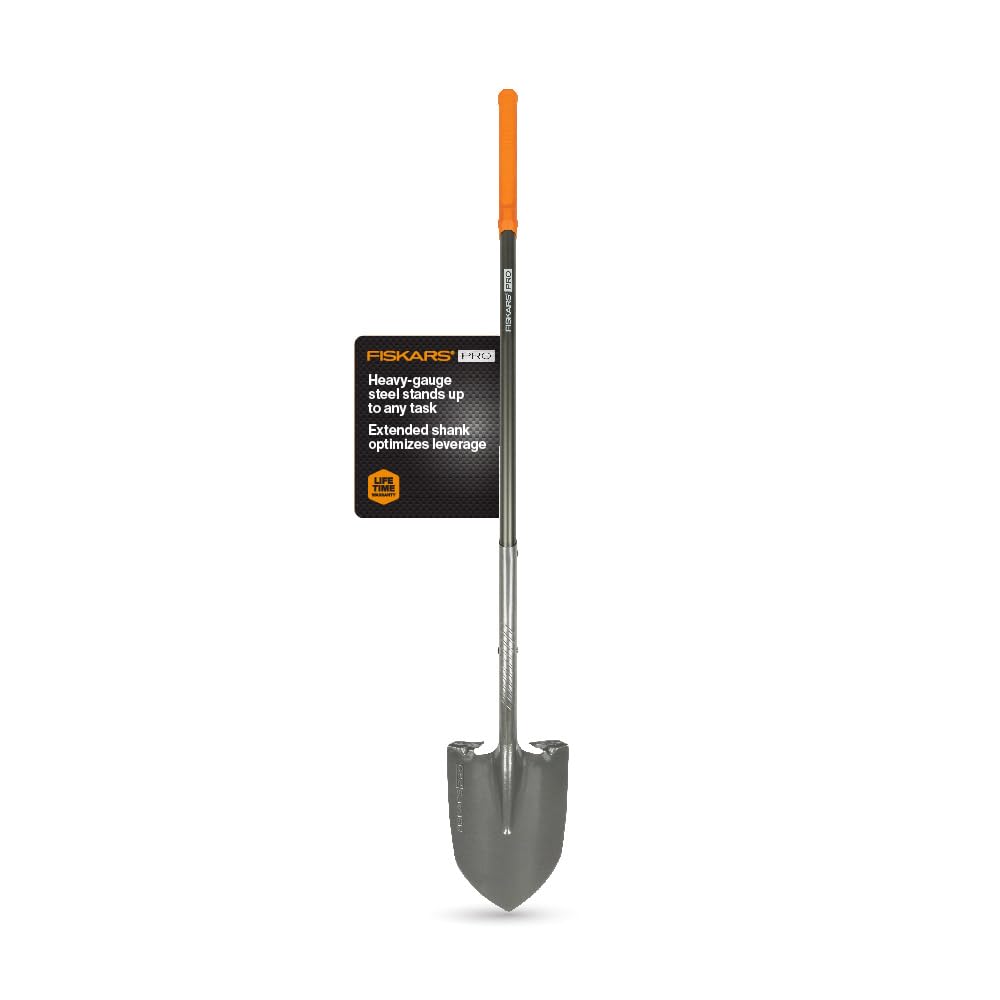
The Fiskars 60″ Pro is the choice for tall gardeners who want to dig deep without bending excessively. At 60.5 inches, it is the longest shovel in this roundup, and that extra length translates into substantial leverage when you are breaking through tough subsoil. The handle is aluminum — not fiberglass or wood — which keeps the total weight at just 2 pounds while providing excellent resistance to bending and corrosion.
The blade is heavy-gauge alloy steel with a sharpened edge that stays sharp well beyond the first season. Owners who have used this shovel to pry out concrete fence posts and dig in rock-filled fields report zero flex in the shaft. The teardrop-shaped shaft is a small but real ergonomic win: it naturally orients your hand position, reducing wrist strain during repetitive scooping motions. The rubber grip at the top is comfortable even without gloves.
For shorter users, the long handle may feel unwieldy, and the straight-handle design lacks a D-grip for two-handed control in tight spaces. It is also strictly a digging shovel — the round-point blade is not ideal for scooping loose material or edging. But if your primary task is breaking ground in heavy soil, this is the most efficient tool in the lineup.
What works
- Extra-long handle minimizes back bending for taller users during deep digging.
- Aluminum shaft is lightweight yet strong enough for prying and levering without flex.
- Sharpened alloy steel blade penetrates hard soil and holds an edge through heavy use.
What doesn’t
- 60-inch length is cumbersome for shorter gardeners and awkward for confined spaces.
- Straight handle lacks a D-grip for two-handed leverage in trenching tasks.
- Round-point design is less effective for scooping loose gravel or mulch.
3. Fiskars 44″ Pro Garden Shovel (D-Handle)

This is the D-handle sibling to the 60-inch straight model, and while they share the same alloy steel blade and aluminum shaft construction, the 44-inch overall length and ergonomic D-grip make it a fundamentally different tool. The D-handle allows two-handed pulling and pushing power, which is critical when you are levering out rocks or prying through root masses. It is heavier than the straight model at roughly 5.5 pounds, but the weight is centered where you need it for momentum.
The real-world feedback here is remarkable: owners report using this shovel to break through 8 tons of river rock without failure, and to survive digging in rocky, rooty clay that snapped two previous shovels. The sharpened edge stays true, and the aluminum D-handle does not splinter or rot. The teardrop shaft shape again helps maintain a natural grip orientation, reducing fatigue over long sessions.
The D-handle takes up more storage space than a straight handle, and the overall bulk makes it less suitable for tight spaces like raised bed corners or car trunks. It is also not ideal for pitching loose material — the heavy blade is excellent for deep digging but inefficient for quickly moving light compost or mulch.
What works
- D-grip handle provides excellent two-handed control for prying and levering in tough soil.
- Aluminum shaft and alloy steel blade survive extreme abuse including rocky clay and river rock.
- Sharpened edge penetrates hard ground with less force than a blunt factory blade.
What doesn’t
- Heavier than many alternatives at 5.5 lbs; the weight adds up during extended sessions.
- D-handle design makes storage awkward and limits use in very tight spaces.
- Not efficient for scooping or pitching lighter materials like compost or shredded leaves.
4. HANTOP Spade Shovel Garden Flat Trenching

The HANTOP spade distinguishes itself with a sawtooth blade made from 1050MN steel — a manganese alloy known for its toughness and wear resistance. The sawtooth edge is not a delicate row of teeth; it is an aggressive scalloped profile that bites into hard-packed soil, ice, and thick turf with authority. Multiple owners describe it as a “snowcrete buster” for its ability to chop through heavily iced-over driveways without damaging the blade.
At 43 inches overall and 4.5 pounds, the weight is in the middle of the pack — heavier than the Ashman but lighter than the Root Slayer. The widened foot platforms are a standout design choice: they provide a broad, stable surface for applying downward force, which is especially useful when you are wearing bulky winter boots. The fiberglass handle is weather-resistant and unlikely to rot, though it is thicker than the aluminum shafts on the Fiskars models, which can feel less precise in hand.
The flat-edge spade shape is ideal for trenching, edging, and cutting square holes for transplanting, but it is less efficient for general scooping and moving loose soil. The sawtooth edge also requires careful maintenance — hitting a buried rock at full force could chip a tooth, though owner reports indicate the blade has held up well against roots and ice.
What works
- Sawtooth 1050MN steel blade cuts through ice, thick turf, and compacted soil effectively.
- Widened foot platforms provide stable, secure footing for forceful downward pressure.
- Fiberglass handle resists weather damage and is non-conductive for electrical safety.
What doesn’t
- Flat spade shape is less efficient for general scooping and moving loose material.
- Sawtooth edge can be chipped if struck against a hidden rock with full force.
- Thicker fiberglass handle feels less precise than a slim aluminum shaft.
5. Ashman Heavy-Duty Digging Shovel

The Ashman Digging Shovel sits in a sweet spot between price and performance. At 2.2 pounds, it is the lightest shovel in this review — lighter than both Fiskars models — yet it uses a hardened alloy steel blade and a fiberglass handle that holds up well against normal garden abuse. Owners report that it survived several years of home use without the handle cracking, a problem that plagued a hardware-store shovel they replaced.
The ergonomic D-handle is comfortable for two-handed gripping, and the round-point blade is sharp out of the box, cutting through hard soil without excessive stomping. The fiberglass handle has low thermal and electrical conductivity, so it stays comfortable in cold weather and is safe around buried utility lines. At 41 inches from blade tip to handle end, it is a mid-length tool suitable for users between 5’0″ and 5’8″.
It is not built for extreme abuse. Prying heavy rocks or using it as a lever against deeply buried roots could cause the fiberglass handle to splinter over time. The blade is also not as thick as the Root Slayer or Fiskars models, so it may show flex under sustained heavy use in very compacted soil. For the typical home gardener performing routine planting, transplanting, and light trenching, this is a capable and well-balanced tool.
What works
- Very lightweight at 2.2 lbs, reducing fatigue during extended gardening sessions.
- Fiberglass handle is weather-resistant, non-conductive, and comfortable in cold weather.
- Sharpened blade penetrates hard soil easily right out of the packaging.
What doesn’t
- Fiberglass handle may splinter under extreme prying or side-leverage loads.
- Blade is not as thick as premium models; may flex in very compacted or rocky soil.
- 41-inch length is slightly short for taller users who prefer less bending.
6. KOLEIYA 41″ Round Point Shovel
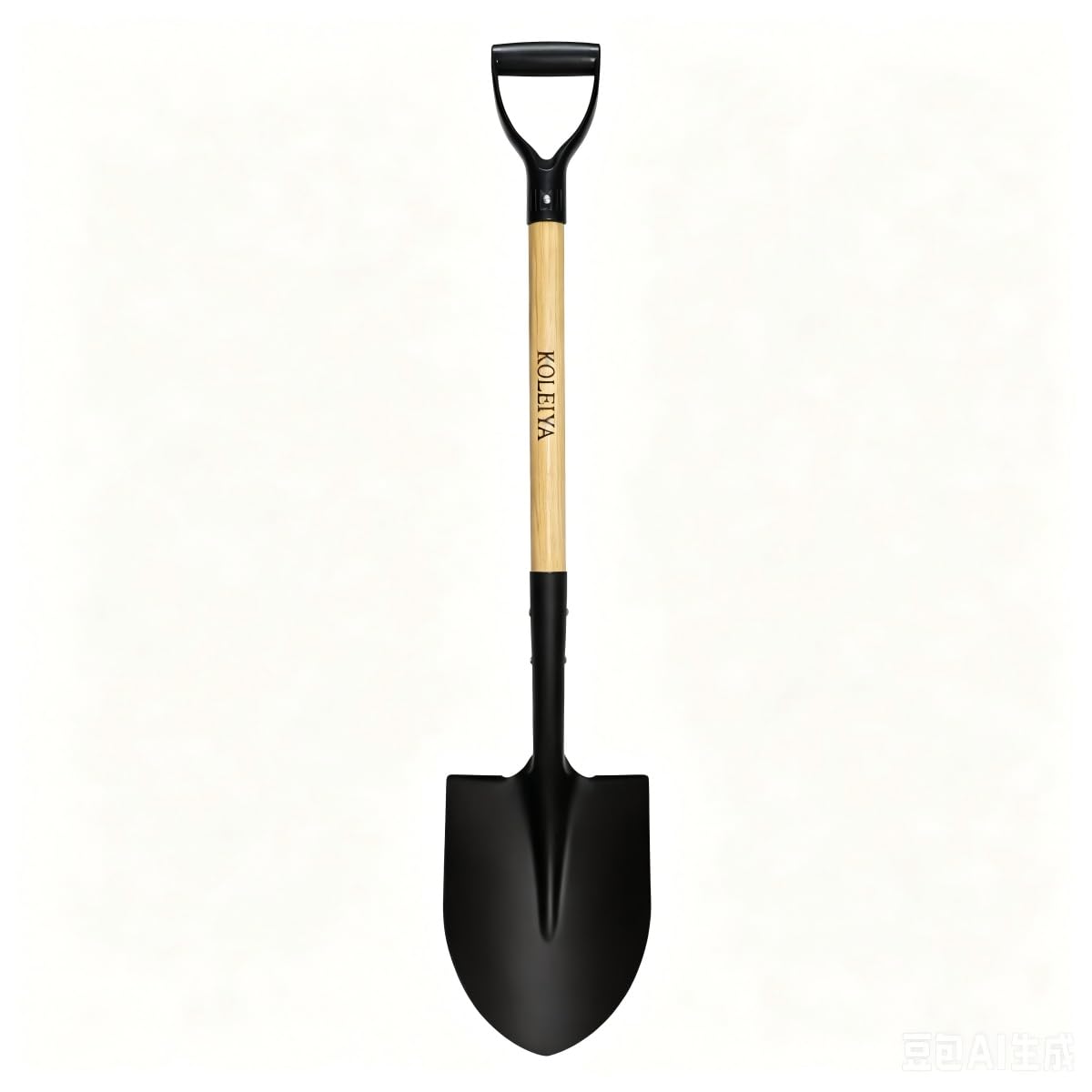
The KOLEIYA shovel occupies the entry-level mid-range slot with a solid wood handle and a steel blade that is purely functional. At 3.3 pounds and 41 inches, it is designed for users who want a standard round-point shovel without paying for premium materials they may not need. The D-handle is wide and smooth, and owners — including a gardener who uses it from a wheelchair — find it surprisingly easy to control for planting and transplanting.
The blade is double-riveted to the handle, which is a critical detail that often separates a shovel that lasts from one that wobbles loose after a season. The cold-rolled steel head has been heat-treated for hardness, and it has shown no signs of bending during moderate digging in average garden soil. The wood handle is comfortable in hand and environmentally friendly, though it will require drying after use and occasional oiling to prevent splitting.
This is not a tool for heavy clay, rocky ground, or root-infested soil. The blade is thinner than the premium options, and the wood handle, while durable for normal use, can crack under extreme side loads. It also lacks a sharpened edge, so penetrating hard-packed soil requires more stomping force than a Fiskars or Root Slayer would demand.
What works
- Double-rivet blade attachment provides a secure, wobble-resistant connection to the handle.
- Lightweight and compact at 3.3 lbs and 41 inches, easy to store and transport.
- Smooth D-handle is comfortable for users with smaller hands or mobility considerations.
What doesn’t
- Blade is not factory-sharpened; requires more force to penetrate hard-packed soil.
- Wood handle requires maintenance and can crack under extreme side leverage.
- Not suitable for heavy-duty tasks in rocky, clay-heavy, or root-filled ground.
7. VNIMTI Round Shovel

The VNIMTI shovel is the most affordable option in this lineup, and it fills a specific niche: the occasional-use gardener who needs a basic digging tool without investing in a premium brand. At 41 inches and 3.3 pounds, it is virtually identical in dimensions and weight to the KOLEIYA, but the build quality and steel treatment are a half-step down. The cold-rolled steel head has been heat-treated to prevent deformation, and owners report it feels sturdy for general gardening tasks like transplanting and moving gravel.
The wood handle has a natural finish that is comfortable to grip, and the D-handle shape accommodates two-handed control. Owners specifically mention that the shorter handle length is a benefit for shorter users, especially women who find standard 48-inch shovels unwieldy. The pedal fins at the top of the blade provide a reasonable stepping surface, though they are narrower than the platforms on the HANTOP or Root Slayer.
The limitations are predictable for this tier. The blade is not sharpened, so breaking into compacted soil requires more effort. The wood handle is not treated with a weather-resistant coating, so it must be stored indoors to prevent rot. Several owners noted they wished the blade were slightly sharper out of the box. For light-duty garden maintenance and users on a tight budget, this is a functional starting point, but anyone facing regular heavy digging should budget for a higher-tier model.
What works
- Affordable entry point for occasional gardeners who need a basic digging shovel.
- 41-inch length is comfortable for shorter users who find long handles awkward.
- Heat-treated steel head resists bending during normal garden soil digging.
What doesn’t
- Blade is not sharpened from the factory, requiring more stomping force for penetration.
- Untreated wood handle needs indoor storage and maintenance to prevent rot and splitting.
- Narrow foot pedals provide less stability during forceful digging than wider platforms.
Hardware & Specs Guide
Blade Steel and Heat Treatment
The steel composition and thermal processing are the primary determinants of a shovel’s resistance to bending. Standard cold-rolled steel is adequate for light soil, but alloy steels with added manganese, chromium, or vanadium are significantly tougher. Heat treatment — specifically quenching and tempering — increases the hardness of the blade edge, allowing it to stay sharper longer and resist deformation when stomped into rocky ground. Shovels that list “1050MN steel” or “heat-treated alloy steel” have an advantage in heavy digging conditions.
Handle Attachment Method
How the blade connects to the handle is a common failure point. Single-rivet attachments are the weakest and can loosen or shear under side loads. Double-rivet attachments are significantly stronger, but the most durable shovels use a closed-socket design where the handle extends into a full metal collar that is welded or forged as part of the blade. This eliminates rivet shear entirely and is the preferred construction method for professional-grade tools. Fiberglass and aluminum handles with integrated sockets are particularly resistant to separation.
Ergonomics and Shaft Shape
A round shaft requires constant grip adjustment to maintain a consistent blade angle, which leads to hand fatigue. Teardrop or oval-shaped shafts naturally orient in the user’s palm, keeping the blade aligned with the direction of force without conscious correction. Straight handles maximize lever length for deep digging, while D-handles provide better control for pulling and prying. The trade-off is storage space: D-handle shovels take up more room in a shed or car trunk. Choose the shaft shape based on your primary digging motion — straight for overhead leverage, D-handle for close-quarters control.
Weight and Material Balance
Lighter shovels reduce fatigue during long sessions but often lack the momentum to cut through dense material efficiently. A 4.5 to 5-pound shovel provides substantial cutting force on the downstroke, making it easier to penetrate hard ground with less user effort. However, every pound of extra weight comes due when you are lifting and moving soil repeatedly. Aluminum-handled shovels offer the best balance of strength and low weight, while fiberglass and wood handles tend to be heavier. For multi-hour digging projects, prioritize a shovel under 4 pounds with a sharpened blade to compensate for the lower mass.
FAQ
What blade shape is best for general garden digging?
How important is a sharpened blade on a garden shovel?
What is the ideal shovel length for a person who is 5’6″ tall?
Can a shovel with a wood handle survive wet storage conditions?
Final Thoughts: The Verdict
For most gardeners, the shovel for gardening winner is the Fiskars 44″ Pro D-Handle because its alloy steel blade, aluminum shaft, and D-grip handle give you the durability and leverage needed for tough soil without the excessive weight of a carbon steel model. If you need to cut through roots and dense ground regularly, grab the Root Slayer 22011 for its serrated carbon steel blade that actively saws through obstacles. And for a budget-conscious starting point that still gets the job done for light garden maintenance, nothing beats the well-reviewed KOLEIYA 41″ Round Point Shovel for its solid wood handle and double-rivet construction.