
The first warm days of spring trigger a frantic flush of growth in your lawn and garden beds, but reaching for the wrong bag of granular feed can scorch tender new roots or wash away before the soil even wakes up. Choosing a spring fertilizer means balancing a quick visual green-up against sustained root-building nutrition that carries your plants through the summer stress period. Too much fast-release nitrogen gives you a two-week carpet of emerald that fades fast, while a slow-release organic blend builds microbial life and deep root resilience over the entire growing season.
I’m Rikta — the co-founder and writer behind Lawn Gear Lab. I’ve spent months cross-referencing NPK ratios, slow-release nitrogen percentages, OMRI organic certifications, and owner-reported performance data to separate the formulas that truly deliver balanced spring nutrition from the ones that just promise a quick green fix.
Whether your priority is feeding a cool-season turf, giving vegetable transplants a gentle boost, or amending flower beds without chemical runoff, this guide breaks down the seven most capable products to help you choose the right spring fertilizer for your specific growing conditions.
How To Choose The Best Spring Fertilizer
Picking a spring fertilizer comes down to three decisions: the nitrogen source (how fast it releases), the NPK balance (what your soil actually needs), and the form factor (granular for slow feed or liquid for quick correction). A granular feed with a high percentage of slow-release nitrogen suits established lawns that need steady color over weeks, while a balanced organic formula with microbial additives helps garden beds build soil structure.
Nitrogen Source & Release Speed
Spring fertilizers ideally contain a mix of quick-release ammonium nitrogen for an immediate green flush and slow-release coated or organic nitrogen that feeds steadily for eight to twelve weeks. Products with at least 40% of their total nitrogen in slow-release form prevent the surge-and-crash cycle that stresses turf and leads to excessive blade growth. Organic sources like fish emulsion or feather meal release even more gradually as soil temperatures rise.
NPK Ratio & Soil Testing
A high first number in the NPK sequence, such as 27-0-5 or 16-0-8, signals a nitrogen-dominant formula best for established lawns coming out of dormancy. For vegetable beds, perennials, or shrubs, a more balanced profile around 6-4-5 or 5-3-3 supports both foliage development and root establishment without pushing excessive leaf growth at the expense of flowers or fruit. Testing your soil’s existing phosphorus and potassium levels prevents over-application; many regions restrict phosphorus runoff, making zero-phosphorus blends like 16-0-8 a practical choice.
Granular vs. Liquid Forms
Granular fertilizers provide a slow, consistent nutrient release over weeks, require a spreader for even application, and work best when watered in after a rain or irrigation event. Liquid concentrates, such as fish emulsion or super-concentrated phosphorus boosters, deliver nutrients to the root zone immediately, making them ideal for correcting deficiencies in seedlings or potted plants. Choose granular for broad lawn coverage and liquid for targeted garden or container feeding.
Quick Comparison
On smaller screens, swipe sideways to see the full table.
| Model | Category | Best For | Key Spec | Amazon |
|---|---|---|---|---|
| The Andersons PGF 16-0-8 | Granular | Lawn recovery with high soil phosphorus | 16-0-8 + Humic DG | Amazon |
| GreenView Fairway Formula 27-0-5 | Granular | Mid-size lawn green-up | 63% slow-release N | Amazon |
| Alaska Fish Fertilizer 5-1-1 | Liquid | Organic vegetable & garden feeding | 5-1-1 OMRI listed | Amazon |
| Farmer’s Secret Plant Booster | Liquid | Early root & seedling development | 1:384 dilution ratio | Amazon |
| FoxFarm Happy Frog 6-4-5 | Granular | Flowers, ornamentals & perennials | 6-4-5 + soil microbes | Amazon |
| Espoma Plant-Tone 5-3-3 | Granular | All-purpose organic garden beds | 5-3-3 + Bio-tone | Amazon |
| Espoma Bio-Tone Starter 4-3-3 | Granular | Transplanting & new plantings | Endo/ecto mycorrhizae | Amazon |
In‑Depth Reviews
1. The Andersons Professional PGF 16-0-8 Fertilizer with Humic DG
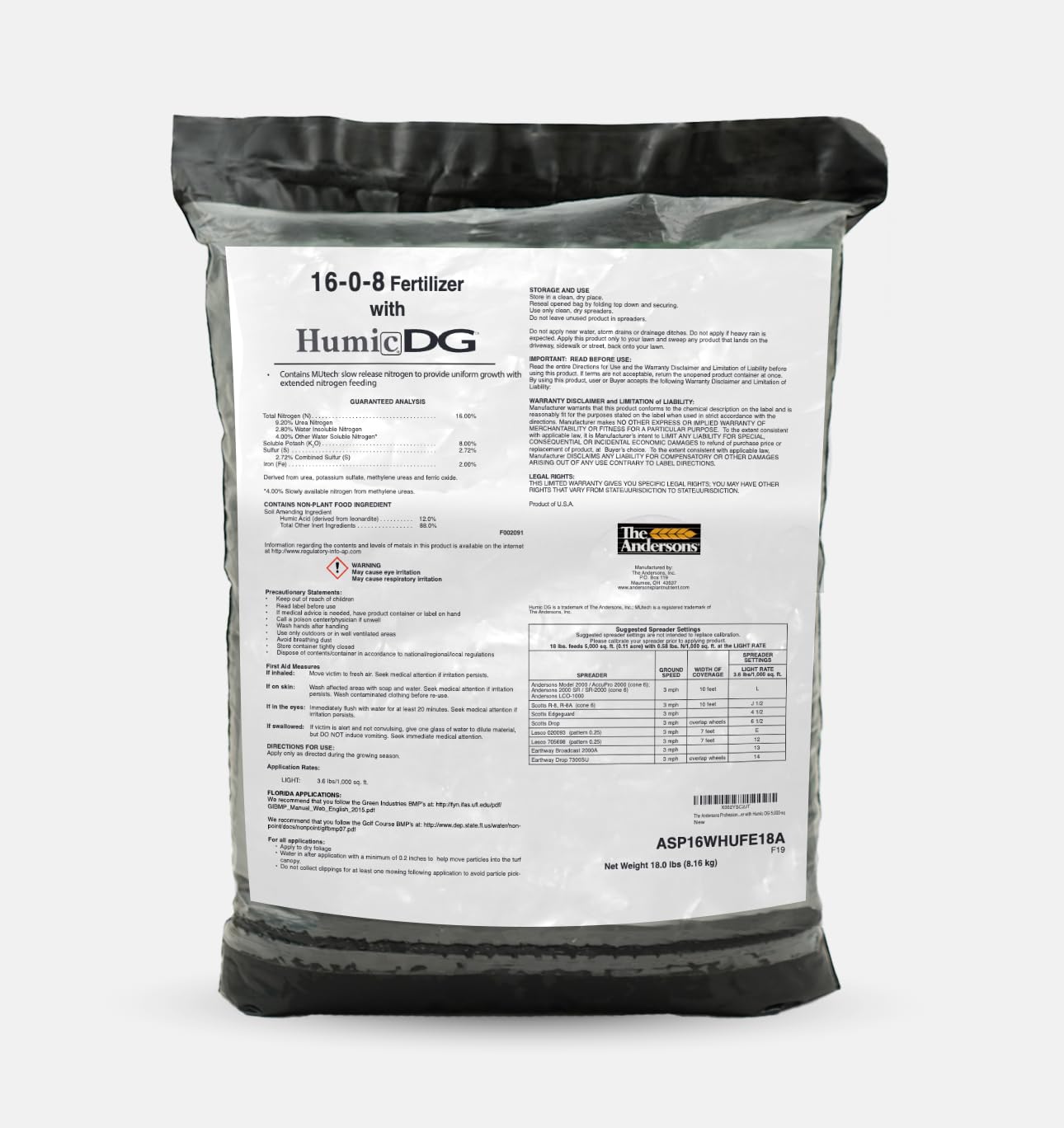
The Andersons PGF 16-0-8 is a professional-grade granular feed built for lawns that already have adequate phosphorus levels. The 16-0-8 analysis supplies a high first-number nitrogen punch while skipping phosphorus entirely, which makes it a smart choice for properties where soil tests show phosphorus buildup or for regions with phosphorus runoff restrictions. The inclusion of Humic DG — a dispersible granule of humic acid — improves nutrient uptake and soil cation exchange capacity, giving each application more staying power in the root zone.
The super-fine particle size delivers twice the number of granules per square foot compared to standard prills, which results in noticeably even color coverage without the striping that coarser fertilizers can leave behind. The nitrogen splits into quick-release for an immediate two-day green-up and slow-release coated sources that continue feeding for up to eight weeks. Owners report that this blend transforms thin, patchy lawns into dense, dark green turf by mid-spring, and many note that the humic content seems to reduce the browning that occurs during summer heat stress.
The main trade-offs are the higher per-bag cost and the fact that it is not available for sale in California or Oregon. The 18-pound bag covers roughly 5,000 to 10,000 square feet depending on application rate, so larger properties need multiple bags. Over-application or applying during a dry spell can still burn turf despite the slow-release component, so following the spreader setting directions precisely matters.
What works
- Humic DG enhances nutrient efficiency and soil biology
- Zero-phosphorus formula suits high-P soils and eco-regulations
- Ultra-fine granules provide streak-free uniform coverage
What doesn’t
- Premium pricing makes it a significant investment for large lawns
- Not for sale in California or Oregon
- Requires careful watering to avoid burn if misapplied
2. GreenView Fairway Formula Lawn Fertilizer 27-0-5

The GreenView Fairway Formula delivers a heavy 27-0-5 NPK ratio with a remarkable 63% of its nitrogen in slow-release form, making it one of the most performance-dense granular options for medium to large lawns. That high percentage of controlled-release nitrogen means the grass gets a steady supply of food over roughly twelve weeks without the sudden surge that forces you to mow twice a week. The bag covers 5,000 square feet, placing it squarely in the mid-range coverage sweet spot for most suburban properties.
This formula contains no phosphate, which keeps it compliant with watershed protection guidelines and avoids feeding broadleaf weeds that thrive on phosphorus. Owners consistently report seeing dark green color within days of application, followed by sustained thickening that reduces the need for a second feeding before summer. The granules flow cleanly through broadcast and drop spreaders without clumping, and the 16.5-pound bag weight is manageable enough for a single trip across the yard.
The only real downside is that the 27-0-5 analysis is too nitrogen-heavy for garden beds or vegetable patches — this is strictly a turf product. It also works best when applied just before a light rain or irrigation; letting the granules sit on dry soil without watering in reduces the slow-release effectiveness.
What works
- 63% slow-release nitrogen provides up to 12 weeks of steady feeding
- No phosphate protects waterways and reduces weed pressure
- Fast visible green-up combined with long residual feeding
What doesn’t
- High-nitrogen formula unsuitable for gardens or ornamentals
- Needs watering-in fairly quickly after application
3. Alaska Fish Fertilizer 5-1-1
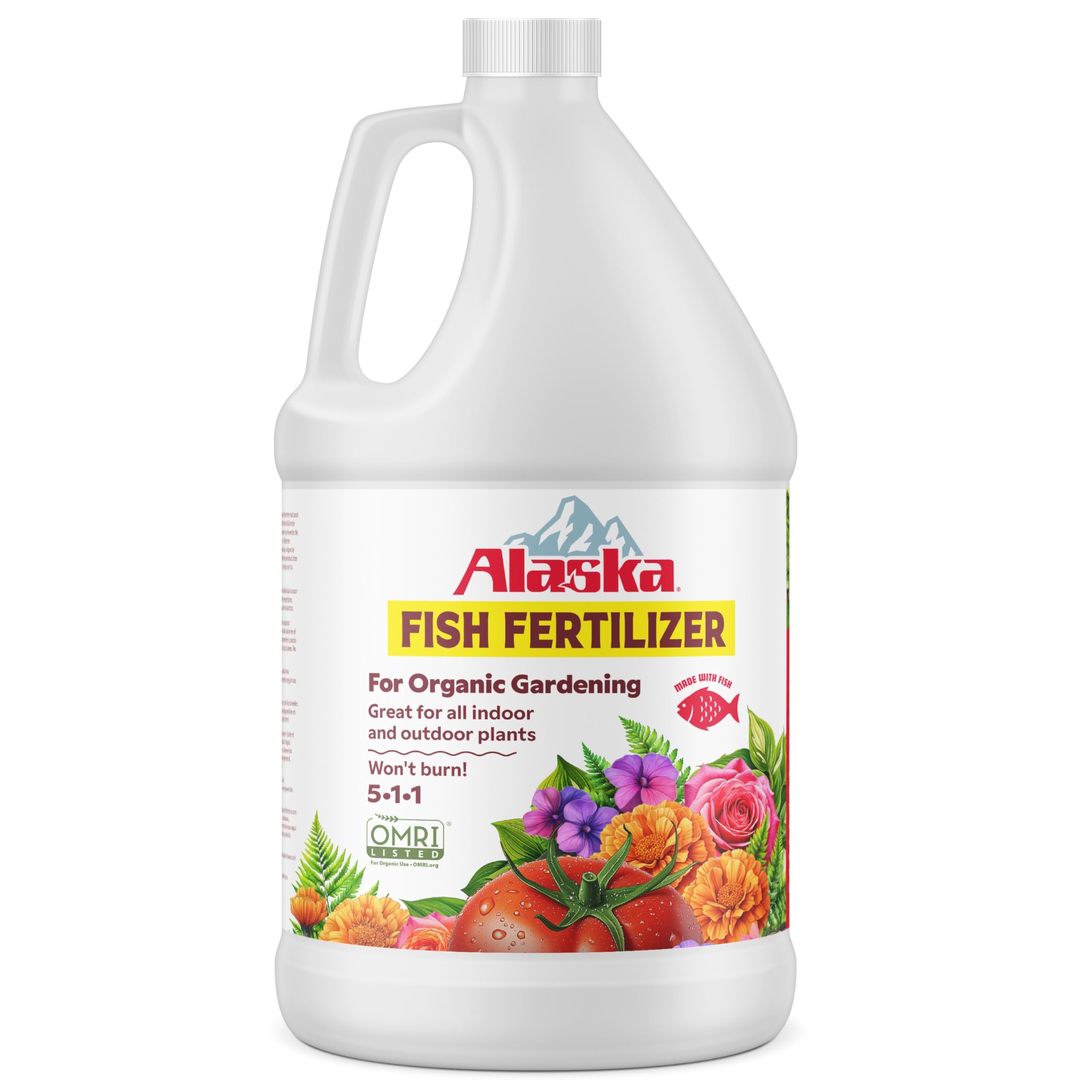
Alaska Fish Fertilizer 5-1-1 is a liquid concentrate derived from cold-processed fish emulsion, carrying the OMRI organic certification that serious organic gardeners demand. The NPK ratio of 5-1-1 delivers a moderate nitrogen boost with minimal phosphorus and potassium, making it ideal for leafy vegetables, perennials, shrubs, and container plants that need a gentle vegetative lift without pushing excessive flower development. The cold-processing method preserves the natural micronutrients and amino acids found in fish, which feed both the plant and the soil microbial community.
At 115 fluid ounces per jug, the value is strong considering that the product is diluted at roughly two tablespoons per gallon of water for garden application. Owners report visible results within a week — deeper leaf color, stronger stem growth, and faster recovery on transplants. The fishy smell is noticeable during mixing but dissipates within a day after watering it into the soil.
The main drawback is the odor; applying it near open windows, patios, or outdoor living spaces can be unpleasant for about 24 hours. It also needs a phosphorus and potassium supplement during the flowering and fruiting stages. The liquid form requires regular reapplication every three weeks, so it demands more calendar discipline than a single granular application.
What works
- OMRI organic certified for strict organic growing programs
- Cold-processed formula retains natural micronutrients
- Versatile for vegetables, perennials, trees, and containers
What doesn’t
- Strong fish odor lingers for about a day after application
- Requires P/K supplement during bloom or fruit set
- Needs repeat applications every three weeks
4. Farmer’s Secret Plant Booster Super Concentrated

Farmer’s Secret Plant Booster is a super-concentrated liquid formula with a heavy phosphorus emphasis, designed specifically for the early growth stages when root development is the priority. The mixing ratio of one teaspoon per two gallons of water — a 1:384 dilution — means a single 32-ounce bottle goes a long way, especially for gardeners managing large vegetable plots or numerous container plants. The high phosphorus content helps seedlings and transplants establish a dense root system before the top growth accelerates.
Owners report that this product transforms struggling plants within days, with thicker stems and more vigorous leaf expansion. It works across all plant types: vegetables, ornamentals, turf, and trees. The concentrated nature also makes it easy to adjust the feeding strength; many users start with a half-teaspoon per gallon for seedlings and step up as the plants mature. The Kentucky-based manufacturer includes clear instructions and responsive customer support.
The drawbacks are tied to its specialization. Because it is phosphorus-dominant, it is not a complete fertilizer for the whole season — you will need a balanced or nitrogen-heavy feed once the plants move past the early vegetative stage. The bottle weight (around three pounds for 32 ounces) reflects the high concentration but can feel heavy compared to standard liquid feeds.
What works
- Extreme concentration delivers professional-grade results per bottle
- High phosphorus targets root and early vegetative development
- Works on vegetables, turf, ornamentals, and trees
What doesn’t
- Phosphorus dominance limits its use to early-season or root-focused stages
- Heavy bottle for the volume of liquid concentrate
- Requires precise dilution measurement
5. FoxFarm Happy Frog All Purpose Fertilizer 6-4-5

FoxFarm Happy Frog All Purpose Fertilizer brings a balanced 6-4-5 NPK profile to flower beds, ornamentals, and vegetable gardens, but its standout feature is the inclusion of beneficial soil microbes and mycorrhizal fungi. These biological additives enhance nutrient uptake and water absorption at the root level, which is especially valuable in spring when soil temperatures are still fluctuating and microbial activity is just ramping up. The OMRI-listed formulation gives organic growers confidence that no synthetic additives are present.
The granular texture is fine enough to work into the top inch of soil around established plants, and it activates quickly with watering. Gardeners note that yellowing tomato and zucchini plants regain their deep green color within a week of application. The 4-pound bag is compact and easy to store, though it covers a relatively small area compared to lawn-focused products — it is designed for targeted garden bed feeding rather than broad turf coverage.
The most consistent complaint is the strong manure-like odor, which is intense enough that indoor application requires open windows, and a few users have seen white mold on the soil surface when they over-applied. The price per pound is higher than conventional granular feeds, but the microbial content justifies the premium for dedicated organic gardeners.
What works
- Inoculated with beneficial soil microbes and mycorrhizal fungi
- OMRI-listed for certified organic gardening
- Corrects yellowing foliage quickly in flowers and vegetables
What doesn’t
- Strong pungent odor is noticeable during and after application
- Small bag size limits coverage for larger garden beds
- Can develop surface mold if applied too thickly
6. Espoma Organic Plant-Tone 5-3-3

Espoma Plant-Tone 5-3-3 is the all-purpose organic granular that Espoma has been perfecting since 1929, and the long manufacturing heritage shows in the consistency of the blend. The 5-3-3 NPK ratio is complemented by 5% calcium, which supports cell wall structure in growing plants and helps prevent blossom-end rot in tomatoes and peppers. The Bio-tone formula includes a proprietary mix of beneficial microbes that continue breaking down organic matter in the soil after application.
This product is approved for organic gardening and is listed as a registered Organic Input Material. It works across annuals, perennials, roses, vegetables, trees, and shrubs. Owners appreciate that it does not burn plants even when applied at the higher end of the recommended rate. The granule size is consistent and spreads easily by hand or with a small hand-held spreader around individual plants. Many users report using it twice a year — spring and fall — with visible improvement in bloom count and foliage density.
The organic ingredients produce a noticeable barnyard odor during application, similar to composted manure, which fades after a day or two. The 4-pound bag (sold here as a 2-pack) is best suited for moderate-sized garden beds rather than broad lawn coverage. The nutrient release is slow enough that impatient gardeners may not see an instant green surge the way synthetic blends deliver.
What works
- 5% calcium content prevents blossom-end rot in fruiting plants
- Registered organic input material with Bio-tone microbes
- Safe, non-burning formula suitable for all plant types
What doesn’t
- Organic odor similar to manure lingers for about 24 hours
- Slow nutrient release does not produce an instant green flush
- Small bag size limits application to garden beds, not lawns
7. Espoma Organic Bio-Tone Starter Plus 4-3-3
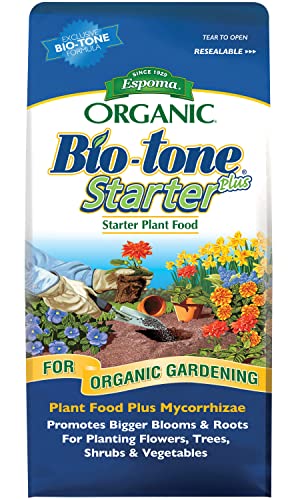
Espoma Bio-Tone Starter Plus shifts the focus from general feeding to transplant and seeding success. The 4-3-3 NPK analysis is intentionally modest to avoid burning delicate new roots, and the inclusion of both endo and ecto mycorrhizal fungi gives it a biological edge that standard starter fertilizers lack. Endomycorrhizae penetrate root cells to improve water and phosphorus uptake, while ectomycorrhizae form a web around root tips to expand the effective root zone area.
The 5% calcium content supports cell division in new growth, and the organic carrier breaks down slowly to create a nutrient reservoir around the planting hole. Gardeners report that transplants settle in faster with less wilting and that seeds germinate with noticeably stronger stems. The product is OMRI-compatible for organic production and has a following among serious gardeners who have adopted it after seeing recommendations from prominent garden influencers.
The biggest downside is the smell — this product is intensely pungent, described by users as “manure crossed with fish,” and it requires holding your breath during application. It is also best used as a soil additive at planting time rather than as a top-dress for established plants, which limits its versatility compared to an all-purpose feed. The 4-pound bag (2-pack) covers a modest number of planting holes.
What works
- Contains both endo and ecto mycorrhizal fungi for root symbiosis
- 5% calcium strengthens new cell walls in transplants
- Reduces transplant shock and speeds establishment
What doesn’t
- Extremely strong odor requires ventilation during use
- Designed for planting holes, not general top-dressing
- Small bags limit coverage to individual plantings
Hardware & Specs Guide
NPK Ratio
The three-number sequence tells you the percentage by weight of nitrogen (N), phosphorus (P), and potassium (K) in the fertilizer. For spring lawn feed, look for a high first number — 27-0-5 or 16-0-8 — because grass needs nitrogen to recover from dormancy. For gardens, a balanced ratio like 6-4-5 or 5-3-3 supports both foliage and root growth without pushing excessive leaf matter.
Slow-Release Nitrogen Percentage
Nitrogen comes in two forms: quick-release (water-soluble ammonium nitrate or urea) and slow-release (coated sulfur-coated urea, polymer-coated, or organic sources like feather meal). A product with at least 50% of its total nitrogen in slow-release form provides steady feeding over eight to twelve weeks. This prevents the rapid growth surge that weakens cell structure and forces more frequent mowing.
Coverage Area per Bag
Granular fertilizers list the square footage a single bag or jug covers at the recommended application rate. A 16.5-pound bag covering 5,000 square feet suits a quarter-acre lawn, while an 18-pound professional bag may cover up to 10,000 square feet. Always measure your actual lawn or garden bed area and match it to the product’s coverage spec to avoid under- or over-application.
Organic Certification & Additives
OMRI (Organic Materials Review Institute) listing confirms that every ingredient in the fertilizer meets organic production standards. Beyond certification, beneficial additives like humic acid, mycorrhizal fungi, and soil microbes improve nutrient cycling and root zone health. These biological components are especially valuable in spring when cold soil slows natural microbial activity, giving plants a faster start.
FAQ
When should I apply spring fertilizer to my lawn?
Can I use the same spring fertilizer for my lawn and vegetable garden?
What does the slow-release nitrogen percentage mean?
Should I choose granular or liquid spring fertilizer?
How do I read an NPK ratio to pick the right spring feed?
Final Thoughts: The Verdict
For most gardeners, the spring fertilizer winner is the GreenView Fairway Formula 27-0-5 because its 63% slow-release nitrogen supplies steady color for up to twelve weeks without the burn risk of cheaper fast-release blends. If you want a phosphorus-free professional-grade lawn feed with humic acid for soil health, grab the The Andersons PGF 16-0-8. And for organic vegetable and flower beds where soil biology matters, nothing beats the Alaska Fish Fertilizer 5-1-1.