
Nothing kills the momentum of a Saturday morning mow like rear wheels digging trenches into damp soil or spinning uselessly on a mild incline. Standard two-wheel-drive mowers lose traction the moment the grass gets wet, the terrain tilts, or the bag fills up. That’s where an all-wheel-drive machine changes the experience, pulling power to the front wheels to keep you moving forward instead of fighting for grip.
I’m Rikta — the co-founder and writer behind Lawn Gear Lab. I’ve spent hundreds of hours analyzing torque curves, deck designs, battery voltage, and owner feedback across gas and electric systems to find the models that genuinely deliver better traction without sacrificing cut quality or maneuverability.
Whether you maintain a hillside lot that slopes in three directions or just want a mower that tracks straight on uneven ground, this guide breaks down the gas, cordless, and robotic options that earn their keep. Here is my researched pick for the best awd lawn mower to keep your lawn looking sharp on any grade.
How To Choose The Best AWD Lawn Mower
The AWD lawn mower category exists specifically to solve traction loss on slopes, uneven terrain, and heavy grass. Choosing the right one comes down to matching drive system type, power source, deck size, and terrain capability to your property’s specific demands. Here’s what to prioritize.
Gas vs. Electric vs. Robotic AWD
Gas-powered AWD mowers typically use a 170cc to 201cc engine paired with a mechanical transmission that drives all wheels. They offer unrestricted runtime and are ideal for properties over half an acre with sustained inclines. Cordless electric AWD models use brushless motors and independent wheel control, providing instant torque and quieter operation, but require battery management for larger lots. Robotic AWD mowers like the Mammotion LUBA 3 and Segway Navimow X4 use four independent motors for precise traction on slopes up to 80%, but their cutting width is narrower and they’re best suited for automated maintenance rather than heavy-duty bagging.
Torque and Traction Specs That Matter
For walk-behind models, look at engine displacement (cc) for gas or torque (ft-lbs) for electric. Gas engines in the 170cc-201cc range provide reliable pulling power. Electric models like the EGO LM2114SP deliver up to 6.0 ft-lbs of cutting torque, while LM2150SP pushes 8.3 ft-lbs. For robotic models, motor wattage is the key metric — the Mammotion LUBA 3 uses dual 165W motors, and the Segway Navimow X450 uses dual 180W motors. Higher wattage directly translates to better climbing ability in dense grass.
Deck Width and Cutting Height Range
A 21-inch deck is standard for electric self-propelled models, while gas units often run 22 inches. The Greenworks 80V model offers a wide 25-inch deck for faster coverage. Cutting height range matters for different grass types: a minimum of 1 inch works for Bermuda, while 4 inches suits tall fescue. Robotic mowers like the Mammotion LUBA 3 have a narrower range (2.2-4.0 inches), suitable for frequent maintenance cuts rather than season-first trims.
Battery Runtime and Charging Infrastructure
For cordless electric mowers, runtime depends on battery capacity (Ah) and grass density. The EGO LM2114SP runs up to 50 minutes on a 6.0Ah battery. The LM2150SP reaches 75 minutes on a 10.0Ah battery (sold separately). The Greenworks 80V 4.0Ah battery covers roughly 40 minutes. Robotic mowers return to their charging station automatically, so their rated coverage area (e.g., 0.75 acres for the LUBA 3 3000H) is more relevant than runtime alone.
Quick Comparison
On smaller screens, swipe sideways to see the full table.
| Model | Category | Best For | Key Spec | Amazon |
|---|---|---|---|---|
| EGO LM2150SP | Electric | Premium cordless cut | 8.3 ft-lbs torque, Select Cut XP | Amazon |
| Mammotion LUBA 3 5000H | Robotic | Large hilly lawns | 80% slope, 50 zones, 215 min | Amazon |
| Segway Navimow X450 | Robotic | Extreme 84% slopes | Zero-turn, 2 × 180W motors | Amazon |
| EGO LM2114SP | Electric | Mid-size yards | 6.0 ft-lbs torque, 50 min run | Amazon |
| Greenworks 80V 25″ | Electric | Large flat & rolling lawns | 25″ deck, dual battery ports | Amazon |
| SENIX 201cc | Gas | Variable speed on slopes | 201cc engine, RWD variable speed | Amazon |
| PowerSmart B7622S 150cc | Gas | Budget gas with B&S engine | Briggs 150cc, RWD self-propelled | Amazon |
| Milwaukee M18 Fuel | Electric | Milwaukee tool ecosystem | 21″ steel deck, dual battery | Amazon |
| Mammotion LUBA 3 3000H | Robotic | 0.75 acre automated care | 80% slope, 30 zones, 165W motors | Amazon |
| SENIX 170cc | Gas | Budget-friendly gas mower | 170cc OHV, 22″ steel deck | Amazon |
| PowerSmart DB8622S | Gas | Compact and lightweight gas | 170cc engine, 22″ alloy steel deck | Amazon |
In‑Depth Reviews
1. EGO POWER+ LM2150SP

The EGO LM2150SP redefines what a cordless walk-behind can do on hills. Its Select Cut XP system uses interchangeable lower blades — one for mulching, one for bagging, one for extended runtime — paired with an upper blade that stays in place. That modular blade design lets you tune the cut pattern for your specific grass type and conditions without swapping the whole blade assembly.
Touch Drive self-propelled technology puts variable speed control at your fingertips via a dial on the handle. You can creep through thick patches and then open up on flat stretches without stopping to adjust a cable. The 8.3 ft-lbs of cutting torque exceeds most gas mowers, and the 21-inch deck with 8 cutting heights (1 to 4 inches) gives you fine control over grass length. The 75-minute runtime on a 10.0Ah battery covers most quarter-acre properties in a single charge, though the battery is sold separately at this price point.
Owners consistently report cleaner cuts than their previous Honda gas mowers, with no clumping and easy cleanup. The fold-flat handle makes storage compact. The only trade-off is that the 5.0Ah battery option runs short — owners recommend stepping up to at least a 7.5Ah pack for the advertised runtime.
What works
- Select Cut XP blade system adapts to mulching, bagging, or runtime preference
- Touch Drive speed control with palm engagement and fingertip dial
- Quiet, no maintenance, push-button start
What doesn’t
- Battery and charger not included
- 5.0Ah battery drains in 20-35 minutes on thick grass
- Self-propel speed can lag on initial engagement
2. Mammotion LUBA 3 AWD 5000H
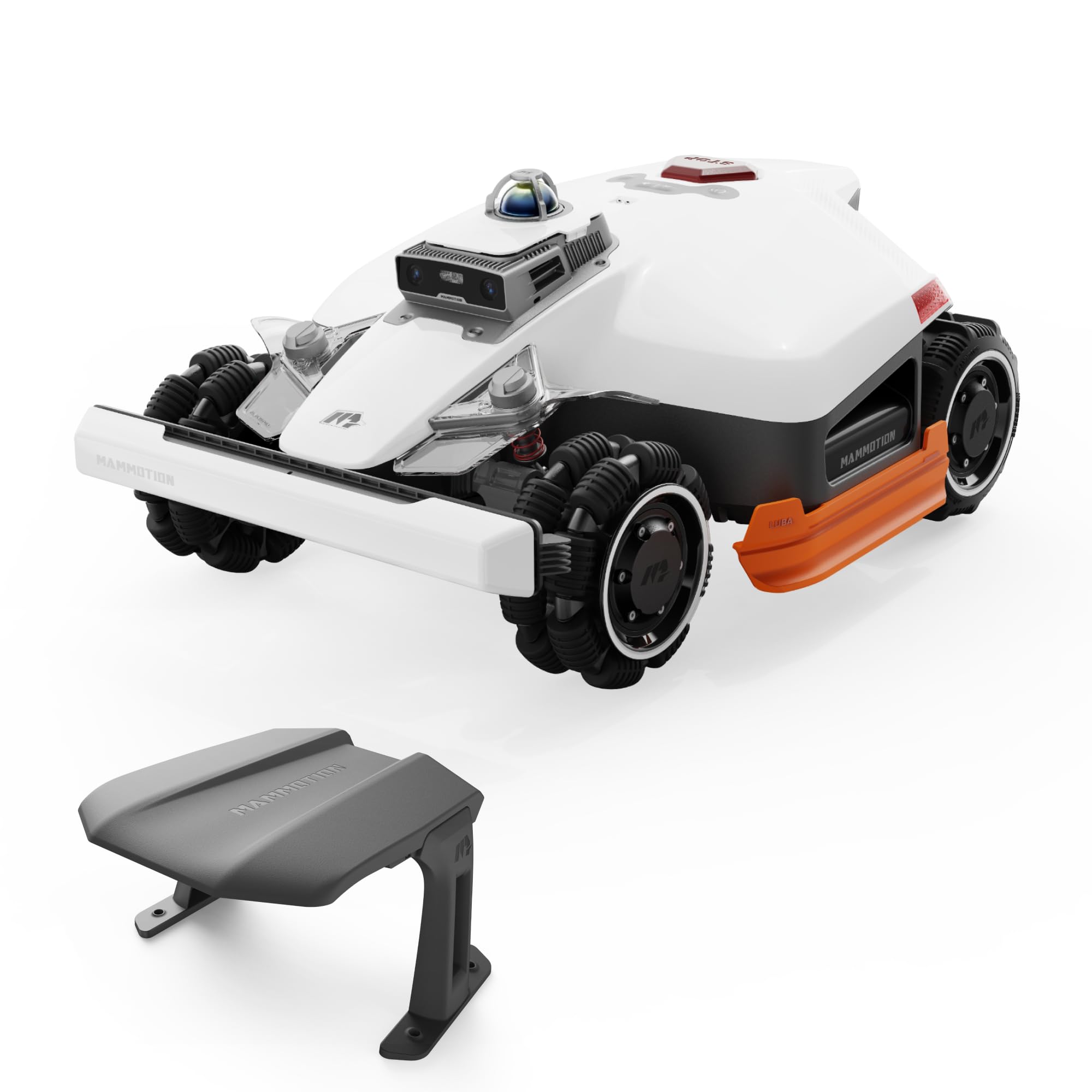
The Mammotion LUBA 3 5000H is the robotic AWD mower for properties where a walk-behind is impractical. Four independently controlled motors drive each wheel, allowing the mower to climb slopes up to 80% (38.6 degrees) and step over curbs or roots up to 50 mm high. That makes it viable for seriously steep terrain that would stall a standard robot.
Tri-Fusion navigation combines 360° LiDAR, NetRTK corrections, and dual-camera AI vision to build a dense point cloud of your property. It identifies over 300 obstacle types and adjusts its path in real time. The dual 165W cutting motors spin six blades across a 400 mm cutting width, and AI adjusts speed based on grass density to conserve battery. On the 15Ah battery, it runs up to 215 minutes per charge, covering 500 m² per hour. The 5000H version supports up to 50 mowing zones and 1.25 acres.
Early adopters praise the cut quality on tall fescue and the reliability of the LiDAR backup under tree canopies where RTK alone fails. Some note that real-world battery coverage runs about 60% of the marketing estimate, and replacement batteries are not user-serviceable. The included garage ships separately.
What works
- Climbs 80% slopes with adaptive suspension
- LiDAR + RTK + AI vision prevents getting lost
- 50 multi-zone management for complex properties
What doesn’t
- Real-world battery coverage below advertised figure
- Battery not user-replaceable
- Long-term parts availability uncertain
3. Segway Navimow X450
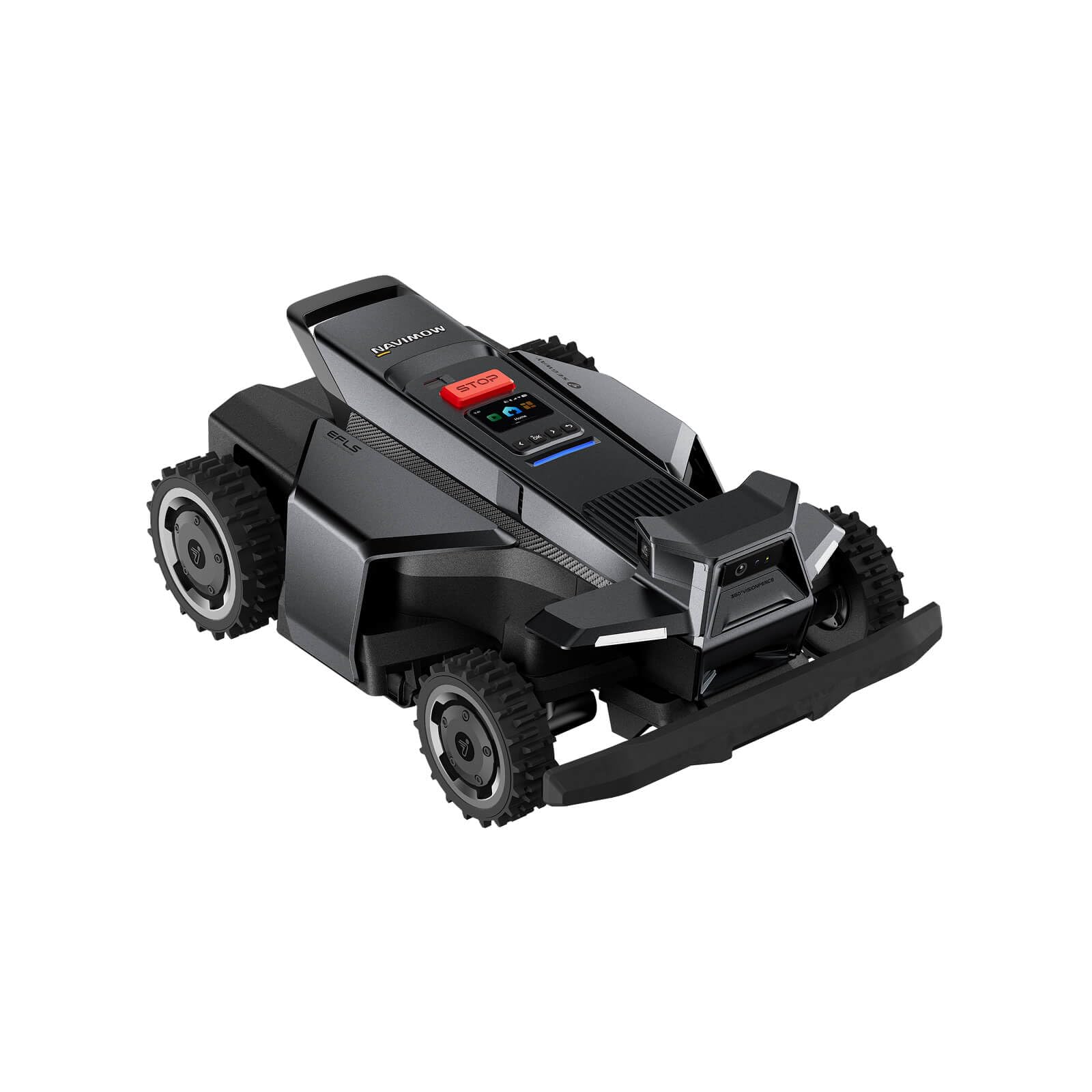
The Segway Navimow X450 tackles the steepest residential grades of any robotic mower on this list. Its ORV-tuned dual suspension system and four-wheel drive handle slopes up to 84% (40 degrees) while the Xero-Turn steering avoids turf scuffing by pivoting the front wheels independently. That zero-turn capability is rare in a robot and prevents the torn-up corners that plague some AWD models on tight turns.
Cutting power comes from dual 180W motors driving two discs with 12 blades total. The 17-inch cutting width is narrower than walk-behinds, but the mowing speed reaches 2.6 ft/s and EdgeSense trimming reduces manual edging to under 2 inches. The EFLS tri-frequency RTK system combined with 360° Vision and VIO delivers centimeter-level accuracy even under dense tree canopies. The app supports one-tap auto mapping, GeoSketch for boundary editing, and voice control through Alexa or Google Home.
Owners report excellent navigation and smooth patterned cuts once firmware is updated. A few experienced initial GPS or docking issues that resolved after a reboot and setting a vision-free zone at the charger. Customer support communication can be slow, but the replacement process is straightforward when defects occur.
What works
- Zero-turn AWD prevents turf damage on tight turns
- Climbs 84% slopes with dual suspension
- Wire-free setup with one-tap auto mapping
What doesn’t
- Initial firmware issues reported by some users
- Cameras confused by low-hanging branches
- Customer support response time can be slow
4. EGO POWER+ LM2114SP
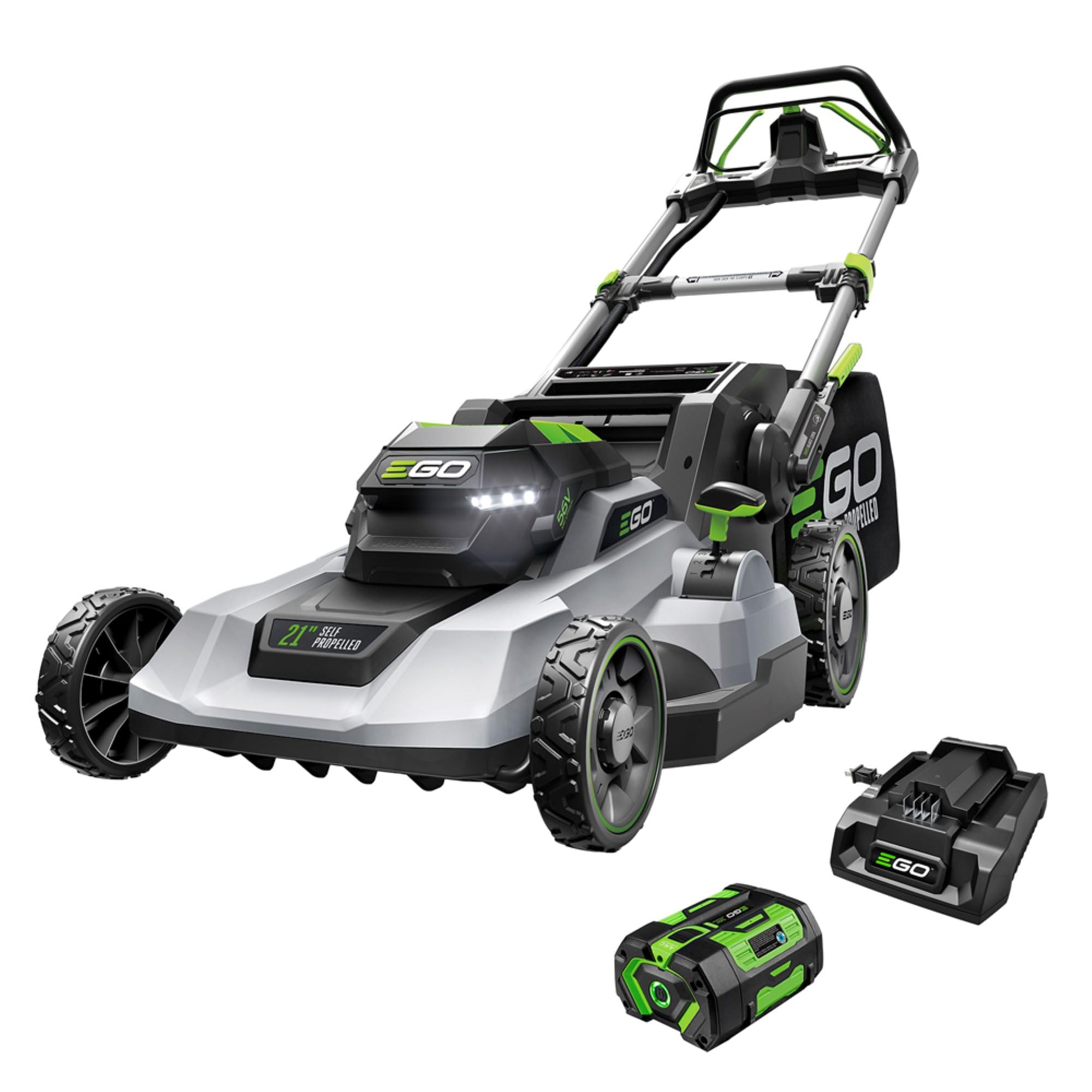
The EGO LM2114SP brings the brand’s proven 56V platform to a more accessible price point without sacrificing the core features that matter on slopes. The high-efficiency brushless motor delivers 6.0 ft-lbs of cutting torque — enough to power through thick St. Augustine and damp Bermuda without bogging down. The 21-inch deck offers 7 cutting heights from 1.25 to 4 inches, and the dual-toggle handleset lets you engage self-propulsion with either hand.
Run time hits up to 50 minutes on the included 6.0Ah ARC Lithium battery, which covers most small to mid-size lots. The charger is included too. LED headlights extend usability into evening hours, and the fold-flat design stores compactly. Owners switching from gas appreciate the instant push-button start, the elimination of winterization chores, and the significantly quieter operation.
The main limitation is that the 6.0Ah battery barely finishes a medium yard on one charge, especially when using self-propel throughout. Owners with larger lawns recommend buying a second battery. The plastic deck also lacks the durability of steel, and the mower clogs in grass over 6 inches tall.
What works
- Powerful brushless motor with 6.0 ft-lbs torque
- Included 6.0Ah battery and charger
- Lightweight, easy to maneuver on flat ground
What doesn’t
- Battery lasts one mow on a medium yard with self-propel
- Plastic deck less durable than steel
- Clogs in tall grass over 6 inches
5. Greenworks 80V 25″ Self-Propelled

The Greenworks 80V 25-inch mower is built for coverage speed. Its 25-inch steel deck is the widest among the walk-behind models here, allowing you to knock down a half-acre lawn in fewer passes than a standard 21-inch mower. The brushless motor runs quietly and delivers enough torque to drive the rear-wheel self-propel system and turn the dual blade at once.
Dual battery ports with automatic switchover extend runtime by letting you slot in two batteries without stopping. The included 4.0Ah battery covers about 40 minutes, but adding a second pack effectively doubles your mowing window. Seven cutting heights range from 1.25 to 4.06 inches, and the LED headlight lets you mow in low light. The aluminum handles fold for storage.
Reviews consistently note that battery life falls short of the advertised 3/4-acre claim — many owners find it covers about half that on thick grass, especially with self-propel engaged. The self-propel can feel touchy at low speeds, and there is no side discharge option, which limits its ability to handle heavy leaf cleanup.
What works
- Wide 25-inch deck for faster mowing
- Dual battery ports with automatic switchover
- Steel deck, brushless motor, LED headlight
What doesn’t
- Battery life falls short of advertised coverage
- Self-propel speed control is touchy
- No side discharge chute included
6. SENIX 201cc Variable Speed
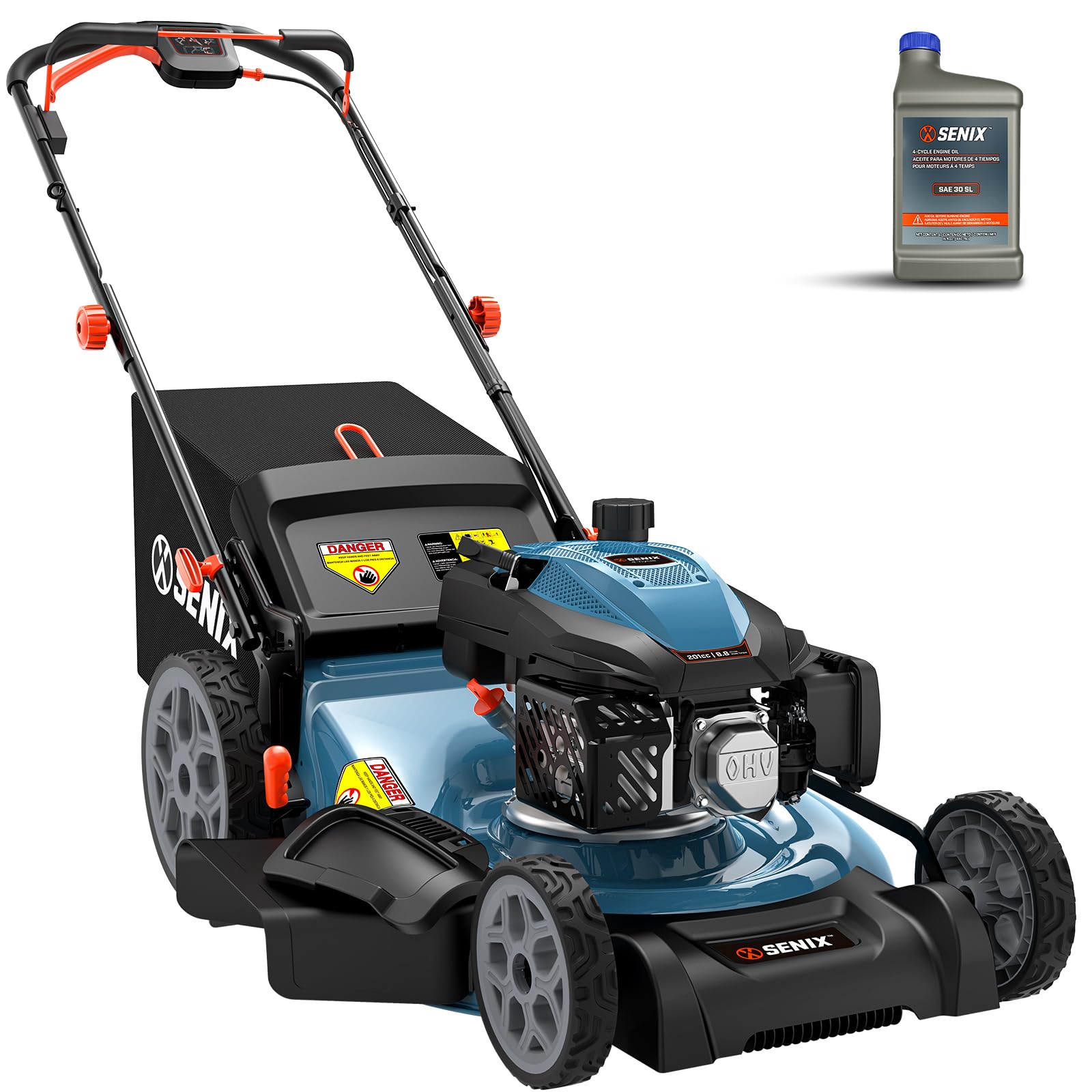
The SENIX 201cc mower brings the largest gas engine displacement in this test group, giving it ample reserve power for thick wet grass and sustained inclines. The four-stroke OHV engine starts reliably and drives a rear-wheel self-propel system with variable speed control — a feature that lets you dial in exactly the right pace for the terrain rather than being locked into a single speed.
The 22-inch steel deck supports three cutting modes: mulching, rear bagging, and side discharge. The 6-position height adjustment covers 1.25 to 4 inches, and the foldable handle reduces storage footprint by 70%. The 19-gallon bagger holds a solid volume before needing emptying. Owners report that the engine starts easily, handles 6-8 inch tall grass without stalling, and stores upright without fuel leaks when folded.
Some units have experienced self-propel belt slippage and loosening handle bolts in early use. A few owners reported gas leaks when storing upright, which contradicts the marketing claim. Customer service has been responsive to replacement requests in most cases, but a small number reported slow warranty processing.
What works
- Powerful 201cc engine for thick and wet grass
- Variable speed self-propel for slope matching
- Foldable design stores upright without leaks
What doesn’t
- Self-propel belt can slip in early use
- Some units have gas leak when stored upright
- Blade compartment clogs without bag attached
7. PowerSmart B7622S 150cc B&S
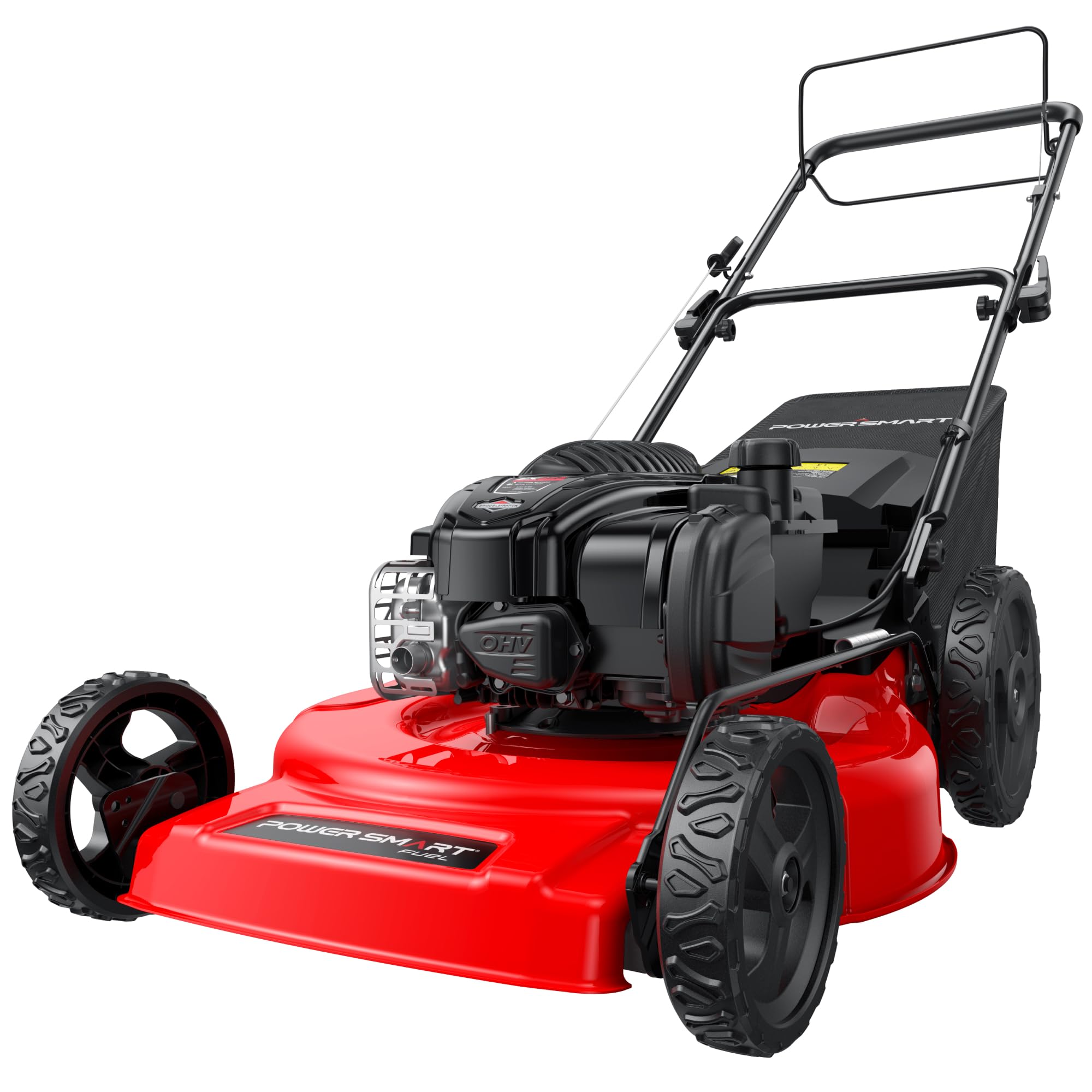
The PowerSmart B7622S stands out in the mid-range gas segment because of its Briggs & Stratton EX625 150cc engine with ReadyStart technology. That engine is built in the USA and provides consistent starting without priming or choking — just pull and go. The rear-wheel drive self-propel gives adequate traction on moderate slopes, though there is no speed adjustment, so you get one pace regardless of terrain.
The 22-inch steel deck is tough and offers 6 cutting heights from 1.5 to 3.9 inches via a single-lever adjustment. The 3-in-1 system supports mulching, rear bagging, and side discharge. The 1.4-bushel bag is quick to empty. Owners find the cut quality good, with fine mulching that returns small clippings to the soil. Assembly is minimal since many components come pre-attached from the factory.
The self-propel runs noticeably slow — some owners find it too fast in its default gear — and there is no speed adjustment. The mower consumes fuel and oil faster than expected, and there is no integrated hose hookup for deck cleaning. Some units arrived with damaged wheels from shipping, and a few owners reported missing bolts on the belt cover that caused self-propel failure.
What works
- Reliable Briggs & Stratton ReadyStart engine
- Solid steel deck with single-lever height adjustment
- Good mulching performance with fine clippings
What doesn’t
- Self-propel has no speed adjustment
- No deck washout port for cleaning
- Some units have missing or loose hardware
8. Milwaukee M18 Fuel 21″ Self-Propelled

The Milwaukee M18 Fuel mower integrates directly into the M18 battery platform, making it a natural upgrade for anyone who already owns Milwaukee drills, saws, or blowers. The all-steel deck is tough, and the 21-inch cut capacity is standard for this class. The dual-battery design draws from two M18 packs simultaneously, distributing power draw and extending runtime compared to single-battery electric mowers.
The brushless motor delivers high RPM for a clean cut, and the self-propel system provides smooth forward movement on moderate terrain. Owners report that the mower handles a yard just under 3/4 of an acre on a full charge with self-propel engaged, which puts it in the upper range of electric mower capability. The compact folded profile is easy to store, and the overall build quality reflects Milwaukee’s industrial design DNA.
The biggest downside is the lack of included batteries — this is a tool-only purchase, and M18 high-output batteries are expensive. The deck is also narrower than some competitors at 21 inches, and the single-position cutting height adjustment is restrictive compared to the 7- or 8-position competitors. Some units arrived with minor cosmetic damage or missing pieces due to inadequate packaging.
What works
- All-steel deck with industrial build quality
- Dual M18 batteries for extended runtime
- High RPM cut quality comparable to gas
What doesn’t
- Batteries and charger sold separately
- Single-position cutting height only
- Packaging can lead to cosmetic damage in transit
9. Mammotion LUBA 3 AWD 3000H
The Mammotion LUBA 3 3000H is the smaller sibling to the 5000H, designed for properties up to 0.75 acres but sharing the same core AWD drivetrain and Tri-Fusion navigation. It climbs slopes up to 80%, uses the same 360° LiDAR + NetRTK + AI vision system, and supports up to 30 mowing zones. The 12Ah battery provides up to 175 minutes of runtime, covering about 500 m² per hour.
The dual 165W cutting motors deliver the same 400 mm cutting width and 6-blade disc setup as the larger model. The adaptive suspension steps over curbs and roots up to 50 mm high. AI automatically adjusts motor speed based on grass density to maximize battery efficiency. The garage ships separately, same as the 5000H.
Owners report excellent cut quality on tall fescue and reliable navigation that avoids getting lost under tree canopies. The real-world battery coverage is closer to 60% of the marketing figure, similar to the larger model. Setup and mapping are straightforward through the app, but Bluetooth connection drops occasionally during initial configuration. The lack of a user-replaceable battery is a concern for long-term ownership.
What works
- Climbs 80% slopes with 4 independent motors
- LiDAR + RTK + AI vision prevents getting stuck
- Supports up to 30 zones and no-go areas
What doesn’t
- Battery life lower than advertised in practice
- Battery not user-replaceable
- Bluetooth drops during mapping setup
10. SENIX 170cc 22″ Self-Propelled
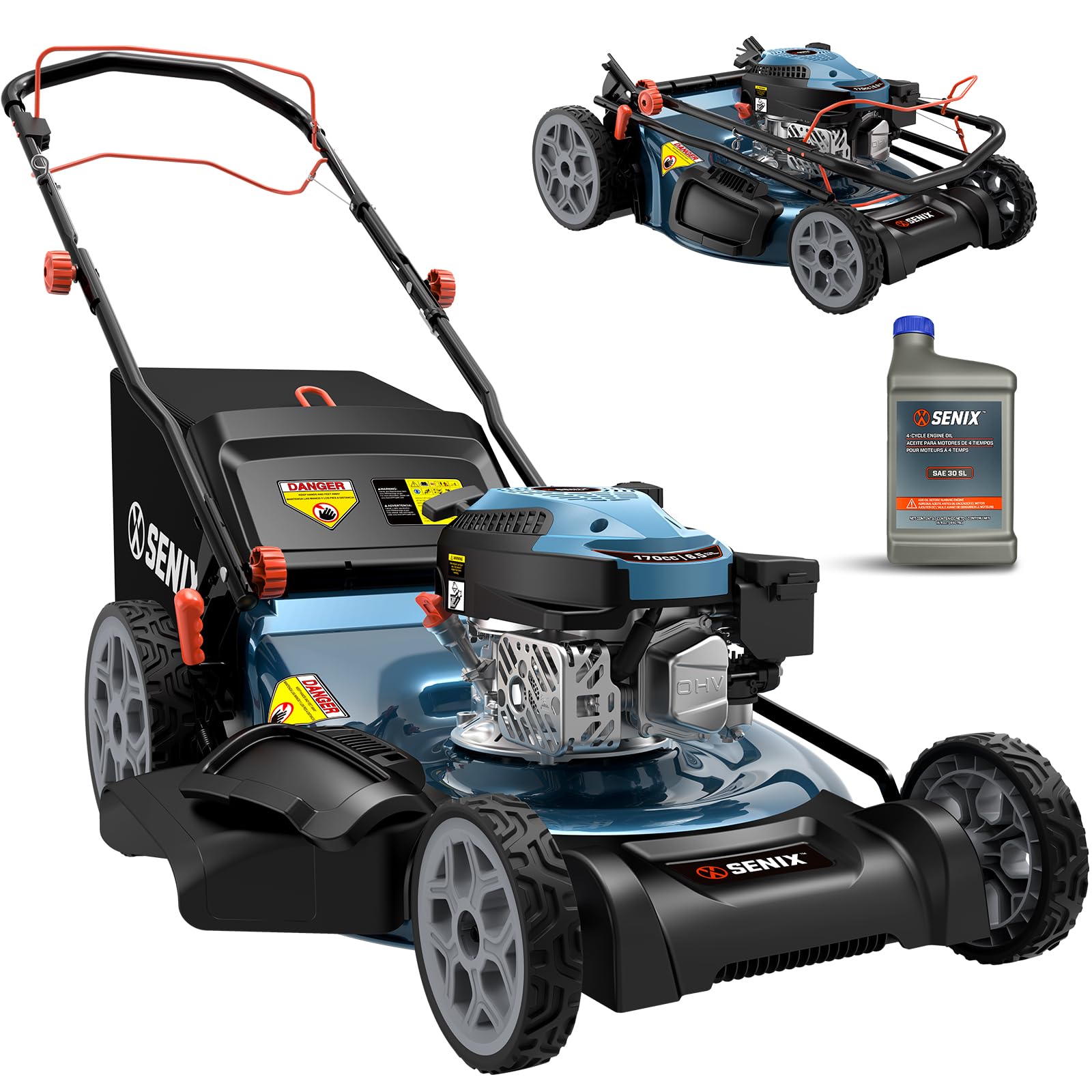
The SENIX 170cc self-propelled mower hits a competitive price point for a gas-powered walk-behind with a 22-inch steel deck. The 170cc OHV 4-cycle engine fires up reliably with a single pull, and the rear-wheel drive self-propel provides a steady forward motion that works well on flat to gently sloping lots. The 3-in-1 cutting system includes mulching, side discharge, and rear bagging with a 19-gallon bagger.
Single-lever height adjustment gives you 6 positions from 1.25 to 4 inches, and the 8-inch front and 11-inch rear wheels roll smoothly over uneven ground. The foldable handle and vertical storage design save garage space. Owners find assembly straightforward — around 10 minutes — and the mower handles 6-8 inch tall wet grass without excessive stalling, though it requires a slower pace in heavy growth.
The main compromises show in build quality details. Instructions are sparse, and the gas and oil fill ports lack clear labeling, which can confuse first-time gas mower buyers. Some owners report handle bolts loosening over time, and the rubber rear skirt is prone to detaching and getting chewed by the blade. Replacement parts availability from the manufacturer is limited.
What works
- Good value for a gas self-propelled mower
- Easy assembly and first-pull starting
- Handles tall wet grass with steady pace
What doesn’t
- Gas and oil ports not labeled clearly
- Rubber rear skirt detaches under use
- Limited replacement parts from seller
11. PowerSmart DB8622S 170cc
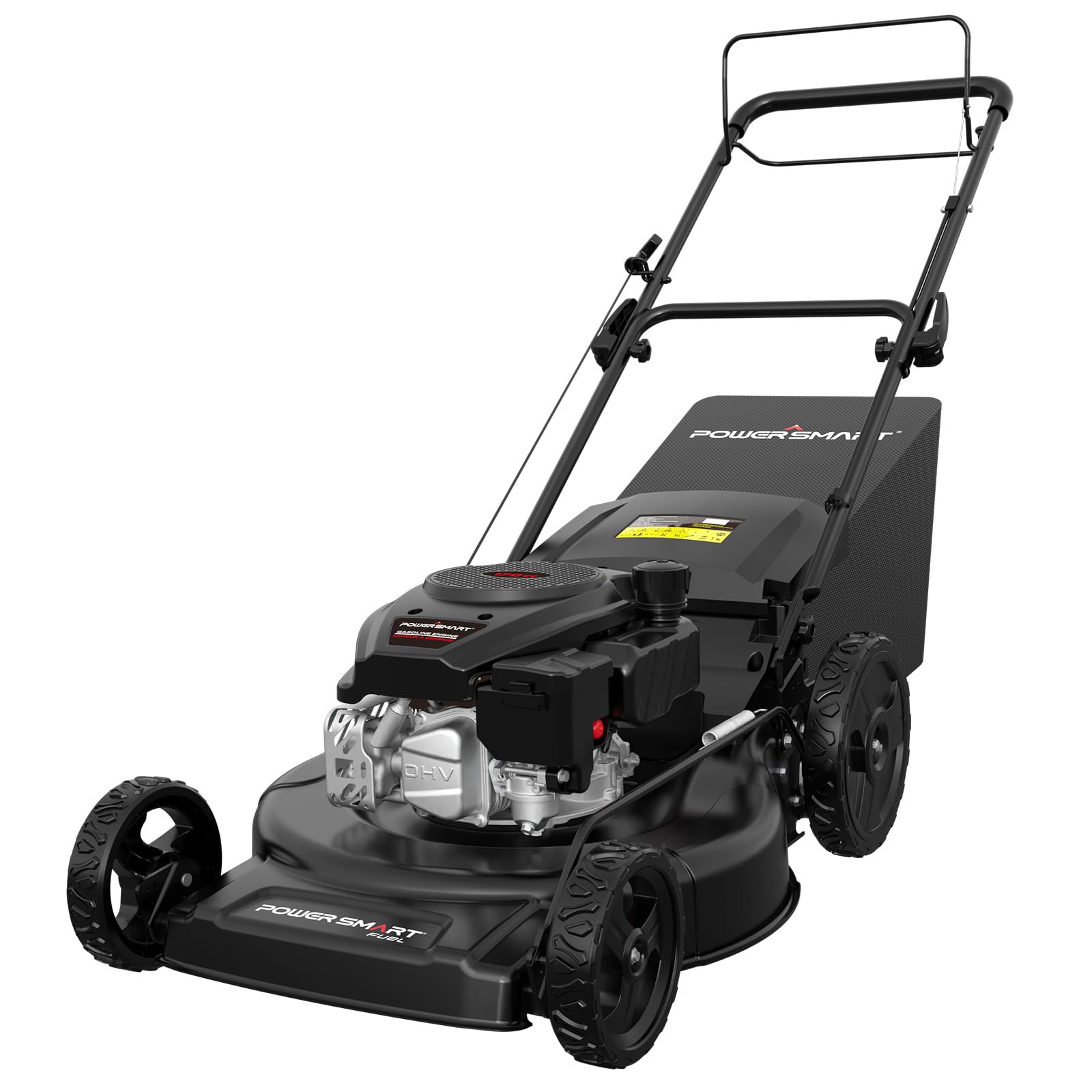
The PowerSmart DB8622S is the most affordable self-propelled gas mower in this group, aimed at small yards under a quarter acre. The 170cc engine with recoil start and auto choke fires up quickly — owners report first-pull starts in most cases. The rear-wheel drive self-propel provides enough traction for mild slopes, though it is not speed-adjustable. At 68 pounds, it is noticeably lighter than many competitors.
The 22-inch alloy steel deck is narrower than some but sufficient for tight spaces. The 3-in-1 system supports mulching, rear discharge, and bagging with a 60L grass bag. Six cutting heights range from 1.5 to 3 inches, which is a narrower band than most mowers here — the 3-inch maximum is restrictive if you prefer to cut grass taller for heat tolerance. The 10-minute assembly time is among the fastest, but some users note the included starter oil is missing from the box.
Owners appreciate the smooth cut and low noise level for a gas engine. However, the handle hardware uses nuts and bolts that loosen and fall off over time, requiring periodic tightening or replacement. The rubber rear skirt and mulching chute are flimsy — some owners report the skirt being chewed by the blade after just a few uses. Replacement parts availability from PowerSmart is minimal, making repairs difficult.
What works
- Lightweight and easy to maneuver
- Quick assembly and reliable first-pull start
- Smooth cutting performance for small yards
What doesn’t
- Handle hardware loosens and falls off
- Rubber rear skirt detaches and gets damaged
- Limited replacement parts available
Hardware & Specs Guide
Cutting Torque (ft-lbs) vs. Engine Displacement (cc)
For electric mowers, cutting torque directly translates to the machine’s ability to maintain blade speed under load. The EGO LM2150SP delivers 8.3 ft-lbs, enough to cut through wet St. Augustine without slowing. For gas mowers, engine displacement in cubic centimeters is the comparable metric — 170cc to 201cc is the typical range for residential walk-behinds. Higher displacement means more reserve power for tall grass and slopes. Robotic mowers use motor wattage (165W to 180W), which determines how fast the cutting discs spin under varying grass density.
Deck Width and Cutting Path
Deck width directly affects how many passes you need to cover your property. A 21-inch deck (EGO, Milwaukee) is standard for electric self-propelled models. A 22-inch deck (SENIX, PowerSmart) shaves a few passes off per mow. The Greenworks 80V’s 25-inch deck is the widest, covering roughly 19% more grass per pass than a 21-inch deck. Robotic mowers like the Mammotion LUBA 3 have a 400 mm (15.75-inch) cutting width, while the Segway Navimow X450 cuts a 17-inch path — narrower than all walk-behinds but compensated by autonomous operation.
Battery Capacity and Runtime
Cordless mowers are rated by battery voltage and amp-hour (Ah) capacity. The EGO 56V platform uses 6.0Ah or 10.0Ah packs, delivering 50-75 minutes of runtime. The Greenworks 80V 4.0Ah battery offers about 40 minutes. The Mammotion LUBA 3 uses a 12Ah (3000H) or 15Ah (5000H) internal lithium pack for 175-215 minutes. Robotic mowers automatically return to charge, so runtime is less critical than total coverage area — the LUBA 3 3000H covers 0.75 acres per charge cycle, while the 5000H covers 1.25 acres.
Cutting Height Range and Adjustability
The minimum and maximum cutting heights determine which grass types the mower can handle. The EGO LM2150SP offers the widest range at 1 to 4 inches across 8 positions, suitable for Bermuda lawns at the low end and tall fescue at the high end. The SENIX and EGO LM2114SP offer 1.25 to 4 inches (6-7 positions). The PowerSmart DB8622S tops out at 3 inches, which limits its utility for warm-season grasses that thrive at 3.5-4 inches. Robotic mowers typically have narrower bands — the Mammotion LUBA 3 adjusts from 2.2 to 4 inches, suitable for frequent maintenance cuts but not season-opening or final scalping.
FAQ
What does AWD actually do on a lawn mower that RWD cannot?
Is an AWD mower heavier and harder to push if the drive fails?
Can a robotic AWD mower replace a walk-behind on a steep lawn?
What battery voltage do I need for reliable AWD performance?
Should I buy a gas or electric AWD mower for a sloped half-acre?
Final Thoughts: The Verdict
For most gardeners, the best awd lawn mower winner is the EGO POWER+ LM2150SP because its Select Cut XP blade system, 8.3 ft-lbs of torque, and Touch Drive self-propel deliver genuine traction and cut quality without gas maintenance. If you want a robotic solution that handles steep grades autonomously, grab the Mammotion LUBA 3 AWD 5000H. And for a budget-conscious gas option with a solid Briggs & Stratton engine, nothing beats the PowerSmart B7622S.