
Begonias are heavy feeders with shallow root systems, making them uniquely sensitive to both over-fertilization and nutrient deficiencies. A fertilizer high in nitrogen pushes out leggy green growth at the expense of the cascading flowers that make these plants worth the effort, while a formula lacking in phosphorus and potassium will leave buds small and colors washed out. The growing medium — be it peat-based potting mix, coco coir, or a hydroponic setup — further dictates how quickly nutrients are absorbed, which means a one-size-fits-all approach rarely works.
I’m Rikta — the co-founder and writer behind Lawn Gear Lab. I’ve spent hundreds of hours cross-referencing label guarantees, NPK ratios, secondary nutrient profiles, and verified buyer experiences to isolate the specific formulas that match a begonia’s feeding windows and root sensitivity.
Whether you grow tuberous, wax, or rex varieties, finding the right fertilizer for begonias means matching the release mechanism and micronutrient lineup to your specific soil and bloom cycle.
How To Choose The Best Fertilizer For Begonias
Begonias demand a specific nutrient profile that balances vegetative support with bloom promotion. Picking the wrong ratio or delivery method can stunt flowers or burn roots. Here are the three defining factors to evaluate.
NPK Ratio: Balance vs. Bloom
A fertilizer labeled with a balanced ratio such as 5-5-5 or 4-4-4 works well for rex and rhizomatous types where foliage is the primary feature. For tuberous and wax begonias grown for heavy flowering, a higher middle number — like a 5-10-5 or a bloom-boosting formula — supplies the phosphorus necessary to trigger bud formation without pushing excessive leaf mass.
Liquid Concentrate vs. Granular Slow-Release
Liquid concentrates provide immediate nutrient availability and are easier to control during the rapid growth phase from spring through early fall. Granular options release nutrients gradually over several weeks, which suits gardeners who prefer fewer applications, but the delayed breakdown can make it harder to correct deficiencies mid-season.
Micronutrients and Support Elements
Beyond the primary NPK numbers, begonias benefit from supplemental calcium for cell-wall strength, magnesium for chlorophyll production, and silica for sturdy stems that support heavy blooms. Formulas that include sea kelp, fulvic acid, or humates improve nutrient uptake in the slightly acidic soil (pH 5.5–6.5) that begonias prefer.
Quick Comparison
On smaller screens, swipe sideways to see the full table.
| Model | Category | Best For | Key Spec | Amazon |
|---|---|---|---|---|
| Growth Technology GT Flower Focus | Premium Liquid | Maximum bloom intensity | 1 Quart (33.8 fl oz) bottle | Amazon |
| Grow Queen Organic Liquid 5-5-5 | Organic Liquid | Balanced feeding all season | 8 oz treats 50 gallons | Amazon |
| BIOPLENAFEED Liquid 6-Pack | Pre-Measured Spikes | No-mix convenience | 6 x 38 mL spike bottles | Amazon |
| Gardenera Organic Superfood Concentrate | Organic Liquid | Soil biology enhancement | 8 oz, 2 tbsp per gallon | Amazon |
| Gardenera Liquid Silica Supplement | Silica Booster | Stem strength & leaf resilience | 8 oz makes 45 gallons | Amazon |
| Gardenera Plant Superfood Spray | Ready-to-Use Spray | Quick foliar & root boost | 8 oz, premixed spray | Amazon |
| Jobe’s Organics Granular 4-4-4 | Granular Organic | Budget-friendly soil amendment | 4 lbs, 4-4-4 NPK | Amazon |
In‑Depth Reviews
1. Growth Technology GT Flower Focus Liquid Plant Nutrient
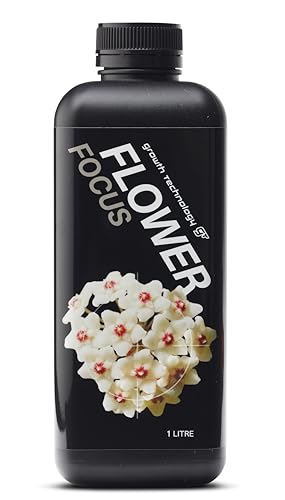
Growth Technology GT Flower Focus is a premium liquid bloom booster built around a mineral profile that prioritizes flower formation over vegetative sprawl. The water-soluble formula mixes cleanly in both soil drench and hydroponic reservoirs, and the 1-liter bottle — roughly 33.8 fluid ounces — supplies enough concentrate for dozens of weekly feedings for a moderate-sized begonia collection. Verified owners consistently report larger flower clusters and more saturated petal colors within two to three applications.
The recommended dosage ranges from 3 to 5 milliliters per liter of water for soil-grown begonias, which is small enough that a single bottle can last several months even with heavy use. The formula includes a full spectrum of secondary minerals — including calcium and magnesium — that prevent the leaf-tip curl and interveinal chlorosis common in begonias fed only basic NPK solutions. Growers transitioning plants into a bloom cycle appreciate how sharply the nutrient profile shifts energy toward buds rather than leaves.
On the downside, the original dispensing bottle has been cited by several users for leaking during shipping, and the per-bottle cost places it firmly in the premium tier. For serious begonia growers who want controlled, predictable bloom results without adjusting pH separately, GT Flower Focus justifies the investment through sheer consistency and concentration efficiency.
What works
- Produces visibly larger and more colorful blooms within weeks
- Concentrated formula requires tiny doses per gallon, extending bottle life
- Works reliably in soil, semi-hydro, and full hydroponic systems
What doesn’t
- Original bottle cap design is prone to leaks during transport
- Premium price point may exceed casual gardener budgets
2. Grow Queen Organic Liquid Indoor Plant Food 5-5-5
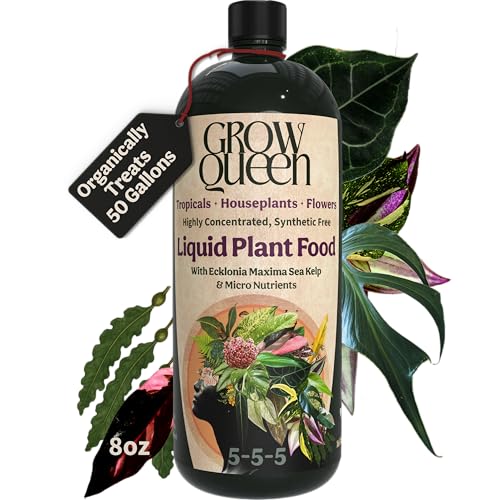
Grow Queen’s 5-5-5 organic liquid is one of the few true 5-5-5 liquids available without synthetic additives, and its NPK balance makes it a versatile feeding option for both foliage-focused rex begonias and flowering varieties. The 8-ounce bottle concentrates enough to treat up to 50 gallons of water, which means a single purchase covers an entire growing season for a standard indoor collection. The formula relies on cold-processed Ecklonia maxima sea kelp as its primary bioactive ingredient, delivering auxins and trace minerals that support root expansion and leaf density without the burn risk of chemical salt-based feeds.
Owners of rare aroid and begonia collections have reported consistent new growth and greener leaves when using this fertilizer at every watering during active growth. The lack of strong odor is a practical advantage for indoor use, and the 5-5-5 ratio provides a stable baseline that can be supplemented with a bloom booster during flower initiation. Growers who prefer to rotate products note that Grow Queen’s formula does not cause nitrogen lockout when paired with other organic amendments.
The primary limitation is that 5-5-5 is not specifically optimized for heavy flowering; tuberous begonia growers may need to pair it with a phosphorus supplement to maximize bud count. Additionally, some users with very large gardens have noted the 8-ounce size runs out quickly when mixing at the full 1 tablespoon per gallon rate across dozens of plants.
What works
- True 5-5-5 organic analysis without synthetic salts or fillers
- Treats up to 50 gallons from one small bottle, offering high value
- Cold-processed kelp delivers natural growth hormones for robust roots
What doesn’t
- Balanced ratio may not push maximum blooms without phosphorus addition
- Small bottle volume can deplete quickly for extensive plant collections
3. BIOPLENAFEED All-Purpose Liquid Plant Food Fertilizer 6-Pack
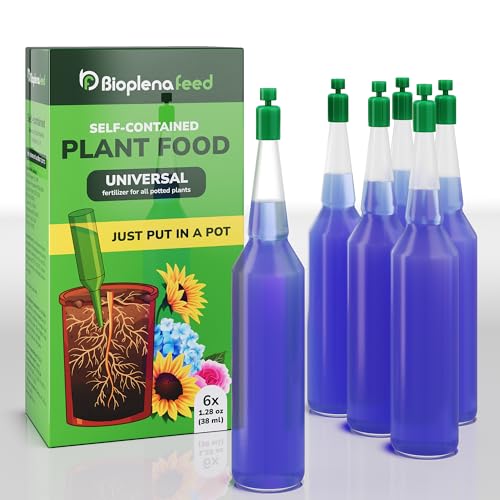
The BIOPLENAFEED 6-pack solves the most common complaint about liquid fertilizers: the mess of measuring and mixing. Each 38-milliliter bottle is a pre-measured spike that you simply snip the tip, invert, and insert into the potting medium. The self-dispensing design slowly releases nutrients directly at the root zone over roughly 15 days, which sidesteps the dilution errors that can burn delicate begonia roots when using concentrates.
Multiple verified owners describe reviving borderline-dead clearance plants within days of inserting a spike — an indicator of how quickly the balanced nutrient solution becomes available to stressed root systems. The NPK ratio supports both foliage and bud development, making it suitable for wax and rex begonias that need consistent, moderate feeding without heavy nitrogen fluctuations. Because each bottle is sealed until use, there is no shelf-life degradation from opened concentrate sitting in a cabinet.
The drawbacks are primarily related to cost-per-feed and customization. Each spike is single-use, so the unit price is higher per application than mixing from a bulk concentrate. Advanced growers who want to tweak ratios between growth and bloom phases will find the fixed formula restrictive. For a lower-maintenance feeding routine or for watering-averse plant owners, however, the simplicity is genuinely compelling.
What works
- Zero mixing, zero measuring — snip and insert for continuous feeding
- Sealed bottles stay fresh indefinitely until opened
- Visible plant recovery reported within days on stressed specimens
What doesn’t
- Higher per-feed cost compared to bulk liquid concentrates
- Fixed NPK ratio offers no flexibility for bloom-specific adjustments
4. Gardenera Organic Superfood Concentrate for Begonia
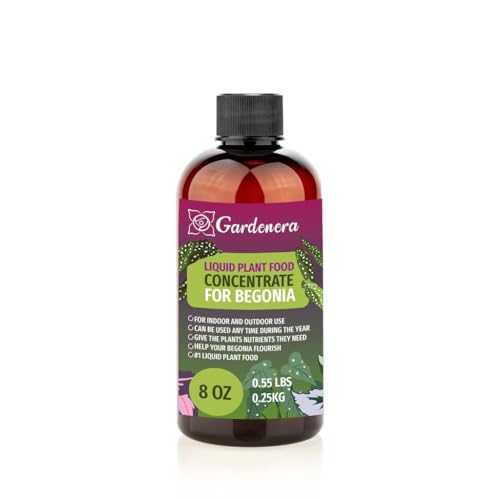
Gardenera’s Organic Superfood Concentrate is a broad-spectrum liquid amendment that goes beyond NPK by incorporating 18 essential nutrients from sources like bat guano, worm castings, kelp meal, and humic shale. The zymology processing method — a multi-year fermentation step — breaks these ingredients down into elemental forms that begonias can absorb almost immediately through both foliar and root pathways. The recommended dilution of 2 tablespoons per gallon makes the 8-ounce bottle stretch across more than 25 full gallons of feeding solution.
Owners of variegated begonia varieties report that the formula helps maintain stable leaf coloration without the browning edges that often accompany high-nitrogen feeds. The microbial content — including mycorrhizae and beneficial fungi — improves soil structure in reused potting mixes, which is especially useful for growers who keep begonias in containers for multiple seasons. Several reviews note visible improvements in plant turgor and leaf size after just two or three waterings.
The concentrate’s diversity of organic inputs creates a distinctive aroma that some indoor growers may find strong until it dries into the soil. Additionally, the 2-tablespoons-per-gallon rate means heavy users with large collections will work through the bottle faster than with super-concentrated synthetic formulas. For begonia enthusiasts focused on soil biology and long-term root health, this is a powerful tool.
What works
- 18-ingredient profile supports complete nutrition beyond NPK
- Microbial components enhance soil biology for sustained health
- Zymology-processed ingredients are readily absorbed by begonia roots
What doesn’t
- Organic formula has a noticeable odor until worked into the soil
- Moderate concentration requires frequent bottle replacement for large collections
5. Gardenera Liquid Silica Plant Supplement for Begonia

Silica is a non-traditional but highly effective supplement for begonias, especially top-heavy tuberous varieties whose flower stalks can snap under their own weight. Gardenera’s Liquid Silica supplement delivers bioavailable silicic acid that strengthens cell walls at the structural level, leading to thicker stems and leaves that resist the browning, curling, and wind damage that plague thin-foliage begonias in outdoor or greenhouse environments. The 8-ounce bottle makes up to 45 gallons of working solution, placing per-dose costs among the lowest of any supplement in this category.
Verified owners using the product on both begonias and other delicate ornamentals like Albo Monstera report that stems become noticeably sturdier within two to three weeks of consistent use. The formula is compatible with both soil drenches and hydroponic reservoirs, and it mixes without the precipitation issues that plague some potassium silicate-based products. For begonias grown in high-humidity conditions where fungal pressure is a concern, silica reinforcement also improves the physical barrier against pathogen entry.
The product is a supplement, not a complete fertilizer — it lacks significant NPK content, so it must be used alongside a balanced or bloom-focused plant food. Growers who skip the primary feed and rely solely on silica will see structural improvement but no flower or foliage color enhancement. Used as directed in rotation with a full-spectrum nutrient line, it fills a genuine gap in begonia care regimens.
What works
- Dramatically strengthens begonia stems, reducing flower stalk breakage
- Extremely economical — one bottle treats up to 45 gallons
- Mixes cleanly in both soil and hydroponic systems without precipitation
What doesn’t
- No NPK content — cannot replace a complete fertilizer regimen
- Results limited to structural support; does not directly enhance bloom color
6. Gardenera Plant Superfood Spray for Begonia Plants
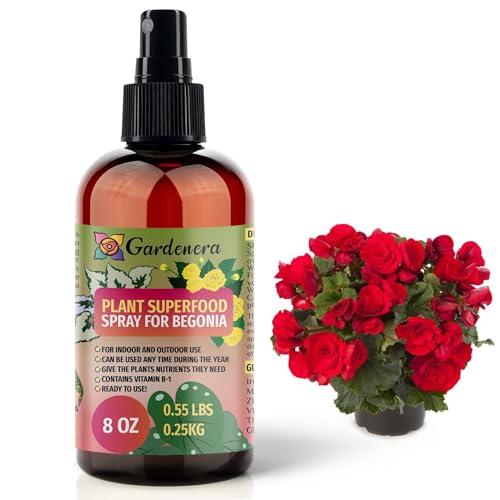
Gardenera’s Plant Superfood Spray differentiates itself through its ready-to-use liquid form and the inclusion of Vitamin B-1, glucose, and chelated micronutrients designed for immediate foliar and root absorption. The spray format is particularly useful for begonias that have undergone transplant shock, shipping stress, or pest damage, because it bypasses compromised root systems and delivers energy directly through leaf stomata and stem tissue. The 8-ounce bottle requires no dilution, eliminating measurement errors that could burn sensitive foliage.
Verified users recount reviving avocado trees, Meyer lemon trees, and begonias from nearly leafless states within a week by spraying the solution on both the top and undersides of leaves and the main stem. The glucose component provides an instant carbohydrate source that supports metabolic recovery, while the chelated iron, manganese, and zinc address the pale chlorosis that often follows overwatering or nutrient lockout. For indoor growers who struggle with maintaining consistent watering schedules, the spray offers a forgiving rescue option between deeper soil feeds.
The primary complaint centers on the spray bottle design — a newer finger-depression nozzle that some users find less ergonomic than a traditional trigger grip. The product also lacks a complete NPK profile, functioning more as a stimulant and micronutrient boost than a standalone fertilizer. It works best as a supplemental tool rather than the sole source of nutrition for a full growing season.
What works
- Ready-to-use spray eliminates mixing errors and burn risk
- Vitamin B-1 and glucose provide rapid recovery for stressed plants
- Foliar absorption supports begonias with damaged or weak root systems
What doesn’t
- Spray nozzle design is less comfortable than a conventional trigger
- Not a complete fertilizer — lacks the NPK levels for long-term sole feeding
7. Jobe’s Organics Granular All Purpose Fertilizer 4-4-4

Jobe’s Organics Granular 4-4-4 is the only dry, slow-release option on this list, and it brings the kind of no-fuss soil amendment that appeals to outdoor begonia beds and large container gardens. The 4-pound bag contains billions of archaea — beneficial microorganisms that break down organic material into bioavailable nutrients over several weeks — providing a steady feeding curve that avoids the nitrogen spikes that can make begonia leaves grow large but pale. The 4-4-4 NPK ratio is conservative enough to be used as a starter fertilizer at planting time without risking root burn.
Growers using Jobe’s in raised beds and in-ground begonia borders report that a single application scratched into the top inch of soil carries plants through four to six weeks of active growth. The granular form is also effective for top-dressing containers where liquid feeding is not practical on a weekly schedule. Several verified owners specifically mention reviving “beds of death” — soil so nitrogen-depleted that previous plantings failed — with visible results within ten days of incorporation.
The organic ingredients produce a strong manure-like smell that is unmistakable during application, though it dissipates once the granules are covered with soil or mulch. The 4-4-4 balance is slightly low in phosphorus for begonia varieties grown primarily for flowers, so growers focused on maximum bloom density may want to supplement with a liquid bloom booster during the flowering phase. For budget-conscious gardeners looking to improve general soil fertility across a range of plants including begonias, this granular formula delivers reliable results per pound.
What works
- Large 4-pound bag provides extended coverage for beds and multiple containers
- Beneficial archaea improve long-term soil biology and nutrient cycling
- Slow-release format prevents nitrogen burn on sensitive begonia roots
What doesn’t
- Strong organic odor noticeable during application until covered
- 4-4-4 ratio is relatively low in phosphorus for heavy-bloom varieties
Hardware & Specs Guide
NPK Ratio and Begonia Physiology
Nitrogen (N) drives leaf and stem production, phosphorus (P) fuels root development and flower formation, and potassium (K) regulates water uptake and disease resistance. Begonias growing in high-light conditions require more frequent phosphorus delivery — around 10 parts in the middle number — to sustain continuous blooming, while shade-grown or foliage-type begonias respond better to balanced ratios such as 5-5-5 or 4-4-4. Formulas with a third number (K) above 8 can build stem rigidity in tuberous varieties grown in windy or overhead-watering environments.
Concentration and Dilution Rates
Liquid fertilizers range from ready-to-use sprays (requiring no mixing) to super-concentrated solutions that treat 40–50 gallons per 8-ounce bottle. The dilution rate directly affects how often you need to reorder. A formula that mixes at 2 tablespoons per gallon will deplete an 8-ounce bottle after roughly 26 gallons — about two to three months for a collection of 30 medium pots. A product mixing at 1 teaspoon per gallon extends the same bottle past 75 gallons, shifting the value equation significantly over a growing season.
FAQ
Should I fertilize begonias during winter dormancy?
Can I use a bloom booster on rex begonias?
What happens if I over-fertilize my begonias?
Final Thoughts: The Verdict
For most gardeners, the fertilizer for begonias winner is the Growth Technology GT Flower Focus because its bloom-optimized mineral profile and high concentration deliver the most dramatic flower color and size improvement per dollar spent. If you want an organic, all-season formula that works across both foliage and flowering varieties, grab the Grow Queen Organic Liquid 5-5-5. And for no-mix convenience and rapid rescue of weakened plants, nothing beats the BIOPLENAFEED 6-Pack spikes.