
Perennial flowers demand a different nutritional strategy than their annual cousins because they need to store energy in their root systems for winter dormancy and re-emerge strong the following spring. The wrong fertilizer pushes leafy growth at the expense of blooms or leaves behind a salt residue that damages soil microbiology over time. This guide cuts through the marketing to help you pick the right blend based on NPK ratios, release mechanisms, and organic certifications.
I’m Rikta — the co-founder and writer behind Lawn Gear Lab. After comparing the NPK analyses, organic certifications, and release profiles of dozens of formulations and cross-referencing hundreds of verified owner reports, I’ve built this guide to the specific products that deliver measurable results for perennial beds.
Whether you are tending a cottage garden border or a dedicated rose bed, this analysis of the best fertilizer for perennial flowers will help you match a product to your soil philosophy and bloom goals.
How To Choose The Best Fertilizer For Perennial Flowers
Perennials live for multiple growing seasons, which means your feeding strategy affects not just this year’s bloom set but the plant’s long-term vigor and winter hardiness. The three factors below will narrow your options quickly.
NPK Ratio — The Middle Number Is King
Nitrogen fuels leaf and stem growth. Phosphorus supports root development and flower initiation. Potassium builds overall plant health and disease resistance. For perennial flowers, a higher middle number (phosphorus) relative to the first number (nitrogen) encourages buds without promoting soft, floppy growth. Look for ratios where the second number is equal to or greater than the first, such as 3-4-5 or 2-6-4.
Release Profile — Slow-Release vs. Water-Soluble
Slow-release fertilizers like Osmocote feed perennials steadily over months and require fewer applications, which is convenient for established beds. Water-soluble powders like Ferti-lome deliver nutrients instantly, making them ideal for a mid-season boost or for correcting a deficiency you can see. Organic granular blends fall in between — they need soil microbes to break them down, so they work gradually and improve soil structure over time.
Organic vs. Synthetic — Soil Health Matters
Synthetic fertilizers provide precise NPK ratios and fast results, but frequent use can degrade soil microbiology and increase salt buildup around roots. Organic options from Espoma, Dr. Earth, and Neptune’s Harvest feed the soil food web and add humic acids, calcium, and trace minerals. For long-lived perennials that stay in the same spot for years, an organic approach often produces healthier root systems and more consistent bloom cycles.
Quick Comparison
On smaller screens, swipe sideways to see the full table.
| Model | Category | Best For | Key Spec | Amazon |
|---|---|---|---|---|
| Fertilome 20-20-20 | Water-Soluble | Quick green-up & blooms | Balanced 20-20-20 NPK | Amazon |
| Maxsea 16-16-16 | Water-Soluble | Seaweed-enriched vigor | 16-16-16 with seaweed | Amazon |
| Espoma Flower-tone 3-4-5 | Organic Granules | Blooms on perennials & roses | 3-4-5 + 5% calcium | Amazon |
| Osmocote Flower & Vegetable | Slow-Release | Low-maintenance feeding | Feeds up to 4 months | Amazon |
| Espoma Plant-tone 5-3-3 | Organic Granules | All-purpose organic feeding | 5-3-3 + Bio-tone | Amazon |
| Neptune’s Harvest 2-6-4 | Liquid Organic | Foliar & root feeding | 2-6-4 NPK + calcium | Amazon |
| Dr. Earth Rose & Flower | Organic Granules | Premium rose & perennial care | Non-GMO Project Verified | Amazon |
In‑Depth Reviews
1. Ferti-lome All Purpose Water Soluble Plant Food 20-20-20

Ferti-lome’s 20-20-20 delivers a perfectly balanced NPK ratio that works on everything from geraniums to hibiscus to hanging baskets. The granules dissolve cleanly in water, and the label specifies separate rates for soil drench versus foliar spray — 1 to 2 teaspoons per gallon for roots and 1/4 to 1 teaspoon per gallon for leaves. This flexibility lets you correct a mid-season lull in bloom production without overloading the root zone.
Owner reports consistently mention revived plants and deeper flower color within two weeks of the first application. One reviewer described how it brought dying hibiscus bushes back in Florida after just two root drench applications over 20 days. The potent formula means a 3-pound bag goes a long way — users note that a single teaspoon per gallon is plenty for most perennial beds.
The only real caveat is that a balanced 20-20-20 formula is high in nitrogen compared to bloom-specific blends, so you will get a significant green growth response alongside the flowers. For perennials that tend to get leggy, you may want to alternate applications with a lower-nitrogen feed later in the season.
What works
- Dissolves completely with no residue
- Foliar spray option gives fast results
- Extremely concentrated value per pound
What doesn’t
- High nitrogen may push excessive foliage on some perennials
- Requires mixing each time you water
2. Espoma Organic Flower-tone 3-4-5

Espoma’s Flower-tone uses a 3-4-5 NPK analysis specifically formulated to shift energy toward bloom production rather than leafy growth. The lower nitrogen content paired with 5 percent calcium helps strengthen cell walls and improve flower petal substance, which is critical for perennials like peonies and roses that hold heavy blooms. The Bio-tone formula includes beneficial microbes that colonize the root zone and break down organic matter into plant-available nutrients.
Gardeners report seeing double the bloom count on perennials after switching to Flower-tone. One review highlighted transformed peonies that produced “gorgeous blooms” after following a YouTube tutorial that recommended this product. The granular form requires no mixing — just sprinkle it around the drip line and water in — which makes monthly feeding during the growing season quick and straightforward.
The organic ingredients produce a strong manure-based smell when fresh, so it is best to store the bag in a garage or shed rather than a potting bench indoors. Some users also note that the granules can attract pets or wildlife if left on the soil surface, so watering in immediately is essential.
What works
- Bloom-focused NPK ratio with added calcium
- No mixing required — sprinkle and water
- OMRI-listed for organic gardens
What doesn’t
- Strong manure odor when fresh
- Slow-release requires consistent soil moisture to activate
3. Dr. Earth Total Advantage Rose & Flower Fertilizer

Dr. Earth Total Advantage is the only Non-GMO Project Verified fertilizer on the market for flowering plants, and it carries OMRI, OIM, and CCOF organic certifications as well. The formulation uses human-grade and feed-grade ingredients — no synthetic chemicals, GMO-infested chicken manure, or toxic additives — and includes multiminerals, proteins, carbohydrates, and humic acids. For gardeners who prioritize transparency and purity in their soil inputs, this product sets the gold standard.
Established rose growers in challenging climates like South Florida report that their bushes thrive year after year with this product as their primary feed. One reviewer with ten rose bushes applies it after winter pruning and again after the first bloom fade, noting that the blooms have been the best they have ever had since switching. The granules work well on all flowering perennials, shrubs, and trees, making it a versatile staple for a mixed perennial border.
The 4-pound bag covers a medium-sized garden bed, but gardeners with extensive perennial plantings may find they need multiple bags per season. Because it is an organic granular feed, results are not instant — you need to give the soil biology a few weeks to process the nutrients before you see visible improvement.
What works
- Highest organic certification standards available
- Feeds soil biology, not just the plant
- Excellent for roses in hot, humid climates
What doesn’t
- Slower visible results compared to synthetic options
- Bag size is modest for large beds
4. Osmocote Smart-Release Plant Food Flower & Vegetable, 4.5 lb
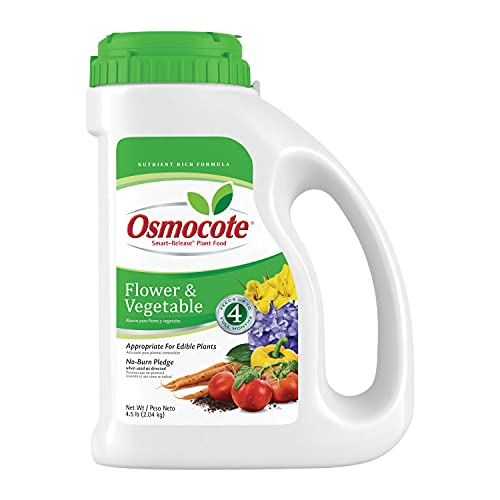
Osmocote’s slow-release technology uses a semi-permeable resin coating that meters out nutrients based on soil temperature, providing a steady feed for up to four months. This makes it one of the most convenient options for established perennial beds — you apply it once in spring and the plants receive consistent nutrition through the main growing season without weekly mixing or reapplying. The formula is designed to promote vigorous top growth and strong root development simultaneously.
Nursery professionals frequently recommend Osmocote because it reliably does not burn roots, even when applied at the recommended rate. One verified reviewer noted they are on their third bag and have never seen any leaf scorch or fertilizer burn. The 4.5-pound bag covers a substantial area, making it a budget-friendly choice for gardeners managing large flower borders with minimal labor input.
The powder form settles into the soil well, but some users caution that the recommended dosage can be slightly heavy for small containers or compact perennial pockets. If you are using it in raised beds or pots, consider reducing the application rate by about 25 percent to avoid overfeeding in confined root zones.
What works
- Single application lasts 4 months
- Does not burn plants when used correctly
- Excellent coverage per bag
What doesn’t
- Synthetic formulation not suited for organic gardens
- Dosage may be too high for small containers
5. Maxsea All Purpose Plant Food 16-16-16, 1.5 lb

Maxsea stands out because its seaweed granules contain over 60 naturally occurring elements that support plant biochemistry beyond the primary NPK framework. The 16-16-16 ratio includes a full spectrum of secondary nutrients including sulfur, boron, copper, iron, manganese, molybdenum, and zinc. This broad micronutrient profile makes it particularly effective for perennials growing in soil that may be depleted from years of continuous planting.
Owner results are dramatic — one gardener reported 6-foot pepper plants, eight-foot-plus tomatoes, and tripled blueberry size after switching to Maxsea. For flowers, users note that hanging baskets and ferns respond with fuller growth and more dense bloom sets. The powder mixes easily in water, though a few users mention that the solution can leave a slight sediment if not shaken thoroughly before each watering.
The 1.5-pound bag is smaller than many competitors, so frequent users with large beds may need to stock up on multiple bags. Additionally, the balanced 16-16-16 ratio is high in nitrogen relative to bloom-specific feeds, so monitor your perennials for excessive leaf growth at the expense of buds.
What works
- 60+ trace elements from seaweed
- Proven results on flowers and fruiting plants
- Suitable for hydroponic and soil systems
What doesn’t
- Sediment can settle; needs thorough shaking
- Small bag size for the price
6. Espoma Organic Plant-tone 5-3-3, 4 lb (Pack of 2)

Espoma Plant-tone is an all-purpose organic formula with a 5-3-3 NPK ratio that leans slightly higher in nitrogen while still supporting bloom development through its Bio-tone microbial inoculant. The higher nitrogen content makes it especially useful in early spring when perennials are emerging and need a green-growth push before the flower-initiation phase. The organic ingredients break down slowly, creating a nutrient reservoir that feeds plants for several weeks.
Gardeners who use Plant-tone twice a year — once in spring and again in early fall — report dramatic improvements in landscaping foliage and flower output. One reviewer noted that the immediate response in spring growth is “truly gratifying” and that the product is simple to apply since it requires no measuring or mixing. The pack of two 4-pound bags provides excellent coverage for medium to large flower beds.
The main limitation is that the 5-3-3 ratio is not optimized for maximum bloom production the way a 3-4-5 or 2-6-4 formula would be. If your primary goal is to maximize flower number rather than overall plant size, you may get better results with a bloom-specific product. The organic manure smell is also noticeable during application.
What works
- Two-pack provides great value for larger gardens
- Bio-tone microbes improve soil health
- Works on flowers, vegetables, trees, and shrubs
What doesn’t
- Nitrogen-heavy ratio for bloom-focused gardens
- Notable organic manure smell when fresh
7. Neptune’s Harvest Rose & Flowering Fertilizer 2-6-4, 18 oz
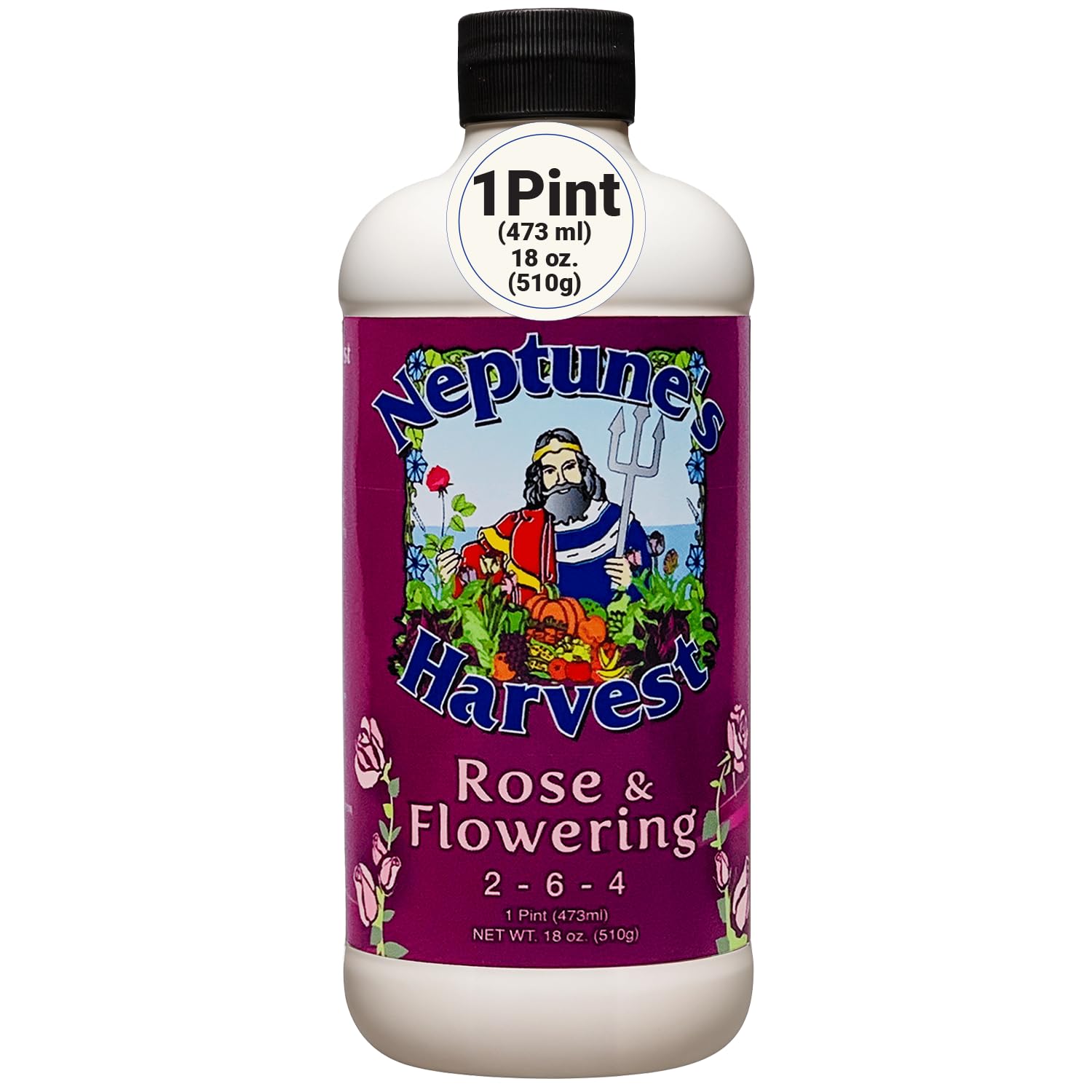
Neptune’s Harvest uses a 2-6-4 NPK analysis that is heavily skewed toward phosphorus and potassium, making it one of the most bloom-focused liquid organic fertilizers on the market. The ingredients list includes fish, seaweed, molasses, humic acids, yucca extract, biological microbes, and liquid calcium. This complex formulation not only feeds the plant directly but also raises Brix sugar levels in the sap, which naturally deters insect feeding without synthetic pesticides.
Growers using this product report measurable yield increases — one indoor gardener harvested 102 bell peppers from nine plants after switching to this feed. For flower beds, the liquid formulation allows both root drench and foliar feeding, giving you two avenues to correct a bloom deficiency quickly. The 18-ounce pint is small but highly concentrated; the label recommends 1 ounce per gallon for most outdoor perennials.
The fish-based formula produces a noticeable oceanic smell that persists until the solution dries on the soil or leaves. While the smell fades quickly outdoors, it is less pleasant for indoor potting applications. The small bottle size means you will need to repurchase frequently if you manage a large garden.
What works
- Bloom-optimized 2-6-4 NPK ratio
- Raises Brix levels to repel insects naturally
- Works as soil drench and foliar spray
What doesn’t
- Fish odor lingers until dry
- Small 18-ounce bottle requires frequent repurchase
Hardware & Specs Guide
Water Soluble vs. Granular
Water-soluble powders like the Ferti-lome and Maxsea products dissolve instantly in water and deliver nutrients directly to the root zone within hours. They give you precise control over feeding frequency and concentration. Granular products — both organic and slow-release synthetics — break down gradually through microbial activity or temperature-dependent coatings. Granules require less frequent application but need consistent soil moisture to activate properly.
NPK Ratio and Perennial Physiology
Perennials store energy in their roots over winter, so feeding them a fertilizer with too much nitrogen late in the season can push tender new growth that gets damaged by frost. Bloom-focused ratios with higher phosphorus (the middle number) and lower nitrogen (the first number) signal the plant to direct energy into bud formation rather than leaf production. For spring feeding, a ratio where the first number is 3 to 5 and the last number is 4 to 6 works well for most herbaceous perennials.
FAQ
Should I stop feeding perennials in late summer?
Can I use a tomato fertilizer on perennial flowers?
Final Thoughts: The Verdict
For most gardeners, the fertilizer for perennial flowers winner is the Espoma Flower-tone 3-4-5 because its bloom-focused NPK ratio, added calcium, and OMRI-listed organic ingredients give perennials exactly what they need without pushing excessive foliage. If you want a single spring application that feeds for four months with no mixing, grab the Osmocote Flower & Vegetable. And for the highest certified organic purity with proven results on roses, nothing beats the Dr. Earth Total Advantage.