
If you are tired of weeds popping back through the gravel driveway, fence line, or pasture within weeks of a spray, your solution is chemical persistence. A standard contact killer vaporizes top growth; a true long-term formula prevents that same root system from regenerating for an entire season or more. The difference lies in the active ingredient’s residual soil activity and the concentration you apply.
I’m Rikta — the co-founder and writer behind Lawn Gear Lab. I spend my time cross-referencing herbicide labels, comparing active-ingredient half-lives, and analyzing months of owner feedback to find which concentrates actually deliver season-long suppression without needing constant re-application.
Buying the wrong bottle wastes time and money. This guide breaks down the most effective formulations — from pre-emergent barriers to systemic, root-absorbed poisons — so you can choose the best long-term weed killer for your specific property and weed pressure.
How To Choose The Best Long-Term Weed Killer
Selecting a season-long herbicide is not about picking the strongest-smelling bottle. You have to match the active ingredient’s mode of action to your specific weed type and the surface you are treating. A product that sterilizes gravel will kill a prized flower bed. A pasture-safe formula may not touch established poison ivy.
Active Ingredient and Residual Activity
The core of long-term control is a chemical that stays active in the soil for weeks or months after application. Glyphosate offers zero soil residual (it deactivates on contact with dirt). Prodiamine and indaziflam create a chemical barrier that stops germinating seeds for up to six months. Triclopyr and aminopyralid provide extended systemic action in woody plants and can suppress root regrowth for a full growing season.
Application Surface and Selectivity
Non-selective formulas such as high-concentration glyphosate kill any green tissue they touch, making them ideal for driveways, fence lines, and total vegetation control. Selective herbicides like MSMA and 2,4-D kill broadleaf weeds and grasses while leaving established turf alive. Using the wrong selectivity type on a lawn will either waste the product or destroy the grass.
Concentrate Strength and Mixing Ratio
Bulk concentrates (1-gallon or 2.5-gallon jugs) offer far lower cost per treated acre than ready-to-use spray bottles. A product like RM43 at 43% glyphosate covers approximately 17,000 square feet per gallon of concentrate. Compare the ounces of active ingredient per gallon of finished spray, not just the bottle price, to find true value.
Quick Comparison
On smaller screens, swipe sideways to see the full table.
| Model | Category | Best For | Key Spec | Amazon |
|---|---|---|---|---|
| Corteva Remedy Herbicide | Post-Emergent | Woody brush & saplings | Triclopyr concentrate | Amazon |
| RM43 Extended Control | Total Vegetation | Gravel & fence lines | 43% Glyphosate | Amazon |
| Roundup Pro Concentrate | General Purpose | Large area knockdown | 2.5 gal concentrate | Amazon |
| Prodiamine 65 WDG | Pre-Emergent | Season-long prevention | 65% Prodiamine | Amazon |
| Remedy Specialty (Ultra) | Pasture & Brush | Rangeland & fence rows | Triclopyr 1 gal | Amazon |
| Dow Milestone Specialty | Selective Pasture | Invasive trees & thistles | Aminopyralid 32 oz | Amazon |
| Target 6 Plus MSMA | Turf Selective | Dallisgrass & nutsedge | MSMA 48.2% | Amazon |
In‑Depth Reviews
1. Corteva Agriscience Remedy Herbicide

Corteva’s Remedy is built around triclopyr, a systemic herbicide that travels through the vascular system of woody plants and kills the root structure. Owners report it eliminates saplings, poison ivy, and palm trees with a single broadcast application — something general-purpose glyphosate cannot do because it only affects green foliage. The 1-acre coverage per jug makes it a powerful option for property owners managing fence lines and light woodland.
Users note it is ineffective on dandelions and shallow-rooted broadleaf weeds that require a different chemistry. However, for targeting mesquite, multiflora rose, and hardwood brush, the feedback is near-unanimous: a properly timed spring application provides season-long suppression without the need for monthly re-sprays. Mixing a small amount of detergent or diesel (for basal bark treatment) improves adherence to waxy leaves and bark.
The customer consensus emphasizes that triclopyr carries significant runoff risk — it will kill ornamental shrubs and trees if applied near their root zones. This is not a spot-spray for the flower bed; it is a heavy-duty tool for non-crop areas where total brush eradication is the goal. The relatively low odor compared to older triclopyr formulations is a welcome improvement for backpack sprayer work.
What works
- Kills woody brush and trees at the root with residual suppression.
- Cost-effective concentrate when compared to retail brush killer sprays.
- Low odor, mixes easily with water or diesel for basal applications.
What doesn’t
- Ineffective on common lawn broadleaf weeds like dandelions.
- High phytotoxicity — will damage desirable trees and shrubs if runoff occurs.
2. RM43 Concentrated Extended Control Weed Killer

RM43 markets itself as a season-long total vegetation control, and its 43% glyphosate content is one of the highest concentrations available without a commercial applicator license. The formula also contains a soil-residual component that prevents regrowth from seed for up to 12 months after application. Users managing gravel driveways, chain-link fence lines, and barn perimeters report that a single annual spray keeps surfaces weed-free.
The practical feedback shows a split on speed of action. Several owners on large acreage (4+ acres) mix 8 oz of RM43 with 6 oz of 2,4-D per gallon of water and see dead weeds within 24 hours on hot, sunny days. Others note that at recommended rates, tall, established weeds can take 2.5 weeks to fully brown out. The inconsistency is likely tied to application temperature — the glyphosate uptake slows significantly in cool, overcast conditions.
Owners consistently praise the value proposition. A single gallon of concentrate makes 16+ gallons of finished spray, which is enough to treat an entire suburban driveway and surrounding fence line for months. The primary caution is the non-selective nature: the residual component will create sterile bare ground for nearly a year, so it must never be applied near lawn edges, garden beds, or tree root zones.
What works
- Up to one year of bare-ground control with one application.
- Very high concentration reduces cost per gallon of finished spray.
- Effective on tough perennial grasses and deep-rooted weeds.
What doesn’t
- Speed is temperature-dependent; can take weeks in cool weather.
- Completely non-selective — kills any green tissue and soil life.
3. Roundup Pro Concentrate (2.5 gal)
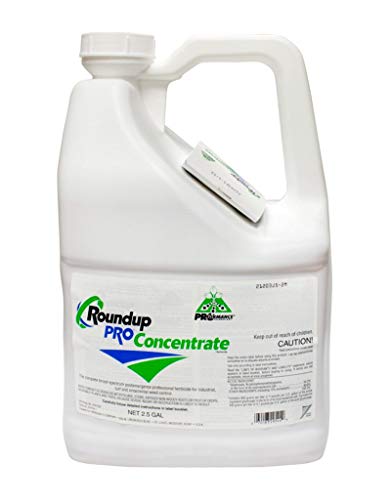
This is a commercial-grade formulation of glyphosate designed for large-scale knockdown prior to replanting or renovation. The 2.5-gallon jug yields up to 150 gallons of regular-strength spray (or 30 gallons of super-strength for tough brush), making it the highest raw coverage in this list. Users who contract spray for multiple properties or manage large pastures find the per-acre cost far lower than any home-center jug.
Owner feedback repeatedly mentions speed: at 2.5–3 oz per gallon, visible wilting occurs in 3–4 days, with full kill within a week during growing-season temperatures. That is significantly faster than some consumer-grade glyphosate mixes that take two weeks. The caveat is the weight — a full jug approaches 30 pounds, and owners strongly advise purchasing a 63mm threaded pump for dispensing rather than attempting to pour.
The product is restricted from sale in Wisconsin and New Jersey, so prospective buyers in those states must check local supplier channels. Several long-term users report that a single spring tank mix leaves almost no weeds through the entire summer, though the lack of soil residual means it does not prevent seed germination. For pre-planting bed prep or fencerow clearing before mulching, this is a professional-tier choice.
What works
- Extremely fast visual results — 3–4 days to wilting.
- Unbeatable coverage cost per acre at this concentration.
- Trusted Roundup formulation consistency across decades.
What doesn’t
- Heavy jug requires a pump dispenser; no easy pour spout.
- No soil residual — does not prevent new seed germination.
4. Quali-Pro Prodiamine 65 WDG (5 lbs)
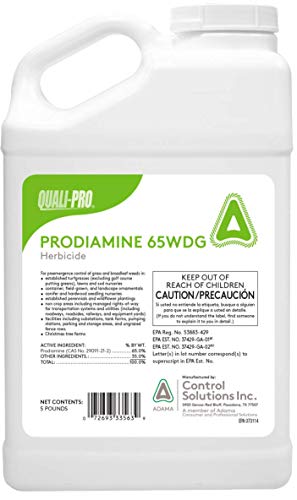
Prodiamine is a pre-emergent that works by disrupting root cell division in germinating weed seeds — it does not kill existing vegetation. This 65% WDG (wettable dispersible granule) formulation from Quali-Pro is a professional-grade generic equivalent to Barricade. Users who time a spring application (early March in Zone 7) report absolutely zero crabgrass, dandelions, or clover breakthrough until late summer, when a light reapplication extends coverage through frost.
The five-pound bag covers a variable area depending on the target weed and rate. At the standard broadcast rate of 0.185 oz per 1,000 sq ft, this bag treats over 43,000 sq ft — more than enough for an entire suburban lawn. Owners highlight the dramatically lower cost per application compared to retail granular pre-emergents. The active ingredient stays active in the soil for up to six months, provided it is watered in within 72 hours after spray application.
The feedback includes an important rotation warning: several experienced lawn managers advise alternating Prodiamine with a dinitroaniline product seasonally to prevent weed resistance from building up. A small subset of users report slower grass growth in treated areas — this is a known phenomenon with root-mitosis inhibitors and generally resolves once the chemical degrades.
What works
- Full-season weed prevention from a single well-timed application.
- Covers over 40,000 sq ft — excellent value per square foot.
- Works on both grassy and broadleaf weed seeds.
What doesn’t
- Requires precise timing before seed germination (does not kill live weeds).
- Can temporarily slow desirable turf growth at high rates.
5. Remedy Specialty Herbicide (Ultra) — 1 Gal
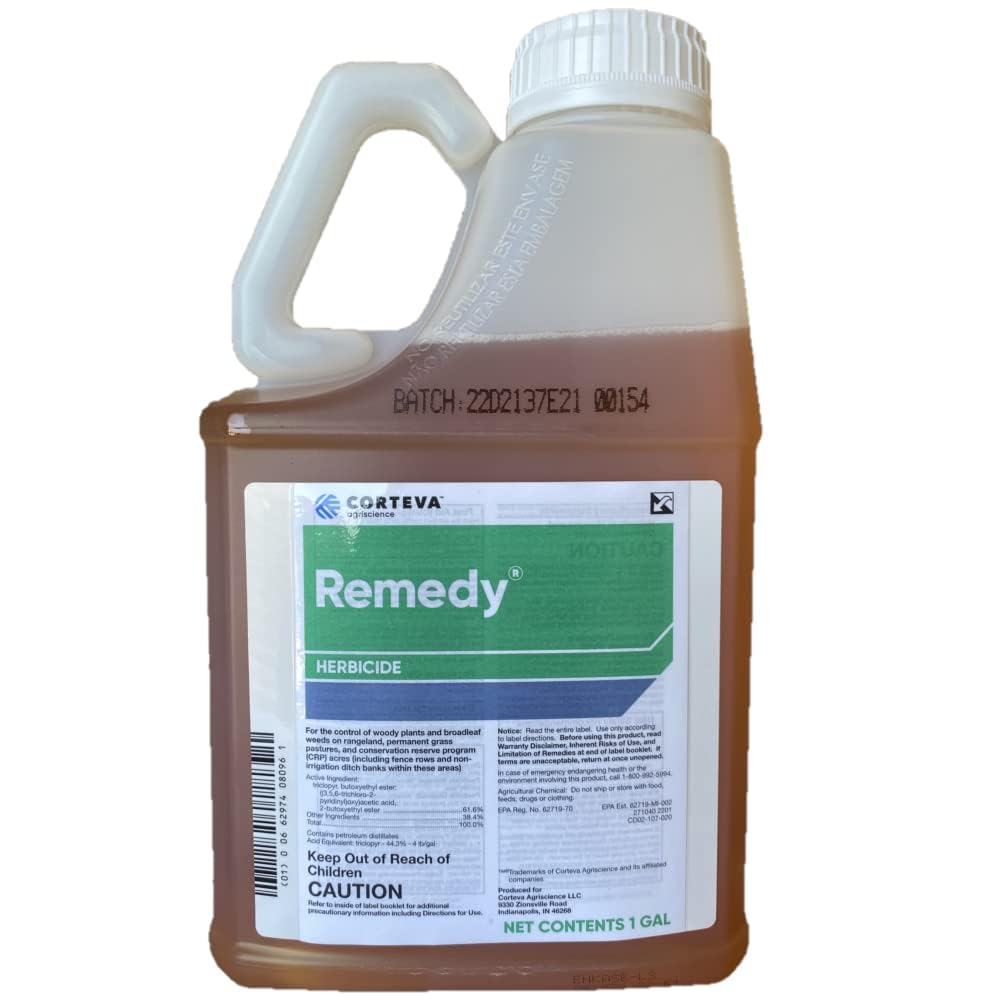
This version of Remedy (often called Remedy Ultra) is the same triclopyr active ingredient as the standard Corteva product, but labeled specifically for rangeland, pasture, and fence-line brush control. The 1-gallon jug is optimized for tank-mixing with GrazonNext or ForeFront HL for broader-spectrum weed control. Users report exceptional results on cogon grass, blackberry brambles, and honey locust — species that shrug off glyphosate.
Several Florida lawn professionals use this product as part of their commercial rotation, noting it kills tough weeds without harming established St. Augustine or Bermuda grass when applied at label rates. The key differentiator from the standard Remedy is the marketing emphasis on pasture safety — the formulation is designed to be safe around children and pets once the spray has dried, per the label.
The most common complaint is the upfront cost, which sits on the higher end of this list. However, owners who use it for basal bark treatments (mixing 1 part herbicide with 3 parts diesel) report near-100% success preventing resprouting from cut stumps. For landowners fighting invasive trees on a multi-acre scale, the per-tree cost is significantly lower than mechanical removal.
What works
- Excellent selective brush control without killing pasture grasses.
- Basal bark treatment prevents resprouting from stumps.
- Low-odor formula improves comfort during backpack spraying.
What doesn’t
- Expensive per jug — high initial investment.
- Less effective on soft-tissue weeds and annual broadleaf species.
6. Dow Milestone Specialty Herbicide (32 oz)

Milestone’s active ingredient, aminopyralid, is a pyridine carboxylic acid herbicide that provides systemic control of broadleaf weeds and woody plants while leaving grasses untouched. The 32-ounce bottle covers 4 to 7 acres, making it exceptionally concentrated. Users in Hawaii fighting invasive albizia trees have found this to be the single most effective chemical — a few drops applied to a machete cut around the trunk causes the entire tree to defoliate and die within weeks.
Pasture managers rate this herbicide highly for controlling tropical soda apple, horse nettle, and Canada thistle. The grasses in the treated area remain healthy, which is critical for maintaining grazing land. The label restricts use to rangeland, permanent grass pastures, CRP acres, and non-cropland areas — it is not approved for residential lawns, so homeowners should verify their application site.
The shelf life is listed at 3–5 years stored in a cool, dry place, which is longer than most liquid herbicides. This makes it a practical purchase for landowners who need an occasional spot-treatment solution rather than a seasonal broadcast program. A small number of users note it is less effective on established grass weeds compared to MSMA or glyphosate-based products.
What works
- Extremely high concentration — 32 oz covers up to 7 acres.
- Selective for pastures — kills broadleaf weeds without damaging grass.
- Excellent results on invasive tree species via cut-stump application.
What doesn’t
- Not labeled for residential lawn use.
- Less effective on grassy weeds and annual sedges.
7. Target 6 Plus MSMA 48.2% (2.5 Gal)

MSMA (monosodium acid methanearsonate) is an organoarsenical herbicide that has been a go-to tool for golf course superintendents and sod farms for decades. Target 6 Plus contains 48.2% MSMA and excels at selective grassy weed removal in established turf, specifically targeting dallisgrass, crabgrass, johnsongrass, and nutsedge. Owners of Japanese zoysia lawns report it knocks out heavy dallisgrass infestations with remarkable precision.
The chemistry is potent and fast: one owner purchased a jug five years ago and is still using it for spot treatments, which speaks to both the concentration and the longevity of the chemical stored properly. Users constantly stress the importance of precise mixing — 2 oz per gallon for general applications — because overdosing can stress Bermuda grass into dormancy, especially during drought conditions. The product is thick and high-quality, manufactured in Israel.
This is not a general-purpose weed killer. MSMA is only appropriate for turf professionals or experienced homeowners who understand grass selectivity and wash-off timing. Its use is restricted in certain states and is not approved for residential lawns in some regions, so label compliance is critical. For the specific job of removing stubborn grassy weeds from warm-season turf, nothing in this list works faster.
What works
- Incredibly fast visual results on dallisgrass and nutsedge.
- Extremely concentrated — one jug lasts for years of spot treatments.
- Selective for turf: does not kill warm-season lawn grasses at correct rates.
What doesn’t
- State-level restrictions — check local law before purchase.
- Overdose risk is high; improper mixing causes turf burn.
Hardware & Specs Guide
Active Ingredient Half-Life
Residual soil activity drives long-term control. Glyphosate has a soil half-life of 24–60 hours — it deactivates almost immediately, offering no future protection. Prodiamine persists 3–6 months in the soil. Triclopyr lasts 2–9 months depending on soil moisture. Aminopyralid can remain active in soil for 2–4 months and in plant tissue for up to a full growing season. Choose a chemistry whose half-life matches your weed pressure cycle.
Application Method and Tank Mixing
Bulk concentrates require a sprayer with consistent agitation. WDG (wettable dispersible granule) formulations like Prodiamine 65 WDG must stay suspended in the tank — use a battery-powered backpack sprayer or a hand-pump with constant stirring. Triclopyr products mix well with non-ionic surfactant for leaf adhesion. For basal bark treatment, triclopyr should be mixed with diesel fuel at a 1:3 ratio. Never mix glyphosate with 2,4-D unless the label explicitly allows it, as certain combinations reduce efficacy.
FAQ
How long does a single application of Prodiamine keep weeds away?
Can I use triclopyr products on my lawn without killing the grass?
Final Thoughts: The Verdict
For most gardeners, the best long-term weed killer winner is the Corteva Agriscience Remedy Herbicide because it kills woody brush at the root with season-long suppression, without requiring multiple applications. If you need total bare-ground sterilization for gravel and fencerows, grab the RM43 Concentrated Extended Control. And for season-long seed prevention in an established lawn, nothing beats the Quali-Pro Prodiamine 65 WDG.