
A perimeter treatment that only kills the workers you see guarantees a return visit; the real target is the queen, and a correctly formulated granular bait or contact spray is the only reliable way to reach her without drenching your yard in broad-spectrum poisons.
I’m Rikta — the co-founder and writer behind Lawn Gear Lab. I’ve spent hundreds of hours cross-comparing active ingredients, residual timelines, and application methods in the outdoor pest-control category, studying product data sheets and synthesizing real owner feedback so you can match the right killer to your specific ant species and property size.
This guide breaks down the seven top contenders by formulation strength, mode of action, and coverage area to help you choose the best outdoor ant killer for a truly colony-free yard.
How To Choose The Best Outdoor Ant Killer
Selecting an ant killer for outdoor use means matching the formulation to the specific ant type, the size of your yard, and your tolerance for reapplication. The three pillars below govern whether a product truly eliminates a colony or merely thins the visible foragers for a week.
Formulation: Bait vs. Contact Spray vs. Granule
Baits — liquid or granular — rely on a delayed-action poison that workers carry back to the nest, killing the queen and the brood. This is the only method that ends a colony permanently. Contact sprays kill on direct hit but leave the queen untouched; they work best as a barrier around structures to prevent entry. Broadcast granules combine both strategies: they kill on contact in the soil and can act as a slow-acting bait if ants ingest the particles.
Active Ingredient and Speed of Kill
Indoxacarb (found in premium granular baits) is non-repellent and metabolically activated inside the insect, making it highly effective at colony transfer. Bifenthrin provides fast knockdown but repels ants from the treated zone, which can prevent bait uptake. Borax-based liquid baits are inexpensive and reliable for sweet-eating ants but require patience as the poison spreads through the colony over several days.
Residual Duration and Coverage Area
A product rated for 3 months of residual activity saves labor over a season. Talstar PL granules, for example, boast the longest residual among broadcast options — up to 4 months. Coverage area matters too: a 20-lb bag treating 25,000 sq. ft. is appropriate for large properties, while a 1-lb shaker bottle suits perimeter spot treatments around a single-family home.
Quick Comparison
On smaller screens, swipe sideways to see the full table.
| Model | Category | Best For | Key Spec | Amazon |
|---|---|---|---|---|
| Talstar PL Granules | Broadcast Granule | Longest residual barrier | 25 lb covers 10,000 sq ft | Amazon |
| Advion Insect Granular Bait | Granular Bait | Colony elimination | 0.22% Indoxacarb | Amazon |
| BioAdvanced Complete Brand Insect Killer | Broadcast Granule | Large lawn coverage | 20 lb treats 25,000 sq ft | Amazon |
| TERRO T1700 Outdoor Ant Killer Spray | Contact Spray | Instant knockdown on patios | Sprays 10–15 ft | Amazon |
| Amdro Ant Killer for Outdoor Home Perimeter | Granular Bait | Whole-yard perimeter barrier | Hydramethylnon, controls 25 ant species | Amazon |
| Sevin Garden Perimeter Insect Granules | Broadcast Granule | Vegetable garden perimeter | Kills 100+ insects | Amazon |
| Spectracide One Shot Fire Ant Killer | Granular Bait | Fire ant mound treatment | Controls 3 months | Amazon |
In‑Depth Reviews
1. Talstar PL Granules
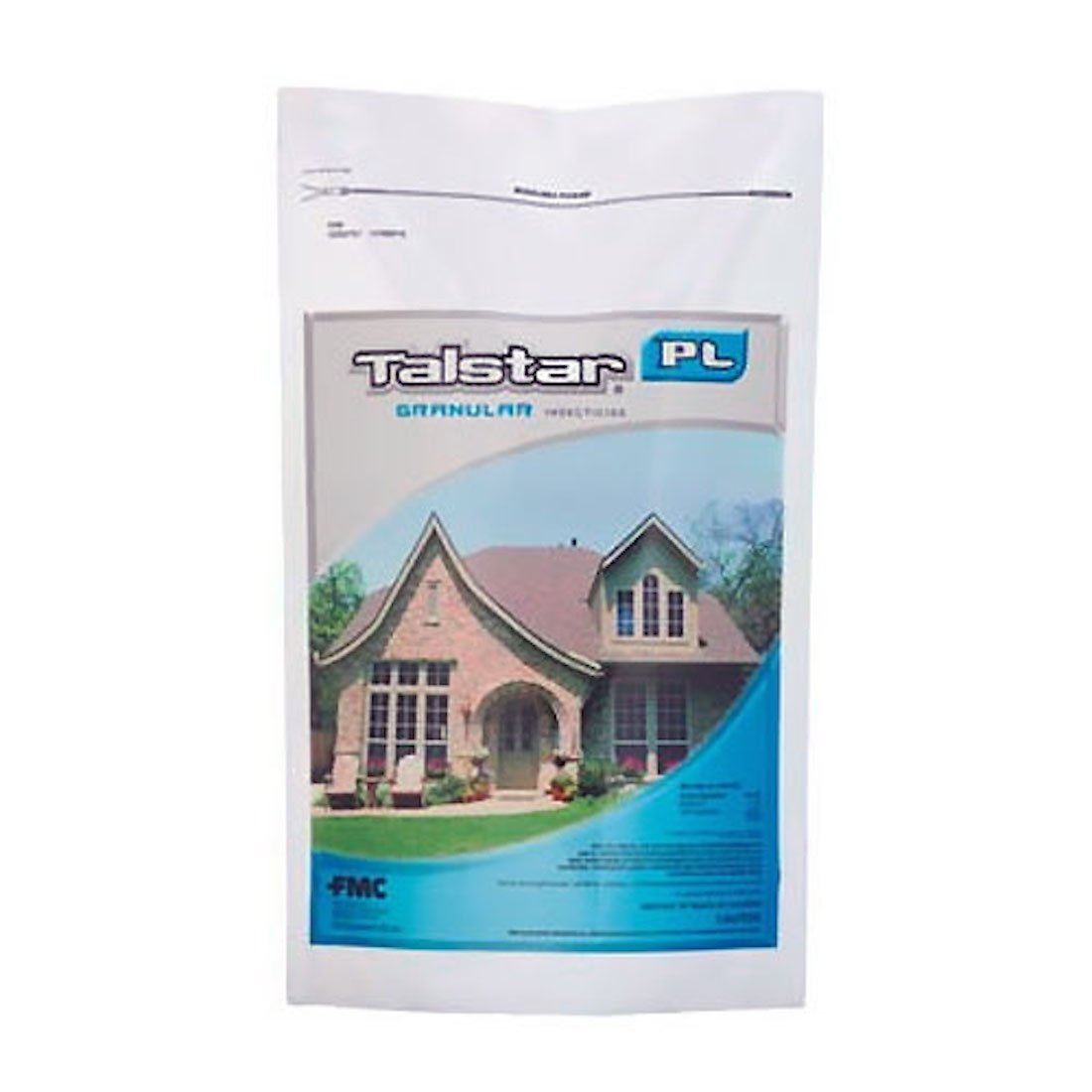
Talstar PL stands apart for its sand-core granule structure paired with bifenthrin, delivering the longest residual of any granular product on the market — a full 2 to 4 months from a single broadcast. Users applying it around perimeters and in large open areas report ant activity dropping noticeably within the first week and staying suppressed through an entire season without repeat dosing.
The granules penetrate mulch and dense grass without requiring immediate watering, which simplifies timing for homeowners who cannot guarantee rainfall after application. Per the EPA-registered label, Talstar also controls fleas, ticks, mole crickets, and other listed lawn pests, making it a multi-pest solution for those who want one product to handle a broad slice of the lawn insect spectrum.
Some users note that Talstar’s repelling property — typical of bifenthrin — can prevent bait uptake if ants are already foraging nearby, so the granule works best as a proactive barrier rather than a reactive mound treatment. The up-front cost is higher than commodity brands, but the extended residual reduces total annual labor and product expense.
What works
- Residual lasts up to 4 months even through rain.
- Broad-spectrum control includes fleas and ticks.
- Penetrates thick mulch without watering.
What doesn’t
- Higher price point than most granular competitors.
- Repellent nature may reduce bait effectiveness.
2. Advion Insect Granular Bait

Advion is formulated by Syngenta with 0.22% indoxacarb, a non-repellent active ingredient that ants cannot detect as a threat. Workers pick up the granules and transport them directly to the nest, where the MetaActive effect activates the poison only after ingestion — a mechanism Syngenta says makes it less likely to affect non-target organisms compared to contact insecticides.
Owner reports consistently describe ants swarming the bait within hours and complete colony disappearance in 2 to 7 days, depending on species. The shaker bottle design makes perimeter banding or spot treatment around foundations and garden edges simple, and the 1-lb size is adequate for a standard suburban lot without leaving leftover product to degrade.
The granular format requires dry conditions during application for optimal uptake, and some users found that heavy rain within 24 hours reduced efficacy. However, the speed of colony kill and the professional-grade active ingredient make this the go-to choice for homeowners who want a single, decisive treatment rather than a season-long maintenance program.
What works
- Non-repellent formula ensures colony transport.
- Visible results in 2 days for most ant species.
- Safe for use near gardens and lawns.
What doesn’t
- Can wash away if heavy rain occurs soon after application.
- Small container size not ideal for large properties.
3. BioAdvanced Complete Brand Insect Killer
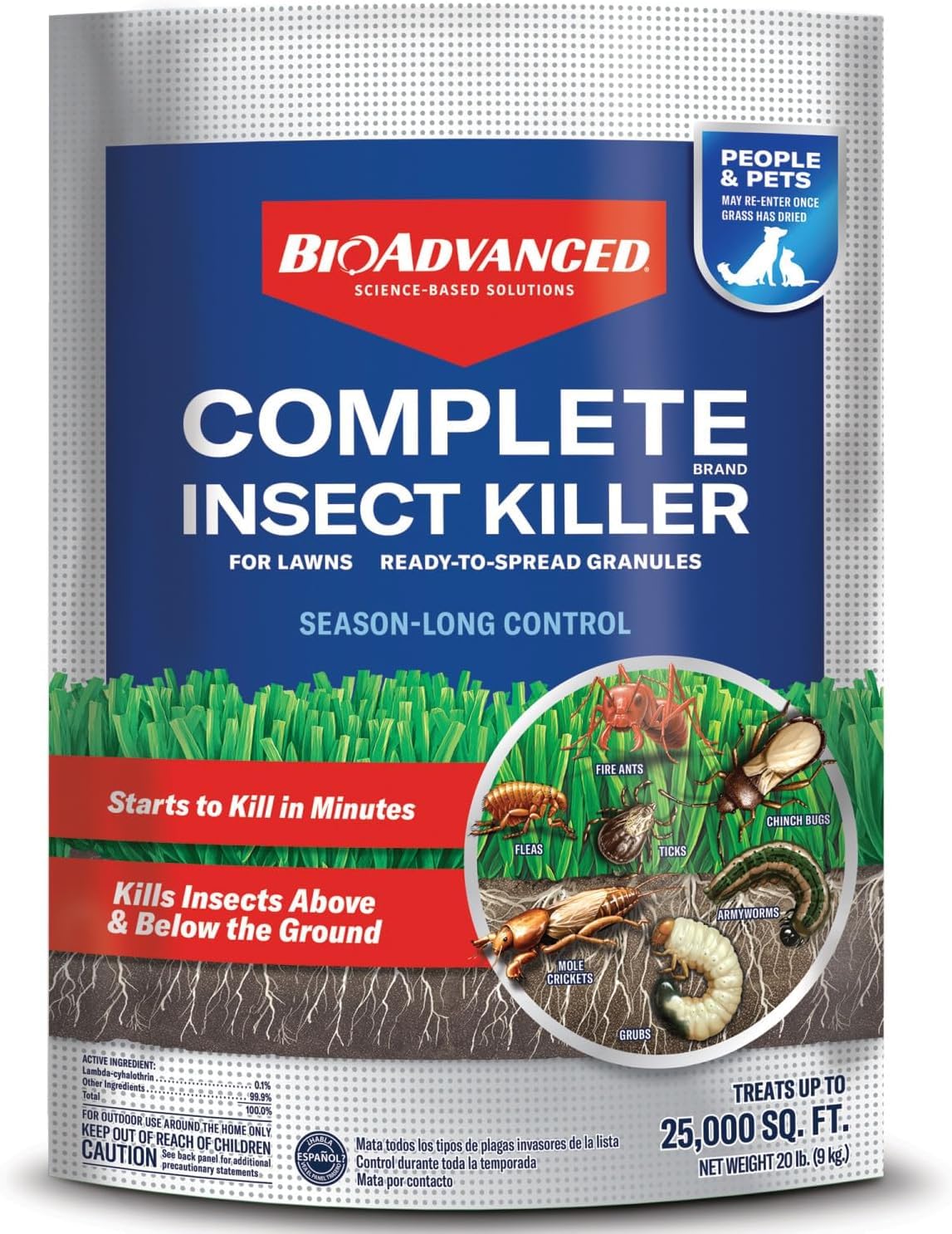
BioAdvanced Complete Brand Insect Killer delivers the highest coverage-per-dollar ratio in this roundup: a 20-lb bag treats up to 25,000 square feet, making it the obvious choice for owners of half-acre-plus lawns. The fast-acting formula kills ants, fleas, ticks, chinch bugs, and grubs on contact, then provides season-long residual protection when applied with a broadcast or drop spreader.
Users in warm climates like South Florida report roughly 3 months of effective control on a single application, and the granular format integrates easily into an existing fertilization schedule. The product is also labeled for direct fire-ant mound treatment and perimeter foundation bands, offering flexibility for spot and broadcast use in one bag.
Some owners note that the product does not suppress fleas as effectively as it handles ants and grubs, and stink bugs appear unaffected by the active ingredient. The 20-lb bag requires a spreader for even coverage, which may be an additional purchase for homeowners who do not already own one.
What works
- Massive 25,000 sq ft coverage per bag.
- Kills on contact and provides season-long control.
- Effective on fire ant mounds and lawn perimeters.
What doesn’t
- Flea suppression is weaker than ant control.
- Stink bugs appear resistant to the formula.
4. TERRO T1700 Outdoor Ant Killer Spray
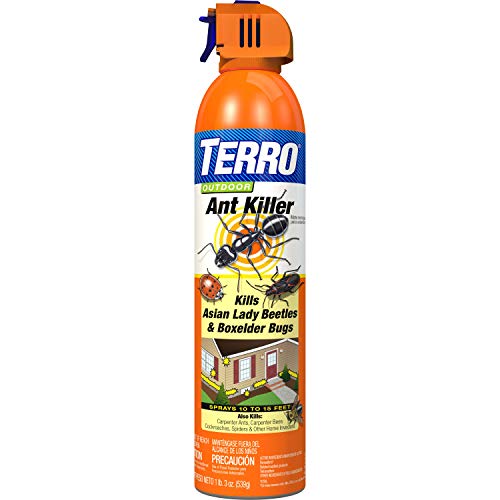
The TERRO T1700 delivers instant knockdown for visible ant trails, nests, and entry points around patios, driveways, and home foundations. Its aerosol spray reaches 10 to 15 feet, allowing users to treat cracks and crevices without bending over or getting close to the nest. The formula also kills carpenter bees, Asian lady beetles, boxelder bugs, and spiders.
Ranch and rural property owners report using the T1700 to spray jack pads and tire areas on RVs, effectively stopping ants from boarding the coach. The adjustable spray nozzle provides a fine mist for broad coverage or a concentrated stream for targeted mound hits, which matters when fast action is needed on visible infestations.
The aerosol can has a known design flaw — approximately 2 to 3 ounces of liquid typically remain trapped after the propellant is exhausted, and the sprayer mechanism can be frustrating to operate. Because this is a contact killer rather than a bait, it will not eliminate the colony unless the queen is directly sprayed, making it better suited for immediate relief than long-term eradication.
What works
- Fast knockdown on contact for visible ants.
- Long 10–15 ft reach for hard-to-reach areas.
- Effective on carpenter bees and boxelder bugs.
What doesn’t
- Does not eliminate underground colony.
- Propellant leaves product unreachable in can.
5. Amdro Ant Killer for Outdoor Home Perimeter

Amdro Ant Killer for Outdoor Home Perimeter is built around hydramethylnon, a delayed-action bait toxicant that foraging workers mistake for food and carry back to the nest before it takes effect — the same non-repellent principle behind Advion’s indoxacarb, packaged instead in a ready-to-use shaker canister meant for banding around the foundation. The label lists control of 25 listed ant species, including odorous house ants, pavement ants, Argentine ants, and carpenter ants, with most owners seeing noticeably fewer ants within about a week as the colony collapses.
Application is simple: sprinkle a band of granules around the foundation, fence lines, and landscaped beds during cool morning or evening hours when ants are actively foraging. One application is rated for up to three months of perimeter protection, making it a lighter-duty complement to a full broadcast granule like Talstar for owners who only need to secure the home’s immediate perimeter rather than the whole lawn.
Because it works as a bait rather than a barrier, Amdro will not deliver the instant knockdown of a contact spray, and the label specifically cautions against applying when the ground or grass is wet, when rain is expected within 24 hours, or when temperatures are below 50°F — all conditions that reduce foraging activity and cut into bait uptake.
What works
- Non-repellent hydramethylnon bait targets the colony, not just visible workers.
- Labeled for 25 ant species for broad perimeter coverage.
- Up to 3 months of protection from a single application.
What doesn’t
- No instant knockdown — colony effects take days to appear.
- Application timing is weather-sensitive (avoid wet soil, rain, or cold).
6. Sevin Garden Perimeter Insect Granules
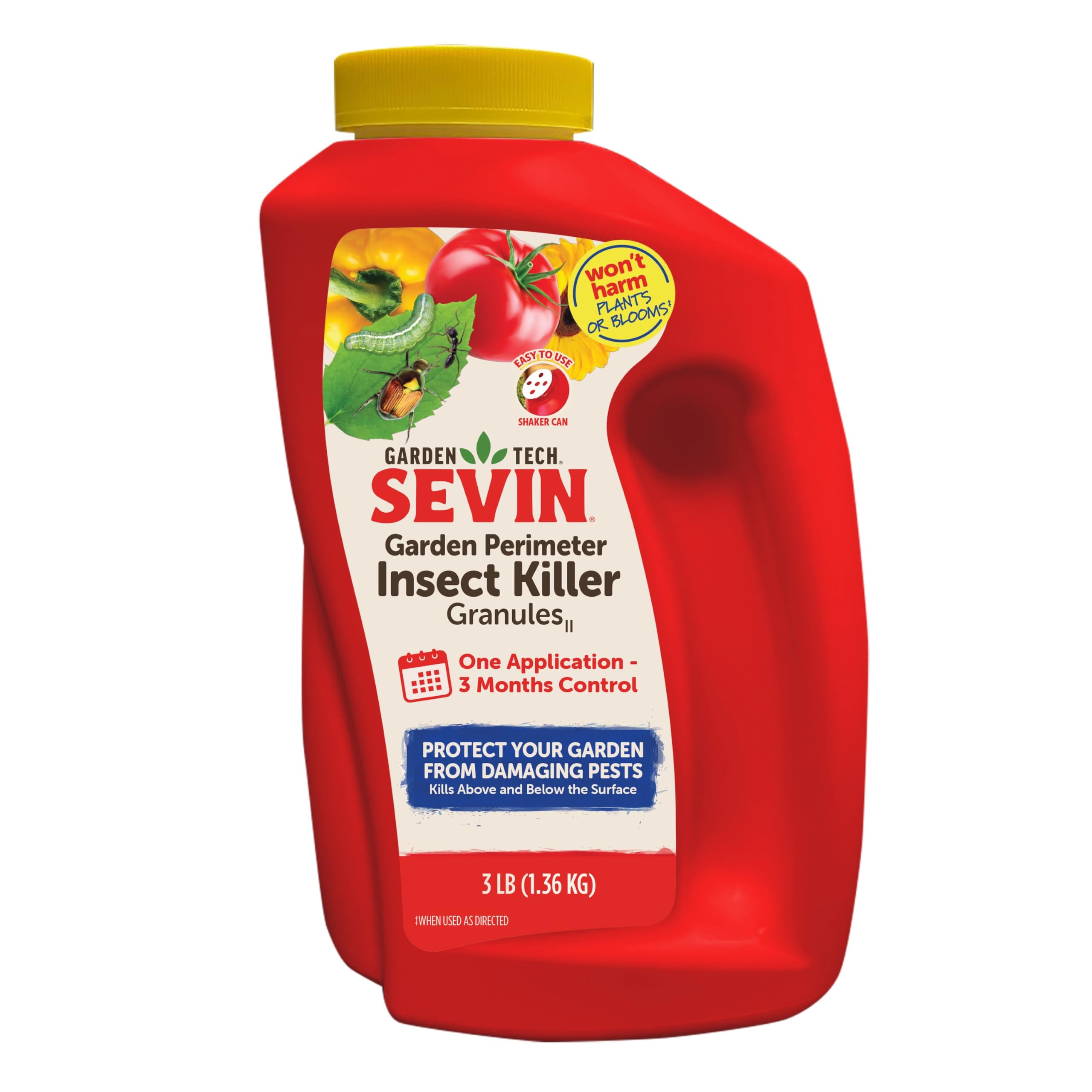
Sevin Garden Perimeter Granules are a low-cost entry point for homeowners managing mixed insect pressure around fruit and vegetable gardens, ornamental shrubs, and flower beds. The formulation kills over 100 listed insect species both above and below the soil surface, with a single application providing up to 3 months of protection against ants, aphids, and other common garden pests.
Gardeners living in wooded areas report that a yearly treatment with Sevin solves their seasonal ant problem, protecting cherry trees and raised beds from aphid-tending ant colonies. The 3-lb bag is compact enough for small urban lots and can be applied by hand or with a small hand-held spreader, requiring no heavy equipment.
The product is a general-purpose insecticide, meaning it will also kill beneficial insects like pollinators and predatory beetles if applied directly to blooms or active feeding areas. The 3-lb bag size is too small for broadcast treatment of large lawns, limiting its use to targeted perimeter bands and spot treatments in garden beds.
What works
- Very affordable for small garden perimeters.
- Kills over 100 insect types below and above ground.
- Provides 3 months of residual control.
What doesn’t
- Will harm beneficial insects and pollinators.
- Bag size insufficient for full-lawn broadcast.
7. Spectracide One Shot Fire Ant Killer

Spectracide One Shot is purpose-built for fire ant mounds, using a granular bait that kills the queen and the colony in as little as 48 hours — without any watering-in step. Users simply sprinkle 4 tablespoons around each mound in early morning or late evening when ants are actively foraging, and the delayed-action poison is carried back to the nest by worker ants.
Homeowners across the southern U.S. confirm that one application controls fire ants for a full 3 months, and the large granule size prevents the bait from blowing away in wind, a common issue with finer granular products. The bait is also effective against other ant species, though performance varies depending on the genus and feeding habits.
The product’s single-species focus limits its appeal for homeowners dealing with multiple ant types simultaneously. Users also note that the bait must be placed around, not on, the mound — applying it directly on the disturbed soil triggers a defensive response and the ants will reject the granules entirely.
What works
- Kills fire ant colony in 48 hours.
- No watering necessary after application.
- Large granules resist wind drift.
What doesn’t
- Narrowly focused on fire ants only.
- Requires precise application around — not on — the mound.
Hardware & Specs Guide
Active Ingredient
This is the chemical compound responsible for killing ants. Indoxacarb is a non-repellent that activates after ingestion, making it ideal for colony eradication. Bifenthrin is a repellent contact killer that excels at creating long-lasting barriers but does not promote nest transfer. Borax (sodium tetraborate decahydrate) is a slow-acting stomach poison commonly found in liquid bait stations.
Application Method
Granules require a broadcast or drop spreader for even coverage over large lawns, while shaker bottles allow precise spot treatment around perimeters and individual mounds. Aerosol sprays deliver immediate knockdown for visible trails and nests but cannot reach the queen. Liquid bait stations are pre-filled and ready to place, with no mixing or measuring required.
FAQ
Should I bait or spray for outdoor ants?
How long does it take for granular baits to kill a fire ant colony?
Final Thoughts: The Verdict
For most gardeners, the best outdoor ant killer winner is the Advion Insect Granular Bait because it uses non-repellent indoxacarb to decimate the colony at the source within days. If you want a season-long barrier that also controls fleas and ticks, grab the Talstar PL Granules. And for targeted fire ant mound elimination on a tight budget, nothing beats the Spectracide One Shot.