
Scouting the lawn care aisle for a concentrate that doesn’t just brown the tops but actually kills the root system is the defining challenge of serious weed control. The difference between a product that wastes a weekend and one that clears a property for the season comes down to the active-ingredient profile and the formula’s delivery system — not the marketing on the jug.
I’m Rikta — the co-founder and writer behind Lawn Gear Lab. I’ve spent hundreds of hours parsing label data sheets, cross-referencing active-ingredient concentrations against real weed-species coverage, and stacking owner-reported efficacy across 7 distinct concentrate formulations to build this guide.
Whether you’re reclaiming a fence line from crabgrass or knocking down poison ivy around a cabin foundation, the right herbicide concentrate demands a clear match between your target weed and the chemical profile in the jug.
How To Choose The Best Herbicide Concentrate
Selecting a concentrate is fundamentally different from buying a ready-to-use spray bottle — you’re the one setting the mix ratio, so understanding the chemical backbone and the application parameters is what separates effective control from wasted chemical.
Active Ingredient & Target Spectrum
The active ingredient is the weapon. Glyphosate (typically 41% in commercial-grade jugs) is non-selective and kills almost any vegetation it contacts, making it ideal for bare-ground prep, fence lines, and total renovation. Triclopyr-based concentrates target woody brush, poison ivy, and broadleaf weeds while sparing established grass — that’s the chemistry behind the Roundup Poison Ivy Plus and Trimec formulations. MSMA (monosodium methanearsonate at 48.2%) is a turf-specific tool for nutsedge, dallisgrass, and crabgrass in warm-season lawns, but it requires precise mixing to avoid turf injury.
Coverage Volume & Mixing Precision
Concentrates list coverage in square feet per jug, but the real variable is your own mix rate. A 32-ounce bottle rated for 1,120 square feet demands a very different tank mix than a 2.5-gallon jug rated for commercial-scale application. Check whether the product requires a surfactant — some formulas (like Gly Star Plus) include a loaded surfactant system, others need a separate additive to help the chemical stick to waxy weed leaves. Rainfast time (the window between spraying and precipitation washing off the chemical) ranges from 15 minutes to 30 minutes across these products, a critical factor if you’re spraying in unpredictable weather.
Professional vs. Residential Labeling
Several high-performance concentrates carry a “professional use only” or “not labeled for residential use” restriction — the Albaugh Gly Star Plus is one example. This isn’t about potency differences in the chemical itself; it’s a labeling classification that restricts retail sale to certain states and user categories. Always check geographic restrictions before ordering; some products cannot ship to California, Oregon, Washington, or other states with stricter pesticide regulations.
Quick Comparison
On smaller screens, swipe sideways to see the full table.
| Model | Category | Best For | Key Spec | Amazon |
|---|---|---|---|---|
| Albaugh Gly Star Plus | Non-selective | Large-area total vegetation control | 41% glyphosate + surfactant | Amazon |
| Ortho GroundClear Super Concentrate | Non-selective | Residential paths & fence lines | 1,120 sq ft coverage per 32 oz | Amazon |
| Roundup Poison Ivy Plus Concentrate | Woody brush | Poison ivy, blackberry, kudzu | Triclopyr 2.5% + Fluazifop 2% | Amazon |
| PBI/Gordon Trimec Lawn Weed Killer | Selective broadleaf | Cool-season turf weed control | 32,000–64,000 sq ft per gallon | Amazon |
| Roundup Weed & Grass Killer4 (1 gal) | Non-selective | Flower bed prep & lawn replacement | Rainproof in 30 min | Amazon |
| Target 6 Plus (MSMA 48.2%) | Turf-specific | Dallisgrass & nutsedge in warm-season lawns | MSMA 48.3% concentrate | Amazon |
| Airmax Shoreline Defense | Aquatic | Cattails & phragmites along shorelines | Glyphosate with surfactant system | Amazon |
In‑Depth Reviews
1. Albaugh Gly Star Plus Herbicide (2.5 Gallons)

The Albaugh Gly Star Plus delivers the highest concentration of glyphosate (41%) in this lineup combined with a built-in surfactant system, meaning you don’t need to buy a separate wetting agent to get the chemical to stick to waxy weed foliage. That alone simplifies mixing for large-scale jobs — one jug of this 2.5-gallon container feeds a tank sprayer for multiple applications across acreages or heavy fence-line infestations.
Owner reports note visible yellowing on annual weeds by day 3 and full kill on perennials within 7 to 14 days, which aligns with the systemic action profile glyphosate is known for. The 2.5-gallon volume makes it the most cost-efficient option for property owners with repeated weed pressure, and the included surfactant ensures rainfastness isn’t compromised even in less-than-ideal application conditions.
The critical caveat is the labeling restriction: this product is classified as professional-use only and cannot be shipped to California, Montana, Nevada, Oregon, Washington, or Wyoming. For buyers outside those states with a non-selective vegetation control need, the Gly Star Plus represents the strongest value-to-volume ratio in the group.
What works
- 41% glyphosate — the highest active concentration in this test group
- Pre-loaded surfactant eliminates separate additive purchase
- 2.5-gallon jug delivers massive coverage for the volume tier
What doesn’t
- Professional-use labeling restricts shipping to several states
- Not labeled for residential homeowner application in some regions
- Requires careful mix measurement — over-concentration risks drift damage
2. Target 6 Plus (MSMA 48.2%) Turf Herbicide

MSMA is a completely different chemistry from glyphosate — it’s an organic arsenical compound with selective activity on grassy weeds in warm-season turf, and Target 6 Plus packs it at 48.2% concentration. This is the go-to product for dallisgrass, crabgrass, nutsedge, and johnsongrass in Bermuda grass or zoysia lawns, but it will not kill broadleaf weeds.
Users report rapid visual response — some note visible wilting within 48 hours of application on dallisgrass — but the mixing precision is unforgiving. The label calls for 2 ounces per gallon for general use, but overdosing by even a small margin can stress Bermuda grass into dormancy, as multiple verified buyers have documented. The 2.5-gallon jug is a multi-year supply for most homeowners, which speaks to both the potency and the required dilution ratio.
This is not a casual product; it demands careful PPE compliance (respirator, gloves, goggles) and accurate calibration of your sprayer. But for specific warm-season turf weeds that glyphosate-based products cannot selectively handle, MSMA remains the industry standard — and Target 6 Plus is one of the few readily available jugs at this concentration level.
What works
- 48.2% MSMA concentration is the most effective tool for dallisgrass and nutsedge in warm-season lawns
- Extremely concentrated — a 2.5-gallon jug lasts years for residential applications
- Fast visual results, often within 2 to 3 days on susceptible species
What doesn’t
- Mixing precision is critical — overdose will stress or kill desirable turf
- Only works on warm-season grasses; not suitable for cool-season turf
- Requires strong PPE discipline and sprayer calibration knowledge
3. Roundup Poison Ivy Plus Tough Brush Killer₂ Concentrate

The Roundup Poison Ivy Plus Concentrate is engineered for a specific pain point: woody vines and brush that laugh at standard glyphosate. Its triple-active formula (triclopyr, fluazifop-P-butyl, and diquat dibromide) targets poison ivy, poison oak, kudzu, wild blackberry, and woody-stemmed invasives that glyphosate alone often only partially suppresses. The triclopyr component is the key — it translocates into the root system of woody plants and delivers a kill that standard formulas miss.
Real-world users report using the “hack and squirt” method on thick poison ivy vines, mixing the concentrate with cooking oil to improve adhesion on waxy vine surfaces. The rainfast window is 30 minutes, which is generous enough to handle light drizzle but still demands good weather planning. Owners confirm visible results within hours on leaves, with full vine collapse progressing over 7 to 14 days.
The 32-ounce bottle is smaller than most jugs in this category, but the potency means you’re mixing at a dilution that still covers significant perimeter areas. This is not a product for spot-spraying dandelions in the lawn — it’s specifically for the woody, perennial invaders that threaten to overtake fences, foundations, and tree lines.
What works
- Triple-active formula specifically designed for woody brush and poison ivy species
- Translocates into root systems of perennial vines for complete kill
- Rainfast in 30 minutes — effective in variable weather windows
What doesn’t
- 32-ounce bottle size requires multiple purchases for large properties
- Strong chemical odor demands respirator-grade PPE during mixing
- Not effective on grassy weeds or as a general broadleaf lawn herbicide
4. Roundup Weed & Grass Killer₄ Concentrate (1 gal)

The 1-gallon Roundup Weed & Grass Killer₄ Concentrate sits in the sweet spot between the small 32-ounce bottles and the professional 2.5-gallon jugs, offering a volume that handles multiple seasons of flower bed prep, lawn replacement projects, and walkway maintenance without committing to commercial-grade quantities. The chemistry mirrors the standard Roundup non-selective profile — it kills broadleaf weeds and grasses to the root — and the rainfast window is a reliable 30 minutes.
Buyers with experience using the older purple-bottle formulation note this version works comparably well, though some caution that it does not prevent re-infestation from new seeds drifting into treated areas. That’s a limitation of any non-residual herbicide — you’re killing existing vegetation, not sterilizing the soil. The gallon jug mixes to a significant volume of spray solution; at the standard 300-square-foot-per-gallon coverage rate, it can prep a substantial garden plot or treat a long fence perimeter.
The primary advantage here is the gallon volume at a per-ounce cost that beats smaller bottles without requiring the handling of a 2.5-gallon container.
What works
- Gallon volume provides economical per-ounce pricing without industrial jug size
- Rainproof in 30 minutes with visible results in hours
- Versatile non-selective kill for beds, fences, walkways, and stump treatment
What doesn’t
- No pre-emergent or residual activity — new weeds can return quickly
- Less concentrated than professional-grade glyphosate 41% alternatives
- Full PPE still required during mixing and spraying
5. Airmax Shoreline Defense Emergent Weed Control Concentrate
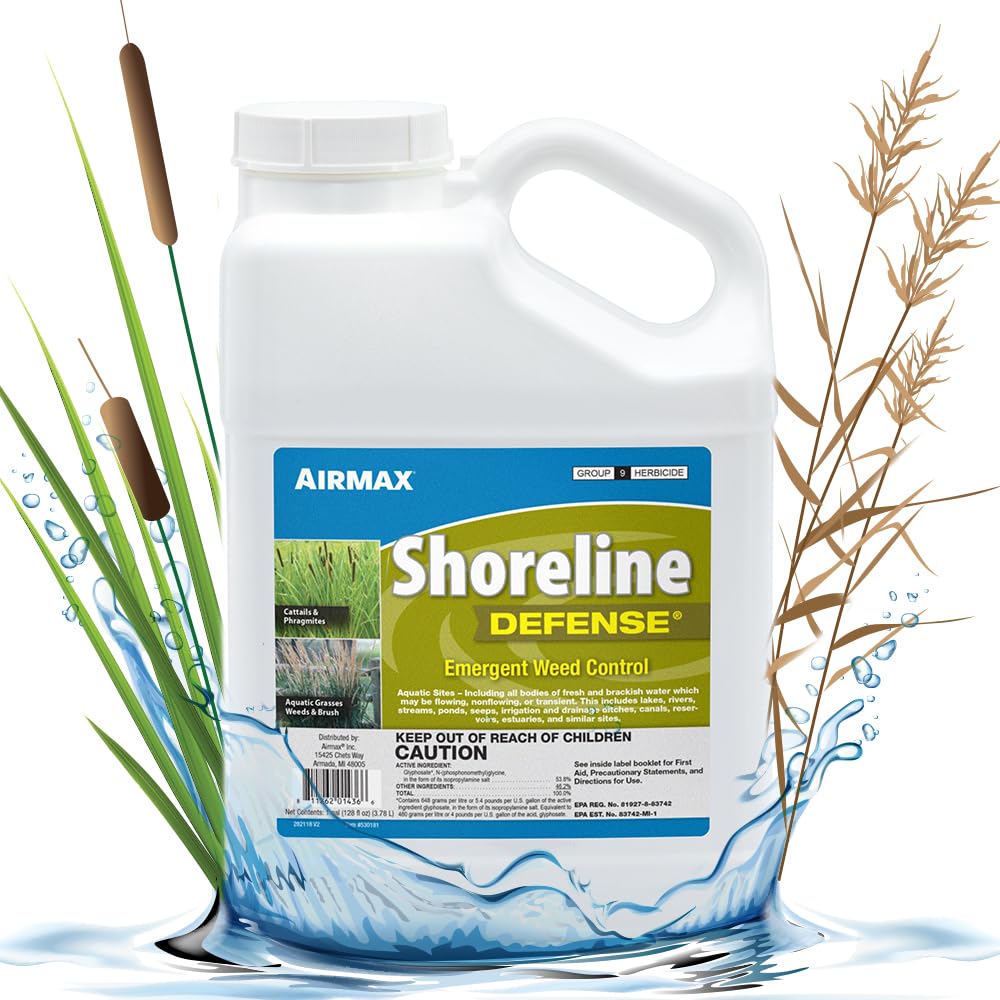
The Airmax Shoreline Defense fills a niche that no other product in this list addresses: emergent aquatic weed control in ponds, lakes, streams, and canals. Its glyphosate formulation is specifically labeled for use in fresh and brackish water environments, targeting cattails, phragmites, and shoreline grasses that crowd out docks, swimming areas, and fishing access points. The product is formulated with a surfactant system designed to stick to waxy aquatic plant foliage without harming fish, birds, or other aquatic life when applied per label directions.
Owners report visible dieback on cattails within two weeks of a late-summer application, with root kill progressing over the following month. The 1-gallon jug covers up to 10,000 square feet of emergent vegetation, and users emphasize that pairing the herbicide with a separate aquatic surfactant (if not using the pre-mixed version) significantly improves adhesion to the slick leaf surfaces of phragmites and cattails.
The cost per jug is higher than standard glyphosate concentrates because of the specialized aquatic labeling requirements, but for anyone with shoreline weed pressure this is the only product in the group that is both legally and effectively suited for the task. Standard non-selective herbicides cannot be used over open water without violating label restrictions — Shoreline Defense is built for that exact scenario.
What works
- EPA-labeled for emergent aquatic use in lakes, ponds, and slow-moving waterways
- Covers 10,000 square feet per gallon — efficient for large shoreline stretches
- Safe for aquatic life when applied per label; no water use restrictions
What doesn’t
- Higher per-ounce cost than standard terrestrial glyphosate concentrates
- Requires separate surfactant purchase for optimal adhesion on slick aquatic leaves
- Dead vegetation must be manually removed from water bodies after treatment
6. PBI/Gordon Trimec Lawn Weed Killer (1 gallon)

The PBI/Gordon Trimec is a selective broadleaf herbicide designed explicitly for cool-season turf grasses — fescue, Kentucky bluegrass, perennial ryegrass. Its active ingredient system (2,4-D, MCPP, and dicamba in the Trimec blend) targets dandelion, clover, creeping Charlie, and plantain while leaving the lawn itself untouched. This is the opposite of a non-selective product; you spray it over the entire lawn, not just the weeds.
Coverage is massive — the label claims 32,000 to 64,000 square feet per gallon depending on weed pressure, which makes this one of the most efficient volume-to-area ratios in the list. Users note that heavy infestations of creeping Charlie or Virginia buttonweed require either a stronger mix ratio or a second application 10 to 14 days later, which is typical for selective herbicides that don’t kill roots on first contact the way glyphosate does.
Some buyers have reported receiving a branded alternative (Weed-Out by ferti-lome) instead of the Trimec label shown on the listing, though they confirm the chemistry performs identically. If you’re managing a cool-season lawn and need a selective product that eliminates broadleaf weeds without damaging the grass, Trimec is the refined choice — but it will not kill grassy weeds like crabgrass or nutsedge.
What works
- Selective formulation kills broadleaf weeds without harming cool-season turf grasses
- Massive coverage range — up to 64,000 square feet per gallon
- Fast visual results on dandelion, clover, and creeping Charlie in 2 to 4 days
What doesn’t
- No activity against grassy weeds like crabgrass or nutsedge
- Heavy weed pressure often requires a second application
- Brand substitution on some orders (same chemistry, different label)
7. Ortho GroundClear Weed and Grass Killer Super Concentrate
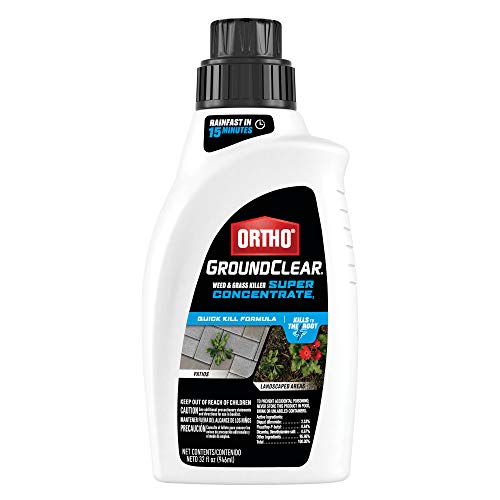
Ortho GroundClear is the most accessible entry point in this lineup — a 32-ounce concentrate that treats up to 1,120 square feet and is rainfast in just 15 minutes, the fastest rainfast rating of any product reviewed here. This makes it the best choice for homeowners who need to spray between unpredictable rain showers or who are tackling a small-to-medium area like a walkway, patio edge, or fence line without committing to a gallon jug.
User feedback emphasizes that the formula kills tough weeds including crabgrass, dandelion, clover, and oxalis down to the root, with visible results appearing within 3 to 5 days on most species. The 15-minute rainfast window is a genuine differentiator — fewer weather excuses means more reliable application timing. Mixing is straightforward: dilute with water in a tank sprayer and spray actively growing weeds when the temperature is above 60°F.
The trade-off is the smaller bottle size relative to the premium and mid-range competitors. For larger properties or heavy infestations, you’ll burn through this quart quickly. But for the homeowner who wants a single-season supply that covers typical residential problem areas without the storage footprint of a gallon jug, the Ortho GroundClear is the most convenient starter concentrate.
What works
- Fastest rainfast rating in the group — 15 minutes
- Small 32-ounce bottle is easy to store and handle for residential use
- Effective on common lawn weeds including crabgrass and oxalis
What doesn’t
- Limited coverage per bottle; insufficient for large acreage or dense brush
- Lower active ingredient concentration than professional-grade glyphosate 41% products
- Not selective — will kill desirable plants on contact if drift occurs
Hardware & Specs Guide
Active Ingredient Concentration
The percentage of active ingredient by weight is the single most important number on a herbicide concentrate label. Glyphosate 41% (as in Albaugh Gly Star Plus) represents the highest concentration available in liquid retail form — every gallon of concentrate contains 41% glyphosate acid equivalent by weight. Lower concentrations like the standard Roundup formulations typically sit in the 18% to 24% range, which directly impacts how much concentrate you need per gallon of spray solution. MSMA products like Target 6 Plus hit 48.2%, but the active chemistry is entirely different and the mix rate is much lower (2 oz per gallon) due to the compound’s potency on grassy weeds. Always match the concentration to your target — higher isn’t automatically better if you’re treating turf where you want to preserve the grass.
Rainfast Window
Rainfast time is the period after spraying during which rainfall can wash the chemical off the leaf surface before it’s absorbed. The Ortho GroundClear’s 15-minute rainfast rating is the fastest here, meaning you can spray and feel confident even if a passing shower hits. The Roundup products (both Poison Ivy Plus and Weed & Grass Killer₄) sit at 30 minutes, which still allows for reasonable weather flexibility. Products without explicit rainfast times on the label — typically MSMA concentrates or some professional formulations — require a 6- to 24-hour dry period for maximum absorption. If you’re spraying in a region with afternoon convective storms, prioritize the products with shorter rainfast windows to minimize wash-off waste.
FAQ
Can I use a glyphosate concentrate like Gly Star Plus in my lawn without killing the grass?
How much concentrate should I mix per gallon of water for general weed spraying?
What does “rainfast in 15 minutes” actually mean for application timing?
Are herbicide concentrates safe to use around ponds or water features?
Final Thoughts: The Verdict
For most gardeners, the herbicide concentrate winner is the Albaugh Gly Star Plus because it combines the highest glyphosate concentration (41%) with a built-in surfactant and a 2.5-gallon volume that scales from fence lines to full-acreage projects at the best cost per ounce. If you need a selective product that targets brush and poison ivy without killing trees and shrubs, grab the Roundup Poison Ivy Plus. And for warm-season turf infested with dallisgrass or nutsedge, nothing beats the Target 6 Plus MSMA.