
Specs are compiled from manufacturer listings and verified buyer reviews and can change over time — please confirm the key details on the product page before buying.
Every fall the same scene plays out: you stand at the edge of a leaf-covered lawn, hoping this year the rake doesn’t snap or slide over the mess. The right yard rake changes that feeling from dread into a quick, satisfying chore — it bites into the debris, carries the load, and lets you move on. That is what this guide is built to find: the rake that actually makes yard work feel efficient instead of endless.
I’m Rikta — the founder and writer behind Lawn Gear Lab. This guide is built by comparing the manufacturers’ published specifications and the patterns across verified customer reviews, so you get each pick’s real strengths and trade-offs instead of marketing spin.
You need a yard rake that matches your specific job — wide for leaves, narrow for tight spots, or steel-tined for soil. Below, six very different rakes are broken down by what they do best, who they suit best, and what real buyers report after putting them to work.
Quick Picks
- Bully Tools Bow Rake 16″ Tines — Best Overall
- Leaf Rake, 30-61 inch (Oliynedy) — Best Value
- 63″ Bow Rake (DIIG) — Premium Pick
- GreatBuddy Adjustable Leaf Rake — Best Overall
- Feblomst Garden Leaf Rake — Best Value
- Oliynedy Adjustable Garden Rake — Best Value
How To Choose The Best Yard Rake
The first split is between a leaf rake and a bow rake. A leaf rake has a fan-shaped head with flexible tines meant to gather loose leaves and grass without scratching the turf. A bow rake (sometimes called a garden rake) has a rigid head with short, stiff tines set at a right angle to the handle — designed to break up soil, level gravel, or spread mulch.
Head Width and Tine Count
An 18-inch head covers more ground per pass than an 8-inch head, which matters when clearing a large lawn. But a narrow head (under 10 inches) gets into tight spots between shrubs or under fences without snagging. The tine count follows the width: more tines mean less debris slips through, but fewer tines may dig deeper into hard soil without clogging.
Handle Length and Material
An adjustable handle lets you match the reach to your height — shorter to reduce arm fatigue, longer to avoid bending. Stainless steel handles are rust-proof but can feel cold and slippery in damp hands. Fiberglass handles are lighter than steel and absorb vibration better, though they can splinter over time if damaged. A rubber grip on any material helps with control when your hands are sweaty or wet.
Durability and Rust Resistance
Look for a head made from alloy steel or American 10-gauge steel if you need to dig into compacted soil or move heavy materials like gravel. A powder coat or anti-rust coating prevents the metal from corroding after it sits in a damp shed or gets left out in the rain. Triple-welded tine connections are a sign the maker expects the rake to handle serious force without the head snapping off.
Quick Comparison
| Model | Best For | Head Width | Handle Length | Weight | Amazon |
|---|---|---|---|---|---|
| Bully Tools Bow Rake 16″ | Heavy-duty soil, gravel, and leveling | 16″ | 58″ | 3.5 lbs | Amazon |
| Leaf Rake, 30-61 inch (Oliynedy) | Large leaf cleanup with one wide pass | 18″ | up to 61″ | 16 oz | Amazon |
| 63″ Bow Rake (DIIG) | Breaking soil and spreading mulch | 17″ | 63″ | 1.75 kg | Amazon |
| GreatBuddy Adjustable Leaf Rake | Tight spaces and shrub beds | 8″ | up to 72″ | 0.84 kg | Amazon |
| Feblomst Garden Leaf Rake | Small lawns and precise tidy-up | 9″ | up to 65″ | 907 g | Amazon |
| Oliynedy Adjustable Garden Rake | Camping and chicken-coop cleanup | 9″ | up to 50″ | 1 lb | Amazon |
In‑Depth Reviews
1. Bully Tools Bow Rake 16″ Tines
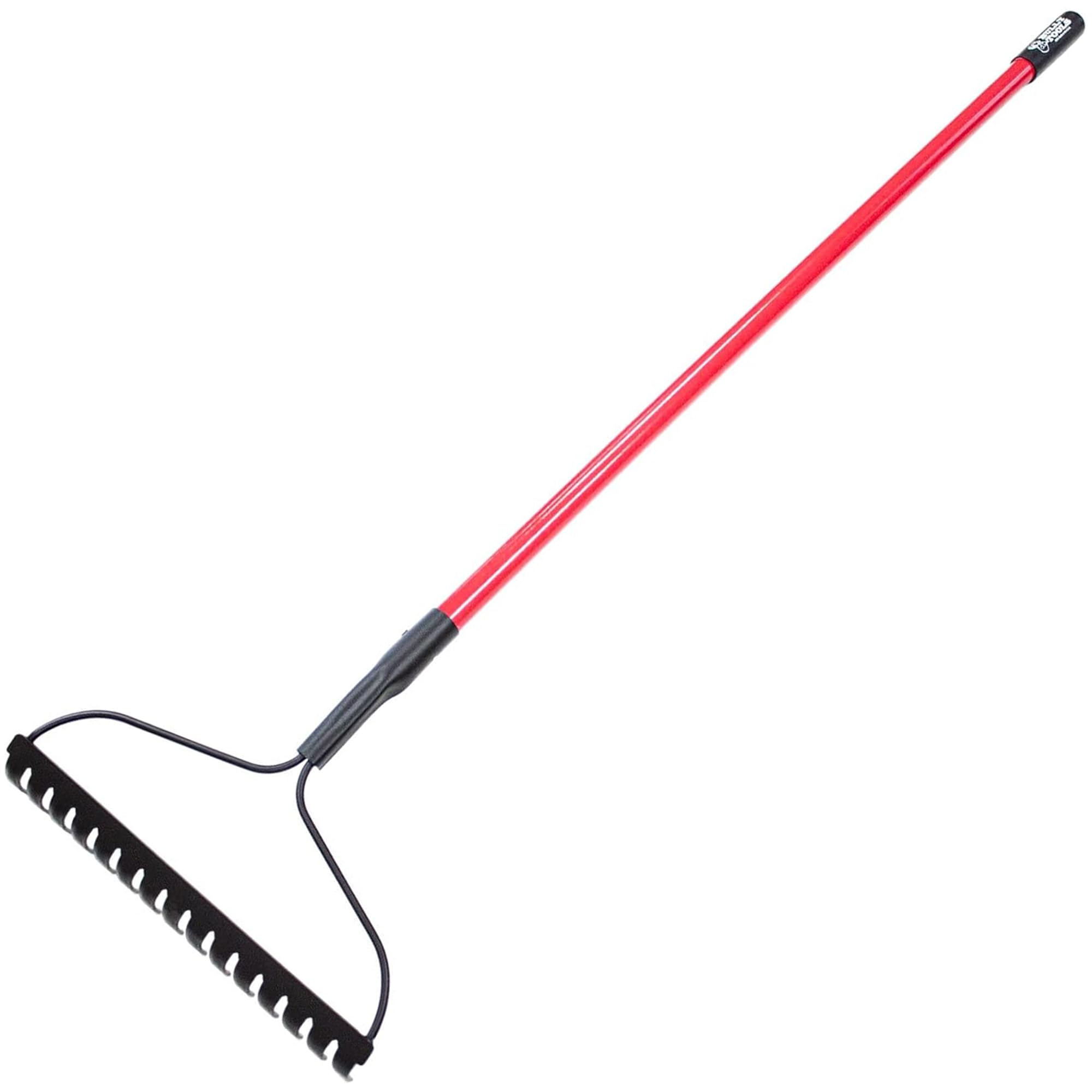
A commercial-grade, American-made steel rake that shrugs off rock, clay, and roots.
If you need a rake to tear into hard-packed soil, spread gravel across a driveway, or level a garden bed, the Bully Tools bow rake is a clear step above the rest. The head is 10-gauge American steel — up to 30% more durable than foreign competitors, according to the manufacturer — and the 16 tines are robotically overwelded so they stay attached under pressure. The fiberglass handle (58 inches long) is coated in a polyester veil to stop splintering, and a rubber grip reduces hand fatigue when you are using it for a long time. This rake weighs 3.5 pounds, giving it the heft to dig in without needing you to push hard, yet it remains balanced enough for extended raking sessions. One reviewer noted it is “rock solid” and gets the job done faster than their older bow rake, noting that the teeth dig into tough material easily.
The trade-off is that this rake is heavy and aggressive — if your task is gently clearing a delicate flower bed, this tool will likely tear out plants. Its 58-inch handle also feels short for anyone over 6 feet tall, as one buyer mentioned they wished for another foot of reach. Assembly takes under a minute with just a Phillips head screwdriver. This rake was selected as the Best Bow Rake in 2020 by Business Insider, proof of its reputation among serious gardeners. It also has a powder coat finish to prevent rusting across all seasons. For anyone breaking ground or managing a large property, this is the most durable yard rake on this list.
The Real Muscle It Brings
- 10-gauge American steel head resists bending where cheaper rakes snap
- Fiberglass handle won’t rot or splinter like wood — one buyer called it “awesome”
- Triple-welded tines handle heavy gravel and soil without loosening
Where It Falls Short
- Heavy at 3.5 lbs compared to lighter leaf rakes — not ideal for big leaf piles
- Short 58″ handle; tall users want a longer option
- Overkill for small lawns and delicate flower beds
Reach for this if: you need to break ground, move gravel, or level soil on a serious property — it will outlast anything with a wood handle.
skip it if: your yard work is mostly leaves and light debris on a small lawn, because the weight and aggression will work against you.
2. Leaf Rake, 30-61 inch (Oliynedy)

A wide, sturdy leaf rake that clears a 1.5-foot path each sweep and flips into a scoop.
The Oliynedy leaf rake clears more ground per sweep than any narrow rake here, thanks to its 18-inch-wide head with 25 tines. One buyer posted that it clears 1.5 ft of leaves in a single sweep — and they noted you can flip the head over to use it like a claw for scooping piles, a trick plastic rakes cannot handle. The head is alloy steel with a rust-proof coating, so it digs into wet leaves and pine needles without the tines bending. The handle extends from 30 to 61 inches, letting you adjust for your height without stooping. It weighs only 16 ounces, which is notably lighter than the Bully Tools bow rake — making it far better suited for overhead storage and long leaf-raking sessions. Assembly is simple: you screw the handle sections together in about a minute. One reviewer has used this rake on a 2-acre property and said the teeth stayed straight after use.
The catch is that the 18-inch head is wider than a typical leaf rake (narrower options at 8 or 9 inches are better for getting between shrubs). A few buyers found the head was smaller than they expected visually, although they still praised its productivity. The handle material is plastic, not stainless steel like some pricier rakes, which means it could feel less premium in hand over the long term. But for someone with a medium to large lawn who just wants to move leaves fast, this rake delivers without costing much. It is an ideal mid-range option that beats most plastic rakes on durability without jumping to bow-rake territory.
Why It Stands Out
- Widest head (18″) of any leaf rake here, moving more debris per sweep
- Durable steel with rust-proof coating — buyers confirm tines don’t bend
- Adjustable from 30 to 61 inches to fit both kids and tall adults
Its Real Limits
- Plastic handle may feel less sturdy than stainless steel alternatives
- Wide head is clumsy for tight spots like flower beds or between shrubs
- Not designed for breaking compacted soil — its flexibility helps leaves, not dirt
Best for: anyone with a medium-to-large lawn who wants to clear leaves quickly in wide, efficient passes — the light weight and adjustable length make it a great daily driver.
Consider another if: you mostly work in tight garden beds or break up soil; this rake is built for surface debris, not ground work.
3. 63″ Bow Rake (DIIG)

A fully stainless steel bow rake with triple-welded tines for heavy soil work without rust.
This DIIG bow rake is built for the gardener who needs to break up compacted soil, spread mulch, and level ground, but also wants the handle to stay rust-free after years of storage. The head has 17 tines with 3 mm of thickness (an actual measured spec) and is triple-welded at the bow connection so the head won’t fall off during serious labor. The handle is stainless steel, with a 1-inch diameter that feels substantial in the hand — unlike the plastic-handled leaf rakes on this list. At 1.75 kg (about 3.9 lbs), it is slightly heavier than the Bully Tools bow rake (3.5 lbs), so it has more momentum for breaking ground. The handle adjusts by screwing or unscrewing sections — you can make it as short or long as you like, letting you switch between close work and standing-height raking. Owners mention it is “very sturdy” and one said, “This very well could become the last steel tine rake you have to buy.” Another found it easy to assemble and praised its heavy-duty construction.
The main friction point is the assembly: you need to use the included tool and wrench together to tighten the screw properly; one owner reported you cannot just tighten it with your fingers, so it takes a few extra minutes. Also, this rake is overbuilt for light leaf-raking — its stiff stainless steel tines will scrape up grass if you just want to sweep autumn leaves from a lawn. The head is 17 inches wide, which is a bit narrower than the Oliynedy leaf rake’s 18-inch head, but it covers ground quickly still. This is a premium tool for someone who frequently works with dirt, gravel, or soil amendments and wants a handle that will never rot.
Its Defining Strengths
- Triple-welded head and 3 mm thick tines resist bending under heavy pressure
- Full stainless steel construction — handle and head — so it resists rust entirely
- Adjustable length makes it flexible for both standing soil work and kneeling tasks
Honest Weaknesses
- Heavier than the Bully Tools bow rake (3.9 lbs vs 3.5 lbs) — more fatigue over long sessions
- Assembly requires a tool and wrench; not a quick screw-together experience
- Stiff metal design is harsh on turf — better for soil than for leaf-only lawns
Who it’s for: gardeners and landscapers who routinely break up soil, spread heavy mulch, or move gravel and want a rust-proof, heavy-duty tool that will last years.
Who should pass: anyone focused on leaf clean-up on a lawn; the stiff tines and heavier weight will fight against the turf instead of gliding over it.
4. GreatBuddy Adjustable Leaf Rake
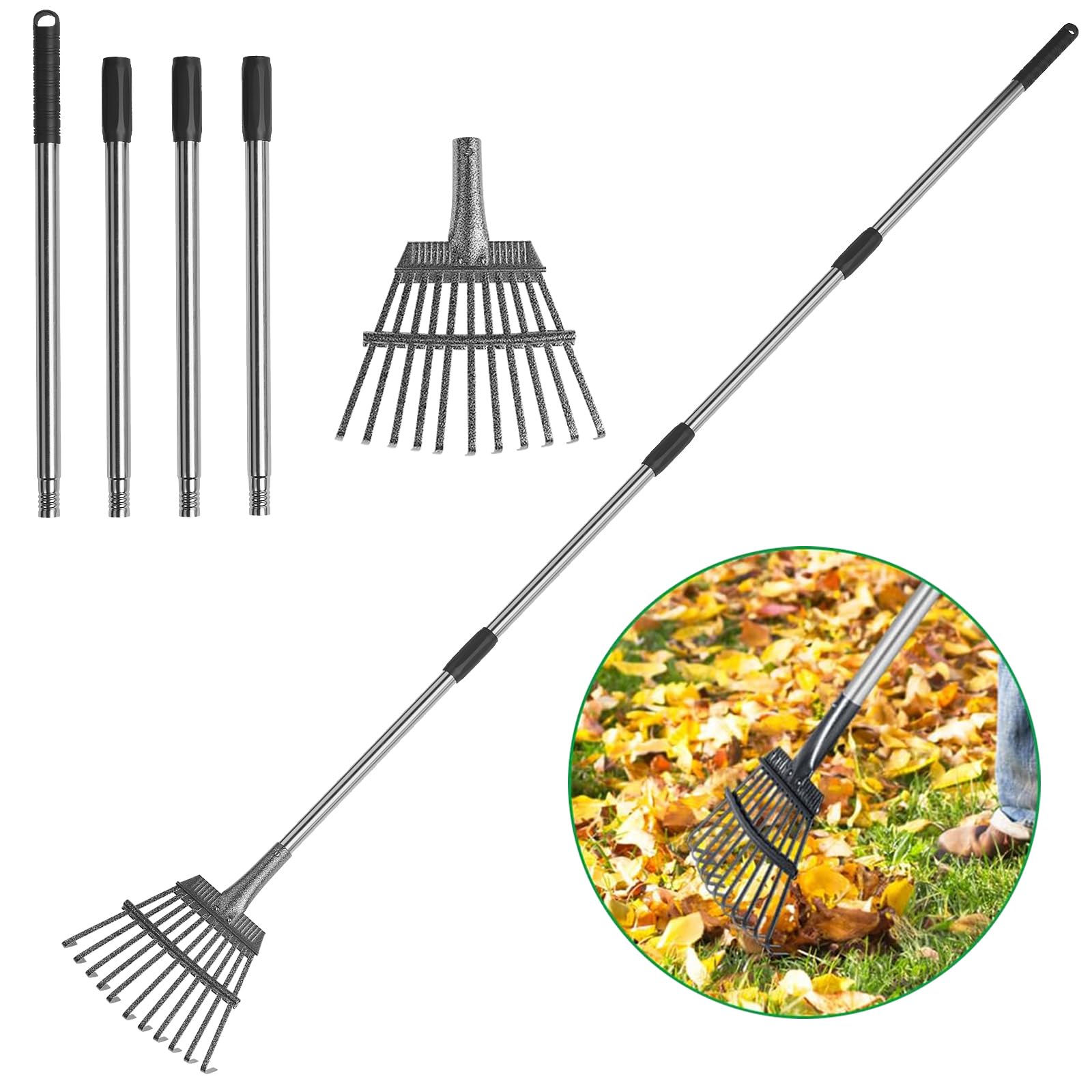
A narrow, adjustable rake that reaches up to 72 inches — perfect for tall gardeners and tight spots.
The GreatBuddy is the narrowest leaf rake on this list at just 8 inches wide, which makes it the go-to tool for cleaning leaves from under shrubs, between flower beds, and around fencing — areas the 18-inch head above would struggle with. Its handle extends to 72 inches, which is the longest reach of any rake here — a full 22 inches longer than the 50-inch max of the Oliynedy adjustable rake (a 44% more reach, making it far better for those who want to avoid bending). The handle is made of rust-proof stainless steel and the head is aluminum-coated metal. One buyer wrote that they “effectively leveled over one ton of topsoil for lawn repair” using this rake, which shows it is surprisingly capable for its narrow width. Assembly is simple: you screw the handle tubes together and snap the head on in minutes. The 11 metal tines are strong but flexible enough to manage heavy debris without damage.
The obvious limitation is that an 8-inch head is not efficient for covering a large lawn — trying to clear a big yard with this rake will take many more passes than with a 16- or 18-inch head. The handle sections screw together rather than using a twist-lock mechanism, so adjusting length on the fly is less convenient. Some buyers noted that a few welds look thin, though no failures occurred during use. This is a specialist rake: it excels in tight spaces and for shorter users, and the extra-long reach helps tall gardeners avoid back strain while working in flower beds. Reviewers consistently praise it as a “great value” and love it for campsite cleanup as well.
Expert Angle
- Longest handle reach (72 inches) of any rake here — ideal for tall users
- Stainless steel handle is rust-proof and feels solid in hand
- One buyer proved its strength by leveling over a ton of topsoil
Notable Shortcomings
- Narrow 8-inch head makes it slow for large, open lawns
- Screw-together segments take time to adjust; not a quick-change mechanism
- Welds on the head appear thin to some buyers, though they held up in use
Reach for this if: you need to get into tight shrub beds, flower borders, or campsites and want a handle long enough to use without stooping.
pass on it if: your yard is mostly open lawn where a wider head would clear three times more debris per sweep.
5. Feblomst Garden Leaf Rake

A compact 9-inch steel rake with a comfortable TPE grip that feels light but stiff in use.
The Feblomst is a narrow-leaf rake for small spaces, with a slightly wider head at 9 inches than the GreatBuddy’s 8 inches, and a Thermoplastic Elastomer grip on the handle that makes it more comfortable for long periods of use. Customers note that the rake head is sturdy and the handle screw-together sections are firm, with “no felt play after using it.” One reviewer specifically said: “It’s light enough to be held at arms length with one hand, yet feels stiff & strong,” and noted it handles heavy wet oak leaves with little flex. The handle extends from 37 inches up to 65 inches — not as long as the GreatBuddy’s 72 inches but still very decent — and the whole thing breaks down for storage in a tote or backpack. The head is 9 inches and 11 tines are spaced closely enough that small leaves and pine needles don’t get trapped between them. The metal has an anti-rust coating, and the manufacturer describes it as “heavy duty.”
The downside is similar to the GreatBuddy: it is not a fast tool for clearing a large open area. It shines in borders, between shrubs, and around raised beds. One buyer uses it to clean up dog poop and pine cones without tearing up the lawn. Another praised it for breaking down in winter and fitting in storage totes. If you primarily garden in beds or maintain a small lawn, the Feblomst offers a great balance of stiffness and portability. Its TPE grip is a small but noticeable upgrade over the bare metal handles of other rakes.
Practical Highlights
- TPE grip reduces hand fatigue compared to bare steel handles
- Stiff enough for wet leaves and soil work, yet light enough for one-handed use
- Breaks down easily for storage in small spaces — perfect for apartment dwellers
Where It Falls Behind
- Narrow 9-inch head means more passes on any lawn wider than a garden bed
- Handle adjustment is by unscrewing and re-screwing, not a quick-lock mechanism
- Not built for breaking soil like a bow rake would be
Best for: homeowners with small gardens, raised beds, or tight borders — the comfort grip and collapsible design make it ideal for precise, comfortable work.
Consider another if: you need to cover acres of leaves; this rake is all about accuracy, not speed.
6. Oliynedy Adjustable Garden Rake

A compact 9-inch metal rake with a 50-inch handle that fits in a trunk for camping and coops.
The Oliynedy garden rake has the same 9-inch head width as the Feblomst but with a shorter maximum handle length of 50 inches — a 22-inch difference from the GreatBuddy’s 72 inches, which means you will need to bend slightly more if you are tall. However, the trade-off is a very portable tool that one buyer described as perfect for their chicken coop because “the tines are heavy metal and don’t bend when I push wet sand.” Another reviewer who used a kid’s rake for 20 years replaced it with this one and called themselves “beyond pleased.” The handle adjusts by connecting four metal tubes, so you can use any combination to get the right reach from 30 inches up to 50 inches. The head is alloy steel with a rust-proof coating, and the 11 tines are thickened to 1 inch in diameter at the main shaft. One buyer at 5’6″ said they were able to adjust it long enough to avoid bending over completely.
The obvious drawback compared to the GreatBuddy and Feblomst is the shorter handle — at 50 inches, it does not offer the same back relief for very tall users as the 65- or 72-inch options. You also cannot pack as long a reach when you need it. On the plus side, its more compact collapsed size makes it slightly easier to carry in a small car or camping bag. If you are a shorter gardener or someone who primarily needs a durable rake for animal enclosures, tight beds, and camping, this is a very solid choice. The metal construction is clearly sturdier than many plastic-handled alternatives in this price range.
Smart Reasons to Choose It
- Buyers confirm the tines handle wet sand without bending — tough for a lightweight rake
- Easy length adjustment with four screw-together sections fits different body heights
- Compact size is ideal for camping, chicken coops, and car trunks
Honest Limitations
- Maximum handle length is 50 inches — 22 inches shorter than the GreatBuddy, meaning more stooping for tall users
- Narrow head is slower for open lawn work than a 16- or 18-inch wide rake
- Plastic grip material feels less premium than the TPE grip on the Feblomst
Who it suits: chicken coop owners, campers, and shorter gardeners who want a tough, portable rake that fits in tight spaces and handles wet, heavy debris without bending.
Who might want more: tall users or anyone with a big lawn who needs a longer reach to avoid back strain — consider the GreatBuddy’s 72-inch handle instead.
Understanding the Specs
Head Width
This is the single biggest productivity factor. A 16- or 18-inch head clears a much wider path per sweep than a 9-inch head — useful for large lawns and big leaf piles. A narrow head (under 10 inches) is slower on open ground but lets you reach between shrubs, under bushes, and into corners without damaging plants.
Handle Reach and Material
Look for an adjustable handle if you share the rake with family members or need to avoid bending at the waist. Stainless steel resists rust and feels sturdy but can be cold and slippery; fiberglass is lighter and dampens vibration better; and a rubber or TPE grip gives you control in wet conditions. A longer handle reduces back strain, but makes the rake heavier to carry.
Tine Count and Metal Thickness
More tines (like 25 on the 18-inch head) trap small debris such as pine needles and grass clippings without them falling back through. Thicker metal (3 mm on the DIIG or 10-gauge on the Bully Tools) resists bending when you push through packed soil or heavy wet sand. Thinner tines are lighter and skip over grass more gently, which is ideal for leaf-only rakes.
Weight
A lighter rake (16 oz to 1 lb) reduces fatigue during long leaf-raking sessions and is easier to hang in an overhead garage rack. A heavier rake (3.5 to 4 lbs) has more forward momentum for digging into soil, but will tire you out faster if you are just moving leaves across a lawn. Consider how much arm strength you want to commit per session.
FAQ
Is a bow rake or a leaf rake better for my yard?
How wide should a yard rake head be?
How long should a rake handle be?
What is the difference between stainless steel and fiberglass rake handles?
Can I use a leaf rake for digging or moving soil?
What does “10-gauge steel” mean for a rake head?
How do I store a yard rake so it lasts?
How many tines should a good leaf rake have?
Can anyone use a 72-inch rake handle comfortably?
Should I oil or treat the metal head of a rake?
Final Thoughts: The Verdict
For most people, the best yard rake overall is the Bully Tools Bow Rake, because its 10-gauge American steel head and fiberglass handle deliver the durability needed for serious soil and gravel work without the handle splintering or the tines snapping. If you mostly clear leaves from a medium to large lawn, the Oliynedy 18-inch Leaf Rake offers the fastest coverage per sweep at a very approachable cost. And for anyone who needs to work between shrubs, around flower beds, or pack a rake in a car for camping, the GreatBuddy Adjustable Rake provides the narrowest head and the longest reach in a single package.
How We Picked
We do not accept paid placement. Every pick is matched to a real buyer and a real use-case; we do not hands-on test units.
Sources & Methodology
Specifications: manufacturer listings and product documentation. Review insights: verified customer reviews, as of July 2026. Pricing: not shown on this page (it changes often); check the current price via the retailer link.
As an Amazon Associate, Lawn Gear Lab earns from qualifying purchases. This does not affect which products we feature.