
Dragging fallen branches to the curb or spending weekends on a smoky burn pile is a waste of good mulch. A wood chipper turns that mountain of limbs, brush, and yard debris into nutrient-rich ground cover or compost material, saving you time and hauling fees. The trick is matching the engine power and cutting capacity to the size of the material you actually have to process.
I’m Rikta — the co-founder and writer behind Lawn Gear Lab. I spend my behind-the-scenes hours cross-referencing displacement specs, reduction ratios, and rotor designs against hundreds of owner reports to find the units that deliver real-world value without burning your budget.
If you are shopping for a machine that can handle a steady diet of limbs and brush, you need a clear-eyed look at the market. This guide breaks down the specs, trade-offs, and real-owner experiences of the best wood chippers currently available for home and commercial use.
How To Choose The Best Wood Chippers
A wood chipper is a long-term investment in your property maintenance. Looking past the marketing and understanding the mechanical details is the only way to avoid a machine that sits idle or breaks under a season of hard use. Here are the core factors to weigh before buying.
Engine Displacement and Horsepower
Most compact 7HP gas chippers use a 212cc horizontal shaft engine. These units supply enough torque for limbs up to 3 inches in dry or moderately green wood. A 14HP or 15HP engine — typically a 420cc class — provides the heavier flywheel mass that keeps the rotor spinning through tough knots and larger hardwood limbs. Higher displacement engines also tend to run cooler and last longer under continuous load.
Reduction Ratio
This figure tells you how much volume the machine compresses. A 15:1 ratio means 15 bushels of branches become 1 bushel of chips. That is perfectly adequate for most home landscaping. A 20:1 ratio produces a finer chip that composts faster and spreads more evenly as ground cover. If you plan to use the output as decorative mulch, the higher ratio is worth the premium.
Feeding Mechanism and Rotor Design
Some chippers rely entirely on the operator to push each branch into the blades. Others have a self-feeding rotor that grabs wood and pulls it through. Self-feeding rotors save your arms and back but require attention — they can yank larger material in aggressively. A larger diameter rotor (over 12 inches) provides more rotational inertia, which reduces stalling when feeding at a steady pace.
Portability, Towability, and Storage
Weight ranges from roughly 115 pounds for a compact 7HP unit to over 440 pounds for a 15HP model with a tow bar. If you need to move the chipper around a sloped yard, pneumatic tires and a solid axle make a noticeable difference. A hinged funnel design that folds or tilts for access to the cutting chamber simplifies jam clearing and blade maintenance.
Quick Comparison
On smaller screens, swipe sideways to see the full table.
| Model | Category | Best For | Key Spec | Amazon |
|---|---|---|---|---|
| MechMaxx GS1500 | Premium | Full-acre owners & hobby farmers | 420cc 15HP / 5-inch capacity | Amazon |
| DK2 OPC506 | Commercial | Commercial-grade output & towing | 14HP Kohler / 6-inch capacity | Amazon |
| GARDENBEAUT S1 | Mid-Range | Fine mulch with high reduction ratio | 212cc 7HP / 20:1 reduction | Amazon |
| SuperHandy 3-in-1 | Mid-Range | Versatile leaf vacuum & chipping | 212cc 7HP / 3-inch capacity | Amazon |
| Champion 200905 | Mid-Range | Brand reliability & warranty | 224cc 7.5HP / 3-inch capacity | Amazon |
| BILT HARD TRA-0401 | Mid-Range | 2-in-1 chipping & shredding | 224cc 7.5HP / 3-inch capacity | Amazon |
| Landworks GUO067-FBM | Mid-Range | Budget-focused 7HP starting point | 212cc 7HP / 3-inch capacity | Amazon |
| GARDENBEAUT S3 | Mid-Range | Compact easy-store design | 212cc 7HP / 3-inch capacity | Amazon |
| EFCUT R30 | Mid-Range | Foldable storage & simple assembly | 212cc 7HP / 3-inch capacity | Amazon |
In‑Depth Reviews
1. MechMaxx GS1500
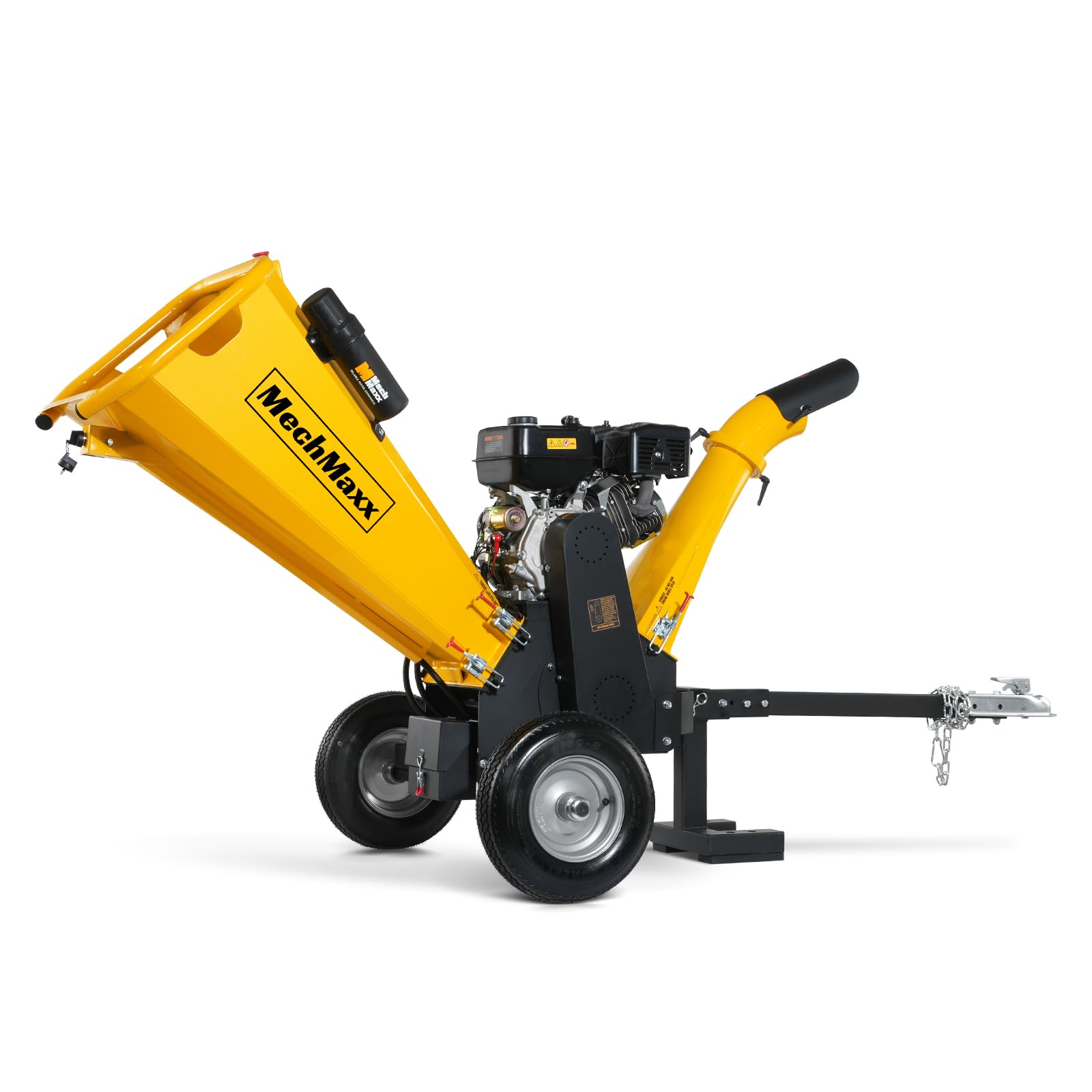
The MechMaxx GS1500 sits at the top of the heap because it solves the biggest pain point of compact chippers: starting. The DUCAR 420cc 15HP engine uses a 12V battery-powered electric start, so you don’t need to yank a rope twenty times after storing it for six months. Once running, the 20:1 reduction ratio and double-edge A8 steel blades produce a consistently fine chip that breaks down quickly in a compost pile.
Owner experiences report that the unit handles fresh hardwood limbs up to 3.5 to 4 inches without strain — the claimed 5-inch maximum is optimistic, but the machine does not bog down on reasonable loads. The 360-degree rotary discharge chute and tow bar make this a genuinely mobile setup for larger properties. Shipping damage and a sparse manual are recurring themes, and the assembly is heavy enough to require a second person or an engine hoist.
For the homeowner who has moved past the hobby-tier machines and needs reliable, fast mulching without wrestling a pull cord, this is the unit that justifies its price tag in reduced frustration and higher output. The 2-year warranty on the engine and machine adds a layer of confidence that the cheaper 7HP units rarely offer.
What works
- Electric start eliminates pull-cord fatigue on cold mornings.
- Double-edge A8 blades and 20:1 ratio produce fine, compost-friendly mulch.
- Tow bar and 16-inch wheels make relocation simple across a large yard.
What doesn’t
- Shipping damage and missing parts reported far too often.
- Assembly is heavy and requires excellent mechanical literacy or outside help.
- True max capacity is closer to 4 inches despite the 5-inch claim.
2. DK2 OPC506
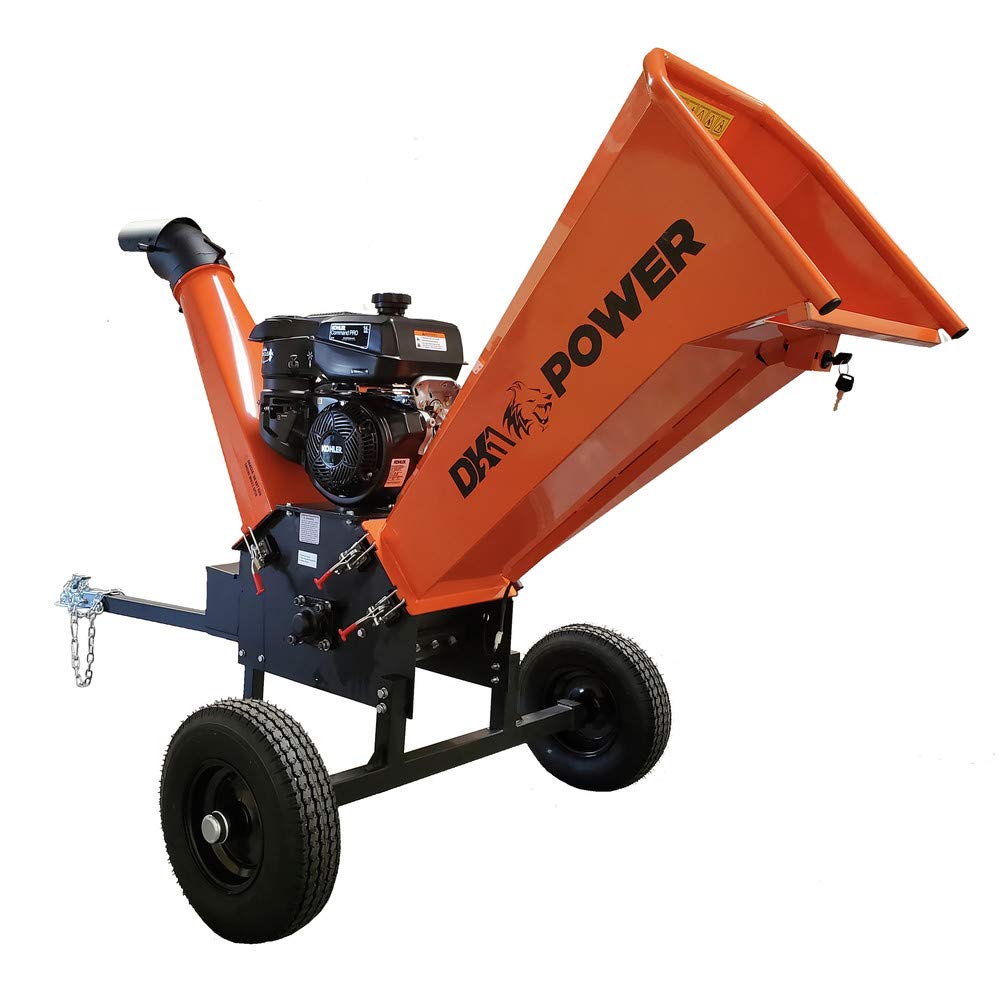
The DK2 OPC506 is the closest you can get to a legitimate commercial chipper without stepping into six-figure PTO-driven territory. The 14HP Kohler engine is a known quantity in the landscape industry — it starts reliably and maintains torque under load far better than the generic 212cc engines found on budget machines. The auto-feed rotor pulls branches in aggressively, and the tool-less hinged funnel design lets you clear jams in seconds without wrenches.
Owner reports consistently describe the DK2 as a “beast” that vaporizes small brush and runs for hours on a single tank of gas. The actual sweet spot for feeding is around 3 to 4 inches — the 6-inch rating applies only to softwood and requires very slow feeding. The extended axles and trailer tow hitch are functional, but the machine weighs 395 pounds and can be difficult to roll up an incline without a vehicle to tow it.
If you maintain multiple acres, manage a woodlot, or simply want a machine that will last well past the warranty period, the DK2 is built to a different standard than the entry-level competition. The initial cost is high, but the hourly processing rate and durability make it a better value over a five-year horizon than buying three cheaper units that fail.
What works
- 14HP Kohler engine starts easily and holds torque through heavy loads.
- Tool-less hinged chutes allow instant access to clear jams.
- Auto-feed rotor pulls branches through with minimal operator effort.
What doesn’t
- Shipping arrives with missing hardware or damage that requires immediate attention.
- Wheel bearings may need repacking before first use.
- 6-inch capacity is only realistic for softwood with careful feeding.
3. GARDENBEAUT S1

Where most 7HP chippers use an 11-inch rotor, the GARDENBEAUT S1 ups the size to 15.6 inches. That extra diameter gives the rotor more rotational inertia, which helps the machine power through wood without stalling as easily as smaller-rotor competitors. The 20:1 reduction ratio produces a fine, uniform chip that looks great as garden mulch. The 10-inch PU wheels are puncture-proof — a real advantage if your property is littered with thorns or sharp debris.
Owners praise the consistent starting behavior and the machine’s appetite for dry hardwoods like ceanothus and small oak. The S1 does not self-feed aggressively, so you will use steady hand pressure, but the larger rotor keeps momentum up between feeds. Some users note that the choke sticker is reversed and that the rope pull angle drags near the exhaust — both are solvable with a relocation bracket or careful orientation during assembly.
For anyone who wants the highest reduction ratio in a sub-120-pound package, the S1 is the smart choice. It is light enough to lift onto a truck bed yet capable enough to turn a weekend’s worth of branch cleanup into a tidy pile of premium mulch.
What works
- Larger 15.6-inch rotor provides better momentum and stall resistance than compact rivals.
- 20:1 reduction yields fine, consistent mulch that enriches soil quickly.
- Puncture-proof PU wheels handle rough terrain without flats.
What doesn’t
- Rope pull angle near the exhaust is a poor design choice.
- Choke sticker is reversed, confusing first-time users.
- No self-feeding draw; all material requires manual force.
4. SuperHandy 3-in-1
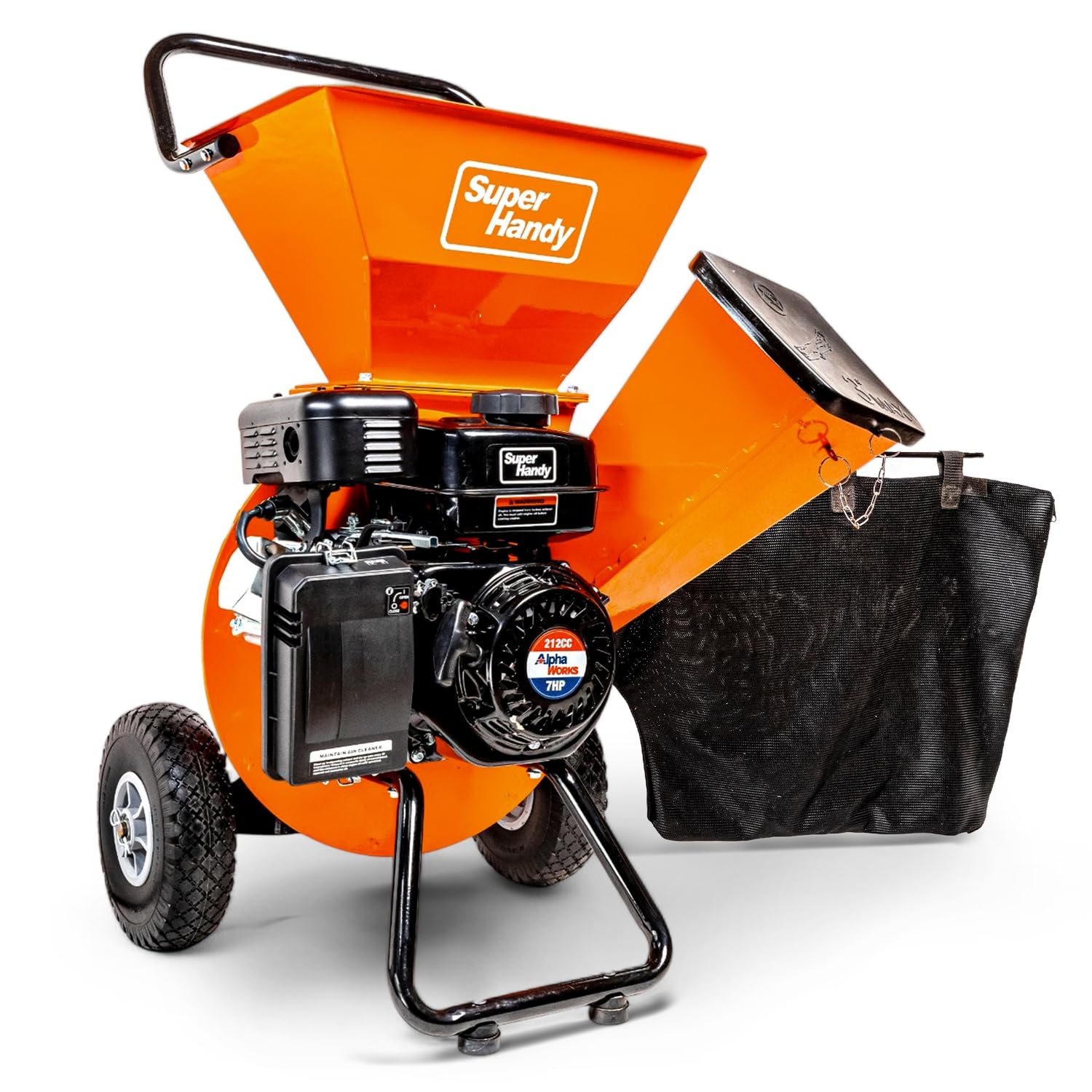
The SuperHandy differentiates itself with a slanted housing design that is engineered to reduce jams — a feature that actually works, according to a notable number of owners. The 3-in-1 capability lets you chip side-fed branches up to 3 inches, top-feed smaller brush and leaves through the 1/2-inch shredder hopper, and attach an optional leaf vacuum kit for mulching large piles of dry leaves. The 15:1 reduction ratio is standard for the category, but the dual-feed layout makes it more versatile than single-chute units.
Owner experiences highlight the machine’s ability to chew through dry branches under 2 inches with near-effortless speed. The case-of-use is excellent — one 70-year-old owner with no previous gas-tool experience assembled and ran it without issue. The included collection bag is small and prone to tearing, and the top hopper clogs quickly with pine straw or wet leaves. The engine is a Honda Predator clone, and the carburetor may need a rebuild if the machine sits for months with ethanol gas.
If you deal with a mix of large branches, fine brush, and mountains of leaves, the SuperHandy’s three-mode flexibility saves you from owning separate equipment. Just budget for a better collection solution and a fuel stabilizer regimen.
What works
- Slanted housing design demonstrably reduces jams during operation.
- Three separate feeding ports handle branches, brush, and leaves.
- Easy assembly suitable for first-time gas tool owners.
What doesn’t
- Collection bag is undersized and develops holes in short order.
- Top shredder hopper clogs with stringy material like pine straw or vines.
- Carburetor sensitive to stale ethanol fuel; requires a clean if stored long-term.
5. Champion 200905

Champion Power Equipment is a known entity in the generator and engine world, and the 200905 chipper-shredder inherits that reputation for straightforward reliability. The 224cc engine is a fraction larger than the standard 212cc found on most competitors, and the .92-gallon fuel tank allows for longer run times between refills. The chipper chute uses hardened steel blades, and the rear access clean-out port makes clearing a jam a simple task without a full teardown.
Owner feedback is overwhelmingly positive for a machine in this price tier. Users report easy first-pull starting and consistent performance on branches up to 2.5 inches. The 2-bushel collection bag is adequate for short sessions, and the discharge throw is powerful enough to spread chips over a 20-30 foot radius. A minority of owners experienced a broken chipper blade bolt after fewer than 5 hours of use, and Champion’s customer service response has been inconsistent — some got replacement parts quickly, others faced long delays.
For buyers who value a recognizable brand and a 2-year warranty over the cheapest upfront price, the Champion 200905 is a safe choice. Keep the feed rate moderate and you will get years of service from a company that still answers the phone.
What works
- Brand reputation with a 2-year limited warranty and lifetime technical support.
- 224cc engine starts reliably and provides steady torque for branches up to 2.5 inches.
- Rear clean-out port simplifies jam removal without removing the funnel.
What doesn’t
- Small but significant reports of chipper bolt breakage within the first few hours.
- Rubber feed guards are stiff, catching branches and requiring removal.
- Customer service response time is inconsistent for warranty claims.
6. BILT HARD TRA-0401

The BILT HARD TRA-0401 stands out in the mid-range for its aggressive rotor configuration — two chipper blades paired with six J-type hammer slices. That combination gives it a genuine 2-in-1 capability: the side chute handles branches up to 3 inches, while the top hopper and hammer mill effectively shred smaller brush, leaves, and even has a vacuum suction function for yard debris. The 224cc 7.5HP engine produces a solid 9.96 ft-lbs of torque for sustained shredding sessions.
Owner reports highlight the machine’s rugged build and its ability to self-feed straight branches. It is very loud — ear protection is mandatory — and it clogs badly if you introduce vines or wet, stringy material. The collection bag is a common failure point, with several owners noting it developed holes or broke within the first few uses. A minority of units arrived with bent components or died after 30 minutes, though the vendor has been responsive in replacing broken parts.
If you want a chipper-shredder that can handle both limb reduction and leaf mulching in a single pass, the BILT HARD offers the most aggressive cutting assembly in this price band. Just avoid feeding anything green or vining, and plan to replace the bag with a tarp or a dedicated collection system.
What works
- Two chipper blades plus six hammer slices provide aggressive dual-stage cutting.
- 224cc engine delivers strong torque for sustained shredding sessions.
- Vacuum suction function works for large leaf piles (attachments sold separately).
What doesn’t
- Clogs catastrophically with wet or stringy material like vines and pumpkin stalks.
- Collection bag is fragile and prone to tearing after limited use.
- Inconsistent quality control — some units arrive damaged or fail quickly.
7. Landworks GUO067-FBM

The Landworks chipper is one of the more popular entry points into gas-powered chipping, and its 530+ ratings confirm its broad appeal. The 7HP 212cc engine is the same platform used by many machines at this price, but Landworks adds unique check windows that let you inspect the blades without disassembling the housing. The compact rotor assembly and 15:1 reduction ratio produce usable mulch from branches up to 2 inches with very little fuss.
Owner experiences are mostly positive, with many noting the machine starts on the first pull and sips fuel through a full day of work. The unit weighs 97 pounds, making it one of the lighter options for moving around a yard. The main complaints center on the muffler welds breaking after extended use and a handful of catastrophic failures where the motor shaft sheared. Landworks customer support has been unhelpful in some cases, leaving owners to rely on Amazon’s return policy.
The Landworks is a legitimate starter machine for occasional use on dry branches under 2 inches. If you treat it gently — slow feed rates, non-ethanol fuel, regular oil changes — it can last several seasons. It is not a machine for heavy weekly use or large-diameter hardwood.
What works
- Lightest machine in the 7HP class at 97 pounds for easy transport.
- Check windows allow visual blade inspection without disassembly.
- Starts reliably and runs efficiently on minimal fuel.
What doesn’t
- Muffler welds are prone to cracking and failure over time.
- Shorter lifespan under heavy use — some units fail mechanically within a year.
- Customer support is difficult to reach and not helpful when problems arise.
8. GARDENBEAUT S3

The GARDENBEAUT S3 is the compact variant in the brand’s lineup, sharing the same 7HP 212cc engine as the S1 but with a smaller 11.8-inch rotor and a standard 15:1 reduction ratio. The adjustable discharge chute rotates between 90 and 145 degrees for directing chips into a pile or a cart.
Owner feedback emphasizes the ease of starting (typically first or second pull) and the machine’s ability to handle dry wood like ceanothus and oak up to 2.5 inches without strain. The 3-inch maximum is achievable but requires slow, deliberate feeding to prevent the engine from bogging down. Complaints center on poor assembly instructions that omit washers, a choke that is wired backwards, and a lack of self-feeding — every branch must be manually pushed to the blades.
The S3 is a good fit for the homeowner with limited storage space who needs a chipper for seasonal cleanup. It is not as refined as the S1, but the lower entry point and compact footprint make it a practical choice for smaller properties.
What works
- Light and compact footprint is easy to store in tight garage or shed spaces.
- Puncture-proof solid wheels handle rough ground without going flat.
- Adjustable discharge chute directs chips accurately into collection areas.
What doesn’t
- Assembly instructions are sparse, missing critical fasteners like washers.
- Choke and throttle controls may be wired backwards from the factory.
- No self-feeding mechanism — all material requires manual pushing to the blades.
9. EFCUT R30

The EFCUT R30 makes the list because of its unique foldable design — the discharge chute and hopper collapse to reduce the storage footprint when the machine is not in use. Beyond that party trick, it is a solidly built 7HP 212cc chipper with a low-oil alert sensor that protects the engine if the machine is operated on a steep slope. The cutting roller design uses durable double-edged blades that can be reversed for a second life before replacement is needed.
Owner reports highlight the machine’s ability to chip through a massive pile of limbs — one owner reduced a 9x5x5-foot pile of mixed oak and pine into a single 30-gallon bag of fine chips. The machine starts reliably, even after winter storage, provided you use non-ethanol stabilized fuel. The foldable chute is genuinely useful for storage, but the assembly instructions are mediocre and some units are delivered upside-down in damaged boxes. Customer support is based in China with limited hours, so returns can be slow.
The EFCUT R30 is a functional, space-saving chipper for the homeowner who appreciates a tidy garage. The foldable feature is a real differentiator, but the machine’s overall build quality is on par with other 7HP budget contenders.
What works
- Foldable chassis reduces storage footprint significantly when not in use.
- Low-oil alert sensor prevents engine damage on uneven terrain.
- Reversible double-edged blades extend service life before requiring replacement.
What doesn’t
- Frequent shipping damage — boxes arrive upside down and components are bent.
- Customer support is difficult to reach with limited North American hours.
- Assembly instructions are mediocre and lack torque specifications.
Hardware & Specs Guide
Engine Displacement and Fuel Type
The majority of compact wood chippers use a 212cc horizontal shaft engine, which delivers about 7HP at 3600 RPM. Some models like the Champion and BILT HARD use a 224cc variant for slightly more torque. Premium units move to the 420cc class (15HP) or a Kohler 14HP. All gas engines on these machines require 87+ octane unleaded fuel, and ethanol-free fuel is strongly recommended to prevent carburetor varnishing during storage. Oil is not included with most units — expect to add 0.5 liters of 10W-30 or 15W-40 before the first start.
Reduction Ratio and Rotor Size
Reduction ratio directly affects chip size. A 15:1 ratio produces coarse chips suitable for pathways and erosion control. A 20:1 ratio (GARDENBEAUT S1, MechMaxx) produces a finer, soil-ready mulch that breaks down faster. Rotor diameter is equally important: a 15.6-inch rotor (S1) has significantly more rotational inertia than an 11.8-inch rotor, which means it resists stalling when feeding larger or denser wood. Machines with a larger rotor also tend to self-feed more aggressively.
Cutting Capacity and Blade Specs
Maximum branch diameter is always measured on dry, straight wood. A 3-inch rated chipper will handle 2-inch hardwood easily but will bog on 3-inch green oak. Premium machines rated at 5 to 6 inches realistically handle 4-inch softwood or require slow feeding for larger diameters. Blade material matters: A8 tool steel (MechMaxx) holds an edge longer than standard steel, and reversible double-edged blades (EFCUT, Landworks) can be flipped for a second season of use before sharpening.
Safety Features and Certifications
Look for a low-oil alert sensor that kills the engine before the engine seizes. This is standard on most 7HP and above units. Emergency stop buttons (MechMaxx) provide a hard kill when you need to clear a jam in a hurry. EPA and CARB certification is required for sale in all 50 states, so verify before buying if you live in California or a state that follows CARB rules. Always wear eye and ear protection — gas chippers produce noise levels well above 90 dB during operation.
FAQ
Can a 7HP wood chipper handle 3-inch oak branches?
Is ethanol-free gasoline really necessary for a gas wood chipper?
Why does my wood chipper keep stalling when I feed branches?
Final Thoughts: The Verdict
For most gardeners, the best wood chippers winner is the MechMaxx GS1500 because the 420cc electric-start engine and 20:1 reduction ratio deliver commercial-grade output without the commercial-grade headache. If you want the versatility of a 3-in-1 design for both branches and leaves, grab the SuperHandy 3-in-1. And for heavy commercial duty with a proven Kohler engine, nothing beats the DK2 OPC506.