
Specs are compiled from manufacturer listings and verified buyer reviews and can change over time — please confirm the key details on the product page before buying.
The grass you see in March was mostly decided back in November. A late-fall feeding is less about keeping the lawn green through the snow and more about building the root system that carries your turf through the cold and into a vigorous spring — without a good winter fertilizer, that early-season green-up can lag by weeks.
I’m Rikta — the founder and writer behind Lawn Gear Lab. This guide is built by comparing the manufacturers’ published specifications and the patterns across verified customer reviews, so you get each pick’s real strengths and trade-offs instead of marketing spin.
Every winter fertilizer here was chosen for its NPK ratio, coverage area, and real-world performance in cold weather. What follows is a clear, no-spin breakdown of the winter lawn fertilizer options that actually prepare your turf for the season ahead.
Quick Picks
- Jonathan Green (12414) Winter Survival Fall — Best Overall
- GreenView Fall Lawn Food 48 lb Bag — Large Lawn Value
- The Andersons Premium Fall Lawn Food 24-0-14 — Best Fast Green-Up
- Greenview Fairway Formula Fall Fertilizer 22.5 — Premium Feed
- Scotts Turf Builder WinterGuard Fall Lawn Food — Budget Champion
How To Choose The Best Winter Lawn Fertilizer
A winter fertilizer is not the same as your summer or spring feed. The goal shifts from pushing leafy top-growth to building root mass and storing carbohydrates. Here is what separates a good winterizer from a waste of money.
The NPK Ratio — Focus on the Third Number
Nitrogen (N) and Phosphorus (P) matter less in a winter blend. The potassium (K) number — the third digit — is the star. Potassium hardens cell walls and helps the grass handle freezing temperatures and disease pressure. A bag labeled 10-0-20 has a strong potassium boost; something like 24-0-14 still delivers but leans heavier on nitrogen for a quick fall green-up alongside the cold protection.
Slow-Release Nitrogen
You want the nitrogen to meter out gradually as the soil cools, not hit all at once. Slow-release nitrogen (often labeled as polymer-coated or controlled-release) keeps feeding the lawn for weeks after application, so the grass builds food reserves it can tap in early spring. A release window around 8 to 12 weeks is the balance for a single fall application.
Coverage Area Per Bag
Winter fertilizers come in different bag sizes, and the coverage number (in square feet) tells you how far the product stretches. A 15,000 sq. ft. bag costs more upfront but can be a better value for a large lawn than a smaller bag that forces you to buy two. For a typical 5,000 sq. ft. lawn, a bag labeled for that size is all you need.
Quick Comparison
| Model | Best For | NPK Ratio | Coverage | Bag Weight | Amazon |
|---|---|---|---|---|---|
| Jonathan Green Winter Survival | Maximum potassium / root storage | 10-0-20 | 15,000 sq. ft. | 45 lb | Amazon |
| GreenView Fall Lawn Food 48 lb | Large lawn value / 8-week feed | 22-0-10 | 15,000 sq. ft. | 48 lb | Amazon |
| The Andersons Premium Fall Food | Fast green + deep color | 24-0-14 | 5,000 sq. ft. | 18 lb | Amazon |
| Greenview Fairway Formula | Moisture-proof / 12-week feed | — | 7,500 sq. ft. | 22.5 lb | Amazon |
| Scotts WinterGuard Fall Lawn Food | Budget-friendly / small lawns | — | 4,000 sq. ft. | 10 lb | Amazon |
In‑Depth Reviews
1. Jonathan Green (12414) Winter Survival Fall Lawn Food

The high-potassium winterizer that stores energy for a faster spring.
The standout number here is the potassium: a 10-0-20 NPK ratio (NPK ratio, meaning the three-number breakdown of nitrogen-phosphorus-potassium) that puts the third digit at 20, which is the highest potassium load in the group. You get that root-toughening benefit across a huge 15,000 sq. ft. from a 45 lb bag — matching the GreenView in coverage but with a potassium advantage for winter stress protection. Unlike the 22-0-10 GreenView that leans toward nitrogen-driven green-up, this Jonathan Green formula is built around the fall-specific job of carbohydrate storage and freeze resistance.
Buyers report that a “Nov application in NE US; by Dec, treated front lawn much healthier than untreated back.” One reviewer noted larger granules compared to typical fertilizers, which helped the product distribute evenly through a spreader, though a few users mentioned they might increase the application rate due to uneven coverage the first time.
The label says a second application in early November — after an initial late-summer or early-fall spread — gives the best overwintering results and a head start on spring green. It works on any turf type, which means no guesswork if you have a mixed lawn.
what separates it
- Highest potassium (20) in the group for root and cold protection
- Covers 15,000 sq. ft. — matches the largest bags available
- Works on newly seeded lawns plus established turf
One Trade-Off to Know
- Granules run large; a few users found spreader coverage uneven on first use
The Best Match: Anyone with a medium to large lawn who wants maximum winter root protection and is willing to dial in spreader settings.
Consider Another Option If: You want fast visual greening right after application — the nitrogen is moderate here by design.
2. GreenView Fall Lawn Food 48 lb Bag

The 48-pound bag that feeds for two months straight through fall.
At 48 lbs, this is the heaviest bag in the lineup, and it covers the same 15,000 sq. ft. as the Jonathan Green but weighs 3 lbs more — a denser formula with a different nitrogen-to-potassium balance. The 22-0-10 ratio gives you more immediate nitrogen for fall color and root building, while the GreenSmart coating meters the release over 8 weeks, compared to the 12-week window of the Greenview Fairway Formula. Owners mention that “this is a great Fall-Winterize fertilizer, it will feed your lawn all winter long and give you a quick green up in the spring.”
One buyer mentioned the product “dissolved well and presumably fertilized the soil” without any clumping or spreader issues, which is a common headache with bigger bags. Another described it as “easy to apply and has already shown greening” after the first use. The NPK of 22-0-10 means you get a stronger early-season color response than the 10-0-20 Jonathan Green, but with less potassium dedicated to freeze protection — think of it as a balanced fall feed that leans toward visual results.
Why It Stands Out
- 48 lb bag is the heaviest; best value per pound for large properties
- 8-week slow-release feeds steadily without a second application
- 22-0-10 ratio provides visible greening soon after spreading
The Catch
- Potassium is half the level of the Jonathan Green — less dedicated winter stress protection
Best Fit: Homeowners with a large lawn (up to 15,000 sq. ft.) who want a single-bag solution with visible greening through late fall.
Choose Something Else If: Your main priority is maximum cold-weather root resilience — the lower potassium here trades some winter protection for nitrogen-driven growth.
3. The Andersons Premium Fall Lawn Food 24-0-14
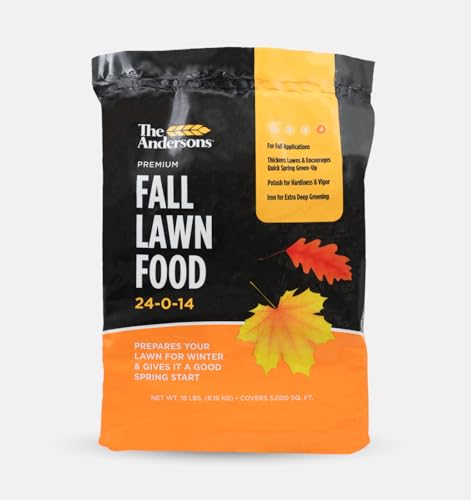
The fertilizer that turns your lawn deep green while prepping roots for frost.
The NPK here is 24-0-14, which throws the highest nitrogen number in the entire list at your grass for a rapid color change, while still providing a meaningful 14 on the potassium side for winter readiness. Unlike the Jonathan Green 10-0-20 that prioritizes storage over appearance, this Andersons blend delivers a noticeable green-up within days. A 24-0-14 ratio like this is rare in dedicated winter fertilizers — most brands cut nitrogen, but The Andersons kept it high and added iron for an extra deep color. Buyers confirm: one user shared “the pictures were taken 7 weeks after I applied it the first week of September,” describing results as superb.
The bag covers 5,000 sq. ft., which falls short of the 15,000 sq. ft. monsters from GreenView and Jonathan Green. At 18 lbs (a 2.7x weight gap versus the 48 lb GreenView), it is far easier to carry and store, but you will need multiple bags for a larger lawn. It contains a mix of quick-, intermediate-, and slow-release nitrogen, so you get an initial burst followed by sustained feeding — ideal for a lawn that took heat damage over summer and needs a visible rebound before dormancy.
Where It Excels
- 24-0-14 NPK plus iron delivers the fastest visible greening in this group
- Triple-release nitrogen gives both immediate and long-term feeding
- Works on all turf types — no special grass restrictions
Where It Falls Short
- 5,000 sq. ft. coverage means buying 3 bags for a 15,000 sq. ft. lawn
- Higher nitrogen means less root-focused winter storage than the 10-0-20 Jonathan Green
Great For: Homeowners with a smaller lawn (under 5,000 sq. ft.) who want a visible change in grass color and a solid potassium foundation for winter.
Not Ideal For: Large properties — the per-square-foot cost is higher when you need multiple bags.
4. Greenview Fairway Formula Fall Fertilizer 22.5 lb

The 12-week feeder that keeps your lawn nourished longer than any other.
While most winter fertilizers release nutrients for 6 to 8 weeks, the Greenview Fairway Formula pushes that window to a full 12 weeks thanks to a proprietary blend with 59% slow-release nitrogen (nitrogen that is polymer-coated so it dissolves slowly). That means a single application in early fall keeps feeding the root system through November and into December, covering the entire transition from fall growth into winter dormancy. It is also phosphate-free (no middle number on the NPK label) — a choice designed to protect waterways from runoff, which is note if you live near lakes or streams.
Buyers who made the switch from national brands report strong results: one user wrote “I’ve used this Greenview product on my lawn for the past 2 years, and it is the best,” specifically praising the moisture-proof packaging that prevents the clumping that plagues many other fertilizer bags. At 22.5 lbs, this bag covers 7,500 sq. ft., landing between the small Scotts bag (4,000 sq. ft.) and the giant GreenView bag (15,000 sq. ft.) — a thoughtful middle-ground that suits a quarter-acre lot without forcing you to store a 48 lb sack. Users consistently mention the lack of clumps in the spreader, crediting the bag’s seal for keeping granules dry.
Why It Is Worth It
- 12-week feed window is the longest in this comparison
- 59% slow-release nitrogen prevents burn and extends coverage
- No phosphate and no clumping bag design
What to Consider
- One owner reported the price is higher per bag than some competitors
- Full NPK ratio is not listed on the package — less transparency for spec-focused buyers
Reach For This If: You want the longest possible feeding duration from a single application, especially in climates where fall stretches into December.
skip it if: You need a specific NPK ratio on the bag for your lawn’s soil test results.
5. Scotts Turf Builder WinterGuard Fall Lawn Food 10 lb

The entry-level winterizer that punches above its bag size.
The smallest bag in the group — 10 lbs covering 4,000 sq. ft. — makes the Scotts WinterGuard the obvious choice for a small lawn or a targeted late-season treatment. That is a 3.8x coverage gap versus the Jonathan Green and GreenView bags, so it is not for a full acre, but a 4,000 sq. ft. lot is precisely the most common suburban lawn size in the US. There is no published NPK ratio on the bag, but customers note that the grass stays green even in freezing weather: one customer observed “this brought my grass to life in late fall and even as winter has started and it is 25 degrees outside, the grass is still bright green and not growing wild.”
Scotts says this is formulated for all grass types and can be applied to a wet or dry lawn. The primary job is root recovery from summer stress rather than winter cold-hardening, so think of it as a general fall maintenance feed rather than a dedicated high-potassium winterizer. It mixes at a 1:1:1 ratio according to the label, which suggests a balanced NPK profile. For the price, it is tough to top as a one-season gamble — several reviewers call it “always good results” and praise the coverage pattern from a standard broadcast spreader. The 160-ounce unit count is about half that of the Andersons Premium bag, but the price is proportionally lower, making the per-square-foot cost very competitive.
What Works
- Low entry price for a 4,000 sq. ft. lawn
- Easy to find and well-known spreader settings
- Reported to keep grass green through sub-freezing temps
What Is Missing
- No NPK breakdown on the bag — you cannot calculate potassium load
- Coverage is 3.8x less than the big bags — multiple bags needed for larger properties
Best For: Small-lot owners or anyone making a single end-of-season pass without needing specific nutrient ratios.
Consider Another Option If: You want a measurable potassium content for winter root storage, or you have more than 4,000 sq. ft. to cover.
Understanding the Specs
NPK Ratio — What the Three Numbers Mean
Every fertilizer bag has three numbers separated by dashes, like 10-0-20. The first is nitrogen (N, for leaf growth and green color), the second is phosphorus (P, for root development — often 0 in winter blends due to runoff restrictions), and the third is potassium (K, for overall plant health, cold tolerance, and disease resistance). For a winter fertilizer, the third number (potassium) is the one you care about most — it strengthens cell walls so the grass survives freeze-thaw cycles. A ratio like 10-0-20 tells you the product is built for winter storage; a ratio like 24-0-14 prioritizes visible green-up while still providing some potassium.
Coverage Area and Bag Weight
Coverage is listed in square feet and tells you how much lawn a single bag treats. A 15,000 sq. ft. bag is ideal for a half-acre lot; a 4,000 sq. ft. bag suits the typical suburban front lawn. Bag weight (in pounds) does not directly predict coverage because different formulas have different densities and application rates — a 45 lb bag can cover 15,000 sq. ft. just like a 48 lb bag if the spreading rate is lower. The real comparison comes from the coverage number on the label, not the weight. Always measure or estimate your lawn’s square footage before choosing a bag size.
FAQ
When is the best time to apply winter lawn fertilizer?
Can I use a regular lawn fertilizer in winter instead of a winterizer?
How much winter fertilizer do I need for my lawn?
What does “slow-release nitrogen” mean, and why is it important?
Is a winter fertilizer with 0 phosphorus okay?
Should I apply winter fertilizer if my lawn is dormant or completely brown?
What happens if I apply winter fertilizer too late, after a hard freeze?
Can I mix winter fertilizer with weed killer or pre-emergent?
Final Thoughts: The Verdict
For most buyers, the winter lawn fertilizer winner is the Jonathan Green Winter Survival because its 10-0-20 ratio delivers the highest potassium load for root and freeze protection, covering 15,000 sq. ft. from one 45 lb bag. If you want fast visual greening and iron-enhanced color, grab the The Andersons Premium Fall Lawn Food. And for the longest feeding window from a single spread, the Greenview Fairway Formula is class-leading at 12 weeks of slow-release feeding.
How We Picked
We do not accept paid placement. Every pick is matched to a real buyer and a real use-case; we do not hands-on test units.
Sources & Methodology
Specifications: manufacturer listings and product documentation. Review insights: verified customer reviews, as of July 2026. Pricing: not shown on this page (it changes often); check the current price via the retailer link.
As an Amazon Associate, Lawn Gear Lab earns from qualifying purchases. This does not affect which products we feature.