
Specs are compiled from manufacturer listings and verified buyer reviews and can change over time — please confirm the key details on the product page before buying.
The grass you see in April is made by the fertilizer you spread in October. Winter fertilizer is not about feeding your lawn while it sleeps — it is about banking nutrients and root strength now so that when the soil warms, your yard explodes green instead of struggling to wake up. The wrong bag can push weak growth that frost kills; the right one locks in energy that lasts through the thaw.
I’m Rikta — the founder and writer behind Lawn Gear Lab. This guide is built by comparing the manufacturers’ published specifications and the patterns across verified customer reviews, so you get each pick’s real strengths and trade-offs instead of marketing spin.
A smart winter fertilizer delivers the low nitrogen and high potassium your lawn actually needs during cold months, feeding the roots instead of the blade so you get an earlier, stronger green-up without the risk of winter burn or disease.
Quick Picks
- Jonathan Green (12414) Winter Survival Fall — Best Overall
- Scotts Turf Builder WinterGuard Fall Lawn Food — Top Performer
- Fertilome (10895) Winterizer — Best Value
- Scotts Turf Builder WinterGuard Fall Weed & — Weed Control Plus
- Green Thumb GT58105 Winterizer Lawn Fertilizer — Budget Champion
How To Choose The Best Winter Fertilizer
Not every bag labeled “winter” is right for your grass. You want a formula that pauses top growth and fuels the root system so the lawn emerges thick, not thin, after the snow melts. Look for three things: the balance of nutrients, the release speed, and the total coverage for your yard size.
Low Nitrogen, High Potassium — The Winter Ratio
Nitrogen pushes leaf growth, which you do not want in cold weather because tender new blades freeze and die. Potassium strengthens root cell walls and boosts the grass’s natural antifreeze. The classic winter ratio looks like 10-0-20 (zero phosphorus) or 32-0-10 (higher nitrogen only if it is controlled-release so it meters out slowly). If you see a high fast-release nitrogen number, that bag is built for spring, not winter.
Slow-Release vs. Quick-Release Nitrogen
Controlled-release nitrogen feeds your lawn gradually over weeks without a sudden growth spurt. Some bags label it “slow-release nitrogen” or “50% controlled release nitrogen.” Quick-release nitrogen, often marked as ammonium nitrate or urea, gives an instant green-up that fades fast — risky in a winterizer because it forces a flush of growth just before a freeze. Always check the label for how much nitrogen is slow-release.
Coverage and Bag Weight
A 10,000-square-foot bag is very different from a 4,000-square-foot bag. Match the coverage to your lawn size to avoid buying two bags when one does the job, or ending up with leftover product you have to store. Bag weights do not always match coverage because different nutrient densities weigh more per square foot, so go by the stated square footage, not the pounds.
Quick Comparison
| Model | Best For | N-P-K Ratio | Coverage | Bag Weight | Amazon |
|---|---|---|---|---|---|
| Jonathan Green Winter Survival | Deep-root winter prep | 10-0-20 | 15,000 sq. ft. | 45.1 lbs. | Amazon |
| Scotts WinterGuard Fall Lawn Food | Large lawns needing recovery | 32:0:10 | 12,000 sq. ft. | 32.3 lbs. | Amazon |
| Fertilome Winterizer 10-0-14 | Established lawns | 10-0-14 | 10,000 sq. ft. | 40 lbs. | Amazon |
| Scotts WinterGuard Feed & Weed | Weed control + winter feed | — | 4,000 sq. ft. | 11.4 lbs. | Amazon |
| Green Thumb Winterizer 32-0-10 | Budget small-lot winterizer | 32-0-10 | 5,000 sq. ft. | 12.6 lbs. | Amazon |
In‑Depth Reviews
1. Jonathan Green (12414) Winter Survival Fall Lawn Food

The high-potassium powerhouse that preps roots for the worst of winter.
This 45.1-pound bag delivers a 10-0-20 ratio that is nearly all lean root fuel and no leaf push — the potassium number is double the nitrogen, which is exactly what cold-stressed grass needs to thicken cell walls against frost. With coverage of 15,000 square feet, this one bag covers 15,000 sq. ft. versus the Fertilome’s 10,000 sq. ft., and its slow-release nitrogen keeps your lawn feeding for weeks so you do not have to reapply.
Buyers report that a first-week-of-November spread in the northeast left the lawn “significantly healthier” by mid-December, even through bitter cold. The trade-off is bag weight: at 45.1 lbs, it is heavier than the Fertilome (40 lbs) and much heavier than both Scotts bags, which some users with small spreaders found tricky to maneuver. The granules are noticeably larger, so a cheap rotary spreader may need two passes for even coverage.
Root-Strength Edge
- Highest potassium in the lineup (20) for freeze protection
- 45.1 lbs covers 15,000 sq. ft. — most ground per bag
- Slow-release nitrogen keeps feeding for weeks
Weight Trade-off
- 45.1 lbs is heavy for carrying and pouring
- Large granules demand a quality spreader for evenness
Reach for this if: you have a medium-to-large lawn (up to 15,000 sq. ft.) and want the strongest winter root prep available, backed by a potassium-rich formula that is proven to keep grass green into the deep cold.
Look elsewhere if: you need a spreader-light bag or want weed control built in — this is straight root nutrition with no herbicide.
2. Scotts Turf Builder WinterGuard Fall Lawn Food

A high-nitrogen winterizer that recovers summer damage without forcing risky growth.
Scotts uses a 32:0:10 ratio, which sounds nitrogen-heavy, but this is controlled-release nitrogen — meaning it meters out slowly so you get root-strengthening phosphorus replacements (zero actual P) and steady feeding without the flush of tender top growth that can freeze. It covers 12,000 sq. ft. from a 32.3 lb. bag, weighing 32.3 lbs and covering 12,000 sq. ft., compared to the Fertilome’s 40 lbs and 10,000 sq. ft. Owners mention that even at 25 degrees Fahrenheit, the grass remained “bright green and not growing wild” — exactly the balance you want.
The bag has no weed killer, so if you are battling clover or dandelions this fall, you will need a separate product. But for pure root recovery after a hot, dry summer, this is the most trusted name in the category. One reviewer noted that their “freshly grown lawn that only gets a few hours of sun a day” stabilized well over the cold months.
Recovery Power
- Slow-release 32-0-10 feeds roots without forcing frost-vulnerable leaf growth
- 12,000 sq. ft. coverage from 32.3 lbs — light bag with big reach
- Works on all grass types
Missing Feature
- No weed control; requires a separate herbicide for fall weeds
- Higher nitrogen means careful timing needed if you live in a very cold zone
Best for: large lawns (12,000 sq. ft.) that took summer heat damage and need deep root recovery without cold-weather risk.
skip it if: you need a one-bag weed-and-feed for fall — this is pure root nutrition, no weed killing.
3. Fertilome (10895) Winterizer for Established Lawns 10-0-14
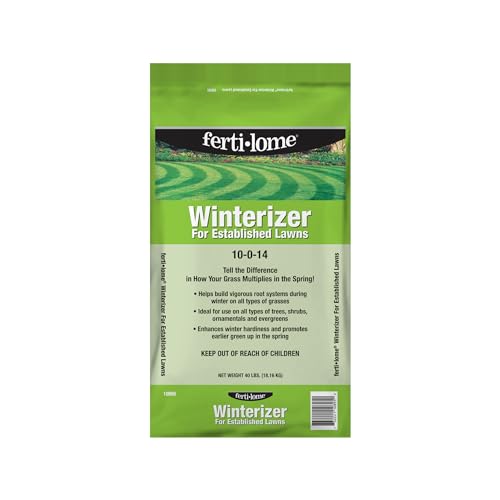
The 40-pound workhorse with a 10-0-14 ratio built for established turf.
This winterizer has a 10-0-14 N-P-K ratio, giving you zero phosphorus and a moderate potassium level — not as high as the Jonathan Green (20-K), but enough to strengthen roots for winter. It covers 10,000 square feet, while the Green Thumb covers 5,000 sq. ft., making it a smart upgrade for anyone with a lawn over a quarter-acre. The 40 lb. bag weighs 40 lbs compared to the Scotts’ 32.3 lbs, but covers 10,000 sq. ft. versus the Scotts’ 12,000 sq. ft., so the nutrient density per square foot is higher.
Customers note that the formula delivers “0.4 lbs N/1k, ideal for final yearly application to avoid growth” — a detail that matters if you want to stop feeding before the deep freeze. Some reviewers mention it works well on centipede grass, and even in January you can spot missed areas because the unfertilized strips stand out. The catch: low iron content, so you will not get the deep dark green that iron-heavy formulas provide.
Smart Spring-to-Fall Usability
- 10-0-14 wins over the 32-0-10 Green Thumb ratio for winter — less leaf push
- 10,000 sq. ft. coverage fits most standard suburban lawns
- Can also be used in early spring or summer for stressed lawns at 0.56 lbs K/1k
Low-Iron Notice
- Low iron content means less cosmetic green compared to iron-rich formulas
- Heavier bag at 40 lbs without the swing weight of the 32.3-lb Scotts
Pick this if: you have an established lawn (10,000 sq. ft.) and want a no-phosphorus, moderate-potassium winterizer that also works for early spring — a two-season bag.
Pass on it if: you want deep cosmetic greening from iron or a bag that covers more than 10,000 sq. ft. in one go.
4. Scotts Turf Builder WinterGuard Fall Weed & Feed₃

The two-in-one bag that kills broadleaf weeds while you winter-feed.
This is the only product in the lineup that combines weed killer with fertilizer — it tackles over 50 listed weeds including clover, dandelion, and plantain while delivering a winter feed. At 11.4 lbs covering 4,000 sq. ft., it is the smallest bag here: at 11.4 lbs covering 4,000 sq. ft., versus the Jonathan Green’s 45.1 lbs covering 15,000 sq. ft.. So you pay for the weed-killing chemistry in a smaller package. One buyer mentioned that after digging up and replanting grass, “masses of clover came up with it” — the product killed the clover within weeks, though the same buyer saw streaks of dead grass from an uneven spread with a cheap spreader.
The weed control is effective only when weeds are actively growing and temperatures stay between 60°F and 90°F, which means your application window in fall can be tight depending on your climate. It works on Bahiagrass, Bermudagrass, Bluegrass, Centipedegrass, Fescue, Ryegrass, and Zoysiagrass. If your lawn is clean of weeds and you only need root nutrition, skip this and grab the straight winterizer instead — the herbicide adds cost you do not need.
Weed-Eating Power
- Takes out over 50 broadleaf weeds (clover, dandelion, purslane, morningglory, etc.)
- Feed and weed control in one pass — saves a separate round
- Works on 7 common grass types
Coverage Catch
- Only 4,000 sq. ft. per 11.4-lb bag — smallest coverage in this roundup
- Weed control needs active weed growth and 60°F–90°F temps to work
- Streaking possible if spreader settings are off
Buy this if: your fall lawn is fighting clover or dandelions and you want one product to feed roots and kill weeds in a single pass on a small-to-medium lawn (4,000 sq. ft.).
Choose straight winterizer if: your lawn is already weed-free and you need value — this bag’s weed-killer premium is wasted on a clean lawn.
5. Green Thumb GT58105 Winterizer Lawn Fertilizer 32-0-10
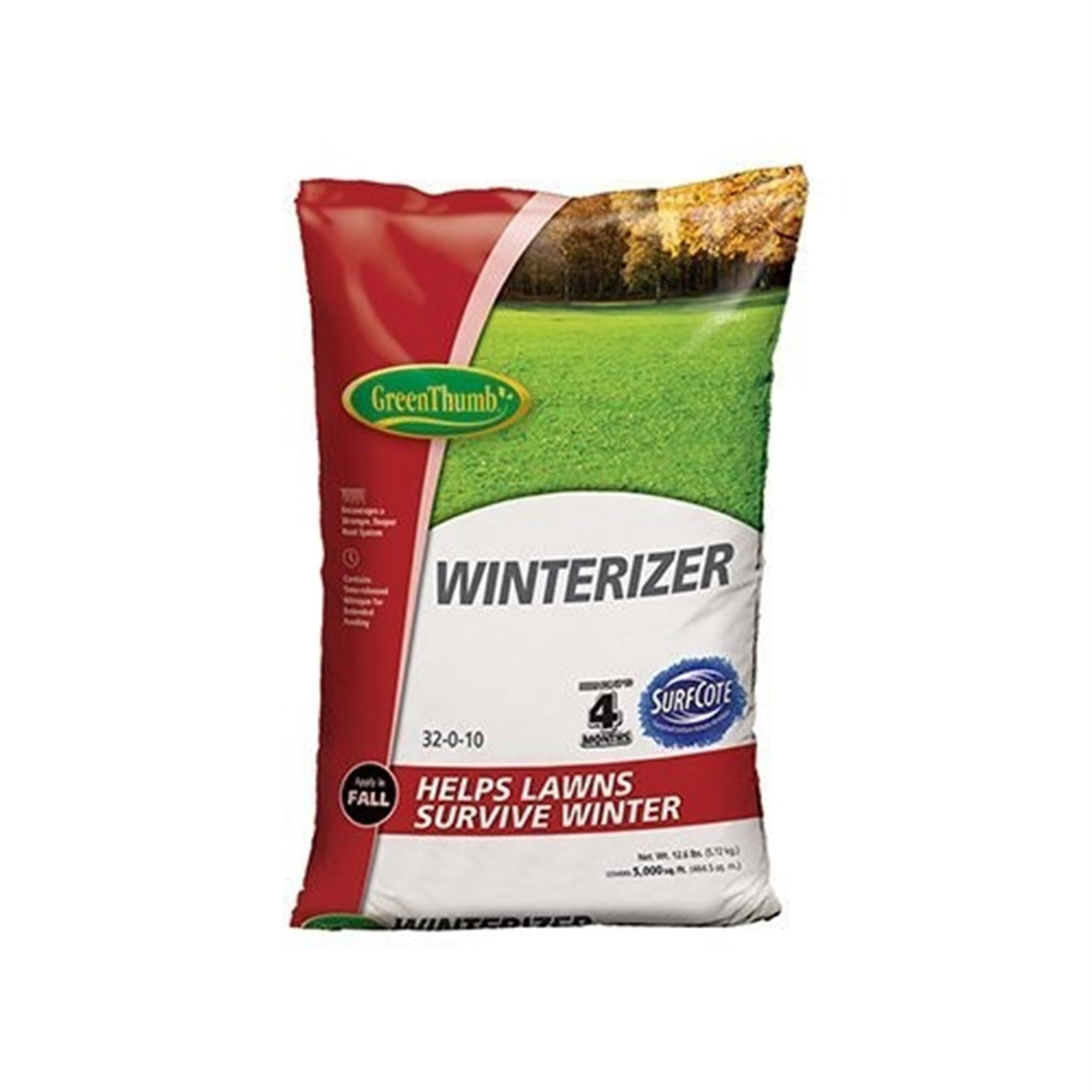
A 5,000-square-foot winterizer with half its nitrogen locked in slow release.
This 12.6-lb bag covers 5,000 square feet with a 32-0-10 formula, and the key detail is that 50% of its nitrogen is controlled-release — meaning half the nitrogen meters out gradually over up to 16 weeks instead of hitting the lawn all at once. That 16-week feeding window is wider than some premium bags, so you get steady root nutrition through the tail end of fall into winter without forcing growth. The ratio (32-0-10) matches the Scotts WinterGuard Lawn Food, but the bag covers 5,000 sq. ft. compared to the Scotts WinterGuard’s 12,000 sq. ft., so the Green Thumb is best for smaller lawns or tight budgets.
Reviewers point out that an October 1st application with five minutes of daily watering for four weeks set the lawn up for a visible green-up by April. One reviewer called it “just as good as Scott’s.” The catch: at 12.6 lbs, the bag is light, but that also means you get less raw material per purchase — if your lawn is closer to 10,000 sq. ft., the Fertilome or Jonathan Green will be a better value per square foot.
Budget-Friendly Nitrogen Control
- 50% controlled-release nitrogen feeds for up to 16 weeks — unusually long for a budget bag
- Includes 2% iron for a deeper green color without extra cost
- Light 12.6-lb bag is easy to carry and pour
Size Limit
- Only 5,000 sq. ft. coverage — you will need two bags for a typical 10,000-sq.-ft. lawn
- At 32-0-10 the nitrogen ratio is high for winter; the slow-release buffer makes it safe, but it is not as root-focused as a 10-0-20 formula
Pick this for: a small lawn (up to 5,000 sq. ft.) where you want the longest possible feed duration from a budget-friendly bag, plus a touch of iron for cosmetic green.
pass on it if: your lawn is larger than 5,000 sq. ft. or you want the lowest possible nitrogen ratio — the Green Thumb’s 32-0-10 is still nitrogen-heavy compared to a 10-0-20 formula.
Understanding the Specs
N-P-K Ratio (the three numbers on every bag)
The first number is nitrogen (N), which pushes leaf and blade growth. The second is phosphorus (P), which helps root development in new lawns. The third is potassium (K), which strengthens cell walls against cold, drought, and disease. For winter fertilizer, you want a low first number (under 15) and a high third number (12 or more) — this way the grass stores energy in the roots without pushing tender leaves that freeze.
Slow-Release vs. Controlled-Release Nitrogen
A bag labeled “slow-release nitrogen” means the nitrogen is coated or chemically modified so it dissolves gradually over weeks instead of all at once. “Controlled-release” is the same idea, often with a specific number of weeks of feeding (like “up to 16 Weeks”). This matters in winter because quick-release nitrogen can cause a flush of green growth that then gets killed by frost. Slow-release guarantees the grass gets a steady trickle of nutrition without a growth spurt.
Coverage per Bag
Coverage is listed in square feet and tells you how much ground one bag treats at the recommended setting. It is the single most important number to check before buying because a bag labeled for 4,000 sq. ft. will not cover a 10,000-sq.-ft. lawn in one pass. Bag weight (pounds) does not equal coverage — different formulas have different densities — so always look for the square-foot number on the label.
FAQ
Can I use a regular fertilizer instead of a winter fertilizer?
When is the best time to apply winter fertilizer?
Should I water after applying winter fertilizer?
Can winter fertilizer burn my lawn?
What does the 0 in 10-0-20 mean?
Is weed and feed good for winter application?
How do I know how many bags I need for my lawn?
Can I use winter fertilizer on a newly seeded lawn?
What is the difference between 10-0-20 and 32-0-10 winter fertilizer?
Will winter fertilizer make my grass green in winter?
Final Thoughts: The Verdict
For the majority of shoppers, the winter fertilizer winner is the Jonathan Green Winter Survival because its 10-0-20 potassium-heavy ratio delivers the strongest cold-weather root protection and covers 15,000 square feet — the most ground in a single bag. If you want root recovery from summer damage with a slow-release nitrogen system, grab the Scotts Turf Builder WinterGuard Fall Lawn Food. And for a budget-friendly option that still gives you a 16-week feeding window, the Green Thumb Winterizer is a solid choice for small lawns.
How We Picked
We do not accept paid placement. Every pick is matched to a real buyer and a real use-case; we do not hands-on test units.
Sources & Methodology
Specifications: manufacturer listings and product documentation. Review insights: verified customer reviews, as of July 2026. Pricing: not shown on this page (it changes often); check the current price via the retailer link.
As an Amazon Associate, Lawn Gear Lab earns from qualifying purchases. This does not affect which products we feature.