
Specs are compiled from manufacturer listings and verified buyer reviews and can change over time — please confirm the key details on the product page before buying.
You have a green lawn you are proud of, except for the clover, dandelions, and chickweed popping up everywhere. Spray a weed killer, and suddenly you are terrified of turning your whole yard brown. The right product solves that — a selective herbicide that targets the broadleaf weeds without touching the grass you actually want to keep.
I’m Rikta — the founder and writer behind Lawn Gear Lab. This guide is built by comparing the manufacturers’ published specifications and the patterns across verified customer reviews, so you get each pick’s real strengths and trade-offs instead of marketing spin.
You want to kill the weeds in your lawn without harming the grass, so the best weed killer that won’t kill grass for you depends on your specific weed types, lawn size, and how much patience you have for multiple applications — that is the honest takeaway from the specs and real buyer reports on the top-selling formulas.
How To Choose The Best Weed Killer That Won’t Kill Grass
Picking the wrong spray is a costly mistake — you either watch weeds thrive or accidentally torch your lawn. Focus on these three things to get it right the first time.
Selective vs. Non-Selective: The single most important label check
A selective herbicide (a weed killer that targets only certain broadleaf weeds) leaves your turf grass untouched. Non-selective sprays, like glyphosate (a chemical that kills any plant it touches), are for patios or driveways, not your lawn. All products here are selective, but you still need to check the bottle to confirm your specific grass type — Bermuda, Fescue, Kentucky Bluegrass, Zoysia, or others — is listed as safe.
Weed type: Match the spray to your specific invader
Not all weed killers handle every weed. Clover and chickweed respond well to formulas with Dicamba and Triclopyr, while crabgrass often needs a different active ingredient or a pre-emergent applied earlier in the season. Read the label’s “weeds controlled” list before you buy — a product that kills dandelions may not touch creeping Charlie.
Application method: Ready-to-use, concentrate, or weed-n-feed
Ready-to-use (RTU) bottles with a spray wand are the simplest for spot-treating a few weeds — just point and spray. Concentrates require you to mix with water (saves money per treatment, but you need a sprayer). Weed-n-feed products combine fertilizer and herbicide, covering your whole lawn in one pass, which is convenient but may waste chemicals on areas that do not need them.
Quick Comparison
| Model | Best For | Coverage | Liquid Volume | Item Weight | Amazon |
|---|---|---|---|---|---|
| BioAdvanced Weed Killer Concentrate 32oz | Large lawns with many broadleaf weeds | 16,000 sq ft | 32 fl oz | 32 oz | Amazon |
| Ferti-lome Weed Free Zone 32oz | Stubborn creeping Charlie and fast results | Full (varies by mix rate) | 32 fl oz | — | Amazon |
| Bonide Weed Beater Ultra Concentrate 32oz | Versatile control over 200 weed types | 10,000 sq ft per pint | 32 fl oz | 2 lbs | Amazon |
| Bonide Chickweed, Clover & Oxalis Killer 128oz | Large patches of chickweed and clover | — | 128 fl oz | 8 lbs | Amazon |
| Ortho WeedClear Lawn Weed Killer 1.33 gal | Easy spot treatment with limited overspray | Approx. 10,644 sq ft | 1.33 gal | 195.68 oz | Amazon |
| Scotts Liquid Turf Builder Plus 2 Weed Control 32oz | Dual-action fertilizing plus weed killing | 6,000 sq ft (warm), 4,000 sq ft (cool) | 32 fl oz | 8 oz | Amazon |
| Ortho Weed B Gon Weed Killer 24oz RTU | Quick results on dandelions and clover | 5,000 sq ft | 24 fl oz | 24 oz | Amazon |
In‑Depth Reviews
1. BioAdvanced Weed Killer for Lawns, Concentrate, 32oz

The biggest coverage for the price — one bottle treats a 16,000-square-foot lawn while staying affordable.
For anyone with a medium-to-large yard, this is the most economical route. At 32 ounces of concentrate, it covers up to 16,000 square feet — compared to the Ortho Weed B Gon RTU trigger’s 5,000 square feet. It kills over 200 broadleaf weeds (dandelion, clover, dollar weed, and more) down to the root without harming your lawn when used as directed, and buyers report it “eliminates dollar weeds effectively.”
Because it is a concentrate, you do need a sprayer and you mix it with water yourself, which takes a few extra minutes per treatment. But the per-treatment cost is far lower than any ready-to-use option, and it works on both southern and northern lawns. One reviewer noted it “saves money vs. heavy Weed & Feed” when paired with a generic 13-13-13 fertilizer.
The active ingredients are Dicamba, Mecoprop-P, and dimethylamine salt — a proven trio for selective broadleaf control. Results show in hours, with root kill preventing regrowth. Just be aware: the concentrate bottle’s dial can be stiff on first use — one reviewer struggled to “press the tab” initially but figured it out by the second attempt.
The Case for It
- 16,000 sq ft coverage per bottle — outpaces every other concentrate here
- Kills over 200 weed types to the root with a single application
- Works on southern and northern grass varieties
Two Things to Know
- Requires a separate sprayer (not included)
- One reviewer saw temporary browning on Bermuda grass after application
Reach for this if: you have a large lawn and want the best value per square foot — mix it yourself and save over RTU options.
Look elsewhere if: you prefer grab-and-go spraying and do not want to mix chemicals or own a sprayer.
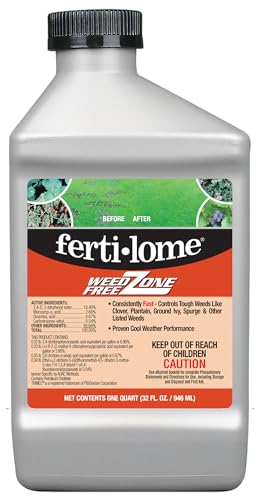
2. Fertilome (10525) Weed Free Zone (32 oz)
The specialist that nails creeping Charlie when nothing else can — visible damage in hours.
Ferti-lome Weed Free Zone is the gold standard for one stubborn weed: creeping Charlie. Buyers consistently say it is the “only product on the market that truly kills creeping charlie overnight.” That alone makes it worth considering, because few selective herbicides handle that ground ivy. It controls over 80 broadleaf weeds total, including clover, spurge, chickweed, and thistle.
Unlike many concentrates, this one works fast — you see injury within hours of spraying. It is safe on Kentucky Bluegrass, Bermudagrass, Bahiagrass, Zoysiagrass, and more. One buyer sprayed weeds between flowers and reported it “did not kill flowers” while killing dandelions and spurge. The catch: some users found the recommended mixture too weak for clover and had to double the potency, and a few added Dawn dish soap to help the spray stick better.
This is a concentrate you mix with water, so you need a pump sprayer or backpack sprayer. The per-bottle cost is higher than the BioAdvanced — one buyer mentioned “it works well but it’s pretty spendy.” But a little goes a long way, and for tough weeds, the speed and reliability justify the extra cost.
Why It Stands Out
- class-leading speed — weed injury visible in hours, not days
- One of the few selective products that kills creeping Charlie effectively
- Safe on a wide range of common lawn grasses
Consider These Limits
- Recommended mix rate may be too weak for clover (users suggest doubling it)
- Higher price per bottle than comparable concentrates
Best if: creeping Charlie is your nemesis or you want the fastest visible results from a concentrate.
skip it if: your lawn only has dandelions and clover — the lower-priced BioAdvanced or Ortho options will work fine.
3. Bonide Weed Beater Ultra, 32 oz Concentrate

A concentrated formula that kills over 200 weed types and stays put after a rain.
Bonide Weed Beater Ultra is a versatile workhorse for anyone dealing with a mixed bag of weeds. It kills over 200 broadleaf weeds — dandelion, clover, ground ivy, oxalis, ragweed, chickweed, and more — without harming your grass when used as directed. One owner reported it was “very effective against wild onion,” which is a weed many other sprays struggle with.
The formula is rainproof within hours after drying, which is a real advantage if you are on a tight schedule and cannot guarantee 24 hours of dry weather. One pint of concentrate treats approximately 10,000 square feet, and the full 32-ounce bottle goes a long way. Owners mention seeing weed injury within hours and plant death in 7–14 days.
It instantly mixes with water and works with backpack, compression, or knapsack sprayers. The main trade-off: persistent weeds, especially broadleaf types, may need 2 or more treatments — one customer observed they “likely need more next season.” It is not a one-and-done for every weed, but it is among the most effective and rain-safe formulas you can buy.
What Works
- Rainproof after drying — no need to worry about an unexpected shower
- Covers a massive range of weeds (over 200 species)
- Kills tough weeds like wild onion and ground ivy
What to Consider
- Some broadleaf weeds need more than one application
- Requires a separate sprayer (not ready-to-use)
Grab it if: you have several different weed types and need a rainproof formula that handles them all.
Pass if: you only have chickweed or clover — a more targeted spray like the Bonide Chickweed & Clover Killer may be simpler.
4. Bonide Chickweed, Clover & Oxalis Killer, 128 oz Ready-to-Use Spray

A giant ready-to-use jug that takes the pain out of spot-treating clover and chickweed across a big yard.
At 128 fluid ounces, this ready-to-use spray from Bonide is the largest-volume RTU in the lineup — compared to the Ortho Weed B Gon 24oz trigger’s 24 ounces. That makes it ideal for anyone who wants to spray large patches of clover, chickweed, or oxalis without mixing anything. Customers note it “kills dandelions in one spray; clovers brown in 3 days.”
The active ingredients are Dicamba and Triclopyr, a combination that targets those specific broadleaf weeds while leaving your lawn grass alone.
A few buyers reported mixed results on clover — one said it “didn’t work on clover” after heavy spraying. That suggests it is most reliable when temperatures are moderate and you follow the “no rain for 2 days” rule. If you have heavy clover infestations, you may need a second pass or a stronger concentrate.
Pros
- Huge 128 oz ready-to-use bottle — no mixing, no measuring
- Fast visible results: clover browning in 3 days
- Clear, nearly odorless formula
Cons
- Hand sprayer is weak for large lawns (buy a separate pump sprayer)
- Inconsistent results on clover for some users
Ideal for: homeowners with medium yards who want grab-and-go convenience and primarily fight chickweed and clover.
Not ideal if: you have a huge lawn or want to blanket-treat — the Bonide Weed Beater Ultra concentrate is more cost-effective per square foot.
5. Ortho WeedClear Lawn Weed Killer Ready-To-Use with Comfort Wand (1.33 gal)

The battery-powered Comfort Wand makes spot-treating weeds as easy as pointing a toy.
If you hate the hassle of sprayers, this is your pick. Ortho WeedClear comes with a battery-powered Comfort Wand that delivers a consistent spray pattern with minimal overspray — buyers call it “intuitive and easy to use.” The 1.33-gallon container covers approximately 10,644 square feet, and it kills crabgrass, dandelion, clover, chickweed, and creeping Charlie down to the root.
It works on a broad range of lawn grasses: Bermudagrass, Buffalograss, Fescues, Kentucky Bluegrass, Ryegrass, and Zoysiagrass. One buyer near Chicago reported it was “effective on mixed grass lawns” and killed dandelions and thistle without harming grass. Just keep your expectations on timing — this is not an instant scorch. The same reviewer noted it “works slowly: wilting in days, death in weeks, full melt in a month.” It is a patient process.
At 195.68 ounces, the total weight is significantly heavier than most RTU products — you carry the whole jug by its handle, not a small trigger bottle. A few buyers reported that recent batches did not work at all, with one saying “no smell during spraying” and weeds staying green. That variability is note, so test a small patch before committing to a full yard.
What You Get
- Battery-powered wand makes spot treatment fast and precise
- Works on 6 common lawn grass types
- Large 1.33 gal container covers 10,644 sq ft
What You Should Know
- Takes weeks to fully kill weeds — not a quick fix
- Some recent batches reported as ineffective by a few buyers
Perfect if: you want the least physical effort — just point the Comfort Wand and spray.
Consider something else if: you need fast results (BioAdvanced or Ferti-lome work faster) or want a concentrate for lower per-treatment cost.
6. Scotts Liquid Turf Builder with Plus 2 Weed Control Ready-to-Spray (32 fl. oz.)

Fertilize and kill weeds in one pass — the hose-end sprayer makes it easy.
Scotts Liquid Turf Builder with Plus 2 Weed Control combines a quick-release nitrogen fertilizer with a broadleaf herbicide. You attach the bottle to your garden hose, spray the whole lawn, and get greener grass while killing dandelions, clover, and 15 other listed weeds — including buckhorn, chickweed, ground ivy, henbit, and ragweed. One user highlighted it “effectively kills weeds and fertilizes grass, resulting in greener, healthier lawn.”
The hose-end applicator is the big convenience: no measuring, no mixing, no separate sprayer. The 32-ounce bottle covers up to 6,000 square feet for warm-season lawns and 4,000 square feet for cool-season lawns. But the weed-killing range is narrower than dedicated herbicides — it does not kill crabgrass or clover reliably according to some buyers. One shopper added it “didn’t kill my crab grass or clover but no dandelions and really great fertilizer.”
Because it feeds and weeds at the same time, you end up fertilizing weeds in areas where you only wanted weed control. And you need to follow the watering rules carefully — granular versions require not watering for 2–3 days after application to avoid burn spots. If your main goal is just weed control without the extra nitrogen, a standalone selective herbicide is a cleaner choice.
Why People Like It
- Two jobs in one — fertilizing and weed control with a single hose-end spray
- Covers up to 6,000 sq ft per bottle
- Reviewers point out noticeably greener, thicker grass after treatment
Where It Falls Short
- Does not reliably kill crabgrass or clover
- Fertilizer is wasted on areas with no weeds
Grab it if: your lawn needs a general green-up plus dandelion control — the dual action saves you a separate fertilizing pass.
pass on it if: you have clover or crabgrass and need targeted killing — pick a dedicated selective spray instead.
7. Ortho Weed B Gon Weed Killer, 24oz, RTU Trigger

A small, simple trigger spray that packs a big punch on dandelions and clover.
Ortho Weed B Gon is the classic entry-level selective weed killer — a 24-ounce trigger bottle that you grab off the shelf and start spraying. It kills 250+ listed broadleaf weeds including dandelions, clover, and chickweed, and it guarantees it will not harm your lawn when used as directed. Shoppers say “seeing great results killing clover and other weeds without killing the grass.”
It covers 5,000 square feet, which is a fraction of the BioAdvanced 16,000 sq ft from a concentrate. But for a small yard or targeted spot treatment, the convenience is real — no mixing, no hose, no cleanup. Results are visible in hours, and it kills weeds to the root so they do not grow back quickly.
The downsides are the price per treatment (it is more expensive per square foot than any concentrate) and the small bottle size. If you have a large infestation, you will need multiple bottles, and the trigger sprayer can be tiring on your hand after a few minutes of continuous use. It is best as a quick spot-treatment tool — pull it out when you see a dandelion pop up and zap it in seconds.
What Makes It Work
- Dead simple to use — spray and walk away, no setup
- Kills over 250 weed types down to the root
- Buyer-tested and loved for clover and dandelions
What Holds It Back
- Small 24 oz bottle — runs out fast on medium lawns
- More expensive per square foot than concentrates
Reach for it when: you have a small yard or want a spot-treatment tool for a few random weeds — the instant convenience matters.
Choose a concentrate if: your entire lawn has a weed problem — the BioAdvanced or Bonide Weed Beater Ultra will save you money and trips to the store.
Understanding the Specs
Selective Herbicide vs. Non-Selective
A selective herbicide (like the products here) targets a specific enzyme pathway that only broadleaf weeds have, leaving your turf grass untouched. Non-selective herbicides kill any plant they touch because they attack a universal process like photosynthesis. Always check the label for the phrase “will not harm lawn or grass when used as directed.”
Coverage Area and Volume
Coverage is usually listed in square feet per bottle — for example, BioAdvanced at 16,000 sq ft and Ortho Weed B Gon at 5,000 sq ft. The larger the number, the fewer bottles you need per treatment. Volume tells you how much liquid you are buying (24 fl oz vs 128 fl oz), but the critical number is coverage because that determines total value.
Active Ingredients: Dicamba, Triclopyr, and 2,4-D
Most selective lawn weed killers use a mix of Dicamba (targets clover and chickweed), Triclopyr (hits woody weeds and creeping Charlie), and 2,4-D (general broadleaf control). Products with all three ingredients tend to be the most versatile. If you have a specific weed like oxalis, check the label for that exact weed name.
Ready-to-Use vs. Concentrate
Ready-to-use (RTU) products come pre-mixed in a spray bottle or wand — you open and spray. Concentrates require you to mix the chemical with water in a separate sprayer. RTUs cost more per treatment but are simpler. Concentrates are cheaper per square foot and let you control the strength, but they require handling the chemical yourself.
Rainfastness
“Rainfast” means the product has dried enough that rain will not wash it off the leaves. Most selective herbicides are rainfast within 2 to 4 hours. If it rains before the product dries, you will need to reapply. Bonide Weed Beater Ultra specifically says it is “rainproof within hours” — a real advantage if you are on a tight spray schedule.
Weed-n-Feed vs. Standalone Herbicide
Weed-n-feed products (like Scotts Turf Builder with Plus 2 Weed Control) combine fertilizer and herbicide in one application. They are convenient but less targeted — you end up fertilizing the weeds too. A standalone selective herbicide lets you treat only the weeds, which is better for light infestations or spot treatment.
FAQ
How does a weed killer kill weeds but not grass?
Can I use a selective weed killer on all grass types?
How long does it take for the weeds to die?
Can I mow my lawn after spraying weed killer?
Will rain wash away the weed killer?
What is the difference between a pre-emergent and a post-emergent weed killer?
How often can I apply a selective weed killer?
Why did my weed killer turn my grass yellow?
Can I use a weed killer and fertilizer at the same time?
Is it safe for pets after spraying?
Final Thoughts: The Verdict
If you want one dependable pick, the best weed killer that won’t kill grass winner is the BioAdvanced Weed Killer for Lawns, Concentrate, 32oz because it covers 16,000 square feet per bottle, kills over 200 broadleaf weeds to the root, and works on both southern and northern lawns at a better per-treatment cost than any ready-to-use. If you want the fastest results on tough weeds like creeping Charlie, grab the Ferti-lome Weed Free Zone. And for the easiest grab-and-go spot treating, the standout is the Ortho WeedClear with the Comfort Wand.
How We Picked
We do not accept paid placement. Every pick is matched to a real buyer and a real use-case; we do not hands-on test units.
Sources & Methodology
Specifications: manufacturer listings and product documentation. Review insights: verified customer reviews, as of July 2026. Pricing: not shown on this page (it changes often); check the current price via the retailer link.
As an Amazon Associate, Lawn Gear Lab earns from qualifying purchases. This does not affect which products we feature.